From the Archives III: Déjà Vu All Over Again

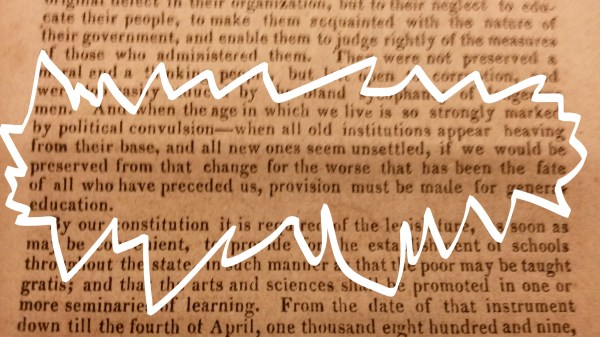
Close your eyes and it might be difficult to guess the decade, much less the century. Fears of a brash, vulgar populist President, a traumatic sense of rapid decline in our public institutions, and a desperate dream that stability might be right around the corner. Sound familiar?Inked1831 house report 1 political convulsions_LI

As SAGLRROILYBYGTH are sick of hearing, I’m down in the Philadelphia archives these days researching my new book. I keep stumbling across head-scratchers that are too good not to share. This bit is from an 1831 report on education from the Pennsylvania house of representatives. They were worried that politics had gotten out of hand. They hoped that high-quality public schools could offer some hope for the future. As they put it,

when the age in which we live is so strongly marked by political convulsion—when all old institutions appear heaving from their base, and all new ones seem unsettled, if we would be preserved from that change for the worse that has been the fate of all who have preceded us, provision must be made for general education.

Clearly, the sorts of political upheaval we’re living through now have a long history.

Should we be reassured or depressed?

From the Archives II: A Dream Deferred

Sad but true: American public schools are segregated places. Kids’ chances of going to school with someone from a very different economic background are slim and getting slimmer. As I continue my work in the Philadelphia archives, I’ve come across another bit of evidence that this was not what Americans wanted.

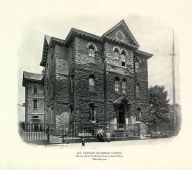
mt vernon school philly

School for all (boys)…at least in theory

In 1828, the education committee of the state senate of Pennsylvania issued a report. There was no disagreement, they said, about the immense value of public education. As they put it,

The diffusion of education among the great body of the people, is an object very near the hearts of the benevolent and humane. It is conceded to be the most powerful means of furthering the cause of morality and religion; and its importance to a country possessing a republican form of government, is universally admitted.

Moreover, schools funded by the public should serve to unite the public. At Pennsylvania’s public schools, the committee promised (with emphasis added):

All the rising generation of a great community are instructed in the rudiments of learning. The doors of the common school houses are open to all without distinction, and the children of the rich and the poor meet there in the participation of a common benefit, upon terms of the most perfect equality. Such a system is above all praise, and deserves imitation every where.

At least, that was the dream. So far, it hasn’t happened. The children of the rich tend to go to schools with other children of the rich. Likewise for the children of the poor. But then again, it has only been 190 years. Maybe we’ll get there soon.

From the Archives: Bad News for Striking Teachers

History might not be destiny, but it can be depressing. As I’ve worked in the Philadelphia archives for my new book, I’ve found some reminders that teachers have always had to shell out their own money just to do their jobs.

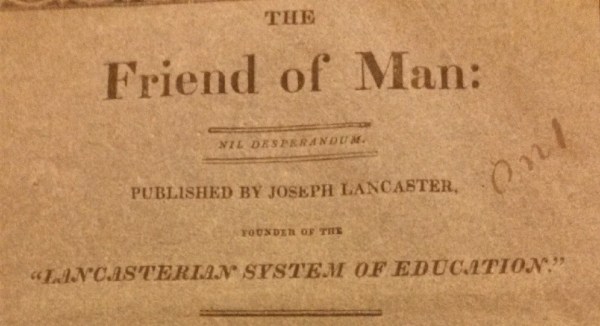
Friend of Man 1 cover

Working without pay has always been considered part of the job…

These days, teacher protests have focused on both low pay and low school funding. As in Oklahoma, teachers have generated sympathy and political power by pointing out how shoddy their classrooms are, and how often they dip into their own wallets to pay for basic classroom materials.

oklahoma textbooks 1

Teachers shouldn’t have to pay for everything, but they’ve always had to…

As I read Joseph Lancaster’s 1821 newsletter I couldn’t help but notice a disturbing parallel. When Lancaster started his career as an educator, he wrote, he visited the nearby town of Stockport, near Manchester. The schools had been terrible until teachers stepped up. They needed better supplies. They needed an expensive new school building. As Lancaster described, the teachers

as a body, offered to work extra hours at their trades, and from their own earnings, to save and devote the sum of five hundred pounds sterling to the proposed building—within twelve months.

Joseph Lancaster told this as a happy tale, showing the possibilities of education if we all pulled together. Almost two hundred years later, though, I can’t help but be a little bummed out that teachers are still expected to donate their scanty mite in order to keep the school lights on.


Time for Conservatives to Tremble?

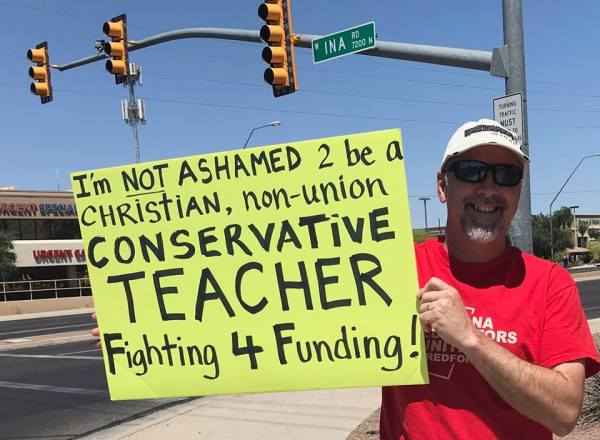
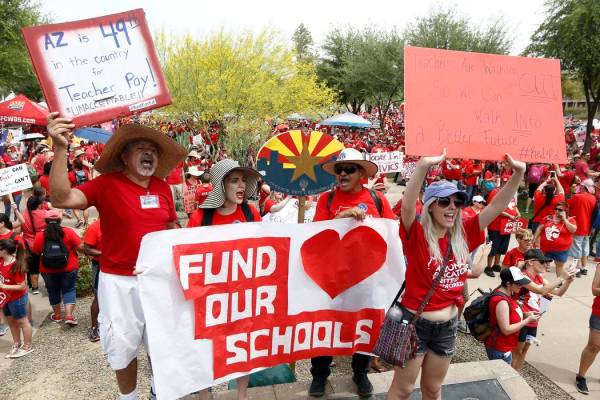
I’m no conservative. But if I were, images like this would make me very nervous. I’m starting to wonder if Paul Krugman’s warning might be more than just wishful liberal thinking. The recent spate of teachers’ strikes might be pushing the GOP into a very dangerous position electorally.

jay bertelsen arizona

Is Arizona’s Jay Bertelsen putting the handwriting on the wall for the GOP … ?

Don’t get me wrong: I understand that there has long been a chicken-little element to American conservative thinking, especially among religious intellectuals. Things seemed dire for conservatives in 1925, then again in 1962, then again in 2015. Conservative intellectuals like Rod Dreher have created a cottage industry of alarmism.

This time, though, the threat to conservatism is coming from a different direction. As The Economist reports, when even self-identified Christian conservative teachers are out on strike, the long, productive marriage between conservatism and the Republican Party looks mighty shaky. Could recent triumphs for conservative Republicans lead unexpectedly to a deepening, divisive schism between conservatives and the GOP? Could it push conservatives back out into the electoral cold, split between the two major parties?

As The Economist argues this week, conservatives and the whole Republican Party would be smart to worry. As they explain,

states where teaching unions are weaker now have more politically active teachers. Ms. Marohn, one of the demonstrators in Phoenix, says that when parents ask her mother, also a teacher, what they can do to help, she tells them to vote. That should worry Republicans. There are 3.2m public-school teachers in America. Giving them a financial reason to head to the polls could spell trouble for some Republicans running in states with teacher unrest. Arizona, North Carolina and Colorado are all battleground states. Republicans had also fancied that they could flip the West Virginia Senate seat held by Joe Manchin, a conservative Democrat. For want of more chalk could the Senate be lost.

When conservative Christian teachers take to the streets in demonstrations against GOP administrations, I can’t help but wonder what the electoral future will bring. If it turns significant numbers of self-identified Christian conservatives against Republican candidates, we might just see a big shake-up at the polls.

Why AZ Teachers Still Aren’t Happy

Seems like a big fat win for Arizona’s striking teachers. Headlines this morning announced a whopping 20% salary raise over three years. So why are some teachers still mad?

az teacher strike

Is RedforEd Dead?

For one thing, many of Arizona’s teachers wanted more than a pay raise. As the legislators voted on the new budget that included their pay raises, the crowd of striking teachers applauded the “no” votes, not the yeses. As one striker told USA Today,

This was never about teachers’ salaries. This was about the future of our kids and the future of education in Arizona.

Striking teachers didn’t only want increased salaries. They wanted a vastly increased budget for public education in general. They wanted funding restored for programs and staffing.

As another strike leader told Jacobin magazine, the new budget—including promises of salary raises—is really only a stopgap, a half-measure meant to distract attention from the state’s real educational funding problems. As she put it,

We’re opposed to this budget, it does not give us what we want. It does not put $1.1 billion back in the funding. What it does give us is a tiny piece of the puzzle, $400 million dollars. Which means we’re responsible for going and getting that other $700 million. We’re going to pivot and go fight to get that money ourselves. We need to fight for the money for our kids and colleagues, because they’ve been left out — and that’s one of the main reasons why we don’t support this budget.

I didn’t hear any strikers mention it, but I can’t help but think that some striking teachers are also peeved at the way they are being talked about by some conservative politicians. I know I would be. For example, even as the budget was being passed, one republican legislator tried to cram in three anti-teacher amendments.

The first would have banned any school closures, except in case of non-political emergency. The second would have allowed lawmakers to call for an investigation of any school district that seemed to be too sympathetic to teachers. The one best calculated to provoke the ire of striking teachers, though, would have prohibited teachers from spouting political ideology in their classrooms, including possible fines of up to $5,000. As this conservative legislator fumed,

It’s far beyond time we rein in indoctrination in our public schools.

As I argue in my book about the history of educational conservatism, this notion that sneaky subversive teachers are using their positions to warp students’ minds has a long and bitter history. Conservative pundits and politicians have long assumed that left-wing teachers were out to corrode children’s faith in America and capitalism. And for most teachers, those sorts of accusations are not only bizarre, but profoundly insulting.

In addition, then, to feeling shorted on their real goals of increasing school funding and reining in charters, I imagine some Arizona teachers must be chagrined to be subjected to this sort of continuing casual slander from their state leaders.

This Can’t Be For Real…

I get it, I really do. I think arming teachers is a terrible idea, but I understand that lots of people disagree with me. When it comes to ideas like the ones we’re seeing this morning, though, we can’t possibly disagree. Does anyone really think this is a good idea? More important, the kerfuffle might tell us something about how schools work in the real world.

mini bats pa school district

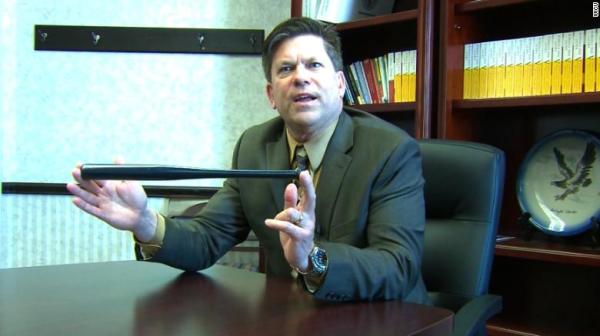
The superintendent explains his plan…

Here’s what we know: Some school districts in Pennsylvania have approved plans to arm their teachers…with miniature baseball bats. You know, the kind you got as a kid when you went to a Brewers game, then left on your desk in your bedroom until finally someone threw it out or something.

The head of the local teachers’ union defended the move. As he put it,

This is a tool to have in the event we have nothing else. . . . Part of the formula now is to fight back. . . . The theory behind the attack option is to create noise, distract, or defend against an active shooter. For a classroom or office setting, this translates to books, staplers, chairs, fire extinguishers, etc. being used as defensible tools.

It gets even weirder. Another district in my area doesn’t give teachers sports memorabilia, but it does provide each classroom with…wait for it…buckets of rocks. When an alert SAGLRROILYBYGTH informed me of this plan, I thought it was a joke. But it seems real. Superintendent David Helsel told Reuters he planned to put buckets of rocks in every classroom. As he explained,

We didn’t want our students to be helpless victims. . . . River stones were my idea. I thought they would be more effective than throwing books or book bags or staplers.

Can they be serious? Is there any support out there for these sorts of preposterous plans?

It seems merely wacky, but this story tells us something about the way public schools often work in practice. There will be a controversial idea—evolution, sex ed, or, as in this case, arming teachers. District leaders will want to be seen taking action, but they also want to avoid controversy at all costs. The result? Half measures that veer sharply into the ridiculous.

We’ve All Got It All Wrong

Whether you call yourself a conservative, a progressive, or something else, if you’re like me you’ve probably got it all wrong. As I was reminded in a discussion last night, those of us who try to shape schools usually make a huge mistake—one we could recognize if we just thought about it for half a second.univ of hawaii

Here’s the background: I was happy last night to talk with some graduate students at the University of Hawaii. (No, I didn’t get to go there in real life. I wish. We used cutting-edge interwebs technology to talk.) They had read my book about the history of educational conservatism and they had some great questions, ideas, and experiences to share.

As I argue in the book, it’s difficult to generalize about conservative activists. Just like progressives, conservative thinkers and doers come from a dizzying array of backgrounds and they are motivated by a huge spectrum of ideas and beliefs. But one thing they do share—at least the ones I studied—is an unexamined faith that school shapes society. I hate to quote myself, but this is how I put it in the book:

Educational conservatives have insisted, in short, on two central ideas. First, schools matter. Conservatives, like their progressive foes, have rarely questioned the notion that the schools of today generate the society of tomorrow. Second, because schools matter, their content and structure must be guarded ferociously. Ideas that challenge inherited wisdom must not be crammed down the throats of young, trusting students. And teachers must not abdicate their roles as intellectual and moral authorities. Educational conservatism, in other words, has been the long and vibrant tradition of defending tradition itself in America’s schools. Without understanding this tradition, we will never truly understand either American conservatism or American education.

One idea on which everyone can agree, in other words, is that schools shape society. The reason so many of us spend so much energy on school reform is precisely because we think it matters. For some conservatives in the twentieth century, teaching kids evolution was dangerous because it threatened to take away their moral and religious compass. For others, teaching kids about sex was a bad idea because it tended to unhinge their self-control. And for yet others, teaching kids socialist ideas was obviously terrible because it would lead to the corruption of their morals and of the entire society.

OTR COVER

You can fix schools all you want, but you can’t fix the outcomes…

Last night, the Hawaii students shared stories that helped puncture those school-reform assumptions. One student, for example, reported that he came to the realization that he was conservative in high school. He was guided to that realization by his favorite teacher. At first, I assumed that the teacher was a conservative, too, and inspired the student by reading Hayek and Burke and smoking a pipe. In fact, the student told us, his favorite teacher was a heart-on-her-sleeve liberal. She taught social studies in a progressive way, one that hoped to help students examine their own ideas and decide questions for themselves. In the student’s case, that meant he came to the realization that his ideas were apparently “conservative.” The left-y teacher, in other words, didn’t indoctrinate this student into leftism, but precisely the opposite.

Another Hawaii student told a very different story. She only realized that she was a liberal when she was teaching Sunday school at her church. The goal was to help young people deepen their religious faith, but it had the opposite effect on her. Instead of becoming more religious, teaching Sunday school convinced this student that her church was full of hooey.

What’s the takeaway? Once we hear the stories, it seems pretty obvious. School doesn’t really work the way we sometimes think it will. No matter what our politics, we can’t control the future of our students by teaching them X or Y or by keeping them away from Z or A. Students are not predictable, programmable outputs. They have their own ideas and backgrounds and sometimes our best-laid plans at shaping America’s future will come out in ways we didn’t predict.

The School Headline We Won’t See

Don’t get me wrong: I’m all for the brave Parkland students who have done so much in the past few weeks to push for change. I’m as distressed as my friends when I hear conservative politicians belittling their activism. But whatever our political views on student activism, we’re likely to believe something about schools that just isn’t true. In spite of what all of us might think if we just read the papers, America’s schools are safe and getting safer. Why don’t we hear more about it?

school safety

Where are the cheers?

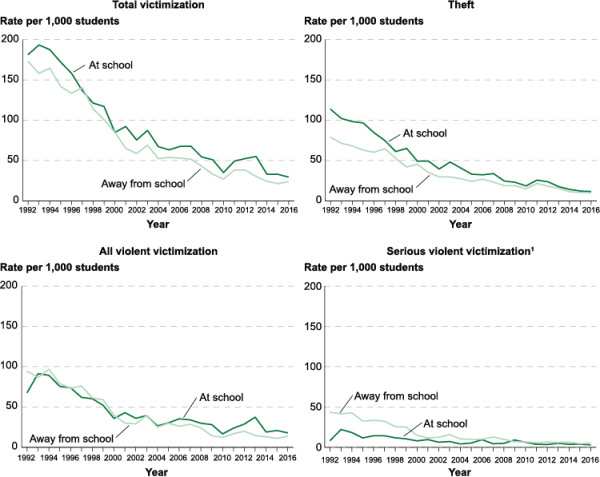
Here’s what we know: The National Center for Education released its new report today about school safety. By any measure, schools today are much safer places than they’ve been since 1992. Crime reports from schools are down, security measures are improved, staffs are better trained in safety measures, and students report less crime.

Why won’t we hear more culture-war blather about this news? Here’s my guess: Whether you’re a conservative, a progressive, or other, you want people to think that schools are dangerous places.

Let’s look at the conservative side first. Throughout the twentieth century, as I argued in my book about the history of educational conservatism, conservatives told one another that schools—especially public schools—had gone to the dogs. For example, as Reagan’s second Ed Secretary memorably lamented, by any “index of cultural indicators,” schools had failed catastrophically.

It wasn’t only Bill Bennett who worried. Religious conservatives also warned that public schools had

grown into jungles where, of no surprise to Christian educators, the old Satanic nature ‘as a roaring lion, walketh about, seeking whom he may devour’ (I Peter 5:8).  Students do well to stay alive, much less learn. . .

In most cases, if conservatives hate something, progressives will love it. But that hasn’t been the case with public schools. From the left, critics charge that public schools are abusive places, especially to students from minority backgrounds. In one recent case from Maryland, for example, activists note that African American students

are subject to daily abuse and humiliation. . . . [from] a decades-long pattern of resistance to change and the creation of a hostile environment for children of color.

Conservatives don’t agree with progressives about much. When it comes to school safety, however, both sides agree that public schools are dangerous and getting worse. Both sides, it seems, won’t allow themselves to be troubled by inconvenient truths.

The Problem with Theoretical Children

Two hundred years is a long time to bang your head against a wall. When it comes to school reform, though, that’s what we seem to do. I’m just back from an archive trip in Philadelphia and I’m spooked by the parallels between school-reform mistakes back then and those pointed out just this week by a savvy teacher in New York.

The New York teacher, Emily Kaplan, tells a story any experienced teacher can relate to. She studied at a great university, learned all she could about children and teaching. When she got to her first classroom, she immediately ran into a situation she had never prepared for: One of her students just wouldn’t/couldn’t stop farting. It’s funny, but it’s more than funny, too. As Kaplan puts it, most of our big-picture ed-reform plans are made for “theoretical children.” As she explains,

Theoretical children are useful: they are predictable, generalizable. They lend themselves easily to an agenda; nothing they do is inexplicable. Their development is linear, their roadblocks routine. They exist neatly in quantified data; they are easily essentialized. Theoretical children don’t cry for no reason, they don’t laugh out of turn; theoretical children certainly don’t fart.

Theoretical children are discussed often by scholars and policymakers, but theoretical children don’t populate our classrooms— because theoretical children don’t exist.

Kaplan is right on. Every real teacher knows that plans need to be held lightly; theories need to be embraced tentatively. As I’m learning in my new research, the effort by experts to change schools based on what children theoretically will do has always plagued our school-reformm dreams.

Last week I began the archival grunt work for my new book. I’m exploring the school-reform plans of Joseph Lancaster and his devotees. Two hundred years ago, nearly exactly, the Pennsylvania legislature passed a law mandating Lancaster-style schools for Philadelphia. Why were the lawmakers so excited about this educational plan?

lancaster schools

Nothing can go wrong if the system is right.

In large part, Lancaster convinced politicians that he had figured out a perfect system. He pitched a school set-up that would deliver cheap, effective literacy, numeracy, punctuality, and nondenominational Protestantism to poor children. In 1803, for example, he published his flawless system, a system built on the actions of “theoretical children.”

As Lancaster explained, school discipline had long been a problem, but he had solved it. He outlined at painful length and detail the way he had supervising boys—“monitors”—track the behavior of their fellows. Students who misbehaved would have logs tied around their necks. They would be shackled together with other miscreants. If that didn’t work, they might be

put in a sack, or in a basket, suspended to the roof of the school, in the sight of all the pupils, who frequently smile at the birds in the cage.

Lancaster didn’t like shaming his students this way, but he thought it was the perfect solution. As he explained, when the misbehaving student

Finds how easily his punishments are repeated—that he himself is made the instrument—and no respite or comfort for him, but by behaving well, it is more than probable he will change for the better.

In theory, the plan was perfect. In theory, anyone could follow the simple steps laid out for good student behavior. In theory, students responded well to Lancaster’s machinations.

Guess what—it didn’t work. As Emily Kaplan points out, children don’t exist only in theory. They fart. They rebel. And sometimes, if you tie a log around their neck or hang them in a birdcage, they don’t respond well.

When Did Conservatives Demand Local Control?

I’m no conservative, but I respect several conservative thinkers and writers. We may disagree—sometimes fiercely—but folks such as Rod Dreher, Patrick Deneen, and Mark Bauerlein are always worth reading, IMHO. In education, I put Rick Hess in this category. In a recent piece about localism, though, Hess makes some mistaken claims about the history of educational conservatism. I can’t figure out why.
OLYMPUS DIGITAL CAMERA

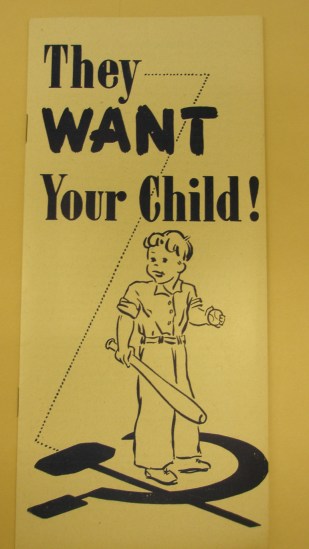
The first worry wasn’t desegregation, but communist subversion.

He’s not alone. Back when my book about the history of educational conservatism came out, I did a brief interview with conservative journalist John Miller. He wanted to know about the long history of conservative desire for charter schools. As I told him, there wasn’t one. The charter movement only became a darling of most conservative thinkers at the very tail end of the twentieth century. Before that, only a few lonely free-marketeers embraced Milton Friedman’s charter plan. (I have described this history in a different academic article, if you’re interested.)

Conservatives aren’t the only ones who don’t like to look their history square in the face, of course. Progressives don’t like to be reminded that WE were the racist ones back in the 1920s, as I also describe in The Other School Reformers.

Hess is too smart and too ethical to distort conservative school history in the usual ways. He frankly acknowledges that conservatives turned to localism in order to protect their right to racial segregation. As he and his co-author put it,

After Brown v. Board in 1954, demands for more “rational” and “less political” oversight were joined by a compelling moral claim—that many communities (and even states) could not be trusted to do right by all their students. Thus, the post-Brown era was marked by school reform agendas—in the states and in Washington—that frequently sought to reduce or even eliminate local control. These strategies came from both the right and left, from both legislatures and the courts, and included new directives regarding desegregation, standards, testing, discipline, funding, teacher quality, school interventions, magnet schools, school choice, and more.

In this telling, federal influence after 1954 pushed states and towns to desegregate. Conservatives pushed back, demanding local control in order to preserve segregated schools. In one sense, he’s not wrong. Brown v. Board marked a milestone in conservative thinking about schools and education. But 1954 was not the watershed year. For American conservatives, the big switch came earlier, in the New Deal era.
OLYMPUS DIGITAL CAMERA

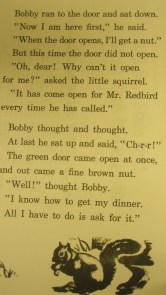
A later effort (1963), but wow.

Through the 1920s, leading conservative public figures tended to call for increased federal involvement in local schools. By the 1940s, conservatives recoiled in horror at the notion of federal control.

What happened?

It wasn’t Brown v. Board. Brown v. Board strengthened conservative animosity toward the idea of federal educational leadership a thousandfold. But it did not create that animosity. Starting in the 1920s, conservative thinkers and activists became convinced that the academic leaders of educational thinking had gone to the socialist dogs.

In the 1930s, conservatives mobilized against the “experts” at places such as Teachers College, Columbia University. As one business leader warned an ally in the American Legion in 1939, professors such as Harold Rugg and George Counts

have been weaning [sic] over to their side a large and increasing population of educational authorities. This ties in with the whole progressive-education movement, which is another thing which some of old-fashioned believers in mental discipline believe is helping to weaken the moral strength and self-reliance of our youth.  That may not come under the heading of Americanism or un-Americanism, but it is a closely related consideration because the progressive educators and the spreaders of radical un-American doctrines are to a large degree the same people and they mix their two products together and wrap them up in one package.

For this patriotic conservative, the leading educational experts could no longer be trusted.

By the 1940s, it had become standard thinking among conservatives—all sorts of conservatives—that federal control meant leftist control. They warned one another that “they” were after your children. For decades, they investigated textbooks for subversive squirrels and other communist rats.

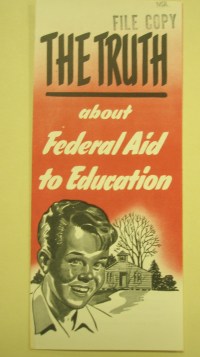
The trend was so powerful that organizations such as the National Association for Education tried to fight back. Federal aid to education, they told anyone who would listen, was nothing but a better way to fund local schools.
OLYMPUS DIGITAL CAMERA

NAE: Don’t hate me cuz I’m federal… (c. 1950)

Conservatives didn’t buy it.

By the time SCOTUS ruled in favor of school desegregation, conservative thinkers and activists had long distrusted the influence of the federal government. They had long since turned to the idea of local control as the only way to protect decent education.

To this reporter, it seems today’s conservatives would want to trumpet this version of conservative educational history, not ignore it. I can’t help but wonder: Why don’t they?