Required Reading: Public vs. Private

[Editor’s Note: We are happy to include an interview with Robert Gross about his new book Public vs. Private. In his book, Dr. Gross explores questions near and dear to the hearts of SAGLRROILYBYGTH: Private schools, public schools, religion, government, and the politics of education. His new book examines the early history of these questions and we’re delighted Dr. Gross has agreed to share some of his thoughts with us.]

1.) In the introduction to Public vs Private, you write,

American conceptions of public and private . . . are impossible to fully understand without placing education at the center of the regulatory state.

Could you please expand on that idea a little? Why is it so important to understand educational history in this area if we want to understand American concepts of “public” and “private?”

There are three main reasons that I think education needs to be placed at the center of our understanding of the history of the regulatory state. The first is simply that, by the early twentieth century, there was perhaps no other sphere of American life that was more heavily regulated. When focusing exclusively on private schools you see the scope of American market regulation in a way that is more hidden in other areas. States regulated almost the entirety of the private school sector: what classes they could teach, what credentials their teachers needed, what language they could speak in the classroom, and so forth. Private schools had to open their doors to inspectors and turn over their attendance rosters. And of course the state reached into the homes of private school parents—paying visits to them if their child was truant or not assigned to a schools.
public v private

Get your copy today.

The second way that education matters to understanding American government power is that court cases about public regulation of private schools have served as major precedents to define the broader scope of market regulation over business. I discuss a range of major supreme court cases in the book—from Dartmouth College v. Woodward to Berea College v. Kentucky to Pierce v. Society of Sisters—that centered on state regulation of private schools, but that also had a tremendous impact on how state governments could regulate to private enterprise more generally. Private schools have thus frequently been the sites over our most important legal contestations over the role of state power.

Finally, I was struck when researching and writing the book how much state officials relied on private schools to accomplish a crucial public goal: of providing mass education at no cost to taxpayers. I don’t think we can understand American government without seeing how it often uses private corporations to achieve public ends—we see that in health care, of course, but it was very much there in the 19th century with schooling.

2.) In the era you focus on in Public vs. Private, religion and religious arguments played a huge role in debates about funding for schools. How were those earlier debates different from today’s fights about religion in public schools? How were they similar?

Religious arguments were indeed used to prevent the vast majority of (religious) private schools from receiving direct state funding. But we have to remember that Catholic school systems, in particular, benefited immensely from a range of financial subsidies, especially property tax exemptions. While this is not something I explicitly write about in the book, my sense is that religious arguments historically have been less successful in obtaining funds than broader, more secular claims from religious schools about the “quasi-public” nature of their work. For example, in the 19th century legislatures and courts allowed Catholic parochial schools to have property-tax exemptions not solely (or even chiefly) because they were religious institutions, but rather because they served an important “public” purpose of educating masses of children. You see a somewhat similar dynamic in the middle of the 20th century over whether private schools that engage in various forms of discrimination can maintain their tax-exempt status. Courts ruled that private schools excluding African Americans, for example, were violating an important area of public policy, and so had no constitutional protections, nor claims to a tax deduction, in doing so. In the Hobby Lobby era we may see a shift in this general trend, of course.

3.) At the heart of the story you tell is an idea that seems foreign to a lot of people today. Can you explain the ways some leading 19th-century school reformers considered all private education to be a threat? Why did they think private schools were dangerous to American liberty?

Horace Mann and other public school reformers wrote extensively in the middle of the nineteenth century about how public school systems not only would eliminate private schooling but should do so. Public schools, they argued, were created precisely to destroy the balkanized provision of education that had existed beforehand—where Americans attended schools on the basis of their religious denomination, their class, or their ethnic heritage. Private schools thus represented an inherent challenge to the public school’s ability to be the assimilationist institution their founders envisioned. And because the vast majority of private schools by the late nineteenth century were run by Catholic organizations and, often, immigrant Catholics, they became enmeshed in deeper American traditions of anti-Catholicism and nativism.

There were a variety of other arguments for why private schools were seen as threatening that I think are worth mentioning as well. Many state public school leaders used economic arguments to suggest that private schools were inefficient, that schooling itself was a “natural monopoly” best operated by the government, without private competition—similar to how the government was increasingly providing other public utilities like water, gas, rail transportation, and so forth.

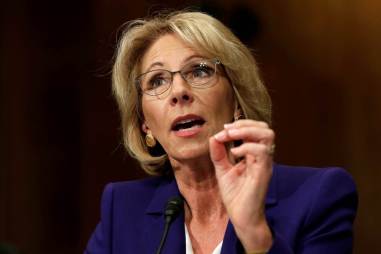
4.) What do you wish Betsy Devos knew about the history of the line between public and private schools?

I cannot speak to what Secretary Devos knows or does not know, but there is an important lesson in this book that I would want any public official to understand. The first is that we spend too much time in our debates about educational policy over whether one “supports” charter schools, voucher programs, school choice, or doesn’t support these initiatives. I think we would be better off if we talked about school choice in less Manichean terms, and instead posed the question that the communities in Public vs. Private had to contend with: “If we have school choice, how do we want to regulate it?” To what standards should we hold schools that receive public subsidies but are privately governed? How should we hold them accountable? Public regulation, as I argue in the book, is what allowed us to have robust school choice in the first place a century ago, and yet too often we ignore it in our contemporary debates.

Author bio: Robert N. Gross is a history teacher and assistant academic dean at Sidwell Friends School. He holds a PhD from the University of Wisconsin-Madison and writes about the social and educational history of the United States.

The Tortuous Triumph of Progressive Education

It’s hard to know whether to cheer or cry. For people like me who want progressive schools and progressive politics, it hurts to see progressive classrooms converted into tools of the rich. But see it we do: More evidence today from Wichita that progressive education has triumphed over its conservative bête noirs, only to be turned into a tool of traditionalism.

wichita wonder koch school

The progressive vision for Wichita. Rich people only, please.

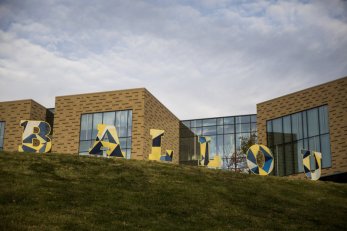
Here’s what we know: The conservative bajillionaire Koch brothers have long been interested in educational issues. Now they have funded a fancy-pants progressive school in Wichita. Second-generation Chase and Annie Koch are opening the Wonder school in Wichita. Their plans could have come straight out of a 1930s progressive-ed playbook.

Their vision? No age-graded classrooms, no report cards, no judgment. Focus on student-directed activity, guided by adult “coaches,” not teachers. As one planner put it,

We think that children are not challenged to the fullest extent that they could be right now. . . . We want to challenge them to take on new tasks and greater ownership over what they’re doing.

So far, so good. Such dreams have been around for a century now, pushed by progressive-ed leaders such as George Counts, William Heard Kilpatrick, and of course, John Dewey.

In the middle of the twentieth century, as I recount in my book about educational conservatism, traditionalists pushed back hard against such notions. These days, at least in Kansas, some of the hardest-core educational conservatives have embraced the obvious superiority of progressive classroom methods.

So we should celebrate, right? Not so fast. Those same progressive-ed-loving conservatives tend to take a very different approach when it comes to schools for the rest of us.

Yes, the Koch’s own kids get to go to schools with fabulously progressive pedagogy. But Koch money pushes a very different sort of classroom elsewhere. In Tennessee, for example, Koch funding promoted charter schools for low-income families. At some of those schools, most famously the KIPP network, students are rigidly controlled. KIPP’s “no excuses” model and “SLANT” rules (Sit up, Listen, Ask and Answer questions, Nod and Track the teacher) can feel oppressive.

At some charter schools—especially urban schools with high proportions of low-income non-white students—students are compelled to sit silently at lunch, march silently and exactly through hallways, respond rapidly and exactly to teacher prompts, and hold their heads rigidly at all times.

What a contrast to the free-wheeling, mind-expanding Koch-funded school soon to be offered to affluent kids in Wichita. Of course, for only $10,000 per year, anyone is welcome at the Wichita Wonder school. Unless, of course, a student has any sort of disability.

What are we supposed to think? I’m no conspiracy theorist, but it’s hard not to see the obvious: Some conservatives have recognized the huge benefits of progressive classroom practices, but they only want them for their own children. Or, to be more charitable, conservatives are only willing to foot the bill for progressive classrooms for their own kids.

News Again: The Oldest Scandal in Public Schools

Don’t act surprised. The depressingly predictable scandal in DC schools serves as yet another reminder of a centuries-old truth about public education. When people tell you they have figured out how to fix urban schools on the cheap, they’re either lying or fooling themselves. When they show you proof, they’re faking it.

ballou HS DC

Where magic didn’t happen….

Here’s what we know: NPR investigated Ballou High School in Washington DC. The school showed remarkable sudden improvements. Graduation rates suddenly jumped to 100% and all the grads were accepted to college.

A triumph, right? Not really. Turns out about a third of the students hadn’t been to school enough to meet minimum requirements. Many of them couldn’t read or write well. Teachers felt enormous pressure to move kids along, whether or not they had met any of their educational goals. Some teachers reported a “culture of fear;” they felt forced to do things they knew weren’t right.

Now wunderkind chancellor Antwan Wilson is in the spotlight. What did he know and when did he know it? Not only Wilson, but informed school folks are all keenly aware of the sobering truth: We all knew this would happen and we’ve known it for centuries. Even for those few folks who don’t read ILYBYGTH to find out the centuries-old story of urban school reform, there are so many recent examples that no one can claim ignorance.

Consider Rod Paige and the overstuffed “Houston Miracle.” Or the ugly cheating scandal in Atlanta. Time and time again, when reformers and administrators build sparkling careers on their sudden, dramatic improvements, they have simply cut corners, cheated, and fudged numbers.

For SAGLRROILYBYGTH in the know, these sorts of educational con jobs are the oldest story in urban public education. As I’m researching these days, in the early 1800s Joseph Lancaster set the pattern that Paige, Wilson, and many others would follow. Lancaster was an earnest young Quaker who opened a school for urban urchins in London. He copied a system that allowed him to educate hundreds of students with only one adult teacher.

Soon, a group of wealthy philanthropists hyped Lancaster’s “Borough Road Miracle.” Lancaster thought he had figured out something radically new. He promised he could establish similar schools for America’s cities. He promised he could turn illiterate “Street Arabs” into upstanding literate Christian citizens.

lancaster schools

The promise: Everyone learns, no one pays…

He couldn’t.

In a few years, Lancaster’s over-hyped schools had flopped and failed. Parents and students complained that they were abused and under-educated. Teachers warned that Lancaster’s methods didn’t work. Lancaster himself was in debt up to his ears and fled to Caracas.

The lesson? It’s not that school reform isn’t possible or desirable. Rather, we need to remember that charismatic, ambitious reformers will always promise more than they can deliver. Politicians will tend to glom on to silver-bullet solutions that don’t cost any extra. School reports that sound too good to be true usually are.

School reform IS possible, but it isn’t easy and it isn’t cheap. If we really want to fix our public schools, we need to stop looking for magic solutions and rather do the difficult and expensive job of improving every school.

Gratuitous Superbowl Reference: What Does Tommy Brady Have to Do with School Reform?

Okay, I admit it: I don’t know much about sports. I DO know that toilet cleanliness isn’t the first thing I think of when I think of the Superbowl. So if Febreze can horn in on Superbowl frenzy with a stupid ad, then we here at ILYBYGTH feel compelled to try to make some connection to Tommy Brady, too. So here it is: The reason schools are so difficult to reform is because they don’t have clearly painted endzones.

febreze superbowl ad

Like sports? Clean your toilet!

Here’s what we mean: In football, unorthodox thinking gets rewarded, if it works. Coaches who come up with schemes that get the ball across the pylon win games. In schools, unorthodox thinking is much more difficult. Why? Because there isn’t a good way to prove that it works. People like Eva Moskowitz use test scores, but that is clearly inadequate. Would you want your second-grader to endure silent lunches?

Other folks suggest measuring the difference in student knowledge at the end of a year, compared to the beginning, but teachers and researchers howl in protest. With something as complicated as a student’s life, how can you say that you can measure the effectiveness of their classes that way?

In the end, we don’t have a clearly defined goal for what makes schools better, because we don’t have agreement on what counts as “good” when it comes to education.

  • Higher test scores? Sure. But we also want students to learn to think outside the box.
  • Winning at competitions? Of course. But we also want students to get practice working together.
  • Memorizing important information? That’s a good thing, IMHO, in spite of what generations of my progressive comrades have said. But I wouldn’t be happy with a school that did only that.
  • Getting into college? That sounds good, but in practice it usually tells us more about students’ families than their schools.

Bill Belicheck and Tommy Brady can wear ugly outfits, be old, and deflate their balls as much as they want. They will still be recognized as great, even by their worst enemies. They can point to accomplishments and measurements that everyone has agreed on.

With schools, we just don’t have that. So we end up falling into endless arguments without any way to point to a clear winner.

Betsy Devos: Progressive Champion?

We could be forgiven for being confused. Ed Secretary Betsy Devos just delivered a rousing endorsement of progressive ideas about schooling and education. What gives?

SAGLRROILYBYGTH might be sick of all this—maybe it’s just too obvious even to mention. But since my years wrestling with the history of educational conservatism (you can read all about it here), I can’t help but obsess over the never-clear meanings of “progressivism” and “conservatism” when it comes to schools.

Betsy-Devoe

I hart progressive ed…or do I?

And now arch-conservative Queen Betsy just threw a Grand-Rapids-size rhetorical wrench into the culture-war works. If she’s talking this way, is there any meaningful way to differentiate the two sides? I think there is.

Here’s what we know: Secretary Devos delivered a prepared talk at the free-markety American Enterprise Institute. In her speech, she harped on progressive themes. Consider the following examples:

  • Progressives say: High-stakes testing is bad.

Quoth Queen Betsy:

As states and districts scrambled to avoid the law’s sanctions and maintain their federal funding, some resorted to focusing specifically on math and reading at the expense of other subjects. Others simply inflated scores or lowered standards.

  • Progressives say: Teachers have been disempowered.

Quoth Queen Betsy:

Most teachers feel they have little – if any — say in their own classrooms.

Quoth Queen Betsy:

we must rethink school.

  • Progressives say: Factory schooling is needlessly rigid and dehumanizing, yet it persists.

QQB:

Think of your own experience: sit down; don’t talk; eyes front. Wait for the bell. Walk to the next class. Repeat. Students were trained for the assembly line then, and they still are today.

  • Progressives say: Schooling should focus on the needs and experiences of every individual child.

QQB:

That means learning can, should, and will look different for each unique child. And we should celebrate that, not fear it! . . .

Our children deserve better than the 19th century assembly-line approach. They deserve learning environments that are agile, relevant, exciting. Every student deserves a customized, self-paced, and challenging life-long learning journey. Schools should be open to all students – no matter where they’re growing up or how much their parents make.

  • Progressives say: School must help make society more equitable. More resources must be dedicated to schooling for low-income Americans and students from minority groups.

QQB:

That means no more discrimination based upon zip code or socio-economic status. All means all….

We should hope – no, we should commit – that we as a country will not rest until every single child has equal access to the quality education they deserve.

What are we to make of all this intensely progressive-sounding rhetoric?

Some pundits pooh-pooh it. ILYBYGTH’s favorite progressive ed writer offers a perfect, pointed put-down: “poison mushrooms look edible.

It is not difficult, after all, to see how Secretary Devos’s endgame is different from that of most progressives. Unlike progressives, Queen Betsy’s final goal is an old conservative favorite, namely, the reduction of federal influence in public schooling. If Devos mouths progressive phrases, she also always returns to the same ultimate desire.

Consider these lines:

QQB:

  • federal education reform efforts have not worked as hoped….

  • The lesson is in the false premise: that Washington knows what’s best for educators, parents and students….

  • The lessons of history should force us to admit that federal action has its limits.

In the end, then, what we’re seeing here is the same old, same old. All sides in our hundred-years culture war have shifted tactics from time to time, while generally keeping the same long-term strategies.  As I argue in my book (and if you’re really lazy you can read a brief version of this in my short essay at Time), for example, in the 1920s, it was conservatives who pushed hard for an increased federal presence in local schools. Why? Because they thought it would force greater Americanization of immigrants and pinkos.

Devos’s canny adoption of progressive rhetoric is another example of this culture-war scheme. All sides tend to use whatever language best helps them achieve their long-term goals. They We tend to fight for any short-term goal that promises to bring them us closer to their our ultimate aims.

For Devos and her allies, the big picture is more religion, more privatization, and more tradition in public schools. Right now, they apparently think local school districts are the most likely governments to help achieve those aims. If bashing “factory models” and “inequality” will help achieve the ultimate goals, so be it.

A Google, a Plan, a Canal

Why don’t start-up tech types understand school reform? They’re excited about it. By and large, though, their schemes flop. Why? The history of school reform offers a big-picture answer.erie canal

Googlers might think they have the wrong logarithm. Or the wrong charismatic leader. Or maybe the wrong business plan. There’s a simpler, better answer that my current research is making painfully clear to me. It might seem like google has nothing to do with the Erie Canal, but when it comes to school reform, they look depressingly similar. Like the school reformers of the early 1800s, today’s googlers are plagued by a fundamental problem they don’t even see:

The wrong metaphor.

Google-founded schools don’t work. They approach school like a start-up business, as curmudgucrat Peter Greene has pointed out time and time again.

It’s not only google, of course. Other techies have experienced similar flops when they thrust themselves into the school-reform game. We can’t forget, for instance, Mark Zuckerburg’s warm-hearted but dunderheaded efforts in Newark.

Today’s tech types have had enormous success with google and facebook and uber and etc. So they jump too quickly to assume that those successes will apply to school as well. In general, and with some exceptions I’m sure, techies invest in bad school reform schemes because they misunderstand the nature of schooling. They think of it too often as a question of information delivery. They assume—based on google’s big success at shepherding information—that they can improve schools the same way they improved the interwebs. If they can only get their proprietary app right—they assume—and get free of stuck-in-the-mud thinking and red tape, there ain’t nuthin they can’t do.

They aren’t the first to make this sort of goof. In fact (and this is the thing that really chaffs us nerds), though they think they are making ground-breaking social changes, today’s tech-fueled reformers are reading from a very old school-reform script. Though many of them are motivated by the best intentions, if they took time to read even one book they could dodge some of these predictable perils. Heck, they could even avoid the library and just spend time with Larry Cuban’s blog or Peter Greene’s.

clinton opening erie canal

Clinton connecting the waters, 1826.

It wouldn’t take much for today’s ambitious reformers to recognize their similarity to those of earlier generations. As I work on my next book about urban school reform in the early 1800s, I’m struck by the parallels. Take, for example, the big dreams of DeWitt Clinton. Clinton was the 19th-century equivalent of today’s tech heroes. He was brilliant, talented, connected, and far-sighted. Most important for our purposes, he embraced new technology in the face of old-fashioned opposition. He pushed through modern solutions to ancient problems, and it all happened fast enough for him to witness the amazing social improvements wrought by his efforts.

In Clinton’s case, it wasn’t the interwebs, but a really long ditch. Clinton believed in the possibilities of a transformational investment in the Erie Canal. Naysayers said nay, but Clinton was proven right. The canal utterly changed the face of American society. Small farmers and city-dwellers alike benefitted.

Elated and maybe a little puffed-up, Clinton looked around for new worlds to conquer. At the time, New York City was growing by leaps and bounds. Its schools couldn’t keep up. Clinton dived into school reform, putting all his chips on Joseph Lancaster’s scheme to transform and systematize schooling for all students, especially those without a lot of money.

You know the end of the story already: It didn’t work. At least, not the way Clinton planned. Unlike a canal, a school system is not something that can be created once and for all. A school system needs more than a one-time start-up investment. The problems that make schooling difficult are not the same as the problems that make a canal difficult.

urban apple orchard

They can thrive anywhere…

It might help if well-intentioned reformers thought of school differently. School isn’t a start-up business. School isn’t a canal.

What IS school? There are many ways we could think about it, but this morning I’d like to suggest one idea and I invite SAGLRROILYBYGTH to suggest their own.

To get school reform right, we can’t think of school like a start-up business. We can’t think of it like a canal. We might do better if we thought of school like an orchard. Why?

  • Orchards take a long time to be healthy and productive, but can be damaged or killed quickly.
  • Orchards are intensely local; they can’t be shipped or packaged easily.
  • Orchards take constant loving care from many people.
  • There are some things that all orchards need, like sunshine, water, and fertilizer.
    • The exact recipe for success, though, depends on local conditions.
    • …and it isn’t the ingredients themselves that lead to success, but the constant loving care with which they are applied and monitored.
  • Orchards can thrive anywhere, but in some places they need more intensive care and maintenance than others.
  • Orchards can be tweaked easily, but they can’t be radically transformed quickly.
  • A healthy orchard isn’t focused on the people taking care of it, but rather on the things it produces.
  • Different orchards can thrive while producing different things; one measurement won’t compare apples very easily.

Now that I see that list in black and white, I’m not sure. Maybe that’s not the best metaphor. I’m not sure if children are supposed to be the fruit…? Or if kids are the ones picking the fruit of education…?orchard

When it comes to thinking about schools, though, I can’t help but think that imagining schools as orchards is better than thinking about them as start-ups or canals. As today’s tech leaders have discovered, thinking about schools as start-up tech firms leads to predictable flops. As yesterday’s leaders found out, thinking about schools as canals didn’t work either.

So maybe thinking about schools as orchards isn’t the best metaphor. I bet people can come up with better. In the meantime, though, I’ll look forward to a multi-million-dollar school reform plan that starts with a more profound understanding of the way real schools work.

Why Do We Want our Schools to Fail?

The numbers are in, and they are good. So why aren’t we celebrating?

Here’s the story: For the past two years, graduation rates have continued to climb for Washington DC schools. And here’s the dilemma: Why don’t we hear more about our continuing love for and satisfaction with our public schools?

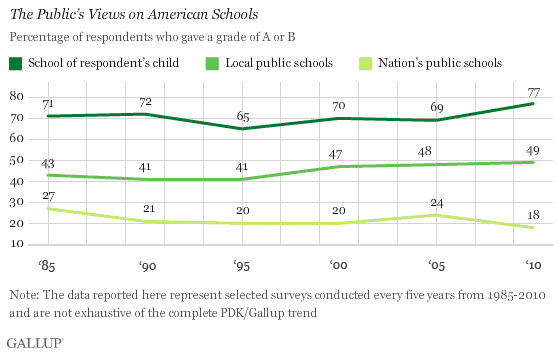
Most of us like our local public schools. As Gallup polls have showed over and over again, public perception of public schools is hugely skewed. Large majorities of respondents with kids in public schools are very happy with those schools. But majorities also say that public schools in general are in terrible shape.

gallup people like their local schools

We love our schools…except we don’t.

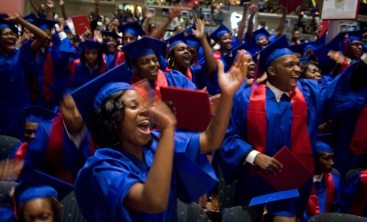
In our nation’s capital, the news has been good for the last couple of years. In 2016, new programs and policies led to increased graduation rates. That trend has continued this year.

So why don’t we see more headlines about the improving state of public education? Why don’t we hear more about the fact that most parents like their local public schools?

I have a hunch that won’t surprise SAGLRROILYBYGTH. When it comes to our bitter educational culture wars, both sides have an interest in promoting bad news.

Progressive types like me worry that schools for low-income and minority students have always suffered from a lack of funding and attention. When we look at the headlines from DC, it’s easy to a huge lurking BUT. Yes, graduation rates are improving and hitting all-time highs, but they still reflect the cruel inequities of our schools and society. As WaPo notes,

In D.C. Public Schools, black and Latino students also saw a boost in graduation rates — to 72 percent and 71 percent, respectively — but they still lag behind their white classmates by more than 10 points.

Plus, the improvements in graduation rates still vary tremendously by school. At selective high schools—schools that non-coincidentally educate a richer, whiter population—more students graduate on time. The numbers are much worse for neighborhood schools.

DC schools are good

Good news travels slow.

The takeaway? For progressive pundits, saying the news is good feels like a betrayal of all the students and families who still aren’t getting a fair shake.

Conservative education pundits don’t agree with that progressive argument, but they also tend to pooh-pooh any sorts of optimism. For many conservatives, the news from DC is still bleak. Public school systems, some conservatives think, are still throttled by sclerotic union-dominated bureaucracies. They don’t really teach kids. For proof, they can point to other parts of WaPo’s reporting:

At H.D. Woodson High School, for example, 76 percent of its students graduated on time, yet just 1 percent met math standards on national standardized tests linked to the Common Core academic standards. Just 4 percent met reading standards.

Shuttling a bunch of under-educated students across the graduation stage, conservatives might argue, doesn’t mean the schools are really doing a decent job of training students for jobs and passing along the big ideas of our culture. All it means is that union-ruled pencil-pushers are inflating their numbers. What public schools really need, conservatives might say, is an authentic shake up, a thorough-going privatization with charters and vouchers.

In every case, pundits tend to prefer bad news. It’s hard to fundraise when you tell people things are fine and getting better.

How Do You Keep an Iceberg Fresh?

The pattern is as old as school reform itself. When we find a school that works, how can we transport those successes to schools everywhere? Two recent stories underline the perennial misunderstandings about school and school reform that have always bedeviled well-meaning reformers. A good school is not something we can package, market, and ship. It’s as difficult as trying to tow an iceberg.

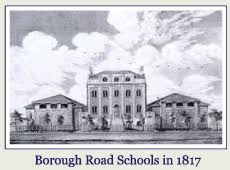
As I’m finding in the research for my next book, good people have always made this same goof. When Joseph Lancaster’s Borough Road School in London began showing decent results educating kids from low-income homes, he became an instant celebrity. Fabulously wealthy dilettantes visited the school and gushed. Back then, those folks were actual royalty.

borough road school 1817Soon, the young Lancaster started believing his own fundraising spiel. He promised the leaders of New York, Boston, and Philadelphia that his master plan could work in any school, anywhere. It couldn’t and it didn’t. The mistake Lancaster made—one of them, at least—was to assume that his limited successes were due to the specific methods he was using, rather than to his endlessly deep royal pockets and his authentic love and enthusiasm for his school and students.
These days, progressive teachers fume about well-meaning celebrities making these same sorts of centuries-old mistakes. In The Nation recently, Megan Erickson offered a scathing review of Eva Moskowitz’s self-promotional memoir. Moskowitz is hard to like. Among her many face-palm-worthy notions is the idea that she could package her program at Success Academy and use it to “fix” schools everywhere.

When Moskowitz connected with some wealthy backers, they hoped to help her do just that. As Erickson put it,

They wanted to figure out how to set up a school that cost no more to run than district schools but achieved far better results, and then replicate that model throughout the country.

As Lancaster’s story showed, it has never worked that way. School is an intensely local enterprise. Trying to package and replicate it will always be a losing proposition.

Don’t believe it?

Consider the story told this week by curmudgucrat Peter Greene. Greene looks at the deterioration of the AltSchool program. This intensely personalized school program for wealthy families has run into some problems, as Greene describes here and here.

The problem?…you guessed it: AltSchool is hoping to take an expensive program and cut it down to fit a replicable mass-market budget. As Greene laments,

Now that Ventilla has some things that sort of work, it’s time to sell a version of them to other schools and make some real bank.

Those schemes have never worked and they never will, just like wacky schemes to tow icebergs from Antarctica to hot deserts. Since at least the 1970s, attention-hungry politicians from hot places have always flirted with such plans. After all, they say, the icebergs are just floating around. With a little funding and pluck, icebergs could provide nice cool water for hot dry deserts.

Could it really work? No! I’m embarrassed to even spell it out, but I will. When you tow icebergs to the equator, the icebergs don’t like it. They break up. They melt.

What does any of this have to do with school reform? Like good schools, icebergs are intensely LOCAL things. They come about because of local conditions. So do good schools. Good schools are fueled by families who feel included. They are good because of the enthusiasm, energy, and dedication of teachers and staff. Good schools work because leaders make smart decisions that focus on supporting those good things and getting obstacles out of the way.

Trying to package those things up, slap a marketing label on them and ship them to other schools is not a smart way to create good schools, just like towing icebergs is not a good way to get ice. Of course, with enough money and energy, it might be possible to pull an iceberg around. You might even make it to the desert. But what you’ll be left with won’t be worth all the hassle; all you’ll get is a handful of lukewarm disappointment.

The REAL Fight about School Reform

It’s not about charters. It’s not about vouchers. It’s not about the power of unions or the role of standardized tests. The fundamental disagreement at the heart of our protracted inability to improve our public schools comes from something else entirely. As a recent commentary from the free-marketeers at Flypaper makes clear, this basic disagreement fuels big dilemmas about school funding and function.

Recently, Ian Rowe made some powerfully true points about this tricky truth at the core of school reform. But he also demonstrated how easy it is to draw some powerfully false conclusions. Rowe worked briefly at the Bill and Melinda Gates Foundation, and he is reacting to the Gates’s recent self-examination of their twenty-first century school reform efforts.

As Rowe correctly points out, spending money—even Microsoft-style bajillions—on silver-bullet school reforms will never be enough to correct the glaring and lamentable differences between public schools for children from affluent families and public schools for low-income families. That is, simply by paying for new school formulas such as smaller schools, more invasive standardized testing, or new subject standards, school reform will never achieve its real goals. Even with new computers or standardized tests, schools for low-income students will never offer the same opportunities and life chances that richer students get.

Rowe is 100% correct that such silver-bullet attempts will always fail because they get the school-reform equation backwards. We shouldn’t think about using schools to equalize a ruthlessly hierarchical society—we first need to pay attention to the reasons that society itself is divided between haves and have-nots.

After that, however, Rowe goes off the rails. His intellectual crash-and-burn illustrates the real dilemma at the heart of school reform.

For Rowe, the real problem with educational inequality has its roots with the culture of low-income Americans. If schools are to offer real opportunities for people to climb up the economic ladder, we need to focus first and foremost on changing that culture. Too many families, Rowe notes, have only one parent. And too many families suffer from immature and even immoral parenting.

To heal America’s divisions, Rowe argues, we need to encourage “parent accountability.” Too many adults in low-income families, Rowe insists, mar their children’s chances at a good education because the adults themselves dawdle in a “state of perpetual adolescence.”

Rowe’s prescription is simple. Schools must change the culture of young people. As he puts it,

Educators can teach students the sequence of life choices—education, work, marriage, then children—that is highly correlated with economic and life success, and that would empower students to overcome substantial race- and class-based institutional barriers.

Rowe is entirely correct that school reform will always fail when it tries to use flashy new methods to offer students from low-income families the same life choices enjoyed by students from more affluent homes. But he is woefully, dangerously incorrect when he suggests that the answer is to use schools to teach children not to be like their parents.

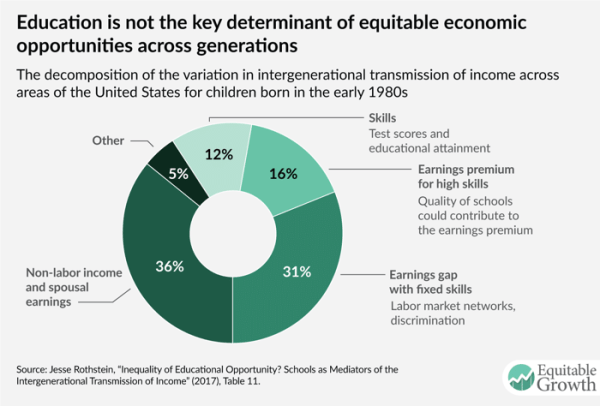
Our latest research, after all, shows that schools are not the biggest factor in economic mobility. That is, success in getting through high school and maybe college to get a better job than your parent had is mostly not do to the schools themselves, but other factors. And Rowe is right that a big part of those outside factors is family structure.Rothstein

The real disagreement at the heart of our school-reform dilemma is about what comes next. By and large, Americans don’t like to talk about the real problem. We don’t like to talk about the fact that some Americans don’t have an equal shot at the American dream. We don’t like to acknowledge the obvious truism that band-aid reforms to some schools here and there are laughably inadequate solutions.

We can’t even agree on what poverty means. For many Americans, especially conservatives and religious Americans, the main cause of poverty is “individual failings.” If only people worked harder and delayed gratification, the thinking goes, they would move up to better jobs and nicer neighborhoods. As recent surveys show, the rest of us tend to blame social structure and “difficult circumstances.” The most important factor in persistent poverty—in this way of thinking—is the way society itself discriminates against poor people, squeezing them into worse houses, with worse schools and worse jobs.

Unless and until we can figure out this persistent disagreement about what it means to be poor in America, our sporadic attempts at school reform will continue to disappoint. Like Bill Gates, well-meaning but poorly informed reformers will wonder where all their money went with so little to show for it.

Can Anyone Really Teach For America?

It’s personal for me. I remember being shocked and perturbed when I started teaching and realized the kinds of lives some of our students lived. It’s one thing to see it on TV; it’s another to get to know a kid who only comes to school when he feels like it because he lives in a house without any responsible adults, where there is no food but there are plenty of drugs and prostitution. Every teacher wants to help. And every good teacher realizes he or she can never help enough–the problems are so big and so overwhelming for so many kids that one great history class seems awfully meaningless in comparison.

A new memoir brings this crusty old question up one more time: How much impact can a teacher really have on students’ lives? Reading with Patrick by Michelle Kuo tells the story yet again. Kuo goes from Harvard to Arkansas with Teach For America. She finds herself shocked and unprepared for the conditions in which her students live.

At The Atlantic, reviewers gush. They write that Kuo manages to avoid the “every kind of awful” clichés of the teacher-as-savior genre.

Veteran teachers aren’t so smitten. Curmudgucrat Peter Greene laments the stale story. As he puts it,

only in teaching do we get this. Students who drop out of their medical internship don’t get to write memoirs hailed for genius insights into health care. Guys who once wrote an article for the local paper don’t draw plaudits for their book of wisdom about journalism and the media.   But somehow education must be repeatedly Columbusized, as some new tourist is lionized for “discovering” a land where millions of folks all live rich and fully realized lives.

Coincidentally, this week I’m asking the grad students I work with to consider this very question. Given the many structural and social inequities that create “tough” schools, how much positive influence can one teacher have on students’ lives?

As Greene points out, in every generation affluent Americans like to “discover” the “shocking” conditions in some urban schools. It’s such a cliché that the Onion can parody the predictable storyline without even breaking a sweat. In my class, I’m asking students to consider both the question itself and the way American pop culture keeps finding itself surprised to hear the same story.

We start with the movie Blackboard Jungle. In 1955, this movie shocked audiences by its depictions of gang warfare, sexual assault, and unruly teenagers. Oh, and of course rock-and-roll music, which was apparently a big thing at the time.

Of no surprise to SAGLRROILYBYGTH, in Blackboard Jungle, an earnest new teacher has some trouble with these violent and turbulent teens. Of even less surprise, he manages to forge positive relationships and get most of them to reevaluate their ideas about school and literature.

Next up: Up the Down Staircase. This 1960s memoir told the same story. In the 1967 film version, we see the earnest and affluent teacher move in to an urban high school. The students are rowdy. They are not all white. They give the teacher trouble.

After some twists—including one frank African American drop-out who explains to the naïve teacher the uselessness of school credentials in his life—the teacher manages by dint of personal awesomeness to help her students get something out of school.

Last but not least, we hear the story again in 2007’s Freedom Writers. In this version, we have an earnest and affluent teacher—wait for it—teaching in a gritty and violent urban school.

I don’t know if you need to hear the rest. It’s the same story told in twenty-first century accents. After significant struggle, by dint of extraordinary effort and personal moxie the heroic teacher manages to connect with her students. The students recognize their own potential as writers, thinkers, and voices for social change.

Don’t get me wrong: I am not saying these stories aren’t heroic in some sense. Most Harvard grads don’t take Kuo’s detour through Arkansas before law school. And even fewer return when things get scary. And I’m certainly not saying I don’t share the moral dilemma of these teachers.

But I still struggle to make sense of a few key questions:

  • Why do Americans keep finding themselves surprised to hear this same story?
  • Are these really “inspiring” or “hopeful” stories, when nothing has actually changed for most students?
  • What long-term impact can isolated, self-sacrificing teachers have in a hierarchical society?