Why Is There a Racial Difference about Standardized Tests?

I just don’t get it. Why do African-American parents and white parents have such a big difference in their attitudes toward standardized testing? The new poll out from Phi Delta Kappa and Gallup reveals some puzzling trends. In general, more white parents would pull their kids out of tests than would African-American parents. Why?

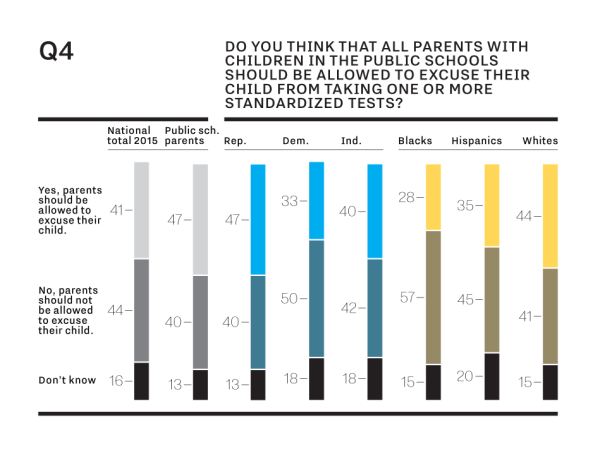
In my new book, I argued that Americans in general retain fairly traditional ideas about schooling and teaching. For many parents, I argued, tests are a common-sense way to measure the effectiveness of schools. In spite of all the attention paid to progressive educational theorists, traditional ideas about testing dominated.  At least, that’s what I argued in my book.  This year’s PDK/Gallup poll makes it harder for me to sustain that argument.Gallup_Q4
This year’s poll asked parents lots of questions about standardized tests. In spite of headlines about families opting out of big tests, most parents do not think that the tests themselves are the most important educational issue.

Black parents, however, tended to value high-stakes tests more than white parents. In one question, pollsters asked parents if they should be allowed to pull their kids out of tests. More than half (57%) of black parents said no, compared to only 41% of white parents. When pollsters asked parents if they themselves would pull their kids out of tests, a whopping three-quarters of black parents said no, compared to only 54% of white parents.

Why the difference? We might be tempted to look at this in ideological terms. Perhaps more conservative people in general value testing in general. But that doesn’t fit with the poll numbers either. According to the poll, more Democrats (63%) than Republicans (55%) said they would not excuse their own kids from the mandatory tests. Similarly, more Democrats (50%) than Republicans (40%) thought that parents in general should not be able to excuse their kids from tests.Gallup_Q7
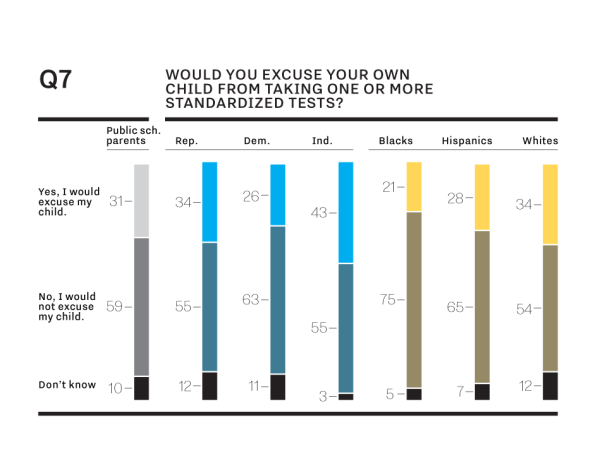
What are we to make of all these confusing results? Of course, we know that “Democrat” doesn’t equal “liberal” any more than “Republican” equals “conservative.” We also know that these majorities are only tendencies, not hard-and-fast rules. But there does seem to be some significant differences in attitudes toward testing between Republicans and Democrats, and between white parents and black parents.

In general, African-American parents seem to value testing more than white parents do. And African-American parents seem less likely to pull their own kids out of big tests.

How can we make sense of this? Is it fair to conclude that African Americans in general have more traditional ideas about schooling than white parents do?

This poll would not be the first evidence of such a trend. As scholars such as Lisa Delpit have argued, African-American children often thrive in fairly traditional, fairly authoritarian classrooms. And, as Theresa Perry and others have argued, African-American culture venerates traditional education.

Hard to say for sure, but it seems as if high-stakes testing is part of a long American tradition. Unlike progressive ideas about building on children’s experiences and making classrooms student-centered, traditional education suggests that children should imbibe knowledge from an authoritative teacher, then demonstrate their mastery of that knowledge on an authoritative test.

Different people have different opinions, of course, but it seems as if African Americans in general value this tradition more than other racial groups do.
Did Fundamentalism Make Her Do It?

Okay, enough already about Rachel Dolezal and her weird tale of cross-racial activism. But before we let it go, let’s consider one new angle: Did Dolezal’s strange behavior result in part from her upbringing in an abusive fundamentalist homeschooling family?

A fundamental flaw?

A fundamental flaw?

That’s the charge leveled by the folks at Homeschoolers Anonymous. Worried that their coverage seemed to be excusing Rachel Dolezal’s behavior, they have since retracted their argument. (You can still read their original article here.) But it seems to me they raised an important question.

For those of us outside the world of fundamentalist homeschooling, Rachel Dolezal’s life history seems simply bizarre. Why did she list “Jesus Christ” as a witness to her birth? Why did she claim to have been beaten with a “baboon whip” as a child? Most important, why would someone go to such extreme and unnecessary lengths to alter her appearance and life history?

I do not want to excuse anyone’s actions, but I think Homeschoolers Anonymous has a right to point out Dolezal’s extreme evangelical upbringing. It doesn’t prove anything, but it adds background information.

The family was active in young-earth creationism. They apparently subscribed to the abusive philosophy advocated by Michael and Debi Pearl. Last year, Rachel Dolezal’s brother published a shocking memoir of their childhood. As HA summarized,

In his memoir, Joshua recounts growing up in the Dolezal’s conservative, Pentecostal home and church. He recounts a raging father, a mother with extreme suspicions of medicine and doctors, home-birthing with birth certificates listing Jesus as witness to the births, and much more.

Now, we need to add some of the usual caveats:

1.) Behavior that seems odd to secular folks like me does not equal child abuse.

2.) Many conservatives use corporal punishment in a loving, caring way.

3.) It does not excuse Rachel Dolezal’s apparent lies to point out her parents’ extreme beliefs.

4.) Homeschoolers Anonymous certainly has an axe to grind with this expose.

Even taking all those factors into consideration, however, knowing a little bit about Rachel Dolezal’s childhood helps me understand how someone might be driven to immoral extremes in order to separate herself from her past.

Nuf sed.

Academic Impostors

What does Rachel Dolezal have to do with Woodrow Wilson? Her story has been poked and prodded from every angle, it seems, except one. In important ways, this is a story about higher education. Universities have always had non-academic categories that they have preferred. Students and faculty—like Dolezal and President Wilson—have always allowed schools to think they fill those categories, even if they don’t.

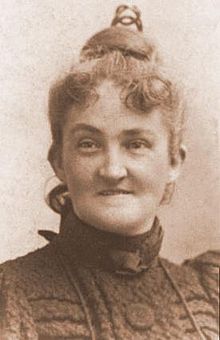
Dolezal then & now...

Dolezal then & now…

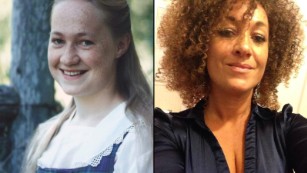
If you haven’t heard about Dolezal yet, congratulations. Her strange tale of a white woman passing herself off as an African American leader has attracted bajillions of comments from all over the punditocracy. In very brief form, here are the highlights: Dolezal has served as the successful chapter leader of the Spokane NAACP. She has either allowed people to think of her as African American, or has even checked that box herself. She may have performed some Facebook fakery to make her family look more African American. She attended graduate school with a full scholarship at the historically black Howard University. She teaches African American Studies classes at Eastern Washington University. Recently, her very white parents outed her as white. The family had split over Rachel’s accusations of abuse. Rachel had fought for custody of one of her younger brothers.

As journalists have noted, this story has raised tricky questions about race and racism in the United States. Conservative commentators have wondered why people can be transgender but not transracial. The NAACP has issued a statement affirming that its leaders can be from any racial background.

As SAGLRROILYBYGTH are well aware, I’m up to my eyeballs in research for a new book about the history of American higher education. To my tired eyes, one angle of this story jumps out and I haven’t heard any other nerds talking about it. As a student and as a teacher, Dolezal’s imposture has reaped significant rewards. If nothing else, her story can give us another example of the ways preferred categories have always affected higher education.

At Howard University, according to Dolezal’s father, Rachel allowed the school to assume she was African American. They gave her a full scholarship for her graduate program in art. She also teaches part-time at Eastern Washington University in the Africana Education Program. It is not certain that she lied to the people who hired her there, but the director of the program told the New York Times he thought she was black.

It seems evident that Dolezal would not have had the same opportunities at Howard or EWU if she had not been perceived as African American. Academic positions, especially in relevant areas such as Africana Studies, usually have explicit preferences for members of underrepresented groups.

Now, don’t get me wrong, I’m not against hiring preferences in higher education. I agree that personal background can be an important factor when it comes to teaching and scholarship and universities are correct to prefer some candidates based on non-academic qualifications. IMHO. Indeed, I only got my job because of my experience as a secondary-school teacher.

The interesting point, rather, is that these non-academic preferences can tell us a lot about the nature of higher education, the non-academic values of colleges. In the past, elite schools used to prefer Christian professors, for example. This is where Woodrow Wilson comes in. When Wilson, future POTUS, was elevated to the Chair of Political Economy and Jurisprudence at Princeton University in 1890, he received a forceful letter from Princeton President Francis Patton. To keep his chair, Patton warned, Professor Wilson would need to be far more explicit in his Christian testimony.

Patton worried in a letter to Wilson

That in your discussion of the origin of the State you minimize the supernatural, & make such unqualified application of the doctrine of naturalistic evolution & the genesis of the State as to leave the reader of your pages in a state of uncertainty as to your own position & the place you give to Divine Providence.

Princeton, Patton insisted, was determined to “keep this College on the old ground of loyalty to the Christian religion.”

Even at the time, as Patton’s language suggested, such Christian orthodoxy was becoming rarer and rarer in American higher education, at elite schools at least. Patton wanted to hire only Christian scholars. Wilson, for his part, allowed Patton to think he agreed, though Wilson’s later work never embodied the sort of loud-and-proud supernatural thinking Patton desired.

What does any of this have to do with Rachel Dolezal? Back in the 1890s, if one wanted a job at Princeton, one was wise to allow school leaders to think one supported orthodox Calvinism. These days, if one wants a job in a university, one is wise to allow school leaders to think one is a member of an historically underrepresented group.

Back then, conservative schools such as Princeton and Yale were clinging to an older tradition of explicitly Christian education. These days, schools are scrambling to include a wider diversity of racial backgrounds.

Wilson’s career was certainly not hurt by his willingness to let Patton believe his Presbyterianism was stronger than it really was. Dolezal—until this ugly scandal, of course—has not been hurt by people’s assumptions about her racial background.

Are We Too Polite to Tell Our Children the Truth?

It’s not a secret. The roots of Memorial Day lie twisted with America’s toughest problems of race and region. But my hunch is that very few Memorial Day speeches mentioned such things. In addition to the vexing problems of knowledge and politics that cause our continuing educational culture wars, I think we need to add one surprisingly boring cause.

Historian David Blight has argued convincingly that the first Memorial Day (Decoration Day back then) was part of a furious effort by African American Southerners to defend the memory of Union soldiers buried in the South. On May 1, 1865, the first Memorial Day celebration took place on Washington Race Course in Charleston, South Carolina.

That first Memorial Day did not bring Americans together. It celebrated the victory of the Union. It celebrated the end of slavery. It used a display of African American military force to make the point to white Southerners that the old days were gone forever.

A dozen years later, of course, many of those white former Confederates had regained political power in the South. African American freedoms had been wrested away by vengeful white elites North and South. By the time of the fiftieth anniversary of the Battle of Gettysburg, Professor Blight tells us in Race & Reunion, North and South had come together to celebrate the heroics of white soldiers on both sides. Memorial Day had come to be a celebration of white unity, at the cost of African American rights.

What would YOU tell them?

What would YOU tell them?

Why don’t we tell any of that to our children? I think there are two obvious culprits and one surprisingly banal one.

Around these parts, local historians like to remind us that the official first Memorial Day took place in Waterloo, New York. In 1966, then-President Lyndon Baines Johnson decreed that Waterloo was the birthplace of the tradition. That’s a comforting story everyone can get behind. And it points out the many reasons why we don’t tell ourselves the story of the Charleston Race Track.

First, lots of us just don’t know. We might not have read Professor Blight’s book. In all fairness, we might assume that the history we get in our newspapers and from our parents is the truth.

Second, there has been significant political activism to make sure we don’t know. As Professor Blight detailed, organizations such as the United Daughters of the Confederacy worked hard to obscure the race-conscious history of Memorial Day. In textbooks and historical markers, in schools and in Memorial-Day speeches, activists such as Mildred Rutherford insisted that the memory of the Confederacy must be honored.

What not to know and how not to know it...

What not to know and how not to know it…

But above and beyond ignorance and activism, there is a far more basic reason why we don’t talk much about the still-festering racial issues at the real root of Memorial Day. For those of us interested in educational culture wars, we can see the same operation at work in questions about evolution and sex education in public schools as well.

As I argue in my new book about conservative school activism in the twentieth century, conservatives have often had a very easy time vetoing ideas or methods in public-school classrooms or textbooks. Why? Because they didn’t have to disprove the ideas, they only had to insist that such ideas were controversial.

Public schools are surprisingly similar to polite dinner parties. Not because everyone’s manners are at their best, but because any topic that is perceived as controversial is taboo. Teachers will avoid it; administrators will recoil from it.

We’ve seen this over and over throughout the twentieth century, in subject after subject.

Here in scenic Binghamton, New York, for example, in 1940, school Superintendent Daniel Kelly yanked a set of history textbooks from the district’s classrooms. Why? Not because he disliked them. He told a reporter, “Personally, it’s the kind of book I want my children to have. To say it is subversive is absurd.” However, he was willing to get rid of them in order to “stop the controversy” about them.

A few years later, in 1942, an enterprising group of academics tried to determine why so few teachers taught evolution. They mailed a survey to a representative group of teachers nationwide. Overall, they found that fewer than half of America’s biology teachers taught anything close to recognizable evolutionary science. Why not? In the words of one of their respondents, “Controversial subjects are dynamite to teachers.”

When it comes to Memorial Day, this polite impulse to avoid controversy must be part of our loud silence about the roots of the holiday. Who wants to be the boor at the cookout who turns a sentimental get-together into a racial confrontation? Who is willing to tell the gathered Boy Scouts and VFW members that their parade is a charade, since it has its roots in the reinstitution of American racial slavery? Who is willing to tell kids in class that their long weekend is really a reminder of America’s long and continuing race war?

Such things are simply not done.

In addition to the obvious culture-war culprits of knowledge and politics, we need to remember this obvious fact: Teaching the truth is rude.

A School Plan to Cure Racism

It can be depressing. Just over fifty years ago, Thurgood Marshall announced the civil-rights victory of Brown v. Board of Education. In no more than five years, Marshall predicted, the nation’s schools would be racially integrated. Looking at America’s schools today, scholars see more and more racial segregation in schools, not less. One fancy school in New York City has embarked on a more aggressive plan to cure racism. Both liberal and conservative commentators are aghast. But can it work?

In New York Magazine, Lisa Miller reports on the new anti-racism plan of Fieldston School. At this private progressive school, the administration planned to separate kids out into racial groups. The goal was to allow kids to talk about race and ask potentially “impolite” questions without feeling subtle pressure.

As the head of the school told Miller,

We don’t want to replicate what has happened traditionally. The education that many of us have received about race has not been adequate. Hence, where are we as a nation? We are trying to pioneer, to be at the vanguard of this opportunity, to see if we can get it right.

How do the kids feel? One student in the “black” group told Miller that he liked it:

I get to be with people I can share my race with, and I don’t feel uncomfortable about it. . . . We talk about how it’s important to know what your race is. We talk about the difference between being prejudiced and being racist. So I can know when someone’s being racist to me, and I can help other people know that, too. I can say I’m proud of being black. I remember my friend saying that the affinity groups are racist, but they’re not. They put you in a group of what race you are — I don’t think that’s racist at all. We get to make jokes and stuff, and comments. When we’re talking, we get to draw, we get to laugh.

Other students weren’t so sure. A student in the “Asian” group reported, “It’s so fricking boring.”

The idea, in general, is to help students of all races talk about race and racism. Too many white liberals, the thinking goes, are trapped by their own progressive prejudices. They see themselves as enlightened and post-racial, yet they are unable to recognize the ways race and racism function. Programs like this will help make visible the ways white privilege works.

Some parents objected. How is segregating kids by race a good way to fight racial segregation? And what categories would the school use? A Jewish parent objected that his family had been persecuted by the Ku Klux Klan. Did that make him something other than “white?”

One group of progressive parents started a protest petition. The school’s plan, they insisted, would cause “irreparable harm” to their kids.

Conservatives, too, balk at such racial programs. Rod Dreher, for example, called the program a “grievance-building fun house.”

But is it the best way to teach kids about race? To help kids understand from a young age that racism is a real thing? Or does this sort of thing only promulgate racial stereotypes?

Creationists against Racism

Do they really mean it?

These days, leading creationists claim to be anti-racist. But fundamentalist Protestantism has a sour history of racism. Do today’s creationists have a fair claim to be authentically anti-racist? Short answer: Yes. Though it might muddy our progressive assumptions, we need to recognize that dissent from mainstream science has also often included dissent from mainstream racism.

Today’s conservative pundits usually don’t like to talk about it. But historically, as I argue in my new book, in the United States conservatism has been tied pretty closely to racism. And as we’ve seen in these pages, white racism has enjoyed strong support within fundamentalist circles.

Let me be clear: Unlike some progressive pundits, I’m not insisting that white conservatives these days are *really* all a bunch of racists. And unlike some progressive historians, I don’t believe that the *real* explanation for the politicization of conservative evangelicals in the 1970s was white racism. But the historical record is pretty clear: Throughout most of the twentieth century, white conservatism was bound up with traditional notions of white dominance.

There is, however, one glaring and important exception to this rule. Among white conservative creationists, there has been a long record of anti-racism. This has usually not been motivated by a civil-rights style of social activism, but rather from creationism itself. If Adam and Eve were the literal historic parents of all humanity, then there can’t be real differences between the races.

Today’s leading young-earth creationist ministry, Answers In Genesis, has long trumpeted its anti-racist creationism. As AIG likes to explain, racism can’t survive if we really believe in Adam, Eve, and Noah’s Ark.

AIG’s position is nothing new among dedicated creationists. As Bradley Gundlach argues in his terrific new(ish) book, Process & Providence, at the dawn of our modern evolution/creation battles, creationists defined themselves as opposed to racist mainstream science. In 1859, Professor Gundlach writes, the main evolutionary question at conservative Princeton Seminary was not Darwin’s new book. Rather, the creationists at Princeton in 1859 were outraged by the new scientific fad of “polygenism.” Leading contemporary scientists embraced the notion that human races were actually different species. Creationists at Princeton said no.

As the creation/evolution battles heated up in the 1920s, too, the anti-evolution crusade had the better claim to anti-racism. White mainstream science at the time often proved friendly to notions of “scientific racism.” As I describe in my new book (page 49 for those of you following along at home), leading evolutionary pundit Henry Fairfield Osborn supported both evolutionary theory and the racism that he thought went along with it.

Of course, simply because dedicated and consistent creationists have often been anti-racist, we can’t conclude that all creationists are anti-racist. Perhaps most famously, Bob Jones University in South Carolina has been fervently creationist AND fervently racist throughout most of its history.

The point here, rather, is that mainstream science has not always been right. Creationists these days can legitimately claim a more consistent history of anti-racism than can mainstream scientists. The same theological impulse that leads young-earth creationists to insist on a young earth also leads them to insist that all of humanity has the same roots.

Racist Fundamentalists…It’s Complicated

Sometimes the archives can make things too complicated. White fundamentalists have always been accused of racism—a charge they’ve vehemently denied. But what do we do when an African American fundamentalist agrees with the racism of his white fellow fundamentalists?

First, a quick historical sketch: Since the 1920s, as I argued in my first book, fundamentalism got tangled up with ideas about Southern Pride. Conservative religion has often become part and parcel of a broader cultural conservatism, one that included support for racial segregation and white supremacy.

Racist? Or just fundamentalist?

Racist? Or just fundamentalist?

By the 1970s, leading white fundamentalists became some of the most public supporters of racial segregation. Most famously, Bob Jones University steadfastly clung to its whites-only policy long after many white Southerners and white fundamentalists had grudgingly moved on. Some historians, such as Randall Balmer, have insisted that white racism among fundamentalists was the real root of the so-called New Christian Right that emerged in the 1970s.

I disagree. There is no doubt that white fundamentalism—especially in the South—has long had close ties to white racism. There is more to the story, however, than quick condemnations of conservative religion as a front for white supremacy.

In my recent work at the archive of the Moody Bible Institute, I came across a document that reminds us how messy history is. In 1970, the leaders of Moody dis-invited prominent fundamentalist John R. Rice from Moody’s big annual Founder’s Week event. Why? Because Rice had come out in support of the segregationist policies of Bob Jones University.

As President William Culbertson informed members of the Moody community,

Moody Bible Institute has for 85 years welcomed young people of all races and nationalities to its tuition-free training in the Bible. Through times of changing social mores the policy has always been to emphasize the salvation from God by which all men who believe are made one in Christ. We have sought, and do seek, to apply the spiritual principles set forth in the Word of God to the practical problems of our culture. We believe that there is nothing in the Bible that forbids interracial relationships. We are absolutely opposed to injustice and exploitation. We are dedicated to the proposition that we are debtors to all men.

Moody Bible Institute, Culbertson told anyone who would listen, still agreed wholeheartedly with John R. Rice’s fundamentalist theology. Moody refused to compromise with those who would modernize the Bible or water down fundamentalist religion. But Moody could not be seen as part of a racist, segregationist movement.

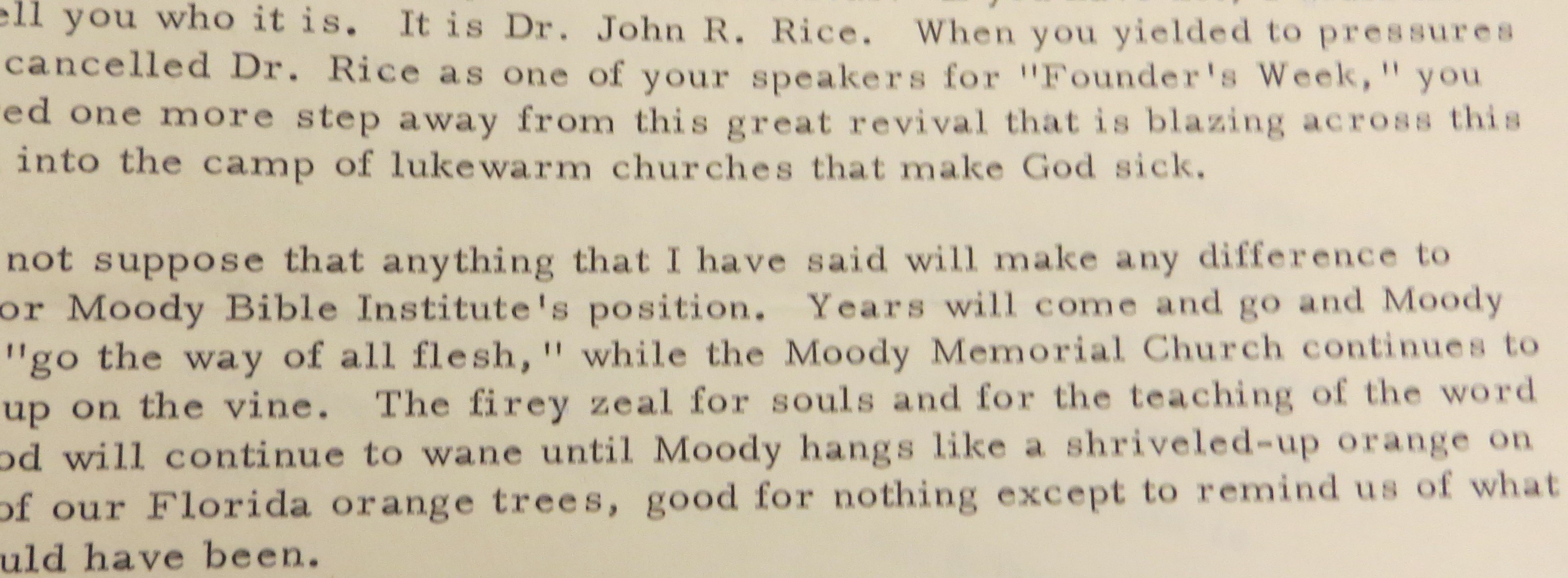
Naturally, John R. Rice and his supporters blasted this decision. More evidence, one Rice supporter charged, that Moody had

moved one more step away from the great revival that is blazing across this land into the camp of lukewarm churches that make God sick. I do not suppose that anything that I have said will make any difference to you or Moody Bible Institute’s position. Years will come and go and Moody will ‘go the way of all flesh,’ while the Moody Memorial Church continues to dry-up on the vine.

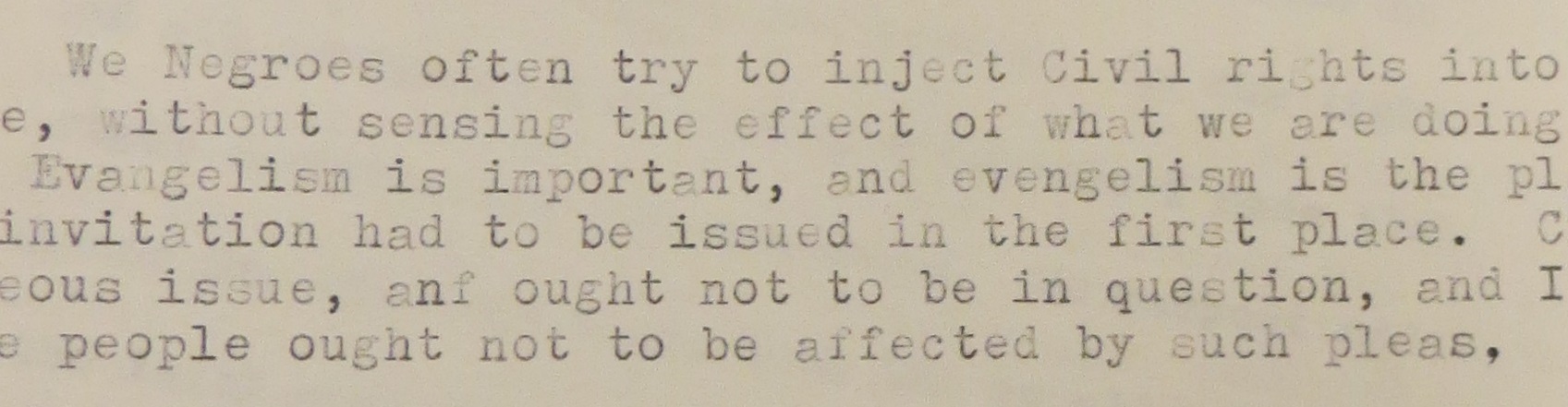
Among the fat stack of angry letters supporting John R. Rice, one stands out. It came from William H. Dinkins of Selma, Alabama. Dinkins was an African American fundamentalist and, in his words, someone who “stand[s] with Dr. Rice for fundamentalism and the old-time religion and all that goes with it.” Too often, Dinkins charged, “We Negroes [sic] . . . try to inject Civil Rights into every circumstance, without sensing the effect of what we are doing.” When it comes to religion and the Word of God, Dinkins continued, “Civil Rights is an extraneous issue, and ought not to be in question, and I feel that responsible people ought not to be effected by such pleas.”

The view from Selma, 1971

The view from Selma, 1971

Dinkins’s letter raises difficult questions about race and religion. First of all, we wonder if this letter was legitimate. Could someone have faked it in order to create an impression of biracial support for racial segregation? If not, we wonder how common such sentiments have been. As historian Jeffrey Moran has argued, white fundamentalists have long tended to ignore their African American co-religionists, at best. And, as John Dittmer and others have showed, in the early days of the Civil Rights movement many African American leaders in the Deep South supported segregation, at least temporarily and pragmatically.

In the early 1970s, was there really any support for racial segregation among African American conservatives? Did fundamentalism trump race?

Conservatives Win a Prize They No Longer Want

A new report about racial segregation in Connecticut’s schools raises a painful historical reminder for conservatives: Conservatives, both white and African American, often promoted school segregation as a central tenet of conservative ideology. These days, mainstream conservatives want to shed their historic legacy of racism. Ironically, that means that no conservative is claiming “credit” for the current resurgence of racial segregation in schools.

The report from Gary Orfield’s Civil Rights Project praises Connecticut’s schools. Unlike most states, Connecticut has made real progress in racial integration of schools. In other states, though, public schools are becoming more starkly segregated.

Sixty years ago, this would have been cause for conservative celebration. Though they don’t like to be reminded, conservatives embraced racial segregation back then as a central plank in the conservative platform. At National Review, for example, William F. Buckley Jr. took a stand in favor of continued white supremacy in the South.

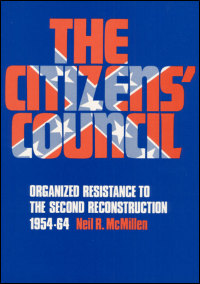
As Neil McMillen made clear in his history of the White Citizens’ Councils, too, leading segregationists consistently tied their racist policies to the broader 1950s conservative movement. In his famous “Black Monday” speech, for example, Mississippi Circuit Court Judge Thomas Pickens Brady denounced the US Supreme Court’s Brown v. Board decision in both racist and anti-communist terms. Not only would school desegregation lead to “amalgamation” of the races, Brady charged, it was also part of a “socialistic” scheme to degrade southern traditions.

Back then, conservatism = segregationism

Back then, conservatism = segregationism

As McMillen tells us, southern segregationists often joined and led other leading conservative organizations. Georgia’s R. Carter Pittman, for example, not only led his local white supremacist Citizens’ Council, but also joined the John Birch Society, the Liberty Lobby, and Billy James Hargis’s Christian Crusade.

Many white segregation leaders in the 1950s embraced religious conservatism as well. The Citizens’ Councils denounced “pinkos in the pulpit” who had declared “private enterprise, rugged individualism, and conservatism in politics . . . equally un-Christian.”

The historical record is clear, if awkward. Though most mainstream conservative thinkers these days don’t like it, in the tumultuous 1950s and early 1960s “conservatism” was tightly bound up with white supremacy.

Even weirder from today’s perspective, many African-American conservatives in the 1950s also embraced continued school segregation. Obviously, they did so in different ways and in different organizations than did white conservatives. No African Americans joined the White Citizens’ Councils, for example. And no African-American conservatives embraced school segregation in the name of white supremacy. Rather, African-American leaders supported segregation in a cautious and strategic way and they abandoned segregation as soon as better options appeared possible.

More complicated than we might think...

More complicated than we might think…

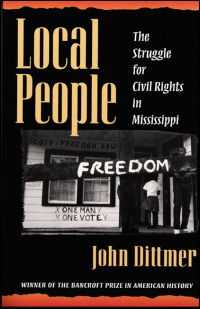
But as John Dittmer demonstrates in his careful history of the civil-rights saga in Mississippi, African-American leaders often preferred racially segregated schools, at least in the early 1950s. At that time, some leaders felt, segregated schools provided Mississippi’s African American population with a steady source of teaching jobs. Some African American leaders also believed that segregated schools offered a better option for African American students than hostile integrated ones.

These days, no one likes to be reminded of this history. African American conservatives largely got on board with anti-segregation campaigns. White conservatives, too, if a little later. But in the 1950s at least, conservatism meant racial segregationism.

And this leads us to our unusual current situation. If today’s public schools are reverting to racial segregation, as the Civil Rights Project documents, we might see this as a long-term victory for 1950s conservatism. Yet, since mainstream conservatives have since abjured their 1950s racist roots, there is no one around to celebrate this significant conservative “victory.”

Required Reading: Rich Parents Are Better

You remember the old joke:

Q: What’s the best way to have a million dollars by the time you’re thirty?

A: Inherit ten million dollars when you’re twenty.

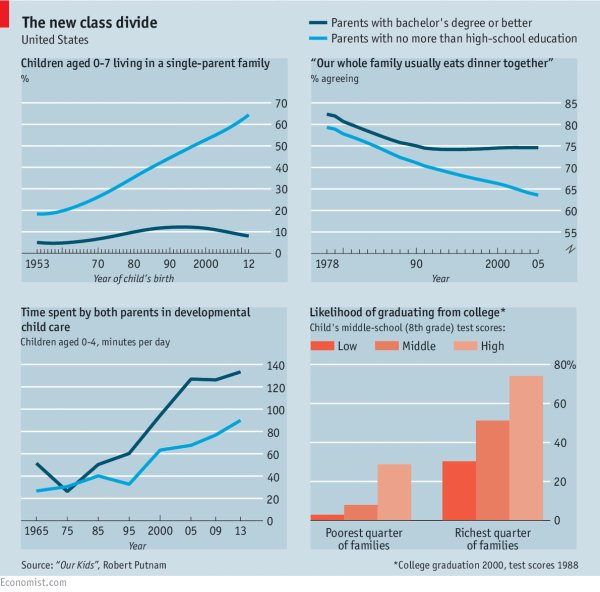
A new book by sociologist Robert Putnam underlines the traditional wisdom: The best way to succeed in life is to pick the right parents. According to reviews in The Economist and New York Times, Putnam amasses solid evidence to demonstrate that the class gap between rich and poor parents is huge and increasing.

Graphic inequality

Graphic inequality

The relationship between parenting and poverty has been a culture-war flashpoint for fifty years. As historian Andrew Hartman relates in his new book, back in the 1960s sociologist and sometime-senator Daniel Patrick Moynihan raised hackles with his study of the causes of African-American poverty.

The problem with too many “Negro Families,” Moynihan argued, was that a destructive anti-family culture had set in. Kids were no longer being raised in stable two-parent households. Fathers were absent or abusive. Mothers were overworked and under stress. The result, Moynihan concluded, was that poor families—especially African American poor families—could not raise successful children.

Critics charged that Moynihan attacked poor people, not poverty. He was accused of a new crime: “blaming the victim.”

The numbers in Putnam’s new book offer some sobering suggestions that Moynihan’s warnings were correct, but not just for African American families. The real divide, Putnam says, is not between black and white parents, but between well-to-do college-educated parents and not-well-to-do parents with less education.

Some of these statistics are truly mind-blowing. Consider, for example, that a poor eighth-grade student who does very well in school still has a worse chance of completing college than a rich eighth-grade student who does very badly in school. The numbers of children living with two well-educated parents has stayed relatively stable. The number of children in single-parent households has shot up among parents with no more than a high-school education.

Traditionalists and conservatives, no doubt, will point to Putnam’s work as more evidence in favor of traditional families. The best way to fight poverty, they might say, will be to encourage stable two-parent households.

Progressives and liberals, meanwhile, will point to these numbers as proof of America’s un-level playing field. Children of parents with fewer educational advantages need extra assistance from government in order to stand any sort of chance.

The long-standing dream of American education has been that education can lead to success. Since the days of Horace Mann, education has been offered as the key to the American dream. Putnam’s study offers more evidence that education is part of the structure of inequality, not the sledgehammer to demolish that structure.

Racists Welcome

Is even the vilest speech protected? The expulsions of racist chanters at the University of Oklahoma has riled up conservative commentators. No matter how hateful the speech, some say, colleges have no right to expel students for exercising their rights to say it. I can’t help but think that the real target of conservative ire is the current vibe on college campuses.

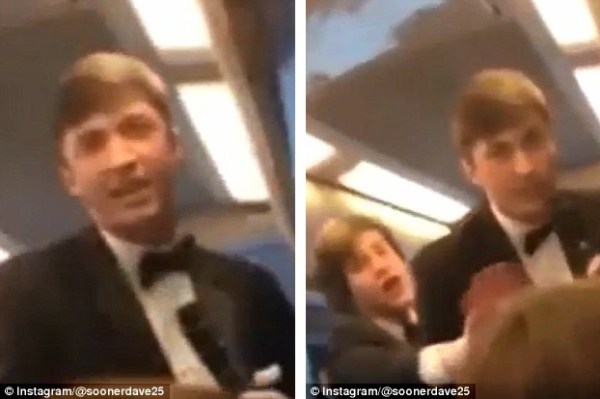
In this case, the speech in question was undeniably horrifying. Frat members sang along that Sigma Alpha Epsilon would never welcome an African American member. Of course, they used a much more offensive term than “African American.” They cheerfully shouted that they could lynch any offender. Horrible stuff.

But is it protected?

Eugene Volokh of the Volokh Conspiracy thinks so. There is no exception to free-speech rights for racist language, even language that creates “hostile environments.” Unless one is issuing specific threats, one may even use language that suggests violence.

Voices of protest?  Or drunken howl?

Voices of protest? Or drunken howl?

At National Review, David French agrees. In its rush to justice, French says, the university failed to observe basic constitutional principles. It was entirely right and just for the national officers of the fraternity to punish the Oklahoma chapter. And it seems fair that the Sooner football team will now lose a prize recruit—to Alabama, no less. But such private-party sanctions are different than official university sanctions.

As have many other conservative commentators, French identifies the broader problem as one of higher-education ideology careening out of control. “Our public universities,” French writes,

are becoming national leaders in trampling the Constitution to legislate their brand of “inclusive” morality.

I understand the argument. And generally, in these pages, I try to refrain from injecting my own opinions. I can’t help but wonder, though, if these conservative intellectuals have over-stepped in their constitutional rationalizations. It seems some conservatives are too quick to protest any action by the leaders of today’s universities.

As I argue in my new book, this anti-university tradition among conservative intellectuals has a long history. Beginning in the late nineteenth century, conservative thinkers bemoaned the changes taking place at leading schools. Instead of passing along time-tested truths, universities made it their job to subvert and question those ideas.

These days, many conservatives lament, universities have become special homes for welcoming certain sorts of offensive speech. For instance, as Professor Volokh points out, many kinds of hateful speech—even violent speech—have long been recognized as protected on campus. No student would be sanctioned for displaying pictures of African American militants wielding shotguns and intoning, “By Any Means Necessary.”

There seems to be an important difference, though, between speech meant to protest against existing conditions and the SAE’s brand of exuberantly hateful race-baiting. The students in this case were not engaged in thoughtful commentary on unfair conditions. They did not hope to attract attention to their cause by using intentionally inflammatory language.

Instead, this looks like a drunken outburst of knee-jerk segregationism, a case in which vino exposed a terrible veritas. When exposed, the expelled students did not defend their actions on the grounds of free speech. Rather, they humbly acknowledged the shamefulness of their actions.

Indeed, it might have been more compelling as a free-speech case if the students had defended their outburst. If, that is, students had been even more painfully racist; if they had been intentionally offensive and if they had knowingly provoked this sort of reaction, then they would have a better claim to constitutional protection. It seems to me, though, that these students are merely petty campus despots, shouting in secret language that they abjure in public.

Does it count as an exercise of free speech when even the speakers find it offensive?