“Some People Just Don’t Value Education”

Teachers! Has anyone NOT heard this ugly phrase at some point? It’s everywhere. We see it in every new TV show about schools. I’m also finding heavy doses of it in the archives as I work on my new book. For hundreds of years now, the myth has not gone away. And it fuels America’s worst impulses.
insecure no students

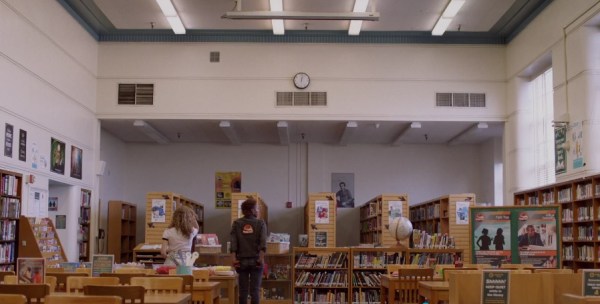
From season 2, episode 1: No matter how good the snacks, students just don’t show up

Consider a few examples. These days, when I’m not in the archives, I’m watching Insecure on TV. It’s great. The main character, Issa, works for a non-profit that tries awkwardly to provide educational resources for low-income Black and Latinx students. In season 2, episode 1, she and her co-worker try desperately to bribe students to attend their afterschool tutoring session. At first, when the students do come, they only steal the snacks and run away. What is Issa supposed to do? She can’t help kids with their Geometry if they won’t show up.

Every teacher could tell similar stories. How is it possible—every teacher ever has asked—how is it possible to teach kids who don’t come to school? How can we beef up resources for kids whose parents don’t come to parent-teacher conferences?

Here’s the worst news—there has never been a time when this WASN’T the case. As I’m finding in my current research, two hundred years ago African-American leaders had a very difficult time convincing African Americans in New York and Philadelphia to send their children to the cities’ free schools. As The Reverend Peter Williams preached to the African-American congregants of St. Philip’s in New York City, April 27, 1828, free public schools were available for African-American students, but only a fifth of the city’s eligible black kids attended. As The Rev. Williams exhorted,

Brethren, if any of you have children that are not at school, do send them, and if you see any coloured children in the city, that are not receiving the benefit of an education, do use your influence with their parents, to have them sent to these fountains of wisdom. By so doing you will serve the interests of the community at large, and the interests of your immortal souls. It is a work of that Divine charity, which greater than, either faith or hope, never faileth, and covereth a multitude of sins.

Even back then, there were plenty of low-income families who just didn’t seem to value school. This long and sad history has led some people to a tragically mistaken conclusion. Correct me if I’m wrong, but I’ll bet dollars to donuts every teacher out there has come across it at some point in our careers. We’ll be wondering how to bridge this gap between school and family, and someone will say knowingly, “Some people just don’t value education.”

The implications are clear and they are terrible. The suggestion is that lower-income families, especially non-white ones, don’t put much emphasis on school for their children. The second implication is worse. It is as if teachers are telling one another not to bother TOO much, because no matter what, some families just don’t care.

Anyone spending two seconds in the archive will see that this cynical bit of teacher lore is utterly untrue. It’s just not true that low-income people don’t value schools. Historically, African Americans have always gone to extreme lengths to provide schools and education for their children. In Providence, Rhode Island, for example, a group of African Americans banded together in 1819 to build a schoolhouse for their children. It was burned down twice, but the families persisted. As one (white) sympathizer commented,

The active zeal evinced by many of the people of colour, in the town of Providence, to provide a place for the education of their children, and the public worship of GOD, is, in our opinion, exceedingly laudable, and worthy of the liberal encouragement of all good people. . . . The people of colour in this town, raised among themselves about five hundred dollars. Their Christian friends, sensible that too little attention had been paid to this class of community, cheerfully assisted them by their prayers and advice.

The dedication and devotion of countless real-life communities like the one in Providence raises a difficult question. Namely, if parents and communities were so dead-set on providing schools for their children, no matter what the obstacles, then why did African Americans who had access to free schools in New York and Philadelphia not take advantage of them?

I’ve found a couple of clues during this research trip. Consider, for example, the conclusion of one New York African American writer. This anonymous person wrote in the African-American newspaper Freedom’s Journal (March 30, 1827) that African-American kids should stay in school, even though, as the writer put it,

Is it asked [sic], What avails it, that we educate our children, seeing that having bestowed every attention in our power to meet this end we find them excluded from patronage suited to their attainments? I answer, Persevere in your efforts, and when our too long neglected race, shall have become proportionally in and informed with the white community, prejudice will and must sink into insignificance and give place to liberality and impartiality.

In other words, African American families in 1827 were asking why they should send their children to free schools, when no good jobs awaited at the end. Why should they persevere, if there were nothing but fake promises of “liberality and impartiality” at the end? The writer hoped that prejudice would evaporate, but I’m guessing plenty of families were not so sanguine.

Moreover, they must have wondered why they should send their children to schools where the teachers often resorted to humiliating punishments, including hanging logs around the necks of children and shackling children together to march around the classroom. After all, those were the recommended punishments in the Lancasterian schools in America’s cities. As school reformer Joseph Lancaster admitted, when some people saw his schools in New York and Philadelphia, they protested that

the apparatus of logs, shackles, caravans, &c. were all implementations of slavery.

It’s not hard for me to imagine an African American family in 1827 wanting to avoid a school that punished children in the “apparatus” of slavery. Nevertheless, as the stories from Providence and elsewhere make abundantly clear, African American families have always made incredible sacrifices—and taken incredible risks—to provide schools for their children. They just don’t want to send their children to schools that humiliate their children for no good reason. They don’t want to send their children to schools that don’t prepare them for jobs at the end.

So…are there people who just don’t value education? Probably. There have got to be parents—rich and poor, black and white—who simply can’t be bothered to care too much about their children’s welfare. But it is not true and it never has been true that certain types of people–lower-income, non-white Americans–just don’t care. To the contrary, historically African-American communities have gone to great lengths to overcome legal and extralegal opposition to their schools.
From the Archives: The Bad Old Days of Educational Entrepreneurship

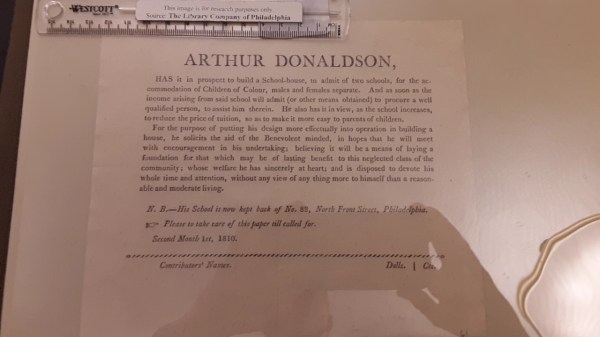
More proof, if more were needed, that today’s bold claims to “free” education from the cold dead hands of bureaucracy are not an innovation, but a step back into the ooze from which public schools evolved. As I argued recently in the pages of the Washington Post, Secretary Betsy Devos’s plans for public education mostly consist of returning schools to the bad old days of the early 1800s. In yesterday’s archive dig, I ran across a sad reminder: Entrepreneurship just doesn’t work when it comes to public education.arthur donaldson school announcementSAGLRROILYBYGTH need no reminder, but here’s a little historical background anyway: Before the mid-1800s, most towns and cities had a mish-mash of school options. In places such as Boston, Philadelphia, and New York City, there were tax-funded schools that were free to attend.

In most towns and cities, there were church schools or entrepreneurial “dame” or “master” schools. The former usually charged some kind of tuition but they also usually raised money to pay for lower-income students. The latter were businesses run by a teacher. These teachers survived by attracting pupils and charging tuition. All in all, it was a fine system for people with money or lucky people without money, but it left a lot of people out.

In 1810, Arthur Donaldson hoped to fix the situation. He was a teacher in a Quaker/Friends-run school for African-American kids. He hoped to broaden the school options for low-income African-American kids by raising more funds from wealthier people to open new schools for students who couldn’t afford to pay tuition. As Donaldson advertised, he wanted

to build a School-house, to admit of two schools, for the accommodation of Children of Colour, males and females separate. And as soon as the income arising from said school will admit (or other means obtained) to procure a well qualified person, to assist him therein. He also has it in view, as the school increases, to reduce the price of tuition, so as to make it more easy to parents of children. . . . he solicits the aid of the Benevolent minded, in hopes that he will meet with encouragement in his undertaking; believing it will be a means of laying a foundation for that which may be of lasting benefit to this neglected class of the community; whose welfare he has sincerely at heart; and is disposed to devote his whole time and attention, without any view of any thing more to himself than a reasonable and moderate living.

Hooray for Donaldson, right? Sounds like good news for the lower-income African-American children of Philadelphia. The catch was, these schools never opened.

Eventually, in 1822, the emerging public-school system of Philadelphia opened a tuition-free school for African-American kids on Mary Street. In 1826 Philly opened a second, the “Gaskill St. School for Negro Girls,” and the Mary Street School became boys-only. In 1828 they added another segregated tuition-free African-American school on Lombard Street.

The take-away? Let’s assume Mr. Donaldson had a pure heart and good intentions. He was a Quaker, a member of the Society of Friends, and he already worked as a teacher in the tuition-charging church school for African-American kids, so he doesn’t seem like a bad guy. As he stipulated, let’s assume that he only wanted to make a “reasonable and moderate living.” He thought the market could support a school for African-American kids. He thought Philadelphia’s wealthy elites could be cajoled into coughing up some of their money to pay for it.

He was wrong. Philanthropy wasn’t enough. Good intentions weren’t enough. Vim, vigor, and smarts weren’t enough. When schools are left to follow market forces, only people with money benefit.

The Least Surprising School Research Ever

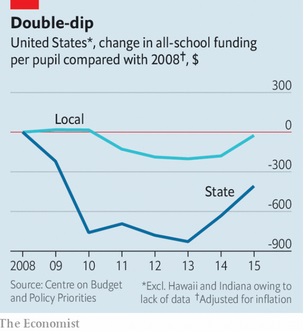
Are you sitting down? Because the results of some recent studies might shock you. As The Economist reported recently, it turns out that cutting school budgets…hurts student learning. And all joking aside, though the connection might be glaringly obvious, the details are pretty interesting and point us once again toward the most important school reform.economist test scores smaller

After the Great Recession of 2008, state governments slashed funding for school budgets. They had to. The impact of those cuts was not distributed equally to school districts, however. More affluent districts could support their schools, but districts with fewer financial resources couldn’t. Lower-income districts have traditionally relied more on state funding, so the cuts hurt them worse.

We know that test scores and other school numbers only tell part of the story, but in this case, that part is sad. Studies of the post-recession funding dip found that lower-income schools cut “core activities.” They saw a drop in reading and math test scores, as well as a drop in graduation rates. As one study found,

A 10% reduction in spending per-pupil in all four years of high school reduced the likelihood of a student graduating by 2.7 percentage points.

What’s the solution? For one thing, state support needs to return. By 2015, most states had not returned to pre-2008 school spending levels. A more comprehensive fix will be to eliminate the cruel educational gerrymander that determines school funding by zip code. Instead of fighting for more charter schools and voucher plans, we should put our energy into unifying city and suburban school districts, bringing together students of different backgrounds and leveling out our current senseless feast-or-famine funding scheme.

Sure, you say, but politically such “redistribution” schemes are a dead letter. No affluent suburban voter would support them, and without that support it’s a no-go. Maybe not. Recent polls in Massachusetts and across the South find that large majorities support overhauls of their states’ school-funding schemes. It’s time to stop fighting about charters and start pushing for real school-funding solutions.

Will THIS Make Colleges Think Twice?

It doesn’t matter how deep your pockets are. An $11,000,000 fine still hurts. I can’t help but wonder this morning if colleges will see Oberlin’s punishment as a wake-up call to rein in their activist students.oberlin protest real.jpg

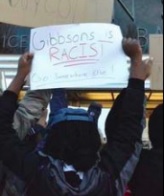
Here’s what we know: A bakery across the street from Oberlin’s uber-liberal campus has just won a whopping $11 million judgment against the school. Back in 2016, three African-American Oberlin students stole from the bakery. The owner chased them down and they were caught. They admitted to the attempted crime and agreed that the incident was not racially inflected.

Before the students confessed, however, outraged Oberlin students took to the street. They chanted that the bakery was racist and waved signs and banners. According to Inside Higher Ed, the administration of the college assisted with the student protest, suspending business with the bakery, organizing protests, and providing materials such as gloves for the protesters.

In light of the facts of the case, the bakery successfully sued for libel. It convinced a state court that the protests

interfered with business relationships, inflicted emotional distress and libeled the owners.

Will this judgment make other college administrators think twice about supporting student protests? As we all know, no matter if a school is conservative, liberal, or other, no administrator is willing to risk legal liability. I can’t help but think that this case will make cautious university presidents reconsider their knee-jerk support for student activism.

From the Archives: Bad Students Are in the Eye of the Beholder

I wish these dispatches from the 1800s didn’t sound so depressingly contemporary. As I do my research into the roots of America’s public schools–like I’ve argued recently at WaPo and HNN–I keep hearing the same bad ideas brought up over and over, literally for centuries. As I found out today, the ugly politics of racism in America’s schools sometimes don’t seem to have changed all that much, either.

InkedAfr Observer quote 1_LI

From Freedom’s Journal (NY); reprinted in The African Observer (Phila.), June, 1827

I’m working these days down here in sunny Philadelphia, digging through the amazing collections of the Library Company and Historical Society. Today I came across lots of accounts of the Lancasterian public schools for African-American students in New York and Philly. I wish I could say I was surprised at one thing that jumped out at me.

Consider the report of Benjamin Bacon. Bacon was white, and he examined Philly’s African-American schools and reported back to the all-white Board of Education. Some of the schools were fine, Bacon reported, even great. One school offered a full hour of musical instruction after the regular school day and students were learning all sorts of academic and artistic stuff.

But some of the schools were terrible. The school on Oak Street met in a “dilapidated” building. It was so crowded that students

are obliged to crawl under, and others over the writing desks, to get to and from their places.

Bacon visited in the middle of February and the students were all freezing because all the windows were broken or missing. So…given all that, how did Bacon explain the poor academic performance of some students? He blamed “The irregular attendance of scholars,” which he thought

imposes extra labor upon teachers, prevents a thorough classification, and makes the recitations less spirited than they otherwise would be.

To be fair, Bacon excused some of the students’ irregularities as “unavoidable,” but he definitely did not blame the teachers, about whom he had this to say:

Of all men and women who labor for the good of others, none are more worthy of appreciation than the faithful teachers of our colored schools.

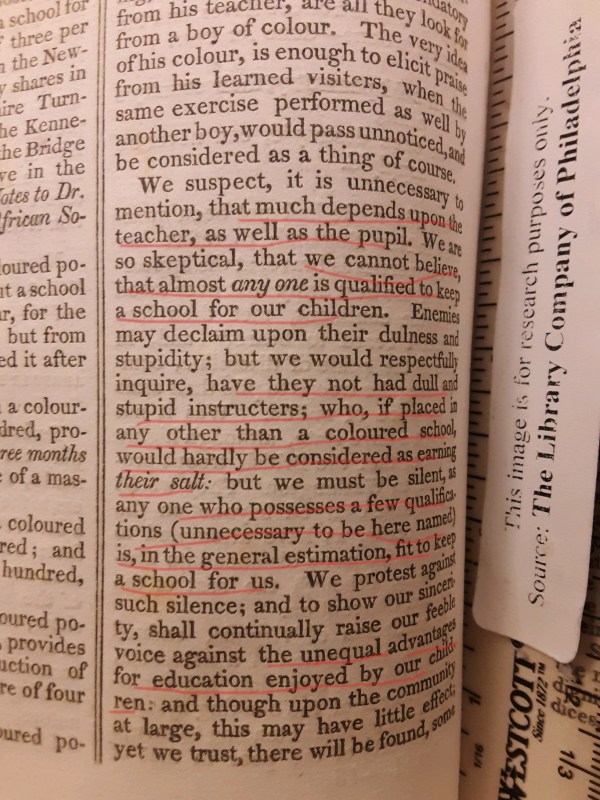
That wasn’t how everyone saw it. Two African-American school visitors had a very different diagnosis. They visited segregated public schools in New York and found an obvious culprit for poor student performance: unqualified teachers. As they wrote,

We suspect, it is unnecessary to mention, that much depends on the teacher, as well as the pupil. We are so skeptical, that we cannot believe, that almost any one is qualified to keep a school for our children. Enemies may declaim upon their dulness [sic] and stupidity; but we would respectfully inquire, have they not had dull and stupid instructers; [sic] who, if placed in any other than a coloured school, would hardly be considered as earning their salt: but we must be silent, as any one who possesses a few qualifications (unnecessary to be here named) is, in the general estimation fit to keep a school for us.

I wish I could say I was shocked that white and black observers came to such different conclusions based on similar evidence, but we all know the same kinds of things go on today. It is all too common for observers to blame students for their own crappy educational conditions.

The Only Percentage that Matters in Charter-School Politics

It seems like it should be a pretty straightforward equation, right? If charter schools are better for more students, they should be supported. If not, not. As today’s battle in California makes clear, though, those numbers and calculations are never as simple as they appear. For one thing, there has always been a huge hidden absolute value in educational politics that wonks tend to ignore. By paying attention to that hidden number, politicians will have a clearer path forward.

CAcharterrallyMarch13-320x215

Justice, yes. But how?

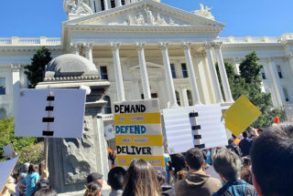
The racial politics of charter schools in California has gotten confusing. A basket of bills to limit charter growth has stalled. They seemed like a slam dunk at first. They were supported by the state NAACP and introduced by an influential member of the state’s California Legislative Black Caucus. Recently, however, three local NAACP chapters came out against the charter limits.

It has become extremely unclear if the African-American community in California supports or opposes charter expansion. Why?

Both sides can point to powerful statistics. African-American leaders who oppose charter expansion can cite the 2016 national NAACP anti-charter resolution. Charter schools, the NAACP charged, lack transparency; they divert funds from public schools; they expel and suspend African-American students at unfair rates; and they promote a

de facto segregation of the highest performing children from those whose aspirations may be high but whose talents are not yet as obvious.

For their part, charter supporters can point to their own powerful data. From Brookings, for example:

there is a subset of charter schools serving overwhelmingly black and poor students in large cities using a so-called “no excuses” education model in which students have experienced dramatically higher achievement than comparable students attending regular public schools.

And from CREDO at Stanford:

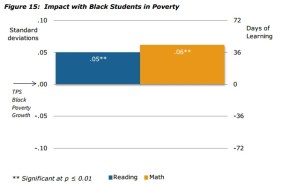
Black charter students in poverty have 36 more days of learning in reading and 43 more days of learning in math than their counterparts in TPS [Traditional Public Schools].

So are charter schools good for low-income African-American and Latinx kids or not?

credo increasesThe numbers and calculations can mask the most important statistic of all. Parents don’t wonder if 15% of local students will attend charters or public schools. They don’t fret if only 72% of children in their district are meeting reading or math goals, or if 81% of students are graduating from high school. No, for families dealing with crappy local schools, there is only one percentage to worry about: What kind of education is available for 100% of my kid?

This hidden number is the most important and explosive educational statistic of all. People who support charter expansion can’t wait for someday. They can’t trust sclerotic school boards to change things overnight. They need a better school today, and they need it to have room for their kids.

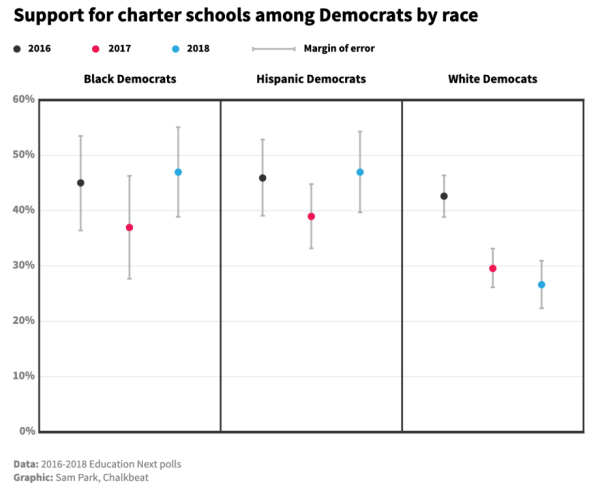
This 100%ism explains why support for charter schools differs by race among members of the Democratic Party. White Democrats tend to oppose charters at higher rates than do African-Americans or Latinx ones. Moreover, support for charters has dropped fast among white Democrats, but not among non-whites. This fact led the editors of the Washington Post mistakenly to chide leading 2020 Democratic politicians to support more charters. As the WaPo editors concluded,

We hope candidates keep in mind the polls that consistently show support for charters among black and Hispanic voters. It’s easy to oppose charters if you are well-off and live in a suburb with good schools. We hope we will also hear from candidates who know about the value of charters from their experiences — including as a mayor who used them to begin to turn around a failing district, as a partner in an administration that promoted charters, as a schools superintendent who made a place for charters.

support-for-charter-scools by raceThere’s a better way.

Here at ILYBYGTH, we agree wholeheartedly with parents’ rights to demand better public schools today, not someday. We support students’ rights to have a high-quality education in their own neighborhoods, surrounded by their friends and support networks. Most of all, we agree with the idea of doing what works to help students become better people and better scholars, instead of merely doing what has always been done before.

But none of that means we should ignore the equally desperate problems of charter schools. School districts have other options besides charters to turn to. Most notably, magnet and specialty programs within traditional public-school districts can accomplish the same things as charter schools, while still allowing transparency and public oversight over the schools and without draining funding from the public-school system.

There is no simple answer to racism, segregation, and poverty. But taking money out of the public-school system is not the way to start. Instead, politicians need to remain aware of the most important statistic in education and find a way to provide families with good schools right now for 100% of their kids. They just don’t need to do it with charters alone.

Gay Trump Card

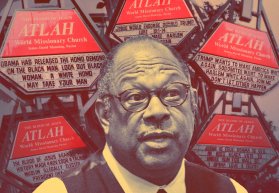
Okay, folks, here’s another head-scratcher from the world of America’s educational culture wars. SAGLROILYBYGTH have probably already seen the latest expose of James Manning’s ATLAH school. So here’s the puzzle for this morning: In spite of long efforts on the Left to combat racism, is it really only on the fundamentalist Right that the war on racism has been won? Where white and black fundamentalists agree on the meanings of race and racism? I don’t know what to think.

manning atlah

Westboro, NYC.

First, a little background: If you haven’t seen the HuffPost expose, it’s worth your time. Pastor James Manning has attracted attention in the past for his fervent and ferocious anti-LBGTQ views. He made wild accusations that Starbucks was infusing lattes with semen. His church sign went into full Westboro mode at times, proclaiming “Jesus would stone homos” and “Obama is a Muslim. Muslims hate fags. They throw fags off buildings.”

Now Manning is facing accusations of abuse of his students and congregants. According to the HuffPost article, Manning locked a student in a dark basement, used sexually suggestive language with minors, and clamped down viciously on any murmur of dissent in his school and congregation.

The recent expose leaves lots of big questions unexamined. Most telling, the racial ideology/theology of Pastor Manning throws a monkey wrench into any simple culture-war divisions. For instance, according to HuffPost, his school uses both A Beka and Accelerated Christian Education (ACE) materials. ACE, at least, has been credibly outed as a congenitally racist and white supremacist outfit.

ACE MLK

What do white fundamentalist think about race and racism?

One might think that Manning simply didn’t care about the entrenched racist attitudes in the ACE materials because he was looking for fundamentalist schoolbooks and couldn’t find any that weren’t racist.

Maybe.

In other publications, though, Pastor Manning has insisted on some non-conventional racial attitudes. He furiously attacked President Obama. And in the clip below, he insists,

Not only am I not an African American, but I’m not a black man.

[Warning: Video below contains extremely offensive racial language.]

I don’t want to jump to too many conclusions, but I can’t help but wonder if Manning’s outside-the-box racial ideology makes him generally comfortable with the racial ideology of the Accelerated Christian Education materials. After all, fundamentalist curricular materials talk about more than just race.

When it comes to student learning and behavior, for example, Manning’s school touts its “memory/articulation/discipline” approach. It is a traditional approach that comports nicely with the classroom ideology of A Beka Book. As one of A Beka’s promoters promised, A Beka materials do more than just teach facts. At an A Beka school, one leader promised,

You learn the Bible.

You learn that God created.

You learn the worth of your soul.

You master the three R’s and other subjects.

You sit up straight and pay attention.

You learn that it is right not to cheat.

You learn to recite when called upon.

You learn honor and respect for your parents.
You learn respect for authority.

You learn that a man’s word is his bond.

You learn that a job worth doing is worth doing well.

You learn personal initiative.

You develop pride in America.

You learn that the free enterprise system is still the best system.

You learn that competition is healthy.

The goal of a school like this, according to A. A. “Buzz” Baker, is not only to teach a few fundamental religious truths. Rather, a good fundamentalist school will bundle those religious facts into a deeply conservative view of life and learning.

To this reader, Manning’s radically traditionalist, violently anti-LGBTQ school fits perfectly into this fundamentalist educational attitude. At first, we might think that the rest of the fundamentalist package—anti-gay, pro-discipline, pro-memorization, pro-Bible—allows African-American conservatives to overlook the racist component of fundamentalist textbooks.

I think the truth is more complicated than that. In the case of ATLAH schools, at least, the racial ideology/theology of white fundamentalism has leaped over the color line. In this one case, at least, both white and black fundamentalists embrace similar notions of race in these United States. I don’t think those notions are healthy, but like violent anti-LBGTQ rhetoric, they seem to have been taken to heart in some surprising quarters.

Why Would Conservatives Want to Turn This Into a Religious Thing?

Not to beat a dead horse here, but I’m truly perplexed. During the long long hours I spent yesterday watching Endgame, I couldn’t stop thinking about our recent discussion. David French and other intelligent conservatives want to insist that America’s culture wars are primarily “a religious dispute.” I disagree, but the real question is this: Why do conservatives want to say that they are? The answer seems obvious to me, but maybe I’m missing something.


Here’s a little background: In his argument for free campus speech, French made the following assertion:

It’s time to recognize the American culture war for what it is — a religious dispute — and incorporate it into America’s existing religious pluralism.

As strategy, I get it. If conservative ideas are a religious imperative, they will get more respect. If culture wars are religious disputes, then both sides should get equal status, at least from the perspective of the government. But as an intellectually coherent way to understand America’s culture wars, I don’t get it. Lots of people share religious ideas yet find themselves on opposite sides of culture-war issues such as race, gender, and sexuality.

One sharp reader offered a better defense than French did. As PH put it,

we are certainly talking about competing ideas and systems of ethical and metaphysical values, beliefs, and commitments concerning the nature of reality, the basis for human flourishing, and ideal social norms. These are ideas based on faith as much as they are on reason or science. Personally, I think “religious” is a pretty good word for that, even if we’re not talking about formal organized religious groups or particular theological traditions.

The way I see it, though, people who share the same religion still disagree about key culture-war issues. For proof, we don’t need to look any further than the Veep’s office. Does Mike Pence represent conservative evangelical Protestantism? The community of Taylor University says both yes and no. And, as I argued recently in WaPo about Karen Pence’s lame defense of her anti-LGBTQ school, there is not a single, undisputed “orthodox” rule about proper social policy for LGBTQ people. Plenty of conservative evangelical Protestants are plenty “orthodox,” yet they disagree with the Pences on these issues.

So to me, it seems achingly obvious why some conservatives might want to redefine political disagreements as religious ones: For at least half a century now, politically conservative people have tried to insist that only their politically conservative version of religion is the true version of religion. They have argued that people who disagree with them cannot possibly be true Christians or Muslims or whatever.

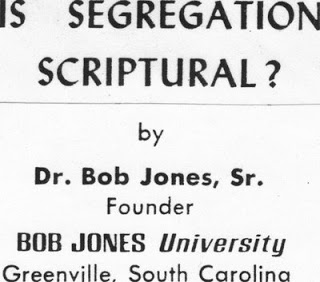
is segregation scriptural

There was more than theology at play then, and there is now…

If real, “orthodox” Christianity insists on racial segregation, for example, as Bob Jones Sr. famously argued in 1960, then the US government has no right to demur. If real, “orthodox” Christianity requires belief in a literal six-day flood and a recent creation of humanity, for example, as Ken Ham famously argues today, then evangelicals have no business questioning it.

Just like questions of LGBTQ rights, however, neither of those ideas are really as simple as conservatives like to think. Debates about them divide people who share the same religious backgrounds. The cultural battles over racism, creationism, and sexuality are not battles between people who have different religions. They are fiercest between people who SHARE religious ideas but have different ideas about public policy.

So are America’s culture wars “a religious dispute?” Only if we use a tortuous definition of the phrase. To say that conservative positions on sexuality, race, or gender are just being “orthodox” only makes sense as a political strategy. As an actual description of the divides we face on such issues, it doesn’t help at all.

A Deal-Breaker for Biden?

I would not want to be Joe Biden right about now. In so many ways, he could be the 2020 front-runner for the Democratic Party if he decides to run. A recent expose in the Washington Post, however, might be enough to kibosh the whole thing.

biden 1975

Frosh Senator, 1972

First, some history for our younger readers: We all know SCOTUS’s 1954 Brown v. Board decision didn’t end racial segregation in schools. What some people might not know if they didn’t live through it was the bitter 1970s battle over busing that followed.

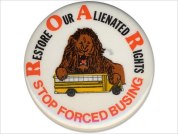
As Roy Formisano has described so brutally, cities such as Boston roiled over the topic. Anti-busing groups coopted 1960s-style protest tactics and language to oppose mandatory plans to shuttle children between schools. The goal was to achieve more racial equality; the effect was much different. The protests ripped the Democratic Party apart back then.

Could they do it again now?

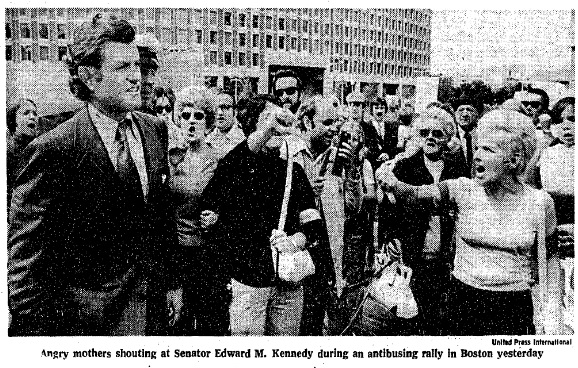
Consider one episode that Joe Biden would like us all to forget: On September 9, 1974, a crowd of white working-class anti-bussers gathered to hear Senator Ted Kennedy speak in Boston. This demographic, usually a solid supporter of the Kennedys and the Democrats, showed their displeasure with Kennedy’s pro-busing stance by turning their backs on him as he spoke. Then, fired up, the crowd chased him from the podium, flinging eggs and expletives. The fury of the crowd was so intense they shattered the glass doors of the Federal building, chanting, “Pig, Pig Pig.”

ROAR button

Boston’s protesters also insisted they weren’t racist, but…

What does any of this have to do with Joe Biden and the 2020 elections? Everything.

The Washington Post uncovered a public statement Biden made against busing in 1975. Back then, the first-term senator from Delaware came out forcefully against busing, though he tried to maintain his support for equal racial rights. As Biden said back then,

I do not buy the concept, popular in the ’60s, which said, ‘We have suppressed the black man for 300 years and the white man is now far ahead in the race for everything our society offers. In order to even the score, we must now give the black man a head start, or even hold the white man back, to even the race.’

How were such comments perceived at the time? Although Biden can point to his long record in favor of civil rights, he won’t be able to spin this as anything but political surrender to the overwhelming unpopularity of busing. At the time, the infamous segregationist Jesse Helms welcomed Biden “to the ranks of the enlightened.”

What biden was trying to avoid

What Biden was scared of in 1975:

While some white Democrats were supporting busing and taking their lumps, Senator Biden was working the political middle, a middle that—at the time—lined up with Jesse Helms and Boston’s fervent racial protesters.

Morals aside, it might have been a savvy political calculation in 1975. However, will be be enough to undo Biden’s calculations for 2020?

The New Conservative Campus Strategy: Punch-bait!

You’ve heard it before: Conservatives have long felt bitterly estranged from mainstream higher education. I’m wondering if we’re on the cusp of a weird new conservative strategy, one in which young conservatives try their hardest to get punched in the face.

https://www.youtube.com/watch?v=UKYemhhzAC4

Here’s what we know: Hayden Williams has attracted a lot of attention recently as the victim of a conservative-bashing at Berkeley. President Trump brought Williams up on stage during Trump’s CPAC speech to help introduce Trump’s new hard line against universities. As Trump crowed,

Ladies and gentlemen — [Williams] took a punch for all of us. … Here’s the good news: He’s going to be a very wealthy young man. Go get ’em, Hayden.

Williams was on campus as part of Turning Point USA’s recruitment drive. In the past, Turning Point USA has provoked attention on campuses for recruiting students to its brand of millennial conservative campus activism. In Nebraska, for example, a Turning Point USA member garnered significant political support in her fight to be heard on campus.

Turning Point USA founder Charlie Kirk was quick to capitalize on the Berkeley bashing. As he told CNN,

Our amazing grassroots organizers courageously face threats of violence and discrimination as they fight for the right for conservative voices to be heard on college campuses.

So how about it? Maybe the most effective strategy for conservative pundits will be to get punched in the face. After all, nothing goes further to prove their claims of persecution and anti-conservative discrimination.