Election Coverage: Evolution Skeptic Wins Seat on Texas State School Board

Education-watchers have long focused on the politics of education in the Lone Star State.  From The Revisionaries to Rod Paige’s skewed statistics, Texas education often serves as a harbinger of education trends nationwide.

Nowhere is this more true than in the touchy issues of education culture wars.

Yesterday’s election put one more conservative voice on Texas’ 15-member State Board of Education.

Marty Fowler of Amarillo won a resounding victory over Steven Schafersman.  The politics of the two candidates demonstrate what Texas voters in district 15 want out of their public schools.

Schafersman went down to defeat with his pro-mainstream science, pro-sex ed platform.  According to mywesttexas.com, Schafersman, “a practicing scientist in the petroleum industry with 23 years of college  teaching experience, said he ran for the board because he wants students to have  unbiased, factual and scientific textbooks and increase[d] knowledge about  contraception.”

Schafersman won a measly 20% of the vote with these positions.  Earlier this year, Fowler explained his support for teaching multiple scientific approaches–intelligent design along with evolution–in Texas’ public schools.  As Fowler put it in an interview with an Amarillo newspaper:

“Evolutionists would say that we progressed to this point through a series of unplanned, random circumstances and random events.  I don’t believe that tells the whole story. I think there is more to our creation that indicates an intelligent being that has played a significant role.”

Beyond the issue of evolution/creation, Rowley won support as the more consistently conservative candidate, with opinions on issues from standardized testing to vocational education that more closely matched the conservative district.

As fence-sitting observers like me have pointed out, this is the real crux of the issue in educational culture wars.  Schools prohibit sex ed and teach creationism not because teachers are ignorant, not because administrators are prudes, but rather because those educational policies are often the clear mandate from large electoral majorities.

Much as it pains me to admit it, Marty Rowley would be acting in an irresponsible fashion if he did not go to work to promote multiple scientific theories in Texas textbooks and schools.  That, after all, is what the voters seem to be demanding.

Condoms on Bananas, or, Why Culture Warriors Aren’t Funny

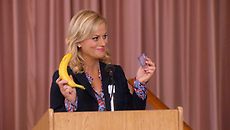
Parks and Rec’s Leslie Knope Sheaths the Banana

I disagree with Russell Moore on many things.  But I do agree with the heart of Moore’s recent argument in the pages of Christianity Today.

Moore commented on a recent episode of the sitcom Parks and Recreation.  I didn’t see the show.  But according to Moore, the plotline concerned an outbreak of sexually transmitted infections among residents at a small-town nursing home.  Moore argued that the show engaged in the worst kind of smug culture-war preaching.

Moore’s accusations ring true.  Many self-professed “liberals” engage in the kind of liberal fundamentalism that Moore describes on the show.  In Moore’s words,

“the show intended to reinforce a view already held by the people to whom they were talking. Those who already deride abstinence education could nod their heads in affirmation, ridicule the morons who oppose good common sense, and feel much better about their moral and intellectual superiority to the Neanderthals out there.”

I support comprehensive sex education in public schools.  But as Moore points out, lots of people disagree.  And lots of those people are smart, caring, informed, and engaged.  At best, the kind of self-satisfied mockery that he describes on Parks and Rec sounds ineffective.  As Moore charges, “few people are going to have minds changed by seeing their viewpoints caricatured.”  At worst, this kind of preaching to the choir deepens our culture-war divisions and leaves us all more bitter, angry, and, in the end, ignorant about the real conflict.

As we battle over issues such as sex ed, prayer in schools, and creationism, we need to keep in mind that those with whom we disagree may have legitimate reasons for their positions.  Moore takes conservative evangelicals to task for often forgetting this message.  As Moore argues,

“Sexual liberation ideology is deadly, but we aren’t preaching to those in bondage to it if we simply repeat slogans. In order to see the true wickedness of sexual liberation, we must ask why it’s appealing, and why deceptive arguments can seem plausible. Only when we speak to the conscience can we get to where people are, as we all once were, hiding from God.

“Darwinism can’t explain the meaning and purpose of the universe or of humanity. But when we simply laugh and say, “My grandpa wasn’t a chimpanzee,” we aren’t taking seriously the claims of our opponents. In fact, we’re not speaking to them at all, just to ourselves.

“When unbelievers hear a canned, caricatured argument, they recognize exactly what I recognized when I listened to the moralizing of the Parks and Rec script: They’re not trying to convince me, or even to talk to me. They just want to soothe the psychologies of their partisans.”

Moore’s central point remains powerful even if we don’t agree about the nature of Darwinism or sex ed.  When we talk about the cultural truths at the heart of our education system, we need to remember that those with whom we disagree deserve respect.  True liberalism is not the pat preachiness of Leslie Knope.  Rather, it requires a much more difficult cultural argument that disagrees without deriding its opponents.

Sex as Religion in America’s Public Schools

Try this one on for size: Religious conservatives are fighting to keep America’s public schools free from religion.  And they have been doing so for a long time.

Here’s the catch: the religion they want excluded is the awkwardly named faith of “sexualityism.”  The campaign by some conservative intellectuals to ban this newly identified theology joins a long history of conservative attempts to reframe secular, liberal, “progressive” ideology.  Such ideas as the relativism of value systems and the virtues of commitment-free sex, these conservative argue, are actually theological ideas.  As such, the conservative argument goes, the fabled wall of separation between church and state requires that they be kept far away from public schools.

For example, writing recently for the conservative journal Public Discourse, Greg Pfundstein denounced a new sex policy in New York City schools.  As we’ve noted here, the Connecting Adolescents to Comprehensive Health (CATCH) program offers contraception to public-school students without parental notification.  The program recently expanded to include “morning-after” pills, in addition to condoms and birth-control pills.

Pfundstein insisted that this program made no sense from a public-health perspective.  Instead, Pfundstein argued, “This is the work of religious fanatics, and their religion is sexualityism.”

At the core of programs such as CATCH, Pfundstein concluded, is nothing less than a “theocracy of the sexual emancipation of children.”

The strategy of identifying secular ideology in public schools as a religion has a storied history among conservatives.  In the 1920s, as I argue in my 1920s book, much of the anti-evolution fervor among religious conservatives resulted from the identification of evolutionary ideas as profoundly religious.  In this case, conservatives argued that evolution was merely atheism in disguise.

More recently, beginning in the 1970s, conservatives attacked public-school ideology as “secular humanism.”  Conservative writers, intellectuals, and activists insisted that public-school curricula embodied the religion of secular humanism, and, as such, violated the First Amendment ban on state-supported religion in public schools.

Perhaps the political high-water mark for this strategy came on May 12, 1976.  US Representative John Conlan of Arizona successfully amended a bill about the financing of higher education to include a denunciation of secular humanism.  As Conlan argued on the floor of the House,

“there is a significant current in education to teach children that there are no values, there is no right, there is no wrong, that everything is relative, and it all depends upon situational ethics.  This is the heart of the First Secular Humanist Manifesto of 1933 and the [13533] Second Secular Humanist Manifesto of 1973.

            “What we are really saying is that much of the social problems that are being dealt with in the schools came from the premise that there are no moral or religious principles.  What I am saying is that since we cannot teach and will not fund those grants and programs to develop the Judaic-Christian ethical concepts, then it seems to me fair that those curriculums opposed to Judaic-Christian concepts should also not be funded.  That is all we are asking.      

            “I have in my hand here the recently published Humanist Magazine article which brags that ‘humanism is alive and thriving in secondary schools.’  But we could go on and on documenting the case of what is happening in our schools.” (Source: Congressional Record, May 12, 1976, pg. 13532-13533)

This argument has had some success in courtrooms.  Most famously, the plaintiffs in Mozert v. Hawkins County (1987) had initial success with their claims.  Though a federal circuit court eventually disagreed, early hearings supported the Mozerts’ claim that textbooks in public schools ought not teach ideas that promoted “secular humanism.”

Could this strategy change the argument about sex-ed in public schools?  Could it shift the debate from talk of public health to talk of public religion?

If the history of conservative attempts to ban “secular humanism” is any guide, the answer is likely no.  In Mozert v. Hawkins County, for instance, federal judges eventually ruled that the Mozerts’ did not have a significant claim to have been harmed.  In essence, the judges disagreed that “secular humanism” represented a state-sponsored religion.

The same will likely be true with the awkwardly named “sexualityism.”  The religious nature of teaching sexuality seems plausible, but courts and public opinion will likely continue to see the public-health benefits of sex ed outweighing the religious objections of conservatives.

“If You’re Planning to Have Sex…”

What should schools be teaching America’s young people about sex?  This is a question that has snarled culture-war arguments about public education for decades.  Sex ed proponents often insist that they can teach a morally neutral approach—just the facts.  This attitude is ridiculously oversimplified.  There is and can be no morally neutral approach to a subject that is so intimately wrapped up in religion and ethics.

Let me be clear at the outset: I personally believe public schools should teach a comprehensive curriculum in sexuality that includes discussions about both the mechanics and morals of sex.  But the common argument that sex ed can be done in a morally neutral fashion relies on a woefully naïve self-understanding.

This liberal tradition begins with a powerful argument in favor of public-school sex ed.  Many sex ed proponents make the strong case that sex is a potentially deadly game.  Since kids are going to do it, they need information to stay safe and avoid unintentional pregnancies.  With the prevalence of HIV and possible pregnancy, the argument goes, this is literally a life-or-death situation.  Refusing to educate young people about sex in a frank and open manner would be a nearly criminal malfeasance on the part of responsible public-school educators.  Yet due to dunderheaded conservative opposition, many sex educators feel, this vital information is often censored.

Perhaps the most famous example of this position was the beleaguered Mary Calderone.  As historian Jeff Moran described in Teaching Sex: The Shaping of Adolescence in the 20th Century, Calderone headed SIECUS, the Sex (later Sexuality) Information and Education Council of the United States beginning in 1963.  The stated goal of the organization, in gendered 1960s language, was “to establish man’s sexuality as a health entity.”  Calderone wanted sex to be understood as a positive thing.  “We must block our habit of considering sex as a ‘problem’ to be ‘controlled’,” she wrote in 1963.  Rather, Calderone argued, “Emphasis must be on sex as a vital life force to be utilized.”  In spite of the reputation Calderone gained as a wild-eyed sex maniac, Calderone remained relatively old fashioned.  She believed sex ed should encourage the ultimate goal of healthy marriages, for instance.  The SIECUS plan insisted it took a “moral-neutrality” approach.  It promised to deluge students with information, not preaching, about sex and sexuality.

Like that of SIECUS in the 1960s, the rationale of sex-ed advocates in subsequent decades has often gone as follows: sex educators in public schools do not encourage young people to have sex.  They merely suggest that if students are going to have sex, they must have the knowledge to do it safely.

For instance, as Laura Sessions Stepp has argued in recent days about a New York City program to provide the “morning after” pill to public-school students without parental consent, merely making information and even contraception available to young people does not encourage sex.

Whatever scientific evidence may suggest, however, proponents of sex ed in public schools often utterly misunderstand the thinking of religious conservatives.  It is difficult for those of us who support public-school sex ed to wrap our minds around the conservative position.  But if we are going to have respectful, productive discussions about sex ed, we must make the effort.

In short, for many religious conservatives, sex ed can never be a neutral message.  Having an adult, perhaps a teacher, stand in front of a group of young people and say, “If you’re going to have sex, here are some ways to do it safely,” suggests that having sex is a legitimate and respectable option for young people.  It encourages young people, some religious conservatives think, to think of themselves as people who might be having sex.

How can we make sense of this conservative position?  We might start with a few analogies.
For example, imagine a parallel situation in Family and Consumer Science, the class formerly known as Home Ec.  Imagine a teacher planned to inform students about the importance of kitchen hygiene.  “If you’re planning on making a ham-and-cheese sandwich,” the teacher might say, “here are some ways to do it safely.”

It is not difficult for us to imagine that a student from a Jewish background might not want to make a ham-and-cheese.  And, with our understanding of the goals and nature of public education, we can agree that such a student should never be forced to make a sandwich that breaks his or her religious rules.  Such a student could make something else.  Or he could be exempted from the class.  No big deal.  Simply because we do not share the student’s understanding of what may be offensive, we do not force the student to abandon that understanding.

In cases such as this, we should remember the words of former Chief Justice of the US Supreme Court Warren Burger.  In Thomas v. Review Board (1981), Chief Justice Burger argued that those who are not compelled by religious rules are not the ones who should decide whether or not those rules are reasonable.  “It is not for us to say,” Burger argued, “that the line [Thomas] drew was an unreasonable one.”

Granted, the case was not about public schools, or sex ed, but the principle remains important.  It is not the role of those who are not offended to declare whether or not certain ideas are offensive.

Perhaps another way to understand this case might be to imagine some permutations.  Consider, for example, how we would feel if a teacher told a class, “Now class, if you’re thinking about killing someone, here are some ways to do it safely.”  Clearly, when we agree that behaviors are beyond the bounds of morality, we agree that public-school teachers ought not be suggesting safe ways for students to engage in them.

That may be the position of religious conservatives.  If an action is entirely beyond the bounds of morality, the notion that young people need to be taught how to do it safely makes utterly no sense.  Simply broaching the topic implies that sex would be a legitimate choice for young people, a position their religion explicitly forbids.

So how can public schools provide information without offending conservative religious families?  It will make a start to understand the complaints of conservative parents as legitimate.  Just as we would not question a Jewish student’s aversion to making a ham-and-cheese, so we should not attack a religious student’s aversion to hearing about safer ways to have sex.  For many sex-ed liberals, myself included, this is a difficult pill to swallow.  It feels as if we are allowing some families to stick their heads in the sand, to restrict their children from hearing vitally important safety information.  Nevertheless, if we honestly respect the home cultures of students from conservative homes, we must allow them to draw the lines between offensive and acceptable.  We can never insist that our understanding of “morally neutral” must be accepted by those who disagree.



In the News: Dancing the Rights Away

The New York Times reports this morning on a strange crackdown in Cranston, Rhode Island.  Seems a father-daughter dance tradition had been taking place despite a state law and district policy against it.  In addition, Federal Title IX rules forbid any gender-discriminatory activities.  In this case, a single mother of a daughter objected to the dance.  Though the school had also organized a mother-son baseball game, the two events were ruled to be not similar enough to avoid charges of sex discrimination.

In the big scheme of things, this tempest on a dance floor seems like no big deal.  The mother attended the dance with her daughter, and the school district reminded dance organizers of their ban on gender-specific events.

But the story serves as an illustration of a few items of perennial interest to those trying to understand the conservative impulse in American education.  First of all, we see again that school policy does not always match school practice.  Most memorably, when the US Supreme Court ruled in 1963 that school-sponsored prayer and Bible-reading violated students’ First Amendment rights, many schools continued to sponsor prayers and Bible-reading regardless.  As political scientists Kenneth Dolbeare and Phillip Hammond found in their 1971 study, many towns and schools continued to pray and read the Bible without eliciting a whisper of controversy.

Even the district in Cranston, Rhode Island, had hung a “prayer banner” in its high school, according to the New York Times.

As in many other cases, we see in this disco scuffle the ways conservatives embrace such seeming government overreach as a culture-war cause.  In this case, Sean Gately, a candidate for State Senate, along with Cranston Mayor Allan Fung, have come out strongly in favor of father-daughter dances. Such politicians have publicized the ban and tried to associate it with their Democratic opponents.  As Gately told the NYT, “Having those little father-daughter dances and seeing her all dressed up in her pretty dress — it’s a very special moment.”  Gately said the ban “offended me as a father and a husband.”   In the end, Gately insisted, “Nobody is being hurt by a father-daughter dance.”   Fox News condemned the “political-correctness police” of the American Civil Liberties Union for stirring up controversy where none existed.  The ACLU, according to Fox, had objected to the dance tradition as perpetuating harmful gender stereotypes: fancy dances for girls, baseball games for boys.  Gately told Fox this was a case of the “local ACLU kind of bullying our school system.”

From the ACLU’s perspective, local school officials just don’t “get it yet,” as state ACLU director Steven Brown told the New York Times.  Gately would likely respond that Brown simply does not “get” that most Cranstonites have no problem with reinforcing gender stereotypes for their children.

Perhaps most important, this dance debate demonstrates the way schools are more often guided by tradition than by explicit policy.  According to the NYT, the district had banned this father-daughter dance years ago.  However, no one on the current Parent-Teacher Organization was aware of that policy.  They organized the “Me and My Guy” dance simply because they had done so in the past.

In dancing as in much else, these kinds of traditions tend to be more powerful than any policy, whether in Cranston, Rhode Island, or from the US Supreme Court.

Fundamentalists Against CATCH

The headlines say it all.  Concerned Women for America’s article announces, “New York City Schools: Reading, Writing, and Morning-After Pills.”  The Family Research Council denounces “New York’s Deadliest CATCH.”

The Family Research Council’s Take on “the Deadliest CATCH”

Sifting through the arguments from these prominent conservative organizations will give us some insight into what religious conservatives dislike about New York City’s Connecting Adolescents to Comprehensive Health (CATCH) program.  As the CWA headline suggests, the program expands the district’s free-condom program to include birth control pills and “morning-after” pills.  As ILYBYGTH has reported, the NY Board of Health has insisted that a very low rate of parent opt-out suggests that most parents find the program inoffensive.

Fundamentalists beg to differ.

Both CWA and FRC point out the absurdity of a school system in which parents must provide copious paperwork in order for schools to provide basic medicine for schoolchildren, yet those same schools will administer Plan B pills without parental notification.  As the FRC briefing notes, “The same nurse’s office that demands a parents’ note for aspirin will be in the position to administer high (and potentially dangerous) doses of hormones to children as young as 14 without so much as a permission slip.”

Such contradictions, both groups insist, indicate the plan is both dangerous and insidious.  “Suppose [a student] has severe side effects from the pill but is afraid to tell her parents?”  CWA’s Brenda Zurita asks.  “It’s late at night or perhaps a weekend, what will she do? Who will she call?. . . Let’s pray that no young girl will die due to complications she was afraid to tell her parents about after she was encouraged at school to hide her sexual activity from her parents.”

Also worrisome, according to both reports, are the results of increased sexual behavior among teen-age girls.  The FRC report cites a 2010 study that finds such birth-control medications increase STIs among young women.

According to the FRC, the root of this problem is an inverted understanding of the proper role between parents, children, and government.  The FRC describes the “Nanny State” ideology at play: “If moms and dads can’t be trusted to ensure that their kids are eating well, then they certainly can’t be trusted with decisions about sex and abortion. So the government takes away chocolate milk because it’s too fattening–only to turn around and give kids the morning-after pill, which can really kill.”

Concerned Women for America’s Zurita agrees.  This program, Zurita insists, is yet another example of an “out-of-control bureaucracy.” “It is frightening and tragic,” Zurita warns, “that there are parents who do not care what their children are doing, and with each example of government intruding between parents and children, this story is fast becoming the norm.”

Finally, CWA’s Zurita raises a powerful point.  The NYC Board of Health has claimed that a low parental opt-out rate means this program is not upsetting parents.  But as Zurita notes, many parents could simply be unaware of the program.  Since when do schools assume that every announcement sent home with students has been dutifully delivered to parents?  With non-controversial notices such as bad report cards, students are required to return parent signatures to prove that parents actually saw the notice.  But with a more profoundly morally complex notice such as this, the school district simply assumes that students shared the information with parents?

In the eyes of these fundamentalist activist organizations, something stinks with New York’s CATCH.

CATCH-ing Up and Opting Out

ILYBYGTH reported yesterday on a new pilot program in New York City high schools.  The program, Connecting Adolescents to Comprehensive Health, or CATCH, will expand the district’s condom-distribution program to include birth control pills and “morning-after” pills.

This morning, we read Catholic League President Bill Donohue’s denunciation of this “imperial edict” in an interview in the Christian Post.  “Whenever it comes to sensitive issues such as sexuality, the government must  always play an ancillary role to that of parents,” Donohue told the CP. “The provision  that parents can opt out smacks of governmental arrogance and must be resisted:  the government has no business eclipsing parental rights.”

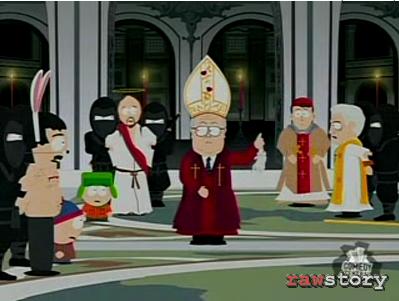
Bill Donohue as the Wild-Eyed Pope on South Park’s “Fantastic Easter Special”

I am usually no fan of

Bill Donohue.  I find myself siding more often with the South Park send-up of his public-morality campaigns.  But in this case, I find his criticism of CATCH more compelling than the lame defense offered by Chanel Caraway of the NYC Board of Health.  Since only 1-2% of parents had opted out of the program, Caraway told ABC News, “this suggests that parents are OK with the service being available to their children.”

Again, please don’t misunderstand.  I support the CATCH program and its goals.  I would want my daughter to be able to get free condoms and contraceptives at school if she couldn’t get them elsewhere.

However, Caraway’s opt-out argument demonstrates a frightening ignorance of America’s educational history.  In prominent cases such as Engel v. Vitale (1962) and Abington Township School District v. Schempp (1963), the US Supreme Court specifically concluded that “opt-out” provisions do not adequately respect families’ and children’s rights to be free of religious coercion.

As Justice Clark argued in his majority decision in Schempp, “Nor are these required exercises mitigated by the fact that individual students may absent themselves upon parental request, for that fact furnishes no defense to a claim of unconstitutionality under the Establishment Clause.”

I understand that this is a very different case.  Clark referred to the unconstitutionality of school-sponsored prayer.  It did not matter whether or not parents could opt out if the program defied Constitutional freedoms.  However, issues of sexuality are intimately connected to religious values for many students and families.  Could not a Bill Donohue argue that such state-imposed sexuality–even with an opt-out provision–denied some students their Constitutional right to free exercise of religion?  To assume that an opt-out clause defuses any potential complaint from conservative religious families seems ignorant at best, and, as Donohue put it, “imperial” at worst.

Schools, Sex, and the War that Isn’t

Sex in our Public Schools is in the news again.  How about this for a headline: “No One Cares”?

It doesn’t promise to get a lot of readers.  But it seems the closest to the truth in this case.

Here’s the story: Thirteen public high schools in New York City will now dispense free contraceptives to high-school students, including the morning-after “Plan B.” As reported by the New York Times and the New York Post, the pilot program, Connecting Adolescents to Comprehensive Health, or CATCH, will supply students with free condoms, birth-control pills, and/or the morning-after pill.

According to the NYT, the new program has not caused any of the traditional controversy.  Only 1-2% of parents returned an opt-out form.  Yet the headlines from more conservative media have emphasized the outrageousness of the new program.  Glenn Beck’s The Blaze declared, “File this one under ‘controversial.'” Fox News’ headline announced, “Parents not told NYC schools dispensing morning-after pill.”

But is a program controversial if it doesn’t raise any controversy?  We are remined of Ben Justice’s terrific 2005 book The War That Wasn’t.  Justice examined nineteenth-century discussions in New York about religion and culture in public schools.  In most cases, Justice argued, “the warfare thesis” does not explain the way schools really work (9).  People usually resolve their disputes about schooling peacefully and even amicably.

That might be the case here.  However, simply because only a small minority of parents have opted out does not mean that most parents support the program.  It might simply mean that parents are not aware of the program.  Or that parents are not aware of their opt-out option.

After all, the fact that very few families complained about prayer and Bible reading in 1960s schools does not prove that such policies were uncontroversial.  It simply means that school policies often fly under the radar until enough parents and activists complain.  In this case, we might still get a public debate over the propriety of issuing birth-control pills to high-school students.  This certainly seems to be the hope of editors at The Blaze and Fox News.

Mommy, I Can Marry a Princess!

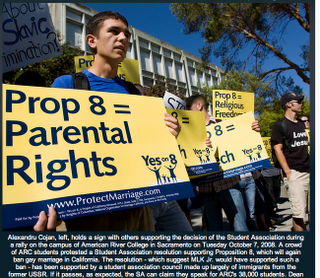
What is so frightening about gay marriage?  A TV ad from California’s 2008 battle over same sex marriage gives us a clue.  Gay marriage, to many conservatives, will ultimately tear families apart. 

For those of us trying to understand conservative, traditionalist, ‘fundamentalist’ culture in America, this TV ad offers some insight into conservative thinking.  Many of us are puzzled by conservative opposition to gay marriage.  Like Jonathan Rauch, it seems to me that a defense of traditional values should logically want to see as many people married as possible. 

Image source: A Collection of Odd

But for many conservatives, a redefinition of marriage will represent a cultural camel’s nose under the tent.  That is, if two same-sex partners are allowed to marry, then a slew of other cultural transformations will soon thrust themselves into mainstream culture.  Any opposition to these radical changes will soon be tarred as mere bigotry. 

In the same-sex marriage debate–as in so many cultural contests–schools and schooling play a central role.  For many conservatives, public schools often play the role of cultural contaminant.  Ideas such as evolution, secularism, moral relativism, and sexual liberation, in the conservative vision, are transmitted into cultural circulation by being injected into children at public schools.  Schools are used by progressive activists to subvert the proper relationship between parent and child.  Schools fill the heads of impressionable children with pernicious ideas about the nature of morality and values. 

We see a particularly striking example of this in California’s TV ads.  During the fight over California’s Proposition 8  in 2008, ads depicted a girl coming home from school, happily telling her worried mother that she learned she could marry a princess.  The ad warned ominously: without Proposition 8 parents would have no legal right to complain.

This ad plays upon a very commonly held notion about the flawed relationship between traditional values, families, and public schools.  In this vision, schools become the institution that transforms cultural change from a general trend to a problem within conservative families. Schools become intrusive agents warping the minds of children and turning those children against the dearest beliefs of their parents.  

I’m sympathetic.  I support gay marriage, evolution, pluralism, etc.  But I recognize that many of my well-meaning education colleagues really do envision public schools as a vehicle to transform children’s culture.  When cultural conservatives worry about camels’ noses, I believe they are smart to worry.  Progressives yearn ardently for a network of public schools as “change agents.”  Just as fervently as conservatives worry about the intrusive moral role such schools might hope to play.

Cross-Dressing for Kindergartners: A Fundamentalist Cause?

Are there fundamentalist activists out there who promote what they call the “radical homosexual agenda?”  It doesn’t seem to fit, but a survey released recently by the fundamentalist activist organization Concerned Women for America raises some puzzling questions. 

The organization claims to be the largest public policy women’s organization in the United States.  Its founder, Beverly LaHaye, tells the story of the day she decided to start her own fundamentalist women’s organization.  She was watching Betty Friedan on TV with her husband, the prolific fundamentalist author Tim LaHaye.  It was the late 1970s, and Friedan promised to keep working until American had embraced “humanist” values.  LaHaye remembers jumping up and exclaiming, “Well, Betty, I’m going to spend the rest of my life seeing that American doesn’t become a humanist nation.”

The organization that resulted from that resolution has become a leading voice in favor of traditionalist family structures, Biblical values in the public square, and other fundamentalist causes.  CWA now claims 500,000 members who have joined LaHaye’s fight for the values of fundamentalist women.  One of the most influential has been Michele Bachmann, who attributed her start in conservative politics to the influence of LaHaye and CWA

So when this leading fundamentalist women’s activist organization released the results of a poll of its members recently, it is not surprising that overwhelming  majorities of CWA’s members oppose what they call the “homosexual agenda” in public schools.  What is surprising is that there are a significant minority of CWA members who seem either ambivalent or even supportive of homosexuality as part of public-school curriculum. 

For those of us outsiders who are trying to understand what we’re calling Fundamentalist America, the results of this survey are truly perplexing. 

For instance, consider this question.  The CWA claimed to have “uncovered proof that children in grades as early as kindergarten are being taught that cross-dressing is an acceptable practice and may be encouraged.”  The CWA asked its membership what kind of impact this would have on children.  Not surprisingly, 84.6% of CWA thought this would have a negative effect on kids.  But here’s the stumper: 6.2% of CWA members answered that this would have a positive effect. 

Here’s another example: the CWA asserted, “The overriding interest of the radical homosexual agenda is to change the moral character of our young people and the moral landscape of our nation through the schools.”  When the CWA asked its members what effect this “radical homosexual agenda” will have “on our nation and the next generation leading it,” almost all CWA members (91.4%) said “negative.”  No surprise there.  But again, a puzzling 5.2% of CWA members answered that the “homosexual agenda” will have a positive impact!

What are we to make of these results?  Is it possible that roughly 1 in 20 CWA members–for a total of roughly 25,000 nationwide–support the homosexual agenda in public schools?  Who think that teaching cross-dressing to kindergarteners is a good thing?  That just doesn’t seem possible.  After all, the CWA’s self-declared reason for existing is to “bring Biblical principles into all levels of public policies.” 

But then how are we to understand these survey results?  A few possibilities spring to mind.  The first is that this survey is simply fake.  The CWA could have simply added in a few minority voices to make their survey results seem more credible.  They might have wanted to project an image as a diverse organization.  But such a fake seems far too obvious.  After all, who could believe that a full 5% of CWA members think that “sexual activity between minors and adults” will have a positive impact on children?  I wouldn’t think that 5%–or even 0.01%–of the American public as a whole could support such things.

Could it be that some CWA respondents did not understand the questions they were being asked?  They might have thought that they were being asked different questions, such as, ‘do you think a fight against cross-dressing curriculum will have a positive impact?’ 

The most difficult of all to believe is that there are a sizeable minority of CWA members who support what the CWA calls the “radical homosexual agenda” in public schools.  That would confound our understanding of what fundamentalists want in American culture, politics, and education.