Lee Meadows and “Sensitive” Evolution

ILYBYGTH friend Lee Meadows, author of Missing Link: An Inquiry Approach for Teaching All Students about Evolution, has posted a great new short video: “Help!  I’m a biology teacher and I don’t really understand evolution.”

I know some ILYBYGTH readers disagree with Meadows’ approach to teaching evolution.  Some anti-evolutionists feel he goes too far in sugar coating a dangerous doctrine.  As an evolutionist myself, I appreciate his student-centered approach to the subject.  He argues that too many evolution educators–out of ignorance or spite–take a hostile approach to their anti-evolution students.  Meadows argues that they don’t need to.  Not only is it unethical, it is ineffective.

Whether you’re a creationist or evolutionist, it’s worth taking a few minutes to check out his thoughtful video.

FROM THE ARCHIVES: Fundamentalists and Federal Aid to Schools

If only Rick Perry could have remembered what he planned to abolish, he might have won the 2012 Republican Presidential primary.  If he had won, he might really have carried out his threat to get rid of the federal Department of Education, along with Energy and Commerce.  Or maybe not.  After all, Ronald Reagan had also promised to eliminate the Department of Education.  In the end, Reagan merely treated the department shabbily.  These days, it seems every self-respecting conservative insists that the Federal Department of Education is an outrage.  Devvy Kidd of WorldNetDaily, for example, insists the department “must be abolished” due to its “chilling” trend toward “communism.”

This hostility toward federal money for local schools has not always been a bedrock belief of American conservatives.  In the 1920s, as Douglas Slawson’s terrific 2005 book The Department of Education Battle describes, the fiercest opponent of a cabinet-level federal department of education was the Catholic Church.  It follows, then, that one of the fiercest PROponents of such a department was the 1920s Ku Klux Klan.  The 1920s Klan, after all, focused much more intensely than did later Klans on fighting the power of the Catholic Church.  It also focused much of its public activism on defending its vision of the “Little Red Schoolhouse.”  For God and Country, the 1920s Klan argued, the USA needed a cabinet-level Department of Education.

By the late 1940s, however, opposing federal aid to local schools had become an article of faith among American conservatives.                        

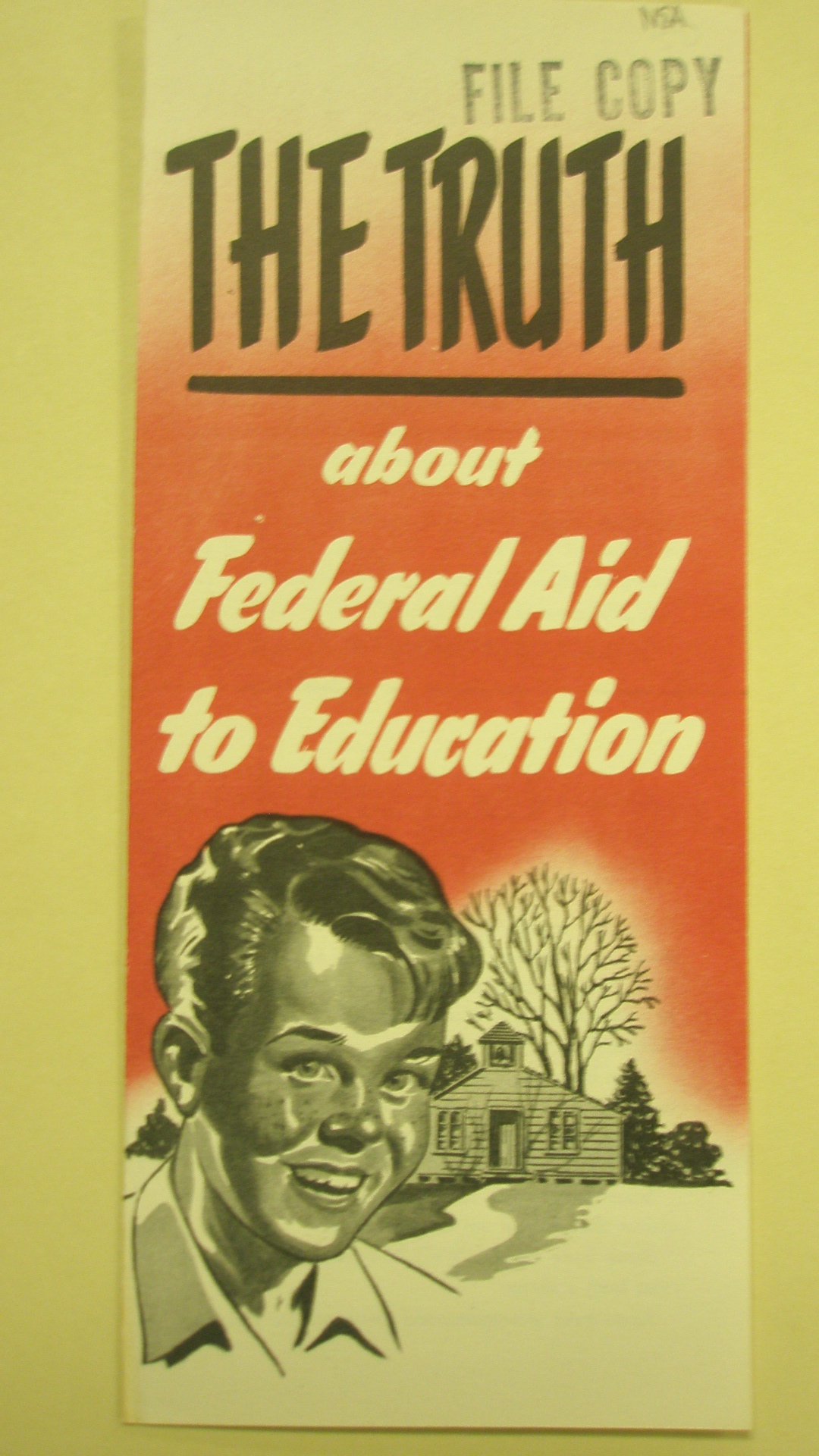
Perhaps because the National Education Association fought so fervently for more federal funding for local schools, as we can see with this 1948 NEA brochure, conservatives insisted that such aid would be merely the camel’s nose under the tent.  Such aid would inevitably include more federal control over local schools.

As one earnest Daughter of the American Revolution warned her conservative sisters in 1943,

“The citizens of the United States do not want the Federal Government to supervise education from the cradle to the grave, from nursery school to adult education. . . .  It is not difficult to see another huge arm of the Federal Government in the making, and more chains being forged to shackle the unthinking. . . . socialist-minded educators would use the funds to build ‘a new social order’ and . . . training in fundamentals [will be] neglected.”

Other conservatives in the 1940s and 1950s agreed.  Allen Zoll, a professional right-wing activist and founder of the National Council for American Education, published a couple of hugely influential pamphlets in the 1940s. 

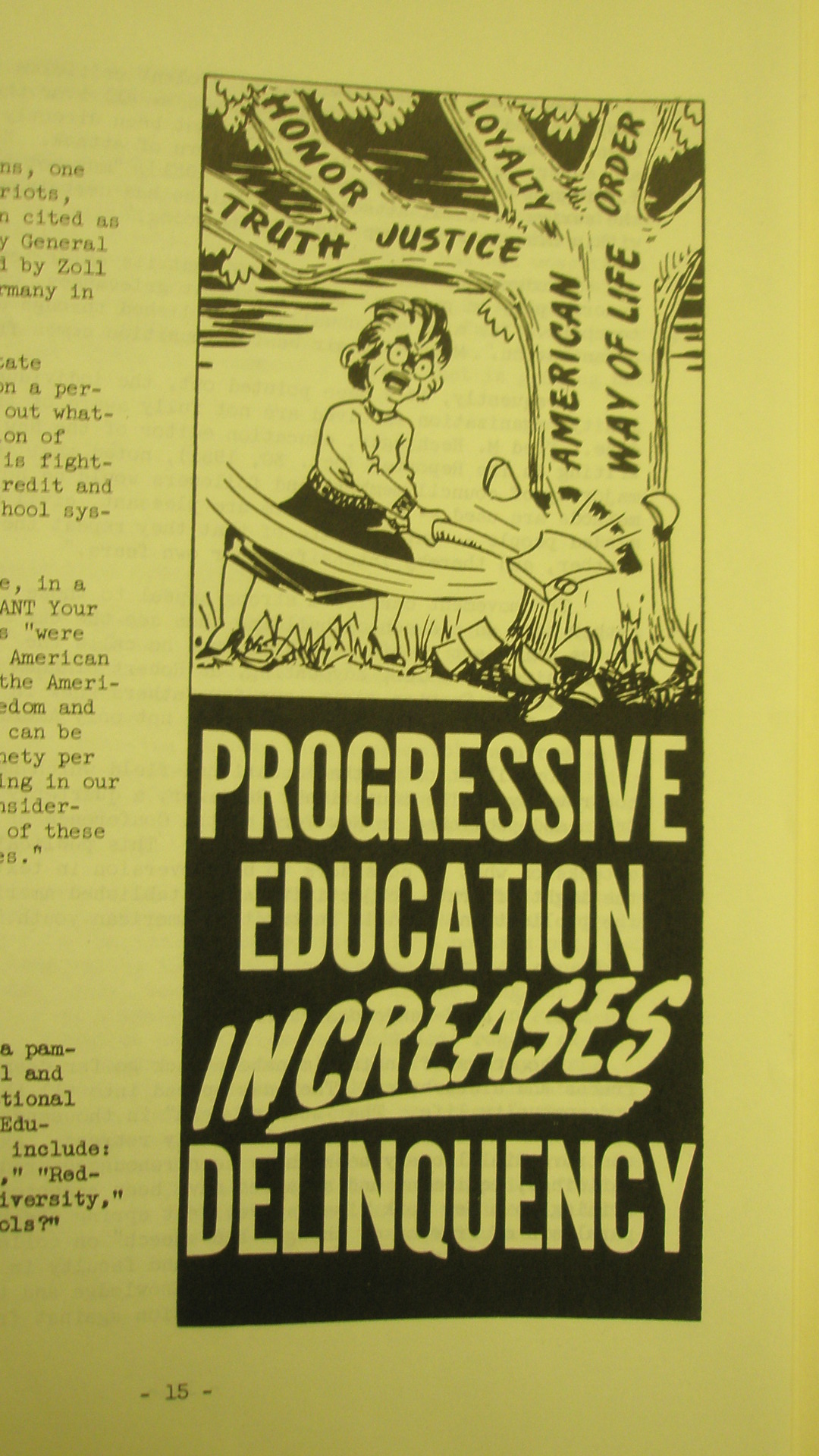
In one of them, “Progressive Education Increases Delinquency,” Zoll warned readers that contemporary education no longer taught students the traditional, fundamental values of American society.  He insisted,

The tragic and terrifying thing about all this is that it represents not merely rebellion against a moral code, but denial that there can be any binding moral code.  It is a fundamental revolution in human thinking of the first order: it is mental and ethical nihilism.  If it goes on unchecked, it will mean not merely tragedy for millions of individuals, it will mean the disintegration and final extinction of the American society.”

In another pamphlet from the late 1940s, “They Want YOUR Child,” Zoll warned that the NEA’s drive to secure federal funding for local schools was a conspiracy of the darkest order, a “conspiracy against the American way of life, against everything that we hold dear, . . . probably the most completely organized, ruthless design against other people ever set in motion in all human history.”

Inevitably, Zoll insisted, federal aid to local schools would lead to federal control over local schools.  Once schools fell for that trap, they would be controlled by an aggressive mind-controlling educationist bureaucracy.  The scheming of “progressive” educators such as Theodore Brameld, William Heard Kilpatrick, and George Counts would soon lead to a softening of the youth of America, a start of the slide to socialism, secularism, and destruction.

Some conservatives in the 1950s took this fight against federal funding one step further.  Although they never represented a majority conservative viewpoint, some insisted that all public monies for schools represented government tyranny.  One eccentric proponent of this maximalist position in the 1950s was R.C. Hoiles.  Hoiles had earned a pile of money—one journalist in 1952 estimated $20,000,000—with his Western media empire.  In his editorials for his newspapers, Hoiles argued that all public schools implied government tyranny.  In one from The Marysville-Yuba City (CA) Appeal Democrat, February 28, 1951, for example, Hoiles argued,

“Very few people realize to what degree the government has grabbed the authority to indoctrinate the youth of the land.  We cannot reverse our trend toward socialism as long as the youth of the land comes in contact and is trained by teachers who believe that they have a right to do collectively what they know would be immoral if done by an individual.  In short, the youth of the land is coming in contact with men who are communistic in their thinking, if we properly define communism.  Here is a good definition of communism written by David Baxter.  ‘Communism is the conclusion that more than one person, or a majority of persons, have a right to do things collectively that it would be wrong and immoral for one person to do.’  Can anyone improve upon this definition of communism?

            “According to this definition, is not every believer in tax-supported schools a believer in communism, whether he knows it or not?”

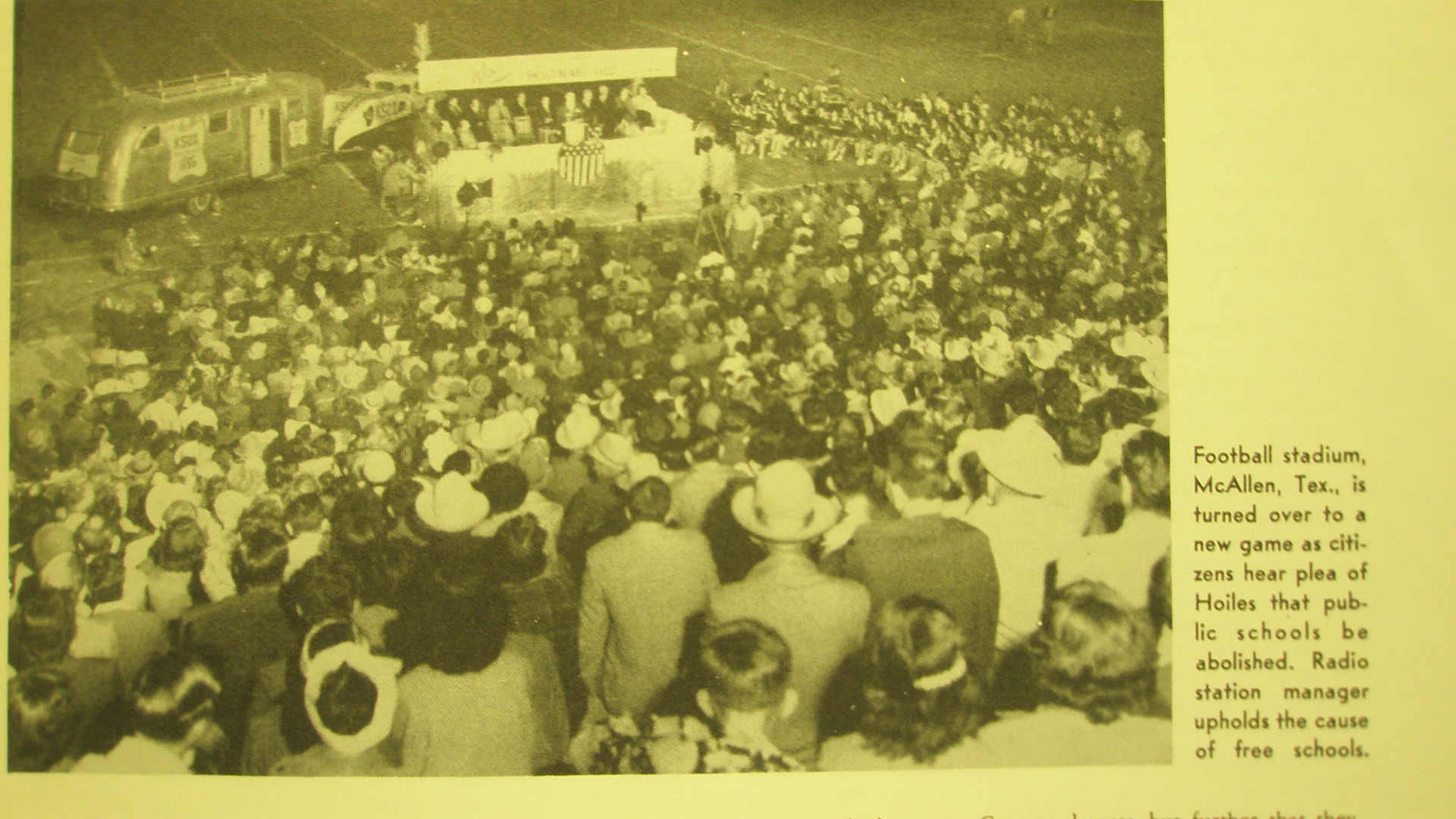
Hoiles also issued a standing challenge to debate this issue.  On February 2, 1952, a radio personality took him up on his offer.  Thousands of people crammed into the football stadium to hear the debate between Hoiles and Roy Hofheinz.  Among the rhetorical gems Hoiles unloaded at that debate included the following:

“Every board of education is government; therefore, it is force.  It is not reason or eloquence—IT IS FORCE!  It is a fearful master—it certainly does not seem rational that understanding and education can be promoted by the force of a policeman . . . “

“There are many ideas as to what is a good government.  But only one idea can be taught in government schools.  And that idea cannot be anything unfavorable to existing government institutions.  It would be impossible to find any teaching in government schools unfavorable to government schools.  It would be impossible to find anything taught in government schools unfavorable to existing state administration.  We cannot now find anything taught in government schools really unfavorable to New Dealism.

            “We believe it would be next to impossible to find anything taught that preaches old-fashioned American individualism as against our modern New Deal fraternalism in government.  Thus we believe that government schools’ teaching in regard to government must favor administration policies, whatever they may be.  Hitler and Hirohito used government schools to promote their regimes. 

            “Stalin is using Russian government schools to promote his regime.  Karl Marx made free public schools one of the points in his famous ‘Communist Manifesto.’  Any government delights in having schools to propagandize its doctrine.” ….

“It has often occurred to me that if an overwhelming majority of Americans really favor the present system of education, it should not be necessary to compel anyone to support it.  A system as sound and popular as tax-supported public schools are supposed to be should be well supported on a voluntary basis.” 

Funding of schools will likely always be a contentious issue.  Taxpayers, especially those who have no children or send their children to private schools, have a dollars-and-cents reason to oppose public schooling.  Perhaps the powerful tradition in Fundamentalist America of opposition to federal funding—or even to any public funding—of local schools can be reduced mainly to a desire to keep more money from the hands of the tax man.  But there also seems to be a deeper ideological connection.  Since the 1940s, at least, fighting against federal funding for local schools has become an article of conservative faith among some citizens of Fundamentalist America.

FURTHER READING: Douglas J. Slawson,  The Department of Education Battle, 1918-1932; Public Schools, Catholic Schools, and the Social Order (University of Notre Dame Press, 2005; Madeleine P. Scharf, “The Education Finance Act of 1943,” Daughters of the American Revolution Magazine 77 (October 1943): 635-637.

IN THE NEWS: Arizona Fights the Cult of Multiculturalism

In today’s New York Times, you’ll find an update on Arizona’s remarkable effort to purge its schools of what educational traditionalists might call “The Cult of Multiculturalism.”  We’ve written about traditionalist objections to multicultural ideology here, here, and here.  Arizona’s law makes these theoretic objections legally enforceable.

Today’s article focuses on the dispute between the state and the Tucson school district.  Since January 1st, the school district has been ordered to enforce Arizona’s 2010 law.  According to the Huffington Post, Judge Lewis Kowal agreed with the state in late December that Tucson’s Mexican-Studies curriculum was guilty of “actively presenting material in a biased, political and emotionally charged manner.”

The law itself, passed two years ago, declared that no school curricula in Arizona could legally

  • Promote the overthrow of the United States government.
  • Promote resentment toward a race or class of people.
  • Are designed primarily for pupils of a particular ethnic group.
  • Advocate ethnic solidarity instead of the treatment of pupils as individuals.

The state superintendent of education at the time, Tom Horne, planned an energetic enforcement of the law.  According to a Fox News story, Horne declared in 2010,

Traditionally, the American public school system has brought together students from different backgrounds and taught them to be Americans and to treat each other as individuals, and not on the basis of their ethnic backgrounds.  This is consistent with the fundamental American value that we are all individuals, not exemplars of whatever ethnic groups we were born into. Ethnic studies programs teach the opposite, and are designed to promote ethnic chauvinism.

In today’s New York Times story, John Huppenthal, the new state superintendent of public instruction, told a reporter he viewed the enforcement of the law as a war.  Quoth Huppenthal, “This is the eternal battle, the eternal battle of all time, the forces of collectivism against the forces of individuality.”

We can’t help but wonder what Arthur Schlesinger Jr. would make of this law.  In his 1998 book The Disuniting of America the eminent historian denounced the “cult of ethnicity [that] has arisen both among non-Anglo whites and among nonwhite minorities to denounce the goal of assimilation, to challenge the concept of ‘one people,’ and to protect, promote, and perpetuate separate ethnic and racial communities.”

But in Arizona’s case, the fight against the tendency of multicultural education to promote what Schlesinger called the “fragmentation, resegregation, and tribalization of American life” has included some ideologically extraneous elements and politically unpalatable images.

First of all, the law itself targets not only ethnic-studies classes, but includes a remarkably broad shot at any schooling that “promote[s] the overthrow of the United States government.”  This boilerplate antiradical language would feel entirely at home in earlier generations of legislative attempts to control schooling.  In the 1920s, for example, the bundle of state laws that were generally called “anti-evolution” actually had a much broader goal.  They hoped not only to ban evolution but to assert traditional Protestant control of public schooling.  As I argued in my book Fundamentalism and Education in the Scopes Era, school laws with these limitless mandates are more of a cultural statement than a practical attempt at crafting educational policy.

For example, a law passed by the US Congress in 1924 prohibited teachers in Washington DC from any teaching that smacked “of partisan politics, disrespect for the Holy Bible, or that ours is an inferior form of government.”  The goal was more a statement of support for traditional values than to regulate school policy.  Arizona’s inclusion of a clause banning anti-US-ism seems similarly vague and symbolic.

Also, as Arizona state superintendent of public instruction John Huppenthal made clear, this law is part of a broader political and cultural effort to battle not only multiculturalism, but any perceived victory by “the forces of collectivism.”  Not only does this bundle the Arizona law into a broader package of anti-leftist activism, but it also reflects the simple political partisanship behind Arizona’s efforts.

Part of the energy behind the 2010 law came from a perceived effort by Democratic activists to use ethnic-studies programs as a way to turn Latinos against the Republican Party.  One of the reasons for the law was Republican outrage about a speech at Tucson High School by activist Dolores Huerta in which she assured students, “Republicans Hate Latinos.”

Republican lawmakers have united behind this school law as more than a way to keep schools from teaching what Schlesinger denounced as the “cult of ethnicity.”  They also see the programs as part of a deliberate partisan effort to undermine their influence with Latino voters.

However, their efforts might do more to undermine that influence than any ethnic-studies programs ever could.  It doesn’t take a political genius to see the electoral damage that might result from the image of school administrators going into classrooms in Tucson collecting copies of seven prohibited books.  Such stormtrooper tactics to save children from the likes of Paolo Friere’s Pedagogy of the Oppressed  and F. Arturo Rosales’ Chicano! The History of the Mexican-American Civil Rights Movement spell political suicide.

I imagine that Schlesinger and others who oppose the ideological overreach of multiculturalist education might recoil from these heavy-handed partisan attempts to control Tucson’s schools.  Such critics of multiculturalism, I imagine, would hope that the effort to ban aggressive assertions of the “cult of ethnicity” must only limit itself to the realm of ideas, not to knee-jerk partisan politics and twenty-first century book burnings.

TRADITIONALIST EDUCATION: CONCLUSION

What are schools for?  Why go to school?  For traditionalists, the answers to these questions call on some fundamental truths about human nature, culture, and youth.  In the traditionalist vision, progressives have deformed American education because they have operated with a radically inaccurate understanding of these basic truths.  To begin healing American schools, traditionalists could insist, we need to recognize a few of these central ideas:

  • People are not all the same.
  • Left to their own devices, people will not naturally choose to improve themselves.
  • Left alone, children will act viciously and often wallow in their own ignorance and slothfulness.

If we acknowledge these fundamental truths, traditionalists could insist, we will be able to think about schooling in a clear-eyed, practical, effective way.  We will recognize the genius of the cultural legacy we have inherited.  We will be able to see that the answers schools used for generations are better than the answers offered students in so-called progressive education.  In the traditionalist view, once we understand these important facts about culture, education, and youth, a few basic notions about formal schooling will become clear:

1.) School is for transmitting information to students.  New information; things they did not already know.  Not a chance for them to develop themselves as people.  That is the job of the family and church.  And not simply a way for them to explore their own lived experience; that’s fine for rich kids but it leaves the disfranchised disfranchised.

2.) School is a chance—not a guarantee but an opportunity—to improve one’s economic position.

3.) Schools must transmit values.  We can articulate those values without imposing traditional Biblical Christianity on the unwilling.

In a nutshell, the traditionalist idea of schooling can be based on much more than a vague nostalgia for the America of the past.  It can be more than just a knee-jerk insistence on a return to the Little Red Schoolhouse, to the good old days when we all walked ten miles to school, uphill both ways.  In its most compelling form, the argument in favor of more traditionalist education offers more than just a masked insistence on a return to schools dominated by Protestant theology or ruled by racial and class segregation.  At its best, traditionalist education can suggest a compelling argument about the nature of education.

TRADITIONAL EDUCATION IIC2: TEACHING VALUES

Everyone wants America’s schools to teach values.  Progressive types tend to imagine schools that teach children the value of egalitarianism, of celebrating the rich mosaic of cultures that make up America. Traditionalists tend to imagine schools that train students in traditional cultural values.  As we have argued in earlier posts about the “Cult of Multiculturalism” (see here and here), traditionalists could argue that the values of progressive education aren’t real values at all.  Traditionalists might argue that the only real moral instilled by the progressive educational regime is a lamentable and decadent relativism.  According to this traditionalist argument, children are indoctrinated by progressive educators in the pernicious notion that there are no transcendent values, that all values must be welcomed equally.

Such traditionalists have insisted that America’s schools must instead lay out an explicit menu of true moral values for their students.  In its more sophisticated forms, this traditionalist argument has pointed out that we can distill a reasonable list of these values that does not simply impose traditional Christian values in public schools.  Rather, it is simple enough to create a short list of moral values that will incorporate the traditions of all cultures.

For example, writing in the 1960s, California School Superintendent Max Rafferty built his career, in large part, on his insistence that public schools must return to their original mission of instilling traditional moral values in children.  The problem with progressive education, Rafferty believed, was that it denied the obvious and inescapable truth that there are “positive and eternal values.”  In such an educational environment, which Rafferty believed had dominated America’s schools since the 1930s, this moral irresponsibility had drastic effects.  Not only did students fail to grasp obvious moral truths, but under the progressive educational regime,

the mastery of basic skills began insensibly to erode, knowledge of the great cultures and contributions of past civilizations started to slip and slide, reverence for the heroes of our nation’s past faded and withered under the burning glare of pragmatism.

In the place of time-tested values, Rafferty argued, progressives offered “such airy and ephemeral soap bubbles as ‘group dynamics,’ ‘social living,’ and ‘orientation.’”

Rafferty noted that such innovations meant both educational and moral failure.  It also ignored the wishes of the vast majority of Americans.  As Rafferty argued in 1964,

Parents, by and large, want what they have always wanted for their children.  They want them turned into civilized, patriotic citizens speaking and writing good English; able to succeed both in business and college; possessing at least a passable knowledge of our great cultural heritage; trained in such minimum essentials as reading, basic mathematics, spelling, grammar, history, and geography; and, above all, well enough grounded in habits of diligence, perseverance, and orderly thinking to enable them to prepare for adult life. 

Such values did not imply, in Rafferty’s opinion, that minority groups and non-Christians would be made to feel unwelcome in public schools.  Rather, Rafferty believed that everyone agreed on a few basic values that schools must impart.  For Rafferty, these included love of country, non-sectarian religiosity, and character traits such as bravery, honesty, thrift, and hard work.

Writing in the late 1960s, Rafferty noted with alarm that public schools had been divested of their traditional role as moral guardians.  As he wrote in 1968,

Parents pay us to introduce their children to the accumulated culture, wisdom and refinement of the ages, not to give them a mud bath in vice and suggestiveness.  They expect us to inspire in those children a love for the good, the true and the beautiful.

Anybody can pick up obscenity and irreverence on any street corner.  You don’t have to go to school to learn four-letter words and ugly racial slurs.  The schools are built and supported to fight against this sort of dry rot, not to go over to it and embrace it.

We teachers need to set standards, understand them and then uphold them.  And this we cannot do until we abandon an educational philosophy which holds that all standards are fictitious and all truths mere fantasy.

The problem with progressive education, in Rafferty’s opinion, was its “bizarre and even creepy” insistence that public schools must “uproot the ethical standards of 2000 years and to substitute for them the moral criteria of a pack of sex-starved alley cats.”

Max Rafferty’s unabashed insistence on traditionalist education for California did not take his career quite as far as he had hoped.  He ran for U.S. Senate in 1968, on an unapologetically conservative platform that included, in the words of one Newsweek article, “shooting looters, summary street courts-martial for other rioters, more capital punishment, abolishing most foreign aid, and escalating the Vietnam war (perhaps with nuclear weapons).”  Unlike other conservative California politicians, most notably Ronald Reagan’s successful bid for governor in 1966 and Richard Nixon’s win as President in 1968, Rafferty lost his election by a huge margin.  Nevertheless, his fulminations on the importance of including traditional values in America’s public schools won him a large and dedicated following among traditionalists.

William J. Bennett shared many of Rafferty’s beliefs about the importance of traditional values for America’s public schools.  As U.S. Secretary of Education in the mid-1980s under President Reagan, Bennett encouraged American schools to encourage “Moral Literacy.”  Bennett built his educational program around what he called the “Three C’s:” Content, Choice, and Character.  He insisted that teaching students traditional moral values was a necessary function of public schools.  Only by doing so, Bennett believed, could schools help young people develop their character, their unique individual moral quality.  Such moral values, Bennett argued, did not imply the imposition of one set of moral values on a culturally diverse American population.  They did not, as his critics allege, yearn for a return for an imagined past in which only the values of White European Americans were valued.  No, Bennett insisted in 1986, “there is a good deal of consensus among the American people about these character traits.”  Americans of all cultural backgrounds, Bennett believed, could agree that schools ought to teach such traits as “thoughtfulness, fidelity, kindness, diligence, honesty, fairness, self-discipline, respect for law, and taking one’s guidance by accepted and tested standards of right and wrong rather than by, for example, one’s personal preferences.”

Bennett worked during his tenure as Secretary of Education to encourage public schools to teach these values formally and explicitly.  He also published the phenomenally successful Book of Virtues to help parents, educators, and young people learn these time-tested standards of right and wrong.

More recently, two academics have attracted attention beyond the usual ranks of committed traditionalists with their concoction of a list of universal character traits that schools ought to be teaching.  Martin Seligman and Christopher Peterson claimed by 2004 to have distilled twenty-four universal values from their survey of moral thinkers from all cultures, from all periods.  As one New York Times article described their work, Seligman and Peterson “consulted works from Aristotle to Confucius, from the Upanishads to the Torah, from the Boy Scout Handbook to profiles of Pokémon characters.”  As we might expect, their list of character traits included some of Bennett’s and Rafferty’s favorites, including bravery and integrity.  They also include personal traits such as gratitude.  As many commentators have noticed, Seligman and Peterson also added a few that might surprise traditionalists, such as the need for “zest” among young people.

Most important for our discussion here, the notion that schools ought to do more than expose children to a variety of moral values has continued to attract vehement supporters among large numbers of parents, scholars, and educators.  According to these supporters, the fundamental presumption of progressivism—that schools ought to help students discover their own morality rather than imposing an external list of disembodied moral values—has proven to be both ineffective and morally indefensible.  Instead, schools must teach students actively and explicitly that they must practice a short list of traditional values.  They must be honest.  They must be charitable.  They must be kind.  They must be brave.  At times, of course, students may stumble and fail as they learn these traits, just as they might not master long division on the first try.  But one of the primary functions of schooling, in this traditionalist argument, must be to guide students toward learning these fundamental values.


FURTHER READING: Max Rafferty, What Are They Doing to Your Children (1964); Rafferty, On Education (1968); William J. Bennett, Moral Literacy and the Foundation of Character (1986); Martin Seligman and Christopher Peterson, Character Strengths and Virtues: A Handbook and Classification (2004).

IN THE NEWS: Santorum on America’s Educational History

This just in from the Republican presidential campaign trail: Rick Santorum knows what conservatives want to hear.  Not much of a surprise there; Santorum’s knack for positioning himself as the true conservative has led him to a surprisingly strong showing lately.

Of interest to ILYBYGTH readers, Santorum recently described his views on the proper nature of American education.  In doing so, he zeroed in on issues that have long resonated deeply with conservatives.

According to stories in the New York Times  and Los Angeles Times (here and here), Santorum outlined his thinking about the nature of public education in a speech on Saturday to the Ohio Christian Alliance in Columbus.

Santorum has already attracted attention as a homeschooler and advocate of government vouchers.  As his official website articulates, Santorum believes parental choice is one way to “restor[e] America’s greatness through educational freedom and opportunity.”

In Saturday’s speech, Santorum blasted the current “factory model” of education.  Today’s public schools, Santorum insisted, represented an “anachronism,” a period in which “people came off the farms where they did home school or had a little neighborhood school, and into these big factories . . . called public schools.”

Proper schooling, Santorum declared, should begin—and often end—at home.  Santorum appealed to a historical vision that is near and dear to the hearts of many American conservatives.  For most of American history, Santorum argued, even the Presidents homeschooled in the White House itself.

Where did they come up that public education and bigger education bureaucracies was the rule in America?  Santorum asked.  Parents educated their children, because it’s their responsibility to educate their children.

As I argue in an essay coming out this month in Teachers College Record,  this vision of the history of American education has been extremely influential among conservatives.  Since at least the 1950s, prominent conservative activists have based their prescriptions for healing American society on the notion that American education went wrong at a specific point in America’s past.  Of course, they also point out the corollary: conservative reforms can put it back on the right track.

Santorum appeals to a glorious educational past in which public schools had not yet tightened their stranglehold on educational opportunity.  This has been a common trope among conservative activists hoping to free traditionalists’ minds from the pernicious notion that education must look like today’s public education system.

Other common ideas that conservatives have insisted upon in their vision of American educational history:

  • schools started out as frankly religious institutions,
  • schools in the past did a better job of teaching more kids with less public money,
  • a set of notions known as “progressive education” ruined America’s strong tradition of real education, and
  • creeping state control led to ideological and theological totalitarianism in public schools.

On Saturday, Santorum indicated his agreement with these notions.  However, just as “progressive” educators have long fought over the proper meaning and function of schooling, so have conservatives.  In my TCR article I take a closer look at four leading activists since 1950:

  • Milton Friedman,
  • Max Rafferty,
  • Sam Blumenfeld, and
  • Henry Morris.

Each of these writers described a different vision of America’s educational past.  Like Santorum and generations of other conservatives, each agreed that the system had broken down.  However, also like Santorum’s unique insistence on the importance of Presidential homeschooling in the White House, each pundit laid out a unique educational past.

Anyone hoping to understand Fundamentalist America will be wise to listen to Rick Santorum this year.  He seems to have a knack for dishing out all the ideas Fundamentalists want to hear.


TRADITIONALIST EDUCATION IIc2: GETTING AHEAD

As argued in earlier posts, the vision of proper schooling among traditionalist educators is so culturally powerful it rarely needs to be articulated.  One goal of schooling, traditionalists assert, is to learn things.  This seems obvious, yet throughout the twentieth century, traditionalists believe, a small but influential cadre of “progressive” educators has maneuvered the public debate about education into a discussion of ways schools can be used instead to achieve other goals.  Schools, these self-proclaimed progressives have argued, can be the institutions that acclimate students to society.  Schools can be the institutions that help students shed their prejudices.  Schools can be, first and foremost, a way to form the character of young people into more egalitarian models.

Such progressives have denigrated the notion that schools should mainly be a place to acquire more information.  Similarly, progressives have denied the powerful idea that schools must be the way to lift poor people out of poverty; they have denied that schools can be the path to greater economic earning power.  Of course, most progressives and traditionalists agree that school must not become only this.  Both sides want part of school to remain learning for its own sake.  But progressives often attack this notion that schooling can be used to get ahead by countering that this is only a myth of the dominant class.  Scholars such as Michael Apple, Paolo Friere, Michael Katz, and Joel Spring have made powerful arguments that real schools only reproduce social inequality.  They insist that the myth of economic advancement through formal education is the fig leaf that justifies an entrenched economic and social hierarchy.  In order to keep the poor from recognizing the injustice of American society, this argument goes, elites offer second- or third-rate educational institutions to the poor and to ethnic minorities.  Those elites can then claim, perhaps even sincerely believing it, that those poor folks who don’t do well in school are failing due to their own laziness and intellectual dimness.  All the while, those schools for poor people offer no real chance of economic advancement.

This argument, traditionalists counter, ignores historical reality.  In every generation, smart, ambitious, hard working young people have used education as their path to a better life.  Consider just a few brief case studies.  Frederick Douglass, for example, the famous escaped slave, used education as his literal path to freedom.  In his case, the institutional systems of education certainly worked against him.  As a young slave, Douglass was forbidden to learn to read.  One of his owners taught him some basic literacy.  But her husband insisted that such education would ruin a slave.  Douglass persisted, and taught himself to read and write nevertheless.  The reading that he was exposed to, gleaned from snatched secret moments with abandoned newspapers and primers from white children in the neighborhood, convinced Douglass of the fundamental injustice of the slave system.  One of his first activities as an antislavery activist was to found a secret literacy school for his fellow slaves.  The goal of that school was not, as so many progressive education advocates have hoped the goal of schooling would be, to adjust slaves to their lived conditions.  Instead, the goal was to give slaves academic skills and information they did not already have.  Frederick Douglass was convinced that this was the ultimate goal of schooling.  His owners believed it as well.  As soon as they discovered his secret school, they broke it up immediately.  The slave owners agreed that the purpose of a school was to impart knowledge.  In this case, that was something they could not allow, since it threatened to move slaves out of their ignorance and give them literacy skills that could help them escape from slavery.
There was no doubt in the minds of either the slaves or their owners that the purpose of schooling was to improve one’s position.  The knowledge acquired in secret slave schools was used to move slaves out of slavery into freedom.

It does not take such dramatically unjust social systems to see the ways schooling has been used as a way to improve economic position.  There are plenty of examples from more recent history of the ways schooling has served as the path out of poverty.  Consider the case of former US Secretary of State and former Chairman of the Joint Chiefs of Staff Colin Powell.  Whatever one thinks of his politics, Powell’s career demonstrates the elevating power of formal schooling.  Powell was born in Harlem.  He worked his way through high school, then through the City College of New York. Thanks to his education, he was able to rise in the ranks of the Army, eventually becoming one of the most powerful and influential leaders of the country.

Or how about the story of Sonia Sotomayor?  She was also born in New York City, the Bronx.  Her family didn’t have a lot of money, but she worked hard in school and earned a full scholarship to Princeton.  Her work there propelled her into the legal career that has resulted in her current place on the US Supreme Court.

And what about Leonard Covello?  With his family, Covello came to New York in 1895.  They didn’t have money; they didn’t speak English.  But Covello worked hard in school and earned a college education.  By the end of his career, Covello had become a national leader in education.

It doesn’t take this kind of rags-to-riches story to prove the point.  The number of people who use schooling to move themselves and their families out of poverty is too many to count.  There are examples anyone involved in education could name.  My first teaching job was at an inner-city middle school in Milwaukee.  The school existed, as do so many schools across the nation, to help students use formal education as their path to a better life.  Did it work for every student?  No.  But the life chances of some of these young people would have been far worse if it had not been for the opportunities presented by formal education.  The notion that schools aren’t working if they don’t lift EVERY young person out of poverty represents a mistaken idea about the nature of schooling.  Schooling is an opportunity, not a guarantee.

Historically, one progressive critique of American education is that it has failed in its mission to lift every poor child out of poverty.  American education, in this view, is a failure since it did not end racial segregation.  American education, such progressive critics might say, is a failure since it has not eliminated widespread poverty.  Such thinking is a misrepresentation of the nature of both society and schooling.  It certainly seems true that schools for more affluent children offer advantages not available to kids from families in traditionally disadvantaged groups.  But this kind of structural injustice is more than schools can fix.

The promise of schooling in America is not that it will lift every poor child out of poverty.  The promise has always been that schooling will be available as a lifeboat.  In the meantime, it is difficult not to resent the fact that schools for more affluent children seem more like cruise ships.  Those young people can relax and enjoy the ride.  But those left rocking in unsteady waters in flimsy lifeboats must work tirelessly simply to stay in place, much less move ahead.  Not all of them will succeed economically, whereas a much larger proportion of cruise-ship students will.

The crucial point, however, is not that this situation is unfair.  It manifestly is.  The important point here is one that ‘progressive’ critics of American education often ignore or don’t recognize.  The main point is that schooling itself is not to blame for this situation, any more than the makers of lifeboats are to blame if a ship hits an iceberg.  Lifeboats and cruise ships are not equal.  They are not fair.  But no one has promised every student from every background the same cruise experience.  Rather, schooling in America has functioned and will continue to function as a chance to change one’s economic position, to dislodge oneself and one’s family from received positions in the economic hierarchy.

Let me describe just one example of the kinds of possibilities that formal, traditional education can offer.  One of our students, I’ll call him Student X, came to the United States in fifth grade.  He didn’t speak any English.  His family didn’t have any money.  But he worked hard in middle school, learned English, and set his sights on serving the Latino community.  He worked hard through high school, and earned a full scholarship to a prestigious college and medical school.  He is now on his way to becoming a doctor.  He plans to return to his old neighborhood to serve low-income and recent immigrant families who struggle to find affordable medical care close to home.

This has always been Americans’ expectation of school.  One Gallup poll in 1972 asked respondents to describe their primary reasons for going to high school.  The number one reason was to get better jobs.  The number three reason was to earn more money.

Schooling, of course, must be about more than just economic improvement.  It should make each young person a better person.  But the “progressive” notion that schools have not been able to help people improve their lives just doesn’t match either experience or the hopes and dreams of most Americans.  Most of all, the progressive criticism of schools misunderstands the nature of schooling.  It can not and never has been able to solve poverty.  Instead, formal schooling has been available as a chance, an opportunity, to improve one’s economic position.


FURTHER READING: Paolo Friere, Pedagogy of the Oppressed (1970); Michael Apple, Educating the ‘Right’ Way (2006); Michael Katz, The Irony of Early School Reform (1968); Joel Spring, The Sorting Machine Revisited (1989); David Tyack and Larry Cuban, Tinkering toward Utopia (1995); Frederick Douglass, Narrative of the Life of a Slave (1845); Colin Powell, My American Journey (2003); Michael C. Johanek, Leonard Covello and the Making of Benjamin Franklin High School (2006); Jonah Winter, Sonia Sotomayor: The True American Dream (2010).

TRADITIONALIST EDUCATION IIc1: LEARNING STUFF

People go to school to learn.  And what we mean by that is that people should gain information and skills they did not previously possess.  For traditionalists, this basic argument about schooling is so breathtakingly obvious it shouldn’t need to be said out loud at all.  However, in traditionalists’ opinions, due to (possibly) well-meaning misunderstandings on the part of progressive educators, this simple fact about schooling is not adequately appreciated.

The core mistake of progressive education, in the eyes of traditionalists, is to think that education must be built on children’s experience.  This idea was articulated powerfully in 1902 by John Dewey and has found influential advocates ever since.  As Dewey argued, in most traditional schools,

Facts are torn away from their original place in experience and rearranged with reference to some general principle.  Classification is not a matter of child experience; things do not come to the individual pigeonholed.  The vital ties of affection, the connecting bonds of activity, hold together the variety of his personal experiences.    

In order to make education more effective, Dewey argued, classroom teaching must be connected more organically to the way children learn.  Not by sitting in rows and reciting, but by building up experiences, by building on their existing experience.

Dewey insisted that the “old education” had gone wrong by making “invidious comparisons between the immaturity of the child and the maturity of the adult, regarding the former as something to be got away from as soon as possible and as much as possible.”

By the time such progressive reforms had found a home in a few American schools, Dewey’s notion of building upon children’s experience often took some turns Dewey found unfortunate.  He had warned in 1902 that there was a “danger” in assuming that the experience of young people alone could be “finally significant in themselves.”  Unfortunately, most self-appointed progressive school reformers didn’t listen to this second warning.  By the late 1930s, though Dewey still insisted that “the cardinal principle of the newer school of education [is] that the beginning of instruction shall be made with the experience learners already have,” he pointed out that in too many progressive schools, “overemphasis upon activity as an end, instead of upon intelligent activity, leads to an identification of freedom with immediate execution of impulses and desires.”

Regardless of Dewey’s own opinion of progressive education in practice, generations of teachers have been enthralled with their own interpretations of what Dewey’s “schools of tomorrow” could look like.   However, as soon as new teachers get any actual experience in education, experience in real schools with real children, they realize that the breathless “progressive” notions they attributed to Dewey don’t have much to do with the work of teaching.

Traditionalist educators insist that progressive notions fall apart in real schools, the way dreams dissipate upon waking.  In the opinion of those traditionalists, this is not merely because—as generations of progressive educators have argued—the progressive ideas haven’t been implemented fully enough.  It is because one of the central intellectual presuppositions of progressive education represents a fundamental misunderstanding of both human nature and schooling.  As Dewey himself insisted, children are not small adults.  They are fundamentally different.  These differences are biological and developmental.  Most important in this traditionalist argument, the differences are also a matter of experience.  By definition, young people lack experience.  Attempting to build schooling on a foundation of children’s lived experience is a mistake.

This does not mean that children do not have experience, or that they do not learn by building on those experiences.  They do.  But those learning encounters will take place outside of institutional schooling, by playing sports, playing with dirt, talking with peers and family members, volunteering at their churches, and so on.  In each of those contexts, young people will build on their experiences to improve at various skills and abilities.  They will build on each of those experiences, hopefully, to become better people.

But schooling is different.  Schooling, by definition, should be the transmission of academic information and skills to young people.  Every day, students should walk out of school with more knowledge and better academic skills than they had when they started in the morning.

There is nothing mysterious about this.  This is not a foreign notion of schooling that has been imposed on people from some grasping social elites.  Rather, this notion of the function of schooling is so basic that it has been embraced by all groups in American society, except for a tiny slice of education “experts” who insist on a different vision of schooling.

For instance, in the years following the Civil War, African Americans in the former Confederacy struggled to build schools that would impart academic information to their children.  As historian James Anderson has demonstrated, many influential voices weighed in on the purpose and function of these schools.  The majority of white northern philanthropists, Anderson argued, insisted that their money go toward schools that built on African Americans’ lived experiences.  Schools for young people and freed slaves, these philanthropists insisted, must teach basic vocational skills that African Americans could really use in their lives, such as farming and house cleaning.  That would be, in the phrase that came to prominence during World War II, a truly progressive “life-adjustment” education.

African Americans themselves, however, rejected that notion.  Except for a few tokens, such as Booker T. Washington, whom Anderson dismisses as nothing more than a racist white philanthropist “in blackface,” most African Americans insisted that their schools and colleges must focus on transmitting academic information and skills to new generations.  Their children should be studying mathematics, Latin, and philosophy, not gardening, milking, and plowing.

Anderson’s depiction of Washington may have been too harsh.  Other scholars such as Louis Harlan have argued that Washington managed to support African American causes in a variety of ways.  The point here, however, is much simpler: traditional education is real education.  The purpose of schools, the way traditionalists see it, is to give information and skills to young people; information and skills they did not already have.  This is the transformation that schools can and should accomplish.  Schools can provide a safe and protected place for young people to gain experience they lack.  In schools, students can experience vicariously the sweep of history and literature.  They can learn mathematics and science.

Any other approach to the basic function of schooling will serve to cement children’s place in the existing social order.  Building schooling primarily around the lived experience of young people will only support a very non-progressive social hierarchy.  The lived experience of kids from affluent families, for example, will prepare them for roles as dominant members of society.  Similarly, building schooling around the lived experience of the poor will anaesthetize poor kids to the structural injustices of current society.

Instead, schooling must deliver new things to students.  This does not mean that the lived experience of students will be dismissed or looked down upon.  Teaching Shakespeare to both rich and poor does not somehow imply that the popular culture of rich and poor is not valuable.  It merely demonstrates that there is a culture beyond popular culture that schooling will transmit to each new generation, regardless of family finances or students’ ethnicities.

This is not a new theory of education.  It merely acknowledges and makes explicit one of the most basic truths of schooling.  It offers students a reason to go to school.

To do otherwise, to assume that schools will build upon the existing experience of students is a cruel and circular notion.  In fact, young people go to school precisely because they lack experience.  They go to school so that they can engage with a broad range of ideas that they would never experience on their own.  The reason Dewey’s notions—or, more exactly, the “progressive” fantasies people have attributed to Dewey—have never made many inroads in real schools is because they fundamentally mistake the function of schooling.  Schooling is about imparting information to young people.  Of course, it is not the only way young people learn.  But in school itself, they do not learn primarily by building on their own small share of lived experience.  Instead, they learn by sampling from the vast array of knowledge and culture left behind by the thousands of years of human experience that has gone before them.


Further Reading: John Dewey, Experience and Education (1938); Dewey, The Child and the Curriculum (1902); James D. Anderson, The Education of Blacks in the South, 1860-1930 (1987); Louis R. Harlan, Booker T. Washington: The Wizard of Tuskegee, 1901-1915 (1983).

TRADITIONALIST EDUCATION IIc: VALUES. . . of what?

If the moral scheme of multiculturalism can’t deliver on its promise for a moral agenda for America’s public schools, what can traditionalists offer in its stead?  This is where traditionalists’ arguments carry the most weight, in my opinion.  They can draw on deeply embedded notions about the purpose and function of schooling, what historians David Tyack and Larry Cuban have called the “grammar of schooling.”  They can rely on ideas of schooling lodged so solidly in America’s idea of itself that they rarely need to be articulated at all.

In the early 1990s, historian Arthur Zilversmit commented on the strength and durability of these traditional notions.  Zilversmit had studied the ways self-proclaimed progressive ideas of schooling had had limited success in the middle decades of the twentieth century.  One of the leading reasons for this lack of success, Zilversmit argued, was the surprising strength of Americans’ “strange, emotional attachment to traditional schooling patterns.”

Of course, from the traditionalist point of view, there is nothing strange about this attachment.  Rather, traditionalists believe it reflects a sensible, rational commitment to time-tested ideas about schooling.  It only seems mysterious, strange, and emotional to those who assume that schools ought to be radically changing their approach to education.

What are these traditional values of America’s schools?  In future posts, I’ll explore each of the next three notions in more detail.  But in short, traditionalists can offer three clusters of values:  First, schools exist to teach young people things they did not know.  Young people go to school primarily to learn these things.  And that means that they should gain and retain information they did not previously have.

Related to this fundamental conception of schooling is another: Schools will help people improve their social and economic status.  If, that is, young people manage to gain skills and information at schools, they can use that knowledge to secure more lucrative, more prestigious employment. They can move up in society.

Finally, traditionalists can argue that the value scheme of America’s public schools does not need to be radically overhauled in order to include the rich pluralism of American society.  Such traditional values as honesty, bravery, kindness, tolerance, and hard work are common to many cultures, including traditional white European American culture.

These values are anything but strange and mysterious.  In fact, they are so commonly held that most people do not question them at all.  And in spite of decades, indeed, generations, of self-consciously “progressive” attempts to undermine these foundational values of schooling, Americans of all cultural backgrounds and economic classes have continued to cling to these ideas.


Further reading: Arthur Zilversmit, Changing Schools: Progressive Education Theory and Practice, 1930-1960 (Chicago, 1993); David Tyack and Larry Cuban, Tinkering Toward Utopia: A Century of Public School Reform (Cambridge, 1995).

IN THE NEWS: A SOCIALIST JESUS AND A NEW EDUCATIONAL REALITY FOR NEW HAMPSHIRE

–Thanks to LC

Live Free or Die!  So every New Hampshire license plate proclaims, and a new law in the Granite State looks like it will move New Hampshire residents one step closer to making that decision.

A controversy arose in December, 2010, when two New Hampshire parents pulled their son out of his Bedford High School.  Their complaint was that the boy had been assigned Barbara Ehrenreich’s Nickel and Dimed in a personal finance class.  The parents complained that the book called Jesus Christ “a wine-guzzling vagrant and precocious socialist.”

I haven’t read the book, but for many people, them’s fightin words.  Predictably, the controversy drew national attention.  Glenn Beck’s website agreed with the New Hampshire parent that the school district made a terrible curricular decision.  The Huffington Post, not surprisingly, ran an article much more favorable to the school district and to Ehrenreich.

There’s not much in the story, in fact, that should raise eyebrows among ILYBYGTH readers.  As we are well aware, parents often complain about the curricular materials assigned in schools.  Conservative pundits encourage careful scrutiny of reading materials they suspect of anti-religious, anti-patriotic, anti-capitalist materials.

The best publicized case of this nature in the past generation was arguably Mozert v. Hawkins County [Tennessee] Board of Education.  In this case from the mid-1980s, conservative Christian parents objected to the content of their county’s reading series by the textbook publishers Holt, Rinehart and Winston.  The parents tried to convince a series of courts that the series promoted a vicious religious system, one they called “secular humanism.”  In addition, the parents claimed the books promoted a grab-bag of pernicious notions, such as witchcraft, extra-sensory perception, pacifism, and non-traditional gender roles.

There is nothing unusual about conservative parents objecting to the curricular materials their children use in schools.  What makes the Bedford, NH case so extraordinary is that it has led to a remarkable new state law.  Thanks to the publicity from the controversy, the New Hampshire state legislature passed House Bill 542, then recently overrode Governor Lynch’s veto.

According to the new law, in effect as of the recent veto override, parents may demand alternative course materials to any material they find “objectionable.”  The parent or guardian must pay for the new alternative materials, but the school district must locate them.  The parents may also remain anonymous and they do not have to reveal their reasons for objecting to the material in question.

This is new.  This is remarkable.  I have spent a good deal of my professional time in the past few years researching the history of conservative educational activism.  Across the course of the twentieth century, conservatives have had remarkable success in keeping America’s schools traditional.  They have challenged “progressive” pedagogy, the teaching of evolution, the restriction of traditional Protestant religion from public schools, and the removal of traditional patriotic themes from public schools.

Throughout all that time, however, even in the 1920s heyday of anti-evolution state legislation, there has not been to my knowledge a state law that allows parents to object to any material they may find offensive for any reason.  Parents have not had the nearly unlimited right expressed in this new New Hampshire law to demand alternative curricular materials without explanation or justification.

When Governor John Lynch vetoed this bill in July, 2011, he noted that the bill would be “disruptive” and that it would be “difficult for school districts to administer.”  More compelling, Governor Lynch decried the bill’s tendency to push “teachers to go to the lowest common denominator in selecting material, in order to avoid ‘objections’ and the disruption it may cause their classrooms.”

What effect will this remarkable new law have in New Hampshire?  My guess is: not much.  The new law will generally fall into the very wide category of laws that are on the books but unknown and unenforced.  That, after all, was the fate of the anti-evolution laws from the 1920s, until the US Supreme Court ruled them unconstitutional in the late 1960s.  However, like the case of anti-evolution laws, even in states that did not have such laws, a large percentage of parents and teachers will be influenced by anti-evolution public sentiment.  One large survey of evolution education in 1942 found that eight percent of biology teachers thought evolution education was illegal in their states, even when they taught in states that had not passed such a ban.

In short, this law will not change behavior too drastically.  But that is NOT because teachers and school districts will continue to teach controversial material.  Rather, the law itself will not change behavior since so many teachers and school districts are already bowed down by the weight of perceived public opinion.