From the Archives: The Creationist Dream

What do creationists want? I know, I know, there are lots of different sorts of creationists out there. As a group, though, I think I found a story that might just articulate some of the fondest hopes and dreams of American creationists. There’s a terrible flaw in the story, and I challenge you to find what it is.

For those of you who are just joining us, I’m working on a history of conservative evangelical and “fundamentalist” colleges and universities. This year, thanks to the munificence of the Spencer Foundation, I’m traveling around to different schools to dig into the history of this network. This week, I’m visiting sunny Biola University in Los Angeles.

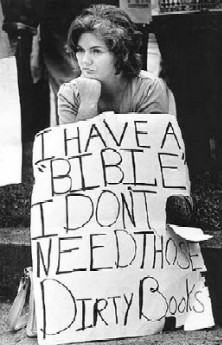
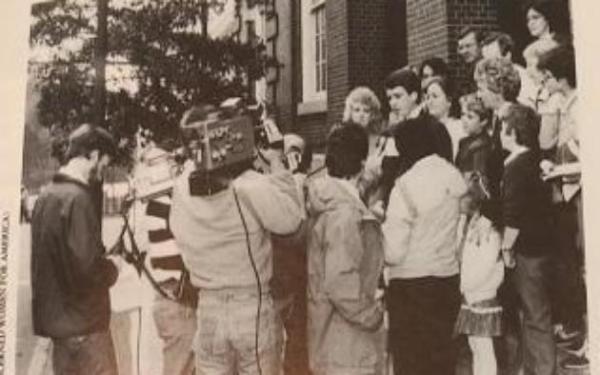
Biola University (originally the Bible Institute Of Los Angeles, get it?), in addition to its main job of cranking out missionaries and teachers, also published an influential evangelical magazine, The King’s Business. It was in the November 1967 edition that I found this little gem.

The King's Business, November, 1967

The King’s Business, November, 1967

I’ll give you the gist of the article. Then I challenge readers to pick out where this creationist fantasy veers most sharply from reality.

We read the story of Hope, the daughter of a fundamentalist minister. Gathered around the dinner table one night, Hope collapsed into tears. At (public) school that day, she finally confronted her aggressive evolutionist biology teacher, Miss Landon. Hope told her teacher that she didn’t believe in evolution. As she told her parents, “I felt I couldn’t sit there and take it any longer.”

The teacher ridiculed her. “I didn’t suppose,” Miss Landon said in front of the whole class,

anyone living in our enlightened age had such old-fashioned ideas. It surprises me that a person who has had the advantages of a modern educational system can be so narrow-minded. Surely there are not many who believe as you do.

Hope felt humiliated and ashamed. But she stood her ground. At the dinner table, as she sobbed, her father put his hand on her shoulder and said,

huskily, ‘Daughter, it gives us great joy to hear you tell this. Who would have thought that so soon after being saved [two weeks before] you would have an opportunity to witness so boldly to your teacher and classmates?’

Hope felt revived. She prayed hard before going to bed, and felt her dad was right. As a result,

Hope returned to school the next day with a song on her lips as well as in her heart. The Lord Jesus seemed to be walking at her very side and a great peace filled her soul. She felt no fear now of encountering Miss Landon again, even though she might be asked to give further ‘reason for the hope within her.’

Sure enough, the next day her evolution-loving teacher challenged Hope to prove that other students felt the same way. To Miss Landon’s surprise,

Before she had finished speaking, nearly half of the girls were standing. What followed can best be described as an old-fashioned ‘popcorn meeting.’ It seemed that everyone wanted to talk at once. Some were wet-eyed; others, with their arms around Hope, were asking her forgiveness for letting her stand alone. Miss Landon was at a loss to know how to handle the situation. She couldn’t be expected to know, since she had never attended a revival service or been asked to pray for souls under conviction. So she just stood there, helplessly looking on.

Finally it occurred to her that perhaps Hope could handle the group. Hope caught her distressed, appealing look, and in a calm voice said, ‘Let us all kneel in prayer.’

The praying and confessing continued throughout the 40-minute class period and Miss Landon made no effort to stop it. The girls may not have learned any biology that day, but many of them learned to know God in a new and real way.

That’s the story.

Now here’s the challenge: Where is the biggest, most obvious goof in this tale? Where does this creationist dream depart most obviously from the realities of evolution and creationism in American public schools?

Now, before people complain, let me offer a few caveats. First, we all understand that not every creationist hopes to have public schools turn into a “popcorn meeting,” whatever that is. And we know that the hokey tone of this story is more a result of its age than of its creationism. The aw-shucks brand of parenting displayed here would fit in just as well with Ward and June Cleaver as it would with Charles and Grace Fuller.

Given all that, I still assert that this story fails the sniff test. There is one element here that simply screams out “fantasy.”

Is it:

  1. No teacher really feels that gung-ho about teaching evolution.
  2. No student really cares that much about creationism.
  3. No parents would encourage their kid to publicly preach that way in a public school.
  4. There would never be that sort of religious revival in a public school.
  5. A teacher would not likely be that clueless about the religious beliefs of her students.

I’ve got to get back to work now, but I’ll offer my answer soon.
From the Archives: A Swizzle Mystery

Hello from sunny Biola University! In my continuing quest to dig into the history of conservative evangelical colleges, I’ll be working in the archives here all week. And I found a stumper in the archives this afternoon.

My oeil has been tromped...

My oeil has been tromped…

As I strolled across campus this morning, I was thinking that everything looked pretty similar to things at my own beloved State University of New York. The students looked the same, the vibe was the same…there was nothing particularly different about the goings-on at this Christian campus compared to my own secular campus. Except, of course, for the fact that the sun was shining and flowers were blooming and the air didn’t hurt when it hit your skin.

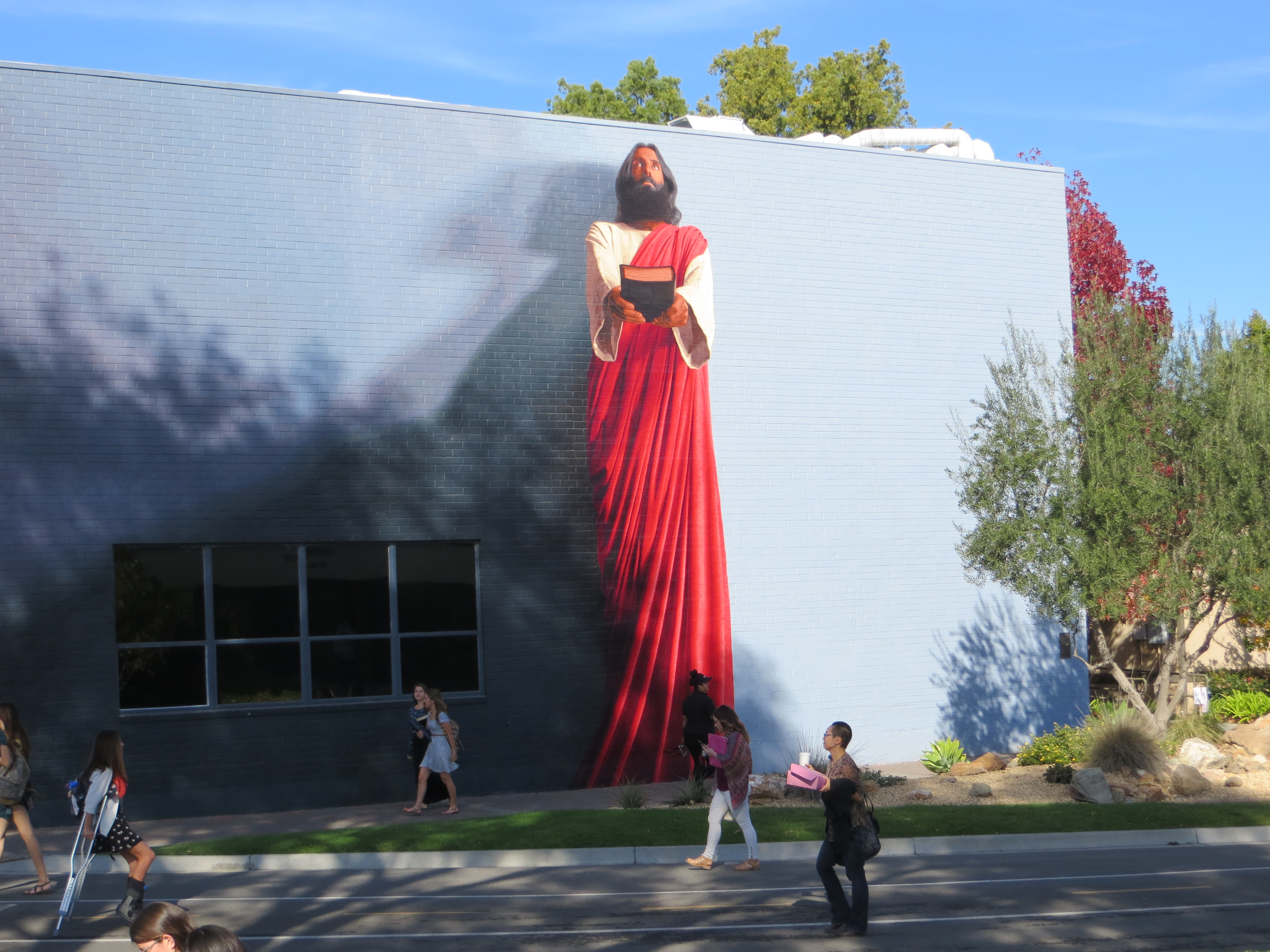
But then, I noticed something I wouldn’t be likely to see on my home campus. As far as I know, we don’t have any humongous Jesus paintings on our buildings.

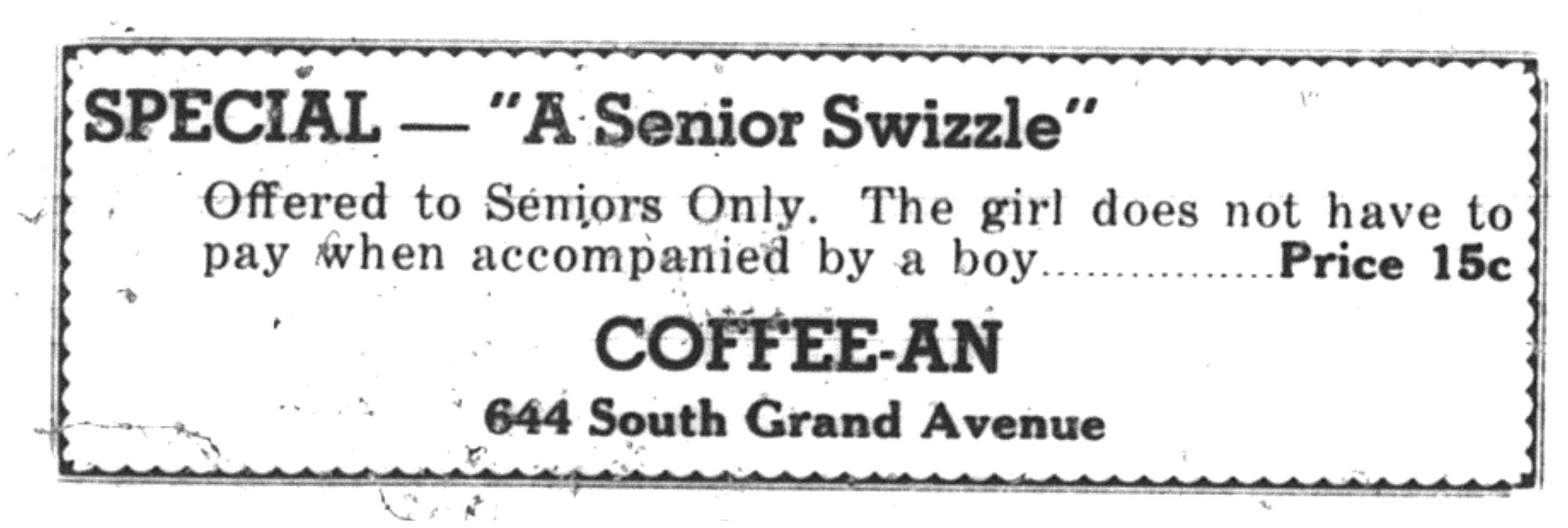
But let’s get to our archive challenge. Among the wonderful holdings here, the Biola library includes issues of the Biola student newspaper going back to 1938. And in the May 1938 edition, I saw this ad. For the life of me, I can’t figure out what it means. I looked up “swizzle,” of course, but besides a “rum swizzle” and a “swizzle stick” I couldn’t find a clue.

??????????????????

??????????????????

Any suggestions?  For full information, I can tell you that the Coffee-An was a lunch counter next to campus.  They advertised regularly in Biola publications.

Atheists and Creationists Agree on This…

You know what they say about the middle of the road: you won’t find anything there but yellow stripes and dead armadillos. In the creation/evolution debates, the John Templeton Foundation has staked out some ground in that dangerous middle. And predictably, the only thing that fervent creationists and obstreperous atheists can agree on is that the Templeton Foundation is terrible.

What does the Templeton Foundation do? According to their website, the foundation

serves as a philanthropic catalyst for discoveries relating to the Big Questions of human purpose and ultimate reality. We support research on subjects ranging from complexity, evolution, and infinity to creativity, forgiveness, love, and free will. We encourage civil, informed dialogue among scientists, philosophers, and theologians and between such experts and the public at large, for the purposes of definitional clarity and new insights.

In general, the foundation uses its money to encourage dialogue between religion and science. With its prizes and grants, it encourages people to bridge the gap. For instance, the foundation provided millions of dollars to help launch BioLogos. How might scientists and theologians come together, BioLogos asked, to help evangelical Christians (and others) understand that evolution was nothing more than the “Language of God?”

Is "compromise" a compliment or a curse?

Is “compromise” a compliment or a curse?

Here at ILYBYGTH, this seems like an eminently worthwhile project. Time and time again, we have seen that science and evolution can wear very different cultural faces. Why bundle together ideas that do not necessarily have to go together? Why feed conservative worries that any understanding of science will somehow doom their children to atheism and immorality? Why not help Christians learn evolution? Why not recognize that some “creationists” really do embrace evolution? Why not listen to the life stories of Christians who have learned that evolution is not the devil spawn they were led to believe?

Partisans disagree. The Templeton Foundation has become the target of angry attack from the hardened edges of both creationism and atheism.

At the young-earth creationist ministry Answers In Genesis, for instance, leader Ken Ham recently blasted the efforts of the foundation. “Sadly,” Ham warned readers,

instead of pointing people to answers from God’s Word about history, organizations like BioLogos and the Templeton Foundation are actively discrediting the Bible’s history. Instead of encouraging people to start with God’s Word, they praise those who impose man’s ideas into the Bible.

Ham might not agree with science pundit Jerry Coyne on much, but they agree about the dangers of the Templeton Foundation. For different reasons, of course. Coyne blasts the foundation for watering down the message of real science, of truckling to culturally powerful and wealthy religious aficionados. “If there is to be interchange” between scientists and theologians, Coyne wrote recently,

let it be not a constructive dialogue but a destructive monologue, one in which science’s efforts knock the props out from under faith, one by one. And religion has nothing to say to scientists, at least nothing that will help us in our work. All religionists can do is educate us about the nature and influence of divine fairy tales that have inimically influenced world culture. Do we really need that?

Now, just because the Templeton Foundation has united both atheists and creationists against it doesn’t prove that the foundation is doing the right thing. But it seems logical to me that if our goal is to help people of every background understand the science of evolution, we should not spurn allies who promise to help. If theologians and scientists can come together to improve public understanding of what the Templeton Foundation calls the “Big Questions,” it seems to me an excess of self-righteousness to oppose it.

A Story We Should Care More About

Every new story about creationist teachers or praying cheerleaders gets lots of attention, but the news we should really care about involves the humdrum topics of taxes and school funding. As creationist hero William Jennings Bryan put it in the 1920s, “The hand that writes the paycheck rules the school.” In Alabama, conservatives passed a law allowing taxpayers to write their paychecks in a different way. Yesterday, the state Supreme Court started hearing arguments about this new conservative strategy. This story is one we should all follow as if it were interesting. After all, it promises to give an answer that no praying cheerleader ever could: Will conservative taxpayers be able to rule the school?

Don’t look at us: Study school-funding laws!

Don’t look at us: Study school-funding laws!

The Alabama Accountability Act allows taxpayers to divert their tax money away from public schools and toward private ones. Alabama is not alone. More than a dozen states have similar laws on the books. What the justices decide in Alabama might direct debate about these laws nationwide.

Of course, not all the laws are the same. As the National Council of State Legislatures reported, as of April 2014, 14 states had some sort of tax-direction law. In general, these laws allow people to shift some of their taxes to scholarship funding organizations (SFOs). Instead of the tax money going to the government, it goes to these organizations. In turn, the SFOs defray the cost of private school for selected students.

Why should we care? Some critics of these laws insist that the laws are intended to break down the wall of separation between church and state. By allowing students to attend private religious schools, some say, these laws use tax dollars to pay for religious indoctrination.

In Georgia, for example, enemies of that state’s law have worried that students will be sent to conservative schools.  At some schools, foes announce, students are forced to pray and banned from supporting homosexual rights.

Conservative supporters of the laws, such as the Virginia-based Institute for Justice, insist that these laws are the last best chance for low-income students. With tax-funded scholarships, low-income students will be able to escape failing public schools. The real issue, according to the Institute for Justice, is the “right of all . . . parents to send their children to the school of their choice.”

Historically, since the 1930s conservatives have agreed that public schools have been taken over by a grasping, out-of-touch academic elite. Any effort to weaken public schools and strengthen private ones has been seen by many conservatives as a win. As I argue in my upcoming book about twentieth-century educational conservatism, this notion has been both enormously influential and widely shared among very different sorts of conservatives.

Religious conservatives have insisted that secularizing “humanists” like John Dewey have taken over public education. Free-market conservatives have worried that the same power-drunk Keynesian economics that dominated public policy between 1930 and 1980 had turned public schools into intellectual cesspools. Patriotic conservatives fretted that sneaky subversion had become the public-school norm. And we can’t forget, of course, that white racial conservatives considered desegregated public schools to be worse than no schools at all.

This sort of tax-direction law is the most recent strategy conservatives have used to move students out of public schools. Will it work? We should all be riveted to the noises coming out the Alabama Supreme Court. Their decision could set a precedent other states will have to notice.

Here’s How We Get a Creationist in the White House

It will take more than six twenty-four hour days. Months ahead of time, the team to put Ben Carson in the White House has been assembled and is feverishly working to get a solid creationist in the White House in 2016.

As Eliana Johnson reports in National Review Online, Carson hasn’t announced his candidacy, but his team is now interviewing thirty-five potential staffers for a possible White-House run. When Johnson asked Carson if he were serious, Carson dodged. “We believe in being prepared,” Carson said,

And that requires a sophisticated and complex infrastructure if I decide to run. . . . It’s like the Boy Scouts: Be Prepared.”

Does Carson think he can win? He told Johnson that the recent mid-term elections pushed him closer. “People are starting to wake up,” Carson told her.

Conservatives love Carson. His rags-to-riches tale and unapologetic religious conservatism, along with his stop-complaining messages to his fellow African Americans, have endeared him to the conservative wing of the party.

That doesn’t mean he has a chance. In the past, conservative hard-liners have entered the primaries even if they don’t think they’ll win. Their goal, in some cases, has been to move the party in a more conservative direction. By running as an unyielding social conservative, Carson will force other GOP hopefuls to tack toward the right.

And whether he wins or not, Carson will bring a dose of good old-fashioned Seventh-day Adventist creationism to the race. Seventh-day Adventism, as historian Ron Numbers argued so convincingly, played a leading role in converting American religious conservatives to a young-earth creationism.

Have you read it yet?

Have you read it yet?

Of course, just because Carson is a member of that staunchly young-earth creationist denomination, it doesn’t mean that he would emphasize those beliefs from the White House. After all, similar fears were raised by conservatives when Catholics such as Al Smith (1928) and John F. Kennedy ran for President. Each candidate had to assure voters that policy would not be dictated from the Vatican.

But Carson has taken a different approach. Instead of distancing himself from the rather extreme form of creationism that is official dogma in his church, Carson has publicly embraced it. In an interview last year, Carson doubled down on his SDA creationism. “I’ve seen a lot of articles,” Carson explained,

that say, ‘Carson is a Seventh-day Adventist, and that means he believes in the six-day creation. Ha ha ha.’ You know, I’m proud of the fact that I believe what God has said, and I’ve said many times that I’ll defend it before anyone. If they want to criticize the fact that I believe in a literal, six-day creation, let’s have at it because I will poke all kinds of holes in what they believe. In the end it depends on where you want to place your faith – do you want to place your faith in what God’s word says, or do you want to place your faith in an invention of man. You’re perfectly welcome to choose. I’ve chosen the one I want.

Maybe I’m viewing the world through evolution-tinted glasses, but I can’t help but think that such a firm statement of YEC belief will be off-putting for many voters. But even if Carson can’t win the race, he can pull his fellow Republican prospects into more firmly creationist positions. By standing firm on a six-day recent creation, Carson can make the entire GOP field friendlier to creationism.

Take a Trip to a Science Museum with a Creationist

“See, fossils!  That’s science.”  So says Megan Fox, self-identified creationist homeschool mom, Tea Partyer, blogger, and Latest YouTube Sensation.

We’ve taken plenty of museum trips here at ILBYGTH: to the Institute for Creation Research’s museum in San Diego, to the big Creation Museum in Kentucky, and even to a medley of creation and mainstream science museums.  Now there is a new option: Take a trip to Chicago’s Field Museum with Megan Fox.  In this half-hour video, Fox explains all the problems with mainstream science.

Plenty of commentators have blitzed Mrs. Fox with insults.  More interesting will be an attempt for those of us outside the creationist community to find out what this creationist thinks about mainstream science.

I’m no creationist-basher, but Mrs. Fox does seem to have an unpleasantly loud and in-my-face personality.  Predictably, bloggers have teed off on her “expose” of mainstream science at the Field Museum. Atheist PZ Myers called Fox “Smug and Stupid.” At Dangerous Minds, she was called a “blithering idiot,” and worse.

I would imagine that many of the intelligent creationists out there wouldn’t have chosen Fox as their ideal spokesperson. But what if we watch her museum tour as a chance to learn more about her creationist vision of science? Historians have worked hard—maybe too hard—to explain the philosophical underpinnings of creationist and Protestant fundamentalist science.

Many agree with George Marsden, who has argued that at heart, fundamentalist science hearkens back to the scientific principles laid down in the 1600s by Francis Bacon. As Marsden wrote in Fundamentalism and American Culture (2006 edition, pg. 59):

the role of the interpreter, according to the same Baconian assumptions, was not to impose hypotheses or theories, but to reach conclusions on the basis of careful classification and generalization alone.

Other historians have agreed. Mark Noll, for example, argued in The Scandal of the Evangelical Mind (pg. 197),

Creationists regularly reaffirm the principles of Baconian science: no speculation without direct empirical proof, no deductions from speculative principles, no science without extensive empirical evidence.

Perhaps the most careful student of conservative Protestant encounters with mainstream science, Jon Roberts, argued similarly in his 1988 book Darwinism and the Divine in America (pp. 41-42 of that first edition from the University of Wisconsin Press),

Nonscientists were also enamored of the Baconian method, for they believed that it was the surest route to the certainty they associated with science. Asa Mahan, a prominent philosopher who served as the first president of Oberlin College, presented in 1872 a typical statement of the prevailing view within the American Protestant intellectual community: ‘Science is knowledge systematized. Into a scientific process, nothing but what is absolutely known can enter.’

Is this what Megan Fox is doing? More interestingly, which term fits Fox better: “blithering idiot” or “Baconian loudmouth”?

I think a better term for Fox’s scientific vision is one used by historian Ted Davis. Though the roots of Fox’s attitude toward proper science may have originated in Baconian principles, it seems misleading to suggest that Fox selected a Baconian framework out of thin air. Like most of us, Fox’s ideas of proper science seem to come from a mix of sources, some of them only dimly understood.

So, instead of calling Fox “Baconian,” I think we should use Davis’s label of “folk science.” As Davis explains, the term came from Jerome Ravetz, Scientific Knowledge and Its Social Problems (1971).

Of course, it is not only creationists who practice “folk science.” As Dan Kahan argues, there is not much daylight between creationists and non-creationists when it comes to actual knowledge about evolution. Most of us have only the vaguest grasp on the real meanings and implications of mainstream science. Unlike Mrs. Fox, however, most of us are willing to learn mainstream science when we go to the Field Museum, not try to pit our folk-ish understandings against the efforts of mainstream science educators.

HT: GB

Asking the Right Questions about Creationism

Is America a “creation nation?” Or have polls tended to inflate the numbers of creationists out there? In an effort to give a more nuanced answer to these questions, BioLogos has published Jonathan Hill’s survey results. Hill offers some powerful insights into central questions:

  • How many Americans really believe in creationism, evolution, or some mix?
  • Who cares the most about it?
  • Who cares at all?
  • And, most important, what factors go into making someone a creationist or an evolution supporter?

You may have seen this report referred to in Emma Green’s recent Atlantic article. Until now, however, you wouldn’t have been able to read the report for yourself. Green’s article had the provocative title “You Can’t Educate People into Believing in Evolution.” True enough, but that’s not news to readers and contributors to ILYBYGTH. Those who take time to read what’s out there about creationism know that creationism is not simply a lack of knowledge about evolution. Rather, creationism is better understood as part of a religious identity.

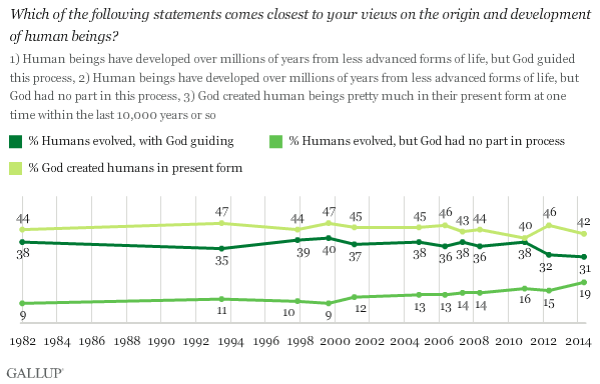
Professor Hill was funded by a BioLogos grant to conduct a large representative survey in the USA. He found that the typical Gallup polls seem to distort the numbers. In those repeated Gallup polls, respondents have three options: (1) humans evolved guided by God, (2) humans evolved on their own, and (3) humans were created within about 10,000 years. In those polls, since the 1980s about 40-45% of respondents have chosen the “young-earth creationist” answer (3). Somewhere between 9-19% have selected the “atheistic evolution” answer (2), and the rest chose number one, the theistic evolution model.

Gallup Questions and Answers

Gallup Questions and Answers

As even the Gallup folks would likely agree, these positions are not very subtle. They don’t allow respondents to explain or describe their own beliefs. Rather, they push people to pick one of three limited options. Professor Hill’s survey allowed people to say they were unsure. It also asked respondents to address different aspects of these beliefs separately. Finally, Hill asked Americans to say how certain they were about their beliefs.

Not surprisingly, those questions yielded very different results. When people can respond to different aspects of creationism differently, they tend to be more nuanced in their responses. For example, in Professor Hill’s survey, only eight percent of people affirmed their belief in both six literal days of creation and the recent creation of humanity.

When taken together, Hill found that 37% of respondents were “creationists,” 16% were “theistic evolutionists,” and 9% were “atheistic evolutionists.” The rest held mixed beliefs or were unsure. When you limit these numbers to those who said they were “very” or “absolutely certain” of their views, then only 29% of respondents were creationists, 8% were theistic evolutionists, and only 6% were atheistic evolutionists.

Also intriguing, only those who hold creationist or atheistic evolutionist beliefs tend to be sure they are correct. They also tend to think it matters to be correct. About three-quarters of creationists said they were sure about their beliefs, and about two-thirds of them said that it mattered a great deal. Among atheistic evolutionists, about 70% were sure of their beliefs, and about half thought it mattered a good deal. In contrast, among those who were unsure about humanity’s origins, only about one quarter thought it mattered a great deal.

In our continuing sniping at one another over the issues of creation and evolution, these numbers themselves matter a great deal. Since large numbers of Americans don’t know about these issues and don’t really care, the debates quickly become dominated by those on either end who feel confident about their own beliefs and who feel sure that it is important to be correct on these questions. We might see a debate between Science Guy Bill Nye and creationist impresario Ken Ham, but we won’t be as likely to see a round-table discussion between people in the middle.

Professor Hill’s survey also buttresses another conclusion popular here at ILYBYGTH: creationism and evolution are not mainly about what you know. Rather, they are questions about who you are. People do not simply pick creationism or evolution out of a neutral grab-bag of ideas. Creationists do not tend to abandon creationism in large numbers when they learn the ideas of evolution. Rather, creationism and atheistic evolution both seem most prevalent among people with recognizable clusters of identity markers. As Professor Hill concluded,

The most important takeaway here is that individual theological beliefs, practices, and identities are important, but they only become a reliable pathway to creationism or atheistic evolutionism when paired with certain contexts or certain other social identities. These positions are not free-floating ideas that individuals snatch from the air after considering all the alternatives; rather, they are found in certain social locations, and they become most plausible when shared with others (especially for creationists).

Read the results for yourself. There’s far more in the report than we can discuss here. For example, the survey raises a host of questions that we want to know more about:

  • Why are atheistic evolutionists so white?
  • Is certainty more important than knowledge?
  • How can we motivate those who don’t really care about creationism to get more involved in public policy debates?

Can YOU Pick the Right Decade?

I guess I should see a doctor. Reading the news from Highland Park, Texas, I had a dizzying sensation of whirling around in time, not sure if it was 2014 or 1974. The Dallas-area controversy over school readings sounded so similar to one that happened forty years ago, I’ve come up with a reader challenge: Can you put the quotations below in the right decade?

Here’s some background: As I describe in my upcoming book, in 1974 Kanawha County, West Virginia was roiled by a ferocious controversy over a new set of language-arts textbooks. Conservative protesters worried that the books had an anti-American tone. They worried that the books promoted a vicious sexuality, an angry rebelliousness, and an unhealthy sense of anti-authoritarianism. Until the books were removed, parents boycotted the region’s public schools. It got ugly. Buildings were firebombed, cars and school buses were attacked, and two people were shot.

From Trey Kay, "The Great Textbook War."

From Trey Kay, “The Great Textbook War.”

This year, as the New York Times reports, an eerily similar protest took off in Highland Park, Texas. In that fancy Dallas suburb, a short list of books were pulled from school shelves. Parents had complained that the books promoted a precocious deviant sexuality. After counter-protests, the district’s superintendent put the books back in schools.

So here’s the challenge: Can you guess the right decade for the quotations below?  Each quotation comes from a conservative challenge to school textbooks.  And the bigger challenge: Can you figure out if this means we are trapped in a never-ending cycle of educational culture wars?

QUOTATION 1: The books include “seduction, rape, child pedophilia, whether oral sex is sex, premarital sex as normative, reincarnation, or that those in authority over them approve of foul language.”[1]

QUOTATION 2: “I found this book to be crass, vulgar, and indecent for students.”[2]

QUOTATION 3: Offensive textbooks are “negative, racist, impulsive, and in some cases right-down vulgar.”[3]

QUOTATION 3: “The book introduces ideas . . . such as beastiality [sic], and sexual penetration by an object, among others.”[4]

QUOTATION 4: “In all of these books . . . I’ve seen many references to God and to Christianity . . . and every time it’s been derogatory.” These books “ridicule Christianity again and again.”[5]

QUOTATION 5: “A child’s formal education should expose him to a broad spectrum of views, but explicit and vulgar writings are not warranted.”[6]

QUOTATION 6: One objectionable book “seeks to frighten children of authority figures, asks children to criticize their parents and invasion of privacy is almost commonplace throughout.”[7]

QUOTATION 7: The offensive books “dwell at length on the sexual aspects of human relationships in such an explicit way as to encourage promiscuity.”[8]

How did you do?  Could you place the conservative protests in the right decade?  Without cheating?

More important, what does it say about our continuing battles over proper education that these parent protests sound so similar?

**********************************************************************************************************

[1] From the NYT article, 2014

[2] From conservative committee member minority report, 2014

[3] June 13, 1974: conservative protester speaking at school board meeting in Kanawha County.

[4] From conservative committee member minority report, 2014

[5] Conservative leader Alice Moore, speaking at school board meeting, June 27, 1974.

[6] From conservative parent protest website in Highland Park, 2014

[7] Judith Casto, “3 basic Kanawha book objections evident,” [sic no caps] The Herald Advertiser [Huntington, WV], November 24, 1974, 41, 44.

[8] Elmer Fike, “Textbook Controversy in Perspective,” Elmer’s Tune, n.d. [fall 1974].


Is Sex Ed Religious Persecution? Is Evolution?

Am I persecuted if my kid is taught sex ed that goes against my religious beliefs?  That’s the question coming out of Arizona this morning.

And it has echoes far beyond the questions of contraception and sex ed.  If kids have a constitutional right to protection from ideas that challenge their religions, it will change the ways we teach evolution, history, literature…really, everything.  But so far, courts have generally not recognized conservatives’ claims of religious persecution. The good news is that there is a simple solution, though it’s one that everyone might hate.

But that doesn’t stop conservatives from making their cases.  As the New York Times reports, a new sex-ed textbook controversy is roiling school politics in Arizona.  Back in 2012, conservatives pushed through a state law mandating that adoption be given preferential treatment in schools.  That is, children in Arizona public schools have to be nudged toward thinking of adoption as a more moral choice than abortion.  An alert parent noticed that a commonly used biology textbook discussed contraception, including the drug mefipristone. According to the NYT, mefipristone can be used to terminate a pregnancy.

A pro-choice lemur...

A pro-choice lemur…

In Gilbert, Arizona, a suburb of Phoenix, the school board voted narrowly that the information violated the 2012 law. What to do? The Gilbert school board ruled that two textbook pages must be removed, somehow.

So far, so ho-hum.  In school controversies, textbooks have been snipped, blacked-out, removed, even burned.  What’s more, the narrative told by conservative school board member Julie Smith seems almost like pages from a tired old script. As I note in my upcoming book about educational conservatism in the twentieth century, nearly every conservative activist has told a similar story. From the 1920s to the 1970s, conservatives have insisted that they were floored by the salacious, socialist, or heretical material their kids brought home from school.

Mrs. Smith brings this tradition into 2014. As she told the New York Times, when her son told her what he was learning about contraception, “I almost drove off the road.”

But Mrs. Smith did not stop with this old chestnut. She also insisted that including this material in textbooks represented an unconstitutional abuse of her religious freedom. As she told the NYT, by having her son read about contraception, the schools “have violated my religious rights.”

Is Smith right? Do religious conservatives have a constitutional right to free exercise of religion in public schools? Is that right violated when public schools force students to learn ideas that contradict their religions?

This question received the most thorough examination in the tortuous path traced by the case of Hawkins County, Tennessee, in the late 1980s. Parents complained that textbooks promoted a bevy of anti-Christian ideas, including secular humanism and occultism. These conservative parents wanted to have their children exempted from reading such anti-religious material.

Mozert makes his case...

Mozert makes his case…

The conservative parents had some initial success in court, but eventually the 6th circuit court ruled against them. In the opinion of that court, the children did not have the right to protection from exposure to mainstream ideas. If the children had been forced to perform religious acts, the court ruled, the parents would have had a better case. But public schools have a duty, not just a right, to expose children to the best current knowledge about every subject, including presumably sex ed.

It’s not for me to tell conservatives what to do, but in this case, it seems Julie Smith is pursuing a losing strategy. Claiming to be religiously persecuted because children are exposed to mainstream ideas is not going to work. If, instead, conservatives could claim that their children were being forced to perform religious acts, conservatives would have a better case.

And, IMHO, contraception is not the right issue for conservatives to pursue with this strategy. Public schools don’t FORCE students to use contraception. Schools simply give students information about contraception.

Conservatives might have a better shot with evolution. Folks like me want to give every person in the United States more information about evolution. There is nothing religious about this goal. For me and other evolution mavens, evolution simply represents the best current science, and students must be exposed to the best current knowledge in every field.

The way I see it, exposing students to knowledge does not violate anyone’s religious rights. But here’s the kicker: The fact that I have a secular purpose in teaching evolution does not mean that evolution does not have religious meanings for others. Again, I don’t want to dictate political strategy to conservatives, but it seems to me creationists could have some success if they claimed that their children have a constitutional right to a certain sort of protection from evolutionary ideas in public schools. Not a right to be protected from hearing or reading those ideas. That would count as simple exposure.

But creationist kids WOULD have a right to be protected from performing religious acts in public schools. For some religious groups, saying that humans evolved from other animals is a religious act. For some religious groups, saying that the earth is billions of years old is a religious act.

In other words, IMHO, public schools have a right and a duty to expose all children to the best current knowledge in all fields. In biology, that means human evolution without any supernatural guidance. In geology, that means an ancient earth and cosmos. At the same time, however, creationist kids have a right to freely practice their religions. And they have a right to insist that the government does not push religious actions upon them. If their religion forbids them from saying that the earth is ancient, kids have a right not to be coerced into saying such things.

This may seem like an unsolvable situation, but there is a simple solution. Public schools and public school teachers have a simple two-word answer to all these conundrums. Instead of pushing students to say that the earth is ancient and that humans have evolved, teachers need only to help students to understand that scientists think these things to be true.

By letting kids say “Scientists say” humans evolved; by letting kids say “Scientists say” the earth is ancient, public schools protect themselves from charges of religious indoctrination. And at the same time, creationists get schools that will not be hostile to their faiths.

The bad news for Julie Smith from Gilbert, Arizona is that she cannot claim any similar sort of constitutional protection. Even if the fact that her son is learning about contraception causes her to drive her car off the road, the public school is not persecuting her by teaching such things.

Happy Thanksgiving: Our Culture-War Holiday

Ah, Thanksgiving…when families gather to eat birds, watch football, and shout at each other. The Thanksgiving tradition of fighting over issues such as gay rights, abortion, taxes, and school prayer has been hallowed by generations of angry get-togethers. After all, when you put a bunch of people around a table, related only by genetics, and feed them too much tryptophan and wine, culture-war fireworks are bound to happen. Today we’ll share some of the punditry about Thanksgiving culture-war battles we’ve gathered from minutes of browsing the interwebs.

I Disagree with You, but I Respect your Commitment to your Position!

I Disagree with You, but I Respect your Commitment to your Position!

1.) Progressives Use Thanksgiving to Convert Conservatives:

At National Review Online, Katherine Timpf cocks a snook at “ridiculous” progressive suggestions for fixing conservative family members. Progressives, Timpf warns, are out to get conservatives this year. Some progressives threaten to turn the Macy’s parade into a feminist diatribe. Others will blather on about the fact that many Americans don’t celebrate Christmas. Some might seize upon the progressive missionary opportunities of the occasion, buttonholing conservative relatives on the issue of climate change, then following up with an email from the Union of Concerned Scientists. If conservative evangelical or “Tea-Party” relatives try to belittle gay marriage or Obamacare, some progressives advise their minions to take conservatives down with prepared statements from the government or the book of Leviticus. And, of course, just to make sure everyone suffers from indigestion, there is at least one progressive pundit out there advising folks to use Thanksgiving to laud the Common Core.

2.) How to Win a Thanksgiving Argument with Conservative Relatives:

At Policy.mic, Gregory Krieg offers a progressive how-to guide for culture-war arguments. Your conservative “bloviating cousin,” Krieg warns, will certainly bring up some culture-war issues. Krieg offers ways to put conservatives in their places on issues such as the Ferguson riots, Obamacare, Obama’s immigration plans, Bill Cosby’s alleged serial rapes, legalizing marijuana, and more. In each case, we’re told, there are factual, reasonable rebuttals to the sorts of “unreasonable, knee-jerk opinions” conservative relatives will be spouting.

3.) How to Publicly Shame your Conservative Uncle:

From an Iowan progressive, we see a few tips on ways to beat your conservative uncle in holiday arguments. It’s important, progressive Iowan Trish Nelson warns, not to “appear too thoughtful—conservatives may confuse this for weakness.” After pounding your conservative relative with piles of facts to explode his ill-considered myths, Nelson promises,

your conservative Uncle will be roasting in his own myths and half truths, so forgive him if he’s a bit thrown off. Take your time and be patient, let him fully cook, and patiently explain the error of his ways.

4.) Again with the “Crazy Right-Wing” Uncle!

I don’t know why uncles are the repository for conservatism this year, but from the LA Times Joel Silberman offers progressive advice on handling a conservative uncle. Don’t fall for the temptation to be polite, Silberman suggests. It is a “patriotic” act to pick fights with your conservative relatives at Thanksgiving. Why? Because these days we don’t often get a chance to engage with people from the ‘other side’ of culture war issues. [Editor’s Note: Unless, of course, we read and comment in the pages of ILYBYGTH!] To be fair, Silberman is not advising the sort of knock-down, drag-out, drumstick-wielding family kerfuffle that I remember so fondly from my childhood. Instead, he suggests that everyone guide their discussion with “respect and know when to stop, and remember that relationships are more important than righteousness.”

Good advice, and a good place to stop. But just like every Thanksgiving fighter ever, I can’t resist getting in one last word. Instead of preparing arguments to win Thanksgiving showdowns, what if we progressives all spent time learning the best arguments our conservative relatives might make? Certainly nothing is less productive in culture-war battles than sitting back smugly and assuming our mastery of “facts” will soon bring our “myth”-laden opponents to their knees.

Rather, why not take an ILYBYGTH approach? Why not do some homework to learn why intelligent, informed conservatives might hold the positions they hold? Why not assume that people of good will might disagree sincerely on abortion, Obamacare, homosexual rights, evolution, and even the Common Core?

After all, the way to quiet a jerkface loudmouth uncle is not to publicly shame him. Rather, it might be more productive if we all studied the best arguments our culture-war opponents might make. Instead of asking: How can I trounce that argument? What if we asked: Why might someone believe that? Or, most important, what if we asked: How can we enjoy all of our blessings without screaming at each other?