Christians CAN Think

Just because someone is a Christian, he or she is not therefore incapable of reasonable thought. That’s the argument recently from Provost Stanton Jones of Wheaton College. But is this true everywhere? Or only in the hallowed halls of Wheaton itself?

Jones was responding to a hatchet job from University of Pennsylvania English Professor Peter Conn. As we noted at the time, Conn accused Wheaton and other evangelical colleges of scamming their way into intellectual respectability. No school that demanded a faculty statement of faith, Conn argued, should be eligible for federal student aid. It was an intellectual and constitutional outrage.

In the discussion in these pages, commenters mostly took Conn to task for closedmindedness. Provost Jones takes a different approach. Not only are Wheaton faculty free to think and research, Jones writes, but they are actually freer than most faculty at non-religious schools. And their work will ultimately be more productive than that of their unfortunate colleagues at those schools.

Those researchers who fit in with the “contemporary intellectual tides,” Jones argues, might feel very free indeed at non-religious colleges. But for those who dissent, the “free” academic environment feels deadeningly constricting. A Bible-believing Christian professor, for example, might not feel entirely comfortable in a rigorously pluralist university like mine. “When we hire colleagues away from nonreligious institutions,” Jones asserts,

we often hear they feel intellectually and academically free here for the first time in their professional careers, because they are finally in a place where they can teach from and explore the connections between their intellectual disciplines and their religious convictions.

That’s not all. Jones uses the tools of postmodern academic life to undermine Conn’s attack. If “truth” is something we can only put in ironic quotation marks, we will be severely limited in our search for it. As Jones puts it,

Purely skeptical and unfettered inquiry is likely to simply chase itself in circles. Disciplined, rigorous, and self-critical inquiry grounded in a thoughtful understanding of one’s particularities can contribute to a vigorous and diverse intellectual marketplace.

Christian academics at schools such as Wheaton, Jones writes, are freer and more productive than their fettered colleagues at secular schools.

We should note, Jones only defends the rigor of academic work at his own school, Wheaton College. Conn’s attack was a broad-brushed condemnation of conservative Protestant colleges in general. Jones does not insist that other evangelical colleges offer conducive research homes for top-notch academics. I can’t help but wonder if this is mere oversight, or an unwillingness to vouch for the academic chops of evangelical higher education in general. Seems like Provost Jones is confident of the high-caliber intellectual firepower at Wheaton, but maybe not so sure of the strength of other evangelical schools.


Close Down Religious Colleges!

Can someone learn to examine ideas critically at a religious college?  To reason and think deliberately and without coerced conclusions?  And if not, should those schools receive federal tax-funded support?  Peter Conn of the University of Pennsylvania says no.

In a recent commentary in the Chronicle of Higher Education, Professor Conn calls attention to the way religious schools receive accreditation.  The problem, Conn believes, is that accrediting bodies scrupulously avoid judging the religious content of some colleges.  As a result, religious schools such as Wheaton and Bryan receive regional accreditation.  Their students are then eligible for federal financial aid.

There lies the problem, according to Conn.  Schools such as Bryan and Wheaton require their faculties to sign statements of belief.  At such colleges, Conn argues, “the primacy of reason has been abandoned by the deliberate and repeated choices of both its administration and its faculty.”

The problem is not that “religious fundamentalists” convene colleges. The “scandal,” Conn writes, is that accrediting bodies legitimize such anti-intellectual organizations. Further, once such schools are accredited, tax dollars go to support their students.

I hate to speak so harshly, but Conn’s argument seems pigeon-headed to me. I’m not religious; I don’t work at a religious college. But my research has centered on the ways conservative Protestant schools have worked to construct a sub-cultural identity as “evangelicals” or “fundamentalists.” And unless I’m missing some nuance of Conn’s essay, he seems to have very little idea what he’s talking about.

In my 1920s book, I looked at the ways the first generation of self-labeled fundamentalists founded and operated schools such as Bob Jones University and Dallas Theological Seminary. In my current research, I’m looking more broadly at the twentieth-century history of evangelical higher education.

To suggest that such schools ought not be accredited due to mandatory faculty creeds seems ridiculous.  After all, as a faculty member at a large public university, I have to sign a loyalty oath.  Does that make me unfit to teach young minds?  Does that make my research anti-intellectual, bound by previous ideological commitments?

More profoundly, the notion that people who agree to a religious creed cannot conduct rigorous research seems a woeful misunderstanding of the nature of religious belief.  In particular, it demonstrates a shocking ignorance of the history of religious colleges in the US.

I know some readers feel more strongly about the pernicious nature of fundamentalism.  Does anyone agree with Conn’s conclusion?  He writes,

The retrograde battle that religious fundamentalists are waging against science has become a melancholy fact of our contemporary cultural life. Legislators around the country conspire to find academic room for the oxymoronic charade called “creation science.” According to Rep. Paul Broun, a Georgia Republican who sits on the House science committee, evolution is a lie “straight from the pit of hell.” By effectively endorsing such blinkered sentiments through its accreditation process, American higher education is betraying itself, and providing aid and comfort to those who would replace reason with theology.


Conservatives and Campus Rape

No one defends rape.  But these days conservative intellectuals often defend students accused of rape.  Why?  What is “conservative” about defending accused rapists?  And what does it have to with higher education?

This is a different question than a similar one we’ve asked lately.  At some conservative religious colleges, we’ve seen a debate over the relationship between theology and sexual assault.  I’ve asked if religion might deter some students from booze-fueled assault.  I’ve also wondered if the top-down authoritarian culture of many fundamentalist schools might encourage assault.

In this discussion, however, we see secular conservatives complaining about the process by which colleges handle accusations of assault.

For instance, columnist George Will attracted a firestorm of controversy when he suggested that assault victims win extra privileges on college campuses.  Liberal-dominated campuses, Will accused, were learning that “when they make victimhood a coveted status that confers privileges, victims proliferate.”

Other commentators also take the system to task.  Legal scholar David Bernstein worried that the bar for proving guilt had been lowered to dangerous levels.  At some universities, Bernstein commented, any touching that did not have explicit approval could count as rape or assault.  By that measure, Bernstein argued provocatively, only prostitutes and their clients were safe from accusations of rape.

Peter Berkowitz, too, demanded a revision of campus assault rules.  In a case from Swarthmore College that attracted a great deal of attention, Berkowitz insisted that the accused rapist did not get a fair hearing.  Too many “elite” schools, Berkowitz argued,

convene kangaroo courts to adjudicate accusations of grave crimes that should properly be left to the police and government prosecutors. Although they cannot sentence students to jail time — the cavalier manner in which these proceedings treat evidence would never pass muster in the criminal justice system — the campus bureaucracies nevertheless impose penalties capable of upending students’ lives.

None of these writers condones sexual assault. Their gripe is with the process by which those assaults are handled. Too often, being accused equals being condemned. Too often, campus committees do not respect the American traditions of being innocent until proven guilty. Each of these writers warns that a rush to convict—even with the best intentions of protecting the innocent—risks trampling the rights of the accused.

But there’s also a deeper rumbling in these essays that points to an important element of conservative thinking. In each case, by attacking campus procedures, these conservative writers condemn the leftist-dominated culture of higher education as a whole.

Peter Berkowitz, for example, located this discussion within a broader problem. Elite schools, Berkowitz wrote, have struggled with

the hollowing out of the curriculum, the aggressive transmission of a uniformly progressive ideology, the promulgation of speech codes, and the violation of due process in campus disciplinary procedures.

And George Will blamed “academia’s progressivism” for its current sorry state. “Academia,” Will concluded, “is making itself ludicrous.” But left-leaning professors and administrators brought it on themselves, Will believes. Colleges have asked for ridiculous rules and short-sighted policies, Will said, “by asking for progressivism.”

There is something more going on here than just procedural complaints. Conservatives are not only complaining about the rights of accused students. Rather, these arguments about sexual assault are part of a longer conservative tradition of fretting about university leftism. For these conservative writers, recent cases of sexual assault serve as yet another example of college radicals gone wrong.


Conservative College Cheapskates

Cheap college for all!  That’s the call of the conservative American Legislative Exchange Council (ALEC).  ALEC members will consider a proposal to mandate public university education for under $10,000.  So why is this a “conservative” idea?

The conservative group’s annual meeting agenda just came out.  Members will be asked to consider several model bills about education, including two that support expansion of charter schools.  No surprise there.  Many free-market conservatives, way back to the 1950s work of free-market guru Milton Friedman, have wanted to reform education by introducing market principles.

ALEC's Get-Together

ALEC’s Get-Together

But I’m puzzled by the higher-ed model bill.  ALEC proposes the “Affordable Baccalaureate Degree Act,” a model bill that will require public universities to offer cheaper college educations.  In the words of the proposed bill,

The Affordable Baccalaureate Degree Act would require all public four-year universities to offer bachelor’s degrees costing no more than $10,000, total, for four years of tuition, fees, and books.  The Act would require that ten percent of all public, four-year university degrees awarded reach this price-point within four years of passage of this act.

To achieve this price-point, universities would be instructed to capitalize on the opportunities and efficiencies provided by (1) web-based technology and (2) competency-based programs.

Simple enough.  There has been oodles of talk lately about the problem of burgeoning student debt.  This proposal would at least introduce a new way to talk about the price and value of college education.

I don’t know the history of ALEC’s model bill, but it looks to be modeled on a similar bill in Texas.  Two years ago, Texas Governor Rick Perry—a decidedly and self-consciously “conservative” politician—introduced a similar affordable-college law.

But here’s my question: What is “conservative” about this proposal?  I know there are conservatives and then there are conservatives, but ALEC has traditionally been a champion, in its words, of “Limited Government, Free Markets, [and] Federalism.”

On first glance, it isn’t clear how this college model bill would limit government or help free markets.  Isn’t the price of college education part of a free market?  Wouldn’t a government imposition of a price cap increase the role of government and decrease the fluidity of the free market?

Here’s my hunch: The key to understanding the “conservative” elements of these bills lies in two important words, “efficiencies” and “competency.”  As I argue in my upcoming book about the history of conservative activism in education, conservatives have long looked skeptically at the way higher education has been run.  Just as conservatives have often insisted that teachers’ unions exert an unhealthy stranglehold on K-12 schooling, they have also often insisted that higher education has been taken over by sclerotic bureaucracies and leftist ideologues.

By forcing colleges and universities to offer credit for “competencies,” free-market conservatives might hope to shatter the grip of college bureaucracies.  Too often, conservatives might argue, college rules have insisted that students spend a certain amount of time in seats, parroting back academic drivel instead of learning real skills.  If students can demonstrate competency in life skills—running a business, maybe, or opening a charter school—those “competencies” should get college credit.

Similarly, by promoting “efficiencies” in higher education, free-market conservatives might hope to force lazy and pampered college faculty to use new technology to deliver information and skills more quickly and cheaply.  Since public universities are funded at least in part by government money, forcing them to run more quickly and cheaply could be seen as crucial part of conservatives’ desire to slim down big government.

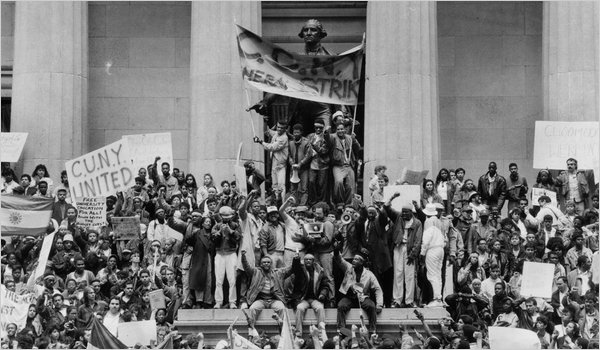
That’s my guess, in any case.  To those who know their higher-education history, though, it is surprising to hear cheap public education promoted as a “conservative” cause.  During the late 1960s and early 1970s, after all, accessibility and affordability were hallmarks of leftist activism in higher education.

Perhaps the best example of this is the history of City University of New York.  During the 1920s and 1930s, CUNY, especially City College of New York, was known as the “Ivy League of the Proletariat.”  Top students crowded into CCNY, especially Jewish students excluded from Ivy League colleges.  It was an elite institution, admitting only the most qualified students.  Back then, it was also free.  If you could get in, you could go.

Do these CUNY tuition protesters look "conservative" to you?

Do these CUNY tuition protesters look “conservative” to you?

In the late 1960s, student activism forced a change in admissions policy.  To fight elitism and cultural prejudice, leftist activists pushed through an open admission policy.  Back then, it was leftist student radicals who called for cheap college for all.

Does ALEC’s model bill signal a shift?  Is it now a “conservative” cause to limit the cost of public higher education?


Orange Is the New Blah…

Okay, I admit it. I’ve been watching Orange Is the New Black. And I like it. But one episode I saw the other night included a painful example of what I’ve been calling the “missionary supposition” of anti-religious folks.

Orange Is the New Hack

Orange Is the New Hack

First, a short introduction for those readers with better things to do: The show follows the prison career of a privileged woman as she serves her time. At first, I didn’t want to watch it. It sounded too much like the terrible genre of ‘brave excursions outside the gated community,’ ignorant self-righteous claptrap along the lines of Barbara Ehrenreich’s Nickel and Dimed.

But after a couple of episodes, I was hooked. The protagonist’s story of elite woe is not as central as I feared. Each of the incarcerated women has her own story and the show makes the most of each.

**SPOILER ALERT: The following contains info about the end of season 1. And some bad language.**

Just because I watch, though, I can’t help but protest some of the stupid blunders incorporated into the story. In a couple of episodes, the protagonist, Piper Chapman, goes a few rounds with fellow inmate Tiffany “Pennsatucky” Doggett. In the show’s depiction of Doggett and in Chapman’s high-handed attitude toward Doggett’s religiosity, we see the worst sort of anti-religious bigotry and ignorance.

Religious = Psychopathic

Religious = Psychopathic

I don’t have much of a problem with the show’s scathing depiction of conservative evangelical religion. We see this most frighteningly in the character of Doggett. Doggett is the unofficial leader of the charismatic Bible group at the prison. She leads deluded healing services and peppers her speech with Biblical references. Not only is Doggett portrayed as a snaggle-toothed, closed-minded, ignorant hillbilly with a heavy penchant for krazy, she actually only won her role as religious prophet by shooting an abortion-clinic worker out of petty spite.

Now, if this show wants to depict religious people that way, fair enough. It is embarrassingly biased, but if the show wants to take that kind of anti-conservative-religion slant, so be it.

But it’s harder for me to swallow the wildly ignorant understanding of religion from one unfortunate scene in the episode “Fool Me Once” [season 1, episode 12, about 55 minutes in]. Pennsatucky wants to baptize Chapman in the laundry sink. At that point, Chapman unleashes her real opinion about the whole thing. IMHO, the following scene demonstrates a terrible misunderstanding of the nature of religious belief, non-religious belief, and the nature of America’s culture wars, not just on the character’s part, but by the makers of this show:

Chapman: Okay, nope, see, I can’t do this. I’m sorry. I really want us to get along. I do. But I can’t pretend to believe in something I don’t. And I don’t.

Pennsatucky: Chapman: We’ve all had our doubts.

Chapman: No, see, this isn’t ‘doubts.’ I believe in Science. I believe in Evolution. I believe in Nate Silver, and Neil deGrasse Tyson, and Christopher Hitchens, although I do admit he could be kind of an asshole. I cannot get behind some supreme being who weighs in on the Tony awards while a million people get whacked with machetes. I don’t believe a billion Indians are going to hell, I don’t think we get cancer to learn life lessons, and I don’t believe that people die young because God needs another angel. I think it’s just bullsh*t, and on some level I think we all know that, I mean, [addressing other Christians] don’t you?

Other Christian #1: [sheepishly] The angel thing does seem kinda desperate…

Pennsatucky: [threateningly, to OC#1] I thought you was a Christian.

OC #1: [defensively] I am, but I got. . . some questions. . .

Whooch! Didja see that? Again, I don’t have a beef if this show wants to malign religious conservatives, if it wants to depict anti-abortion activists as cynical, stupid, self-serving sociopaths. It’s an awkward hack job, IMHO, but not as bad as the wildly ignorant fantasy depicted in the scene above.

As I’ve argued in the pages of the Reports of the National Center for Science Education, too many anti-creationists show this same sort of ignorant “missionary supposition.” They think, along with Piper Chapman and the makers of this show, that the truths of anti-religion are so blindingly obvious that any (thinking) religious person must secretly share them.

Now, to be fair, I should point out that I do (roughly) share those beliefs.  I believe in science.  I believe in evolution.  I like Neil deGrasse Tyson and I don’t think anyone is going to hell.  But just because I agree doesn’t mean I can stomach the weirdly ignorant assumptions in which those statements are wrapped.

When Chapman recites her sophomoric list of village-atheist taunts, the gathered Christians are only kept from agreeing by the bullying of their psychopathic religious leader. In this sort of atheist fantasy, the truths of science only fail to conquer when hearers are not free to acknowledge their obvious awesomeness.

This attitude mirrors nothing so much as the overweening confidence of early religious missionaries. Many Bible missionaries in the early part of the twentieth-century, for example, assumed that the truth of the Bible was so overwhelming that anyone who caught a glimpse of its pages must be supernaturally converted. As a result, Bible missionaries spent a great deal of time and treasure to distribute the Gospel around the world.

At Chicago’s Moody Bible Institute, for example, evangelists distributed printed tracts and gospels throughout the nation and the world, based on this assumption about the supernatural power of Holy Print. As William Norton of the MBI’s Bible Institute Colportage Association related in 1921,

A man was given a tract by the roadside; simply glancing at it, and coming to a hedge, he stuck the tract into the hedge; but it was too late; his eyes had caught a few words of the tract which led to his conversion.

In this understanding of salvation and conversion, some truths have such power that the merest exposure to them is enough to convert the unwilling. Ironically, folks at places such as the Moody Bible Institute have gotten much more sophisticated in their understanding of conversion, while self-satisfied atheists like the makers of Orange Is the New Black apparently have not.

Among conservative evangelical Protestants these days, the difficulties of missionary work are more thoroughly appreciated. As conservative Christian educator David Harley wrote in 1995, missionaries must begin with a “sensitive appreciation of other cultures.” Missionaries who try to plunk down in the midst of a non-Christian population and simply begin spreading Truth amount to nothing more than “evangelical toxic waste,” Harley argued.

Actual missionaries no longer think they can convert without effort. They no longer tell each other to shout out the Gospel and count on it to spread itself. Rather, religious people show a more nuanced understanding of the ways people change their minds.

But there still seem to be people out there so ignorant of other cultures that they think they can convert the heathen with a simple exposition of the Truth. Folks who think that by declaiming a few holy names, such as Christopher Hitchens and Neil deGrasse Tyson, the scales will fall from the eyes of the benighted Christian multitudes.

Pish posh.


Creationist Credentials and the Toilet-Paper Doctorate

What does it take for a creationist to earn a PhD?  As arch-anti-creationist Jerry Coyne pointed out yesterday, not a whole lot.  Coyne looked at the embarrassingly weak doctoral work of young-earth creationist Kent Hovind.  This sham dissertation leads us to ask again about the paradoxical relationship between creationism and credentials.

patriot bible university

Hovind’s Alma Mater

It does not take a creationist-hater like Professor Coyne to find big problems with Hovind’s doctoral work.  Hovind cranked out a hundred awkward pages of claptrap about creationism under the auspices of Patriot Bible University of Del Norte, Colorado.

Intelligent creationists might cringe at this sort of hucksterism, with good reason.  It allows even the most accomplished creationists, such as Harvard-educated Kurt Wise, to be lumped together with this sort of snake-oil academic flim-flam.

Throughout the history of the creation/evolution debates, creationists have struggled to prove their intellectual bona fides.  It hasn’t been easy.  For the first generation of modern anti-evolutionists, it came as a surprise to find that their ideas no longer held sway at leading research universities and intellectual institutions.

As Glenn Branch of the National Center for Science Education demonstrated recently, this 1920s revelation led anti-evolutionists to scramble for certifiable creationist experts.  The most famous anti-evolutionist of the 1920s, William Jennings Bryan, groped awkwardly among scientists to find some who opposed “Darwinism.”

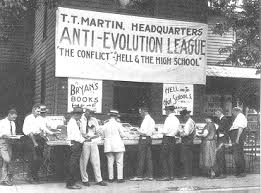
Bryan wasn’t alone.  As I note in my 1920s book, all the anti-evolution activists of the 1920s were obsessed with demonstrating that creationism[*] had expert support.  T.T. Martin, for example, who attracted attention with his eye-catching booth at the 1920s Scopes monkey trial, listed his expert supporters relentlessly.  In his book Hell and the High School, 67 out of 175 pages consisted of nothing more than lists of anti-evolution experts and their backgrounds.

Experts! Experts! Get Yr Experts Here!

Experts! Experts! Get Yr Experts Here!

Another anti-evolution activist from the 1920s showed similar determination.  On a typical page of Alfred Fairhurst’s Atheism in Our Universities, Fairhurst included only 23 original words.  The remaining 107 consisted of quotes from “leading writers on evolution.”

Writing in 1922, Arthur Brown used the same tactic.  He piled up impressive-sounding lists of experts and scientists who disputed evolution.  Why should readers accept evolution, Brown asked, when it had been discarded by the likes of

world-renowned men like Virchow of Berlin, Dawson of Montreal, Etheridge of the British Museum, Groette of Strassburg University, Paulson of Berlin, Clerk Maxwell, Dana, Naegeli, Holliker, Wagner, Snell, Tovel, Bunge the physiological chemist, Brown, Hofman, and Askernazy, botanists, Oswald Heer, the geologist, Carl Ernst von Baer, the eminent zoologist and anthropologist, Du Bois Reymond, Stuckenburg and Zockler, and a host of others. . . .  It seems to be a fact that NO opinion from whatever source, no matter how weighty or learned, is of any account with those who are consumed with the determination to reject the Bible at any cost, and shut God out of His universe.

As I traced in my 1920s book, following the work of historian Ron Numbers, this impressive-sounding list did not really make the point Brown hoped it would.  The names he listed came from earlier generations or from scientists who agreed with evolution’s broad outlines but disagreed on details.  But Brown, like Bryan, Martin, Fairhurst, and virtually all other creationist activists felt compelled to establish the academic credentials of anti-evolutionists.

Hovind’s case reminds us of this peculiar conundrum of credentials among creationists.  One does not have to be an evolutionary bulldog like Professor Coyne to find Hovind’s academic pretensions silly and reprehensible.  Hovind’s work certainly gives skeptics such as Professor Coyne an easy route of attack.

For those of us who don’t care to attack or defend creationism, though, Hovind’s doctoral ouvre offers different lessons.  Once a dissenting group has been turned away from mainstream institutions, credentials become both more precious and easier to attain.  At least since the 1920s, that is, anti-evolutionists have scrambled to find expert backing for their beliefs.  But once creationism had been kicked out of elite research universities, it became far easier for creationists to claim credit for academic work at bogus universities.  If universities themselves are suspect, in other words, the ridiculousness of diploma mills like the Patriot Bible University becomes less damning.

[*] The term “creationism” is an anachronism here.  Anti-evolutionists in the 1920s did not call their beliefs “creationism” yet.  But I’ll use it just to keep things readable.

Can Conservatives Care about Black People?

Would you take twenty-five million dollars from a conservative donor?

That’s the question posed recently to the United Negro College Fund.  The love-em-or-hate-em Koch brothers gave a $25 million donation, and some voices in the academic community want the UNCF to give the money back.  We have a different question to ask.

The prominent historian Marybeth Gasman argued that the UNCF should give the money back.  [Full disclosure: Professor Gasman and I will both be contributing chapters to an upcoming volume about agnotology and education.]  For anyone who knows the history of African-American higher education, Gasman wrote, this sort of conservative funding raises ominous red flags.

As Gasman has demonstrated, philanthropists have too often exerted control over historically black colleges and universities (HBCUs) and the UNCF.  James Anderson, too, has argued that philanthropists have pushed HBCUs away from liberal-arts education and towards manual training courses.

With that history in mind, Professor Gasman insisted that the Koch money is tainted.  “The Koch brothers,” she wrote,

have a considerable history of supporting efforts to disenfranchise black voters through their backing of the American Legislative Exchange Council. In addition, the Koch brothers have given huge amounts of money to Tea Party candidates who oppose many policies, initiatives, and laws that empower African Americans.

Balderdash, say leading conservative intellectuals.  In the pages of Forbes  Magazine, George Leef argued that the UNCF should be celebrating.  First of all, Leef insisted, the Koch brothers’ anti-big-government activism will help African Americans, not harm them.  And in addition, the money is just money.  Take it, spend it, help people, Leef concluded.

In an interview with Michael Lomax of the UNCF, American Enterprise Institute’s Frederick Hess suggested a similar happy ending.  Lomax told Hess that he hoped to take money from whomever he could.  Too much ideological thinking, Lomax said,

has really poisoned the thinking of some people all across the country. For them, there’s this kind of purity thing that, unless we agree on everything, there is no common ground.  Call me a pragmatist but, if I can agree on something meaningful with folks that I don’t agree with on other things, I’m going to try to work on what we agree on and, hopefully, build a meaningful and productive relationship.

Professor Gasman worried that the Koch brothers will use their gift to have a nefarious influence on the UNCF. Lomax insists it won’t. But in the world of conservative education policy, we’ve seen a different struggle.

As I argue in my upcoming book, conservative intellectuals and activists have argued since the end of World War II that their school policies did not make them racist. As we’ve seen in these pages, conservatives have worked long and hard to overcome the accusation that conservatism is inherently anti-black.

In 1950 Pasadena, for example, progressive superintendent Willard Goslin pushed a new zoning plan that would have desegregated Pasadena’s schools by race. Conservatives reacted furiously and eventually booted Goslin. But their opposition to desegregation, conservatives insisted, did not make them racist. To prove it, many conservatives cited the support of prominent African American leaders. As one conservative activist told a packed school-board meeting, her anti-deseg petition could not possibly be racist, since it was signed by “her Negro, Mexican and Oriental neighbors.”  Plus, this woman told the meeting, she could not be racist, because she had become friends with a “Negro physician” in her neighborhood.

Similarly, in the fight over textbooks in 1974 Kanawha County, West Virginia, conservatives insisted that their position did not make them racist. In that case, new textbooks included provocative passages from writers such as Eldridge Cleaver and George Jackson. White conservatives hated the books, but not because they were racists, they insisted. In their support, conservatives cited prominent African American voices such as George Schuyler.

In all these cases, conservative educational activists trumpeted the support of African American voices to prove that their conservative ideas did not make them racist. In a way, foes of the Koch brothers could argue that this UNCF gift will serve a similar purpose. If folks like Professor Gasman accuse the Koch brothers of racism, the Koch brothers can now call on Michael Lomax and the UNCF to burnish their anti-racist credentials.

Professor Gasman argued that the Koch gift will come with unacceptable strings. But we could also ask this question: Is the UNCF now vouching for the Koch brothers? Is the UNCF willing to back the Koch brothers when they insist that their conservative activism does not make them racist?


Want School Reform? Go Medieval!

It’s hard to cross the street these days without bumping into a new panacea to fix America’s schools.  Longer school days, more parent choice, uniforms, more art, more math, more tech, less tech…everybody’s got a new idea to fix education.

We read today in the pages of Forbes Magazine a different sort of proposal.  To fix America’s high schools, Pascal-Emmanuel Gobry writes, we should go medieval.  To be specific, we should emulate the tutorial style of education developed in the middle ages at Oxford University.  Could it work?  Or, more intriguing, could proposals like Gobry’s serve as a new grand educational rapprochement between conservatives and progressives?

In that tutorial system, Gobry argues, students read a book every week and write a short essay about it.  Then they share the essay with a small group, including a tutor and two or three fellow students.  There is no grading, there are no test scores.  The reading list would include great books, however we wish to define them.

Could it work?  Gobry insists that this plan is both practical and “urgent.”  Elsewhere, Gobry wrote that too often education is misunderstood.  His plan would put it back on track.  Even liberal leaders, Gobry pointed out recently, seem to agree that education is meant mainly to produce technically qualified but dead-eyed engines of economic growth. “Nobody stops to ask what education is for,” Gobry lamented,

because the answer is implicitly accepted by all: an education is for getting a job. It is, in other words, for being a cog in the giant machine of post-industrial capitalism. It is, in other words, for the opposite thing that our forefathers wanted for us. I do not use these words lightly, but it is against–in the sense that a headwind is against a ship–the very foundations of our liberty and our civilization.

We could nitpick about whether Gobry’s plan could work.  As a ten-year veteran classroom teacher, I can see plenty of holes that Gobry does not seem to recognize.  But a more interesting question for ILYBYGTH readers is this: Could Gobry’s proposal serve as the foundation of a grand rapprochement between liberals and conservatives?

Here’s what I mean: At the roots of both “progressive” and “conservative” educational reform traditions there lurks a desire to free students of mindless routine and push them to more rigorous study, more authentic, transformational learning.  John Dewey, for example, hoped his school reform program would eliminate mind-numbing recitations and force students to engage more thoughtfully with the big ideas.  And William F. Buckley sparked the post-war conservative fusion movement with his searing critique of the soft and soulless education peddled at his alma mater.

Dewey became the spokesperson for progressivism, while Buckley personified conservatism.  But when it came to the goals and process of learning itself, the two thinkers were not very far apart.  This may seem a shocker, but Gobry’s short essay supports the notion.  What thinking conservative would not support a notion of education that presses students to engage profoundly with the formative documents of our civilization?  That forces teachers to do more than process young humans and train them in lock-step obedience?  And what thoughtful progressive does not want an education that makes human freedom its primary goal?  An education that tears up meaningless standardized tests and instead engages students of every background to struggle with humanity’s oldest problems?

In the end, I don’t really think Gobry’s great-books plan will work as a silver bullet to fix America’s public schools. But Gobry’s line of thinking might serve as a way to get conservative and progressive intellectuals to come together in recognition of their vast similarities.


Teachers’ Unions: The Root of All Evil

Last week a California judge decided that bad teachers can be fired.  In his decision in Vergara v. California, Judge Rolf M. Treu dealt a severe blow to the power of teachers’ unions.  Not surprisingly, conservative intellectuals rejoiced.  For almost a century, conservative school reformers have insisted that teachers’ unions represent a double-headed threat.  But here’s my question: why do today’s conservatives only focus on one half of their traditional gripe against teachers’ unions?

In Judge Treu’s decision, he argued that ineffective teachers have a negative impact on students.  And since the poorest students suffer most, the judge concluded that the situation was open to judicial remedy.

In the pages of the conservative National Review, writers celebrated the decision.  One “liberal” pundit shared her horror stories of terrible teachers and school principals, protected and made more arrogantly despicable due to their union-backed sinecures.  Andrew Biggs suggested taking the California decision national.  Biggs offered a simple four-word phrase to rejuvenate the nation’s public schools: Fire the Worst Teachers.

Not every conservative intellectual liked the decision.  Frederick Hess of the American Enterprise Institute warned that the judge’s power-grab could spell out a future of terrible decisions by similarly activist judges.

But even Hess did not support the unions’ traditional role as the unpopular defender of teacher-tenure rules.  After all, conservative school reformers have for generations identified unions as the source of all that was rotten in America’s public-education system.

Perhaps most memorably, the late free-market economist Milton Friedman argued that the dead hand of teachers’ unions had strangled public schooling.  As I wrote a few years back in the pages of Teachers College Record, Friedman’s narrative of educational history pivoted on the development of teachers’ unions.  Most teachers, Friedman wrote, were “dull and mediocre and uninspiring.”  Nevertheless, beginning in the 1840s, Friedman believed, those teachers had captured control of America’s educational system.  Instead of working to improve education for all, teachers’ unions only worked for their own “narrow self-interest.”  The driving force of expanded public-education systems in the 1840s, Friedman argued in Free to Choose, was teachers’ selfish desire to

enjoy greater certainty of employment, greater assurance that their salaries would be paid, and a greater degree of control if government rather than parents were the immediate paymaster.

Today’s conservative complaints about the power of teachers’ unions owe a lot to Friedman-esque free-market critiques.  Schools suffer, free-market conservatives argue, when the market for good teaching talent is blocked by sclerotic union rules.  Instead of bringing in the best teachers, unions dictate a self-interested last-in-first-out rule that preserves seniority, no matter how incompetent.

But there is another reason why conservative intellectuals have long battled against the power of teachers’ unions.  Those unions, after all, have resolutely supported left-leaning or even frankly leftist social programs.

Perhaps the most dramatic example of this leftist tendency was the tumultuous history of New York’s Teachers Union.  From the 1930s through the 1950s, as Clarence Taylor has described in his great book Reds at the Blackboard, New York’s Teachers Union wrestled with questions of communism, reform, and subversion.  Again and again, the union suffered internal factional disputes, most famously the expulsion of the communist Local 5 faction.  And again and again, the union came under attack for harboring subversive teachers, most famously the purge of hundreds of affiliated teachers in the 1950s.  Throughout its history, though, the famous union supported left-leaning causes.  Internal factional disputes were not left versus right, but rather left versus left.

Even today, teachers’ unions often endure factional disputes on the left.  The militant Badass Teachers Association wants to push the more moderate American Federation of Teachers and the staid National Education Association to take more recognizably leftist positions.

Given all this history, why do conservative these days focus on the free-market angle?  That is, why don’t conservative pundits attack unions as islands of antiquated leftist ideology, instead of just attacking unions as inefficient and self-serving?

One possibility is that conservative school reformers these days take the tried-and-true school reform tactic of taking the politics out of education.  As historian David Tyack argued most memorably in his 1974 book The One Best System, school reformers always insist that their ideas are not about politics, but only about better schooling for all.  As Tyack showed, calls to “take the schools out of politics” never really want to take the politics out of schooling.  But reformers from every political background score more success when they appear to be impartial educators, interested in pedagogy, not ideology.

Is that what’s going on here?  Do today’s conservative intellectuals hope to eliminate the power of leftist teachers’ unions without making it look like a politically motivated hack job?  Do conservative pundits focus on the educational problems of teachers’ unions, instead of focusing on their left-leaning political positions, in order to make it look as if conservatives only want better schools for all?


US Government Employs Creationist Scientists

Thanks to the ever-watchful Sensuous Curmudgeon, we learn of plans to open a new, enormous creation museum near Boise, Idaho.  But in exploring the announcement of this planned mega-museum, we came across an interesting tidbit: Two of the creationist scientists involved in this project worked for the US government as geologists.  Does this mean that the government is funding creation science?  And does it prove the creationist claim that their experts are engaged in “real” science?

As reported yesterday by the Boise Weekly, the Northwest Science Museum has big ambitions.  Its founders want to open an enormous display area, 300,000 to 450,000 square feet.  They hope to build a full-size replica Noah’s Ark that could rival the plans of the more-established Creation Museum in Kentucky.

Big Plans for Boise

Big Plans for Boise

Whether or not the Idaho creationists succeed in their lavish plans, they will likely end up adding another stop to those who want to tour the nation’s many creation museums.  More interesting, the announced plans also raise crucial questions about creationism and government support for religion.

In their attempt to raise funds for their new project, the leaders of the Boise museum published a prospectus that includes information about themselves.  According to this document, the leadership team includes two experienced geologists.

Douglas J. Bennett, founder of the museum, has degrees in geology and science education from Boise State University.  For the past eighteen years, Bennett has worked as a geologist for the US Bureau of Reclamation.  Similarly, museum founder Brent Carter earned a degree in geology from a large public university and worked for 42 years as a geologist for the same US Bureau, retiring with the title of Chief Geologist of the Pacific Northwest Region.

More than the opening of a new creation museum, these careers raise important questions for those of us interested in issues of evolution and creationism.

First, some might suggest that long governmental careers for these ardent and active creationists implies government support for religion.  But does it really?  After all, the government likely hired them to do specific jobs.  They had the necessary qualifications.  Whatever they chose to do in their private lives wouldn’t be any of the government’s business.  Nor would the government be supporting these men’s religious work, as long as each geologist didn’t do his creationist research while on the clock.

More interesting, we have to ask what these careers tell us about the intersection of mainstream science and creation science.  In the recent debate between leading creationist Ken Ham and leading science pundit Bill Nye, Nye repeated his charge that creationism blocked kids from learning science.  Ham retorted with several examples of successful creationist scientists and engineers.

The careers of Bennett and Carter seem to help the creationist case.  After all, if they have both had successful careers as geologists, how can we say that creationists can’t do science?  One might suggest that the sorts of engineering tasks these creationists engaged in were not primary science.  But it seems to me a stretch to say that these creationist geologists did not have careers specifically in the science that is contested.  In other words, both of these men worked as geologists, though their religious beliefs gave them very non-mainstream ideas about that geology.

Consider—again from the museum prospectus—the tasks Bennett claimed to have worked on for the US government.  As part of his job, Bennett

Performed surface and subsurface geotechnical studies and exploration programs utilizing diamond drill, power-auger, test pits, tunnels, and other processes to secure data for seismotectonic, ground-water, and other special studies of dams, reservoirs, canals, tunnels, spillways, power plants, and related structures.

One might say that none of this engineering work includes primary geological research.  And if it did, someone who believed in a young earth and a recent world-wide flood would be at a crippling disadvantage.  But anti-creationists sometimes make a different point.  Bill Nye, for instance, has warned that a creationist nation will soon fall behind in technology and engineering.

The careers of Bennett and Carter seem to demonstrate the weakness of that argument.  Indeed, Nye argues that creationism will turn kids away from science-related careers.  But in the case of these two men, at least, it was precisely their religious beliefs that led them to careers in geology.

So does this case show government support for creationism?  Not really.  But it does offer evidence that creationism does not necessarily deter young people from going into science-related careers.  Indeed, because of the tumult over the nature of biology and geology, perhaps creationist beliefs actually drive some young people into careers in science.