“Conservative Thought” or “Bigotry”? A Conservative Professor Makes Waves

Is it “conservative” or “bigoted” to express skepticism toward sensitivity training about transgender people? About sexual-harassment investigations?

Steven Hayward finds himself facing these questions as he completes his one-year position as visiting professor of conservative thought at the famously left-leaning University of Colorado at Boulder. ILYBYGTH readers may remember the program that brought Hayward out to Boulder. Conservative critics of the university had complained that the school did not include any conservative intellectual presence. As a result, outside political pressure pushed through the program to welcome a series of one-year visiting professors to the campus. The hope was that these prominent conservative intellectuals would spark debate and a more profound sense of intellectual diversity.
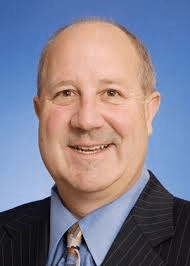
Steven Hayward

Steven Hayward

Predictably, the sparks have begun flying. Hayward has been accused of bigotry. His representations of conservative thought, he has charged, have been said to “‘border’ on ‘hate speech.’” In response, Hayward declared, “they’re welcome to fire me if they want.”

What’s the issue? Hayward publicly questioned university policies about sexual harassment and gender sensitivity training. In an interview and an editorial a few weeks back, Hayward asked if the CU philosophy department was really guilty of sexual harassment. In his editorial, Hayward compared the investigation to a witch hunt:

Unquestionably philosophy is among of the most male-dominated disciplines in universities today, but inviting outside review by the American Philosophical Association’s (APA) Committee on the Status of Women was guaranteed to produce a finding as predictable as the Salem Committee to Investigate Witchcraft in 1691. The irony of this situation is the unacknowledged reversal of the presumption of “privilege” that was at the heart of the original (and justified) feminist complaint about sexism a generation ago. While it may still be justified in the case of academic philosophy, it should not be beyond question whether mere statistical “underrepresentation” should be regarded as prima facie evidence of guilt, and therefore allowing the APA report to assert damning findings about the whole department while disclosing virtually no concrete facts.

And recently, Hayward poked fun at campus sensitivity trainings. New faculty at Boulder, as at many college campuses, must attend a session geared toward increasing their awareness about transgender sensitivity. What pronouns should we use when addressing students? How can we avoid unintentional offense to those who do not fit into neat traditional gender divisions? Hayward dismissed this sort of training as “gender-self-identification whim-wham.”

Students reacted with predictable fury. “Bigotry is not diversity,” proclaimed student editorialists Chris Schaefbauer and Caitlin Pratt. In Hayward’s breezy dismissal of the complaints of sexual harassment in the philosophy department, Schaefbauer and Pratt charged, he engaged in the worst sorts of “victim-blaming.” In his dismissive comments about sensitivity toward gender-identity issues, Hayward “invalidate[d] the lived realities of transgender individuals and mock[ed] the LGBTQ community as a whole.”

The kerfuffle has raised some important questions about intellectual diversity and culture-war politics. Is it possible for a university to include a diversity of opinions? Or is there a need for inclusive environments to police any ideas that challenge that sense of inclusivity?

As we’ve seen recently with the case of Brendan Eich at Mozilla, some issues seem to include less wiggle-room than others. It is widely considered “bigotry” these days to oppose same-sex marriage. But I would suggest, in spite of what some conservative intellectuals have asserted, that it is not seen as bigotry to oppose abortion. It might be seen as “bigotry” to make fun of non-traditional attitudes toward gender identity, but it is generally not seen as bigotry to press for lower taxes or more free-market solutions to social problems.

Can a university include a diversity of opinions about sexual-harassment policies? About gender-sensitivity training? Or, to paraphrase one pithy conservative commenter on Hayward’s blog, have birkenstocks become the new jackboots?

It wasn’t a tough call to predict this sort of situation. Back when Hayward was announced as the first Visiting Professor of Conservative Thought at Boulder, your humble editor made the following guess:

this experiment seems certain to degenerate into the most fruitless sort of culture-war grandstanding.

It’s not very satisfying to be proven right when the case was so clear. It can be depressingly difficult to engage in discussions that cross culture-war trench lines.

Conservative thought has always struggled with accusations of bigotry. By framing themselves as defenders of tradition and traditionalism, conservative intellectuals have put themselves in the position of defending the gender and racial hierarchies that were part and parcel of those traditions. Perhaps most famously, conservative intellectual guru William F. Buckley supported segregationism in the 1950s. Though Buckley later repudiated those views, we must ask a difficult question: Will conservative intellectuals always have to defend yesterday’s traditions?

And, on the other side, student leftists have struggled with accusations of hypersensitivity. It is not difficult to lampoon campus activists. Students preach diversity while sometimes demonstrating a stern intolerance toward ideas that ruffle their feathers.

Is this just a question of irreconcilable cultural politics? Will conservative intellectuals continue to outrage leftist sensibilities? Or is there some way to find agreement about the definition and value of intellectual diversity across the culture-war trenches?
 

Building the Machine: Conservatives Debate the Common Core

She’s in a hurry.

Balancing a crate of oranges in one hand, a purse and bag of groceries in the other, a stylish, affluent, and beautiful mom hustles to answer a call on her iPhone from a friend. “Calling to see if you’re going to the special PTA meeting,” the friend asks as creepy music deedles in the background, “the school is changing the tests next Spring . . . something about the Common Core Standards?”

That’s the opening of a new short film about the Common Core Standards produced by the Home School Legal Defense Association. The forty-minute film, Building the Machine, examines conservative arguments for and against the new standards. As we’ve noted in these pages [check out ILYBYGTH coverage here, here, or here, for instance], conservatives have wondered about the implications of these new standards. I’m told by watchful members of the ILYBYGTH community that the film has made a big splash among conservative homeschoolers. What are conservatives supposed to think about the new standards? What do they need to know about them?

The conservative HSLDA certainly wants to portray the CCSS in a negative light. As HSLDA leader Michael Farris makes clear in the documentary, he feels the standards make a fetish of centralization, systematization, and data collection. But the film gives ample time for pro-CCSS conservative intellectuals to make their cases.

Most prominently, Michael Petrilli of the conservative-leaning Fordham Institute tries to allay conservative worries. The standards, Petrilli argues, resulted from an open and public process. They were not imposed top-down by grasping central elites. Best of all, they will improve education. They will hold teachers, unions, administrators, and students to higher standards. Are they perfect? Not according to Petrilli. But they are the nation’s best shot at renewing academic rigor in public education.

Petrilli is joined by conservative standards-boosters such as Mike Huckabee and Chester Finn. But most of the screen time is devoted to CCSS dissidents Sandra Stotsky and Jim Milgram. Both were part of the original validation committee in charge of the standards, and both refused to sign off on the final product. Why? Both Stotsky and Milgram assert that the new standards are not offering the rigorous academic benchmark that they claim to be. And both insist that their dissent was swept under the rug.

The HSLDA documentary also features conservative critics from the Heartland Institute and Pioneer Institute. The new standards, conservative intellectuals complain, were crafted in a secretive manner, rammed through by the federal government, and do not make academic sense. By aiming at the broad middle, by promising to make all students “college and career ready,” these standards fail to prepare students for either college or careers. More troubling, the standards represent a dictatorial overreach by central government. Mega-rich donors such as Bill Gates greased the slide and snuck this project past the complacent American public.

Perhaps more than the messages delivered by the talking heads, the film’s fast-cut montages and sinister musical background send a clear message: Take your kids and run for the hills. We can’t all be as hip, rich, and beautiful as the mom in the opening montage. But the film makes it clear. All of us—beautiful moms and the rest of us alike—need to wake up and smell the Common Core.


What If Stories: Creationism and World War I

Much Less than 6,000 Years Ago

Much Less than 6,000 Years Ago

What if World War I had never happened? As the centenary of the start of that cataclysmic war nears, the National Center for Science Education has asked a group of eminent historians (as well as yours truly) to speculate how things might be different.

The first post in the NCSE series was penned by the Dean of Creationism History, Ronald L. Numbers.* Numbers, the author of the definitive history The Creationists, argues this morning that World War I was central to the shape of the creation/evolution struggles that emerged in the 1920s. As Ron notes, this sort of “counterfactual” game is tricky for historians. There are so many factors at play, such a varied interplay of contingencies and possibilities, that academic historians tend to shy away from guessing what might have happened. Nevertheless, Ron makes a strong case that the 1920s would have looked very different—in terms of creationism—had there been no big war. But does Professor Numbers think there would still have been a creation/evolution battle in the 1920s without a war? You’ll have to read his full post to find out.

I’m looking forward to reading the rest of the posts in this series. My own humble offering will come at the end of the series, I’m told.

* Full disclosure: Ron was my PhD mentor at the University of Wisconsin and is still a personal hero and friend of mine.


Astorino Blasts the Common Core: “Our Children Are Not Guinea Pigs!”

Should conservatives embrace the Common Core? As we’ve seen [check out ILYBYGTH coverage here, here, or here, for instance], conservative intellectuals have disagreed about the new standards. New York gubernatorial hopeful and staunch conservative Rob Astorino offered a stinging attack on the new standards last week. His analysis of the good and the bad might give us some insight into the ways conservatives view these new standards. Indeed, Astorino’s comments might offer insight into conservative attitudes about education as a whole.

Astorino is leading the conservative charge against sitting New York Governor Andrew Cuomo. Astorino, a County executive from affluent Westchester County, just north of New York City, has pledged to take the Great State of New York in a more conservative direction. As part of that campaign, Astorino issued a blistering attack on the Common Core Standards.

http://vimeo.com/90498744

Flanked not only by the US flag, the New York flag, and a copy of the US Constitution, but also by a few cheerful children’s drawings, Astorino blasted the CCSS as an “untested experiment” that would lead America in dangerous directions. Indeed, Astorino repeated the word “experiment” or “experimental” a total of four times in the four-minute announcement. He also repeated the phrase “Andrew Cuomo’s Common Core exam” four times. Clearly, Mr. Astorino hopes to label the CCSS as both experimental and part of Governor Cuomo’s program.

Most compelling, Astorino announced last week that his own children will be opting out of the exams. The Opt-Out movement has attracted support from all across the political and ideological spectrum.

For Astorino, opting out is the right choice for conservatives. Why? He offered a laundry list of problems with the standards and with the associated exams.

First, with common standards and exams, Astorino warned, local schools will become “centralized organs of the Federal government.”

Second, these exams and standards will raise property taxes “through the roof.”

Third, these exams are not tested, but are simply the misbegotten brainchildren of people such as Bill Gates. According to Astorino, the exams came from the same political greenhorns who cobbled together the disastrous “Obamacare.” Worst of all, Astorino asserts, these standards and exams represent just the latest effort by distant educational elites to exert their unwanted and poorly conceived influence over all the nation’s schools. As he put it, “We’re risking our children’s futures for a few scraps from Washington.”

As I argue in my upcoming book about conservatism and American education, the notion that a scheming group of educational usurpers has taken—or is taking—control of our nation’s schools has a long and potent history. Astorino appeals to this tradition by taking a firm stand on what he calls this “expensive, experimental, Federal curriculum.”

So what’s a conservative to do? According to presumptive GOP gubernatorial candidate Rob Astorino, conservative parents should run for the hills.


Persecution, Mozilla, and Gay Rights

Who is the bully? Who is the victim? Is it former Mozilla CEO Brendan Eich? Or is it the many LGBT people who might not have equal marriage rights?

Unless you’re living under a rock, you’ve heard the story by now. Co-founder and former Chief Technology Officer of Mozilla Brendan Eich recently resigned from his new job as Chief Executive Officer. Why? In 2008, he donated $1000 to support California’s Proposition 8. The Proposition would have banned same-sex marriage. His donation caused such a backlash against Mozilla that Eich resigned.

Throughout the furor, Eich made conciliatory noises about the values of diversity and tolerance, but he did not abjure his political beliefs against gay marriage. For many in the tech community, such beliefs are tantamount to bigotry and politicized hatred. To be against gay marriage, for many folks (full disclosure: I include myself in this group), implies a willingness to deny equal legal rights to a category of people. This is the very definition of bigotry. Such a position, pro-gay-marriage activists insist, is akin to denying people the right to marry across the race line.

In short, by opposing gay marriage, Eich defined himself as a bully and a bigot. To oppose gay marriage, many felt, puts Eich and his ilk beyond the pale of civil society.

In the conservative intellectual community, of course, the shoe is on the other foot. Conservatives insist that the bullying is being done by the pro-gay-marriage crowd. How is it “tolerant,” conservatives ask, when successful business leaders are forced to step down strictly because of their political beliefs? The bigots here, conservatives argue, are those who won’t allow a true intellectual or political diversity. The real bullies, conservatives say, are those who won’t allow for any disagreement with their worldview.

As usual, one of the most perspicacious articulations of these positions came recently from Princeton’s Robert George. In the pages of First Thoughts, George argued the case that the victims here were religious folks. Anti-Eich-ism, George asserts, threatens to squeeze religious folks out of the public sphere entirely. As Professor George puts it,

Now that the bullies have Eich’s head as a trophy on their wall, they will put the heat on every other corporation and major employer. They will pressure them to refuse employment to those who decline to conform their views to the new orthodoxy. And you can also bet that it won’t end with same-sex marriage. Next, it will be support for the pro-life cause that will be treated as moral turpitude in the same way that support for marriage is treated. Do you believe in protecting unborn babies from being slain in the womb? Why, then: “You are a misogynist. You are a hater of women. You are a bigot. We can’t have a person like you working for our company.” And there will be other political and moral issues, too, that will be treated as litmus tests for eligibility for employment. The defenestration of Eich by people at Mozilla for dissenting from the new orthodoxy on marriage is just the beginning.

Are conservatives the victims here? Is it legitimate political activism to oppose same-sex marriage? Or is it bigotry and intolerance?


Florida, Football, and Fundamentalism

Is football a religion? Do the high priests of college football act like the leaders of the nation’s most conservative fundamentalist colleges? In some ways, when it comes to responding to accusations of rape and sexual assault, the similarities seem creepily prominent.

News emerged today that the case of football star Jameis Winston at Florida State will undergo a new round of scrutiny. Back in December, Winston evaded charges about an alleged sexual assault. At the time, pundits accused FSU of coddling Winston because of Winston’s star power.

As we’ve seen in these pages, conservative evangelical Protestant colleges–“fundamentalist” schools–have weathered similar charges of stonewalling and covering up charges of sexual assault on their campus.

Are these cases similar? Does football function like fundamentalism? That is, does the culture of big-name, big-money football create an environment in which everything else takes a back seat to success on the gridiron? Where any questioning of the football team becomes similar to questioning basic tenets of orthodox religious belief?

Let’s take a look at some of the similarities and differences.

At least according to some accusers, fundamentalist schools actively target victims of sexual assault. Both men and women, students and administrators, are steeped in a “purity culture” that encourages all involved to see female victims as sexual temptresses. When accusations of rape emerge, victims are attacked by students and administrators. The threat of making such accusations intimidates many other victims into a scarred silence.

Similar hostility emerges with college football. The alleged victim of the FSU rape, for instance, eventually dropped out of school and moved out of town due to constant harassment and death threats.

Also, it seems both football and fundamentalism push college administrators to worry first about the school, and only secondly about the complaints of victims. With football, the stars must be protected. No one can win a Heisman Trophy or a national championship from a jail cell. And with fundamentalism, schools must protect their reputations as uniquely safe environments. Publicity about sexual assault would certainly threaten that reputation.

But there are also significant differences. First of all, non-fundamentalist schools are almost all subject to review by federal guidelines. In the case of FSU, for example, the case has come back into the headlines because of accusations that the FSU administration might have violated provisions of Title IX in its handling of the case. Most fundamentalist schools refuse all federal funding, so they can operate without such oversight or federal review.

More profoundly, cases at fundamentalist schools are about more than just administrative cover-ups. Some pundits insist that the culture at fundamentalist schools operates as a hyper-charged version of broader cultures that blame women victims. More than at pluralist public schools such as FSU, critics allege, fundamentalist schools promote both sexual assault and victim-blaming by insisting on a “purity culture” standard. Women involved in sex of any kind often find themselves accused of instigating sinful acts.

Victory we have heard on high

Victory we have heard on high

There’s no doubt that big-time college sports look like religions, in lots of ways. They have weekly rituals, with ceremonial outfits and traditional musical accompaniment. They have high priests and acolytes who huddle to make important decisions. And, at least in the eyes of many fans and players, they involve the community in a staged fight of the powers of good versus the powers of evil.

But does this quasi-religious adoration of college sports bleed over into the treatment of accusations of rape as well?


Cruz at Liberty: Freedom under Attack

Senator Ted Cruz told the commencement crowd at Liberty University that they were in danger. Unless they remained willing to sacrifice for their faith, unless the Liberty community remained willing to get active in politics, the religious liberties of the United States could be crushed under the heel of a metastasizing federal government.  Unlike some typical graduation speakers, he hoped the career path of his audience would include some time in prison.

In some ways, Cruz’s commencement address sounded very similar to such addresses at colleges all across the nation and all across the political and religious spectrum. In spite of the fact that Senator Cruz has earned a reputation of one of the staunchest and most outspoken religious conservatives in national office, his speech often seemed mere boilerplate graduation fare: he told the crowd they were all inspirational; he told a few mildly humorous anecdotes; he allowed himself to notice how very famous he was; and he exhorted the crowd to get on out there and change the world.

But in the context of Liberty University, founded in 1970 by fundamentalist leader Jerry Falwell, Cruz also included more ideologically charged material. He reviewed the conservative vision of the nature of the United States. Throughout United States history, Cruz insisted, we see nothing more starkly evident than the fact that “Faith and freedom are intertwined.”

The United States had weathered storms, Cruz said, but he warned ominously, “religious liberty . . . has never been more imperiled than it is right now.”

Cases such as the Hobby Lobby suit or that of the Little Sisters of the Poor, Cruz told the Liberty audience, demonstrate the dangers to religious freedom. These cases are not about contraception, Cruz warned. If religious people can be forced to go against their beliefs to satisfy the demands of big government, Cruz warned, then the generations of sacrifice by Godly Americans will have been for naught.

The folks at Liberty had a chance to change things, Cruz concluded. If they were brave enough to remember that they were “called to action as believers,” Liberty grads could “change the world.” But they had to be willing to suffer for it, to sacrifice for it. Like The Reverend Dr. Martin Luther King Jr., Cruz told his Liberty audience, Christians need to be willing to go to jail to promote their beliefs.

“How many of us,” Cruz asked, “have been to prison for Christ?”


From the Archives: Saving Hearts and Minds in the 1930s and 1940s

What do we need to do to educate young people? Conservative activists, just like their progressive or leftist opponents, have long recognized that education goes far beyond school. Doing archival research for my upcoming book about conservative educational activism in the twentieth century, I found abundant evidence of conservative activism that ranged far beyond the classroom walls. Unfortunately, due to space considerations, much of that material did not make it into the final book draft.

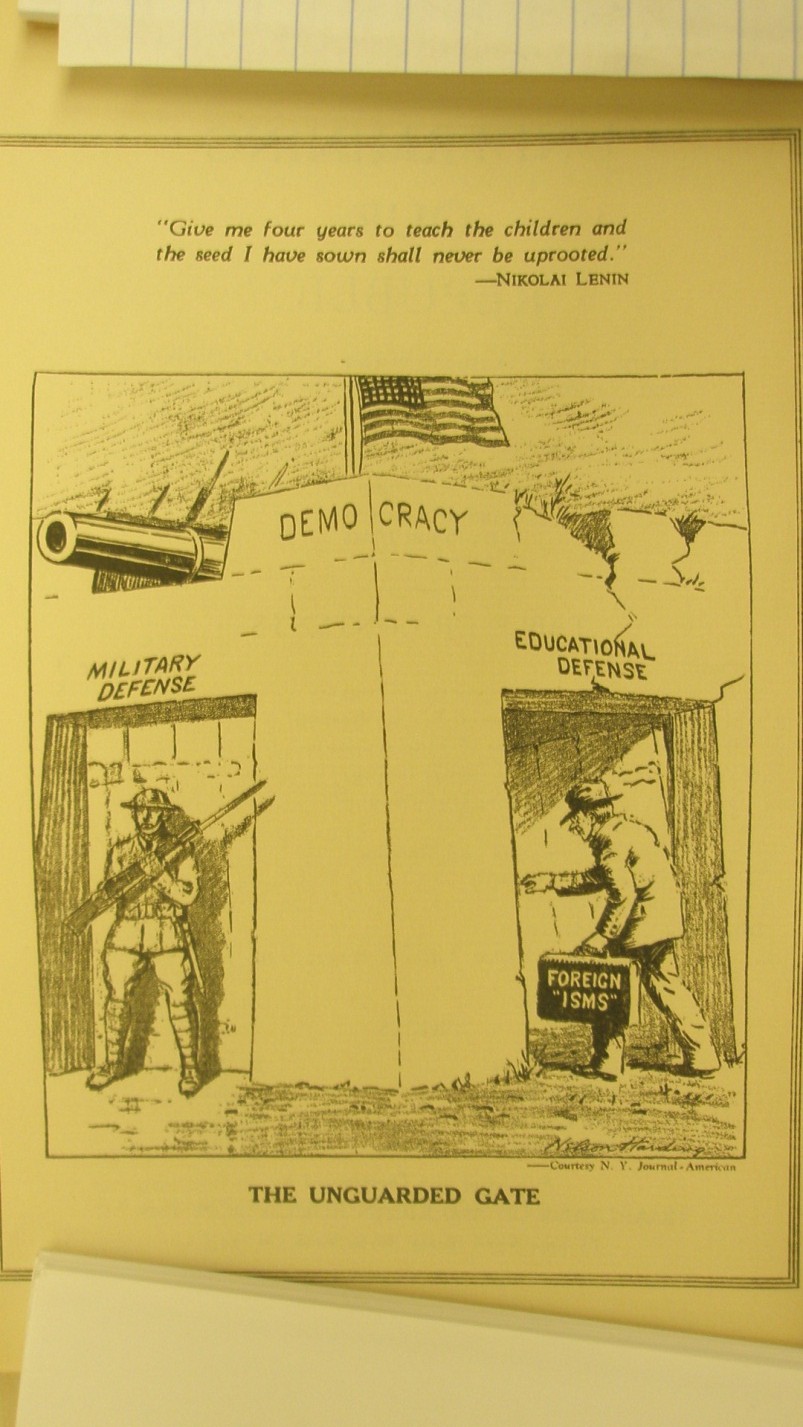
Today, I’d like to share some of the gems from the conservative patriotic activism of the American Legion, things I couldn’t fit in the book. Throughout its long existence, the AL has made education one of its primary concerns. Only if young people learned to love America, generations of AL activists have argued, would the nation remain strong. As this 1941 cartoon makes clear, some Legion members believed education was the “unguarded gate” through which un-American and anti-American sentiments could sneak into America’s body politic.

"The Unguarded Gate," from a 1941 magazine.

“The Unguarded Gate,” from a 1941 magazine.

Other Legion activists emphasized the need to fill children’s minds, souls, and schedules. Only by matching the energetic activism of communist subversives, some Legion voices claimed, could patriotic education match anti-patriotic. As national AL leader Homer Chaillaux warned in 1934, the Legion must provide a full menu of educational opportunities for young people, including baseball leagues, military training, Boy Scout groups, citizenship classes, and school awards. “The average citizen,” Chaillaux warned,

has either never heard of or knows nothing of the background of the Young Pioneers (a youth Communist group), the International Economic Conference of Students (a radical and pacifist student group), the Industrial Unions (at least 42 Communist Unions), the National Students’ League, the Trade Union Unity League, the American Civil Liberties Union (supposedly an organization standing for free speech, but we find them rising in defense of every Communist when in trouble), and numerous others traveling under camouflaged nom de plumes.

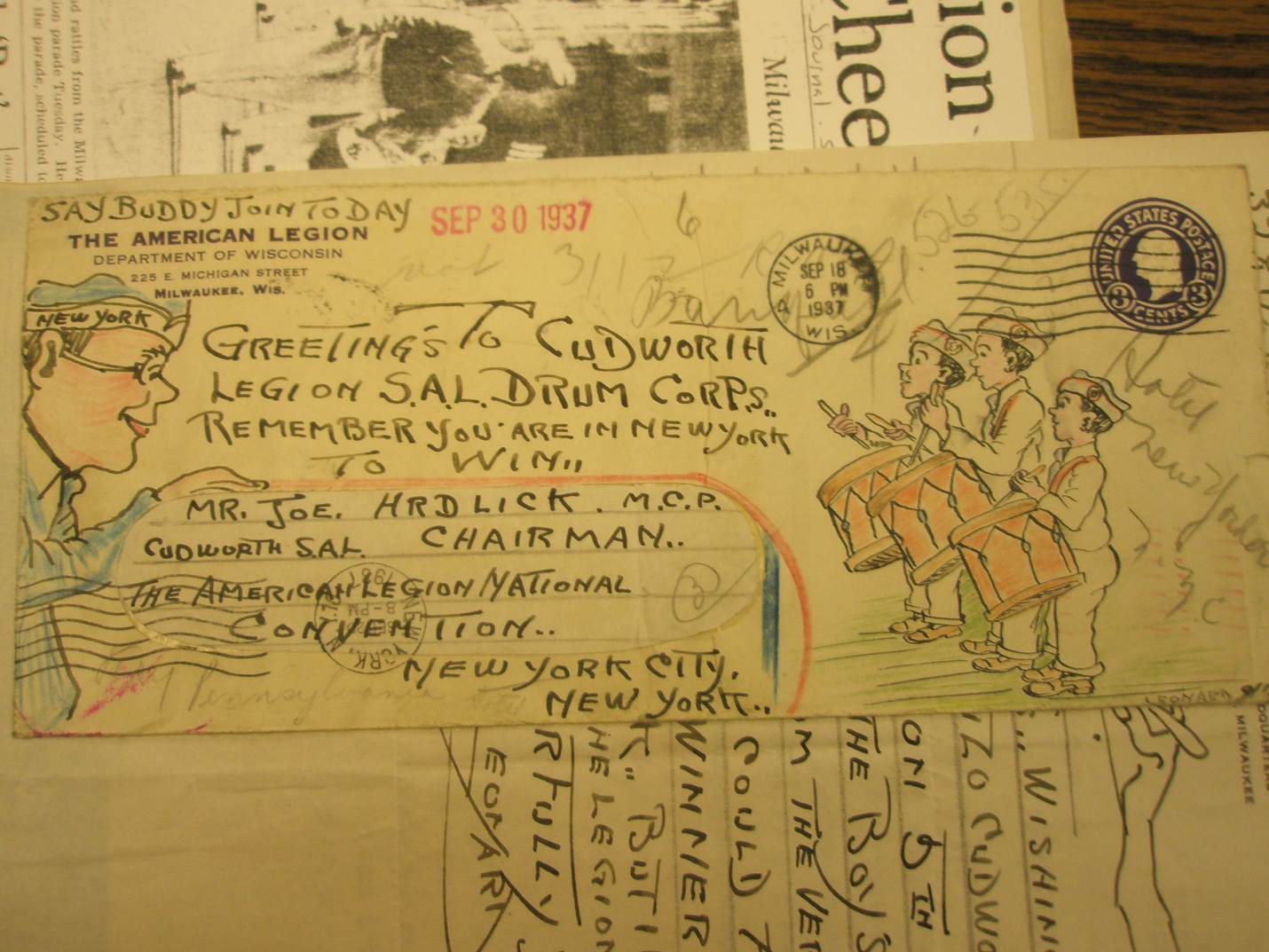
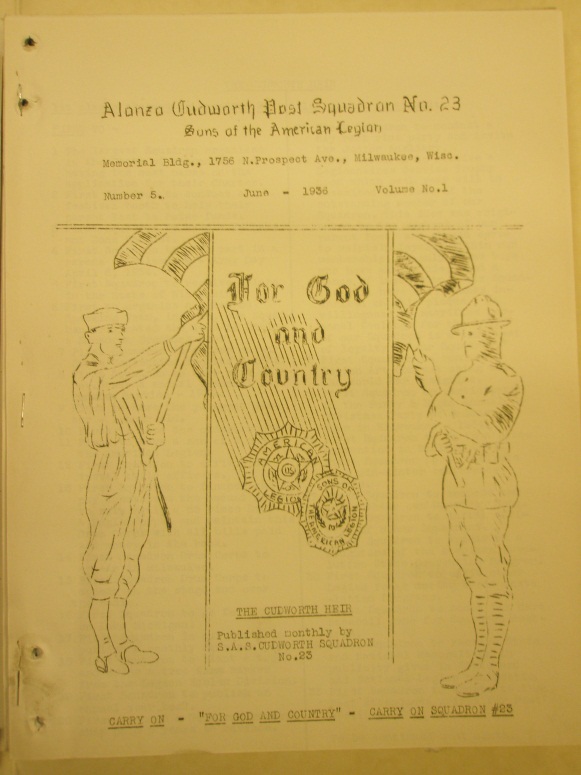
With this sort of foe, the American Legion wanted to be sure young people had patriotic, traditionalist American alternatives. Across the nation, local posts organized a wide array of youth activities.  I found these relics of such organizing from Milwaukee, Wisconsin.  As did posts around the nation, Legion adults set up youth chapters of the Sons of the American Legion, as well as marching bands, baseball leagues, essay contests, and a host of other activities meant to educate boys and girls into a firmly patriotic, socially conservative anti-communism.

A memento from a Milwaukee-area Sons of the American Legion Marching Band trip to the national championships.

A memento from a Milwaukee-area Sons of the American Legion Marching Band trip to the national championships.

From the same Milwaukee-area SOTAL club, a cover from a 1936 newsletter.

From the same Milwaukee-area SOTAL club, a cover from a 1936 newsletter.

As one Legion writer put it in 1930, these efforts must range far beyond just exhortation. They must envelop young people into a profound spiritual web of learning and becoming. In this writer’s words:

While the communist organizes his young pioneers, his youth movement in colleges, and so forth, let us do some organizing. Let us organize Boy Scout troops, ROTC units and boys’ baseball teams, if you please. Let us win and hold the confidence of our boys through such work. While the communist scatters literature among the youth of the land to teach it disrespect for parental authority, let us preach the doctrine of love of parents and love of home. While the communist ridicules the ethics of religion, let us teach its beauty and comfort and hope. While the communist preaches its cowardly philosophy of dissipating the fruits of labor and capital, let us strive to inculcate the manly principles of energy, ambition and thrift in the hearts of our people. While the communist, in the guise of the professional pacifist, spreads his doctrine to palsy the arm of our national defense, let us keep our people informed on matters pertaining to the need and necessity of national defense. … While the communist gathers up boys and girls and sends them to colleges and universities of his own endowment for the purpose of making teachers of communism and atheism out of them, let us make opportunity for patriotic and religious education more universal, in order that the schools and pulpits of tomorrow will be filled with right-thinking men and women.


Montana Tech Faculty: Conservatism YES, Creationism NO

H/T: LMW

Can a science-oriented public museum welcome creationists as commencement speakers? No way, says a faculty group at Montana Tech.

According to an article by Scott Jaschik in Inside Higher Ed, the controversy at Montana Tech revolves around the coming commencement address by Greg and Susan Gianforte. No matter which way we slice it, this discussion raises crucial questions about the values of diversity, the politics of creationism, and the nature of science.

According to the university’s Chancellor, Don Blackketter, the Gianfortes are the perfect choice. After all, Montana Tech is a science-oriented subunit of the University of Montana. Ms. Gianforte has engineering degrees from fancy schools including Cornell and Berkeley and the couple together has a long record of success in software entrepreneurship. As Blackketter gushed on the school’s website,

Greg and Susan are a great example of passionate individuals and entrepreneurs who have had much success and have given back in so many ways. Their messages will resonate well with our students who will be leaving Montana Tech to make their mark out in the world. We are honored they will be a part of our event.

If you ask some of the faculty, however, you’ll likely get a different story. In addition to supporting conservative causes such as the Milton Friedman Foundation and the Association of Classical Christian Schools, the Gianfortes have donated to the creationist Glendive Dinosaur and Fossil Museum. The museum endorses a vigorously creationist vision of the origins of the earth and of humanity.

According to journalist Scott Jaschik, faculty protesters insist they do not have a beef with the conservative politics of the Gianfortes. But the faculty faction DOES object to the Gianfortes’ support for creationism. Pat Munday, department chair for technical communication and a professor of science and technology studies, told Jaschik that a “publicly funded, science-based institution” like MT could not seem to condone such anti-scientific beliefs. More provocatively, Henry Gonshak of the English Department told Jaschik that the Gianfortes could not cut the mustard. Though they promised not to discuss their political activism, Gonshak was not convinced. “If Saddam Hussein or Osama bin Laden promised not to mention their own political and religious beliefs,” Gonshak asked, “would we pick them as commencement speakers?”

Though I find Gonshak’s comparison excessive and counterproductive, I agree with him that inviting creationist-supporters to speak at a public science school’s commencement raises some difficult questions. First of all, are the Gianfortes automatically “anti-science” for their support of a creationist museum? Chancellor Blackketter doesn’t think so. He told Jaschik the Gianfortes were “great supporters of science and . . . science and math have been part of their successful business ventures.” As we’ve argued time and time again, the notion among some mainstream scientists that creationists are incapable of learning or using “real” science just doesn’t hold water. The Gianfortes seem like an example of successful creationist engineers.

Second, does it suppress the university’s mission of intellectual diversity to ban commencement speakers of any kind? What if the university wanted to ban prominent science pundit Jerry Coyne due to Coyne’s in-your-face atheism and unapologetic dismissal of religious beliefs? Wouldn’t that seem outrageous? How can we ban one sort of speaker and not another?

Third, should we think about this as a political question? That is, must we who want more evolution taught in our nation’s public schools fight against any event that lends scientific credibility to evolution deniers? If so, the faculty’s move at Montana Tech seems appropriate. Hosting the Gianfortes as commencement speakers at a public science university sends a message. If science does not include creationism, the Gianfortes should not be invited to speak.

Fourth, does it matter that the Gianfortes are charged with supporting a creationist institution, rather than promoting creationism directly? It seems an illegitimate McCarthyite tactic to dig through the record of public figures to denounce them by association. Do we know if the Gianfortes themselves are creationists? I’ve given money to the Catholic Church, for example. But I would not consider it fair to label my politics as anti-contraception because of that. People should be judged on their own merits, not smeared by tenuous affiliations.

The ultimate question, I suppose, is this: Would you sign a faculty petition to oust the Gianfortes as commencement speakers?


Christian School: Be a Girl

Does an eight-year-old girl have the right to like traditionally “boy” things such as baseballs and short haircuts? Or, more precisely, is she permitted to cause confusion about her gender identity among her fellow students? Not if she wants to attend Timberlake Christian School in Virginia.

Does this story represent an outrageous outlier along the fringes of Christian education, or is this typical of the strictly gendered worldview of conservative evangelical Protestantism? Here at ILYBYGTH, we try not to rush to assume the worst about conservative schooling. In this case, however, it seems the school really did push Sunnie to be more of a girl.  And prominent evangelical intellectuals are willing to defend this decision as central to the cultural politics of conservative evangelical Protestantism.

According to a story by James Gherardi at WSET TV in Lynchburg, Virginia, eight-year-old Sunnie Kahle likes to have short hair. She likes to dress in jeans and t-shirts. She likes to play outside. For all these reasons, school administrators at Timberlake Christian School worried she was not acting enough like a girl. To be more specific, they worried about student confusion. Apparently, a group of boys had attempted to pull Sunnie into a boys’ bathroom.

It seems this is not a case of a student who chooses to identify as a different gender than the one she has been assigned. Sunnie agrees that she is a girl. She just likes to have short hair and play outside in the mud. Her fellow students think she acts too much like a boy and insisted she use the boys’ bathroom instead of the girls’ room.

School administrators worried that Sunnie’s dress and behavior did not match the school’s gender standards. As principal Becky Bowman told Sunnie’s guardians (her great-grandparents) in a letter,

we believe that unless Sunnie as well as her family clearly understand that God has made her female and her dress and behavior need to follow suit with her God ordained identity, that TCS is not the best place for her future education.

For their part, Sunnie’s great-grandparents insist they will not accommodate the school’s demands. Sunnie is just fine, they insist. They pulled her out of TCS and enrolled her in the local public school.

For those of us outsiders trying to understand conservatism in education, we have some questions we need to ask: Does the attitude of TCS represent the thinking of many other conservative evangelical Protestants? Would other Christian schools have acted similarly? Or was this an outrageous exception, a story that garnered international attention precisely because it was so outlandish?

As we’ve noted in the past, conservative Christians have long worried about loosening gender norms in schools. School bathrooms, specifically, have been a hot-point in these school-gender deliberations. Can students who were identified as one gender at birth, but who choose to identify as another, use bathrooms of their chosen gender? That is, can a student who was called a “boy” at birth but who calls herself a “girl” use the girl’s room? This has been a concern far beyond the reaches of Timberlake Christian School.

And significantly, Mat Staver of Liberty University School of Law has waded into this controversy. Staver has announced that Liberty will represent the nearby Christian school. This issue, Staver announced, “is far beyond a simple ‘hairstyle and tomboy issue’ as inaccurately portrayed.” The support and involvement of Staver and Liberty University makes it appear as if this issue represents something widespread among conservative evangelical Protestant educators.

For their part, the school clarified its position. This was never about hairstyles or clothing, they insist. Nor was Sunnie every kicked out of the school. Rather, this was in line with the school’s duty to create and maintain a Christian environment. As the school explained in a public statement to the Roanoke Times,

Parents and guardians send their children to the School because of our Christian beliefs and standards. We have a duty to create an environment that is supportive of these Christian values. We cannot have conflicting messages or standards because such conflict will confuse our students and frustrate the parents and guardians who have entrusted the education of their children to us.

When elementary children and their parents or guardians express concerns regarding use of the restroom and other matters arising from the sensitive issues here, the School has a duty to address those concerns and to ensure that all interests are heard and protected in accordance with the Christian mission of the School.

At least according to these sentiments, this episode was more than just an over-hyped miscommunication. The school really did insist that Sunnie make her gender identity clearer to other students. And school administrators really did envision this as part of the central mission of the school.

But note also that the school was not the gender-monolith we might think. According to Sunnie’s great-grandmother Doris Thompson, Sunnie’s kindergarten teacher worried about Sunnie’s gender identity. But Sunnie’s first-grade teacher did not. Then again this year in second grade, the issue cropped up once more. It seems the teachers at TCS have different attitudes themselves about the centrality of gender identity to proper Christian education.

So what’s the connection between gender identity and conservative Christian schooling?   It seems the attitudes of Timberlake Christian School administrators represent widespread feelings among conservatives. Girls must be clearly girls. Boys must be clearly boys. This is not just a question of haircuts and blue jeans. This is a more profound question of public behavior and gender expectations.  At TCS, traditions of gender behavior and identification have become a central part of non-negotiable theological principles.