NASA Puts Creationists to Work!

Forget about creationism in public schools for a minute. Is it true that the US Government hires young-earth creationist scientists? Can it be true that leading scientific agencies such as NASA employ people who believe that the universe was created within the past 10,000 years?

All in a day's work?

All in a day’s work?

In the past, we’ve heard of government geologists who hold to young-earth creationist beliefs. But today we see a claim by young-earth impresario Ken Ham that NASA employs “many” creationist scientists. Is it true?

Ken Ham, the force behind leading young-earth ministry Answers In Genesis, wants to be clear. He is not talking about folks like John Glenn. Glenn, world-famous astronaut and sometime Senator, recently attested to a more moderate vision of creationism. Apparently, sixteen years ago, Glenn had claimed, “to look out at this kind of creation out here and not believe in God is to me impossible.” Recently, he offered a slightly different explanation of his creationist beliefs. “I don’t see,” Glenn attested,

that I’m any less religious by the fact that I can appreciate the fact that science just records that we change with evolution and time, and that’s a fact. It doesn’t mean it’s less wondrous and it doesn’t mean that there can’t be some power greater than any of us that has been behind and is behind whatever is going on.

Teach evolution, Glenn insisted. There’s no reason we can’t do that in our public schools without hurting children’s religious belief.

Not so fast, Ham warned. If we accept the premises of deep time and evolution, we have to call God a liar, and we have to ignore reams of scientific evidence that points to a newer creation.

Luckily, Ham reports, the labs of NASA are freighted with true creationist scientists. When he gave a talk to the “Bible Club” at NASA’s Goddard Space Flight Center in 1994, Ham says, he was “thrilled to meet many scientists who were also biblical creationists!”

Now, maybe it’s my secular bias, but I have a hard time believing that NASA really employs a sizeable population of young-earth creationists. In the past, I’ve defended the notion that young-earth creationists are not necessarily “ignorant,” as so many secular people like to claim. We have scads of evidence that smart people can be trained in scientific careers and hold to a belief that the universe is fairly new.

But Ham’s claim that NASA is teeming with young-earth creationists seems to be a different case. In the day-to-day work of NASA—a work I admit I know nothing about—it would seem difficult to reconcile a belief in a newish universe with basic assumptions about space exploration.

The claim seems to put Mr. Ham in a difficult position. If NASA really does employ “many” creationist scientists, then NASA can’t fairly be accused of anti-creationist prejudice. But Answers In Genesis insists that mainstream scientists are uniformly blinded to the truths of creationist science by willful prejudice.

On the other hand, if NASA doesn’t really employ “many” creationist scientists, then Ham’s claim doesn’t stand up. He mentioned one of NASA’s creationist scientists by name, one Bill Daniels. If it’s the same person, Bill C. Daniels of New Smyrna Beach, Florida worked as a “project equipment manager” for NASA, according to Daniels’ obituary. Is it possible that NASA’s Bible Club was full of employees who did not have to engage with the scientific paradoxes of young-earth belief in an organization dedicated to exploring an ancient universe?

Would You Fire This Teacher?

HT: MM

Would you fire a teacher if he did any of the following?

  • Graphically described a sex act to his high-school class?
  • Graphically described a homosexual sex act to his high-school class?
  • Graphically described a submission/bondage sex act to his high-school class?
  • Read a poem in class by one of the greatest twentieth-century American poets?

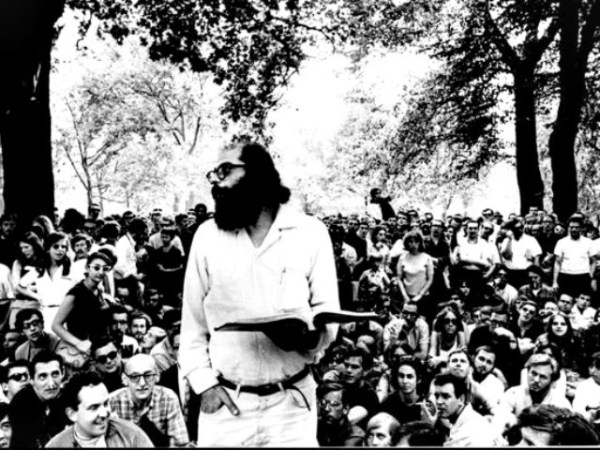
The trick, of course, is that the teacher in question did all of those things, and all at the same time.  We read news from the wilds of South Windsor, Connecticut, where an experienced and award-winning teacher was pushed out of his classroom.  His crime?  Reading Allen Ginsberg’s 1968 poem “Please Master.”

The SAGLRROILYBYGTH will no doubt leap to the culture-war implications of this case.  To my mind, Olio’s ouster raises a couple of issues of perennial difficulty.  First, what are public schools supposed to be doing about sex?  And second, are hippies heroes or villains?

Your sub for today will be hairy...

Your sub for today will be hairy…

As David Freedlander reports in The Daily Beast, David Olio had taught in the district for nineteen years.  He had won awards for teaching excellence.  On the fateful day in question, a student brought in the Ginsberg poem and asked if they could read it in class.  Olio agreed.

The poem does contain some pretty explicit sexual language.  It makes me uncomfortable to think about reading it to any group of people.  More interesting, though, are the interpretations of Olio’s use of the poem.  Progressives see it as a proper and even heroic act.  Conservatives call it something else entirely.

As Freedlander argues from the progressive side, shouldn’t high-school students be reading such things?  Students at that age are keenly aware of explicit sexual activities, even if many students have only vague and false notions of what they are.  Is it not the point of a rigorous education to guide students through these difficult and controversial topics?

Or is this a question of sexual malfeasance?  At Breitbart.com, Susan Berry pleads the conservative case against Olio.  Using such “graphic gay sex” material in class, Berry believes, abrogates the “trust” parents place in public schools.

At the heart of such disagreement lurks a deep divide over the meaning of Allen Ginsberg himself.  Was he a heroic boundary-pusher?  Freedlander cites Ginsberg fan Steve Silberman.  Ginsberg, Silberman insisted,

thought that by bringing material into poetry that were previously considered unpoetic, he enlarged the poetic occupation.

Or was Ginsberg only typical of 1960s sexual excesses?  Conservatives might scoff at the notion that there is any true artistic merit in poetry that apotheosizes our most prurient sexual nature.  As usual, conservative educational icon Max Rafferty expressed in 1968 some of the most memorable anti-hippie bon mots.  He blasted the literary pretensions of “the lank-haired leaders of our current literati.”  Too many hippie protesters, Rafferty insisted, “look as though their main grievance was against the board of health.”  Young people needed more talk about sex, Rafferty believed, “about as much as Custer needed more Indians.”  Instead, Rafferty thought, literary education should focus on the tried-and-true guides to basic morals such as bravery, self-sacrifice, and honesty.

At the heart of this case, it seems, we find some tangled culture-war history.  As Andrew Hartman argues in his new book, the “1960s” serves as a flashpoint for continuing battles over morality and public policy.  If Ginsberg is a Great American Poet, then it does indeed seem short-sighted to punish a teacher for exposing students to his work.  If Ginsberg, on the other hand, was the dirty edge of a vapid adolescent “howl” of self-seeking hedonism, then teachers have a duty to protect children from such foul material.

What would you do?  Would you punish this teacher for a sex crime?  Would you perhaps forgive him for a momentary lapse in judgement?  Or, on the contrary, would you reward him for engaging his class in a bold and inspired moment of curricular bravery?

Are We Too Polite to Tell Our Children the Truth?

It’s not a secret. The roots of Memorial Day lie twisted with America’s toughest problems of race and region. But my hunch is that very few Memorial Day speeches mentioned such things. In addition to the vexing problems of knowledge and politics that cause our continuing educational culture wars, I think we need to add one surprisingly boring cause.

Historian David Blight has argued convincingly that the first Memorial Day (Decoration Day back then) was part of a furious effort by African American Southerners to defend the memory of Union soldiers buried in the South. On May 1, 1865, the first Memorial Day celebration took place on Washington Race Course in Charleston, South Carolina.

That first Memorial Day did not bring Americans together. It celebrated the victory of the Union. It celebrated the end of slavery. It used a display of African American military force to make the point to white Southerners that the old days were gone forever.

A dozen years later, of course, many of those white former Confederates had regained political power in the South. African American freedoms had been wrested away by vengeful white elites North and South. By the time of the fiftieth anniversary of the Battle of Gettysburg, Professor Blight tells us in Race & Reunion, North and South had come together to celebrate the heroics of white soldiers on both sides. Memorial Day had come to be a celebration of white unity, at the cost of African American rights.

What would YOU tell them?

What would YOU tell them?

Why don’t we tell any of that to our children? I think there are two obvious culprits and one surprisingly banal one.

Around these parts, local historians like to remind us that the official first Memorial Day took place in Waterloo, New York. In 1966, then-President Lyndon Baines Johnson decreed that Waterloo was the birthplace of the tradition. That’s a comforting story everyone can get behind. And it points out the many reasons why we don’t tell ourselves the story of the Charleston Race Track.

First, lots of us just don’t know. We might not have read Professor Blight’s book. In all fairness, we might assume that the history we get in our newspapers and from our parents is the truth.

Second, there has been significant political activism to make sure we don’t know. As Professor Blight detailed, organizations such as the United Daughters of the Confederacy worked hard to obscure the race-conscious history of Memorial Day. In textbooks and historical markers, in schools and in Memorial-Day speeches, activists such as Mildred Rutherford insisted that the memory of the Confederacy must be honored.

What not to know and how not to know it...

What not to know and how not to know it…

But above and beyond ignorance and activism, there is a far more basic reason why we don’t talk much about the still-festering racial issues at the real root of Memorial Day. For those of us interested in educational culture wars, we can see the same operation at work in questions about evolution and sex education in public schools as well.

As I argue in my new book about conservative school activism in the twentieth century, conservatives have often had a very easy time vetoing ideas or methods in public-school classrooms or textbooks. Why? Because they didn’t have to disprove the ideas, they only had to insist that such ideas were controversial.

Public schools are surprisingly similar to polite dinner parties. Not because everyone’s manners are at their best, but because any topic that is perceived as controversial is taboo. Teachers will avoid it; administrators will recoil from it.

We’ve seen this over and over throughout the twentieth century, in subject after subject.

Here in scenic Binghamton, New York, for example, in 1940, school Superintendent Daniel Kelly yanked a set of history textbooks from the district’s classrooms. Why? Not because he disliked them. He told a reporter, “Personally, it’s the kind of book I want my children to have. To say it is subversive is absurd.” However, he was willing to get rid of them in order to “stop the controversy” about them.

A few years later, in 1942, an enterprising group of academics tried to determine why so few teachers taught evolution. They mailed a survey to a representative group of teachers nationwide. Overall, they found that fewer than half of America’s biology teachers taught anything close to recognizable evolutionary science. Why not? In the words of one of their respondents, “Controversial subjects are dynamite to teachers.”

When it comes to Memorial Day, this polite impulse to avoid controversy must be part of our loud silence about the roots of the holiday. Who wants to be the boor at the cookout who turns a sentimental get-together into a racial confrontation? Who is willing to tell the gathered Boy Scouts and VFW members that their parade is a charade, since it has its roots in the reinstitution of American racial slavery? Who is willing to tell kids in class that their long weekend is really a reminder of America’s long and continuing race war?

Such things are simply not done.

In addition to the obvious culture-war culprits of knowledge and politics, we need to remember this obvious fact: Teaching the truth is rude.

Trigger . . . a Celebration

Do universities these days coddle their students? Do progressive dreams of inclusive campuses result in hothouse indignation? That’s the charge from pundits as students complain of hostile classrooms. Far from a problem, though, this trigger-warning brouhaha should be cause to celebrate, for two reasons.

Warning: Woman turns into a tree...

Warning: Woman turns into a tree…

In recent days, commentators have leaped upon a story from Columbia University. A group of students published a complaint about insensitive classrooms and professors. One student had been forced to endure a discussion of Ovid’s Metamorphoses, replete with stories of rape and assault. The problem was not just Ovid. The students wrote,

like so many texts in the Western canon, it contains triggering and offensive material that marginalizes student identities in the classroom. These texts, wrought with histories and narratives of exclusion and oppression, can be difficult to read and discuss as a survivor, a person of color, or a student from a low-income background.

Even worse, when students complained about these texts, or suggested other authors such as Toni Morrison, they were pooh-poohed or dismissed.

Predictably, writers from a variety of religious and ideological backgrounds have pointed out some of the over-the-top elements of such student protests. Atheist author Jerry Coyne denounced the students’ “Literature Fascism.” Conservative columnist Peggy Noonan cussed the over-sensitivity of the “trigger-happy generation.”

Noonan pulled no punches. She blasted this “significant and growing form of idiocy” as something that must be addressed. “I notice lately,” Noonan goes on,

that some members of your generation are being called, derisively, Snowflakes. Are you really a frail, special and delicate little thing that might melt when the heat is on?

Do you wish to be known as the first generation that comes with its own fainting couch? Did first- and second-wave feminists march to the barricades so their daughters and granddaughters could act like Victorians with the vapors?

Everyone in America gets triggered every day. Many of us experience the news as a daily microaggression. Who can we sue, silence or censor to feel better?

Ouch. Before we talk about why these crusty columnists give us cause for celebration, let us make a few complaints. First, contra Noonan, this is not a generational thing. As SAGLRROILYBYGTH are keenly aware, Columbia and other elite schools are nearly beside the point when it comes to understanding the broad picture of higher education in this country. They attract a tremendously disproportionate share of commentator attention, but almost no one attends such schools.

And even in the calculated environment of Columbia, the student protesters represent only a tiny sliver of the student body. As Noonan smartly pointed out, the reaction from other Columbia students was not sympathetic. One student wrote, “These girls’ parents need a refund.”

Second, anyone of a certain age can attest to the fact that these same discussions have been happening—with different buzzwords—for the last fifty years. I remember my days as a student radical, back in the 1980s. Sure enough, at one of our indignant protest meetings with a dean, one student complained that the dean’s cigarette smoke was causing her some anguish. His response? Deal with it, Snowflake.   Nowadays, of course, I can’t imagine any college official smoking during a meeting, but the general tenor of student complaint was the same.

In spite of all that, this dustup over trigger warnings should give us cause for celebration. Why? First of all, it has brought together indignant “kids-these-days” jeremiads from all sides of our campus culture wars. Atheists and conservative Catholics, liberals and conservatives, Jerry Coynes and Peggy Noonans . . . a variety of pundits can agree that this sort of student activism is both silly and counterproductive. Any time we can have people from different culture-war perspectives agree on something, we can build on that.

Second, as historian Andrew Hartman has pointed out recently, simply having students who seem to care about Ovid and Toni Morrison is a refreshing sort of culture-war problem. Too often, those kinds of disputes over the proper types of college reading have been replaced by more frightening existential questions of whether or not colleges will fund literature departments.

So rejoice, all those who yearn for robust college campus life! When students are interested in the morals of their reading lists, we might suspect that they are actually doing the reading. When students come together to protest against campus policies, we might hope that they will remain active citizens as they age and fatten. And finally, whenever an issue can bring together curmudgeonly elders from a variety of culture-war positions, there is hope that we all can continue to have robust, controversial conversations.

A School Plan to Cure Racism

It can be depressing. Just over fifty years ago, Thurgood Marshall announced the civil-rights victory of Brown v. Board of Education. In no more than five years, Marshall predicted, the nation’s schools would be racially integrated. Looking at America’s schools today, scholars see more and more racial segregation in schools, not less. One fancy school in New York City has embarked on a more aggressive plan to cure racism. Both liberal and conservative commentators are aghast. But can it work?

In New York Magazine, Lisa Miller reports on the new anti-racism plan of Fieldston School. At this private progressive school, the administration planned to separate kids out into racial groups. The goal was to allow kids to talk about race and ask potentially “impolite” questions without feeling subtle pressure.

As the head of the school told Miller,

We don’t want to replicate what has happened traditionally. The education that many of us have received about race has not been adequate. Hence, where are we as a nation? We are trying to pioneer, to be at the vanguard of this opportunity, to see if we can get it right.

How do the kids feel? One student in the “black” group told Miller that he liked it:

I get to be with people I can share my race with, and I don’t feel uncomfortable about it. . . . We talk about how it’s important to know what your race is. We talk about the difference between being prejudiced and being racist. So I can know when someone’s being racist to me, and I can help other people know that, too. I can say I’m proud of being black. I remember my friend saying that the affinity groups are racist, but they’re not. They put you in a group of what race you are — I don’t think that’s racist at all. We get to make jokes and stuff, and comments. When we’re talking, we get to draw, we get to laugh.

Other students weren’t so sure. A student in the “Asian” group reported, “It’s so fricking boring.”

The idea, in general, is to help students of all races talk about race and racism. Too many white liberals, the thinking goes, are trapped by their own progressive prejudices. They see themselves as enlightened and post-racial, yet they are unable to recognize the ways race and racism function. Programs like this will help make visible the ways white privilege works.

Some parents objected. How is segregating kids by race a good way to fight racial segregation? And what categories would the school use? A Jewish parent objected that his family had been persecuted by the Ku Klux Klan. Did that make him something other than “white?”

One group of progressive parents started a protest petition. The school’s plan, they insisted, would cause “irreparable harm” to their kids.

Conservatives, too, balk at such racial programs. Rod Dreher, for example, called the program a “grievance-building fun house.”

But is it the best way to teach kids about race? To help kids understand from a young age that racism is a real thing? Or does this sort of thing only promulgate racial stereotypes?

Would You Buy Cookies from a Girl with a Penis?

It is difficult to ask that kind of question, because we don’t like to think about children and sexuality at the same time. It’s even more awkward, since we don’t seem quite sure what we mean when we say “boy” and “girl.” Recently the Girl Scouts announced their continuing policy to allow transgender girls to participate in scouting. Today in the Christian Post we see some explanation of why religious conservatives dislike it.

As SAGLRROILYBYGTH are well aware, ideas about gender are among the most contentious in today’s culture wars. We’ve recently seen in these pages a productive interchange across the culture-war trenches.

...can we talk?

…can we talk?

In general—and I’m painting with a broad brush here—conservatives tend to see gender as a God-given and immutable part of human identity. People are born male or female, just as God created them. On a more sophisticated level, conservative intellectuals might look askance at gender-bending ideas as merely the latest efflorescence of cultural degeneration. When Rome rotted, for example, sophisticated Romans scoffed at old ideas about divinity and sexuality. The moral thing to do, with this mindset, is to fight all attempts to blur the bright line between boys and girls.

On the other side, progressives—including your humble editor—tend to see gender as more fluid. People are born with a wide spectrum of biological parts. Babies are assigned one gender at birth, based usually on their dominant physical sex characteristics. That assigned gender does not always match a person’s true gender, or a person may not identify with any particular gender at all. In this mindset, the moral thing to do is to recognize and value the ways people discover and identify their own genders.

The Girl Scouts now officially agree with this position. As their “Chief Girl Expert” explained recently, they have decided to recognize girls as those young people who identify as girls, regardless of external biological characteristics and regardless of the gender they were assigned at birth. As she put it,

If a girl is recognized by her family, school and community as a girl and lives culturally as a girl, Girl Scouts is an organization that can serve her in a setting that is both emotionally and physically safe.  Inclusion of transgender girls is handled at a council level on a case by case basis, with the welfare and best interests of all members as a top priority.

What’s wrong with that? The socially conservative American Family Association started a petition to encourage the Girl Scouts to change their minds. As the AFA explained,

This means girls in the organization will be forced to recognize and accept transgenderism as a normal lifestyle. Boys in skirts, boys in make-up and boys in tents will become a part of the program. This change will put young innocent girls at risk.

Adults are willing to experiment on our kids – both the boys who are confused and the girls who will wonder why a boy in a dress is in the bathroom with them.

The Girl Scouts of America has lost its moral compass and needs your encouragement to rescind this new policy. Since 2003, bad policies like this have resulted in GSA’s enrollment dropping by over one million girls, almost 27% of its membership.

In this statement we can see what some conservatives object to in the Girl Scouts’ decision. First, the AFA says that this decision will normalize transgenderism. Fair enough, I think. But to folks like me, that seems like a good goal. To some conservatives, it does not. To the AFA, transgender girls are not brave people who have worked hard to wrestle with fundamental questions about their true selves. Rather, they are “boys in skirts. . . . boys who are confused.” For many conservatives, this notion that transgender girls are really boys seems enormously powerful.

Also, the AFA charges that these masquerading boys will be put in intimate and potentially sexual contact (“boys in tents”) with “real” girls. Just as we’ve seen elsewhere when the question of transgender youth comes up, there is worry among conservatives that the inherent aggressive sexuality of males will put “young innocent girls at risk.”

Moreover, these sinister changes are not merely accidental. According to the AFA, they are the calculated efforts of wrong-headed progressive adults. As I argue in my new book, this accusation against progressives’ proclivity to engage in dangerous experimentation on kids has a long history. In this conservative mindset, progressivism isn’t just wrong, it is dangerous to children.

Finally, in this AFA petition we see an appeal to a bedrock conservative notion. The AFA accuses the Girl Scouts of having lost their “moral compass.” Just as with our cultural disagreements over the notion of gender itself, conservatives and progressives tend to disagree over the idea of a moral compass. For many conservatives, we know—and have always known—the distinction between right and wrong. The rules have been laid out for millennia. When organizations change or challenge those rules, some conservatives think, they have willfully abandoned those God-given rules.

Progressives, for their part, tend to value the ability to adapt to changing and unique circumstances.  What is the morally correct thing to do?  In general, we should value all persons, regardless of their differences.  In this case, that means welcoming transgender girls into the Girl Scouts.  To do otherwise would be cruel and immorally rigid.

Predictably, it will be very difficult to communicate when we have such fundamental disagreements.  Predictably, progressives will accuse conservatives of hatred and bigotry. Conservatives will accuse progressives of encouraging sexual license among children. Both accusations are intensely hurtful. Who wants to be a bigot? Who wants to be a pimp?

Isn’t there any better way to have this discussion?

Dissenters, Not Ignoramuses

[Editor’s Note: As SAGLRROILYBYGTH are well aware, I’ve just completed work on a new book about creationism and evolution education in the United States.  Based on that effort, the education editor of Anthropology Now invited me to contribute some thoughts about the implications of the creation/evolution controversy.  Below I’m reprinting that essay in its entirety, with the permission of Anthropology Now.  You can also find the essay in its original form in the April 2015 edition of that magazine. Thanks to Zoe Burkholder and Maria Vesperi of AN.]

Physical anthropologists have long been on the front lines of debates over evolution. In the Texas textbook tumult over the past decade, for example, Ronald Wetherington of Southern Methodist University has gone head-to-head with creationists over the content of science textbooks. There is no debate over the science, Wetherington has argued. There is simply no way humanity’s origins can be traced to two bashful ancestors in an idyllic garden, 6,000 years ago.[1]

Image courtesy of Scott Thurman, The Revisionaries

Wetherington thinking it over. Image courtesy of Scott Thurman, The Revisionaries

Yet the fight goes on. Creationists insist on including their religious beliefs in public-school science classes. Mainstream scientists protest. All too often, the debate has forced folks such as Wetherington to attack the scientific pretensions of creationism. How would it be possible, mainstream scientists insist, for the earth to only have a short history? For humanity to trace its lineage from the Garden of Eden? The genetics just don’t line up. The fossils don’t line up. Nothing fits.

This sort of back-and-forth about the possibilities of science goes nowhere. More false debates pitting mainstream scientists against creationist scientists in a choreographed and predictable non-dialogue about the proper nature of science are not needed. One side calls the other a bunch of ignoramuses. Creationists retort that they are the only real scientists in the room.

Creationists may or may not be ignorant about evolutionary theory, but there is a better way to understand creationism, as primarily a form of religious dissent. Of course, notions of religion and religious dissent have always played a part in creation/evolution debates. Court decisions, especially, have tended to reject creationists’ claims on the basis that they represent a religious viewpoint, not a scientific one. Even those decisions, however, have pushed creationists to insist on their status as scientific dissenters above all. For everyone’s sake, including that of creationists themselves, creationism should be viewed first and foremost within the tradition of religious dissent in the United States.

This approach offers hope for moving the long debates over creation and evolution in a more productive direction. In the end, centering the debate on religious dissent rather than on scientific truth could offer two promising new policy goals. First, it would require both sides to agree on different goals for evolution education. Public schools would be tasked with clarifying their expectations and demands. While students from every background must be helped to understand evolution, their beliefs about that knowledge are their own business. As religious dissenters, creationists have the right to preserve their religious beliefs. Second, for public-school teachers to teach dissenting students, teachers themselves must be taught some basic principles about cultural difference and inclusion. Here is where anthropologists can get involved. Teachers should study not only biology and geology, but also ethnography and principles of cultural anthropology. Science teachers must understand the cultural beliefs of religious dissenters in order to welcome those dissenters into science classes. And teachers should be trained to understand their own cultural perspectives, to see the dissent of their students as a cultural strength, not a deficit to be corrected or an ignorance to be attacked.

Anthropologists can be helped by historians. As every historian is well aware, the US educational system has a long, spotty record of handling religious dissent. All too often, public schools have crammed hegemonic notions of proper culture and theology down the throats of minority students and families. In the 19th century, as historian Carl Kaestle has argued, Protestant school leaders often pooh-poohed the objections of Catholic dissenters. In the 1830s, Protestant school leaders in cities such as Boston, New York, and Philadelphia dismissed Catholic complaints about textbooks that ridiculed the Pope and described Catholics as inquisitors and anti-Christians.[2] Even into the 20th century, as David Wallace Adams has shown, minority groups felt the heavy hand of the dominant culture. At Native American Indian boarding schools, Adams found, non-native teachers made it their mission to squash the religion of their native charges. School founder Richard Henry Pratt wanted to “kill the Indian and save the man.”[3]

As the 20th century progressed, religious dissenters scored some successes in major court cases. Perhaps most influential, the US Supreme Court ruled in Abington School District v. Schempp (1963) that students had the right to dissent from religious practices in public-school classrooms. Even if families were allowed to opt out of prayers and Bible readings, the Court decided, such religious practices involved the government too closely in private religious beliefs.[4] Other federal courts have underlined the rights of religious dissenters in public schools. One Tennessee district court ruling in 1979 spelled it out: “if that which is taught seeks either to disparage or to encourage a commitment to a set of religious beliefs, it is constitutionally impermissible in a public school setting.”[5] It is not enough anymore for public schools to allow minorities to attend. It is not enough to permit dissenters to share in parts of the public-school culture. Public schools, rather, must welcome dissenters and minorities as equal members.

That new consensus can be applied to the status of creationist dissenters. Their beliefs should not be mocked or dismissed out of hand. But while dissenting religious beliefs must be respected, religion should never inform the public-school curriculum. Students of all backgrounds, dissenting or not, must be exposed to the very best knowledge on offer. They should be helped to understand that knowledge, even if it contradicts their home religions. At the same time, they must not be forced to believe anything that they find theologically repugnant.

Although creationists and mainstream scientists have disagreed bitterly for generations, they have often agreed on one fundamental—but mistaken—notion. Both sides have repeatedly defined the struggle as a scientific one, rather than a religious one. Many creationists insist that their religiously motivated understanding of the origins of humanity represents a scientific vision. And many mainstream scientists engage on just this issue: Which model represents the better scientific explanation? These debates—fascinating but ultimately pointless and unproductive—roiled in the 20th century and continue into the 21st.

Monkeys and Modernity

The first generation of evolution/creation debates in the 1920s set the tone for those that followed. One of the leading anti-evolution voices of that generation, William Jennings Bryan, insisted that evolution was first and foremost bad science. Bryan proudly and pointedly maintained his membership in the American Association for the Advancement of Science. In the pages of the New York Times in 1922, Bryan insisted that his anti-evolution position represented a deep love of true science. “We do not ask,” Bryan told readers, “for the exclusion of any scientific truth, but we do protest against an atheist teacher being allowed to blow his guesses in the face of the student.”[6] Those who insisted on forcing such false ideas on America’s students, Bryan mocked, were nothing but irresponsible “pseudo-scientists.”[7]
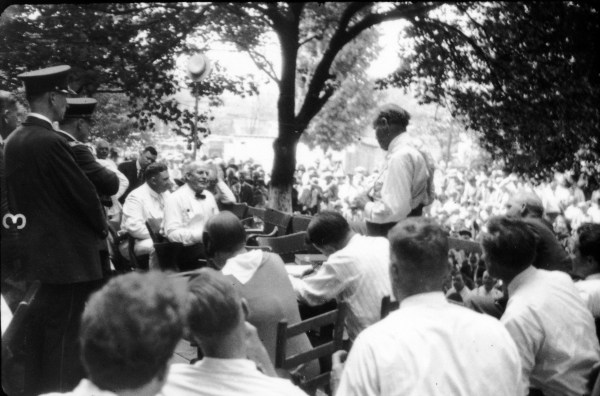
"Are you know or have you ever been...an ignoramus?"

“Are you know or have you ever been…an ignoramus?”

Mainstream scientists met Bryan on the field of science. They often insisted that his was not real science, yet allowed the discussion to focus too often on such definitions. One of Bryan’s primary public antagonists in the 1920s was Princeton biologist Edwin Conklin. Conklin called Bryan a “non-scientific person,” someone utterly unqualified to assert the boundaries of scientific knowledge.[8] Conklin poured out a good deal of time, sweat and ink in his attempt to prove that creationism did not count as real science. Real science, he wrote, was the “freedom to seek and to find truth. . . . confident that even unwelcome truth is better than cherished error.”[9] Real scientists never shied away from uncomfortable conclusions, while Bryan’s sort—scientific usurpers—began with false conclusion and worked backwards.

Perhaps the defining moment of these battles over evolution and creationism came in the summer of 1925. The Scopes Trial in July of that year focused the world’s attention on the question of evolution and creationism, religion and science. Bryan battled famous atheist Clarence Darrow in the sweltering heat of Dayton, Tennessee. The trial brought public attention to the question, but did not do much to resolve the issues. Too often, debates still focused on questions of science.

For example, in the months following the trial, the first celebrity creation scientist from the United States debated the issue with journalist Joseph McCabe. In this debate, held in London in September 1925, leading creationist George McCready Price pilloried evolution as a scientific travesty. The theory made sense, Price told the assembled crowd, “for the times of comparative ignorance of the real facts of heredity and variation and of the facts of geology which prevailed during the latter part of the nineteenth century.” To real scientists, though, Price insisted that evolution could not hold water. Any believer in evolution, Price concluded, would “wake up some fine morning and find that he needs an introduction to the modern scientific world.”[10]

Price never mentioned the need to protect the rights of religious minorities. He did not argue in 1925 that evolutionary theory might outrage the religious sensibilities of dissenters such as himself. Yet it is without doubt that Price’s scientific vision emerged from his religious faith. Price was a member of the Seventh-day Adventist church, a denomination founded in the aftermath of William Miller’s failed 1844 apocalyptic visions. The prophetess of the denomination, Ellen G. White, founded the group largely on her visions of the beginning and end of time. In the beginning, White attested, God created the universe in six literal days. For orthodox Seventh-day Adventists such as Price, faith demanded a young Earth, a worldwide flood and a six-day special creation by God.[11]

Such debates at the start of the modern culture-war controversies over the teaching of evolution defined the issue mainly as one of science and science education. Not that activists did not also discuss the religious aspect of these debates—Conklin, for example, accused Bryan of pushing for “medieval theology” in place of real science—but too often the debates implied that the central questions were scientific ones.[12]

The More Things Change…

Contemporary debates feature similar definitions and boundaries. In February, 2014, for instance, today’s leading young-Earth creationist Ken Ham debated the prominent science-educator Bill Nye, “The Science Guy.” In that debate, Ham insisted that mainstream science had lost its way. Creationists such as himself, Ham told the crowd, had a better grasp of the impossibility of “historic” science. Real science, Ham informed Nye and the world, did not make leaps of illogic about past events. Mainstream scientists made a fundamental error when they limited themselves to the echo-chamber of flawed evolutionary reasoning.

Bill Nye played along. The simplest facts of real science, Nye insisted, proved the utter baselessness of young-Earth creationism. Nye referred to the local Kentucky limestone as just one example of the many that made the case. “We are standing,” Nye said, “on millions of layers of ancient life. How could those animals have lived their entire lives in just four thousand years?” The briefest introduction to the principles of geology or biology proved the power of evolutionary theory beyond any reasonable doubt.[13]

Even in the 21st century, creationists insist that their religious beliefs are better science  and mainstream scientists (and “Science Guys”) agree to define the fight as one about the proper boundaries of science. For their part, creationists these days are in a strategic pickle. Courts have ruled against teaching religious views in science classes. Most significantly, the US Supreme Court’s 1987 decision in the case of Edwards v. Aguillard specified that creationism could not be taught in public schools. Such beliefs, the court ruled in a 7-2 decision, represented religion, not science. However, the majority decision stipulated that dissenting visions of science could be taught if they represented better science instead of simply better religion.[14] Thus creationists can hope to include creationism in public-school science classes only if they can demonstrate that their science is better than mainstream teachings. Mainstream scientists, too, still hesitate to dispute creationism on religious grounds. After all, it is easier to attack the scientific pretensions of what philosopher Philip Kitcher has called “dead science” than it is to critique an opponent’s religious beliefs.[15]

While courts have repeatedly concluded that creationism is primarily a religious belief, both creationists and mainstream scientists have continued their endless rounds of debate. But embracing the definition of creationism as a form of religious dissent instead can reveal new approaches to the controversies. Dissenters in public schools have a contentious but clearly defined tradition of rights and responsibilities. They must be treated respectfully and knowledgeably, but their beliefs do not grant them the right to dictate curriculum for the entire school. Dissenters must be allowed to specify why they find curricular material offensive, but simply calling something offensive does not automatically guarantee that it should be excluded from public education.

Two general rules of thumb will help public schools walk this fine line, teaching evolution to everyone, yet respecting the beliefs of those who dissent for religious reasons. First, teachers should make their goals clear. When it comes to evolution education—or any other form of public education, for that matter—the goal should be for students to understand the material, not to adopt any sort of belief about it. In the case of evolution, all students from all backgrounds would be expected to learn the outlines of evolutionary theory. But teachers would be required to avoid implying that students should believe anything in particular about human origins or the age of the universe. And again, teachers would need to know more about the home cultures of dissenting students. Educating teachers about creationism in its cultural context would help smooth away unnecessary conflict between evolution educators and dissenting creationist students.

Creationists Get On the Bus

Along with their arguments about the superiority of their science, some creationists have long argued for their rights as religious dissenters. Most famously, in 1978, creationist scholar Wendell Bird argued for the rights of creationists as a minority in the pages of the Yale Law Review. “Exclusive public school instruction in the general theory of evolution,” Bird insisted, “abridges free exercise of religion.”[16] Other creationist activists and writers have similarly insisted on their rights as beleaguered minorities. In the mid-1980s, for instance, creationist Jerry Bergman complained that he had been denied tenure at Bowling Green State University due to his creationist beliefs. “A similar case might be,” Bergman claimed, “if a black were fired on the suspicion that he had ‘talked to students about being black,’ or a woman being fired for having ‘talked to students about women’s issues.’”[17] Speaking in the mid-1990s, creationist activist Duane Gish took a similar stance. When he learned he was one of only two creationists invited to a scientific dialogue, Gish erupted, “I will proceed to take one of the two seats on the back of the bus reserved for the creationists in this meeting.”[18] No one believed more strongly in the definition of creationists as put-upon minorities than these creationists themselves. If the benefits of that position can be made clear, perhaps other creationists would embrace a definition as religious dissenters.

Even if they do, however, it remains a question whether it be possible for creationist students to learn about evolution without embracing it as a belief. Can students be asked to understand something if they are not asked to believe it? Some scattered evidence suggests this is already happening. Anthropologist David Long, for example, studied a small group of about 30 undergraduate biology students at a large public university. Many of them came from creationist backgrounds. Those students reported no trouble in learning and understanding evolution without changing their religious beliefs. One student told Long:

I take those really big classes, because it’s really easy to excel in those huge classes. I mean, I got like a hundred on every test. You have to be an idiot pretty much not to. If you just sit, and you listen to what they’re saying, and you know how to take tests, it’s very easy to do well in those classes.[19]

Of the students from creationist backgrounds in Long’s sample, only one abandoned her creationist beliefs while studying biology at a public university. And that student had already begun to abandon her faith before she left high school.[20] Learning evolutionary science, Long found, did not lead to religious conversions.

Similar results occur in high schools. One study of roughly one hundred public-school biology students found that a three-week unit on evolution did not force creationist students to abandon their beliefs. Indeed, though students in this study learned a good deal about evolution, many of them became more firmly convinced of their creationism by learning about evolution. After the unit on evolution, for instance, students improved their performance on a test about basic evolutionary principles. More of these same students, however, agreed or agreed strongly—after studying evolution—with the statement, “Genesis is the best account of how the Earth was created and populated with life.”[21]

Americans in general already seem to separate knowledge from belief when it comes to evolution. In 2012, the National Science Board (NSB), which is part of the National Science Foundation, experimented with the wording of its questions about general science knowledge. Only 48 percent of respondents agreed with the statement, “human beings, as we know them today, developed from earlier species of animals.” But when the NSB prefaced that statement with the phrase, “According to scientists,” 72 percent of respondents agreed.[22] In short, significant numbers of Americans know what the science says about evolution. They simply choose not to agree that it is true.

Finally, students learn better when they feel some connection to their teachers. Teachers who can connect culturally with their students will have an easier time teaching anything, from evolution to arithmetic. As education scholar Gloria Ladson-Billings has argued, “Teachers who practice culturally relevant methods. . . . see themselves as part of the community and they see teaching as giving back to the community. They help students make connections between their local, national, racial, cultural, and global identities.”[23]

For teachers who come from non-creationist backgrounds, the effect of a short course in cultural anthropology could be profound. For one thing, it would introduce teachers to the idea that the world of creationism includes a vast kaleidoscopic array of beliefs and cultures. It would be useful to know how a Baptist creationist student might differ from a Seventh-day Adventist or from a Gulenist. More important, an introduction to the foundational principles of cultural anthropology can help science teachers understand that difference is not deficit. Simply because creationist students do not accept evolution, they are not necessarily naively ignorant about evolution. Indeed, as David Long has noted, many students from creationist backgrounds perceive any discussion of evolution as “troublesome or even dangerous.”[24] Good teachers want to help students, not terrify them. A primer on the principles of cultural anthropology can help teachers connect with creationist students more productively.

None of this will make creation/evolution controversies go away. There is no magic wand here. But by placing the educational discussion more squarely on the rights and responsibilities of religious dissent, we may drain some of the venom from our achingly repetitive school battles.  

Notes

[1] See Scott Thurman’s documentary, The Revisionaries (2012).

[2] Carl F. Kaestle, Pillars of the Republic: Common Schools and American Society, 1780-1860 (New York: Macmillan, 1983).

[3] David Wallace Adams, Education for Extinction: American Indians and the Boarding School Experience, 1875-1928 (Lawrence: University Press of Kansas, 1995), 52.

[4] Abington School District v. Schempp, 374 U.S. 203 (1963).  (accessed January 11, 2015).

[5] Wiley v. Franklin 474 F. Supp. 525 [E.D. Tenn. 1979] at 531.(accessed January 11, 2015).

[6] William Jennings Bryan, “God and Evolution,” New York Times, February 26, 1922, 11.

[7] William Jennings Bryan, In His Image (New York: Fleming Revell, 1922), 69.

[8] Edwin Grant Conklin, “Bryan and Evolution,” New York Times, March 5, 1922, 1.

[9] Edwin Grant Conklin, The Direction of Human Evolution (New York: Scribner’s, 1921), v–vi.

[10] George McCready Price, “Is Evolution True?” in Ronald L. Numbers, ed., Creation-Evolution Debates (New York: Garland Publishing, 1995), 160.

[11] See Ronald L. Numbers, The Creationists: From Scientific Creationism to Intelligent Design, expanded edition (Cambridge, MA: Harvard University Press, 2006), 91-93.

[12] Conklin, “Bryan and Evolution,” 1.

[13] Video of the debate from February 4, 2014 is still available at http://debatelive.org/ . See the author’s commentary and discussion at “Time for Ham on Nye!” I Love You but You’re Going to Hell, February 4, 2014,  (accessed June 2, 2014).

[14] Edwards v. Aguillard, 482 US 578 (1987)  (accessed April 14, 2014).

[15] Philip Kitcher, Living with Darwin: Evolution, Design, and the Future of Faith (New York: Oxford University Press, 2007), 8.

[16] Wendell R. Bird, “Freedom of Religion and Science Instruction in Public Schools,” The Yale Law Journal 87 (January, 1978): 518.

[17] Jerry Bergman, The Criterion: Religious Discrimination in America (Richfield, MN: Onesimus Press, 1984), 43.

[18] Duane T. Gish, “The Scientific Case for Creation,” in Frank Awbrey and William Thwaites, eds., Evolutionists Confront Creationists: Proceedings of the 63rd Annual Meeting of the Pacific Division, American Association for the Advancement of Science, Vol. I, Part 3 (San Francisco: Pacific Division, American Association for the Advancement of Science, 1984), 26.

[19] David E. Long, Evolution and Religion in American Education: An Ethnography (New York: Springer, 2011), 36.

[20] Ibid., 75.

[21] Anton E. Lawson and William A. Worsnop, “Learning about Evolution and Rejecting a Belief in Special Creation: Effects of Reflective Reasoning Skill, Prior Knowledge, Prior Belief and Religious Commitment,” Journal of Research in Science Teaching 29:2 (February 1992): 143-166.

[22] National Science Board, Science and Engineering Indicators 2014, “Chapter 7: Science and Technology: Public Attitudes and Understanding,” National Science Foundation, February 2014  (accessed January 11, 2015). See also “Evolution in Science and Engineering Indicators 2014,” National Center for Science Education Blog, February 18, 2014  (accessed January 11, 2015).

[23] Gloria Ladson-Billings, The Dreamkeepers: Successful Teachers of African American Children (New York: Wiley, 1997), 25.

[24] Long, Evolution and Religion in American Education, 15.

Loving your Homosexual Neighbor: Hell or Rapture?

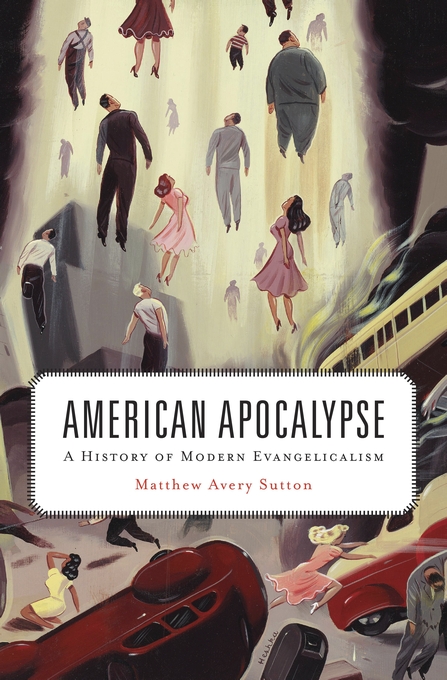
Why are our culture wars so durable? In his new book American Apocalypse, historian Matthew A. Sutton argues that the answer lies in the end of the world. But more evidence keeps piling up that there is a different answer, a better explanation. For some conservative religious people, the culture wars are about more than just winning elections or improving schools. The fight for America’s soul is nothing less than a battle to save people from eternal torment.

I Love You but It's the End of the World...?

I Love You but It’s the End of the World…?

Professor Sutton’s book is really terrific. He examines the history of what he calls “radical evangelical” belief as it emerged in the twentieth century. Unlike most historians, he doesn’t ignore important aspects of the radical evangelical family, such as Pentecostals and African Americans. The part that I’m struggling with is Prof. Sutton’s definition of radical evangelicalism. At its heart, Sutton says, American fundamentalism can be understood as

radical apocalyptic evangelicalism. . . . fundamentalists’ anticipation of the soon-coming apocalypse made them who they were.

In other words, Professor Sutton thinks that the heart and soul of fundamentalist belief comes from beliefs about the imminent and cataclysmic apocalypse. Our American culture wars are so virulent, he explains in chapter four, because fundamentalists and other radical evangelicals believe that they will be judged soon by a righteous God. They must fight against immoral movies, immoral booze, and other immoral trends because such things are part of the seductive Satanic lure of the end days.

Certainly, ideas of Bible prophecy and apocalypse are central to fundamentalist belief. But are they really as central as Professor Sutton contends? Are there other ideas that are even more important?

We stumbled across an evangelical warning this morning that raises the question again. In the pages of World Magazine, conservative evangelical Andree Seu Peterson explains why fundamentalists can’t relax. She does not mention the coming apocalypse. To Peterson’s way of thinking, there is a different reason why fundamentalists must continue fighting culture wars.

Peterson warns that things have changed fast in the last ten years. For conservatives, the question of homosexuality used to be cut-and-dried. Ten years ago, she says,

homosexuality was fringy and dangerous and you were dead set against it. Today homosexuality is the guy grilling steaks next door, waving to you over the picket fence, calling, “How about those Phillies!”

Conservatives might be tempted to accept homosexuals as part of God’s family. Christians might be tempted to love their neighbors, as Christ commanded. In secular terms, we might say, conservatives might feel pressure to adapt their beliefs to changing cultural norms.

Such thinking is dangerous, Peterson warns. Not because the world will be ending soon, but for a more basic reason, a reason more fundamental to fundamentalists. If you really care about your neighbor, Peterson explains,

If you want to talk about “love your neighbor,” need we mention that neighbors don’t let neighbors go to hell? … What good is all the good will you reap now when in the future Mr. Steak Griller next door curses you from across the chasm for your quiet complicity in his damnation?

When it comes to culture wars, this I-Love-You-but-You’re-Going-to-Hell logic is the equivalent of a perpetual motion machine. Whenever religious conservatives might be tempted to relax, to get along, to go with the flow, they can remind themselves of the eternal dangers of compromise. Even when it seems as if the kind thing to do, the loving thing to do, is to meet our neighbors in the middle, such apparent kindness, to some religious conservative, is a terrible mistake.

For some conservative religious people, culture-war issues are not just about accepting our neighbors’ “alternate lifestyles.” If they were, then we could all just get along. As Peterson tells the tale, we could all just smile and wave at one another, then go our separate ways. But for some conservatives, the culture wars have eternal stakes. If they don’t win, they will be guilty of sending people straight to hell.

Is that related to the apocalypse? Sure. Sorta. If Jesus will be returning sometime soon, suddenly and without warning, then these questions of damnation become even more urgent. But it is the damnation itself that is the crucial idea.

For those of us outside the circle of conservative evangelical belief, it can be difficult to understand the vital importance of the idea of damnation to evangelicals. For those of us who don’t believe in a real and terrifying hell, it can be easy to miss the enormous implications of such an idea. The apocalypse is only scary because of the threat of eternal damnation. The culture wars are only worth fighting if we can save some souls from such torment. Missionary work is only crucial because we need to spread the light as far as we can. Indeed, rather than defining fundamentalism as the radical evangelical belief in the apocalypse, we might better define fundamentalism as the radical evangelical belief in a real, eternal, and difficult-to-avoid Hell.

Certainly everyone interested in the nature of fundamentalism and culture wars should read Professor Sutton’s book. And maybe someone can explain to me what I’m missing. It seems to me, though, that the central idea to understanding what makes fundamentalists unique is hell, not just the coming apocalypse.

The Creeping “Christian” Coup

Take a stroll around America and you’ll see bajillions of “Christian” book stores, “Christian” schools, “Christian” churches. Of course, these institutions represent a certain sort of Christianity, a conservative evangelical Protestant one. There are lots of Christians who do not fit this definition of “Christian.” But a new set of survey data from the Pew Research Center for Religion and Public Life shows that the gap between the two seems to be narrowing. There are fewer Christians overall, but “Christians” are doing just fine.

Anytown, USA

Anytown, USA

So get ready for it. In the next week or so we’ll hear lots of exclamations about the recent Pew numbers. We’ll be told that the United States is becoming less Christian. As the folks at Pew tell us,

The Christian share of the population is declining and the religiously unaffiliated share is growing in all four major geographic regions of the country. Religious “nones” now constitute 19% of the adult population in the South (up from 13% in 2007), 22% of the population in the Midwest (up from 16%), 25% of the population in the Northeast (up from 16%) and 28% of the population in the West (up from 21%). In the West, the religiously unaffiliated are more numerous than Catholics (23%), evangelicals (22%) and every other religious group.

Does this mean we’ll see an abatement in culture-war scuffles over religion? Will America disagree less about abortion? Gay rights? School prayer? Evolution?

Not likely. In fact, we should expect the opposite.

Here’s why: Christianity’s share of the overall population might be dwindling, but evangelical Christianity has shrunk, if at all, by a much smaller percentage. In the words of the Pew report,

The new survey indicates that churches in the evangelical Protestant tradition – including the Southern Baptist Convention, the Assemblies of God, Churches of Christ, the Lutheran Church-Missouri Synod, the Presbyterian Church in America, 0ther evangelical denominations and many nondenominational congregations – now have a total of about 62 million adult adherents. That is an increase of roughly 2 million since 2007, though once the margins of error are taken into account, it is possible that the number of evangelicals may have risen by as many as 5 million or remained essentially unchanged.

I don’t know why the pollsters lumped Missouri Synod Lutherans in with evangelical denominations, but they certainly belong in the conservative camp. In any case, as anyone who knows the long history of our culture wars is aware, the fiercest fights have usually been between liberal and conservative Protestants.

Many of our liberal and secularizing culture-war leaders have come from mainline Protestant denominations. These days, for example, from the United Church of Christ, the denomination formerly known as Congregationalism, The Reverend Barry Lynn heads the liberal Americans United for Separation of Church and State. In the 1920s, as I argue in my first book, liberal Protestants such as Edward Birge and Edwin Conklin led the fight for evolution education.

If that sort of liberal Christianity continues to dwindle, it is entirely possible that Americans will come to agree that to be a “Christian” means adhering to a conservative evangelical Protestant faith. It might even snowball. The new Pew numbers show that evangelicalism is the only major religious group to pick up adherents from other churches. As they put it,

The evangelical Protestant tradition is the only major Christian group in the survey that has gained more members than it has lost through religious switching. Roughly 10% of U.S. adults now identify with evangelical Protestantism after having been raised in another tradition, which more than offsets the roughly 8% of adults who were raised as evangelicals but have left for another religious tradition or who no longer identify with any organized faith.

If evangelical Christianity bucks the trend of shrinking Christian identification, it makes sense to think that soon more and more Americans will identify evangelicalism with Christianity as a whole. What might that mean?

It’s impossible to predict, of course, but I’ve got a couple of hunches. First, we’ll see a stronger distinction between liberal evangelical Protestants and conservative ones. There is a strong tradition of politically progressive evangelicals, but its story tends to get swamped when people talk about evangelicalism.

Second, we’ll see a continuing weakening of the racial divisions between conservative evangelicals. As the new Pew report asserts, “Black Protestant” groups are also growing. But the Pew pollsters don’t differentiate between very different sorts of African American evangelicals. If evangelicalism becomes more of a stand-in for Christianity as a whole, pollsters will begin to connect conservative evangelicals across the race line. The interesting questions will become how many conservative evangelicals there are out there, not how many “Black Protestants.”

Third, and for SAGLRROILYBYGTH perhaps the most interesting, we will likely see a heating-up of culture-war rhetoric. Conservative evangelicals will frame themselves more and more vociferously as the voice of “Christianity.” With smaller numbers of liberal Christians to naysay, the identification of conservative evangelicals with the entire Christian community will become ever tighter.

Bush at Liberty: “Seven Thousand Acres of Shared Conviction”

He didn’t have much choice. These days, any front-runner for the Republican Party presidential nomination seems required to make a speech at Liberty University. But when Jeb Bush gave his commencement address at Liberty this week, he did not have to emphasize one of American fundamentalism’s deepest-held convictions. But he did.

As the sophisticated and good-looking regular readers of I Love You but You’re Going to Hell (SAGLRROILYBYGTH) are well aware, I’m working on a book about the history of schools like Liberty. And among the issues I’m struggling with are the distinctive traditions that set off fundamentalist and evangelical colleges from other religious schools.

Certainly, as Roger Geiger outlined in his definitive new history of American higher ed, in the United States every religious group has scrambled to establish its own colleges and universities. It has become a way for religious groups to confirm their legitimacy and American-ness.

So, for Catholics, and Lutherans, and Methodists, and Nazarenes; for Muslims, and Jews, and Mennonites…every religious group has its own network of schools that train its young people in its distinctive faith traditions as well as in professional skills and the liberal arts.

Unlike most of those other traditions, however, the network of fundamentalist colleges that developed since the 1920s has seen itself not only as a haven from a hostile wider American culture, but more specifically as an enclave of true Americanism. Unlike most other conservative Protestants, even, fundamentalists have a fairly unique proprietary feeling about the US of A.

Back in the day, brainy Catholic kids might have gone to Georgetown or Boston College, either to become priests or just become educated Catholics. And they did so in order to study in an intellectual refuge from the relentless anti-Catholicism that permeated mainstream culture for so long.

Since the 1920s, brainy evangelicals and fundamentalists have gone to Bob Jones or Wheaton or Liberty, either to become pastors or just to become educated evangelicals. But these evangelical schools were not seen as islands set off from a hostile mainstream America. Or, to be more specific, they were seen as islands, but only in the sense that they represented a last resort of true Americanism. Such schools often talked about their need to preserve a slice of the true America.

Since the 1950s, those schools that aligned with the more moderate “evangelical” wing of fundamentalism tended to downplay this tradition. Schools who clung to the “fundamentalist” label—such as Bob Jones, Pensacola Christian College, the late Tennessee Temple University, and Liberty—often doubled down on their sense of usurped Americanism.

When Governor Bush made his Liberty speech, he made the usual paeans to religious freedom and religious liberty. But he also went the extra rhetorical mile to endorse Liberty’s sense of itself as an outpost of true Americanism. As Bush put it,

How strange, in our own time, to hear Christianity spoken of as some sort of backward and oppressive force. Outside these seven thousand acres of shared conviction, it’s a depressing fact that when some people think of Christianity and of Judeo-Christian values, they think of something static, narrow, and outdated. We can take this as unfair criticism, as it typically is, or we can take it as further challenge to show in our lives the most dynamic, inclusive, and joyful message that ever came into the world.

“Seven thousand acres of shared conviction”! A phrase surely calculated to warm the hearts of Liberty’s leaders. The implication, clearly, is that Liberty represents an enclave of purity, a reservation for America’s Moral Majority, which promises to preserve American values until that day that they can be spread back into the rest of America’s 2,432,000,000 acres.