Is This Progressive College Anti-Science?

How do you know your gender?  At the conservative Weekly Standard last week, Jonathan Last took Smith College to task for leftist anti-science when it came to gender identification.  Are Last’s accusations fair?

First, some background.  Smith College, an historic women-only school in western Massachusetts, has finalized its position on transgender students.  In short, the leaders at Smith decided on what we might call a “past-the-gate” rule.  If a student identifies as a woman when she applies, she may be admitted.  This is true no matter what gender she was assigned at birth.  If, however, someone identifies as a woman as a freshman, but transitions to a man during his time at Smith, he will be permitted to remain, even though Smith maintains its women-only rule.

Make sense?  In other words, the leaders at Smith want to recognize students’ right to identify their own genders.  It is not biological hardware that determines gender, Smith agrees, but rather a person’s identification.

Is this anti-science?  Last thinks so.  As he puts it, this decision

has shown that the left’s allegiance to capital-“S” Science is only a sometimes thing. Progressives believe that science contains the definitive answers to all questions—except when it doesn’t, and we must accept the idea of deep, human truths, which might contradict science.

Of course, anyone who spends time with culture-war issues knows that the Left embraces plenty of anti-science.  There are lots of progressives who oppose vaccines and genetically modified food.  But this transgender case seems trickier.

Last accuses Smith of ignoring the claims of science.  He implies that the scientifically verifiable claims of biology should be given more weight than people’s subjective ideas about their true gender identification.

Deluded?  Or scientific?

Deluded? Or scientific?

Now, maybe I’m blinded by my progressive prejudices here, but isn’t there a scientific reason to believe that gender is something beyond simple biology?  In other words, we may be born with primary and secondary sexual characteristics, but there is a divide between having certain biological characteristics and identifying as a particular gender.

So Last’s accusation raises an interesting question.  If we view gender identification as merely a belief, a feeling, or a choice, then Smith College’s decision seems to place those non-scientific things above scientific proofs.  But if we trust mainstream scientists such as those at the American Psychological Association, gender identity is something more.

So who are the real anti-scientists here?  Conservative intellectuals who deny the internal aspects of gender identity?  Or progressive college leaders who ignore biological verities to respect students’ preferences?

From the Archives: A Creationist Mother’s Day Puzzler

What’s a Presbyterian to do? Especially at the staunchly conservative Princeton Seminary at the end of the nineteenth century, Presbyterian intellectuals wrestled with the questions posed by their creationist theology. One problem remained particularly stubborn and particularly relevant to Mother’s Day.

B.B. Warfield was no liberal. He was largely responsible for the “Princeton Theology” that bequeathed to American fundamentalism a vital notion. Along with his colleague A.A. Hodge, Warfield argued that we must read the Bible as inerrant in its original autographs. That is, later translators may have messed things up here and there, and we may certainly err in our understanding of the Bible, but real orthodoxy requires us to believe that the inspired writers of the Bible did not make mistakes.

All about Eve...

All about Eve…

Among the many gems in Bradley Gundlach’s book about Princeton and the “evolution question,” we find Warfield’s notes about Eve and evolution.

In the late 1800s, Warfield and the other lions of orthodoxy at Princeton wondered what evolutionary ideas meant for orthodox belief. Could an evolutionary theory fit in with a universe that had been planned for eternity by an all-knowing God? If evolution could be separated from its materialistic assumptions, could it be used as a way to understand God’s plan for humanity?

As Professor Gundlach argues, time and again Princeton’s conservative thinkers said yes. They objected to the assumptions that some people wrongly associated with evolution—that it was random, directionless, and atheistic, for instance. But they embraced the notion that God had developed all life from earlier forms. Just as a tree rests within the potentiality of a seed, so all life may have developed from simpler forms, the Princetonians insisted.

In short, most Old Princetonians embraced what has been called “theistic evolution,” a notion similar to what some folks today call “evolutionary creationism.”

There was one tough sticking point, however. As Professor Gundlach describes, in Warfield’s lectures on anthropology from the late 1800s, he struggled with the theological implications of evolution. Warfield asked himself and his students if a God-guided evolution was

consistent with the Biblical account of the origin of things in general & of man in particular.

According to Gundlach, Warfield answered with a qualified yes. The only problem Warfield saw was at the root of Mother’s Day. As Warfield explained in his anthropology class,

I am free to say, for myself, that I do not think that there is any general statement in the Bible or any part of the account of creation, either as given in Gen I & II or elsewhere alluded to, that need be opposed to evolution. The sole passage which appears to bar the way is the very detailed account of the creation of Eve.

The rest of the Genesis account of creation, Warfield believed, could be read without doing violence to its original meaning as a poetic description of evolution. But Eve was different. The Mother of Humanity was made by a special divine act, in language starkly different from that of the rest of Genesis.

For Warfield, at least, evolution need pose no problem for Christians. Only the question of Eve needed to be resolved.

Climate-Change Party Crashers

I love the analogy, but I don’t know if the story sounds realistic.

Over at the National Center for Science Education blog, Executive Director Ann Reid tells a story about converting skeptics into climate-change believers. Dr. Reid tells a two-part tale of her encounter at a dinner party with someone who does not accept the scientific consensus on climate change. She explains how she made her case.

Full disclosure: I’m a big fan of the NCSE. Unlike some of my fellow evolution mavens, I appreciate the NCSE’s accommodating attitude toward life in a pluralistic society. I’ve personally seen the ways leaders at the NCSE speak respectfully and productively with creationists. Instead of labeling conservatives “the enemy,” the thoughtful activists at the NCSE try to understand creationist thinking, try to see things from a creationist perspective.

Will she be invited back?

Will she be invited back?

But Director Reid’s story still sounds a little outlandish to me, on two counts.

Before I describe my objections, let’s hear the story. Dr. Reid tells a two-part tale (one and two) in which she chats amiably at a dinner party with a scientist who believes that today’s climate changes are just part of naturally occurring cycles. What to do?

Dr. Reid listens to the skeptic’s reasons, then lays out her best case. One doesn’t need to know everything about everything, Dr. Reid says, to see the overwhelming evidence. Consider just a couple of studies that show the drastic warming of the North American landmass. Species are moving north. And planting zones are shifting, too.

What did her interlocutor say?

Well, I’d never heard that before. That’s very interesting.

The savvy Dr. Reid knows that she won’t convince every skeptic this way. She’s not even sure she convinced this one guy.   But, she concludes,

I certainly made him think a little bit. I didn’t get into a debate, and I gave the rest of the table some conversational fuel for the next time they are seated next to a skeptic. Not bad for one dinner party. Give it a try! And let us know how it turns out.

Can it work? Like Dr. Reid’s dinner-party companion, I’m skeptical. Here’s why:

First, I agree that a Thanksgiving dinner is an excellent analogy for our continuing culture wars over climate change and other educational issues. But the analogy really points in a different direction.

As I argue in my new book, conservative activists have usually been able to exercise a veto over new ideas in America’s public schools. And they do so in a dinner-party way. That is, in America’s public schools—like at America’s dinner-party tables—controversial issues are anathema. It is not acceptable at dinner parties (except, of course, at really good dinner parties) to lambaste one’s fellows with offensive phrases or ideas.

Across the twentieth century, conservative activists have used this sort of dinner-party mentality to restrict significantly the advance of progressive ideas in America’s schools. Should we teach evolution? Not if it’s controversial! Should we teach kids how to have safer sex? Not if it’s controversial! Should we teach kids that boys can like pink toys? …that good books sometimes include bad words? …that every idea should be questioned, even religious ideas? …that every country has its flaws, even the USA? …and so on?

When an idea can be labeled “controversial,” public schools will flee from it in terror, as timid as a dinner-party host who has invited the boss over.

In generation after generation, conservatives have been able to maintain fairly traditional classrooms—though the vision of “tradition” has changed over time—by exercising this sort of dinner-party veto. Conservatives do not need to prove their case against progressive textbooks, or science, or literature. All they need to do is prove that those things are considered offensive by some, and the dinner-party rule kicks in.

Of course, that’s not the only reason to be skeptical about Dr. Reid’s optimistic story. In real life, most encounters like hers will go very differently, for a fundamental culture-war reason.

The way she tells the tale, her two mind-blowing pieces of evidence got everyone thinking. They exposed the skeptic to a new way of thinking about climate change. And her story ended there.

In real life, educated and informed culture-war partisans are not simply ignorant of the other side. Creationists know a lot about evolution. Wallbuilders know a lot about academic history. Abstinence-only educators know a lot about sexually transmitted diseases.

Dr. Reid’s dinner-party companion would likely know a lot about climate change. At the very least, he would have some of his own party-pleasing evidence ready to share. Instead of receiving Dr. Reid’s examples in humble silence, he would likely have countered with his own show-stopping studies. The rest of the dinner table would be left in the same position as it was when the party started: Confronted with two competing and seemingly convincing arguments, from two authoritative-seeming sources.

How should they pick?

Like most of our educational culture-war issues, this climate-change dinner party would likely come to a more obvious conclusion. Instead of fighting vehemently for one side or the other, instead of splitting the dinner table into hostile camps, most dinner parties come to a different conclusion. Like public schools, dinner parties choose to avoid any controversial subject, rather than get into a down-and-dirty debate.

Of course, I don’t get invited to many dinner parties, so I don’t really know what I’m talking about. Does my dinner-party analogy seem too cynical? Too negative?

Yearnin’ for the Good Ol’ (Earth) Days

How old is the planet? For some creationists, it may seem like an ancient bit of Christian orthodoxy that God created the whole thing less than ten thousand years ago. But we see more proof today that the idea of a young earth is a relatively novel idea among conservative Christians.

Anyone who has done their homework knows the story. As historian Ronald L. Numbers outlined in his definitive book The Creationists, most conservative Christians believed in an ancient earth until the 1960s. Even in the hottest days of anti-evolution controversy in the 1920s, fundamentalist leaders usually felt no need to believe in a young earth.

As 1920s fundamentalist leader William Bell Riley put it in 1927, there was not

an intelligent fundamentalist who claims that the earth was made six thousand years ago; and the Bible never taught any such thing.

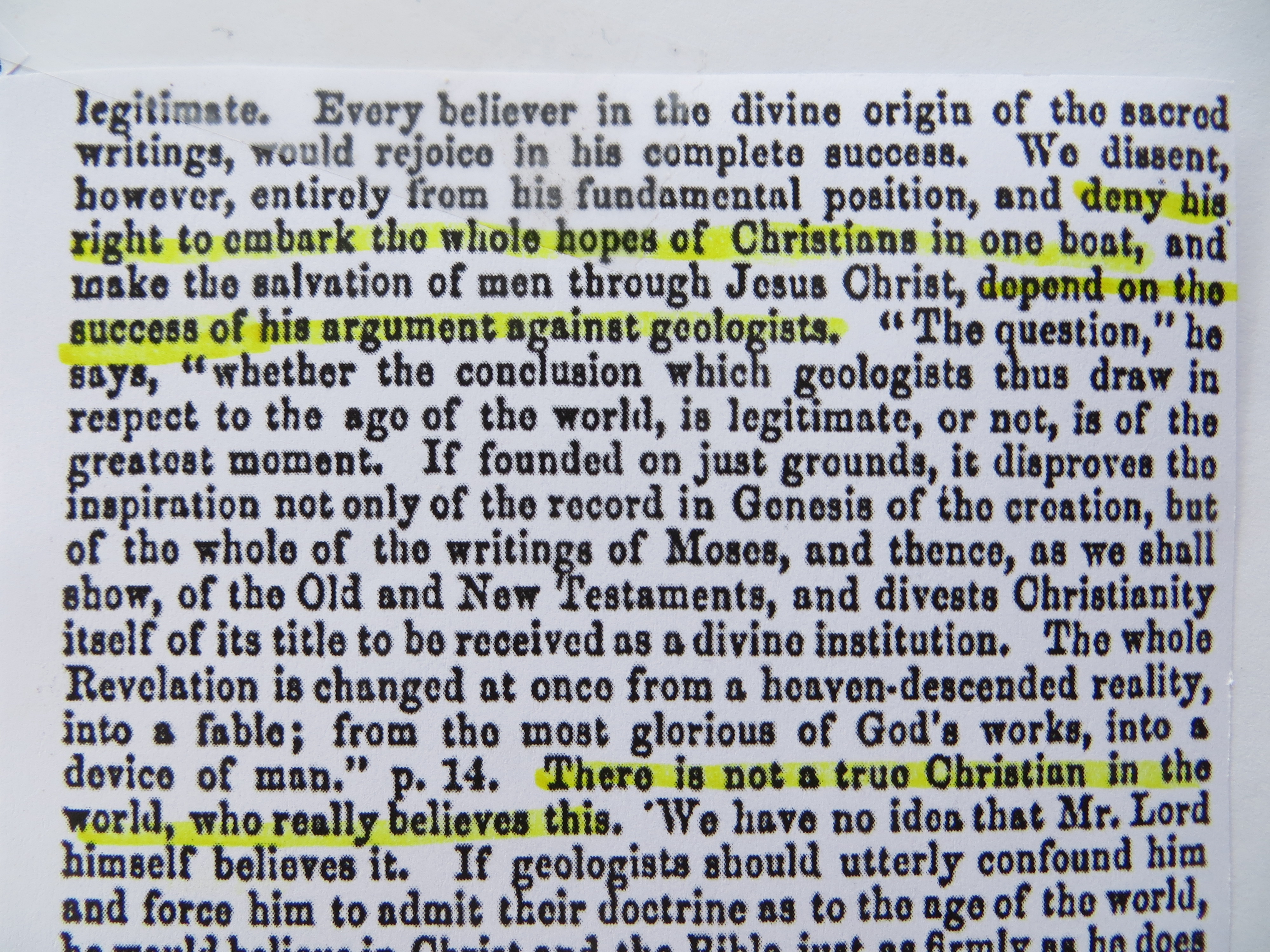
As I make my way through Bradley Gundlach’s excellent book Process & Providence, I came across a similar example from the 1800s. Back then, Princeton Seminary was the redoubt of thinking creationists. In 1856, the school’s journal offered a short review of a new book by David N. Lord, Geognosy, or the Facts and Principles of Geology against Theories.

In his long book, Lord argued that mid-nineteenth-century geologists often missed the boat. Such foolish pseudo-scientists, Lord wrote, mistook the boundaries of their own science and slid into both scientific and theological error when they suggested that the earth must have existed for millions of years.

Antique appreciation...

Antique appreciation…

Today’s conservative creationists might think that any self-respecting creationist would applaud Lord’s work. And the guardians of orthodoxy at Princeton did, to an extent. They described Lord’s goal as “elevated and holy.” His conclusions, however, did not sit well with the Old Princetonians.

In a way that might be surprising to today’s young-earth creationist crowd, the theologians at Princeton assailed Lord’s attempt to defend Scripture by attacking emerging geological science. Why? Not because they doubted the inerrant nature of the Bible. No, the Princetonians instead refused to allow their religion to be bound and hampered by any possible scientific discovery.

They “dissent,” the reviewers wrote, from Lord’s

Fundamental position, and deny his right to embark the whole hopes of Christians in one boat, and make the salvation of men through Jesus Christ, depend on the success of his argument against geologists.

Lord had argued that the new geology threatened to disprove Genesis. It was imperative, Lord wrote, for thinking Christians to disprove geology instead. Balderdash, huffed the Princetonians: “There is not a true Christian in the world, who really believes this.”Good old days 2 PRIME

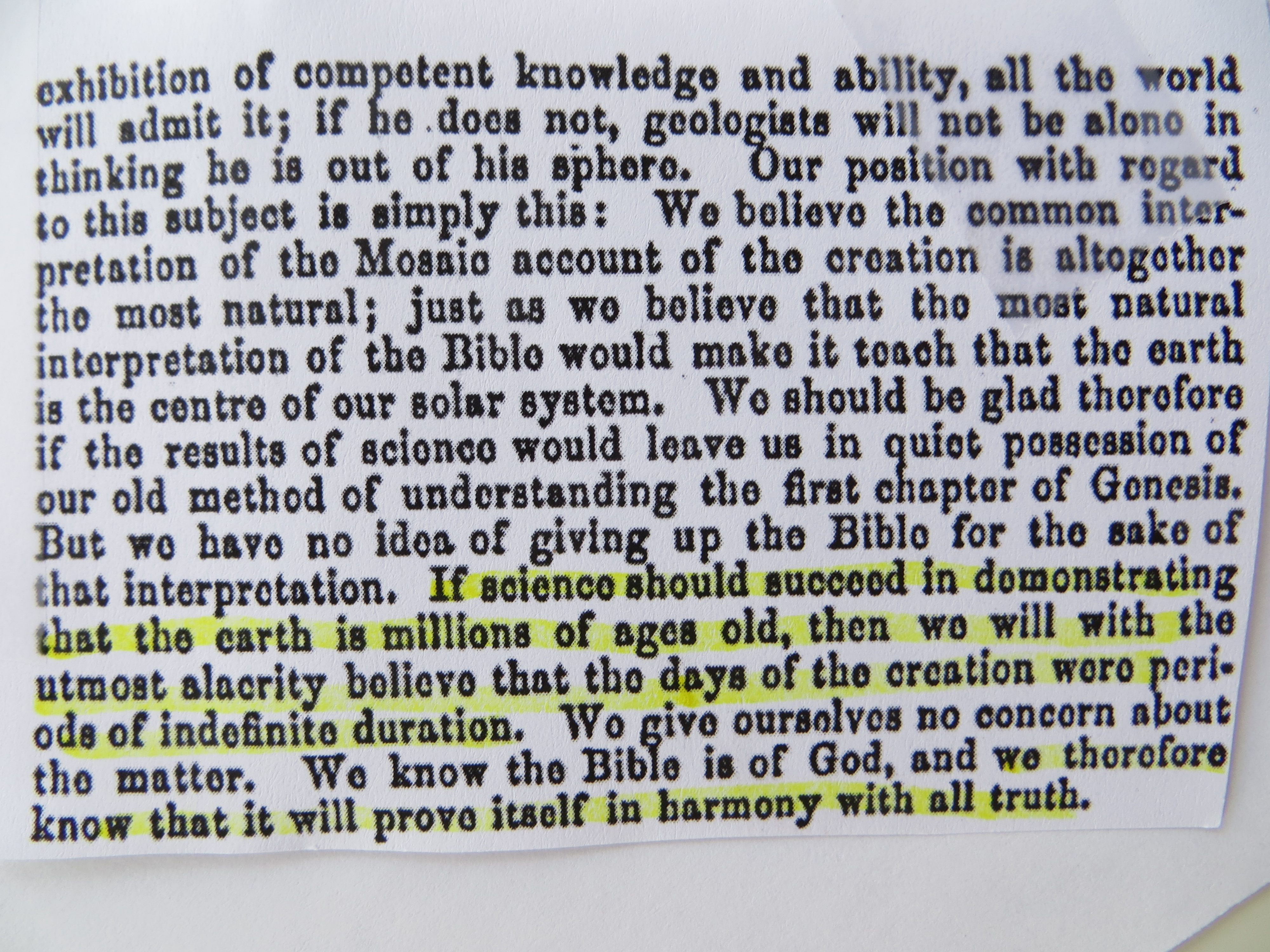
Instead, the old-earth creationists at Princeton insisted that creation was an established fact, whichever way the scientific winds might blow. “If science,” they concluded,

Should succeed in demonstrating that the earth is millions of ages old, then we will with the utmost alacrity believe that the days of the creation were periods of indefinite duration.

Creationism and Job Security

Creationism is more than just an idea, more than just a choice. In the United States, creationism represents a complete set of dissenting institutions: Schools, churches, publishing houses, summer camps, etc. These institutions do more than create an intellectual subculture. As we are reminded this morning, they also provide the nuts-and-bolts support creationists need in order to thrive.

For some of us outsiders, it can be difficult to understand how a creationist can remain so firmly entrenched in her beliefs when the claims of mainstream science seem so compelling. Recently, for example, Professor Dan Kahan drew attention to the ways creationist students can do well in mainstream science classes. He described the case of “Krista,” a high-school senior who excelled in her biology class while holding on to her creationist beliefs.

Krista wants to be a veterinarian. And, as Kahan points out, she might not be able to maintain her “cognitive dualism.” If she doesn’t, though, Kahan insists it will not be due to some sort of “logical or psychological contradiction.” To the contrary, Kahan concludes, Krista’s eventual “upsetting incompatibility” will be the result of

an imperfection in the constitution of an aspiring Liberal Republic of Science that hasn’t yet acquired the knowledge, created the institutions, and cultivated the public mores necessary to quiet the forms of cultural status competition that force diverse citizens to choose between using their reason to know what is known by science and using it to express their defining moral commitments (Elsdon-Baker 2015; Hameed 2015; Kahan 2015; Kahan in press).

In other words, if future Krista is forced to choose between the mainstream science she uses in her day job and the dissenting science she uses in her faith life, it will be because the United States has several competing scientific authorities. Our society, Kahan argues, has not yet figured out a way to decide between the scientific claims of creationism and the scientific claims of mainstream evolutionary science.  People like Krista (and the rest of us) are forced to rely on authorities to tell them which science is appropriate for them.

In her day-to-day life, though, Krista will likely be able to get by without straddling the boundaries between these competing scientific realms. More likely, Krista will continue her science career without ever needing to wrestle with its apparent contradictions. Her potential success will be due at least in part to the fact that creationists have successfully created institutions and cultivated creationist mores that allow creationists to use mainstream science without giving up their theological reservations. Perhaps even more important on the day-to-day level, Krista may succeed as a creationist veterinarian because her job might depend on it.

In academic realms, at least, creationism can be a big career boost. It has always been thus. As Bradley Gundlach has described in his great book Process & Providence, creationist colleges have often guaranteed steady work for creationists. In 1878, back when Princeton University and Princeton Seminary remained dedicated to a religious interpretation of emerging evolutionary science, school leaders worked hard to woo top creationists. The school took unprecedented measures to lure John William Dawson away from McGill University in Montreal. At that time, Dawson was one of a dwindling band of scientists with mainstream credentials who still disputed the transmutation of species.

Take this job and love it...

Take this job and love it…

Dawson didn’t come. But Princeton’s herculean efforts to get him demonstrate the possible career upside of creationism. If a geologist, or a veterinarian, or a science teacher can represent a dissenting creationist idea, then he or she will be uniquely attractive to the many institutions that insist on creationism.

Don’t believe it? Check out this morning’s job post on Ken Ham’s blog. As Ham explains, he doesn’t usually post such things, but he recently met with a school administrator from Kansas City. That school principal needed a science teacher, and he only wanted one who signed on to Ham’s brand of young-earth creationism. The school required a teacher who knew creation science and was “trained in apologetics.”

For students like Krista, as Professor Kahan argues, belief in a young-earth need not lead to any sort of intellectual discomfort at all. And, as this job posting reminds us, Krista might feel significant practical incentives to ignore any discomfort she might feel.

Commitment to a young earth and a special divine creation might, after all, offer increased job security in the nationwide network of dissenting creationist institutions.

Creationists against Racism

Do they really mean it?

These days, leading creationists claim to be anti-racist. But fundamentalist Protestantism has a sour history of racism. Do today’s creationists have a fair claim to be authentically anti-racist? Short answer: Yes. Though it might muddy our progressive assumptions, we need to recognize that dissent from mainstream science has also often included dissent from mainstream racism.

Today’s conservative pundits usually don’t like to talk about it. But historically, as I argue in my new book, in the United States conservatism has been tied pretty closely to racism. And as we’ve seen in these pages, white racism has enjoyed strong support within fundamentalist circles.

Let me be clear: Unlike some progressive pundits, I’m not insisting that white conservatives these days are *really* all a bunch of racists. And unlike some progressive historians, I don’t believe that the *real* explanation for the politicization of conservative evangelicals in the 1970s was white racism. But the historical record is pretty clear: Throughout most of the twentieth century, white conservatism was bound up with traditional notions of white dominance.

There is, however, one glaring and important exception to this rule. Among white conservative creationists, there has been a long record of anti-racism. This has usually not been motivated by a civil-rights style of social activism, but rather from creationism itself. If Adam and Eve were the literal historic parents of all humanity, then there can’t be real differences between the races.

Today’s leading young-earth creationist ministry, Answers In Genesis, has long trumpeted its anti-racist creationism. As AIG likes to explain, racism can’t survive if we really believe in Adam, Eve, and Noah’s Ark.

AIG’s position is nothing new among dedicated creationists. As Bradley Gundlach argues in his terrific new(ish) book, Process & Providence, at the dawn of our modern evolution/creation battles, creationists defined themselves as opposed to racist mainstream science. In 1859, Professor Gundlach writes, the main evolutionary question at conservative Princeton Seminary was not Darwin’s new book. Rather, the creationists at Princeton in 1859 were outraged by the new scientific fad of “polygenism.” Leading contemporary scientists embraced the notion that human races were actually different species. Creationists at Princeton said no.

As the creation/evolution battles heated up in the 1920s, too, the anti-evolution crusade had the better claim to anti-racism. White mainstream science at the time often proved friendly to notions of “scientific racism.” As I describe in my new book (page 49 for those of you following along at home), leading evolutionary pundit Henry Fairfield Osborn supported both evolutionary theory and the racism that he thought went along with it.

Of course, simply because dedicated and consistent creationists have often been anti-racist, we can’t conclude that all creationists are anti-racist. Perhaps most famously, Bob Jones University in South Carolina has been fervently creationist AND fervently racist throughout most of its history.

The point here, rather, is that mainstream science has not always been right. Creationists these days can legitimately claim a more consistent history of anti-racism than can mainstream scientists. The same theological impulse that leads young-earth creationists to insist on a young earth also leads them to insist that all of humanity has the same roots.

What’s Left? Bernie Sanders on Education

It doesn’t really matter. But it has become a central part of the process nonetheless.

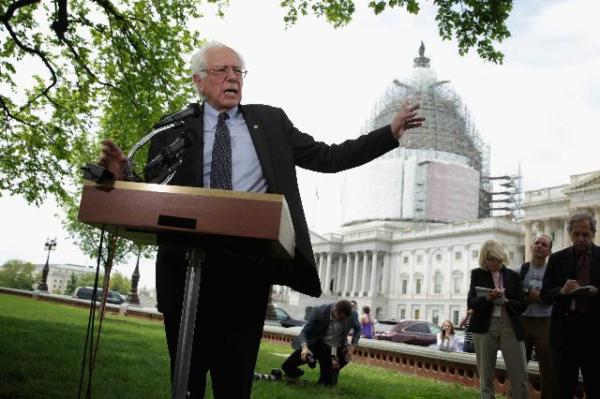
Even though the vast majority of thinking and funding of public schools is still done at the state and local levels, presidential candidates these days spend a good deal of time sharing their plans for fixing America’s schools. On the right, we’ve heard from all the GOP contenders. This week, Forbes Magazine summed up a few of Bernie Sanders’s positions on education. Some of the ideas are predictable, but some are surprising.

...and to my left...

…and to my left…

On the conservative side, candidates have a few hoops to jump through. Whatever their personal beliefs, contenders have to sound at least friendly to creationism. And these days—though as I argued recently this has not always been the case—GOP hopefuls have to denounce furiously any federal role in local schools.

Senator Sanders has a little more wiggle room. As a self-declared socialist representing the Peoples’ Republic of Vermont, Sanders has no real chance of snatching the nomination from front-runner Hillary Clinton. So his campaign can be more about ideas than votes.

What does the Socialist Senator say about schools?

First—no surprise—he has denounced the “privatizing” tendencies of vouchers and charter schools. Also, in February Senator Sanders suggested a federal program to cut college tuition in half. The federal government, Sanders thinks, must stop making profits off of student loans. More radically, Senator Sanders wants to make public universities tuition-free. Beyond higher education, Sanders has pushed for better pre-school options for all. And he has decried the fact that “the top 25 hedge fund managers earned more than the combined income of 425,000 public school teachers.”

It all fits. But there are some ideas that are conspicuous by their absence. Unlike other progressive pundits, we don’t hear from Senator Sanders an attack on the dehumanizing standardized tests that have taken over so many public schools. Nor do we see a strident defense of teachers’ unions.

Here in the Great State of New York, we’ve seen how protest candidates in the Democratic Party can win votes by adopting those popular positions. It’s still early days, of course, but we can’t help but wonder why Senator Sanders has not made more noise about these issues.

Required Listening: Us & Them

Can we talk across the culture-war divide?  That’s the question journalist Trey Kay is asking in his new podcast series, Us & Them.  Is it worth talking to someone with whom we have fundamental disagreements?

In his first episode, Trey Kay describes his culture-war-defying friendship with conservative activist Alice Moore.  Kay first got to know Alice Moore when he was working on an earlier documentary about the 1974-75 textbook controversy in Kanawha County, West Virginia.

As the sophisticated and good-looking regular readers of I Love You but You’re Going to Hell (SAGLRROILYBYGTH) are well aware, this Kanawha County story also plays a prominent role in my recent book about educational conservatism.  Alice Moore played a leading role as a conservative leader in that tumultuous school boycott.

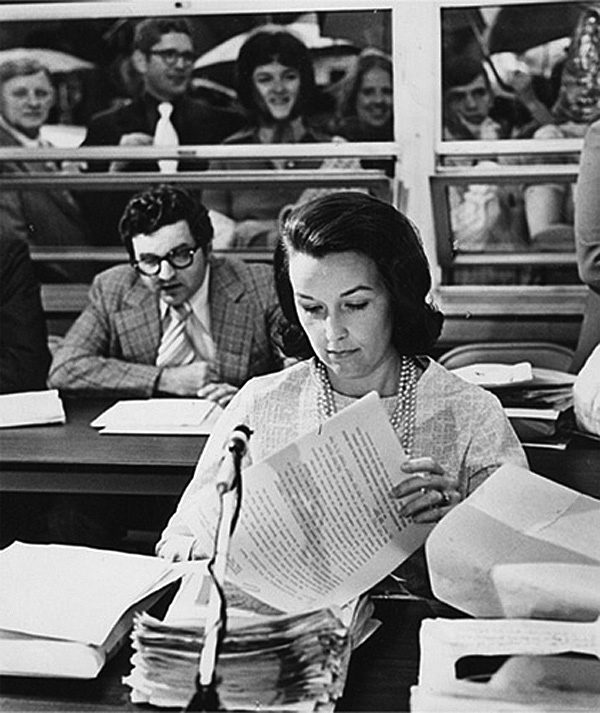
Ms. Moore makes her case in a crowded 1974 school-board hearing...

Ms. Moore makes her case in a crowded 1974 school-board hearing…

In his first podcast, Kay describes his continuing friendship with her.  The two of them inhabit different culture-war realms; Kay is a self-identified “blue-state liberal,” while Moore is a “red-state conservative.”  More than that, Ms. Moore believes in a conservative evangelical Protestantism that liberals often find intellectually outrageous.

Can the two of them be friends?

At the very least, it would take careful diplomacy on both sides. As Kay asked himself, “I have core beliefs.  What if I truly felt that they were under attack?”

Check out the whole episode when you’ve got a few spare minutes.  Kay and Moore manage to do the things friends do: Get a meal together, talk about politics and religion.  Yet neither of them budges an inch on his or her core beliefs.

Are such conversations worth having?  As Kay includes in this episode, his editor wasn’t sure.  She told Kay, “I don’t know how you can stand to have this conversation.”  It seemed to Kay’s editor that he was listening to Moore, but Moore wasn’t listening back.

Frenemies?

Frenemies?

Yet Kay remained convinced there was some value to such outreach programs.  He asked historian Jonathan Zimmerman’s opinion.  Zimmerman insisted that Americans need to speak with each other; we need a common language to discuss “American problems . . . shared by all of us.”  The most dangerous culture-war idea going around, Zimmerman said, is that those who disagree with us are either morally warped or ignorant.

Trey Kay hopes his new series will help figure out “what might happen if we take the time to listen to each other.”  Can it work?

Ah Ha! Proof of Liberal Profs!

HT: VB

Everyone knows college professors are a liberal bunch, right? A new study from Harvard University, a school just outside of Boston, Massachusetts, seems to confirm this beloved stereotype. But is it really proof?

First, some background. As the sophisticated and good-looking regular readers of I Love You but You’re Going to Hell (SAGLRROILYBYGTH) are well aware, the notion that the professoriate skews liberal is a deeply held culture-war notion. Conservatives decry it, even pushing through a mandatory conservative chair at Colorado University. Even perspicacious liberal thinkers worry about it. Historian Jonathan Zimmerman of New York University, for example, has suggested that true intellectual diversity requires some sort of affirmative action for conservatives.

It is not a made-up phenomenon. As Neil Gross argued in his new(ish) book, Why Are Professors Liberal and Why Do Conservatives Care?, there really does seem to be a tilt toward liberalism in higher-ed faculties. Not because liberals are smarter (sorry, liberals), and not because conservatives suffer from discrimination (sorry, conservatives), but because historical patterns have pushed more liberals into the profession.

An article in the Harvard Crimson describes the political donations of the faculty. Turns out, those faculty members who give money to political parties tend to give almost only to the Democrats. In the Arts & Sciences faculty, the majority tipped a whopping 95.7% in the direction of the Democratic Party, compared to a measly 3.7% who gave to the Republican Party. Things were a little more balanced in the Business School, with 36.7% of donations going to the GOP. In some departments, such as the Graduate School of Education, a Brezhnevian 100% of donations went to the Democrats.

Should we worry?

If we hope for a system of higher education that pushes students to think critically about a range of issues, should these numbers cause us to consider home-colleging our students? Both for us liberals and our conservative colleagues, is it time to think about creating a better sense of real intellectual diversity on college faculties?

I think not, for a couple of reasons. First, as both the Crimson article and Professor Gross’s book insist, a tilt toward the Democratic Party does not equate with a rigid groupthink. From the history of the culture wars, we can see proof that conservatives do very well in schools dominated by liberal faculties.

Leading young-earth creationist Kurt Wise, for example, studied under the vehemently anti-creationist Stephen Jay Gould at Harvard. Both scholars reported a cordial and productive relationship. Dr. Wise is not alone. For generations, leading conservative scholars, intellectuals, and pundits have done just fine in schools with liberal-leaning faculty. From William F. Buckley Jr. at Yale to Dinesh D’Souza at Dartmouth, nerdy conservatives thrive in elite colleges.

Perhaps the explanation can be seen in the work of sociologist Amy Binder. Binder and a colleague studied conservative students at two elite colleges. Binder argued that conservative students are certainly shaped by their environments. But at both a large western public flagship college and an elite eastern one, conservative students honed and shaped their conservatism, rather than being groomed away into liberal ideologies.

More important, perhaps, is the fact that almost nobody actually attends the elite colleges that culture-war punditry focuses on. Harvard, Yale, Dartmouth, Colorado, Brown, NYU…perhaps the faculties on these schools tip heavily in a liberal direction. But very few students go to these schools. Of the young people who go to college, many more of them go to less-fancy places.

My hunch—and I’d love for someone to get some numbers to back this up or refute it—is that the faculty at less-elite colleges tends to be more politically and culturally conservative. From the field of teacher education, I have heard anecdotes that suggest it’s true.

The Crimson article gives us some proof, but not about higher education. Rather, all we see is that Harvard faculty tip liberal. Harvard may have plenty of influence, but it doesn’t actually do much. Though the alumni might bother people with their smug self-satisfaction, there really aren’t too many of them around.

Sex Sells, but Who’s Buying?

The kids are alright. And if they’re not, all of our culture-war fuss ‘n’ stuff over sex in schools is not making too much of a difference. Thanks to the inestimable Jonathan Zimmerman, Binghamton University last night enjoyed a mind-blowing discussion of sex education worldwide. Among the many takeaway lessons, Professor Zimmerman argued that culture-war fulminations about sex ed generally have only a very tenuous relationship to what children actually learn about sex.

As the sophisticated and good-looking regular readers of I Love You but You’re Going to Hell (SAGLRROILYBYGTH) are well aware, sex education has long been a lightning rod for controversy in the USA. Liberal activists insist that this is literally a life-and-death matter, with the rise of HIV and unplanned pregnancies. For their part, conservatives have blasted liberal efforts as something akin to child pornography. Or even as a scheme by sex predators to loosen up the victims.

In his talk last night on the scenic campus of Binghamton University, Prof. Zimmerman shared some of his work from his new book, Too Hot to Handle: A Global History of Sex Education. Over the course of the twentieth century, sex education has spread around the world, led in many ways by pioneers in the United States. What people have wanted out of sex ed, and the shape sex ed has taken, have continually been subject to withering debate.

Who's for it?

Who’s for it?

Sex ed—and fights over sex ed—have a long history, back to about 1914. But things changed radically with the introduction of HIV. Since that time, everyone involved has agreed that sex ed is a drastic necessity. But there have been bitter disagreements about what sex ed should look like.

Two distinct types of missionary outreach have competed for global influence. On one hand, we have what might be called the “health and autonomy” position. Advocates of this type of sex ed—which, for the record, is generally something your humble editor supports—want children to have maximum information about sex. This might be touchy, but children need to learn how sex works. Perhaps more important, children need to learn to assert control over their own sexuality. Coerced and risky sex are the twin scourges against which effective sex education should be designed to fight.

On the other side, conservatives have preached a moral approach, something we might call the “just say no” school. Around the world, activists have insisted that the best offense in the case of sex is a good defense. If traditional courtship patterns can be preserved, if sex can be something done only within the bounds of a heterosexual marriage, then the blights of disease and exploitation can be eliminated.

From New York to Auckland, Dhaka to Copenhagen, these sorts of culture wars over sex education have raged for a generation. During that time, leaders and organizations have come and gone. Buzzwords and strategies have mutated and metastasized.

One thing that has not changed, according to the good professor, was that the sex education curricula in public schools has not had much direct correlation to the ways young people learn about sex.

First of all, activists tend to debate official curricula, not actual learning. In other words, as with other educational culture-war issues such as evolution and school prayer, adults tend to fight over the official standards for what should be taught in public-school classrooms. In practice, there is a vast and unmeasured distance between official learning standards and real classroom learning.

Also, even if we take official sex-ed curricula as our guide to what kids are learning, in the USA we don’t find much. At most, Professor Zimmerman explained, students in US public schools get about six hours per year of sex education.

It might be no surprise, then, that students don’t learn much about sex in school. Since the 1920s, Professor Zimmerman told us, students have put school near the bottom of their lists of places they learn about sex. Consistently, students respond that they glean about five percent of their knowledge about sex from their classes in school. Five percent! That means that almost all of their sex education takes place outside the classroom walls.

Yet time and again, both sides in our tumultuous sex-ed culture wars have issued dire warnings about the importance of public-school sex-education programs. Do such programs matter? Certainly. But too often, culture-war activists make cataclysmic claims about the positive or negative effects of school programs. And too often, these claims are about building political careers and establishing public profiles, rather than helping kids learn.