College Is Dumb

What do college kids learn about these days?  It is a question about which conservatives have fretted for a long time.

Most recently, the Heritage Foundation warns that too many students, especially at America’s elite universities, are filling their heads with the mental junk food of Lady Gaga and zombie thrillers.  Worst of all, according to Mary Clare Reim on Heritage’s education blog, elite schools don’t seem to do much to encourage more substantial mental work.  For hefty tuition fees, Ivy League schools seem happy to have pampered youth meander lazily through fluff classes such as

“The Fame Monster: The Cultural Politics of Lady Gaga”; “Blame It on the Bossa Nova: The Historical Transnational Phenomenon”; “The Sociology of the Living Dead: Zombie Films”; “Fairytales: Russia and the World.”

Students are given the freedom, Reim laments, to fill their college years with nothing but such interesting but ultimately impractical mental games.

Reim cites a recent study from the American Council of Trustees and Alumni (ACTA).  The ACTA graded schools on how much core curriculum they require for their students.  By this measure, Harvard, Yale, and Stanford all get Ds.  Baylor and Colorado Christian University, on the other hand, move to the head of this class.

Reim’s worries place her in a storied tradition of nervousness among American conservative thinkers.  Since at least the 1920s, conservatives have worried that college students are being sold an intellectual bill of goods.  Classes are watered down, or worse, pernicious ideas are snuck in as the latest academic fad.

In the 1920s, for instance, William Jennings Bryan warned that elite schools such as Wellesley, Yale, and the University of Wisconsin filled the heads of students with pernicious nonsense.  In a dispute with Wisconsin’s president in 1921, Bryan snarkily suggested that Wisconsin should post the following warning sign:

Our class rooms furnish an arena in which a brutish doctrine tears to pieces the religious faith of young men and young women; parents of the children are cordially invited to witness the spectacle.

In 1935, one American Legion writer warned that “colleges all over the land” had been taken over by left-leaning numbskulls.

In 1950, one anonymous letter-writer wrote in to the Pasadena Independent to offer an explanation of why so many classes were so stupid.  If young people didn’t learn basic facts and skills, they would become easy prey for what this conservative writer called “propaganda leaders.”

In other words, keeping young people dumb was more than just laziness or faddishness.  Among conspiracy-minded activists, dumbing down colleges could work to prepare America for failure.

More recently, too, conservative intellectuals often assume that the content of higher education—especially at the most elite schools—ranges from sex-soaked to subversive.  Peter Collier, for example, in a recent article in the Weekly Standard, warned that left-wing ideas had taken over at Teachers College, Columbia University, beginning in the 1980s.  Under the name of “critical pedagogy,” Collier wrote, academics had “slowly infiltrated leftist ideas into every aspect of classroom teaching.”

Given the possible intellectual threat posed by socialism and blundering leftism, it seems conservative intellectuals might be happy to see courses that are merely stupid.


Hamas, Textbooks, and a Real Educational Culture War

What does a real educational culture war look like?  A recent story in the New York Times describes the way the Hamas government in Palestine’s Gaza Strip has pushed its all-out war against Israel into its textbooks.

The militant Hamas government has produced new histories that glorify the role of Hamas, that denigrate Israeli land claims, and that teach a self-consciously heroic history to youngsters in the Gaza Strip.

Will these textbooks change the way the next generation understands the Palestinian/Israeli conflict?

The director of the research study about the Hamas textbooks thinks so.

As quoted in the NYT story, Daniel Bar-Tal, a professor at Tel Aviv University, explained,

When a leader says something, not everyone is listening. But when we talk about textbooks, all the children, all of a particular peer group, will be exposed to a particular material. . . . This is the strongest card.

Fair enough.  Textbooks matter.  As Professor Bar-Tal carefully put it, textbooks “expose” children to a certain perspective.   As we’ve seen in the American context, every conservative group from the American Legion to Accelerated Christian Education has attempted to introduce patriotic or religious textbooks that will transform schooling and culture.

But “exposing” children to a certain worldview is not the same as imposing that worldview on them.  Textbooks make up only one part of education.  As we’ve seen with evolution/creation battles in the USA, the way teachers use textbooks is significantly more important.  As political scientists Eric Plutzer and Michael Berkman argued, teachers function as “street-level bureaucrats,” making important decisions about what to teach and how to teach it (pg. 149, see also pps. 160-169, 219).

As the NYT article argues, Hamas certainly seems to understand this.  The education policies of Hamas have ranged far beyond altering textbooks.  Hamas sends morality police to patrol school campuses for proper behavior between boys and girls.  They have also made important structural changes in schools in the Gaza Strip.

Most of all, we see in this case the central importance of schooling and education in culture-war battles far beyond the shores of the United States.  It seems whenever two groups come into drawn-out conflict, schools become an important battleground.


What Do Conservatives Want from Public Schools?

We often hear of conservative attacks on this or that curricular item in public schools.  Conservatives want sex ed out.  They want evolution out.  They block this and they block that.

But many conservative school activists also have a strong idea of the kinds of things they want IN public schools.  The Texas Freedom Network Insider shared recently a review form from the Texas State Board of Education.  The questions asked by the SBOE tip readers squarely in the direction of conservative, traditionalist textbooks.

These Texas conservatives might take a page from their grandparents’ playbook.  In the 1920s and 1930s, conservative activists promoted their own textbooks in America’s public schools.  Tired of seeing books that bashed capitalism or traditional family values, conservatives in those decades took matters into their own hands.

The tactics from today’s conservative activists seem more modest.  As the TFN Insider points out, the review form used by the Texas SBOE asks reviewers to respond to “politically loaded” questions such as the following:

“Does this lesson present positive aspects of US heritage?”

“Does this lesson present unbiased materials and illustrations?”

“Does this lesson present generally accepted standards of behavior and lifestyles?”

“Does this lesson promote respect for citizenship and patriotism?”

“Does this lesson promote the free enterprise system?”

These questions hint at the kinds of things conservatives would like to see in textbooks and classroom materials.

Conservatives in Texas might find inspiration from their grandparents’ generation.  There’s nothing new about conservative hopes for textbooks that promote capitalism, patriotism, traditional lifestyles, and a good attitude about the USA.  But in the past, conservative activists did more than just ask reviewers to look for such things.

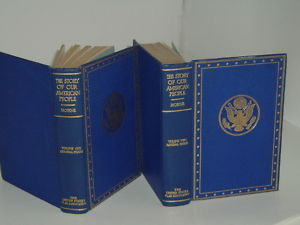
In the 1920s, for example, the American Legion sponsored a new textbook that promised to give students a patriotic yet accurate story of America’s roots.  When Charles Hoyne’s The Story of the American People appeared in 1926, conservatives lavished praise upon it.  The Klan-backed governor of Oregon, Walter M. Pierce, sent Hoyne a gushing letter.  Pierce called the volumes “the finest history of early America that we have ever had.”  Other conservatives agreed, calling the book a blessing to “the loyal and liberty-loving people of our country” and books that defended “the spirit of American patriotism.”

Unfortunately for Hoyne, for the American Legion, and for the conservatives who jumped to embrace the new textbooks, other readers had different opinions.  A Legion-appointed review committee found the books to be full of errors.  Writing in the pages of Harper’s, critic Harold Underwood Faulkner called the books “perverted American history.”

Image Source: Amazon.com

Image Source: Amazon.com

In the end, despite high hopes for schoolbooks that would finally put a positive—but accurate—spin on all things American, the Legion withdrew their support and Hoyne’s books went nowhere.

The National Association of Manufacturers had much more success producing capitalism-friendly school materials.  Starting in 1939, NAM sent educational literature and classroom posters to roughly 17,000 classroom teachers and school administrators.  Being savvy businessmen, the leaders of the NAM wanted to know if this investment was a good one.  They wanted to know if the pamphlets made people like capitalism better.  To find out, they hired pollster Henry Abt to survey the schools.  Abt reported that most of the teachers considered the NAM-produced books “primarily as an informational service; an authoritative source of economic and social data.”  From the NAM’s perspective, nothing could be better.  Students read NAM’s paeans to capitalism and took them as authoritative social science.

Perhaps the book reviewers in Texas might take a page from the lessons of the 1920s and 1930s.  If conservatives really want to see more conservative textbooks, they might have to publish them themselves.  Of course, they’d want to watch out for the Hoyne trap.  Any classroom materials must be more like the slick, glossy pamphlets and posters distributed by the National Association of Manufacturers.  Anything else will end up just an embarrassment.


From the Archives: Conservatives, Historical Knowledge, and the Political Process

Guest Post by Kevin B. Johnson

How could American History bother conservatives?

Most people probably believe that sex education and evolutionary biology are the most contentious subjects taught in school.

But conservative activists have also targeted American history.  Why?  Because as historians such as Jon Zimmerman and David Blight have argued, America teeters on a culture-war divide in its understanding of its own history; a culture-war divide no less contentious than questions about sex and God.

Nowhere has this battle over the nation’s history been more bitter or grueling than in Mississippi.

A look at the record of conservative activism in the Magnolia State may shed some light on the continuing battle over the nature of history.  It also demonstrates the ways conservatives have scored their greatest successes.  In Mississippi, at least, conservatives managed to win by promoting one central idea: historical knowledge, properly understood, is static and unchanging.

As the Cold War split nations into the Free, Unfree, and Third Worlds, Americans began scrutinizing their communities in search of suspected communists and subversives. In Mississippi, these searches involved the content in state-approved social studies textbooks. Civic-patriotic organizations such as the American Legion, the Sons of the American Revolution (SAR), the Daughters of the American Revolution (DAR), and the Mississippi Farm Bureau Federation led the charge in exposing objectionable historical knowledge presented in social studies texts.

The civic organizations were not alone in controlling textbook content. In the 1940s Mississippi began providing students with schoolbooks; lawmakers also set up the State Textbook Purchasing Board charged with governing the screening and selection of all texts. In the Cold War context, however, many civic organization leaders believed the state’s education professionals were ill-suited for this job and challenged their role in screening school materials.

A few key figures spearheaded the effort to guard historical knowledge. Mississippi State College education professor Cyril E. Cain, for example, found reading and “doing” history to be a mystical-spiritual experience. In 1949, Cain learned about the California SAR calling for removal from that state’s schools the Building America textbook series. America and its democratic system was not part of a process, the SAR argued. Rather, American democracy had been built and perfected in comparison to rival governments.

Through the Mississippi Patriotic Education Committee, Cain called upon other conservatives guard against the historical knowledge contained in schoolbooks. He wrote to the state regent of the Mississippi DAR—Edna Whitfield Alexander, asking for collaboration between their two organizations “for the common cause of defending America” from textbook authors who espoused “alien ideologies.”

For the next twenty years, Alexander became the South’s preeminent textbook activist. She developed her organizational skills through the Mississippi DAR, which held significant power in the 1950s and 1960s. Many DAR members’ husbands served in state government or were the state’s business leaders; the DAR owned numerous radio stations throughout Mississippi. A segregationist society like other civic clubs, its members naturally opposed perceived egalitarian messages in textbook treatments of history, civics, and economics. History was the DAR’s domain and it held what they believed was magnificent power to order present-day society.

Gaining the attention of Mississippi’s leaders, especially Mississippi House Speaker Walter Sillers, Jr, by 1958, Alexander and DAR activists officially recorded their objection to the content in dozens of state-approved books.

The following are just a few examples:

“Laconic treatment of the South…did not mention Fielding Wright as Vice-Presidential nominee of the States Right party…praises Federal aid to education…Booker T. Washington picture is much later than Thomas Jefferson [sic]” –review of United States History, American Book Company, 1955 reprint.

“This slanted-against-the-South book makes no mention of the fact that Russia offered to help the North [during the American Civil War]” –review of The Making of Modern America, Houghton-Mifflin, 1953.

“…records a good bit of history—some of which we are not too proud, and conspicuously omits some of which we are very proud like religious freedom!” –review of Your Country and the World, Ginn & Company, 1955.

“…advocates creation of a state of social equality…” –review of Economic Problems of Today, Lyons and Carnahan, 1955.

“Formerly history was largely concerned with kings, monarchies, laws, diplomacy, and wars…Today history deals with the entire life of a people. So now were are told that history must change along with this changing world and George Washington, Valley Forge, and the U.S. Constitution are no longer worthy of recognition to be ignored so far as our children’s history books are concerned.” – wrote a DAR reviewer of The Record of Mankind, published by D. C. Heath, 1952.

The DAR, in addition, opposed books citing renowned scholars such as Henry Steele Commager, Charles Beard, Allen Nevins, Gunnar Myrdal, Arthur Schlesinger, John Hersey, in addition to Mississippi writers like Hodding Carter, Ida B. Wells, and William Faulkner.

These comments sent to Sillers demonstrate the DAR’s view of History.  In the DAR vision, History should be dominated by pro-South, segregationist, and patriotic biases. The reason for teaching history in the Cold War context, the DAR and others agreed, was to instill in school children loyalty to state and country.

The DAR, under Alexander’s leadership, began a concerted lobbying effort. In 1959, Alexander informed the Mississippi Superintendent of Education and head of the State Textbook Purchasing Board, Jackson McWhirter “Jack” Tubb, that “youth must be taught Americanism in its purest form if this Republic is to survive.”

The American Legion and the Mississippi Farm Bureau Federation became important DAR allies. These civic clubs conducted official studies of Mississippi’s approved books and found that many “cater to alien ideologies contrary to the Mississippi way of life.” Boswell Stevens, a Legionnaire and president of the state’s Farm Bureau, believed social studies curricula should cultivate among students adoration of quintessential American values like Jeffersonian individualism, capitalism, and patriotism.

During state elections in 1959, the lobbyist coalition collaborated by staging exhibits of objectionable texts in the lobby of the Robert E. Lee hotel in Jackson. After Sillers intervened the DAR moved the exhibit to the lobby of the state capitol in time for the 1960 legislative session.

Lawmaker-members of American Legion and the Farm Bureau dominated the Legislature, passing amendments to state laws pertaining to textbook screening and adoption. The amendment gave the governor, recently elected Ross Barnett, appointment power over the state’s education professionals on these important textbook screening committees.

These conservative victories were not unopposed, however.  Newspapers editorials considered the DAR efforts as a “witch-hunt” and the state’s teachers association believed that textbook reviews were best left to education professionals.

But politics—in this case, staunchly conservative politics—trumped the claims of journalists and teachers.  Conservative activists also managed to stymie complaints from academic historians. In 1975, for example, James W. Loewen and several co-authors of the history text Mississippi: Conflict and Change had to file a federal lawsuit against Mississippi for adoption of their revolutionary new textbook. Loewen even commented at the time that most of the state-approved books were merely “didactic chronologies.”

Loewen’s lawsuit demonstrated the deeply entrenched nature of conservative visions of History in Mississippi.  For decades, conservative activists had succeeded in establishing state sanction for their vision of History: a static, unchanging field of facts, uniquely useful for promoting patriotism and instilling a love for traditional Americanism.


Kevin Boland Johnson is a doctoral candidate in American history at Mississippi State University and a dissertation fellow with the Spencer Foundation. His dissertation, “The Guardians of Historical Knowledge: Textbook Politics, Conservative Activism, and School Reform in Mississippi, 1928-1988,” explores numerous education reform efforts designed either to constrain or improve public school social studies curricula. You can reach Kevin at kbj41@msstate.edu.



Get In Line, David Barton

What history books should American school children read?

Most recently, the history darling-in-chief among many conservatives has been Wallbuilders’ David BartonGlenn Beck, Mike Huckabee, and other conservative politicians have praised Barton’s vision of American history.

For those who haven’t followed the story lately, here’s a brief synopsis: Barton claims to be the best historian around, the only one honest and dedicated enough to discover the real Christian intention of most of the Founding Fathers.  His latest book, The Jefferson Lies, came under brutal attack for its historical inaccuracies and misrepresentations.  The accusations came not only from partisan leftists, but also from conservative Christian critics.  As a result, the original publisher pulled the book from store shelves.  Glenn Beck’s publishing arm quickly picked up the title.

Image source: Ebay

Image source: Ebay

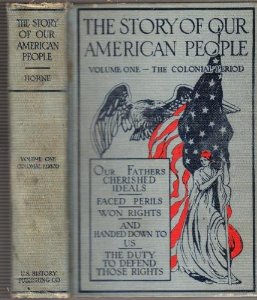
In the research for my current book about conservative educational activism in the twentieth century, I came across an eerily similar story from the 1920s.  In that decade, the American Legion resolved to sponsor a two-volume school history.  Too many of the books on the market, the Legion concluded in 1922, “contain misrepresentation of American history.”  Legion leaders contacted Charles F. Horne, a professor of English at City College of New York.  Horne agreed to author the books, to be called The Story of Our American People.

This textbook, the Legion’s special committee in charge of the textbook project declared in 1925, would build “character.”  Too often, the Legion leaders lamented, young people “grow up ignorant or anarchistic or otherwise ‘destructive.’”  There was no chance, the Legion wrote, that such youth, taught that their government deserved nothing but contempt, could mature into healthy, productive citizens.  Most commercial history textbooks only tore down young people’s confidence in their society and government.  A good history textbook could fix this.  The proper teaching of history, the Legion argued, must teach, despite “occasional mistakes,” that American history has been “so glorious that its proper study must inspire any child to patriotism.”

When a preliminary draft emerged in 1925, it earned some instant praise from conservatives who had long fretted about the deplorable state of most history textbooks.  Walter M. Pierce, for example, in 1926 the Klan-backed governor of Oregon, dashed off a letter to Professor Horne.  The new volumes, Governor Pierce gushed, represented “the finest history of early America that we have ever had.”

But other early readers took a different view.  Writing in the pages of Harper’s Magazine, historian Harold Underwood Faulkner blasted Horne’s books as “perverted American history.”  No professional historian, Faulkner sniffed, would have produced such drivel.  The books represented nothing more than a “bombastic eulogy of all things American.” (Harold Underwood Faulkner, “Perverted American History,” Harper’s, Feb. 1926, pp. 337-346. [Subscription only.]) They could not even be criticized on historical grounds, Faulkner claimed, since the books did not really constitute a history.  Worse, the books were intended to “produce a bigoted and stereotyped nationalism . . . a deplorable subservience to the rule of ignorance.”

Such criticism from snobby historians might not have doomed Horne’s books.  But an internal committee of the American Legion itself also found the books “filled with incomplete and inaccurate statements.”  Instead of inspiring American youth to embrace a patriotic vision of America’s past, the Legion investigators concluded, such shoddy history could only mislead youth and heap ridicule on the American Legion.

The Legion abrogated its contract with Horne.  They agreed not to receive any revenue from the book project and withdrew their endorsement.

As a result, the books never made the impact on schools Legion activists had hoped for.  Even among Legionnaires, the 1920s textbook project quickly became a politely forgotten story.  In 1949, for example, one Legionnaire wrote in the pages of The American Legion Magazine that the Legion ought to sponsor its own patriotic textbooks.  Such a textbook series, this writer insisted—apparently utterly innocent of the history of the Horne histories—could replace the overabundance of boring pink textbooks with “the rich and meaty story of American history.” [See John Dixon, “What’s Wrong with American History?” The American Legion Magazine (May, 1949): 40.]

So get in line, Mr. Barton.  You are far from the first to attempt to impose sectarian history on America.  Just as the fiercest and most effective critics of the Horne books were the Legion investigators themselves, so the conservative Christian criticism of Barton’s books helped isolate and neutralize Barton’s influence.

William F. Buckley and a Party already in Progress

There it is again!  Every now and then we see some commentator who starts her historical discussion of conservatism in American education in 1951, or 1968, or 1980. 

This week we got another dose: In her Salon.com article about the conservative attack on liberal-arts education, Katie Billotte claimed William F. Buckley “pioneered these attacks [on liberal-arts higher education] in his 1951 book God and Man at Yale, and his claim that universities serve as indoctrination camps for liberalism has become a standard talking point on the right.”

Billotte made her claim as part of a rebuttal of a Joseph Epstein article, “Who Killed the Liberal Arts?”  Her argument, and Epstein’s, are both worth reading.  But once again, we must point out that conservative attacks on the nature of higher education must be traced back at least to the 1920s.  The first generation of Protestant fundamentalists, for instance, complained bitterly about the ideological and theological perversions of liberal-arts higher education.  Texas Baptist fundamentalist leader J. Frank Norris, to cite just one example, warned in 1921 that college students went wrong when they studied “in Chicago University where they got the forty-second echo of some beer-guzzling German Professor of Rationalism.”

The tradition of conservative attacks on leftism and radicalism among liberal-arts educators in higher education was not limited to religious conservatives.  For example, in 1938, American Legion National Commander Daniel Doherty took an audience at Columbia University to task for becoming “the Big Red University.”  To a chorus of boos from his Columbia audience, Doherty warned, “The name of Columbia is besmirched from time to time when preachments containing un-American doctrines emanate from those who identify themselves with this institution.”  The problem, Doherty felt, stretched far beyond Columbia.  Later in 1938, he accused,

It is well known that many of our institutions of higher learning are hotbeds of Communism.  They disseminate theories and philosophies of government which are entirely alien to the American concept and American principles under which we have prospered more than a century and a half as no other people.

Such sentiments were standard fare among conservative activists and thinkers long before William F. Buckley criticized the trends at his alma mater.  Indeed, Buckley himself may be presumed to be familiar with the work of Albert Jay Nock.  We know Nock spent time at the Buckley home in Buckley’s youth.  And Nock’s attitude toward higher education, at least as expressed in his Memoirs of a Superfluous Man (1943) leaves little room for Buckley to “pioneer.”

Nock remembered his own liberal-arts education fondly.  Since his time, however, Nock claimed a far-reaching “educational revolution” had destroyed the liberal-arts tradition (85).  The “purge” was “based on a flagrant popular perversion of the doctrines of equality and democracy” (88). 

The conservative protest against the theological and ideological tendencies of higher education and its liberal-arts program long preceded William F. Buckley Jr.  In addition to drinking in long conservative traditions, Buckley cribbed much of his enfant-terrible critique of Yale directly from Nock and his ilk. 

Billotte might protest that her interest lay with today’s conservative attacks, not those from the 1920s, ’30s, or ’40s.  But like many other commentators, she makes claims about the history of conservatism without any apparent familiarity with the subject.  Buckley’s criticism of Yale only makes sense when we understand that it was not a pioneering effort at all.  Billotte’s argument will make sense only when she takes time to understand the legacy of her opponents’ ideas.


Traditionalist Teaching for Progressive Teachers? Lisa Delpit and Fundamentalism in Black and White

Fundamentalists don’t like progressive education.  They may not realize that they have some potential allies deep in the heart of the academic education establishment.

What do fundamentalists mean when they fight against “progressive education?”  For one thing, fundamentalists tend to pooh-pooh reading instruction that allows children to ‘discover’ reading on their own.  And they dismiss the notion that classroom teachers should put authority in the hands of students.  Also, fundamentalists often look askance at education professors who advocate soft-heading, child-centered classroom teaching that fails to deliver basic information and academic skills.

Generally, fundamentalists make these complaints from outside of the academy.  Some historians and other prominent academics—folks such as Arthur BestorRobert Hutchins,  or Arthur Schlesinger, Jr.—have critiqued the claims of progressive education, but most of the effective critics have worked outside of higher education.  But in the past generation, at least one prominent academic educator has critiqued “advocates of any progressive movement” who fail to consider the opinions of those “who may not share their enthusiasm about so-called new, liberal, or progressive ideas.”  The work of this world-famous educational activist is read at every school of education, especially ones in which teachers are trained to use progressive teaching methods.

Then why does she talk this way?  Because she framed the issue not as traditional and progressive, but as black and white.  Her name is Lisa Delpit, and her traditionalist critique of progressive education did not lead to her exclusion from the education academy.  On the contrary, she has received some of the academy’s most prestigious awards for her work, including a MacArthur “Genius” award in 1990 and Harvard Graduate School of Education’s Outstanding Contribution to Education award in 1993.

To be clear, Delpit demonstrated considerable differences from many other traditionalist education activists.  For example, she backs a multicultural approach to education, most conservative traditionalists do not.  (See the ILYBYGTH discussion of traditionalist critiques of multicultural education here, here and here.)  She supports reading in depth and excoriates rote instruction.

But she also pushes a traditionalist ideology of teaching.  She offers withering criticisms of progressive teachers’ justifications.  In one career-making speech and article from the late 1980s, Delpit castigated progressive educators for their misplaced softness toward students.  She cited with approval one African American classroom teacher who described her anger at white progressive teachers as “a cancer, a sore.”  This teacher had stopped arguing against progressive methods.  Instead, she “shut them [white progressive teachers and administrators] out.  I go back to my own little cubby, my classroom, and I try to teach the way I know will work, no matter what those folk say.”  Delpit suggested that a direct-instruction model matched more closely the cultural background of most African American students.  In one model Delpit described favorably, the teacher is the authority.  The goal is to teach reading via “direct instruction of phonics generalizations and blending.”  The teacher keeps students’ attention by asking a series of questions, by eye contact, and by eliciting scripted group responses from the students.  Such traditionalist pedagogy, Delpit noted, elicited howls of protest from “liberal educators.”

In a sentence that could come straight from such conservative traditionalist leaders as Bill Bennett or Max Rafferty, Delpit supported the notion of many African American educators that “many of the ‘progressive’ educational strategies imposed by liberals upon Black and poor children could only be based on a desire to ensure that the liberals’ children get sole access to the dwindling pool of American jobs.”

In another critique, Delpit argued that white, middle-class teachers hid their classroom authority in ways that were confusing to poor and African American students.  Teachers of all backgrounds, Delpit suggested, need to be more explicit about their power and authority in the classroom.  A good teacher, Delpit noted, was seen as both “fun” and “mean” by one African American student.  Such a teacher, Delpit’s interviewee argued, “made us learn. . . . she was in charge of that class and she didn’t let anyone run her.”

More important for fundamentalist activists, Delpit’s voice is not alone.  A call for traditional pedagogy and schooling seems to be gaining adherents among African American parents and educators.  We could look at the deep traditionalism of such prominent schools as the New York Success Academy Charter Schools.  Or we could probe the attitudes of those who run KIPP (Knowledge Is Power Program) Schools, which tend to serve significant numbers of African American students.  In a recent article about school “paddling” in USA Today, one African American school administrator confirmed that she believed in spanking “because I’m from the old school.”

The numbers indicate African American students tend to receive corporal punishment more often than students of other racial backgrounds, but don’t indicate the level of support for such punishment among African American teachers as opposed to teachers of other races.  There are some indications that African American parents tend to use corporal punishment more often than other groups.  This would support Delpit’s assertion that many African American students have different cultural expectations from other students when they get to school.  But the same study asserts that a huge majority of parents of other groups also use corporal punishment at home.  And, indeed, there is a lot of support for corporal punishment at school among white conservative activists.  But such support generally comes as part of a broader traditionalist, anti-progressive ideology of schooling.

Delpit’s argument is different.  She argues for traditional authoritarian teachers within a progressive, multicultural educational system.

What does this mean?  I’ve got a couple of reflections, and I’d welcome more.

For one thing, it tells us something about the current state of education scholarship.  Seen optimistically, we might conclude that the popularity of Delpit’s work proves that education scholars are willing to embrace a true diversity of opinion.  That is, education scholars might not be the petty intellectual tyrants some traditionalists accuse them of being.  To cite just one example, arch-traditionalist Max Rafferty in 1968 accused the “education bureaucrats” of only speaking to regular people “with that air of insufferable condescension.”  Such “educationists,” Rafferty charged, only listened to one another; they only hoped to turn America’s schools into something approaching a “well-run ant hill, beehive or Hitlerian dictatorship.”  Delpit’s example of progressive traditionalism might suggest that education scholars are more open to dissent than Rafferty and others have consistently charged.

In a less rosy light, though, we might conclude that this is yet another example of the ways the mainstream academy is hamstrung over racial ideology.  We might wonder if Delpit’s ideas would be welcomed as fervently if education scholars weren’t so terrified of being considered racially insensitive.  It helps, of course, that Delpit is a wonderful writer and powerful polemicist.  But it is hard to ignore the question: How warmly would a scholar be welcomed who trashed the idea of progressive pedagogy in general?  Not just for one group of students, but for students and schools in general?

One other point jumps out at us: we apparently need to be more careful when we talk about traditionalist education.  I’ll plead guilty.  I am most interested in those traditionalists who act out of what we can fairly call a conservative impulse to transform American schools and society.  Folks like Rousas Rushdoony, Max Rafferty, Sam Blumenfeld, Mel and Norma Gabler.  Groups like the Daughters of the American Revolution and the American Legion.  Activists from these groups have long believed that teaching must be made more traditional so that American society itself can reclaim some of its lost glory.  But there are traditionalists like Delpit who hope that schools will transform school and society in a vastly different way.

Perhaps we need to treat “educational traditionalism” the way we treat “evangelicalism.”  A lot of folks, scholars and normal people alike, tend to treat “evangelicalism” as if it were the sole domain of white, conservative folks such as Billy Graham and Jerry Falwell.  But religious historians are also interested in other forms of evangelicalism.  There have always been leftist evangelicals, for instance, as Raymond Haberski has recently noted.  And, of course, there has always been a strong evangelical tradition among African Americans.

Perhaps the most important notion to think about here is that we have more than one kind of educational traditionalism.  Bashing progressive education has long been the national pastime of educational conservatives.  For the last twenty-five years or so, such conservatives have been joined by an influential cadre of mainstream education scholars.

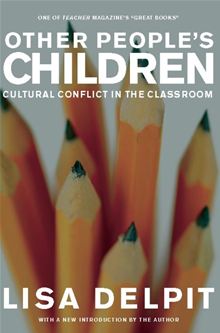
Further reading: Lisa Delpit, “The Silenced Dialogue: Power and Pedagogy in Educating Other People’s Children,” Harvard Educational Review 58 (Fall 1988): 280-199; Delpit, (1986). Skills and other dilemmas of a progressive black educator. Harvard Educational Review, 56(4), 379-386; Delpit, Lisa. (1995). Other People’s Children: Cultural conflict in the classroom. New York, NY: The New Press; Delpit, L & Perry, T. (1998). The Real Ebonics Debate: Power, Language, and the Education of African-American Children (Eds.). Boston, MA: Beacon Press; Delpit, L. & Dowdy, J. K. (2002). The Skin That we Speak: Thoughts on language and culture in the classroom (Eds.). New York, NY: The New Press; Delpit, L. D. (2012). Multiplication is for White People: Raising expectations for other people’s children. New York:The New Press.

Required Reading: Louis Menand and the Left-Leaning Ivory Tower

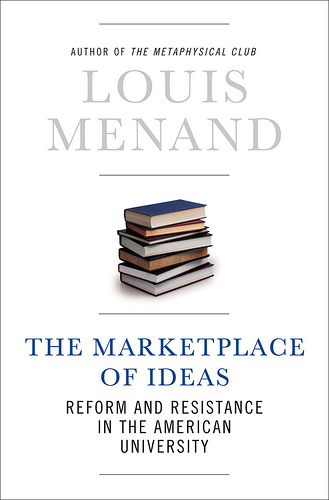
Louis Menand,  The Marketplace of Ideas: Reform and Resistance in the
American University.
  New York:  W.W. Norton, 2010.

Fundamentalists have long argued that America’s colleges and universities had been captured by a sinister left wing.  Now they have some evidence to back up their complaints.

Most often, those accusations branded mainstream American univeristies as hopelessly lost to pernicious non-fundamentalist ideas.  For example, Texas fundamentalist minister J. Frank Norris insisted in 1921 that the problem with America all started when some influential young Americans studied “in Chicago University where they got the forty-second echo of some beer-guzzling German Professor of Rationalism.”

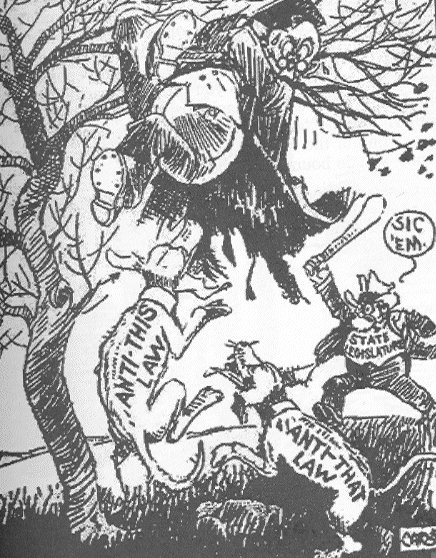
This hostility among fundamentalists toward the professoriate was noted by one cartoonist in the Wall Street Journal around the time of the Scopes Trial in 1925.  In this cartoon, hillbilly fundamentalists sic their legislative dogs on a hapless professor.

In the run-up to that Scopes Trial, the greatest fundamentalist scientist of the 1920s, George McCready Price, informed William Jennings Bryan confidentially that evolutionists had fallen prey to a debilitating group-think.  Because they only listened to one another, Price insisted, such evolutionists had become “out of date,–behind the times,–and don’t know it.”

This outright hostility toward the academic classes continued throughout the twentieth century.  For instance, one pamphlet from the American Legion in 1930 warned that too many college professors saw their jobs as indoctrinating each new generation of young, impressionable minds.  In this author’s opinion, college professors did not try to authentically educate their students, but only saw their jobs as a chance to make new “teachers of communism and atheism out of them.”

In the early 1960s, conservative California State Superintendent of Education Max Rafferty found the main culprit of America’s decline in the progressive, leftist orthodoxy promulgated in America’s institutions of higher education.  Rafferty insisted that colleges had created a new landscape of “temples . . . great universities which marble the land.”  These temples no longer pursued true intellectual endeavor, Rafferty claimed, but only passed along a deadened orthodoxy, “turning out swarms of neophytes each year to preach the gospel of Group Adaptation.  Their secret crypts and inner sanctums are the graduate schools.”

More recently, fundamentalist blockbuster author Tim LaHaye agreed.  In the twenty-first century, LaHaye believed, university faculties had placed themselves hopelessly in thrall to the false idols of the cultural Left.  After his huge publishing success with the Left Behind series, LaHaye set out to create a new biblical hero.  In Babylon Rising (2003), LaHaye described the adventures of biblical archeologist Michael Murphy.  In Murphy, LaHaye hoped to create a “true hero for our times,” one who united unwavering biblical faith with scholarly acumen and a dose of two-fisted machismo.  In one telling scene, Murphy is confronted by his smarmy secular dean.  This little episode tells us a lot about continuing fundamentalist attitudes toward the professoriate.

“Hold it, Murphy!”

A bony hand grabbed Murphy by his backpack as he left the hall. “Dean Fallworth.  What a fine example you set for the students by monitoring my lecture.”

“Can it, Professor Murphy.”  Fallworth was as tall as Murphy but cursed with a library-stack pallor that would make some mummies look healthy by comparison.  “You call that a lecture?  I call it a disgrace.  Why, the only thing separating you from a Sunday tent preacher is the fact that you didn’t pass the plate for a collection.”
“I will gratefully accept any donation you wish to make, Dean.  Did you need a syllabus, by the way?”

“No, Mr. Murphy, I have everything I need to get the university board to begin accreditation hearings for this evangelical clambake you’re calling a class.”

“Temper,” Murphy mumbled to himself.  “Dean, if you feel my work is unprofessional in any way, then please help me to improve my teaching skills, but if you want to bash Christians, I don’t have to stand here for that.”

“Do you know what they’re already calling this silly circus around the campus?  Bible for Bubbleheads, Jesus for Jocks, and the Gut from Galilee.”

Murphy couldn’t help but laugh.  “I like that last one.  I’m intending this to be a quite intellectually stimulating course, Dean, but I confess I did not post an I.Q. requirement for taking it.  The knowledge will be there, I promise you, but I will likely fall short of your apparent requirement that the only acceptable instructional method is to bore your students to an early ossuary.”

“Mark my words, Murphy.  Your hopes of this course surviving and your hopes of tenure at this university are as dead as whatever was in that bone box of yours.”

“Ossuary, Dean.  Ossuary.  We’re at a university, let’s try to use multisyllabic words.  If it doesn’t turn out to be legitimate, maybe I can get it for you cheap and you can keep your buttons in it.  Now, if you’ll excuse me, I have a new artifact to begin work on.”

In this vision of the world of higher education, only fundamentalists have remained true to the original mission.  Fundamentalist intellectuals, this line of reasoning goes, have retained their sense of inquiry and intellectual honesty.  They have not been seduced by the showy appeals of false science, such as evolution.  They have not been lulled by a peaceful-sounding pluralism that in practice degrades human dignity.  And they have not been willing to accept the hidebound leftist, secularist, evolutionist orthodoxy required of the mainstream academic.

This trope has remained so ubiquitous among fundamentalist activists that is tempting to dismiss it as sour grapes.  In this sour-grapes line of thinking, fundamentalists attack the intellectual pretensions of college professors since those professors show universal disdain for the Biblical belief of fundamentalists.  Fundamentalist attacks, this argument goes, actually prove the intelligence and perspicacity of college professors.

Louis Menand’s new book suggests otherwise.  Menand, best known for his Pulitzer-Prize-winning Metaphysical Club, now takes aim at the sclerotic intellectual culture of American higher education.  Menand is no fundamentalist.  Nor does he have an axe to grind against the left-leaning cultural politics of today’s universities.  However, he does agree with fundamentalist critics that the professoriate encourages group thinking and intellectual conformity rather than innovative ideas and iconoclasm.

Unlike fundamentalist critics of higher education, Menand does not blame evolution, socialism, or secularism for this state of affairs.  Rather, Menand’s critique is more prosaic.  In order to become a tenure-track professor in the humanities, Menand points out, aspiring professors must endure years, even decades, of powerless apprenticeship.  Those who survive this ordeal do so not by bucking the intellectual party line but rather by honing their ability to locate and placate the institutionally powerful.

In Menand’s view, this leads to a dangerous state of affairs in which “The academic profession is not reproducing itself so much as cloning itself” (153).  Until and unless research universities find a new way to train the next generations of faculty, Menand frets, the trend toward intellectual conformity will accelerate.  [UPDATE: For a full review of Menand’s book, be sure to check out the H-Education list review commissioned by Jon Anuik:  https://www.h-net.org/reviews/showrev.php?id=33892 Thanks, Jon, for this notice.  –Editor]

Fundamentalists won’t be surprised.  For generations they have dismissed the protestations of the kept intellectuals at America’s universities.  Menand’s book should serve to give them support from outside their own ranks for their deeply held distrust of pointy-headed professors.