Required Reading: Assemblies of God on Faith/Science

Can Pentecostals embrace science?  Can they find a way to love both God and Gould?

For those of us trying to understand the conservative vision of education from the outside, the newest edition of the Assemblies of God’s Enrichment Journal is a treasure trove.  This edition offers a series of articles for the denomination’s readers about the proper relationship between faith and science.  As General Superintendent George O. Wood explains, the dangers for young people in the church are stark.  He quotes “Mike,” who declared, “I knew from church that I couldn’t believe in both science and God, so that was it.  I didn’t believe in God anymore.”  Wood hopes that this volume will help Assemblies of God members negotiate a more profound and religious relationship between science and faith.

For those unaware of the distinctions among conservative Bible-based Protestant groups, the Assemblies of God, very briefly, is the largest denomination of Pentecostal believers, claiming 65 million members worldwide.  Pentecostalism, also very briefly, is a form of conservative evangelical Protestant belief that came into existence in the early 20th century.  It combines conservative Bible-based theology with an emphasis on baptism by the Holy Spirit.  Pentecostal services are typically vibrant, dramatic events that can include speaking in tongues and divine healing.  As historian Grant Wacker argued in Heaven Below (2001), the attraction of early Pentecostal churches derived from their combination of a powerful “primitivist” theology with a comfortable cultural “pragmatism.”

In an opening piece, Amos Yong of Regent University encourages Pentecostal readers to “work to overcome the history and culture of anti-intellectualism that persists in some segments of the Pentecostal church.”

Perhaps the most interesting section of this issue for those of us outside the conservative tradition is its forum on the variety of evangelical positions for the age of the earth.  Kurt P. Wise makes the case for a young earth, Hugh Ross for six long ages, and Davis A. Young for an old earth.

With each article, we see the very different intellectual playing field for evangelical intellectuals.  Among mainstream scientists, the first question is usually whether any new approach offers better insight into the natural world.  Among evangelical thinkers, the first question is whether any scientific approach offers better insight into the natural world while allowing Christians to maintain an authentic faith.

As Kurt Wise argues in his pitch for a young earth, “believers” enjoy a more promising guide to the natural world.  Wise insists, “We should look at the eyewitness account from God before we begin inferring the meaning of circumstantial evidence.”

Everyone interested in the creation/evolution debate will be well served by reading through these articles.  Some of the most fervent young-earth creationists such as Answers in Genesis’ Ken Ham have condemned such forums.  Any consideration of an old earth, Ham blasted in a blog post, results in a “dogmatic, intolerant stand against those who take the position we do at AiG.”

But for those of us outside of evangelical circles, an understanding of both the different evangelical views of science and the ways evangelicals construct their scientific arguments will go a long way to decoding the stubborn controversy over evolution and creationism.


Quantum Physics and the Need for God

Here’s one we missed until Anna Williams of First Things brought it to our attention: Stephen M. Barr, physicist at the University of Delaware, examines the argument that quantum mechanics suggests a reality beyond the material world.

Barr walks readers through the argument that quantum mechanics makes more sense if we include a notion of transcendent mind.  Here is his conclusion:

“The upshot is this: If the mathematics of quantum mechanics is right (as most fundamental physicists believe), and if materialism is right, one is forced to accept the Many Worlds Interpretation of quantum mechanics. And that is awfully heavy baggage for materialism to carry.

“If, on the other hand, we accept the more traditional understanding of quantum mechanics that goes back to von Neumann, one is led by its logic (as Wigner and Peierls were) to the conclusion that not everything is just matter in motion, and that in particular there is something about the human mind that transcends matter and its laws.  It then becomes possible to take seriously certain questions that materialism had ruled out of court: If the human mind transcends matter to some extent, could there not exist minds that transcend the physical universe altogether? And might there not even exist an ultimate Mind?”

One of the favorite scientific arguments of many intellectuals in Fundamentalist America is that their faith does not contradict the discoveries of true science.  From evolution to abortion, many conservatives will insist from time to time that science will eventually catch up with their religiously motivated beliefs.  Many, like Robert George recently, note that false science, like that of eugenics, has historically captured the fidelity of mainstream scientists for a time.  George insisted that the arrogance of mainstream science often mistakes its own fashions for abiding truths.  In the 1920s and 1930s, George argued,

“Affluent, sophisticated, “right-minded” people were all on board with the eugenics program. It, too, seemed like a juggernaut. Only those retrograde Catholics, joined by some other backward religious folk, resisted; and the thought was that the back of their resistance would soon be broken by the sheer rationality of the eugenics idea. The eugenicists were certain that their adversaries were on “the wrong side of history.” The full acceptance of eugenics was “inevitable.” But, of course, things didn’t quite turn out that way.”

The false science of eugenics and its temporary dominance among mainstream scientists has also long been a favorite theme of creationists.  For example, as David Dewitt argued on the Answers in Genesis blog, eugenics was simply the “dark side of evolution.”

The long-standing hope of many conservatives is that science will eventually come around.  Outsiders often accuse conservatives, especially creationists, of being anti-science.  But a better term might be “anti-professoriate.”  Many conservatives cling–sometimes with increasing desperation–to the hope that mainstram science will someday recover from the long night of materialism.  Arguments such as Professor Barr’s provide fuel for this long siege.

Medievalism and Fundamentalist America

Are Fundamentalists medieval?  Only kinda sorta, says Carl Pyrdum at Got Medieval.  On the one hand, as Pyrdum points out, American Protestant fundamentalism would not be recognizable to European medieval church folks.  But on the other hand, both medieval chroniclers and some American fundamentalists take lessons from lake monsters.

Here’s the story:  As we’ve reported here recently, Accelerated Christian Education–a very conservative fundamentalist school curriculum publisher popular with Christian schools and fundamentalist homeschoolers–has been accused of teaching children that the Loch Ness Monster helps disprove evolution.  Pyrdum describes a story from a seventh-century life of St. Columba as Columba traveled in today’s Scotland.    When Columba came to Loch Ness, he encountered the terrifying monster within.  Instead of quaking in fear, Columba dispelled the monster with a holy wave.

St. Columba and Nessie

Pyrdum is being lighthearted in his discussion, but I think there are some lessons to be learned from this comparison across the centuries.  First of all, we must lament Pyrdum’s lumping together of the Westboro Baptist Church with Answers in Genesis as all fundamentalist together.  As we’ve written here before, the WBC often serves as a sort of menacing but misleading symbol of all of Fundamentalist America.  This is simply unfair.  I’m no fundamentalist, but the differences between a tiny cultish group like the WBC and Answers in Genesis still seem worthy of respecting.

Those quibbles aside, Pyrdum’s description of Columba’s encounter with Nessie shows the very different world of early medieval European Christianity.  As Pyrdum extracts, Columba’s trouncing of the monster won the admiration of all his fellows:

Then the brethren seeing that the monster had gone back, and their comrade Lugne returned to them in the boat safe and sound, were struck with admiration, and gave glory to God in the blessed man. And even the barbarous heathens, who were present, were forced by the greatness of this miracle, which they themselves had seen, to magnify the God of the Christians.

Columba’s world is one inhabited by both Christians and heathens; it is one in which Christians expected to be able to demonstrate significantly more power than the heathen; it was one in which God intervened directly, powerfully, and often.  Prydum does not make this point, but to our minds this world view is one that would resonate powerfully with many twentieth-century American fundamentalists.  In tone and substance, it feels very similar to the world inhabited by those Left Behind in Tim LaHaye and Jerry Jenkins’ best-selling series about the fundamentalist apocalypse.

The first connection might be a fascination with lake monsters, but I think the more powerful link is the similarity across the centuries.  Pyrdum may be correct that medieval Europeans would not understand the world of postmodern fundamentalism. However, those fundamentalists would have an easy time relating to the struggles of St. Columba, a stranger in a strange land, demonstrating the power of God’s love among the heathen multitudes.

Evolution in American Schools: The View from the UK

—Thanks to EB.

What Scottish people look like.

Our Man in Scotland informs us of a recent news item in Scotsman.com.  It seems some Christian-press textbooks have suggested that the Loch Ness Monster can help disprove evolution.  If the earth is really only roughly six to eight thousand years old, the creationist line goes, humans and dinosaurs must have coexisted at some point.  Relics like the Loch Ness Monster show that such coexistence continues into the present.BTW, the article cites as an authoritative reference frequent ILYBYGTH commentator Jonny Scaramanga.  In addition, the article implies that such notions are included in curricular materials produced by two leading Christian school publishers, Accelerated Christian Education and Bob Jones University Press.  I can’t confirm that these textbooks really contain such materials.  However, it is true that the coexistence of humans and dinosaurs has long been a key idea for many creationist intellectuals.

For instance, The Creation Museum of Ken Ham’s Answers In Genesis actively promotes the notion that human history is replete with evidence of human/dinosaur coexistence.  I visited the museum a while back and was struck by the emphasis on the ubiquity of the dragon motif in a variety of human cultures.  This served as proof, AIG contends, that humans throughout history have lived alongside dinosaurs.

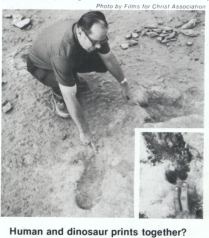
Further back in twentieth-century history, the debate over the authenticity of the Paluxy River tracks   covered similar ground.  Creationists interpreted these fossilized footprints in Texas as evidence that humans and dinosaurs had coexisted.

Not surprisingly, mainstream scientists disagreed.  For mainstream scientists, the notion that humans and dinosaurs coexisted is simply impossible.  Even a rough understanding of the evolutionary “bush” of life shows that millennia separated the age of dinosaurs from that of humans.  But, of course, taking a Biblical worldview, it is just as obvious that dinosaurs and humans coexisted.  If God created the world, humans, plants and animals after their kind in Eden, then there must be some crossover between dinosaurs and humans.

With this understanding, it would be shocking for creationists to teach students anything BUT a hope that Nessie proves to be a plesiosaur.  If true, Nessie would bolster creationists’ claims for a young earth.

In the News: Dinosaur Billboards and the Creation Museum

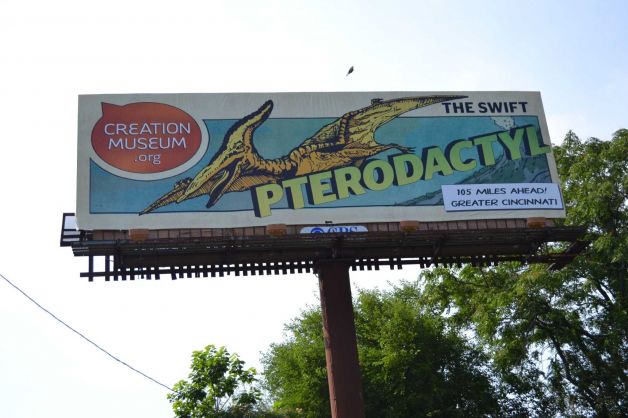
ABC News reported recently that Answers in Genesis’ Creation Museum has launched a new nationwide billboard advertising campaign.

The billboards feature retro-style dinosaurs, and appeared recently in cities such as Chicago, San Francisco, and Houston.  Some critics have wondered why the ads focus on dinosaurs instead of God, or whether this equates to a ‘Flintstones’ theology, but Ken Ham of Answers in Genesis pooh-poohed such folks.  Ham pointed out on his AIG blog that atheists have long used billboards to promote their point of view.

Anti-Evolution III: Science

ANTI EVOLUTION III: SCIENCE

Anti-evolutionists often assert scientific arguments against evolution.  This trend grew especially
strong in the later part of the twentieth century.  At that time, anti-evolutionists associated with the Institute for Creation Research in San Diego realized that their ideas would never be allowed into public school classrooms as religion.  But they could be allowed if they were used as alternative scientific explanations.  The science of creation science was born.

I personally am not convinced by these arguments.  There is plenty of evidence that those who know this stuff best—biologists, geologists, etc.—find these arguments baseless.  Nevertheless, I will attempt to summarize some of their arguments here.  As with the rest of these posts, I will not attempt to convince those already dedicated to an evolutionary worldview.  Rather, I only hope to show that there are reasons why anti-evolutionists hold their beliefs.  They do not have to be ignorant or crazy to do so.  Just as an undergraduate college student in a secular university learns about the geologic ages of the earth and the process by which one form of life evolved from another, so a college student at some religious colleges will learn that the earth was formed in the past 10,000 years and all life forms on it were created by divine fiat.  Those forms, the student will learn, developed according to kind.  Just as the student at the secular school does not have to be ignorant or crazy in order to accept the idea of an ancient earth and a long, directionless process of
evolution, so a student at a religious school does not have to be ignorant or crazy to learn an alternative science.
It is only the exceptional student at either school—usually one with a previous intellectual commitment to a different understanding of the origins of life—that will really question the big story she or he is being taught.

Another reason to cut these anti-evolution scientific arguments plenty of intellectual slack is because they are forced to argue in terms that do not fit their basic underlying ideas.  Imagine that the current mainstream scientific understanding of the origins of life had to justify itself in
Biblical terms.  It would be difficult.  So those who believe in a young earth are forced to make their scientific cases in language that has developed to explain an ancient earth.

One of the oldest scientific arguments against the notion of evolution through natural selection has been that of the development of complex organs.  This case was made long before the notion of evolution became the dominant scientific paradigm and it continued among anti-evolutionists throughout the twentieth century.  And it has been attacked by evolutionary scientists as unsatisfactory.  But for those of us who are not trained in evolutionary science, the argument makes intuitive sense.  I, for one, can’t see what’s wrong with it, and that makes me think that sensible, intelligent, rational people trained in this sort of argument have some grounds for opposing the notion of evolution.

If we understand the mechanism of natural selection to be one in which large-scale evolutionary change happens as an accumulation of tiny random beneficial mutations, then the evolution of complex organs is hard to account for.  Consider Darwin’s tentative explanation of the evolution of the eye, for instance.  He suggested that some part of an early animal’s skin would develop light sensitivity.  Then that sensitive spot would develop the parts of an eye that allowed it to see things.

How could that work?
With any complex organ, there would not be much of a selection advantage until the entire organ developed.  That is, it would not help a blind frog to mutate just a retina, without the rest of the eye.  It would not pass on its genes for retina-having at a greater rate than those blind frogs who had no such genes.  The Darwinian story of a long slow growth of beneficial mutations, even if there was only the tiniest chance of such mutations, falls apart with organs that would need several distinct parts to develop at the same time in order to offer any evolutionary benefit.

So, in order for our blind frog to be able to pass along his genes at a higher rate, there would need to be an impossibly complex mutation.  This would be a comic-book mutation, one beyond what even evolutionists posit as possible.  Our frog would need to mutate an entire, functioning eye that allowed it to see.  All at once.  The chances against even the tiniest advantageous mutation are so small it requires millions of years of accumulating mutations for evolution to make sense.  How can we believe that a complex organ would simply spring into existence?  It strains credulity.

More modern evolution doubters have offered more subtle versions of this complex-organ  argument.  Biochemist Michael Behe has examined the process of blood clotting and suggested that such processes represent what he calls an “irreducible complexity.”  A mutation might be
possible that gave an animal one part of this clotting mechanism.  But having only one part of this package would not offer any evolutionary benefit.  And the notion that all of the many interlocking biological parts necessary to produce such an effect could have simply happened by chance all at
the same time are simply too far beyond the range  of the possible to convince any rational observer.

Consider another example.  Evolutionists will tell you that one of the strongest pieces of evidence
for organic evolution is that once you start looking at evidence, it all confirms the hypothesis.  But if you start with a different hypothesis, you can also find all sorts of confirming evidence.  For example, instead of assuming that evolution created life on earth, assume instead a young earth,
less than 10,000 years old.  If you begin with this idea, it requires a very different understanding of the development of life forms.  There is no time for dinosaurs to have had their millennia, then died out.  If such creatures existed, they would have to have lived at the same time as humans.
We would predict some record of the sightings of such creatures by humans.

That prediction, one could say, has been repeatedly borne out.  By people from different cultures
in different centuries.  The evidence has been right in front of our faces, but because scientists have assumed an ancient earth, they have been blinded to it.  The obvious evidence is all the reports of giant lizards.  In Europe and Asia, the so-called ‘dragons’ have been reported by credible witnesses for centuries.  The fact that such dinosaurs died out, apparently, before the modern era does not mean that they did not coexist with humanity for a long time.

The bar of proof does not need to be very high.  The point is that the idea of a young earth can find confirming evidence from history and nature.  It can support itself with arguments about complex organs and blood-clotting mechanisms.  It does not require, as some evolutionists assert, a willful ignorance or dementia.  Just because those trained in an evolutionary worldview do not understand or agree with the scientific arguments in favor of a creationist worldview doesn’t mean that creationists are ignorant or crazy.   It only means that they are committed to a different understanding of nature and of the nature of humanity.


ANTI-EVOLUTION III: FURTHER READING:

Michael Behe, Darwin’s Black Box: The Biochemical Challenge to Evolution, 2nd ed. (New York: Free Press, 2006); Henry M. Morris, Scientific Creationism (Green Forest, Arkansas: Master Books, 2006); Duane T. Gish, Evolution: The Fossils Still Say No! (El Cajon, California: Institute for Creation Research), 2006); John C. Whitcomb Jr. and Henry M. Morris, The Genesis
Flood: The Biblical Record and Its Scientific Implications
(Philadelphia: Presbyterian and Reformed Publishing Company, 1966); Ken Ham, The Great Dinosaur Mystery Solved! A Biblical View of These Amazing Creatures (Green Forest, Arkansas: Master Books, 2008).