Does Loving the Bible Make Americans Racist?

Yesterday on GetReligion Terry Mattingly asked a hard question: “does anyone have any hard evidence that moral conservatives are more likely to be racists?”

Mattingly critiqued a pre-election story on NPR, in which David Cohen, a University of Akron political scientist, opined that President Obama’s race was a factor for many conservative voters.

Mattingly suggests issues such as abortion weigh more heavily on the decisions of “moral conservatives” than do issues of race.

The connection between white religious conservatives and racism is one I’ve been wrestling with lately in a book chapter I’m working on.  In the 1974 school controversy in Kanawha County, West Virginia, white conservative protesters (usually) insisted they were not racist.  Yet their liberal/progressive opponents, including an investigating committee from the National Education Association, usually assumed that they were.

It was a generation ago, to be sure, but in the 1974 controversy, some book protesters did indeed seem to be motivated largely by anti-African American racism.  For instance, the local Ku Klux Klan held sympathy rallies for the conservative protesters.

But other conservative protesters presented what seems to me to be solid evidence for their anti-racist conservatism.  Many religious protesters, such as Karl Priest, Avis Hill, and Ezra Graley, noted the racial balance of their church communities, including African Americans in leadership roles.

More secular protesters such as Elmer Fike noted that conservatives voted in large numbers for a conservative African American candidate for the state legislature, while liberals did not.*

Many liberals dismiss all such conservative claims of anti-racism as mere window dressing.  As we’ve discussed here recently, there is a long tradition among conservatives of using coded language to express racist sentiments in an apparently non-racist way.

What would it take for conservative anti-racism to be taken seriously?  One comment on Mattingly’s essay noted a 2007 PhD dissertation by Inna Burdein at SUNY-Stony Brook, “Principled Conservatives or Covert Racists.”  In her study, Burdein concluded that social conservatives tend to privilege racial considerations, while economic conservatives did not.  In other words, Burdein found that white “moral conservatives”–what we’re calling Fundamentalist America–would tend not to vote for African American candidates.

I don’t think Mattingly would insist that all white “moral conservatives” would vote for an African American President.  Some white conservatives are likely motivated by racism, to some degree.  But I think Mattingly’s question is still very important.  It does not seem that NPR’s story consulted work such as Burdein’s.  Commentators such as David Cohen simply take for granted the preeminence of white racism in conservative politics.

*This claim is reproduced in James Hefley, Textbooks on Trial (Wheaton, IL: Victor Books, 1976), pg. 171.

Olympic Fever and Reading the Bible like a Fundamentalist

Call Benny Hinn!  ILYBYGTH has caught Olympic Fever!

And in our delirium, we’ve hit upon a mental challenge for all our fellow non- and anti-fundamentalists out there.  Here’s the question: Why is mental discipline heroic in sports but anathema in non-fundamentalist intellectual culture?

For the elite athletes who compete in these international games, a key component of their success is mental discipline, mental toughness.  As journalists marveled about Michael Phelps the last time around, winning in the Olympics means being “mentally tough.”   For all peak athletes, it means developing a powerful single-mindedness in training, preparation, and competition.  As one study defined it, mental toughness means “an unshakeable perseverance and conviction towards some goal despite pressure or adversity.”

This is the quality that allows elite athletes to prepare.  It gets them into the pool, or onto the track, or into the gym, day after day, hour after hour, through grueling workouts.

This summer, we’ll see this kind of preparation pay off for some.  But we have to remember that the athletes themselves have no guarantee of victory.  The key to real mental toughness is realizing that these athletes subject themselves to this kind of regimen in spite of the fact that they might still lose.  They might devote years of their lives to preparation, to struggle and suffering, only to find that they did not win, or didn’t even make the Olympic team.

What does this have to do with Fundamentalist America?  For those of us outside of fundamentalism, the way many conservative Protestants read the Bible can seem ridiculous.  For those of us outside this tradition, it makes very little sense to read the Bible as a collection of inerrant writings.  We have been taught, instead, to question every assertion of authority; to approach every statement with profound and illuminating skepticism.

But for many conservative Protestants, the proper approach to reading the Bible is more like the preparation plans of elite athletes.  They read the Bible with “an unshakeable perseverance and conviction towards some goal despite pressure or adversity.”  In other words, those who read the Bible as an inerrant Book might simply be demonstrating the mental toughness necessary to compete at an elite level.  They may be fully aware of the “pressure or adversity” that comes from a skeptical mindset.  But they may consciously and knowingly set those doubts to the side in order to pursue the indefinite goal of greater spiritual understanding.

Is this really the way fundamentalists read the Bible?  I don’t know.  But I do wonder why many of us non-fundamentalists admire this kind of devotion in the realm of Olympic sports, but disdain it in the world of intellectual culture.


In the News: Fanaticism, Freedom, and Building Code Violations

It has all the elements of a Left Behind novel: Government thugs storm into a Bible meeting.  They threaten to arrest the pastor and fine his congregants for praying together.  They appeal for community support by accusing Bible-believing Christians of “fanaticism” and “intolerance.”

And that’s the way the story is being told in some of Fundamentalist America’s news outlets, such as Glenn Beck’s Blaze.  It is the tale told by the Bible pastor himself and his wife in recent YouTube videos.

Of course, neighbors and city officials in Phoenix tell a different story.

In any event, this story is worth the attention of all of us who are struggling to understand Fundamentalist America.

In short, as Ray Stern and Sarah Fenske have been following the story in the Phoenix New Times, Michael Salman is battling his neighbors over his desire to build a church in his backyard.  Several years ago, he built a shed-like structure and began hosting smallish worship services there.  He has been in a battle with the city ever since about code violations and his right to freedom of worship and freedom of assembly.

As Alan Weinstein, the director of the Law & Public Policy Program at the Cleveland-Marshall College of Law in Cleveland, commented in 2008,

“Say I just bought a 63-inch TV, and every Sunday at 11 a.m., I have 20 people over my house to worship at the church of the NFL,” Weinstein says. “There are probably football fans who do that every Sunday. And if they don’t stop that, they can’t stop a Bible study that’s meeting once a week, either.”

The city has insisted all along  that the issue is not about religion but about building and fire codes.  The neighbors, too, complain about Salman’s building plans.  They say his proposed church would be too close to a property line.  They say it would change the character of the quiet neighborhood of large homes and large lots.  But they also agree that Salman’s kind of religious zealotry left a bad taste in their mouths.  As Sarah Fenske reported in 2008,

When, at a neighborhood association meeting, one neighbor told Salman he didn’t like the plan, Andrea and Mike Julius watched Salman grow visibly angry. . . .

“It was clear at that point what we were dealing with,” Andrea Julius says. “I don’t want to say someone who seemed possessed, but not a cool-headed person.”

Tom Woods remembers thinking the same thing. When neighbors complained about how his project would affect their property values, Woods says, Salman was dismissive.

“He gave us a lecture on the fact that all of us were going to make money on our property, and if we were true Christians, we ought to be willing to sacrifice a little bit,” Woods recalls. “You can imagine, a few guys in the audience were all over him for that.

“That meeting is where the real animosity started. He made no effort at being conciliatory or cooperative. That really united the neighbors against him,” Woods says. “He was his own worst enemy.”

And Salman’s personal story and theology are somewhat different from what his neighbors might have hoped for.  In his youth, he was a drug-using, gun-toting member of a Phoenix street gang.  He served jail time for shooting up a rival’s house, nearly killing the rival’s mother.  In jail, he experienced a religious conversion.  Upon release, he dedicated his life to his new Bible ministry.  He embraced some beliefs decidedly outside the mainstream, such as the human-government-defying Embassy of God movement.  He also posted a series of sermons on YouTube, including this one in which Salman calls evolution “nothing but hogwash.”

But does that mean he shouldn’t be allowed to have a church in his backyard?  He doesn’t think so.

Does the fact that he wants to build a church mean that he can ignore building codes?  The city of Phoenix and his neighbors don’t think so.

Perhaps the most telling twist in this continuing story is that when Salman recently tried to turn himself in for some jail time, Phoenix authorities refused to arrest him.  As Ray Stern reported in the Phoenix New Times, when Salman reported to jail to serve a pending 60-day sentence, jail officials turned him away.

Salman had an easy explanation: “God granted me an injunction.”  Though Phoenix officials wouldn’t comment, the fear of bad publicity likely had more influence on their decision than the fear of God.

The Bible in America: Reading Prayerfully and Relating Autistically

Here’s a thought experiment: Could fundamentalists accuse the rest of us of a profound intellectual disorder?  Do non-fundamentalists fail to read the Bible properly?

As we’ve been discussing lately, conservative Protestants in Fundamentalist America insist on the importance of the Bible.  But in order to be meaningful, they often repeat, such reading must be done prayerfully.  This injunction is so ubiquitous it almost fades into meaninglessness.  That is, the instruction to read prayerfully is such a commonplace that it almost becomes part of the intellectual wallpaper of Fundamentalist America.  But if we stop and look carefully at the importance of reading prayerfully we might learn a good deal about the nature of the Bible in Fundamentalist America.  For us outsiders, an honest and humble attempt to understand the meaning of prayerful Bible reading might help us understand the meanings of the Bible in Fundamentalist America.

To do so, we need to take a look at what it might mean to read prayerfully.  As the Reverend Craig Ledbetter (to be fair, a voice from Fundamentalist Ireland, but the accent does not seem much different from that of Fundamentalist America) described recently, reading prayerfully means inviting the Holy Spirit to guide our understanding.  Without such a guide, Ledbetter writes, “much . . . will seem only foolishness.”  It means wrestling with the Bible, conversing with it, praying with it.  Anything else will lead to “a God of [one’s] own design.”

Or, as another advocate suggests, reading prayerfully means that the reading must be done with the “major goal . . . that we become more and more satisfied with God. Pray that this encounter through the word produces that fruit.”  Reading the Bible without that prayerful attitude will not result in any sort of meaningful religious experience.

In the words of another non-American Bible-lover, the Archimandrite Justin Popovich, those who do not have their questions answered from reading the Bible “have either posed a sense-less question or did not know how to read the Bible and did not finish reading the answer in it.”

This notion is the heart of our thought experiment.  What if a non-fundamentalist reading of the Bible meant that we simply do not know how to read the Bible?  What if it meant we non-fundamentalists read with some sort of overly “flat” approach?  Could non-fundamentalists be accused of reading with an autistic approach? 

Before we pick it apart any further, let’s start with a few givens.  First of all, autism spectrum disorders are a very diverse group of phenomena.  People with these disorders can think and behave in very different ways from one another.  But let’s take as a given that one distinguishing feature of autism is a tendency to understand other people as object-like.  This does not mean that people with autism are necessarily selfish or aggressive, but only that many people with autism do not relate to other people the way non-autistic people do.  Autistic people often relate in a distinctly unengaged, unemotional fashion.

Here’s another condition we need to set: reading the Bible prayerfully means investing one’s self in the reading.  It is very different from reading for information.  The Bible, read prayerfully, is one part of a dialogue, or even a multilogue.  The voices of the past, the voice of God, the voice of the reader, all can become part of a conversation in which the reader takes a profoundly active role.  Reading prayerfully means doing much more than simply reading to find out what the Bible says.  It means approaching the Bible with an open and humble heart.  It can mean treating the Bible as the inerrant Word of God, but it must mean reading with an understanding that what we read may be beyond our comprehension.  The fault, in that case, must be understood to be more than just an inadequacy of the text, but a failing of the reader as well.  Reading prayerfully means putting other things out of our mind and entering into the reading as if we are entering into an intimate conversation with God.  Reading prayerfully means praying to find understanding in the Bible.

For non-fundamentalist people like me, this is a foreign experience.  I have read the Bible, but I can’t say I’ve ever read it prayerfully.  When I read the Bible, I experience it as I’ve been taught to.  To me, it seems like a sometimes edifying, sometimes brutal, sometimes incomprehensible collection of traditional tales from Jewish and early Christian tradition.  I find it very difficult to understand why the words of this collection of tales should be presumed to be inerrant, just as I find it difficult to understand why one religious leader in Vatican City should be presumed to be able to speak infallibly.  I think there are lots of people who think the way I do.  It does not mean that I am not Christian.  I find it easy to be Christian and yet not look to the Bible as an inerrant collection of God’s word.

But let’s return to our thought experiment.  Many liberals, ex-fundamentalists, and secular people assert that fundamentalists have an infantile intellectual approach to the Bible.  Fundamentalist Bible exegesis is accused of missing the ambiguities and ambivalences that come with a more sophisticated reading.   Instead, this line of argument continues, fundamentalists are intellectually “frozen” into a simple inerrant reading of the Bible.  To be clear, I am not making this argument, only acknowledging that this is a common indictment of fundamentalist culture.  I imagine informed fundamentalists will recognize it as well.

But what if we put the shoe on the other foot?  What if we outsiders tried to imagine how fundamentalists could critique a non-fundamentalist reading of the Bible?  This is where the shaky analogy to autism comes in.  I wonder if fundamentalists could compare a non-prayerful reading of the Bible to autism. 

People like me who do not read the Bible prayerfully could be compared to people with autism spectrum disorders.  By not pouring myself into the reading, by not opening myself up to the possibilities of a new and profound truth coming to me during and through my Bible reading, I am approaching the reading “flatly.”  I’m reading the Bible the way some autistic people relate to other people.  They understand intellectually the concept of other people, but they often do not share the emotional experience of relating to people.

Is non-prayerful reading like that?  Do non-prayerful readers like me understand we can get information from the text, but not relate to the text in a way that prayerful readers do?  So, for instance, by reading the Bible as if it were just another book, do we misunderstand the possibilities of truly relating to the text?  Here’s an example: a non-prayerful Bible reader can certainly find parts of the Bible that seem to contradict one another.  There seems to be two different creation stories in Genesis, for instance.  Or, we can read about Noah drinking and cursing Ham and conclude that these supposed prophets were not so upright after all.  We can find in Abraham’s murderous faith clear signs of undiagnosed mental disorder.  Then we can dismiss the Bible as a parochial collection of outdated tribal tales.  We can wait for the Bible to overcome our skepticism; wait for the Bible to prove itself beyond a rational doubt.  And when it does not do that, we can allow ourselves to feel superior to those who still cling to its stories.

But that treats the Bible as if it were a mere object.  It relates to the Bible the way some autistic people relate to other people.  It does not approach the Bible with the necessary attitude.  Therefore, there is no surprise that the Bible does not share its lessons.  A human relationship in which only one person shares herself would also not prove very fulfilling.

Does it hold water?  I’m not sure.  But at the very least, this thought experiment might help non-fundamentalists see their theology through fundamentalist eyes.  By acknowledging our theological deficiencies from the fundamentalist viewpoint, we can begin to understand how different a fundamentalist understanding of the Bible can be.  We can avoid pat dismissals of fundamentalist intellectualism.  We can steer clear of an all-too-common smugness among secular intellectuals about the possibilities of non-secular intellectual culture.

All in the Family: The Westboro Baptist Church

–Thanks to EH

“God Hates Fags.”  That is the line that has attracted so much attention for Fred Phelps and his cultish Westboro Baptist Church.  This is the tiny family-based church from Topeka, Kansas that pickets the funerals of American servicemen and -women.  They insist that such casualties are God’s just punishment for America’s sinful ways.

ILYBYGTH’s attention was drawn to a fascinating interview with Nate Phelps, one of the pastor’s sons.  Nate grew estranged from the family church and has taken to public criticism.  Nate Phelps tells an horrific tale of cruelty and terror justified by dogmatic if erratic Biblicism.

We here at ILYBYGTH have only joked about Phelps’ brand of extreme fundamentalism.  We know it’s not funny, but we also feel that Phelps is not representative of Fundamentalist America.  Rather, as my new hero “Ivan Fyodorovich” perceptively commented during an online discussion about Nate Phelps’ story,

There’s some weird codependent relationship between Phelps and progressives.  I’m here a couple hours away from Topeka in Kansas City, where my sister and her family are heavily involved in an enormous evangelical community (which played prominent role in that revival Perry appeared at in Houston last year) that is activist in the same culturally conservative causes as as WBC is — opposition to gay marriage, anti-abortion, theocratic civil governance, and all part of End Time preperation — and she had never heard of Fred Phelps when I mentioned him a few years ago.  Because WBC is a non-entity in this larger world that is much more active, much more powerful and influential than WBC ever will be.
And yet those of us opposed to this worldview spend so much time on Phelps and so little time on the millions like my sister’s ministry.  The reason for that is that her ministry absolutely doesn’t want the sort of press that Phelps gets.  They are more influential without the press than they would be with it.  But Phelps wants this kind of press, though, because it’s not about being influential in achieving his worldview, it’s about the fact that he’s an evil fuck with a cult who loves the limelight.
The views that we despise in Phelps are views we rightly despise elsewhere.  And I’m not saying that we shouldn’t oppose him, really.  He’s noxious.  But he’s not really the face of the enemy.  In a way, he’s the face the enemy wants us to have of them.  We’re not helping our cause when we place some much importance and attention on Phelps.

In our opinion, Ivan Fyodorovich hits the nail on the head here.  Phelps’ WBC is part of Fundamentalist America.  Fair enough.  But for many outsiders, especially for many anti-fundamentalists, Phelps’ brand of Bible-based noxiousity ends up standing in for the real complexity of Fundamentalist America.  It does not lead to real understanding if we outsiders simply assume that Phelps’ pathology can be taken as a demonstration of the meaning of conservative Protestantism.  Please don’t misunderstand: I’m not trying to justify or dismiss Phelps’ angry sect.  We need to understand Phelps as one of the frightening possibilities of fundamentalism in America.  But we must not fall into the outsiders’ trap of assuming that Phelps is representative of anything except himself.

A much better place to begin would be with Ivan F.’s moving description of his family relationships that helps demonstrate a clearer picture of life in Fundamentalist America.

The Bible in America: Proof-Texting and the Cultural Divide

Quick: What does the Bible have to say about vegetarianism?  …about the war in Iraq?  …about Catholicism?

I don’t know the answers to these questions.  And, without meaning any disrespect, I can honestly say I don’t care.  I don’t think my ignorance on these issues makes me “ignorant.”  I don’t think it makes me uneducated.  I just don’t think the Bible’s opinions on these issues are important.  Don’t get me wrong: I’m not anti-Bible.  In fact, I’m confident I’d be better off if I had spent my youth memorizing the Psalms instead of the lyrics to the Gilligan’s Island theme song.  But I didn’t.  And I don’t feel the loss.

Just sit right back and you’ll hear a tale…

However, many citizens of Fundamentalist America would consider my ignorance deeply embarrassing.  For many conservative religious folks, especially among the Protestant denominations, the ability to cite Scriptural chapter and verse is one sign of an adequate spiritual education. 

This divide fuels America’s culture wars.  Many non- or anti-fundamentalists doubt that fundamentalists are even capable of rational, logical intellectualism.  (Consider a few examples: here, here, here, here, and here.)  The more ardently conservatives dig into their Bibles to prove their points, the more confident anti-fundamentalists become that conservatives have lost all claim to intellectual coherence.    

And many fundamentalists don’t seem to understand that their compilations of Biblical proof-texts carry very little weight outside the borders of Fundamentalist America.  They build arguments against homosexuality  or same-sex marriage based on collections of chapter and verse.  But such arguments are only compelling—or even comprehensible—if we accept the premise of the Bible proof-text in the first place.  As a result, different sides do not speak to one another.  They speak—or yell—past one another, scoring points that only the people on their own side can recognize.    

If we outsiders are to understand Fundamentalist America, we need to understand the proof-text tradition.  Why do religious conservatives care so much what Leviticus has to say about whether or not people should have sex with animals?   Why is it so important that evidence for a young earth can be found not only in Genesis, but also in Mark 10:6, 1 Corinthians 15:26, and Matthew 19:4,5? 

It is not a stretch to say that this style of proof-text argument had been, until the late 1800s or early 1900s, the standard style of theological disputation among Protestants.  In the nineteenth century, European scholars began to look at the Bible in a new way.  By the turn of the twentieth century, leading American Protestant theologians disputed the intellectual usefulness of the Scriptural proof-text.  In 1907, for instance, William Newton Clarke lambasted his more conservative colleagues for their continued reliance on this method.  “Even if,” Clarke argued, “a proof-text method were a good method in itself, it could not be successfully employed now, since the texts of the Bible have suffered such serious though unintended distortion.”  Since liberal theologians had come to disagree with the notion of an inerrant Bible, the method of proving an argument by assembling an overwhelming dose of chapter and verse no longer seemed compelling.

During the twentieth century, however, among Bible-centered Protestants—including self-styled fundamentalists, neo-evangelicals, Pentecostal groups, conservative Lutherans, and others—the proof-text tradition continued.  For those groups who maintained a faith in the Bible as inerrant, it remained convincing to prove every point with an assembly of relevant texts. 

Consider the following doctrinal statement from David Cloud’s Way of Life Ministries.  Each point is proven with an array of relevant texts. 

STATEMENT OF FAITH

Way of Life Literature
P.O. Box 610368, Port Huron, MI 48061
866-295-4143 (toll free), fbns@wayoflife.org
http://www.wayoflife.org


THE SCRIPTURES

The Bible, with its 66 books, is the very Word of God. The Bible is verbally and plenarily inspired as originally given and it is divinely preserved in the Hebrew Masoretic Text and the Greek Received Text. The Bible is our sole authority in all matters of faith and practice. The King James Version in English is an example of an accurate translation of the preserved Hebrew and Greek texts; we believe it can be used with confidence. We reject modern textual criticism and the modern versions that this pseudo-science has produced, such as the American Standard Version, the New American Standard Version, the Revised Standard Version, and the New International Version). We also reject the dynamic equivalency method of Bible translation which results in a careless version that only contains the general ideas rather than the very words of God. Examples of dynamic equivalency versions are the Today’s English Version, the Living Bible, and The Message.

2 Samuel 23:2; Psalm 12:6-7; Proverbs 30:5-6; Matthew 5:18; 24:35; John 17:17; Acts 1:16; 3:21; 1 Corinthians 2:7-16; 2 Timothy 3:15- 17; 2 Peter 1:19-21; Revelation 22:18-19

THE CREATION

We believe in the Genesis account of Creation and that it is to be accepted literally and not figuratively; that the world was made in six 24-hour days; that man was created directly in God’s own image and did not evolve from any lower form of life; that all animal and vegetable life was made directly and made subject to God’s law that they bring forth only “after their kind.”

Genesis 1; Nehemiah 9:6; Job 38:4-41; Ps. 104:24-30; Jn. 1:1-3; Acts 14:15; 17:24-26; Rom. 1:18-21; Col. 1:15-17; Hebrews 1:1-3; 11:3

THE WAY OF SALVATION (THE GOSPEL)

Salvation is by the grace of God alone, which means that it is a free gift that is neither merited nor secured in whole or in part by any virtue or work of man or by any religious duty or sacrament. The gift of God’s grace was purchased by Jesus Christ alone, by His blood and death on Calvary. The sinner receives God’s salvation by repentance toward God and faith in the Lord Jesus Christ. Though salvation is by God’s grace alone through faith, it results in a changed life; salvation is not by works but it is unto works. The faith for salvation comes by hearing God’s Word. Men must hear the gospel in order to be saved. The Gospel is defined in 1 Corinthians 15:1-4.

John 1:11-13; 3:16-18, 36; 5:24; 14:6; Acts 4:12; 15:11; 20:21; Romans 10:9-10,13, 17; Ephesians 1:7; 1:12-14; 2:8-10; Titus 3:3-8; Hebrews 1:3; 1 Peter 1:18-19; 1 John 4:10

CIVIL GOVERNMENT AND RELIGIOUS LIBERTY

We believe that civil government is of divine appointment for the interests and good order of human society; that magistrates are to be prayed for (1 Tim. 2:1-4), conscientiously honored and obeyed (Mat. 22:21; Rom. 13:1-7; Titus 3:1; 1 Pet. 2:13-14), except only in the things opposed to the will of God (Acts 4:18-20; 5:29); that church and state should be separate, as we see in Scripture; the state owing the church protection and full freedom, no ecclesiastical group or denomination being preferred above another. A free church in a free state is the Christian ideal.

We can see the proof-text tradition in David Cloud’s sermons as well. 

The way Cloud and Way of Life use proof-texts is just one example from a galaxy of possible examples out there.  Especially among Bible-based conservative evangelical Protestant groups, the proof-text is the method by which truth is established.  The Bible is the inerrant authority.  In order to make any point, about any subject, the name of the game is proof-texting.  Of course, among many conservative Protestants, the term “proof-text” has taken on negative connotations.  It should not mean that one simply has to slap a bunch of Bible citations together to prove a point.  In this continuing intellectual tradition, the cogency of the argument is based on the proper selection of texts.  How well do the selected texts establish the point at hand?  Does the author use each text in a way that respects the context and original meaning of the selected passage?  Does the author consider relevant passages that might disagree with this interpretation?  Or does a poorly educated pastor merely assume an air of false erudition by throwing Scriptural citations around willy-nilly

To be sure, it is an intellectual tradition that no longer carries weight in mainstream religion and culture.  Though large majorities of Americans might believe that the Bible contains the answers to all of life’s questions, those same majorities do not necessarily agree that the Bible should be the main intellectual authority in all matters.  Indeed, especially galling to many non- and anti-fundamentalists is proof-texters’ assumption that their particular religious tradition should be considered binding in matters of public policy.  In other words, it may be fine for Way of Life to demonstrate the validity of its creed through proof-texts.  But that does not mean that proof-texts can be used to demonstrate the need to teach religious doctrine in science classes. 

These are important arguments.  Proof-texters need to understand that their intellectual tradition does not carry weight outside the borders of Fundamentalist America.  But that is a much different thing than admitting to being non-intellectual or anti-intellectual.  If we outsiders can better understand the tradition of proof-texting, we will be better able to speak intelligently, reasonably, calmly, and even productively with Fundamentalist America.     

FURTHER READING: William Newton Clarke, The Use of the Scriptures in Theology (Edinburgh: T. & T. Clark, 1907); Timothy P. Weber, “The Two-Edged Sword: The Fundamentalist Use of the Bible,” Nathan O. Hatch and Mark A. Noll, eds., The Bible in America: Essays in Cultural History (New York: Oxford University Press, 1982), 101-120.

The Bible in America: Thunderbolt, Part III: What Thunderbolt?

As we’ve discussed here lately, some fundamentalists harp on the Schempp and Engel Supreme Court decisions of 1962 and 1963 as the time God was kicked out of public schools.

Some of the reasons for this go beyond the obvious.  First of all, although the 1963 case took the name of Abington Township School District v. Schempp, it was actually a joinder decision with a case brought by the prominent atheist Madalyn Murray O’Hair.  The Schempp family were religious Unitarians.  Murray (later Murray O’Hair) was an outspoken and aggressive atheist.  Partly as a result, the Schempp case took on overtones of a fight of religion vs. atheism.  It took on overtones, in Fundamentalist America, of a last-ditch defense of God.

Such perceived high stakes led to a perception of a profound loss for Fundamentalist America.  As we’ve argued here recently, conservative evangelical Protestants reacted with profound dismay and disillusionment to the court’s 1963 decision.  A Moody Monthly poll in 1964 ranked the decision as the most important social or political event of the year, more important than the church bombings in Birmingham, Alabama.  Presbyterian fundamentalist leader Carl McIntire asked, after more than a decade of struggle to pass a Constitutional prayer amendment, “Why aren’t Christians standing where it counts and saying, ‘I’m for America and I’m for the Bible?’”

But what did the 1962 and 1963 decisions actually do?  What effects did they have in America’s public schools?

In the aftermath of the Schempp decision, a pair of political scientists—Kenneth Dolbeare and Phillipp Hammond—studied the effects.  They first consulted survey data.  Not surprisingly, they discovered that the Schempp and Engel decisions had led to a precipitous drop in the amount of school-sponsored religious activity that went on in public schools.  More precisely, they found that the decisions had led public school leaders to report a sharp drop.  About two-thirds of school districts reported that they stopped school-sponsored devotions.  Teachers reported a sharp decline.  Sixty percent reported that they had lead classroom prayers before the decisions, while only 28% admitted they still led such prayers.

Of course, even these large declines meant that many teachers and school districts continued to lead prayers and Bible readings.  But even that stubborn minority was isolated.  Most of such holdouts were in the South.  Reports from the West—where such in-school religious practice had often already been banned—and from the Plains and Northeast gave a much different picture.  In those regions, survey responses indicated nearly full compliance with the Supreme Court decisions.

We must remember that the South at this time was roiling with anti-Brown sentiment.  The white power structure had nearly unanimously agreed to resist school desegregation in spite of the 1954 Supreme Court ruling.  Many agreed with Alabama Governor George Wallace, who had declared in 1963, “I don’t care what they say in Washington.  We are going to keep right on beating the Bible in the public schools of Alabama.  I wouldn’t be surprised if they sent troops into the classrooms and arrested little boys and girls who read the Bible and pray.”

In such a climate, school leaders in the former Confederacy had a much easier time publicly renouncing the Supreme Court’s ban on school-sponsored prayer.  Indeed, it may have been political suicide for many of them to publicly support the Court.

Outside the South, however, most survey respondents claimed they had stopped teacher-led prayers and Bible readings.  But when Hammond and Dolbeare examined those schools and classrooms more closely, they found that even outside the South, teacher-led prayer and Bible reading went on just as they had before the decisions.  In other words, teachers and school administrators outside the South told surveyors that they had stopped leading religious devotions in their public schools.  They knew that such practices had been prohibited.  But when the classroom doors were closed, they continued to pray and read from the Bible with their students.

Most remarkable, in Dolbeare and Hammond’s opinion, was the fact that throughout the communities they studied in the Midwest, everyone knew what was going on and no one complained.  As long as state-level school administrators could claim that they did not know of any teacher-led devotions, the devotions themselves went on undisturbed.  Teachers led prayers in their classrooms.  School building principals led prayers at school ceremonies.  Bible verses adorned graduation speeches and school hallways.  According to Hammond and Dolbeare, most of the people involved were aware of the Supreme Court’s ruling.  Yet they continued to engage in exactly the sorts of practice the Court had ruled against.

Fast forward to the twenty-first century, and we see a much different picture.  Regional variations in racial desegregation in schools have often flip-flopped, with the most segregated school districts now in places such as New York City, Detroit, and Milwaukee, Wisconsin.  Similarly, in spite of a relatively recent New York Times article that assumed school-sponsored religious practices had been shunted to “some corners of the country, especially in the rural South,” even a casual observer of the news will see that battles over the proper role of religion in public schools continue all over the country.

For example, we noted recently a remarkable law passed recently in New Hampshire, hardly an outpost of the “rural South.”  This law mandated that parents could request alternate textbooks or curricular materials for any reason.  In theory, this could mean that strict vegetarian parents could object to books that portrayed meat-eating in a flattering light.  The intent of the law, however, was clearly to protect the faith of evangelical Protestant children.  The push for the law began when one family objected to the Jesus-bashing of author Barbara Ehrenreich.

Or the continuing case of Bradley Johnson.  Johnson insisted on putting religion-friendly placards on his classroom wall.  His stubborn activism can only be called “Southern” if we include “Southern” California.  And while San Diego is technically one corner of the country, it is hardly an isolated outpost of ‘hillbilly’ culture.

Just as it was for Dolbeare and Hammond in the 1960s, it is nearly impossible for us to know what really goes on in most public-school classrooms.  Cases like Johnson’s don’t tell us much about what most teachers are doing.  As Dolbeare and Hammond concluded, one of the main reasons for the continuing practices of teacher-led prayers and Bible readings was that everyone involved hoped to avoid any controversy.  Parents did not want to stand out as anti-prayer.  Teachers did not want to appear to denigrate religion.  School administrators did not want to crack down on what many perceived to be wholesome traditional American practices.

These days, it is difficult to predict just what practices might pass for non-controversial in America’s public schools.  Local traditions—even down to the level of individual schools and neighborhoods—trump Supreme Court decisions or New York Times reporters’ assumptions.

For conservatives, this means that traditional practices such as prayer or Bible reading might continue in public schools, as long as there has never been a local complaint against the practice.  It also means that conservative activists such as Bradley Johnson might mount a counter-revolution in any part of the country.

For many such activists, public schools have taken on an aura of secular fortresses.  In the rhetoric of many conservatives, public schools are the headquarters of Jesus-bashing, evolution-teaching, sex-teaching, drug-selling liberals.  A more careful look, like what Dolbeare and Hammond did forty years ago, would likely present a much more traditional, religion-friendly picture of life inside those public-school walls.

FROM THE ARCHIVES: Fundamentalist Pied Pipers

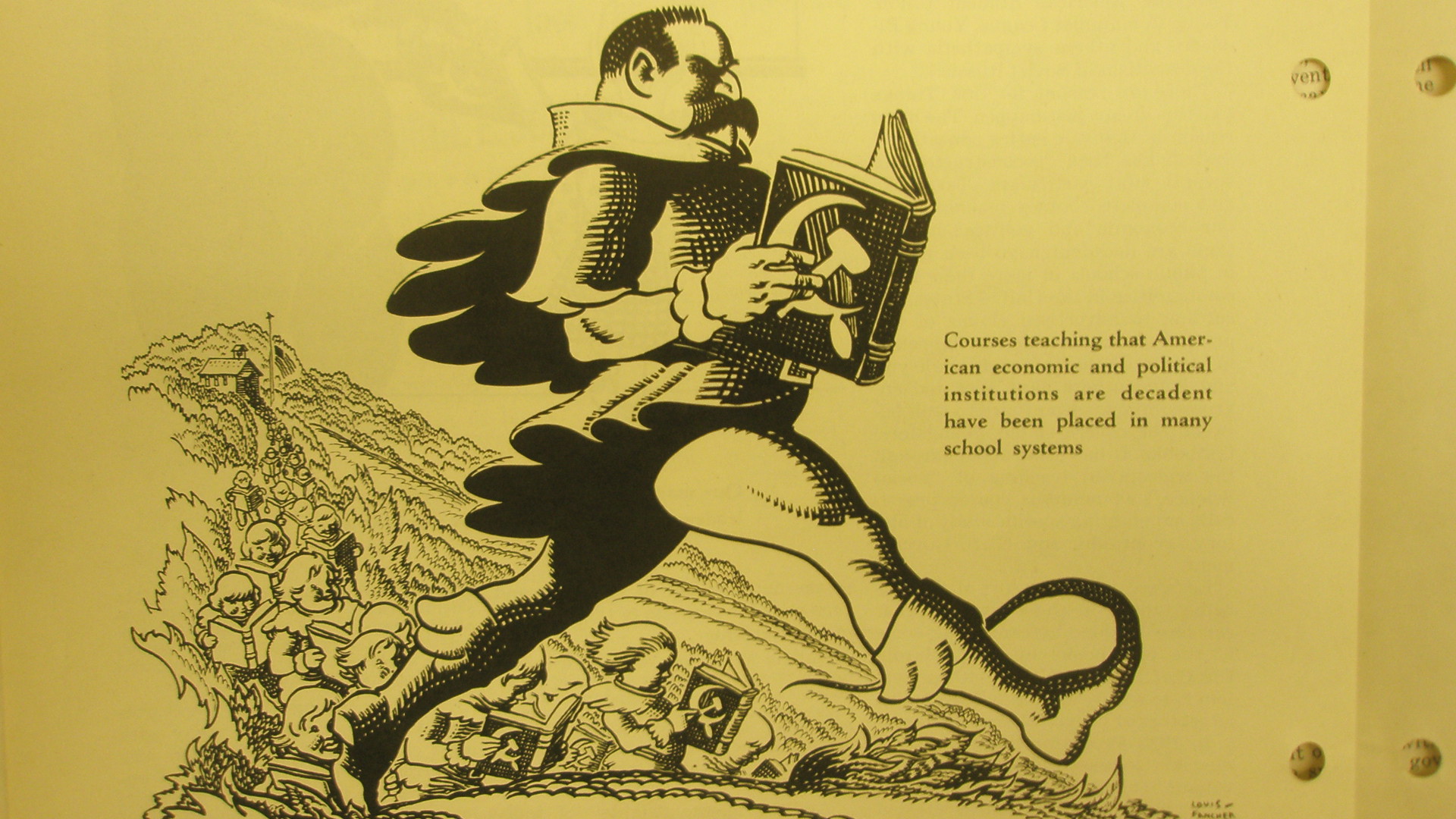
I’m up to my eyeballs in my book manuscript about conservative educational activism in the 20th century.  There are plenty of recurring themes.  Just like every other sort of activist, conservatives return again and again to images or ideas that work.  On a recent research trip I found another example of a common theme among educational conservatives: the Pied Piper.  For decades, conservatives have warned of Pied Pipers leading children out of their schoolhouses and into damnation.  The specific tune might change.  Sometimes, it is the dangerous sound of evolution.  At other times, it is communism, or atheism, or lack of Bible awareness.  I’ll include a few of the most striking images here.  Enjoy!

EJ Pace, Christian Cartoons, 1922

I thought the cartoon above captured the spirit of the 1920s Protestant fundamentalist school campaigns so well that I used it as the cover of my first book.  It comes from a wonderful book of cartoons by the evangelical artist EJ Pace.

EJ Pace, 1931

This is another gem from EJ Pace.  This one appeared in the newsletter of the Evangelical Theological College, a seminary new in the 1920s.  It later became the Dallas Theological Seminary, a leading training school for conservative Protestant ministers.  Of course, there’s not an actual Pied Piper here, but I’m including it because it has the same theme of students being led from their school (you can see it way in the background) down to the chasm of unbelief in God.  The cartoon was an advertisement for a Bible campaign that never really got off the ground.  The plan was to deliver 1,000,000 Bibles to college students so that they might better resist the intellectual and spiritual dangers of higher education.

From “Our ‘Reconstructed’ Educational System,” Nation’s Business, April, 1940

Here we see a different sort of Pied Piper.  Instead of evolution or the lack of Bibles, the threat here is communistic school textbooks.  Stalin as Piper is able to lead the students out of their little red schoolhouse down a dangerous path.  In this use of the Pied Piper theme, the danger comes from improper, un-American teaching.  But the basic message is the same.

I imagine there are lots of Pied Piper cartoons floating around out there for all different sorts of educational ideas.  The idea that improper education–whatever that might mean–is leading our young people down a dangerous path is too obvious to be restricted only to patriotic or religious conservatives.  However, I don’t know if any other cartoon could possibly match the excitement of seeing Stalin in tights and pointy-toed shoes.

Bible Cheats!

Ah, the irony!

One of the interesting parts of managing this blog is watching the search terms that direct people here.  It is not too Big-Brother-y, but I can scroll through the list of terms that people have Googled.

Most of them are no surprise.  Lots of people Google themselves.  Embarrassing, but understandable.

And lots of people who end up on I Love You But You’re Going to Hell also Google terms such as “traditionalist education,” “Bible in schools,” “anti-evolution,” and so on.  Makes sense.

But there’s another common search term that could help English teachers.  Having taught high-school English for several years myself, I remember that teaching the concept of “irony” was always difficult.  It only got harder when Alanis Morrissette butchered the concept with her pop song “Isn’t It Ironic.”   

Thanks to SMS, this should link to the video now. –AL

But now I’ve found a new illustrative example of “irony.”  Among the many common search terms that direct people to ILYBYGTH, one of the top phrases is “What the Bible Means to Me Essay.”

I’m no cynic.  But having taught middle- and high-school for ten years, I can smell a cheat.  In a lot of cases, plagiarism made sense.  For instance, as a US History teacher, I came to expect some students in our Prohibition unit to offer up plagiarized essays in favor of the legalization of marijuana.  It was still cheating, of course, but it made sense.  Fit the profile.

How much sadder is it to have students trying to rip off an essay on “What the Bible Means to Me?”

The Bible in America: Thunderbolt, Part II: Schempp

If we listen to the voices of Fundamentalist America, we might conclude that public schools in America are terrible places to be.  Twenty years ago, John Morris of the Institute for Creation Research warned that public schools had become “aggressively anti-Christian.”  The problems, Morris declared, went beyond the obvious:

Open drug sales and use, ethnic gang wars, and student/teacher violence are easily recognized problems, but how about the more subtle attempts at “values clarification,” or the encouragement of experimentation in “sex education” classes, or the inclusion of homosexuality as a legitimate lifestyle, or easy access to abortions through school clinics.

Other conservative Christian activists agree.  Thirty years ago, Jerry Combee wrote,

the public schools have grown into jungles where, of no surprise to Christian educators, the old Satanic nature ‘as a roaring lion, walketh about, seeking whom he may devour’ (I Peter 5:8).  Students do well to stay alive, much less learn.

More recently, activists involved in the Exodus Mandate have warned that public schools “are no more reformable than Soviet collective farms. . . . Conservative school reformers are a lot like Civil War reenactors who specialize in Pickett’s Charge.  They never take the high ground; they never really win.”

This staggering decline in the quality of public schools began, many conservatives insist, when the US Supreme Court kicked God out of schools in 1962 and 1963.  In 1962, as we’ve seen, the court decreed that states could not impose a non-sectarian prayer in public schools.  More devastating to many conservative Christians, in 1963 the court ruled in the decision Abington Township School District v. Schempp that even Bible reading and the Lord’s Prayer had no legitimate place in those schools.

Despite what many outsiders might think, the world of conservative evangelical Protestantism in America is truly kaleidoscopic, to borrow the phrase of religious historian Timothy L. Smith.  Different schools of thought among Bible believers disagree vehemently on questions of politics, culture, and theology.  Ask twenty “fundamentalists” what the Bible means and you’ll get at least twenty different answers.  Yet when it came to the Schempp decision, a variety of voices from around this diverse world all agreed.  This decision meant not only that God had been kicked out of public schools, but that Christianity itself had been kicked out of American public life.

For instance, in the immediate aftermath of the Schempp decision, separatist Presbyterian fundamentalist Carl McIntire still hoped that concerted political action might overturn it.  McIntire helped organize “Project America” to press politicians to adopt a Constitutional amendment in favor of prayer and Bible reading in public schools.  At first, McIntire repeatedly stressed his feeling that huge majorities of Americans would support such an amendment.  After a bitter political fight, however, McIntire acknowledged that it was hopeless.  Writers in McIntire’s Christian Beacon began to emphasize the notion that their beliefs made them a beleaguered minority in American life.  In 1965 one writer warned that America was “moving farther and farther from its Christian heritage.”  Another predicted that soon mainstream Americans would resort to “repression, restriction, harassment, and then outright persecution . . . in secular opposition to Christian witness.”

Other evangelical voices made similar about-faces in the aftermath of Schempp.  Baptist fundamentalist publisher John R. Rice reflected that the relationship between evangelical faith and public schooling had changed drastically.  He recounted for his readers how things had been radically different in the not-too-distant past:

Once when I was engaged in revival services in the Second Presbyterian Church in Chattanooga, Tennessee, I was invited to speak in every high school in the city and in the principal grade schools, both white and colored, and was gladly received.  The only people offended were those involved in the few elementary schools where I could not come for lack of time. 

Such halcyon days, however, had been destroyed by the cowardly Supreme Court.  Worst of all, Rice concluded, the court seemed to have the support of “the public sentiment.”

This sense of a drastic and sudden shift in the relationship between evangelical belief and public life was widely shared among all different sorts of conservative evangelical Protestants in the aftermath of Schempp.  One writer in the Moody Bible Institute’s Moody Monthly, for example, concluded that evangelicals must retreat to play the role of God’s “witnesses and lights in a dark place” in mainstream American culture.

Similarly, the intellectuals at Christianity Today articulated their shock and dismay of the implications of Schempp. At first, the editors believed that America’s “devout masses” still supported school prayer.  As did other evangelicals, however, they concluded bitterly that “In the schools secularization has triumphed.”  Instead of relying on devout masses, the editors soon hoped only to energize the “believing remnant” in America to support Bible-reading and prayer in public schools.

As we’ll see in future posts, the Schempp decision might not have had the drastic impact many of these writers assumed at the time.  Nevertheless, the degree of unanimity among a wide variety of conservative evangelical Protestants is remarkable.  From separatist fundamentalists to more ecumenical neo-evangelicals, prominent voices all agreed that this momentous decision had done more than just kicked God out of public schools.  In their opinions, Schempp had forced a sudden recalculation of the role of Bible believers in all of American public life.

Coming soon: Thunderbolt, Part III: What thunderbolt?