The Bible in America: What Is the Bible For?

The questions we’ve been wrestling with for the past few weeks here at ILYBYGTH concern the nature, function, and meanings of the Bible in Fundamentalist America.

As I’ve admitted, I do not get it.  But I make no claim to be a Bible believer, at least not in the sense most conservative Christians mean.  I do know that if we hope to understand life in Fundamentalist America, we need to understand the ways Fundamentalist America understands the idea of “the Bible.”  Many of the non-Fundamentalists and anti-Fundamentalists I meet assume that reliance on the Bible as a source of morality and knowledge must imply a certain closedmindedness.  For many folks outside the boundaries of Fundamentalist America, the two sides in America’s rumbling culture wars are precisely that: on one side are openminded intellects who rely on Science and Reason; on the other side are militant Fundamentalists who depend on Scripture and Tradition.

If we want to understand Fundamentalist America, we need to probe beyond those political stereotypes.  Yesterday, Peter Leithart shared some thoughts on the use and meanings of the Bible on First Things.  My hunch is that Dr. Leithart would reject the label “fundamentalist.”  Nevertheless, his exposition What is the Bible For? will help outsiders understand what the Bible can be for in Fundamentalist America.

As Leithart agrees,

The Bible rarely lives up to our ordinary standards of practicality. Page after page is given over to genealogical lists of obscure people whose only role is to be a human bridge between famous ancestors and notorious descendants. A third of Exodus is nothing but verbal blueprints for building the tabernacle and the first quarter of Leviticus contains detailed regulations concerning sacrifice. Two lengthy chapters of Leviticus diagnose the varieties of skin disease that cause impurity. It seems so tedious, and even when the Bible holds our interest, it doesn’t seem very useful. Stories of plagues, exodus, and wars of utter destruction make for juicy reading, but how do they help one become virtuous? Why can’t the Bible be more relevant?

Both the problem and the solution, Leithart articulates, come not from the text but from the reader.  To understand the Bible, in his telling, we need to look at it as more than a old book:

Scripture is ethical paedeia, not an ethics manual. All Scripture is practical because God breathed all of it to form people, both individuals and community. God tells stories to stock our memory with a common moral past that projects his people into the future. God’s word expands our imagination to grasp more of what’s really there and to envision what might be there in the future. The Bible is useful because it opens our eyes, and because it’s highly impractical to walk through life with our eyes closed.

How Does the Bible Work? Rightly Dividing the Word of Truth

Those outside the borders of Fundamentalist America, like me, are often stumped by the way conservative Protestants use the Bible.  For instance, I have a hard time understanding how conservative Protestants, in particular, interact with the Bible.  I should note here that this reverence for the Bible is still a fairly bright line between conservatives Protestants and other conservative religious folks.  Though Catholics, for instance, value the Bible, they generally do not invest it with the same authority as do conservative Protestants.  Also, even among conservative Protestants, there are many different traditions of Bible interpretation, exegesis, and hermeneutics.

Granting all that, there is still one question that puzzles me and many other outsiders: If the Bible is the Word of God, how can fundamentalists edit it?  As we’ve seen, fundamentalist missionaries have long used selections from the Bible as tools.  Fundamentalists often believe that these words have supernatural power to convert people to fundamentalist Christianity.  In addition, some of the most popular books among fundamentalists have been editions of the Bible with fundamentalist commentary.  This history goes back to the earliest days of Pilgrim and Puritan in Europe and the New World.  In 1560, Protestant divines completed an English-language Geneva edition of the Bible, flush with voluminous marginal commentary.  According to historian Harry Stout, it would have been considered irresponsible by sixteenth-century Protestants to “provide this Word raw, with no interpretive guidance.”  The commentary explained to readers, following Martin Luther, that every bit of Bible inclined toward the Christ.

In the twentieth century, this tradition of Bible commentary continued with enormously popular commentary editions, such as the Scofield Bible.  This edition of the Bible adds voluminous commentary on each smidgen of text.  Scofield’s interest in eschatology and suggestions of distinct dispensations contributed materially to the dominance of a dispensational reading of Scripture among American fundamentalists. 

In order for outsiders to understand Fundamentalist America, especially the Protestant traditions of fundamentalism, evangelicalism, Pentecostalism, conservative Lutheranism, and other Bible-based faiths, we need to understand this attitude toward the Bible.  The Bible, to many conservative Protestants, must be understood as the inerrant Word of God.  Yet that does not contradict with the notion that the Bible is also—and has also always been—the proper target of editing, translating, and commentating.

The Bible as America’s Book: Americans Love the Bible

I don’t care much about the Bible.  I admit it.  In my work as a historian of American conservatism and conservative Christianity, I’ve tried a couple of times to study the Bible systematically.  After all, the Bible and its phraseology play a large role in the culture of the people I’m studying.  At the very least, I need to cultivate a familiarity with it so that I can catch the references that fly around so fast and furious in Fundamentalist America.  So I’ve tried to read the Bible.  Turns out I can read it if I have to, but I admit I’ve never felt any of the spiritual power that many Christians have described.

I can take it one step further.  I don’t think the Bible can help me figure out my problems.  I don’t think it has much to say about my personal life.  I feel even more strongly that the Bible doesn’t have any answers for our common cultural or political life.  Intellectually, I agree with skeptics such as Richard Dawkins and others who have dismissed the Bible as a collection of ancient myths, trapped in the provincial traditions of one group of Middle Eastern nomads.

For most of my life, I assumed such attitudes were normal.  I thought that most Americans agreed that the Bible must not be used as the simple truth about life and eternity, but rather as a collection of moral tales from one religious tradition.

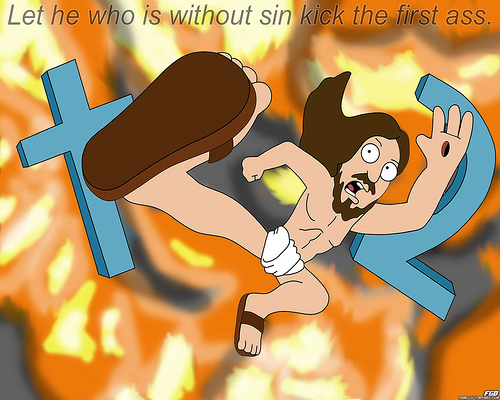
I felt confirmed that my attitudes matched those of lots of Americans by seeing hilarious religion jokes by folks like George Carlin (wait for it) and the makers of Family Guy.

I thought such irreverent attitudes about the Bible were the norm.  They still seem to be the norm among my circle of professional and personal acquaintance.  But they are not.  If we want to understand life in America, and especially if we hope to understand Fundamentalist America, we need to recognize the significant power of the Bible in the lives of most Americans.  If we can believe Gallup poll data, we must acknowledge the continuing deep reverence for the Bible among most Americans.  For instance, one 2000 poll asked respondents, “Do you believe the Bible answers all or most of the basic questions of life, or not?” 65% of respondents answered yes.  65%!  That is a significant majority.

And consider these responses to an often-repeated Gallup question:

  The Bible is the actual word of God and is to be taken   literally word for word The Bible is the inspired word of God but is not to be   interpreted literally The Bible is a collection of myths and fables.
1976 38 45 13
1980 40 45 9
1991 32 49 9
1993 35 48 14
1998 33 47 17

Looking at these results, especially if we combine the first two Bible-friendly categories, we see truly impressive majorities of American respondents view the Bible as the word of God.  Even when we only consider those who think of it as the literal truth, the numbers are still fairly large—certainly large enough to attract the attention of political strategists and advertisers.

Just as with similar questions about evolution, we must acknowledge that the number of Americans who don’t embrace the Bible is remarkably small.  We need to avoid the arrogance and self-importance of many Bible skeptics.  Instead of asking, Why do so many Americans seem to believe in the Bible or creationism?, we really should be asking, How have such small minorities of evolutionists and Bible skeptics been able to achieve such influence in American culture?

I know many ILYBYGTH readers will not be surprised by these statistics.  Anyone who knows much about life in Fundamentalist America recognizes the large majorities Fundamentalism can claim.  But many folks outside of Fundamentalist America’s boundaries have very little idea how isolated they are.  Like me, many people only interact with folks who tend to believe in evolution, with people who do not look to the Bible as their source of answers to life’s problems.  If we hope to understand Fundamentalist America, we need to acknowledge the continuing power of the Bible among such commanding majorities of Americans of every background.


The Bible in America: A Graphic

Thanks to Jared Fanning and Mark Misulia of First Things, we have a new graphic to consider.  As we’ve argued before, the Bible sells.  Though we don’t want to jump too quickly to conclusions about what that means, it seems evident that the Bible matters to Americans.  Anyone who hopes to understand Fundamentalist America needs to understand the unique and important role of the Bible in American history and culture.

The Bible as America’s Book: The View from 1898

Fundamentalists insist that America needs the Bible.  As we’ve explored here before, many argue that America was founded as a Biblical nation.   Fundamentalists will tell you that America went to the dogs when Americans foolishly agreed to kick the Bible out of public schools.  If you have three minutes to spare, check out this video for a brief and dramatic version of this line of Fundamentalist thinking.

As with a lot of historical claims in Fundamentalist America, this one needs some scrutiny.  Outside of angry nostalgia and heated rhetoric, what can we know about the uses and meanings of the Bible in the history of America’s public schools?  Educational historians agree it is notoriously difficult to find out what went on in classrooms in the past.  Reading textbooks only tells us what was in those books, not what teachers and students really did.  Reading memoirs of student life can tell us what students choose to remember from their school days, but it can’t get us behind that closed classroom door.  And reading school laws and regulations only tell us what rulemakers wanted schools to do, not what the schools actually did.  But in spite of all these difficulties, we do have scattered chunks of evidence about classroom practice in the past.

In this post, I’ll analyze one such piece of evidence.  At the end of the nineteenth century, the Chicago Woman’s Educational Union conducted a survey to determine the degree to which the Bible played a leading role in American public education.  In 1898, the CWEU published the results as The Nation’s Book in the Nation’s Schools As the name implies, this was never meant to be a disinterested survey.  The editor, Elizabeth Cook, planned to use her evidence to promote a vision of American public schools as the proper home of a thoroughly Biblical culture.  As she wrote in her preface, Cook hoped to “aid in the beautiful work of guarding and extending the proper use of the Bible in our Glorious Educational System.”  The historical vision of the Chicago group would have made today’s fundamentalist historians such as David Barton proud.  Cook explained to readers that the Founding Fathers had imagined a thoroughly Biblical culture and society.  In 1777, she described, the Continental Congress ordered 30,000 English copies of the Bible for public distribution.  This proved, Cook argued, “how deeply the conviction that a knowledge of Biblical truth was essential to National life and health.”  The Chicago women’s group decided to see if the Bible still retained a prominent role in the nation’s public schools.  They surveyed state, county, and city school administrators.  The results of this survey satisfied the women that the Bible did indeed remain central to American public education.

Of course, we must recognize that the responses of these school superintendents tell us more about the political nature of the inquiry than about actual Bible reading in public schools in the late nineteenth century.  It shows us more about how these school politicians wanted to be seen than about what actually went on in classrooms.  These survey responses framed a political statement about the proper role for the Bible in 1898’s public schools, not a neutral batch of evidence.  Nevertheless, for that very reason the responses can tell us a great deal about contemporary attitudes.

The survey responses from my new home state, New York, described what Cook interpreted as a thoroughly Biblical public school culture.  A significant majority (53 of 94 respondents from across the state) reported Bible reading as an opening daily exercise in their schools.  Yet a sizeable minority (17 of 94) answered that the Bible was not read in their local schools.

In a neighboring state we see a similarly complicated response.  The state superintendent of public education in New Jersey, one CJ Baxter, responded that most schools in his Garden State read from the Bible.  Their reasons for doing so, he insisted, were simple.  Baxter told the Chicago Bible women that New Jerseyans “rejoiced under the reign of God, confident that He would ‘beautify the meek with salvation.’”  This answer from a state superintendent of education certainly sounds different from what one would expect from such an official today.  Not only did he agree with the surveyors that the Bible ought to be part of public education, but in 1898 he publicly aligned himself with the evangelical Protestant tradition.  With such attitudes at the top, it would not be surprising to find New Jersey’s teachers reading from the Bible in many public classrooms.  But it would also be unsurprising to find that significant numbers of parents and teachers quietly ignored their state leader’s loud evangelicalism.  It does not take a stretch of historical imagination to envision plenty of New Jersey schools in 1898 working out a far less evangelical attitude toward the practices in any given classroom.  And, in fact, even Superintendent Baxter confessed that “a few” of the school boards in New Jersey did not allow Bible reading in their public schools.

From Pennsylvania, the state superintendent reported that 15,780 out of 18,109 public schools in the Keystone State read from the Bible.  Such statistics delighted Cook and the CWEU.  But in other places, officials reported that Bible reading would not be allowed.  The curt responses from school leaders in Idaho and Utah, for example, demonstrated different regional attitudes.  John Parks, Utah’s state superintendent, offered a Mormon-powered interpretation of the use of Bible in public schools.  “While morality is taught and inculcated in all of the public schools of this State,” Parks told the Chicago Bible women, “the Bible is not read in any of them.  The belief seems to be quite wide-spread here that moral teaching in the public schools should be wholly non-sectarian, and many believe it to be impossible to introduce the Bible into the schools without at the same time removing one of the strongest guards against sectarianism.”

In 1898 Utah, “non-sectarian” meant no Bibles.  But in many eastern and southern states, non-sectarian had a much different meaning.  Most eastern and southern respondents felt that if the Bible could be used in a way that did not discriminate against or among Protestants, Catholics, and Jews, it could be used freely.  In spite of the eager evangelical tone of the New Jersey superintendent, most of those who approved of reading from the Bible in public schools agreed it must be done “without note or comment.”  Most school Bible rules explicitly stated that the Bible’s words must be allowed to stand free of any imposed interpretation.

For example, Baltimore’s Bible rule, according to Cook’s report, specified that schools might use either the evangelical-friendly King James Version or the Catholic-friendly Douay version for their school readings.  The rule in New York City specified,

No school shall be entitled to, or receive any portion of the school moneys, in which the religious doctrines or tenets of any particular Christian, or other religious sect, shall be taught, inculcated, or practiced; or in which any book or books containing compositions favorable or prejudicial to the particular doctrines or tents of any particular Christian or other religious sect, or which shall refuse to permit the visits and examinations provided for in this chapter.  But nothing herein contained shall authorize the Board of Education to exclude the Holy Scriptures, without note or comment, or any selections therefrom from any of the schools provided for by this charter.”

In other words, most school leaders agreed there must be no sectarian books in schools.  In Utah, that meant no Bibles.  But in New York, it didn’t.  In New York, and many other eastern and southern states, the Bible stood out as a uniquely powerful book, beyond all sectarian controversy.  All people, the thinking went, could support the reading of the Bible in public schools, since it transcended all religious differences.

Such differences in New York City and Baltimore focused on Catholic/Protestant/Jewish disagreements about the nature and uses of the Bible.  Those in Utah and Idaho implied LDS/mainstream Protestant disagreements.  Reporting from North Carolina, State Superintendent of Public Instruction John L. Scarborough noted a different division.  The Bible, Scarborough responded to the survey, transcended racial differences, with a “native population, white and black, the majority of whom and their leaders, love the old Book, and its doctrines and morals.  God bless her people every one, and keep her in the old paths.”

Most of the survey respondents who wanted Bibles in their schools argued that the Bible ought to be read in public schools for fundamentally non-religious reasons.  Though some, like New Jersey’s and North Carolina’s superintendents, might have personally agreed with the Protestant evangelical mission of the Chicago Bible women, most framed their arguments in terms of moral indoctrination.  For instance, one school superintendent from Tennessee declared that the Bible was and must remain in Tennessee’s public schools.  He did not say this would lead children to heaven, though.  Instead, he insisted, “The Bible is our rock of public safety.”  Such arguments in favor of Bible reading in public schools seemed to resonate strongly in late-nineteenth-century America.  Cook summed up this patriotic morality by noting, “Even as all political parties of the United States honor our Flag and National Constitution, so should the people of every faith look to our Nation’s Bible for instruction in National righteousness.”

In Cook’s opinion, the Bible stood out as a unique moral guide.  She argued not only that it should be used in America’s public schools, but that it was used in a vast majority of those schools.  Yet her own evidence shows how complicated that use was.  In many parts of the country, the Bible in 1898 was seen in a way very similar to the way it is seen today: as a divisive religious book.  In states such as Utah, Idaho, and Montana, state superintendents responded that the use of the Bible in public schools would mean an un-American imposition of religion in public schools.  In many other regions, however, the Bible seems to have been embraced as an appropriate non-sectarian—or better yet, super-sectarian—book for use in public schools.

Where it was used, however, it generally took its place as a generic moral guide.  Most school leaders did not say they read from the Bible in order to lead children to heaven.  Much more common was the argument that public schools must read the Bible in order to lead children out of the gutter and the prison.

FROM THE ARCHIVES: Bible in America: Bibles to the Backwoods

A few years back I stumbled across a remarkable Bible campaign.  Beginning in 1921 and continuing throughout the twentieth century, Bible evangelists based at Chicago’s Moody Bible Institute delivered Bibles, New Testaments, and tracts to underserved regions.  This campaign, which began as part of the Bible Institute Colportage Association and eventually became part of the Moody Literature Mission, delivered millions of Bibles and religious literature to the Southern Appalachian region, as well as the Ozarks, western logging camps, Louisianan Catholic schools, prisons, hospitals, and other venues in which missionaries thought people were hungry for the Word. 

            At the time, I focused my study on the missionaries’ use of Appalachian public schools as a distribution network for this religious literature.  I published some of my findings in an academic journal [“The Quiet Crusade: The Moody Bible Institute’s Outreach to Public Schools and the Mainstreaming of Appalachia, 1921-1966,” Church History 75:3 (September 2006): 565-593.]

            Looking over my notes as I thought about the meanings of the Bible in Fundamentalist America, I came across my collection from this research.  As usual, there was a lot more material than what I could use in the article. 

            This will be the last of these collected posts from BICA and MBI. See other posts from this series HERE and HERE.  Most of the material is available at the Moody Bible Institute in downtown Chicago.  The people there were very accommodating and friendly on my visits, and the archive is certainly worth a visit if you’re in the area. 

            I won’t argue that these materials somehow capture any single essence of fundamentalist attitudes about the power of the Bible.  That would be far too simplistic.  But I do believe that the attitudes toward the Bible expressed in these materials give a window into a commonly held fundamentalist vision of the nature of Holy Scripture.  As we’ll see, the Bible missionaries from Chicago believed the Word had a unique power.  The Gospels, to them—and, I argue, to many fundamentalists in the 1920s and since—meant more than just a collection of edifying religious messages.  As we’ll see, many of these Bible missionaries held a fundamentalist belief in the saving power of this powerful text. 

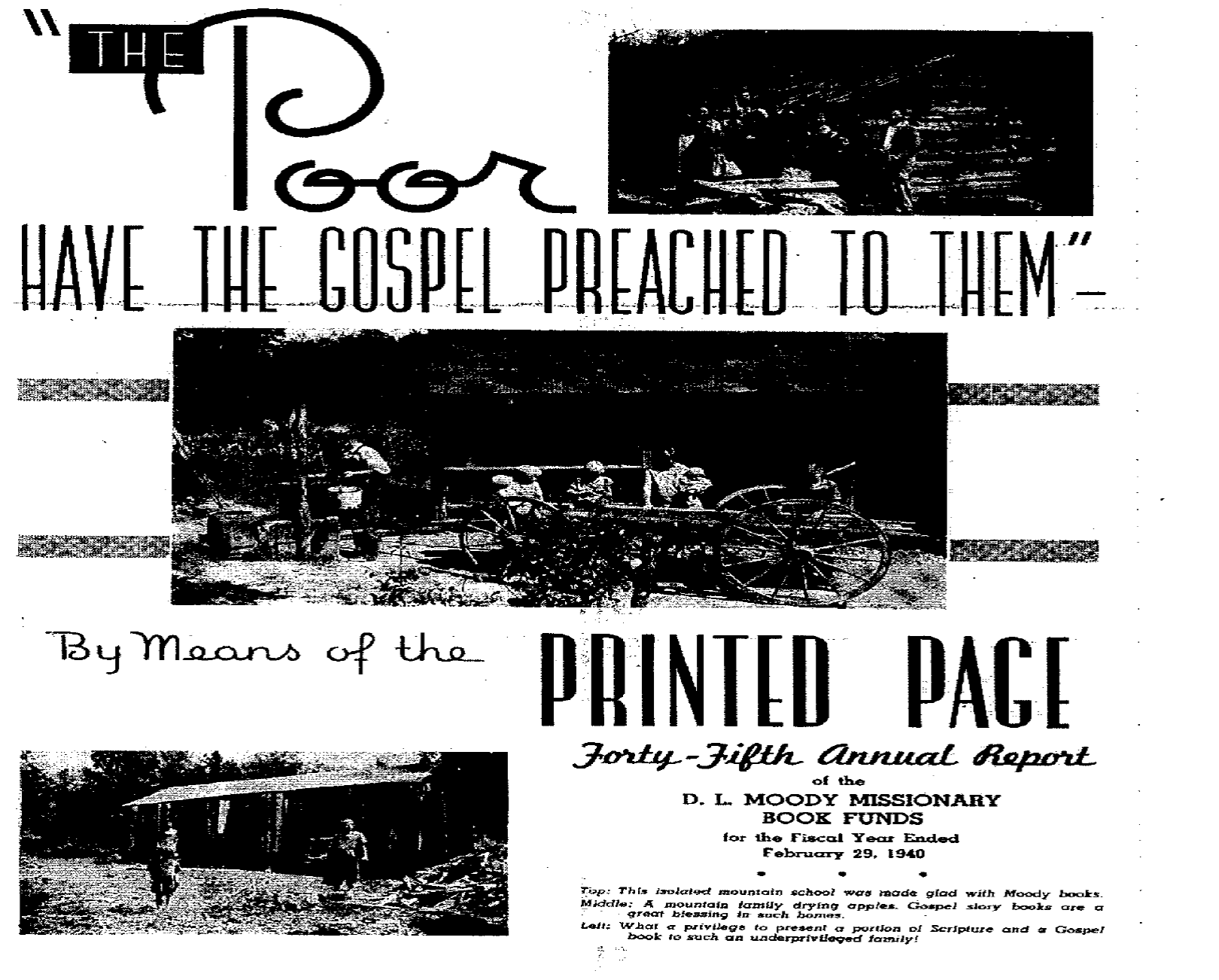
The inspiration for the Moody Bible Institute missionaries to deliver Bibles to the Southern Appalachian region came from the apparent lack of reading material of all kinds in the region.  In the 1920s, ‘30s, and ‘40s, the Chicago missionaries saw the “mountaineers” as particularly ready for literature outreach.  The reasons to send Bibles instead of humans were many.  First of all, Bibles were cheaper and easier to crate and ship.  Second, the Bible had a supernatural power to convert.  As one missionary proclaimed in 1921, the Gospels formed “the most unique, the most startling, the most compelling, and most unearthly message that has ever commanded God’s attention.”  No matter how talented a human missionary, he or she could not hope to compare with the words of the Gospel itself.  But another reason why Bibles made good missionaries was because the people of the region desperately wanted reading material of any kind.  Folks starved for reading material, the argument went, would eagerly read the Bible if only they could get one.  And by reading the Bible, they would be convinced by its supernatural power; they would embrace Fundamentalist Protestantism.  As one fundraising brochure from 1940 called it, this crusade could preach the gospel to the poor by using the “printed page.”

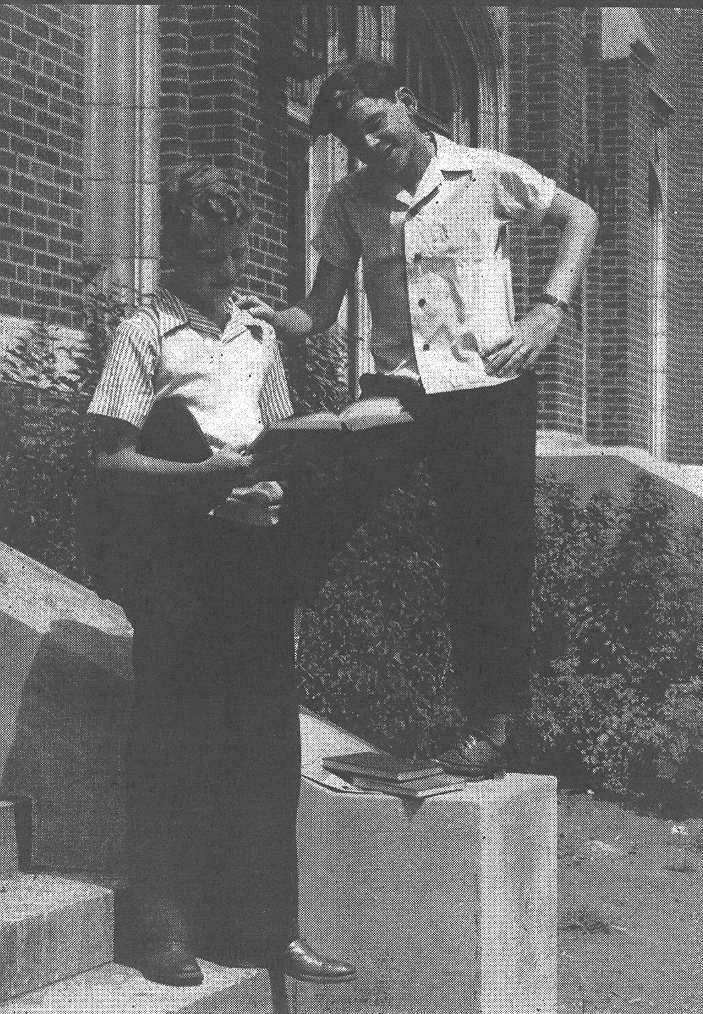
Many children from the region craved book ownership, it seemed, much more than they craved enlightenment.  Many of the Chicago book missionaries capitalized on that notion to satisfy young people’s lust for books with a healthy desire for the Gospel.  This picture of children in front of their log school was meant to show children’s appreciation for the Gospel.  It also shows, though, how much young people liked to have a book of their own.

These images from the Moody Bible Institute’s outreach tell us something about fundamentalist attitudes toward the Bible.  For many people, especially those without access to many books, the Bible served as both a religious text and a status symbol.  Both the Appalachian schoolkids and the Chicago Bible missionaries accepted this premise.  The Chicago missionaries played up this appeal by instituting a traditional Sunday-school Gospel-memorization strategy.  If schoolkids memorized a certain number of Bible passages, the missionaries would reward them with a Bible of their own.  Missionaries saw the lust for Bibles as a healthy desire for spiritual uplift.  Some of the schoolkids eagerly participated in the memorization program merely out of their desire to own books of their own.  They conflated their desire for ownership with their desire for salvation.

Also, this campaign shows us how evangelical Protestant missionaries in the early twentieth century tended to present their targets as different from themselves.  The missionaries may have been well-to-do—or at least middle-class—urban, Northern whites.  The folks they hoped to reach with their Bible outreach were consistently presented as something else.  Here, that other-ness was the “mountain” aspect of Appalachian life.  The little kids with their tiny log school, the farmers with their ancient wagon technology, or even simply the description of targeted populations as “The Poor,” all of these markers separated the missionaries themselves from those they hoped to reach.  As we’ve seen, by the middle of the twentieth century these Fundamentalist Protestant Bible missionaries had shifted their understanding of their targets.  Instead of consistently distancing their targets from themselves, by the mid-1940s these Bible missionaries presented their targets as white middle-class urban and suburban people.  This shift in Bible outreach tells us a great deal about the changing nature of Fundamentalist America in the twentieth century.  These Bible missionaries came to see themselves as reaching out in their own neighborhoods, to people like themselves. They no longer assumed that the only ones in need of soul-saving work were in far-away locations with exotic cultures.  Fundamentalist America came to see itself as working close to home.


The Bible in America: How the Bible Works

A lot of people don’t get it.  Why does it matter so much in Fundamentalist America what the Bible says?  After all, the Bible, for a lot of people, is just one collection of ancient writings.  Richard Dawkins concluded his Blind Watchmaker, for example, by calling “the Genesis story . . . just the one that happened to have been adopted by one particular tribe of Middle Eastern herders.”  Dawkins has not been the first to make such accusations.  In the 1920s, sociologist Harry E. Barnes derided the Bible as merely “the product of the folkways and mores of the primitive Hebrews. . . and the personal views of religious reformers of all grades from Jesus to Paul.”  It doesn’t make sense to non-fundamentalists to base social policy or even personal ethics on this collection of cranky commandments from ancient sheep-herders.  Deuteronomy just doesn’t fit with today’s lifestyle, some think.

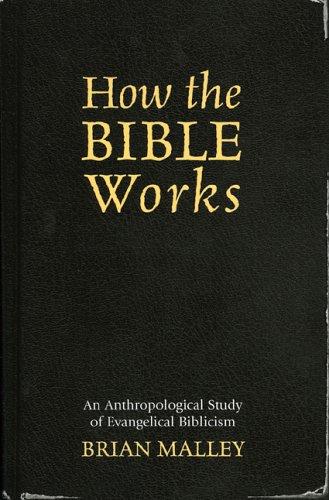
Those hoping to make some sense of the ways Fundamentalist America understands the Bible should take some time with a newish book, Brian Malley’s How the Bible Works.   It is not an attack or expose of fundamentalist foibles.  Rather, it is an ethnographic study of one evangelical community, “Creekside Baptist.”  It is a thoughtful and deeply sympathetic attempt to understand what one group of conservative evangelical Protestants mean when they say “Bible.”  Malley himself is the product of a conservative evangelical Protestant upbringing.  ILYBYGTH readers will likely appreciate his perspective.  He is not out to demonize or lionize the folks he studies.  Rather, he conducted a series of interviews and probed the complicated questions lying at the heart of many conservative Protestants about the Bible and their faith.

In the first section of the book, Malley asks his informants to help him understand labels.  Perhaps most interesting for ILYBYGTH readers, he asks then to explain how they felt about “fundamentalist.”  Here is a taste of some responses:

“the word has gotten such a bad rap, but yes [I consider myself fundamentalist.]  Not in the sense that you hear in the news.  Basically I view those words as being interchangeable—evangelical and fundamentalist.”

Several interviewees said they felt fundamentalist, but that the term had a negative connotation.  For example, in the words of one “middle-aged man”:

“That [‘fundamentalist’] has a more negative connotation to me.  I think of it as a person.  ‘Fundamentalist’ to me today means more of a judging person that has a whole series of rules that they follow and I don’t think that’s right.  I’m not on the other end of the spectrum either, a wild liberal person either.  I guess I don’t live primarily by rules but by principles.  The principles come from the Bible.  But I don’t see myself as what I hear people describing fundamentalist as today.”

Another interviewee, “Stan,” said,

“I don’t like the term because of the connotations that it has.”

            Brian: “Which ones specifically?”

            Stan: “Connotations being I think that if you said that in this country, a fundamentalist would be considered kind of a far-right-wing wacko, and is a way extreme almost to the point of being non-Christian, something other than Christian.  Probably in its true identity, the definition of the word is you believe the fundamentals of Christianity, the basics of Christianity, that term would apply.  But that definition doesn’t apply anymore in this country.”

One young man, “Todd,” offered this explanation:

“Again, ‘fundamentalist’ is another term which I fear has been misunderstood and caricatured and stereotyped widely across modern American culture.  I’m not really familiar with what I consider properly called ‘fundamentalist culture.’  I know a bit of fundamentalist theology, but . . . I think properly understood, especially if you look at historical roots of fundamentalism, it gets down to what are fundamentals of the faith, and I think most fundamentalists and I agree what the fundamentals of the faith are, if you boil it down.”

For these conservative evangelical Protestants, “fundamentalism” had attracted a cluster of unfair meanings.  They generally agreed with what they understood to be fundamentalist theology, but they felt that fundamentalism as a whole had come to include all sorts of other meanings.

But Malley’s main interest in in the ways his respondents felt about the Bible.  Evangelicals, Malley argues, create a many-layered meaning around “Bible.”  One important part of this is what Malley calls “artifactual knowledge.”  Evangelicals know the Bible as a physical thing, a certain kind of book.  As he describes, this kind of knowledge is encouraged among evangelicals.  In the very youngest of children’s groups at Creekside Baptist, two-year-olds are taught to hold a Bible while they sing song such as “Pat the Bible” (to the tune of Did You Ever See a Lassie, or Wheels on the Bus, or Here We Go Round the Mulberry Bush, etc.).  In the words of one teacher of this two-year-old class, the youngsters should learn that the Bible is a special kind of book.  It is something to be cherished and valued.  It is not something to be treated like other books.

Another fascinating point Malley makes is that his respondents don’t think of the Bible as a certain translation of the original documents.  He held up two versions in some of his interviews, one in Greek and one in English.  He asked his interviewees which one they thought was “the” Bible.  Not only did the folks he talked with say they were both equally “Bible,” they thought the very question was nonsensical.  In other words, for this community at least, “The Bible” does not refer only to one specific translation.  Rather, it is understood to be a collection of texts that has been and will continue to be understood in a variety of languages, in a variety of translations.  Not only that, but folks at Creekside Baptist all agreed that the Bible did not actually have to be a printed book at all.  It could be put onto a website or CD.  It could be printed on enormous sheets or in a tiny pocket edition.  But it could NOT be made into a movie.  Movies could be made ABOUT the Bible, but they would not be the Bible itself.  The Bible was print, but it could be print in a variety of formats, languages, and translations.  As long as the text stayed true to the original meanings, any sort of text could be used to create an authentic Bible.

Malley also argues that his respondents have an interpretive Bible tradition, but not a hermeneutic one.  That is, evangelicals define their intellectual and theological world in large part as an interpretation of Biblical texts.  Scholarship and intellectualism mean, in large part, engaging in interpretation and citation of Biblical texts.  This results in the Bible-centered talk that non-evangelicals often find so baffling.  For example, evangelicals will explain their political opinions on topics such as gay marriage by offering Bible citations.  To evangelicals, those citations act as strong intellectual arguments.  If one can back up opinions on any topic with proper citations, one can carry the argument.  But evangelicals are not trained—outside of academic theologians—to engage in hermeneutic acts with and about their Bibles.  That is, Malley’s respondents did not feel a need to apply special interpretive skills to reading their Bibles.  Respondents consistently referred to reading their Bibles not as an act that required intellectual training, but as an act that required devotion.  The challenge was not to learn a set of keys to make sense of the Bible, but rather to learn an attitude toward reading.

Another topic Malley tangles with is the complex meanings of “literalism.”  Some folks outside of conservative Protestant circles misunderstand the notion of a literal interpretation of the Bible.  For Malley’s informants, as for most conservative Protestants, “literalism” does not mean that every word of the Bible must be taken as the literal truth.  In some places, the Bible clearly speaks figuratively, as when Jesus tells his audience they are the salt of the earth.  For Malley’s informants, the important aspect of literalism is a reading of the Bible that gives authority to the Bible itself.  Instead of taking freedom to interpret passages in ways that make the most sense to readers, the Bible must be read in ways that make the most sense in the context of the Bible itself.  Literalism, in this understanding, is more about authority than anything else.  If a passage was intended to be literal, it must be taken that way, even if that seems to contradict with the reader’s experience or desire.  Generally, when the Bible does not mean for itself to be taken literally, as in Jesus’ parables, it makes that abundantly clear.  Readers do not have the right to assume it is speaking symbolically when it does not clearly say that itself.

Malley points out that there are several layers of Biblical interpretation active at the same time in the evangelical world, broadly considered.  Among evangelical scholars, questions of authority and interpretation receive intense scrutiny.  But among the folks he talked to, there was much wider latitude for traditional, passed-along understandings of “Bible” and its meanings.  As Malley argues, “The evangelical tradition solves this problem by maintaining fairly rigorous standards of exegesis in its scholarship and quietly ignoring those standards in the churches.”

So, for example, Malley’s informants at Creekside Baptist could confidently assure Malley that the Bible was authoritative, even if they could not clearly explain what they meant by that when Malley pressed them.  As one way of testing this principle, Malley pressed people to explain why they regarded only some parts of the Bible as authoritative.  He asked, for example, what respondents thought about passages such as Romans 16:116, repeated in 1 Corinthians 16:20, 2 Corinthians 13:12, and 1 Thessalonians 5:26, in which Christians are instructed to “greet one another with a holy kiss.”  Malley interviewees acknowledged that the instruction was in the Bible.  They agreed that the Bible was authoritative.  And they acknowledged that they did not follow that particular instruction.  When pressed to explain the contradiction, respondents argued that such passages were “cultural” commands, meant to apply to people at the time, but not to them.  Or respondents shrugged.  The important point is that Biblical Christians did not feel this kind of apparent contradiction challenged the authority of the Bible, or their justification in considering the Bible authoritative in their lives.

For those living outside of the tradition of evangelical Protestantism, such apparent paradoxes can seem like proof that a Biblical worldview is non-sensical.  Malley doesn’t try to make that leap.  Rather, he is more interested in understanding and explaining how his respondents themselves understand this seeming contradiction.  He is more interested in exploring the fact that it does not appear to be much of a contradiction at all to them.

If outsiders hope to understand Fundamentalist America, this kind of intellectual stretching will help.  Malley’s study of one evangelical community can’t be taken to speak for all conservative Protestants, much less for the broad conservative coalition that makes up Fundamentalist America.  But his book is a good place for outsiders to start.  It will help people from outside the tradition make sense of the many meanings of “Bible” in Fundamentalist America.

FURTHER READING: Harry Elmer Barnes, “Sociology and Ethics: A Genetic View of the Theory of Conduct,” The Journal of Social Forces, III (January, 1925): 214; Brian Malley, How the Bible Works: An Anthropological Study of Evangelical Biblicism (Walnut Creek, CA: Altamira Press, 2004).

FROM THE ARCHIVES: Bible in America: The Power of Books

A few years back I stumbled across a remarkable Bible campaign.  Beginning in 1921 and continuing throughout the twentieth century, Bible evangelists based at Chicago’s Moody Bible Institute delivered Bibles, New Testaments, and tracts to underserved regions.  This campaign, which began as part of the Bible Institute Colportage Association and eventually became part of the Moody Literature Mission, delivered millions of Bibles and religious literature to the Southern Appalachian region, as well as the Ozarks, western logging camps, Louisianan Catholic schools, prisons, hospitals, and other venues in which missionaries thought people were hungry for the Word. 

            At the time, I focused my study on the missionaries’ use of Appalachian public schools as a distribution network for this religious literature.  I published some of my findings in an academic journal [“The Quiet Crusade: The Moody Bible Institute’s Outreach to Public Schools and the Mainstreaming of Appalachia, 1921-1966,” Church History 75:3 (September 2006): 565-593.] 

            Looking over my notes as I thought about the meanings of the Bible in Fundamentalist America, I came across my collection from this research.  As usual, there was a lot more material than what I could use in the article. 

            For the next few posts, I’ll pull up various pamphlets, brochures, and other materials from this archival collection.  Most of the material is available at the Moody Bible Institute in downtown Chicago.  The people there were very accommodating and friendly on my visits, and the archive is certainly worth a visit if you’re in the area. 

            I won’t argue that these materials somehow capture any single essence of fundamentalist attitudes about the power of the Bible.  That would be far too simplistic.  But I do believe that the attitudes toward the Bible expressed in these materials give a window into a commonly held fundamentalist vision of the nature of Holy Scripture.  As we’ll see, the Bible missionaries from Chicago believed the Word had a unique power.  The Gospels, to them—and, I argue, to many fundamentalists in the 1920s and since—meant more than just a collection of edifying religious messages.  As we’ll see, many of these Bible missionaries held a fundamentalist belief in the saving power of this powerful text. 

The most powerful book, fundamentalists agree, is the Bible.  Among conservative Protestants, the Bible is often considered to have supernatural power on its own.  The Chicago book missionaries of the Bible Institute Colportage Association and Moody Literature Mission were no exceptions.  They believed the Bible could transform lives.  But the Chicago book missionaries also believed in the power of non-Biblical literature.  Especially as a counterweight to an expanding pulp press, Bible-friendly fiction could be an important way to save souls.  In this post, I’ll describe an example of each type of book that the Chicago book missionaries distributed.

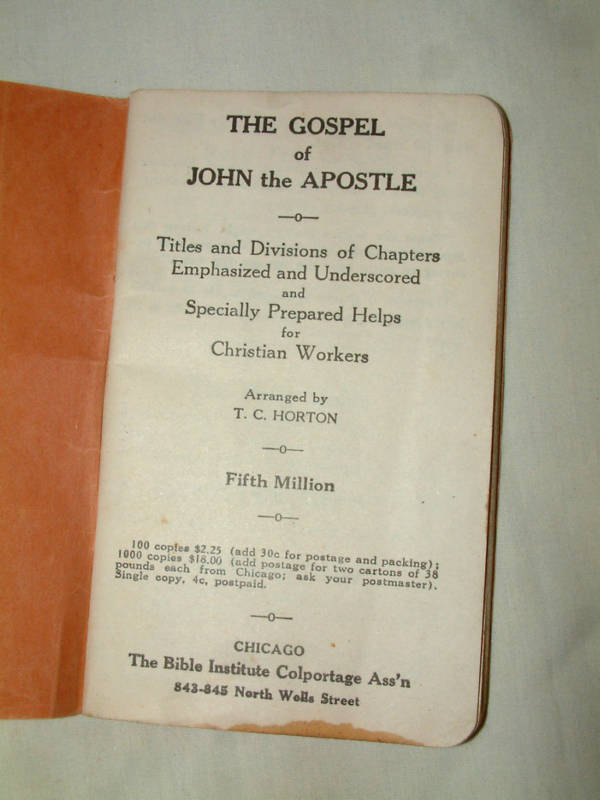
First, the Bible.  The most commonly distributed Bible book wasn’t the entire Bible, but rather a special edition of the Gospel of John.  This edition was edited by TC Horton in 1922.  At the time, Horton was at the peak of his career.  He was a minister and organizer in the Los Angeles area.  He was best known in 1922 as the editor of the Kings Business, the magazine of the Bible Institute of Los Angeles (now Biola University).

Horton’s attitude toward this little volume was clear from the verse on the front cover.  Sorry, it’s hard to read in this photo, but the verse says,

  Here is a little book for you!

                        Just take it, now, and read it through.

                        Page sixty-six, verse thirty-one,

                        Believe it, and the work is done!

If any curious reader followed this clue, he or she would find the following verse: “But THESE ARE WRITTEN, THAT YE MIGHT BELIEVE THAT JESUS IS THE CHRIST, THE SON OF GOD; AND THAT BELIEVING YE MIGHT HAVE LIFE THROUGH HIS NAME.”

In case readers didn’t follow the cover clue, Horton repeated the message on the inside cover.  Horton insisted that the Gospel of John was “the incomparable piece of English Literature.”  But it was not only good literature.  It was inspired by God in order specifically to convert people to Biblical Christianity.  If only people would read these words, Horton believed, their lives would be transformed.  As Horton insisted, this supernatural power was the reason why this Gospel “should be placed, as far as possible, in the hands of every man, woman, and child in the world.”

As we’ve seen, fundamentalists in America have embraced this mission.  In a campaign that sometimes seems bewildering to non-fundamentalists, Bible missionaries have worked to get people to see these Gospel words.

The files of the book missionaries shed some light on this attitude toward the saving power of Gospel words.  The first director of the Bible Institute Colportage Association, William Norton, told stories of the instant power of the words of the Gospel.  In 1921, Norton told a story of a man given a Gospel tract.  At first, the man ignored it.  “Coming to a hedge,” Norton related, “he stuck the tract into the hedge.”  However, thanks to the awesome power of the words of the Gospel, “it was too late; his eyes had caught a few words of the tract which led to his conversion.”  In another story from 1921, a vicious murderer found a copy of a Gospel tract.  “Through reading the Gospel of John this man saw the error of his way, changed his manner of living, and moved to the Bear Creek community in Scott County, Tenn.”

For Bible missionaries like the ones from Chicago, this power of conversion came from the power of the Gospels.  The words were inspired by God to lead to this kind of conversion.  It only made sense, then, to distribute those words as widely as possible.  This attitude toward the words of the Gospel has informed the outreach of Fundamentalist America in ways that remain bewildering to folks who don’t understand the impulse.  But if we can understand this book, these words, as inspired by God to lead people to salvation, we can understand something about the Fundamentalist desire to get these words in front of as many people as possible.  For the Chicago book missionaries, this meant delivering hundreds of thousands of copies of these tracts and Gospels to children across the nation.

Among fundamentalists, only the Bible had the kind of supernatural power that could lead people to instant conversion, merely by seeing the words.  But other kinds of books, too, could help.  The Chicago book missionaries also distributed hundreds of thousands of copies of short novels.  These books weren’t as powerful as the Bible, but they could still work to combat the trend toward sin in popular literature.  As one missionary warned in 1937, they needed uplifting books “during these difficult days when much pernicious literature is being widely distributed by religious cults, atheistic organizations and anti-Christian societies, whereby many are being deceived and destroyed.”

Back in 1921, William Norton had called these books “true-to-the-Bible literature.”  One of the most popular was Rosa’s Quest, originally published in 1905.

In this story, a poor girl is lost in a big city.  Her Christian mother had died, and just before she died she told Rosa to find her in the “beautiful land.”  Unfortunately, the girl lacked any Christian education.  She wandered around the city, rebuffed by nominal Christians who did not reach out to her.  Finally, a missionary on a city bus explains the Word of God to Rosa.  Rosa is converted, then adopted by a wealthy secular family.  In the end, Rosa converts all of her new family using the Gospel.

In the eyes of Bible missionaries, books like this did not have the same supernatural power as the Gospel itself.  They could not change lives simply by being read or heard one time.  But missionaries still reported that the books could help save souls.  One missionary in 1921 reported that the children she worked with were “very enthusiastic” about Rosa’s Quest.   One child from Madison County, Kentucky, wrote to the BICA to thank them for the free books, and noted that he felt “like little Rosa in Rosa’s Quest.  I have found the way to heaven.”  Another recipient wrote in 1937,

“FROM KENTUCKY: ‘In the year 1929, one of my friends loaned me some of your books entitled “Little King Davie,” “The Way Home,” “The Robber’s Grave,” “A Peep behind the Scenes,” and others.  I was thirteen years of age.  God definitely spoke to me through the books and gave me a peep behind the curtains which hid my heart.  In the same year I received a heart-felt experience from God, and also a call into His service.  I am now a missionary in the mountains of Kentucky.”

For the conservative Protestant missionaries of the Moody Bible Institute, books had power.  Some of them, if they contained the actual words of the Gospels, could have supernatural power.  Those words, distributed in books, tracts, and leaflets, emblazoned on billboards, eventually printed on Tim Tebow’s face, could change a life in an instant.  Other books, like Rosa’s Quest, merely provided information about how such change could happen.  They did not save lives the same way the Gospel could, but they kept young people from reading literature that could confuse them or lead them into sin.


The Bible in America: Harry Potter and the Demons of Gergesenes

Adult nerds have a new reason to dress up in funny costumes and line up outside of bookstores for days on end.  Seems J.K. Rowling has announced plans to publish a new novel for adult audiences.  She has apparently not released the details of this plan.  As of this writing, we don’t know if it will be about grown-up wizards looking for magical answers to middle-age troubles like underwater mortgages and sagging physiques, or if it might be an “adult”-adult novel in which bodices will rip.

Whatever it is about, Rowling will be hard pressed to improve upon her record of publishing success.  Rowling’s series of Harry Potter novels charted a meteoric path through the worlds of publishing and culture.  All told, by early 2012 her seven young-wizard books sold some 400 million copies.  That’s a lot.  Predictably, academic types rushed to analyze the cultural impact of the phenomenon.  Some argued that the Potter novels succeeded on such a grand scale because they captured the deep mythic memory of our cultural heritage.  Harry represented the powerful trope of the fairy-tale prince and the archetypal Hero.  Others wondered whether the novels could shed light on contemporary Britain’s struggles with “the legacy of a racial and class caste system.”

In any case, it seems hard to argue with the notion that these enormous sales figures tell us something about the nature of American culture.  Though it’s true enough that some measure of the runaway success of these books is due simply to the faddishness of Americans, it also seems reasonable to think that something in the books resonated with something deep in American culture.  The books fascinated so many people because something in the books made sense to Americans.  We identify, perhaps, with the young Harry, when he was surrounded by hostile blowhards who neither understood him nor appreciated him.  Or maybe we feel like the older Harry, when he was struggling to understand himself as an adult with new powers and daunting responsibilities.

In any case, something about Harry Potter means something in American culture.  The sheer numbers of its publication can tell us that.

If that is true—and by now you may have guessed where I’m going with this—then we must also recognize fundamentalists’ claims that the Bible is not just another book.  If Harry Potter’s enormous publication numbers mean that the books struck a chord with American culture, then the staggering publication numbers of the Bible must mean it says even more about that culture.  Consider a few numbers.  The American Bible Society, muggles all, was founded in the early nineteenth century to distribute Bibles and tracts to the population.  Between its founding in 1826 and 1979, the ABS distributed three BILLION Bibles and tracts.  THREE BILLION.  Those are Sagan-esque numbers, and they put Rowling’s sales figures to shame.  In just one year, 1979, the ABS distributed 110 million bibles and tracts in the USA alone.

If literature scholar Rebecca Sutherland Borah is at all correct in her surmise that the fan communities of the Harry Potter novels can tell us a good deal about the ways communities can form around a shared devotion to Rowling’s texts, how much more of a cultural indicator is the Bible?  Fan communities of Harry Potter may camp out overnight to receive each new installment of the series, but fan communities of the Bible have worked for centuries to help all people of all nations hear the Word.

Consider the work of the Gideons, for instance.  If you’ve spent any time in America, you’re familiar with the ubiquitous Gideon Bibles placed in nearly every hotel room in the country.  The organization began in the late nineteenth century, founded by a small group of Wisconsin businessmen.  They decided they could best spread Christianity by using their travels to spread the Bible.  Starting in 1908, they began distributing Bibles and New Testaments to hotels around the world.  By 2012, they claimed to have given out over 1.6 billion Bibles and testaments.

Granted, they’ve had a century to do so.  Nevertheless, the devotion of such Bible distributors as the Gideons and the ABS demonstrates the reverence with which many fundamentalists hold the Bible.  Mere distribution of the text itself is seen as the most effective type of missionary work they can achieve.

And the success of their efforts has been impressive.  Taken by numbers alone, the Bible really is America’s book.  No other book can come close to rivaling the Bible’s physical presence in the United States.
Nor is this due to devoted missionary distribution networks alone.  The Bible also sells well.  I spent some time recently with a guy who had an easy first job: selling Bibles door-to-door in Texas.  It was easy work, he described, since everyone he met could be convinced that they needed a Bible.  Even though they already had one.  Or several.  ‘Like selling beer at a baseball game,’ he told me.  ‘Heavy to carry around, but not hard to convince people they could use another.’

A glimpse at some sales numbers for the Bible seems to bear this out.  Not only in Texas, but around the country.  For example, there have been 2500 different English-language editions published between 1777 and 1957.  When a new version, the Revised Standard Version, came out in 1952, it sold an average 1,000,000 copies annually for at least a generation.  Similarly, the Kenneth Taylor Living Bible paraphrase sold 25,000,000 copies in its first eleven years of publication.

People buy the Bible.  People distribute the Bible.  We don’t know for sure from these facts what the Bible actually means to people, but we would be a little kooky to assume it doesn’t tell us anything.  If the monstrous sales of the Harry Potter books means something about American culture, then surely the even more startling sales and publication history of the Bible means even more.  It is hard not to agree with leading historians Mark Noll and Nathan Hatch when they insist, “the cultural history of America is unthinkable without the Bible.”


FURTHER READING: The Ivory Tower and Harry Potter, edited by Lana Whited (University of Missouri Press, 2002); Nathan O. Hatch and Mark A. Noll, eds., The Bible in America: Essays in Cultural History (New York: Oxford University Press, 1982).


FROM THE ARCHIVES: Bible in America: Bible Evangelism to the Crabgrass Frontier

A few years back I stumbled across a remarkable Bible campaign.  Beginning in 1921 and continuing throughout the twentieth century, Bible evangelists based at Chicago’s Moody Bible Institute delivered Bibles, New Testaments, and tracts to underserved regions.  This campaign, which began as part of the Bible Institute Colportage Association and eventually became part of the Moody Literature Mission, delivered millions of Bibles and religious literature to the Southern Appalachian region, as well as the Ozarks, western logging camps, Louisianan Catholic schools, prisons, hospitals, and other venues in which missionaries thought people were hungry for the Word. 

            At the time, I focused my study on the missionaries’ use of Appalachian public schools as a distribution network for this religious literature.  I published some of my findings in an academic journal [“The Quiet Crusade: The Moody Bible Institute’s Outreach to Public Schools and the Mainstreaming of Appalachia, 1921-1966,” Church History 75:3 (September 2006): 565-593.] 

            Looking over my notes as I thought about the meanings of the Bible in Fundamentalist America, I came across my collection from this research.  As usual, there was a lot more material than what I could use in the article. 

            For the next couple-few posts, I’ll pull up various pamphlets, brochures, and other materials from this archival collection.  Most of the material is available at the Moody Bible Institute in downtown Chicago.  The people there were very accommodating and friendly on my visits, and the archive is certainly worth a visit if you’re in the area. 

            I won’t argue that these materials somehow capture any single essence of fundamentalist attitudes about the power of the Bible.  That would be far too simplistic.  But I do believe that the attitudes toward the Bible expressed in these materials give a window into a commonly held fundamentalist vision of the nature of Holy Scripture.  As we’ll see, the Bible missionaries from Chicago believed the Word had a unique power.  The Gospels, to them—and, I argue, to many fundamentalists in the 1920s and since—meant more than just a collection of edifying religious messages.  As we’ll see, many of these Bible missionaries held a fundamentalist belief in the saving power of this powerful text. 

For many fundamentalist evangelists, the merest exposure to the words of the Gospel can have a saving power.  It can serve as an inoculant to sinful doctrines and sinful ignorance.  For example, one post-World War II brochure trumpeted its success in exposing students in public schools to the Word.  These students were described as “otherwise unreached boys and girls.”  By giving them Bibles, these missionaries proclaimed they had been “introduced to the way of salvation for the first time, with many of them accepting Christ as their personal savior.”

In the view of these fundamentalist missionaries, the dangers to these students—depicted as white, fairly affluent suburbanites—came from both ignorance and false doctrine.  This brochure warned of other missionaries: “Jehovah’s Witnesses, Mormons, Catholics and Seventh Day Adventists,” all of whom were “making devastating inroads among these gospel-hungry communities.”  In the view of these Bible missionaries, young people did not need anything beyond the Bible to be protected from this threat.  If these students could simply be exposed to the “true message of eternal life” from the Bible, missionaries would be able to “capture them for the Lord Jesus before they are ensnared by the evil one.”

There is a good deal here of interest for those who hope to understand Fundamentalist America.  As I write, the 2012 Republican presidential primaries are slogging along, with (Catholic) Rick Santorum fighting (Mormon) Mitt Romney and (Converted Catholic) Newt Gingrich for the vote of the Fundamentalist Faithful.  Romney’s Mormonism sometimes comes up as an issue for conservative Protestant voters.  We don’t see as much, though, about the threat of Santorum’s Catholicism.  We have wondered here about this “Fundamentalist Mystery.”  This brochure from sixty-odd years ago paints a very different picture of the relationship between fundamentalist Protestants and conservative Christians of other groups.  The relationship between the two has long been tense.  Some historians have argued that it was only the “pro-life” movement that emerged in the 1970s that brought the two together.  But there had been other rapprochements, with prominent Catholics such as William F. Buckley Jr. leading a broader conservative movement in the years after World War II that attracted many Protestants as well as Catholics.

In this Protestant brochure, written around the same time that Buckley began his long career as the intellectual darling of Fundamentalist America, Catholics, Mormons, Seventh day Adventists and Jehovah’s Witnesses are not seen as part of a broad conservative coalition, but rather as deadly, aggressive threats to the health of America’s unreached masses.

For those outsiders who hope to understand Fundamentalist America, another interesting lesson from this brochure is the perceived power of the Gospel among these literature missionaries.  This point is so central to this tradition that it usually went unremarked, but if we want to understand Fundamentalist America, we need to explore the meanings of this Biblicism in a little more detail.  First of all, we need to note that this tradition is strongest only in this segment of today’s broad Fundamentalist coalition.  Conservative Catholics, for example, don’t historically place the same emphasis on the miraculous power of Bible text.  For these Chicago book missionaries, however, the assumption was that the words of the Bible, especially those of the four Gospels, had the power to effect soul-saving conversions on anyone who read them.  The challenge, then, for the missionaries was only to get the Word out there.  If these white suburban schoolkids could somehow be persuaded or cajoled into looking at the Gospels, their souls would be saved.  Again, this assumption is so powerful among a segment of today’s Fundamentalist Americans that it usually goes without comment.  But it explains a good deal that is puzzling to non-fundamentalists.  So, for example, when people at sporting events hold up signs with Biblical chapter and verse—either as Broncos’ quarterback Tim Tebow or just as a guy in the bleachers—the hope is the same.  If they can simply convince people to look at John 3:16, the tradition goes, sinful or ignorant people will be eternally saved.  This is the impulse behind much of the fundamentalist effort to Biblicize public space.  If students in public schools can be exposed to the words of the Bible, they will be saved.  If billboards can proclaim the words of the Gospel, readers will be saved.  If court sessions can start with a Bible reading, sinners will be saved.  All of these goals only make sense once we understand the enormous power some Fundamentalists grant to the words of the Gospel.  The merest exposure is presumed to have eternal power.

Another interesting point about Fundamentalist America that this brochure reveals is its presumption about its readers.  This is a fundraising brochure that trades on its readers’ sense of duty.  The duty is to save as many souls as possible.  The public schools, in this brochure, present an “opportunity” to reach many imperiled young souls with only a small effort and expense.  The central point of this public-school campaign is that students in schools are likely to be reading.  Why not help make that reading material Biblical?  At least among this particular postwar Fundamentalist community, the missionaries did not need to explain that their readers should want to save souls.  Instead, the assumption was that Fundamentalists worked in contest with other spiritual missionaries—Mormons, Catholics, Seventh day Adventists, and Jehovah’s Witnesses—to capture as many souls as possible.

This Fundamentalist requirement to save souls helps explain some of the puzzle of Fundamentalism.  Many non-fundamentalists have complained about the aggressive nature of Fundamentalist America.  In the 1920s, for instance, famous atheist Clarence Darrow put it something like this, “I don’t mind them going to heaven their way, but I don’t want them to stop me going to hell my way.”  Other non-fundamentalists, these days, say they don’t understand why fundamentalists care if other people do things like marry same-sex partners.  Once we see the centrality of soul-saving outreach to the Fundamentalist tradition, we can get a better sense of the reason for this aggressive insistence on the morality of everyone, not only the Fundamentalist community itself.

Finally, this brochure shows us the ways some Fundamentalists starting seeing whitebread suburban America as the newest “mission field” for their outreach work.  In the nineteenth and early twentieth centuries, a lot of this outreach was directed away from mainstream middle-class American life.  Earlier fundamentalists assumed that the core of American middle-class culture was safely aware of the Gospels, safely educated and inoculated from the spiritual dangers of life.  Of course, some of those folks might still choose a life of sin, but at least they knew the saving message of the Gospels.  After World War II, some fundamentalists—like these Bible missionaries—began to see their role in American culture differently.  Their missionary outreach no longer had to be only to “outsider” groups, whether that be in sub-Saharan Africa, Latin America, Asia, among immigrant communities in big American cities or among isolated mountain families in places like the Southern Appalachians.

Instead, some fundamentalists started to see themselves as surrounded by a vast mission field.  Even in affluent white communities they began to see their role as one of outreach and salvation.  Much as later fundamentalists such as Jerry Falwell would complain that they were a minority group, so these postwar evangelists saw themselves as one missionary enterprise among others, competing for the souls of middle-class white kids in suburban public schools.