
A few years back I stumbled across a remarkable Bible campaign. Beginning in 1921 and continuing throughout the twentieth century, Bible evangelists based at Chicago’s Moody Bible Institute delivered Bibles, New Testaments, and tracts to underserved regions. This campaign, which began as part of the Bible Institute Colportage Association and eventually became part of the Moody Literature Mission, delivered millions of Bibles and religious literature to the Southern Appalachian region, as well as the Ozarks, western logging camps, Louisianan Catholic schools, prisons, hospitals, and other venues in which missionaries thought people were hungry for the Word.
At the time, I focused my study on the missionaries’ use of Appalachian public schools as a distribution network for this religious literature. I published some of my findings in an academic journal [“The Quiet Crusade: The Moody Bible Institute’s Outreach to Public Schools and the Mainstreaming of Appalachia, 1921-1966,” Church History 75:3 (September 2006): 565-593.]
Looking over my notes as I thought about the meanings of the Bible in Fundamentalist America, I came across my collection from this research. As usual, there was a lot more material than what I could use in the article.
For the next few posts, I’ll pull up various pamphlets, brochures, and other materials from this archival collection. Most of the material is available at the Moody Bible Institute in downtown Chicago. The people there were very accommodating and friendly on my visits, and the archive is certainly worth a visit if you’re in the area.
I won’t argue that these materials somehow capture any single essence of fundamentalist attitudes about the power of the Bible. That would be far too simplistic. But I do believe that the attitudes toward the Bible expressed in these materials give a window into a commonly held fundamentalist vision of the nature of Holy Scripture. As we’ll see, the Bible missionaries from Chicago believed the Word had a unique power. The Gospels, to them—and, I argue, to many fundamentalists in the 1920s and since—meant more than just a collection of edifying religious messages. As we’ll see, many of these Bible missionaries held a fundamentalist belief in the saving power of this powerful text.
The most powerful book, fundamentalists agree, is the Bible. Among conservative Protestants, the Bible is often considered to have supernatural power on its own. The Chicago book missionaries of the Bible Institute Colportage Association and Moody Literature Mission were no exceptions. They believed the Bible could transform lives. But the Chicago book missionaries also believed in the power of non-Biblical literature. Especially as a counterweight to an expanding pulp press, Bible-friendly fiction could be an important way to save souls. In this post, I’ll describe an example of each type of book that the Chicago book missionaries distributed.
First, the Bible. The most commonly distributed Bible book wasn’t the entire Bible, but rather a special edition of the Gospel of John. This edition was edited by TC Horton in 1922. At the time, Horton was at the peak of his career. He was a minister and organizer in the Los Angeles area. He was best known in 1922 as the editor of the Kings Business, the magazine of the Bible Institute of Los Angeles (now Biola University).

Horton’s attitude toward this little volume was clear from the verse on the front cover. Sorry, it’s hard to read in this photo, but the verse says,
Here is a little book for you!
Just take it, now, and read it through.
Page sixty-six, verse thirty-one,
Believe it, and the work is done!
If any curious reader followed this clue, he or she would find the following verse: “But THESE ARE WRITTEN, THAT YE MIGHT BELIEVE THAT JESUS IS THE CHRIST, THE SON OF GOD; AND THAT BELIEVING YE MIGHT HAVE LIFE THROUGH HIS NAME.”
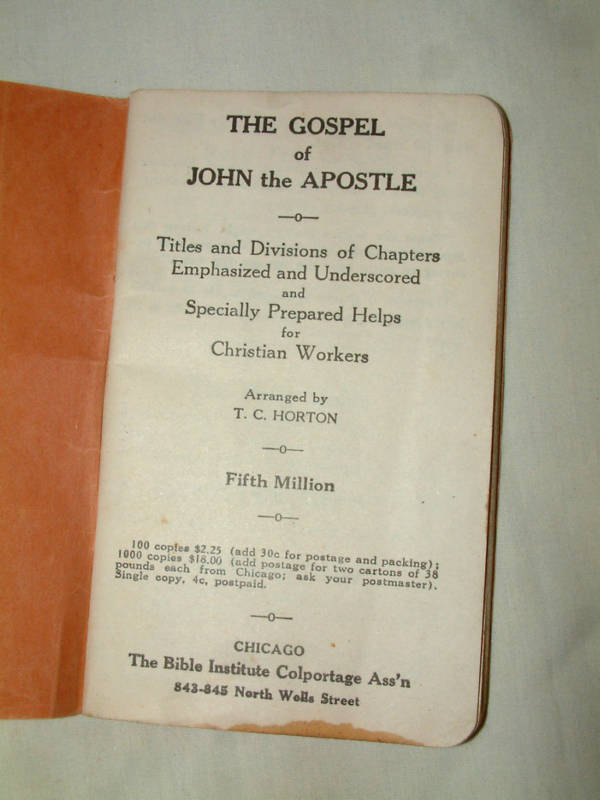 In case readers didn’t follow the cover clue, Horton repeated the message on the inside cover. Horton insisted that the Gospel of John was “the incomparable piece of English Literature.” But it was not only good literature. It was inspired by God in order specifically to convert people to Biblical Christianity. If only people would read these words, Horton believed, their lives would be transformed. As Horton insisted, this supernatural power was the reason why this Gospel “should be placed, as far as possible, in the hands of every man, woman, and child in the world.”
As we’ve seen, fundamentalists in America have embraced this mission. In a campaign that sometimes seems bewildering to non-fundamentalists, Bible missionaries have worked to get people to see these Gospel words.
The files of the book missionaries shed some light on this attitude toward the saving power of Gospel words. The first director of the Bible Institute Colportage Association, William Norton, told stories of the instant power of the words of the Gospel. In 1921, Norton told a story of a man given a Gospel tract. At first, the man ignored it. “Coming to a hedge,” Norton related, “he stuck the tract into the hedge.” However, thanks to the awesome power of the words of the Gospel, “it was too late; his eyes had caught a few words of the tract which led to his conversion.” In another story from 1921, a vicious murderer found a copy of a Gospel tract. “Through reading the Gospel of John this man saw the error of his way, changed his manner of living, and moved to the Bear Creek community in Scott County, Tenn.”
For Bible missionaries like the ones from Chicago, this power of conversion came from the power of the Gospels. The words were inspired by God to lead to this kind of conversion. It only made sense, then, to distribute those words as widely as possible. This attitude toward the words of the Gospel has informed the outreach of Fundamentalist America in ways that remain bewildering to folks who don’t understand the impulse. But if we can understand this book, these words, as inspired by God to lead people to salvation, we can understand something about the Fundamentalist desire to get these words in front of as many people as possible. For the Chicago book missionaries, this meant delivering hundreds of thousands of copies of these tracts and Gospels to children across the nation.
Among fundamentalists, only the Bible had the kind of supernatural power that could lead people to instant conversion, merely by seeing the words. But other kinds of books, too, could help. The Chicago book missionaries also distributed hundreds of thousands of copies of short novels. These books weren’t as powerful as the Bible, but they could still work to combat the trend toward sin in popular literature. As one missionary warned in 1937, they needed uplifting books “during these difficult days when much pernicious literature is being widely distributed by religious cults, atheistic organizations and anti-Christian societies, whereby many are being deceived and destroyed.”
Back in 1921, William Norton had called these books “true-to-the-Bible literature.” One of the most popular was Rosa’s Quest, originally published in 1905.
 In this story, a poor girl is lost in a big city. Her Christian mother had died, and just before she died she told Rosa to find her in the “beautiful land.” Unfortunately, the girl lacked any Christian education. She wandered around the city, rebuffed by nominal Christians who did not reach out to her. Finally, a missionary on a city bus explains the Word of God to Rosa. Rosa is converted, then adopted by a wealthy secular family. In the end, Rosa converts all of her new family using the Gospel.
In the eyes of Bible missionaries, books like this did not have the same supernatural power as the Gospel itself. They could not change lives simply by being read or heard one time. But missionaries still reported that the books could help save souls. One missionary in 1921 reported that the children she worked with were “very enthusiastic” about Rosa’s Quest. One child from Madison County, Kentucky, wrote to the BICA to thank them for the free books, and noted that he felt “like little Rosa in Rosa’s Quest. I have found the way to heaven.” Another recipient wrote in 1937,
“FROM KENTUCKY: ‘In the year 1929, one of my friends loaned me some of your books entitled “Little King Davie,” “The Way Home,” “The Robber’s Grave,” “A Peep behind the Scenes,” and others. I was thirteen years of age. God definitely spoke to me through the books and gave me a peep behind the curtains which hid my heart. In the same year I received a heart-felt experience from God, and also a call into His service. I am now a missionary in the mountains of Kentucky.”
 For the conservative Protestant missionaries of the Moody Bible Institute, books had power. Some of them, if they contained the actual words of the Gospels, could have supernatural power. Those words, distributed in books, tracts, and leaflets, emblazoned on billboards, eventually printed on Tim Tebow’s face, could change a life in an instant. Other books, like Rosa’s Quest, merely provided information about how such change could happen. They did not save lives the same way the Gospel could, but they kept young people from reading literature that could confuse them or lead them into sin.
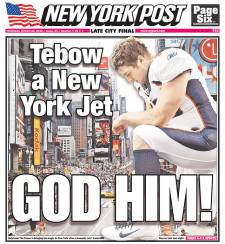 move to the New York Jets brought a new round of media focus on Tebow’s style of loud public Christian-ness.






 I Love You but You're Going to Hell