The Coming Split at Conservative Colleges

Is your school for bigots?…Or for apostates? That’s the choice that conservative school leaders have faced throughout the twentieth century. And it is coming round again. As the US Supreme Court hears arguments about same-sex marriage in Obergefell v. Hodges, conservative religious schools and colleges should gear up for another divisive debate over equality and theology. If SCOTUS rules in favor of same-sex marriage, will evangelical and fundamentalist schools face a return to the hot tempers of 1971?
More bad news for conservatives...

More bad news for conservatives…

The case itself is a combination of cases from four states. In short, SCOTUS is trying to decide two issues: whether or not the Constitution requires states to allow same-sex marriage; and whether or not same-sex marriages in one state must be recognized by all states.

Conservative Christians have made their feelings clear. Among the hundreds of friend-of-the-court letters are one from the US Conference of Catholic Bishops and one from Governor Mike Huckabee’s advocacy group.

At the Christian Post this morning, we see nervous worries about the possible fall-out for conservative Christian schools. Justice Samuel Alito made an explicit reference to the precedent on every conservative’s mind: the Bob Jones University case. Back in 1970, the leaders of BJU refused to allow racial integration on their South Carolina campus. As a result, the Internal Revenue Service took away BJU’s tax-exempt status. By 1983, BJU had taken its case all the way to the Supreme Court. It lost.

Alito asked Solicitor General Donald Verrilli if the precedent would apply:

JUSTICE ALITO:  Well, in the Bob Jones case, the Court held that a college was not entitled to tax­exempt status if it opposed interracial marriage or interracial dating.  So would the same apply to a university or a college if it opposed same­ sex marriage?

GENERAL VERRILLI:  You know, I ­­ I don’t think I can answer that question without knowing more specifics, but it’s certainly going to be an issue. ­ I don’t deny that.  I don’t deny that, Justice Alito.  It is ­­ it is going to be an issue.

Conservatives worry that this might mean the end of religious schools and colleges. Should religious schools refuse to provide housing for same-sex married couples, the federal government could revoke their tax-exempt status. For most schools, that would mean a sudden and impossibly steep tax bill. When schools are already teetering on the brink of financial insolvency, it could certainly mean the end.

But that’s not all. If history is any guide, Christian school leaders should also prepare for another kind of crisis. Back in the 1970s, fundamentalist schools endured a vicious and destructive split over Bob Jones University’s position on racial segregation.

As I’ve been finding in the archives this past year, even schools that agreed with BJU’s fundamentalist theology sometimes disagreed with BJU’s position against interracial marriage. At the Moody Bible Institute, for example, leaders decided to cancel an invitation to pro-BJU fundamentalist leader John R. Rice. The decision subjected MBI’s leaders to withering criticism from fundamentalists nationwide.

Reporters and observers have noted that SCOTUS’s decision in this case might raise questions for leaders of conservative religious schools. Those leaders should also consider another likely outcome. If SCOTUS’s decision puts pressure on school leaders to recognize same-sex marriages, it might lead to another in a long line of bitter fights among schools.

Will conservative evangelicals and Catholics submit to the law of the land? Or will they resist, citing a higher authority? Will conservative schools lose their conservative credibility if they give in to the new cultural ethos?

It’s not going to be an easy choice. If I were the president of a conservative Christian school or college, I’d get myself ready for a lose-lose decision. Do I want my school to be labeled a bunch of fanatical bigots? Or would I prefer to join the ranks of schools that don’t take their religions very seriously?
Racist Fundamentalists…It’s Complicated

Sometimes the archives can make things too complicated. White fundamentalists have always been accused of racism—a charge they’ve vehemently denied. But what do we do when an African American fundamentalist agrees with the racism of his white fellow fundamentalists?

First, a quick historical sketch: Since the 1920s, as I argued in my first book, fundamentalism got tangled up with ideas about Southern Pride. Conservative religion has often become part and parcel of a broader cultural conservatism, one that included support for racial segregation and white supremacy.

Racist? Or just fundamentalist?

Racist? Or just fundamentalist?

By the 1970s, leading white fundamentalists became some of the most public supporters of racial segregation. Most famously, Bob Jones University steadfastly clung to its whites-only policy long after many white Southerners and white fundamentalists had grudgingly moved on. Some historians, such as Randall Balmer, have insisted that white racism among fundamentalists was the real root of the so-called New Christian Right that emerged in the 1970s.

I disagree. There is no doubt that white fundamentalism—especially in the South—has long had close ties to white racism. There is more to the story, however, than quick condemnations of conservative religion as a front for white supremacy.

In my recent work at the archive of the Moody Bible Institute, I came across a document that reminds us how messy history is. In 1970, the leaders of Moody dis-invited prominent fundamentalist John R. Rice from Moody’s big annual Founder’s Week event. Why? Because Rice had come out in support of the segregationist policies of Bob Jones University.

As President William Culbertson informed members of the Moody community,

Moody Bible Institute has for 85 years welcomed young people of all races and nationalities to its tuition-free training in the Bible. Through times of changing social mores the policy has always been to emphasize the salvation from God by which all men who believe are made one in Christ. We have sought, and do seek, to apply the spiritual principles set forth in the Word of God to the practical problems of our culture. We believe that there is nothing in the Bible that forbids interracial relationships. We are absolutely opposed to injustice and exploitation. We are dedicated to the proposition that we are debtors to all men.

Moody Bible Institute, Culbertson told anyone who would listen, still agreed wholeheartedly with John R. Rice’s fundamentalist theology. Moody refused to compromise with those who would modernize the Bible or water down fundamentalist religion. But Moody could not be seen as part of a racist, segregationist movement.

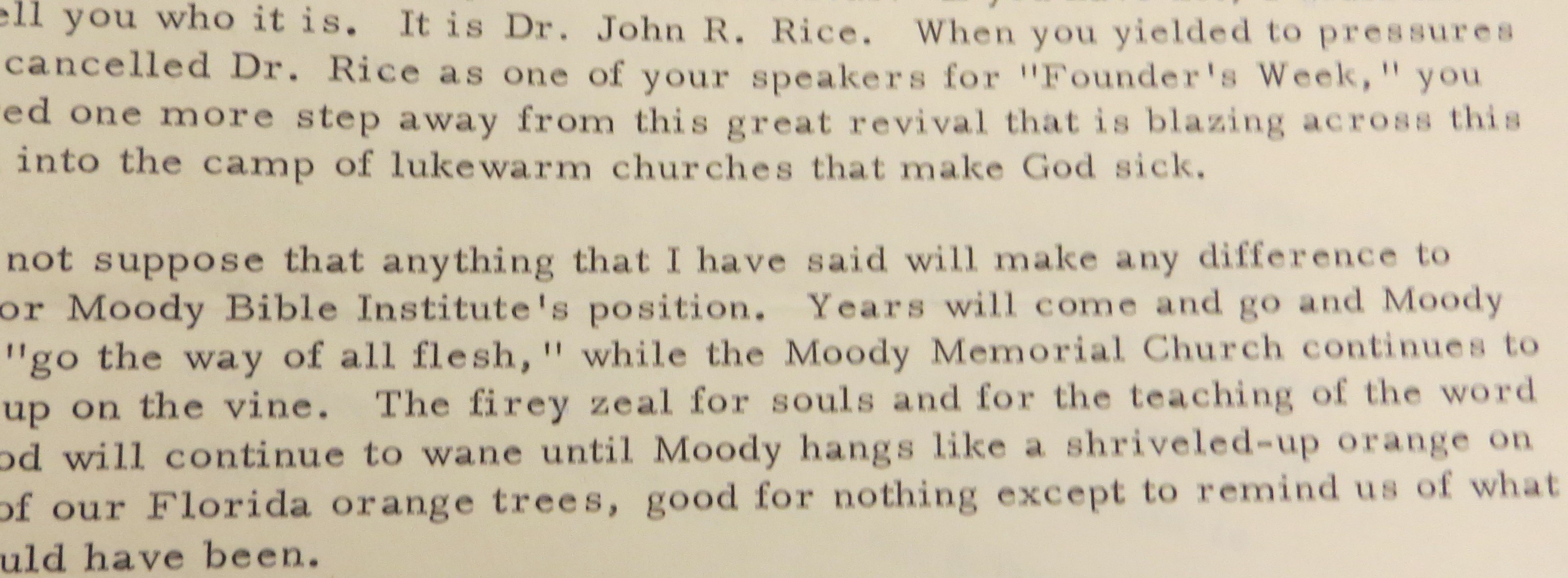
Naturally, John R. Rice and his supporters blasted this decision. More evidence, one Rice supporter charged, that Moody had

moved one more step away from the great revival that is blazing across this land into the camp of lukewarm churches that make God sick. I do not suppose that anything that I have said will make any difference to you or Moody Bible Institute’s position. Years will come and go and Moody will ‘go the way of all flesh,’ while the Moody Memorial Church continues to dry-up on the vine.

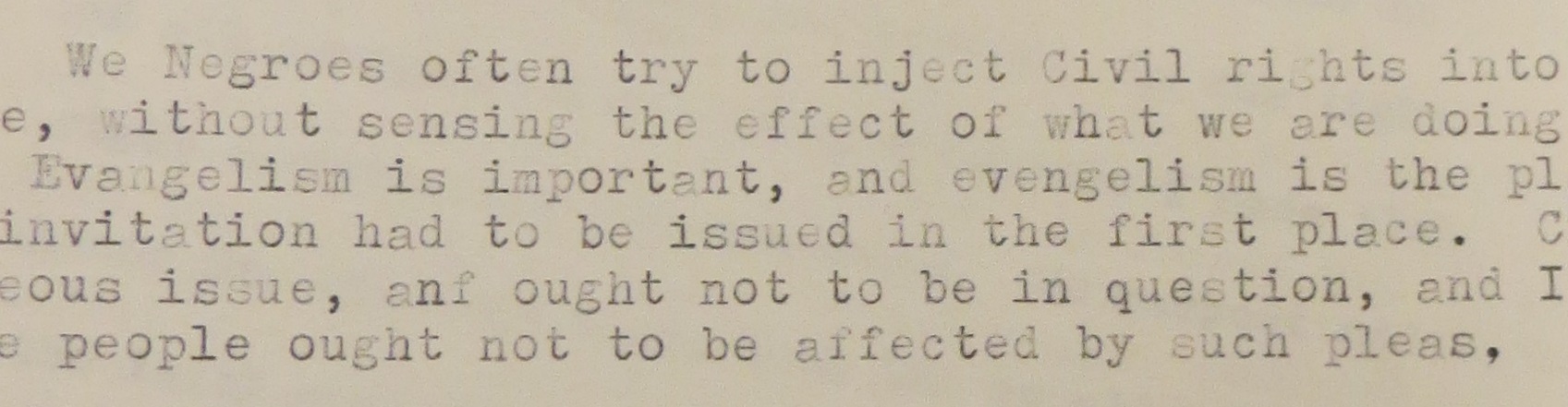
Among the fat stack of angry letters supporting John R. Rice, one stands out. It came from William H. Dinkins of Selma, Alabama. Dinkins was an African American fundamentalist and, in his words, someone who “stand[s] with Dr. Rice for fundamentalism and the old-time religion and all that goes with it.” Too often, Dinkins charged, “We Negroes [sic] . . . try to inject Civil Rights into every circumstance, without sensing the effect of what we are doing.” When it comes to religion and the Word of God, Dinkins continued, “Civil Rights is an extraneous issue, and ought not to be in question, and I feel that responsible people ought not to be effected by such pleas.”

The view from Selma, 1971

The view from Selma, 1971

Dinkins’s letter raises difficult questions about race and religion. First of all, we wonder if this letter was legitimate. Could someone have faked it in order to create an impression of biracial support for racial segregation? If not, we wonder how common such sentiments have been. As historian Jeffrey Moran has argued, white fundamentalists have long tended to ignore their African American co-religionists, at best. And, as John Dittmer and others have showed, in the early days of the Civil Rights movement many African American leaders in the Deep South supported segregation, at least temporarily and pragmatically.

In the early 1970s, was there really any support for racial segregation among African American conservatives? Did fundamentalism trump race?

Getting Stoned at Bob Jones University

Is it now okay to be gay at fundamentalist Bob Jones University? Last week, former president and current chancellor Bob Jones III apologized for vicious anti-gay rhetoric from 1980. But this does not mean that homosexuality is now an accepted thing at BJU.

Time to celebrate?

Time to celebrate?

For those like me outside the orbit of fundamentalist colleges, the cultural politics of BJU can come as a shock. BJU has a long history of holding out against progressive social trends. Until the twenty-first century, for example, the South Carolina university proudly opposed interracial marriage.

As I’m finding as I research Bob Jones and other fundamentalist colleges, BJU has always been an outlier. The family leadership has a long tradition, when challenged, of doubling down on its own opinions as God’s Truth. Any criticism from within or without merely strengthened the leaders’ resolve. Again and again, this has led to purges of dissenting faculty, students, and administrators.

For those in the know, then, the recent apology for anti-homosexual rhetoric seems like another welcome change. In a press release, BJIII responded to a petition from a gay-rights group at BJU. In 1980, at a White House press conference, then-president BJIII suggested that the appropriate punishment for homosexuality was stoning. Here’s what he said back then:

I’m sure this will be greatly misquoted. But it would not be a bad idea to bring the swift justice today that was brought in Israel’s day against murder and rape and homosexuality. I guarantee it would solve the problem post-haste if homosexuals were stoned, if murderers were immediately killed as the Bible commands.

In his recent apology, BJIII distanced himself from such shocking language. As he put it,

I take personal ownership of this inflammatory rhetoric. This reckless statement was made in the heat of a political controversy 35 years ago. It is antithetical to my theology and my 50 years of preaching a redeeming Christ Who came into the world not to condemn the world, but that the world through Him might be saved. Upon now reading these long-forgotten words, they seem to me as words belonging to a total stranger—were my name not attached.

So can gay people at BJU now come out of their fundamentalist closets? Apparently not. As anti-fundamentalist Jonny Scaramanga noted, BJIII’s apology still condemned homosexuality. The statement apologized for the threat of stoning, not for labeling homosexuality a sin. BJIII carefully noted that he did not believe stoning was the appropriate punishment for “sinners.” He never apologized for considering homosexuality itself a sin.

Nevertheless, as the response from the gay-rights group BJU Unity makes clear, homosexuals are part of the BJU community. As I’m finding in my current research, they always have been. BJIII’s apology is not nothing, but it does not welcome homosexuals openly into BJU’s fundamentalist family.

Religious Students, Secular Schools

HT: HH

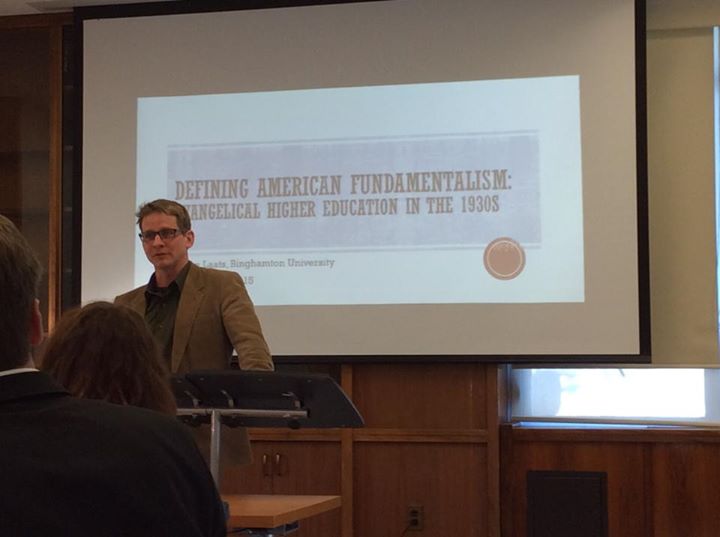
Thanks to all those who came out Wednesday to participate in my talk at Binghamton University about fundamentalist colleges in the 1930s.  Not only was a good time had by all, but the conversation made clear that even at this, our most “secular” of colleges, religion is thriving.  Despite the ignorant nostrums of elite secular academics and fuming fundamentalists, conservative religious students and faculty seem to thrive at pluralist schools like ours.

Don't hate me  because I'm beautiful...

Don’t hate me because I’m beautiful…

For those who are just tuning in, this talk was part of our series in “Religion in the Modern University.”  I shared my current research into conservative evangelical colleges.  The conversation after the formal talk revealed that both students and faculty at our beloved public university come from all sorts of religious backgrounds, including conservative evangelical Protestantism.

Unlike the schools I’m studying, our “secular” college does not actively encourage any specific sort of religious belief.  Nevertheless, our school proves a congenial home for students and faculty who hold conservative evangelical beliefs.

This flies in the face of some common assumptions about secularism and higher education.  As sociologist Elaine Howard Ecklund found in her study of elite secular academics, many of them have absolutely no idea of the high level of religious belief at their own non-religious elite universities.

Fundamentalists, too, have long assumed that “secular” colleges were hostile to their sort of religious belief.  As fundamentalist college founder Bob Jones Sr. was fond of saying in the 1920s, he would

just about as lief [sic] send a child to school in hell as to put him in one of those institutions.

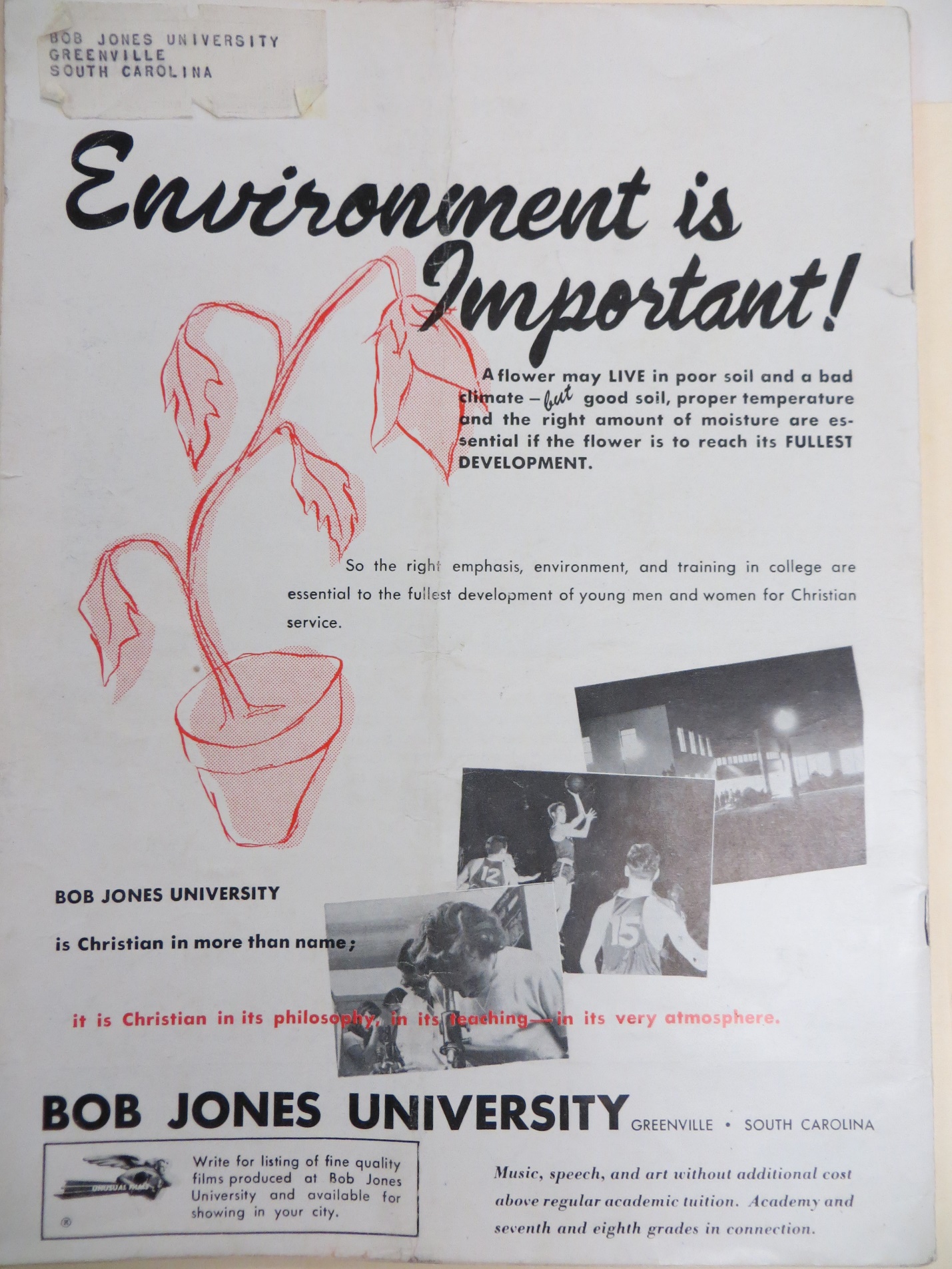
At Bob Jones University, as at other fundamentalist universities, this notion that only a truly fundamentalist school can protect students’ faith remained central throughout the twentieth century, as this 1956 advertisement demonstrated.

Fundamentalist students, fundamentalist schools

Fundamentalist students, fundamentalist schools

More recently, too, creationist leader Ken Ham took me to task for questioning his insistence that creationist families must send their children to young-earth-friendly colleges.  As Ham concludes,

at the very minimum I do urge parents to ensure they do all they can to equip their children to be able to defend the Christian faith against the attacks of our day, and to stand uncompromisingly on the authority of the Word of God.

Does that mean that religious students need to go to schools that share their faith?  I don’t think so.

I certainly understand the many differences between a pluralist school like our beloved Binghamton University and schools with a unified religious message.  But we need to remember that so-called “secular” colleges like ours are often very friendly places to creationists and fundamentalists.

A February for Fundamentalism

Don’t dilly-dally. You’ve only got three weeks left to pick out your outfit. It’ll need to look sharp, because you’re invited to a talk on February 23rd, on the scenic campus of Binghamton University.

All joking aside, all Binghamton-area folks are heartily invited to come hear me share some of my current research as part of the university’s spring 2015 speaker series. In this talk, I’ll discuss the ways conservative evangelical colleges helped define what it meant to be a “fundamentalist” in the 1930s.

bju bannerI’ll tell stories from three very different places: The Denver Bible Institute, Wheaton College, and Bob Jones College. Each of them had a very different idea of what it meant to be fundamentalist, as well as a different idea of who had the right to decide.

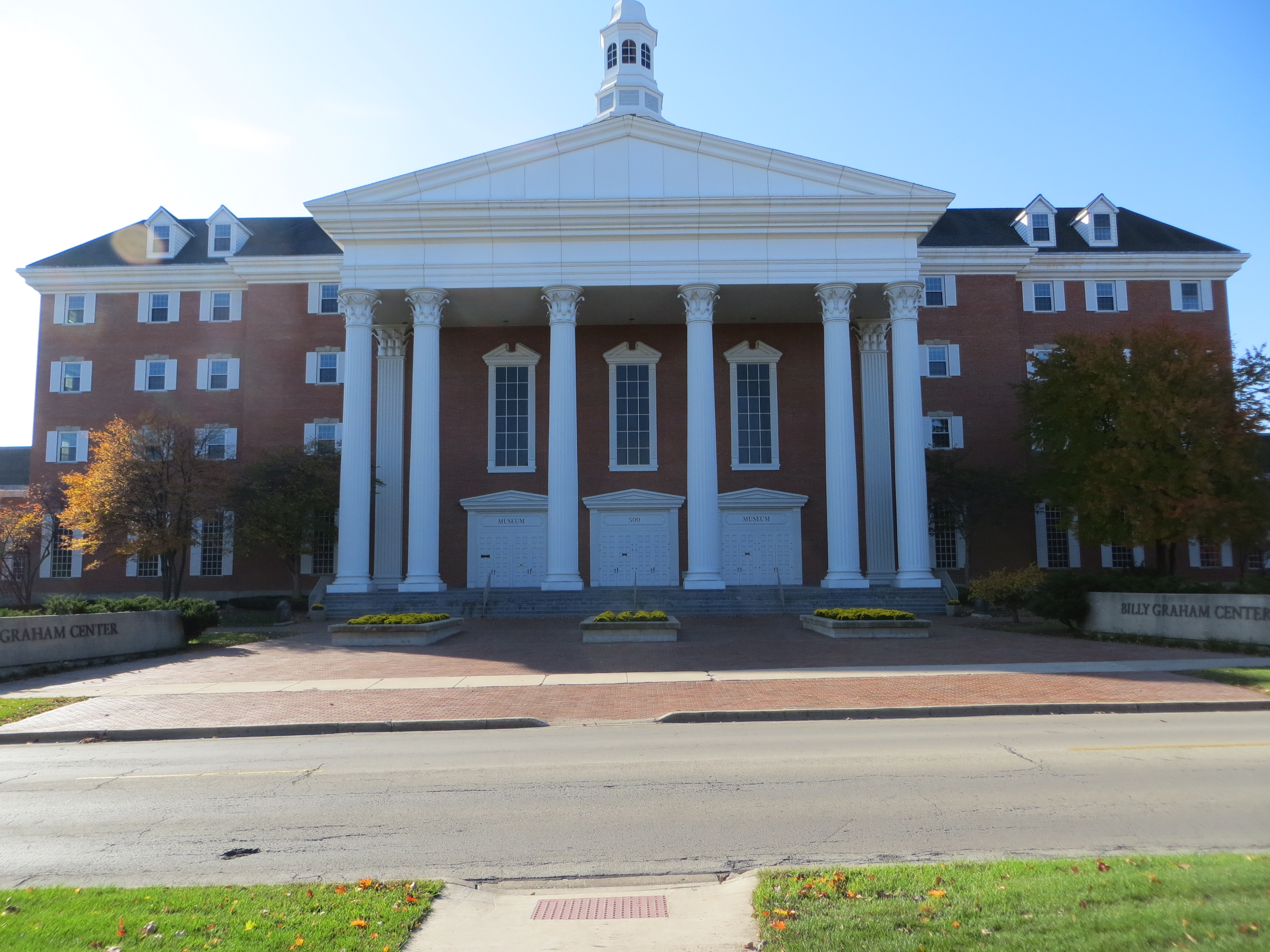
At DBI, supreme leader Clifton Fowler ran into hot water in the early 1930s as his faculty and church split. Fowler was accused of holding non-fundamentalist ideas about sex, leadership, and Scripture. To heal the rift, Fowler appealed to fundamentalist leaders nationwide to conduct an investigation.Billy Graham Center 2

At Wheaton, meanwhile, President J. Oliver Buswell was tossed out for a range of offenses, including Buswell’s leadership of a Presbyterian faction as well as Buswell’s moderate ideas about creationism.

Down at Bob Jones College (not Bob Jones University until the 1940s), founder Bob Jones Sr. engaged in a very different sort of definition. When faculty members got too chummy with students, when they played jazz records and mocked Jones’s uptight attitude toward modern culture, Jones gave them the boot. At Bob Jones College, fundamentalism meant what the founder said it meant.

DBISignIn each case, we can see the ways institutions wrestled with the tricky question of definition. At a small school like DBI, the leader had to ask famous fundamentalists to give him a fundamentalist seal of approval. At Bob Jones College, on the other hand, leaders imposed a more top-down idiosyncratic definition. At Wheaton, fundamentalism did not have room for the sort of bare-knuckle denominational wrangling that Buswell considered the heart and soul of fundamentalism.

These stories have it all: sex, jazz, and Presbyterianism. So come on down to Binghamton University at four o’clock on February 23rd. We’re meeting in the conference room of the Institute for Advanced Study in the Humanities, on the first floor of the Library Tower.

The event is free and open to all; no registration is required.

What Unbroken Leaves Out

**SPOILER ALERT: If you haven’t yet read Unbroken or seen the recent movie, you might want to skip this. But it’s so interesting, you’ll be sorry.**

Unbroken?...or Un-Finished?

Unbroken?…or Un-Finished?

What is the takeaway message from the life of Louis Zamperini, subject of the new film Unbroken? The power of resilience? The unplumbed depths of human courage?

…or is it the healing power of Protestant fundamentalism?

In the pages of World Magazine, Cal Thomas asks an intriguing question: Why did the recent film leave out the central role played in Zamperini’s life by the fundamentalist revival of Billy Graham?

When protagonist Louis Zamperini returned home from his hellish ordeals at sea and in Japanese prison camps, he struggled with alcoholism and depression. As the original book by Laura Hillenbrand makes very clear, Zamperini overcame these demons through fundamentalist faith. After attending a 1949 revival by fundamentalist preacher Billy Graham, Zamperini turned his life around.

This conversion was not an incidental part of Zamperini’s story. Zamperini, we could say, gave America a powerful demonstration of the healing power of a particular brand of fundamentalist Protestantism. But that is not the way celebrity director Angelina Jolie saw it. Thomas wants to know why Jolie left that part out. As Thomas puts it,

it is puzzling why Jolie, who directed the film, and the Coen brothers, who wrote it, left out the most important part of Zamperini’s story.

Not only is Zamperini’s conversion a central part of his life story, it reflects the power of a specifically fundamentalist religion. Some readers may be more familiar with Billy Graham’s later work, when Graham had begun to articulate a kinder, gentler evangelical faith. In the 1940s, however, at the time of Zamperini’s conversion, Graham’s crusades packed a firmly fundamentalist punch. Not just theologically, either, but politically.

In his 1940s campaigns, for instance, the message of conversion was wrapped in a conservative anti-communist package. At the blockbuster Rose Bowl campaign of 1950, for example, theologian Harold Ockenga introduced Graham’s sermon as “The Answer to Communist Aggression.”

And just as Billy Graham was helping Zamperini defeat his demons, Graham insisted on his loyalty to the fundamentalist message. Though later a split developed between the most conservative fundamentalists and Graham’s famous crusades, that split had not yet developed by 1949. At that time, Graham loudly proclaimed his loyalty to the fundamentalist message. In a 1949 letter to staunch fundamentalist leader Bob Jones Sr., for example, Graham called Jones the

model toward which we are patterning our lives. Your counsel means more to me than that of any individual in the nation.

During the late 1940s, Billy Graham remained a staunch fundamentalist partisan. The message that saved Zamperini was not just one of generic Christian healing, but one of specifically fundamentalist rigor. In this one famous case, at least, we can see the ways fundamentalism’s unyielding moral stance pulled a suffering soul out of a personal hell.

We can’t help but echo Cal Thomas’s question: Why didn’t Angelina Jolie include this part? Jolie no longer returns my calls, but I can’t help but think that she might have some aversion toward fundamentalism.

I’m no fundamentalist myself. American fundamentalism has its share of skeletons in its closets, as we’ve explored here at ILYBYGTH. It may be fair to accuse the latter-day followers of Bob Jones Sr., for example, of terrible misconduct. But if we really want to be fair, shouldn’t we also acknowledge the ways that fundamentalism has saved lives?

Investigative Report: Sex Abuse at Fundamentalist U

HT: DW

Are fundamentalist universities guilty of encouraging sex abuse? Does “purity culture” encourage predators? Does the environment at fundamentalist universities force victims, at best, to suffer in silence and shame?

We don’t have all the answers, but the GRACE report of sex abuse at Bob Jones University offers a few clues. Short answer: BJU is guilty of establishing an idiosyncratic administration and campus culture that punished victims and rewarded loyalty over caring and competence.

I’ve taken some heat in the past for wondering if fundamentalist universities had been targeted unfairly on this subject. Certainly, fundamentalist schools have done a terrible job in handling sexual assault and abuse. But so have secular and liberal schools. Wasn’t it possible, I asked, that the no-drinking, no-partying culture at fundamentalist colleges helped deter some cases of assault? Given the large number of alcohol-fueled assault cases recently, I still think these are fair questions.

In spite of such questions, however, the recent GRACE report paints a damning picture of Bob Jones University. I’ll repeat: I do not think it is fair to assume that conservative schools will somehow automatically do a worse job of handling abuse and assault cases than other schools. However, the GRACE report points to systemic problems at BJU that are likely shared by smaller, less prestigious fundamentalist colleges and schools.

As I see it, BJU has failed in two significant ways. First, it has insisted on a climate in which student complaints of any kind were viewed as a moral failing for the complainer. Second, since the 1930s BJU has maintained a policy of rewarding staff loyalty over any other concern. As a result, leading administrators were woefully—perhaps even criminally—incompetent to deal with student victims of sexual abuse and assault.

I do not make these charges lightly. Nor do I have any personal animus toward BJU or other fundamentalist colleges. But the record is clear.

First, some brief facts of the case. Two years ago, administrators at BJU commissioned an outside study of their response to abuse claims. In itself, this sort of outside examination made a clear break with BJU tradition. The assembled commission, Godly Response to Abuse in the Christian Environment, or GRACE, recently published its findings. BJU’s current leader, Steven Pettit, has apologized for any suffering the university has caused or ignored.

That is a start. The university, in my opinion, has two main faults for which it needs to apologize.

First, the leaders of the school have insisted for decades on one cardinal rule: No “griping.” Students who complain have been consistently treated as disloyal, or at least suspicious. For example, in one statement made by the founder, Bob Jones Sr., on June 19, 1953, Jones advised the BJU community of the first rule: “Griping not tolerated, but constructive suggestions appreciated.”

In practice, the culture at BJU has promoted a suffer-in-silence mentality.

Second, and perhaps more problematic, hiring and promotion practices at BJU have encouraged loyalty above all other factors, including competence. In cases of abuse and assault, this has led to terrible consequences. As the GRACE report documents, administrator Jim Berg handled many abuse reports since 1981. Time after time, Berg demonstrated his lack of preparation. For a while, Berg was unaware of South Carolina’s mandatory-reporting law.

The blame here belongs to more than Berg alone. Berg’s leadership role was the product of an institutional culture that valued loyalty first. Berg’s decisions and professional intuitions were the product of a culture that saw itself as removed from all obligations to the outside world.

The evidence for this loyalty-first culture is abundant. In the same 1953 statement referred to above, Bob Jones Sr. warned faculty that he had an obligation to fire anyone “who is not loyal.” This statement came in the wake of mass resignations at the school in 1952 and 1953.

That was not the only time the school’s leaders made their emphasis on loyalty clear. In 1936, just before another group firing, Bob Jones Sr. warned one faculty member,

First: There must be absolute loyalty to the administration. If something happens in the administration which you do not like, your protest is your resignation. If you stay here you must not under any circumstances criticise [sic] the administration.

The results of such a sustained policy are clear. Those who remained in leadership positions at BJU were rewarded for loyalty first, competence second. In the case of student abuse and assault, such an emphasis left students in the hands of utterly unprepared administrators.

All schools—all institutions—can suffer from incompetence, of course, but the BJU policy of loyalty-first intentionally undervalued professional competence.

It bears repeating that BJU’s current leader has apologized for these faults. As he put it,

I would like to sincerely and humbly apologize to those who felt they did not receive from us genuine love, compassion, understanding and support after suffering sexual abuse or assault …To them I would say—we have carefully listened to your voice. We take your testimony in this report to our hearts. We intend to thoroughly review every aspect and concern outlined in the investigation and respond appropriately.

And, sadly, we must remember that fundamentalist institutions are by no means alone in establishing and protecting cultures of abuse. Other religious groups, such as the Catholic Church, and other colleges, such as Penn State University, have similarly criminal histories.

As it might at those institutions, perhaps the future at BJU and other fundamentalist universities will be brighter than the past.

Jesus in Uniform

Can US military officers be required to sign a conservative evangelical statement of faith? That’s the question posed by the Wheaton College Reserve Officer Training Corps (ROTC) program. And it unearths broader questions about the proper relationship between the military and fundamentalist religion. Can fundamentalists serve as military chaplains?

Christianity Today reports on the investigation into Wheaton’s ROTC program. At Wheaton, faculty members above the rank of assistant professor are required to sign on to Wheaton’s conservative statement of faith. Recently, the Military Religious Freedom Foundation complained that ROTC officers at Wheaton, who are paid and appointed by the US government, are required to be “of Christian faith.”

According to the CT article, legal experts had differing opinions. One thought that the Wheaton rule passed constitutional muster, since the ROTC program required all professors at all schools to meet their schools’ policies. Another argued, in contrast, that the current situation represented an unconstitutional attempt to “Christianize” the ROTC program.

For Christ, Kingdom...and the Rolling Thunder Battalion?

For Christ, Kingdom…and the Rolling Thunder Battalion?

This report made me wonder about other military questions. In my recent trip to the archives of Bob Jones University, I discovered to my surprise that BJU had pursued an aggressive policy of finding spots for its seminary graduates in military chaplaincies. The fundamentalist school had used its considerable influence in the US government to grease the pipeline from the BJU seminary into military positions.

Now, I admit my vast ignorance about the role of chaplains in the US military. Most of what I know about a chaplain’s job comes from watching MASH. I earnestly invite those who know more to weigh in here. But the notion that BJU was sending its graduates into chaplain positions made me wonder.

As I understand it—and once again I freely admit that I don’t know much about it—the role of a military chaplain in the US armed services is to provide two things: religious services for those who desire them, and religious counseling for all.

Throughout the 1960s, at least, when significant numbers of BJU-trained ministers entered the chaplaincy, the school taught a rigid separatism. That is, a key religious tenet of BJU’s fundamentalist faith was that believers must not support the work of heretics. In the world of American fundamentalism, those “heretics” represented not only Jews, Muslims, and Catholics, but even liberal Protestants.

Perhaps the most dramatic example of this doctrine of separatism came with when the Bob Joneses denounced the headline-grabbing crusades of Billy Graham in the 1950s and 1960s. Graham agreed to co-sponsor those mass meetings with liberal Protestant groups. When enthusiastic attendees saw the light, they were sent to various churches to learn more about their new or renewed faith. And that was the problem for the leaders of Bob Jones University.

As they made clear time and time again, Bob Jones Sr. and Jr. never had a personal problem with Billy Graham. But in their opinion, sending new Christians to liberal Protestant churches meant sending them to hell. Real Christians, the Bob Joneses argued, could and should work with non-real Christians and other heretics on political issues. But they must not work together on religious issues, since endorsing heretics meant endorsing heresy.

With separatism such a guiding element of BJU theology, it seems to me that BJU-trained chaplains would be putting themselves in a very difficult position. If their jobs require that they respect the faiths of their military “flocks”—even if they don’t agree with those faiths—but their own faith requires that they DON’T respect those heretical faiths, what are chaplains to do?

I could see how some fundamentalist pastors would see their non-fundamentalist troops as a sort of “mission field.” That is, fundamentalist chaplains could see their goal as the ultimate conversion of non-fundamentalist soldiers. But that would put those chaplains at odds with the US military. As a governmental body, the military needs to respect all faiths (or no faith) equally.

On the other hand, I could see how some fundamentalist pastors might agree to respect the home faiths of their troops, whatever those faiths might be. But especially at the ferociously separatist Bob Jones University, that would put those chaplains in an equally untenable situation. They might be implicitly endorsing those faiths by working with non-fundamentalists on an equal basis.

Things are fuzzy enough in the world of religion and public schooling. These military questions raise an entirely new field of fuzz. Perhaps Wheaton College can make a case that its ROTC policy is constitutional. But how can fundamentalist pastors serve as military chaplains?

From the Archives: Fundamentalist Luxury

Why do families choose fundamentalist colleges? As regular ILYBYGTH readers know, I’ve been wondering about this question as part of the research for my new book. Today’s work in the archive of Bob Jones University offered one surprising answer from the early days.

I’ll be working in the archive here all week. The archivist has been extraordinarily helpful and productive, digging through piles of files to track down whatever I’ve mentioned.

I'll be here all week...

I’ll be here all week…

One of the questions I’m curious about is the appeal of these schools. In its early days, Bob Jones College (it only became Bob Jones University in the late 1940s) worked hard to attract new students. In the early files, I found an example of a personal letter written by a college official to a potential student in 1928.

It’s not clear who wrote it, but it may have been any of a handful of early 1920s administrators. In any case, the letter starts out as you’d expect. As I argued in my 1920s book, back then schools such as BJC promised a safe haven from the developing higher-education world of evolution, smoking, and flappers.

So the letter’s first questions are about what we’d expect:

Would you like to attend a school where you would be taken care of physically, where you have fine Christian boys and girls for associates—where you would have fine, scholarly, Christian teachers who would give you personal and constant attention, and where expenses are reasonable? If so, fill in the enclosed application blank.

But as always, it’s more complicated than that. Check out the promises at the end of the letter:

I will give you and [your friend] a room together. This is one of the nicest dormitories you ever saw. There is a connecting bath between every two bed rooms, hot and cold running water in every room and steam heat for winter time. It is the last word in physical convenience and comfort.

Not what I expected! But of course, it makes sense that a college recruiter would pull out all the stops in an effort to get students for a brand new college…any brand new college. To me, this is more evidence that the world of fundamentalist higher education shared a good deal more with mainstream schools than we tend to think.

Rah rah

Rah rah

Just as colleges these days go broke building climbing walls and luxury dorm suites, so colleges in the 1920s fell all over themselves to attract paying students. Even fundamentalist colleges—or, at least, this one fundamentalist college—promised a collegiate life of luxury.

If Fundamentalists Hate So Many People, Why Do They Love Artists?

Why does the leading fundamentalist university in America also have one of its best private art collections? Not just a collection of Jack Chick cartoons, either, but a diverse collection of religious art from the greatest of European old masters? One writer recently called this bewildering. The answer lies in the misunderstood nature of fundamentalism itself.

This is not what fundamentalist art looks like at Bob Jones University.

This is NOT what fundamentalist art looks like at Bob Jones University.

In the pages of The Imaginative Conservative, Dwight Longenecker recently described his trip to the art museum on the campus of Bob Jones University. As Longenecker explained,

I thought the art gallery would be perhaps a small and preachy collection of kitsch Evangelical art: pictures of the rapture taking place, memorabilia of the Jones family or stilted illustrations of Bible stories. I was wrong. The Bob Jones gallery houses an astounding array of old master paintings, icons, antiques, sculpture and Biblical antiquities.

And Longenecker asks the right questions: How can a school famed for its rigid fundamentalism host such an eclectic display of non-fundamentalist art? How can Bob Jones Jr. denounce Jerry Falwell as “the most dangerous man in America” in 1980 due to his willingness to work with conservative Catholics, yet splurge on a collection of Catholic and Russian Orthodox art treasures?

Fundamentalist art, BJU-style.

Fundamentalist art, BJU-style.

One question Longenecker doesn’t ask is also vital: How can a university pay faculty and staff much less than going salary rates, while its leader travels across Europe, purchasing world-class art for a private gallery?

The answer lies in the history of fundamentalist higher education itself. As I’m exploring in my new book, beginning in the 1920s, fundamentalist colleges struggled to figure out how to remain fundamentalist. After all, too many religious colleges had slidden into liberalism and eventually into secularism. Harvard, University of Chicago, Duke…too many leading schools had begun with conservative religious intentions, only to drift into worldly liberalism and pluralism.

Different schools worked out different solutions. One leading college, Wheaton College in Illinois, eventually settled into a pattern. The board of trustees kept careful watch on the goings-on among students and faculty. But the wider fundamentalist world, too, constantly questioned Wheaton’s leaders about on-campus events and tendencies. Conservative evangelicals around the country felt a right and a responsibility to keep Wheaton safely orthodox.

Wheaton’s archives are full of this sort of fundamentalist scrutiny. To pick just one example, President Hudson Armerding received a short, scrawled note in late 1968 from a woman who had no apparent personal connection to Wheaton. She was not an alumna, not a parent of a student. She was just a concerned fundamentalist who worried about the school’s continuing conservatism. “Recently after a church meeting,” she wrote to Wheaton’s president,

a group of persons was discussing Wheaton College. Some said that your school now teaches ‘theistic evolution’ and has departed from the fundamentals of the Bible. Is this true? Would you please investigate your curriculum? Also—statements made were that [sic] the school allows ‘worldly practices’—movies, smoking, etc. Please reply. Thank you.

At Bob Jones College (it became Bob Jones University only in the late 1940s), on the other hand, the 1930s wrought a very different way of maintaining orthodoxy. During that period, the school’s founder, Bob Jones Sr., established a principle of “loyalty.” The school community would be guided and maintained in its fundamentalist rigor by unswerving loyalty to the school’s original fundamental purpose. Faculty would be expected to support the school fervently and unstintingly. As Bob Jones Sr. put it in one chapel talk,

We are not going to pay anybody to ‘cuss’ us. We can get ‘cussin’’ free from the outside. . . . We have never been a divided college. . . . We are of one mind in this school. We have not always had smooth sailing, but we have thrown the Jonah overboard. If we get a Jonah on this ship, and the ship doesn’t take him, we let the fish eat him! We throw him overboard. . . ‘United we stand, divided we fall.’ That is the reason that in this school we have no ‘griping.’ Gripers are not welcome here. If you are a dirty griper, you are not one of us. . . . God helping us, we are going to keep Bob Jones College a kingdom that isn’t divided and a house that stands together.

In practice, this expected loyalty to the school became an expected loyalty to the school’s leader. The Bob Joneses—Senior, Junior, then III—embodied the meanings of “fundamentalism” at the school. As outsiders have struggled to understand, this development allowed Bob Jones College to be more liberal in some matters, while still maintaining its status as a ferociously fundamentalist school.

For example, at the far less conservative Wheaton College, students were not allowed to put on plays until the 1960s. The worry of the broad fundamentalist community was that “worldly” drama might tarnish students’ religion.

But throughout its existence, Bob Jones University has encouraged students to dive into drama, especially the not-particularly-Christian work of Shakespeare. This may seem like a paradox, a mystery, but it is explained by the principle of loyalty at BJU. At BJU, the entire fundamentalist community did not debate whether or not Shakespeare was acceptable for fundamentalists. The leaders decided.

And once they decided, it became a principle of loyalty for faculty and community members to go along. One faculty member in the 1930s criticized the school’s policy of putting on Shakespearean dramas. Such worldly amusements, she argued, could not help guide the fundamentalist faith of BJC students. At a school like Wheaton, those arguments carried a lot of weight. But not at Bob Jones College. As Bob Jones Sr. later explained,

She walked around and said, ‘You know, I’m so concerned. They have drama at Bob Jones College, and I think we should have a prayer meeting.’ . . . that’s her privilege. You don’t have to love Shakespeare. . . . But she knew Bob Jones College loved Bill Shakespeare.

She was fired.

For many observers, this is the constant paradox of Bob Jones University. As Dwight Longenecker reports from his visit to the art gallery, the school combines an indefatigable insistence on rigid fundamentalism with an embrace of non-fundamentalist art that might shock even moderate evangelicals. From the worldly Shakespeare to the Catholic Old Masters, Bob Jones University has the ability to be less conservative about some things than more moderate schools.

Dwight Longenecker attributes this seeming paradox to the “eccentric and unique flair” of Bob Jones Jr., president of the school between 1947 and 1971. There’s truth to that, but only part of the explanation. At Bob Jones University, the loyalty/leadership principle allowed Bob Jones Jr. to indulge his taste for non-fundamentalist art and drama in ways that less conservative fundamentalist institutions could never have allowed.

This history matters for more than just the campus surprise of BJU’s beautiful art museum. The influence of BJU among fundamentalists is hard to overstate. Due to its extensive network of influential alumni and its powerful school-publishing arm, the meanings of “fundamentalism” at Bob Jones University can influence the meanings of fundamentalism nationwide.

And with so much of that meaning determined by the school’s leaders, the personality and taste of a leader such as Bob Jones Jr. can have an enormously outsized influence on fundamentalism in general.