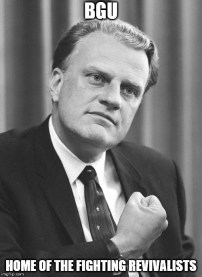
I’m back in Philadelphia to get back into the archives for my new book. And the trip has reminded me of a great question that never got an answer: Why isn’t there a Billy Graham University?
Last time I was down here, I got to sit in on Jon Zimmerman’s history of higher-ed seminar. They had read Fundamentalist U and I was happy to talk with the students about it. One of the students raised the question and it has bothered me ever since.
After all, it did seem to be a pretty standard part of the revivalists’ resume. Moody had Moody Bible Institute. Billy Sunday had Winona Lake. William Bell Riley started Northwestern. Bob Jones had, well, Bob Jones. The list goes on and on. Falwell-Liberty; Oral Roberts-Oral Roberts; Robertson-Regent.
So why is there no Billy Graham University?
Wheaton’s Billy Graham Center
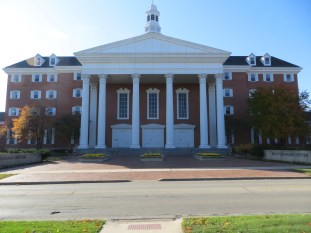
One possibility is that Wheaton has functioned as the de facto BGU. The Billy Graham Center is there, and the connection is pretty tight.
Maybe we’ll see a repeat of the Bryan University story. Back in 1925, after the sudden death of William Jennings Bryan in the immediate aftermath of the Scopes trial, fundamentalists rallied to open a college in Bryan’s memory. Some wanted it in Chicago; some wanted it to be a junior college. In the end, Bryan’s widow won the day with her plea to open the new school in Dayton, Tennessee. The junior-college idea was rejected in favor of a traditional liberal-arts university.
Is it possible that we’ll see a similar push for a memorial BGU?
After all, neither Hillsdale nor Pence seemed reticent about the conservative particulars of the school. Pence called Hillsdale a “beacon of liberty and American ideals.” He praised the college’s aggressive leader, Larry Arnn, for grounding students “in the traditions and teachings that are our greatest inheritance in America.”
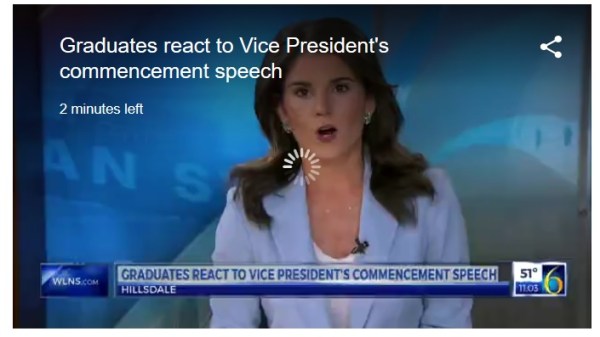
So why don’t the locals seem to care? On the local news about Pence’s address, absolutely no mention was made of the conservative nature of the college. Pence’s speech was stripped of any ideological meaning. Graduates talked about their jobs and their hopes for the future, a future pointedly stripped of any mention of taking over Washington DC with a new, Hillsdale-inspired conservative vision.
Is this simply Midwestern politeness? Local-news inoffensiveness? Or do they just not care about the central mission of their local university?
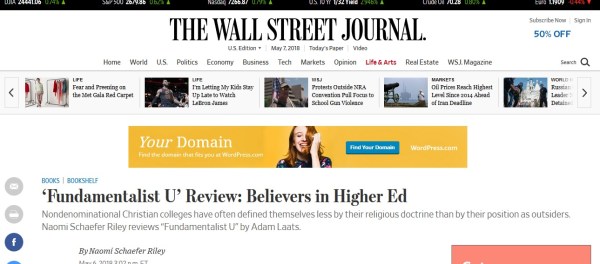
nondenominational Christian schools like Liberty have often defined themselves less by their religious doctrines than by their position as outsiders.
I wouldn’t say “less,” but as I’ve been arguing recently, I do believe the MAGA sensibilities of many white evangelicals have long roots in the history of evangelical higher education. Back in the 1920s, fundamentalist college leaders looked angrily and resentfully at the changes that had occurred at many mainstream schools.
Subscription only, I’m afraid.
Riley puts her finger on this enduring tension at the heart of evangelical higher education. As she concludes her review,
Caught between the vast changes in American higher education and the religious families they are supposed to serve, fundamentalist colleges have had to be especially attuned to which way the cultural winds are blowing. Which may occasionally get them some incongruous commencement speakers.
According to Riley, Fundamentalist U
takes a topic that could easily be treated with condescension and turns it into the occasion for a fascinating and careful history.
Thanks to Riley and WSJ for the thoughtful review.
As historian John Fea commented, Falwell’s use of “Christian” to mean only those few conservative-evangelical universities that grew out of the fundamentalist movement seems stunted.
I certainly agree. When former Liberty President Pierre Guillermin bragged in 1982 that his evangelical school planned to become “the Notre Dame of the Christian world athletically and the Harvard of the Christian world academically,” it’s difficult not to wonder what all those Notre Dame Christians might have thought. For Guillermin, Falwell, and many other conservative-evangelical leaders, the use of “Christian” to denote only their own conservative-evangelical faith seems presumptuous indeed.
However, if we accept for the sake of argument Falwell’s definition of “Christian” universities as limited only to conservative-evangelical schools, his complaint makes a little more sense. As I noted in my recent book about the history of evangelical higher education, requiring faculty annually to sign a statement of faith really HAS been a hallmark of these schools, and GCU really has abandoned that requirement in its effort to attract more students and retain more faculty.
As GCU pointed out, they require faculty to sign a statement saying they “understand” the school’s mission, but that is a far cry from the “ironclad” attempts of fundamentalist schools to ensure all faculty members agreed with their schools’ religious beliefs without any mental reservation. In contrast to that strong fundamentalist tradition, GCU claims to be a “missional community” that welcomes “students, faculty and staff from all walks of life, some of whom may experience Christianity for the first time at the university.” Unlike the conservative-evangelical schools that grew out of the fundamentalist movement—and the many denominational schools that generally consider themselves part of the conservative-evangelical network—GCU does not require faculty to “commit to affirming and practicing the same faith.”
How did capitalism, Christianity, and college combine?
So when Falwell complains that GCU isn’t really following the same playbook, he’s not wrong.
But ditching the required faculty statement of faith is not the most shocking innovation GCU attempted. When its enrollment numbers plummeted at the start of this century, GCU adopted a for-profit business model. It became Grand Canyon Education, Incorporated and focused on in-demand majors such as nursing and education. These days, with for-profit schools under scrutiny, GCU has attempted to move back to non-profit status.
So here’s my question: If Falwell wanted to prove that his “Christian” school was the biggest, why didn’t he say that GCU shouldn’t be considered “Christian” because it was a for-profit business?
And here’s my hunch: Since at least the late 1800s, American cultural conservatives have assumed that capitalism is the best sort of social system. Many conservative Christians have argued that free-enterprise systems are somehow God’s preferred way of organizing an economy. In the twentieth century, a lot of the connections between capitalism and Christianity came from the shared opposition to communism.
God = Capital
The tight connections between free-market principles and evangelical ones were usually simply taken for granted. To cite just one example, the president of Gordon College promised in 1967 that his school was a place in which
youth is encouraged to have faith in the historical validity and continuity of the principles of competitive free enterprise.
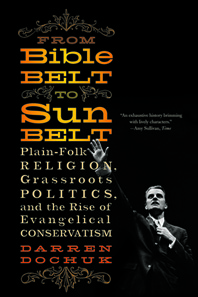
As historians Darren Dochuk and Bethany Moreton have explored, some schools such as Harding College and John Brown University raised the principle of “Christian free enterprise” to an all-encompassing mission.
So it doesn’t seem crazy that President Falwell wouldn’t even wonder if adopting a for-profit status might push his rival GCU out of consideration as a real “Christian” school. At least, that’s how it looks to this reporter.
Am I missing something? Is there any other reason why Falwell would ignore the huge, obvious fact that GCU wasn’t really “Christian” if it peddled its mission for mere lucre?
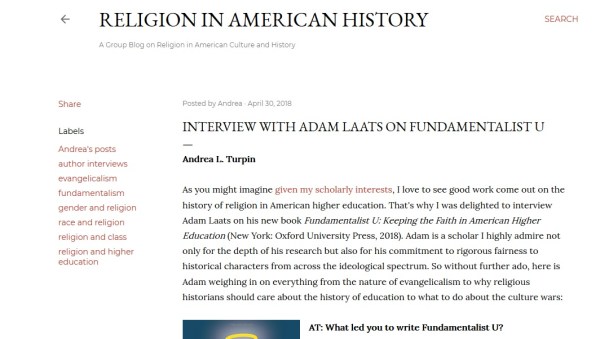
Why should historians of religion care about schools? How can our study of history help us heal our culture-war ulcers? This week, I had the chance to talk with Professor Andrea Turpin of Baylor University about these questions and more.
In our interview, she asked terrific questions that got right to the heart of the matter. What does the history of evangelical higher education tell us about the relationship between “fundamentalists” and “evangelicals?” How does political conservatism line up with theological conservatism? …and more!
If you didn’t know much about Liberty University or conservative evangelical higher education, you might be surprised to hear that President Jimmy Carter will be giving the commencement address at Liberty this year.
Do I have a problem? For sure. Am I embarrassed about it? Not at all. But I do want to make my case for the importance of old grudges and festering scars in understanding the world of evangelical higher education.
Even better, Compton has nice things to say about my book. As he puts it, Fundamentalist U
offers an invaluable introduction to the esoteric world of Christian higher education. Few existing studies offer this level of insight into the inner workings of schools like BJU and Liberty.
Compton captures the central dilemmas I emphasized, such as the tension between keeping students safe and keeping up with changing academic trends. He notes the important divisions that emerge between new “evangelical” colleges and stalwart “fundamentalist” ones.
I can’t help but comment, though, on one of Compton’s points. He is doubtless absolutely correct when he states,
some readers may be turned off by Laats’s fascination with long-forgotten rivalries involving long-dead university administrators[.]
I am certainly fascinated by such things. And I don’t doubt that sensible people have better things to do with their time than ponder the administrative squabbles in Cleveland, Tennessee or Wheaton, Illinois in 1937. This is why I don’t get invited out very often. Most people are, in fact, turned off by my fascination with these questions.
For those of us who hope to understand American evangelicalism, though, there’s no way we can consider such rivalries “long-forgotten.” As in any family feud, time may have obscured the details, but it has not tempered the animosity. If anything, bitter feelings caused in 1937 may have earned angry compound emotional interest over the decades, giving original squabbles a power and fury they didn’t originally possess.
To give just one example from the book, I can certainly see how many readers might not immediately care about the firing of President J. Oliver Buswell from Wheaton College in the 1930s. President Buswell wanted Wheaton to pursue a more theologically pure separatist approach. He wanted Wheaton to encourage its faculty and students to withdraw from mainline Protestant denominations and focus instead on creating a consistently conservative evangelical institution.
Wheaton’s trustees disagreed. They insisted that Wheaton maintain its efforts to attract conservative students who remained within mainline denominations as well as those that joined breakaway fundamentalist churches.
As Professor Compton notes, all the players in this 1930s drama are long-dead. But their squabble is anything but long-forgotten. Throughout its history, Wheaton struggled to figure out how to handle the tension between conservative purity and (relatively) big-tent inclusiveness. Time after time, whenever faculty members challenged the vagaries of Wheaton’s assumptions about orthodoxy, they were given the boot.
If you think these patterns are no longer in effect, just ask Professor Hawkins. Perhaps no one in that recent Wheaton battle invoked the specter of President Buswell’s 1930s ouster, but the college as a whole still deals with the echoes of every long-ago conflict.
Early distance-learning programs at MBI claimed to reach the world with cutting-edge technology, c. 1947. These “mountaineers” got free Gospels if they read them in school. And, yes, that is their school building.
The Liberty Online story is a big one. As the Times article describes, Liberty now claims $2.5 billion (yes, that’s B-illion with a B) in net assets, largely from its online department. Because Liberty is a non-profit, it is not subject to the same oversight as for-profit schools such as Corinthian and the University of Phoenix.
Some online students, the article describes, felt pressured to sign up and ripped off with the results. As one unhappy former Liberty student told the Times,
What’s killing me is that I went into this program to try to change my situation . . . and I’m worse off than I was at the beginning.
But the Times story leaves out a crucial part of the historical context. The way they put it, Liberty’s online program came about as part of an experiment, an “educational novelty.” As the article explains,
One educational novelty that Falwell dabbled in, starting in the mid-’70s, was an early form of distance learning. Liberty would mail lecture videotapes and course packets to paying customers around the country — at first just certificate courses in Bible studies, and by the mid-’80s, accredited courses in other subjects as well.
The inspiration, according to the NYT, was the work of John Sperling and the University of Phoenix. I don’t doubt that President Falwell Jr. admired Sperling’s business model. I don’t dismiss the importance of the notion that Falwell has treated his school, as he told NYT, “like a business.”
However, if we really want to understand Liberty’s online success, we have to also understand its context as part of the history of evangelical higher education. It is difficult for some secular people (like me) to notice or acknowledge, but evangelical schools and missionary institutions have always led the way with finding new ways to use new technology to deliver distance education.
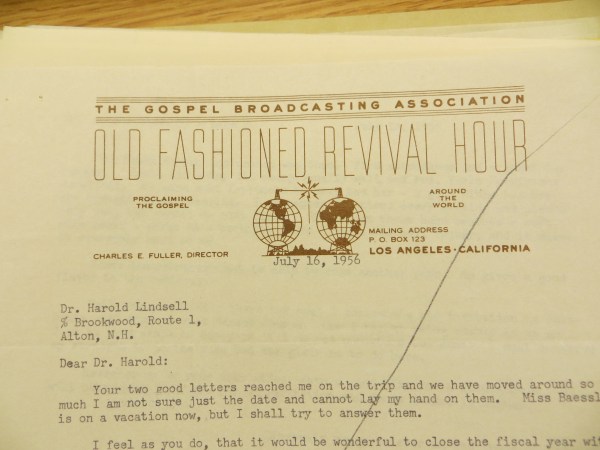
Check out the 1950s-era “high-tech” logo! More evidence of the evangelical obsession with technology and distance learning, from Fuller Seminary, c. 1956.
Perhaps the best example might be the Moody Bible Institute in Chicago. No matter the decade, no matter the technology, the Moody educational empire has found ways to expand its reach using new technological means. The drive is obvious: For MBI and other evangelical institutions, the primary goal is to deliver the Gospel to as many human eyes and ears as possible, as fast as possible. If new technology will help accomplish that mission, all the better.
To note just a few of the best-known programs, MBI was a pioneer in early radio, with its WMBI established in 1926 to bring the Word to the world. By 1940, WMBI’s Radio School of the Bible had over 10,000 registrants. In 1942, WMBI claimed to broadcast its programs through 187 radio stations across the USA, Canada, China, and Latin America.
In the 1940s, MBI set up its Moody Institute of Science, distributing missionary science films to a wide audience.
At the same time, MBI carried out less-well-known distance-learning programs as well. As I discovered in the MBI archives, from the 1920s through the 1960s the Moody Literature Mission delivered millions of books and tracts to readers throughout the country and throughout the world.
The point of these distance-learning programs was always the same. MBI, like all evangelical colleges and universities, had a mission of missions. It was dedicated to training young people to carry the Gospel around the world. And, unlike some people’s image of stuffy Luddite conservatives, evangelical institutions were always pioneers in every type of technology: print, radio, film, and internet.
So when the Jerry Falwells experimented with distance education, they weren’t innovating at all, really. Rather, they were merely continuing the long tradition of evangelical higher education—using all available means to deliver the Gospel around the world.
Professor Miller asked questions that got right at the heart of the book: What does it mean to be a “real” college? How did students react to the strict rules at evangelical colleges? Do evangelical schools have academic freedom?
At first, I thought Professor Miller was simply a peculiarly acute reader, but it turns out he himself spent some time in evangelical higher ed, so he really knew what he was talking about.
Apparently sales have been brisk. By the mysterious logarithms of our Amazon overlords, that means they lower the sticker price. I noticed this morning that Amazon has lowered the price to a measly fifteen bucks! So get yr copy today.








 I Love You but You're Going to Hell