
Casual observers might assume that every Fundamentalist vote is a lock for the GOP. After all, at least since Reagan took the evangelical vote away from the evangelical Jimmy Carter, the Republican Party has cultivated an image as the staunch defender of life, family, and traditional values.
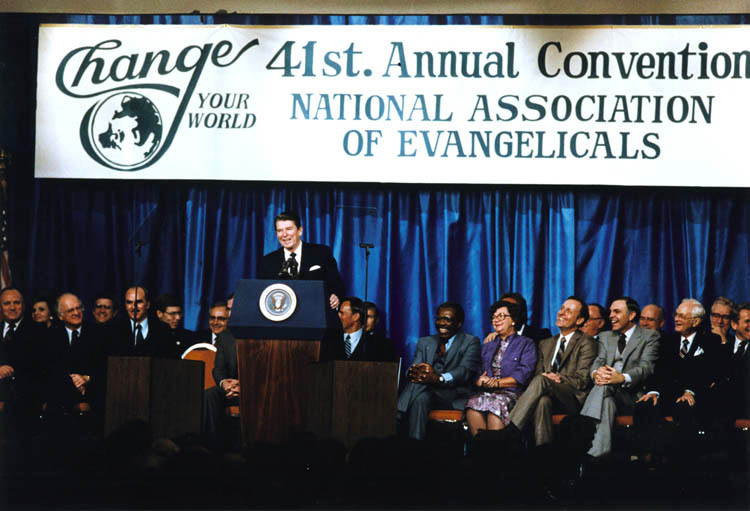
Reagan at the 1983 NAE Convention.
So even though the presumptive GOP nominee is a leader of the LDS Church, it is a general electoral rule of thumb that Bible voters will go for Romney in 2012.
But will they?
An article in this week’s Economist tries to pick apart the “evangelical vote.” The article offers some interesting numbers. Here are a few to consider: in 2008, 65% of (self-identified) white evangelicals called themselves Republicans. A recent poll put that number at 70%. Self-identified white evangelicals made up 44% of Republican primary voters in 2008, compared to “over half” in the first 16 GOP primaries in 2012. That’s a strong vote of support.
But look at the other side of those numbers. In 2008, almost one-quarter of evangelical voters voted for Barack Obama. Part of that support comes from a closer look at the meaning of “evangelical.” President Obama, according to the Economist article (citing a Pew Research Center poll), enjoys a 93-point lead over Governor Romney among African American voters. And those voters, after all, include a large percentage who are evangelicals.
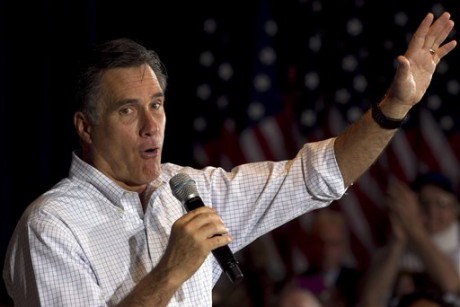
The numbers get even dicier when we expand our understanding of “Fundamentalist America” beyond the boundaries of evangelical Protestantism. Many conservative Catholic voters line up these days with conservative Protestants to vote for a vision of traditional Christian values. And the conservative Catholic vote includes large numbers of Latino voters. Such voters may vote for the GOP as the pro-life, pro-family, pro-Jesus party. But many Latinos might be turned off by the Republicans’ growing support for harsh anti-immigration laws, many of which seem to target Latinos specifically. As the Economist article points out, President Obama leads Governor Romney by 67% to 27% among surveyed Latino voters.
Could these numbers harken a shake-up of the relationship between Fundamentalist America and the two major parties? For those who know their history, it would not be the first time. After all, before the 1980 presidential elections, white evangelicals often portrayed themselves as above party politics. They claimed to vote for candidates who best embodied the values of Bible-believing America. And before the 1930s, African American voters reliably voted Republican, the Party of Lincoln.
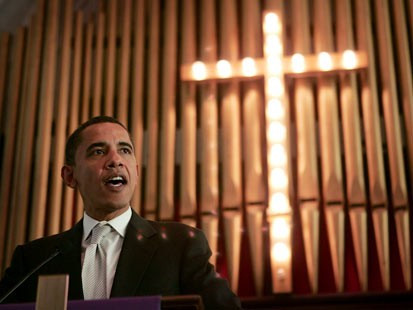 Could we be on the verge of another party shake-up? Could the Democratic Party attract young and non-white conservative Christians by appealing to social justice issues? Could the GOP fumble by alienating non-white Fundamentalists and young social-justice evangelicals? Even more interesting, could we be on the verge of a vast party realignment, of the kind that has revolutionized party politics a few times in the past? In the mid-1800s, the new Republican Party built a powerful coalition out of the remnants of the Whig Party, the American Party, and abolitionists. In the 1930s, the Democratic Party built another blockbuster with a Solid (white) South, urban “ethnic” voters, the union vote, and non-whites.
These powerful electoral coalitions don’t need to be logical. But a new party that combined today’s Democratic Party’s tradition of social justice, plus the GOP’s tradition of traditional Christian values, could capture this broad middle from Fundamentalist America.



 I Love You but You're Going to Hell