Confronting the Myth of Leftist College Students

I plead guilty. When I was a college student, I debated whether our campus Marxist-Leninist was really leftist enough. I remember feeling honestly surprised back then that so many people clung to their outmoded religious beliefs when the world had so obviously proved them wrong. In short, (cue the dramatic music): I Was a College Leftist. And I admit to a continuing illogical tendency: I tend to think that young people are somehow “naturally” more leftist than older adults. Are they? A scholar recently defended his claims that most college students in reality are conservatives. And not just any sort of conservatives, but a dunderheaded, abrasive, unreflective, Rush-Limbaugh sort.

I don’t think I’m alone. I’m not the only one who assumes college students are somehow naturally inclined to go through a leftist phase. We all know the jokes:

Q: What is a “fiscal conservative?”

A: A college leftist who just got a mortgage.

Q: What is a “social conservative?”

A: A college leftist who just had a daughter.

Before we look at the back-and-forth about students and conservatism, let’s remember our continuing debate about college faculty. As we’ve seen in these pages, Neil Gross has argued that the professoriate really does lean left. And conservatives in Colorado, at least, have mandated that their flagship state university open its halls to at least one staunch conservative.

But what about students? Some conservative writers have worried that conservative students are systematically denied free speech on today’s campuses. Some surveys suggest that faculty look askance at conservative religious students. And pundits often simply assume that conservatism is not allowed to rear its rightist head on most campuses these days.

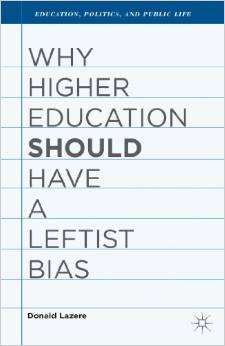
In the pages of The American Conservative, scholar Donald Lazere defended his claims that most college students these days are actually knee-jerk conservatives. Lazere was responding to a harsh critique of his book by political scientist Jonathan Marks. In his book, Why Higher Education Should Have a Leftist Bias, Lazere argued that students needed to be exposed to thoughtful liberalism.lazere
In his original review, Marks pointed to some survey data that seem to undermine Lazere’s central claims. “I don’t know Lazere’s students,” Marks wrote,

but I do know that the Higher Education Research Institute annually conducts a survey of incoming freshmen. That survey shows that more students enter college as self-identified liberals (26.8 percent in 2012) than enter as self-identified conservatives (21.1 percent). Many (47.5 percent) call themselves middle-of-the-road. Seventy-five percent agree that same-sex marriage should be legal. Some 64.6 percent agree that the wealthy should pay more taxes. So much for conservative commonplaces.

Maybe at Marks’s fancy-pants Ursinus College, Lazere responded.

But I taught mainly at California Polytechnic State University, San Luis Obispo, in a rural stretch of Central California; it was originally an ag college, and most of the English courses I taught were lower-division General Education and Breadth requirements for students in majors like Agricultural Management. Many such students resented having to waste their time and money on any general education at all. Does Marks really think that more college students resemble those at Ursinus than those at Cal Poly?

Lazere points out a key problem with many of our studies of college culture. Too often, social scientists look at fairly elite schools and make unsupportable generalizations. Or, more precisely, too often scholars examine elite schools and hasty readers make unsupportable generalizations.

For example, Elaine Howland Ecklund’s study of scientists and religion is often used to “prove” that scientists are ignorant about religion. As Ecklund made clear, however, she only spoke with scholars at elite universities. What about scholars at the kinds of schools most Americans actually attend? Similarly, Amy Binder’s look at student conservatives looked at only two schools, a western public flagship university and an elite eastern Ivy League school. What about the average student at the more representative non-flagship, non-Ivy League college?

Even back in the supposedly radical 1960s, leftist students at elite colleges attracted most of the attention. It was the takeover of the dean’s office at Columbia and shotgun-wielding curriculum changes at Cornell. It was bombings at Wisconsin and Free Speech Movements at Berkeley. What were the “Sixties” like at less elite schools?

After all, there are colleges and then there are colleges. At the colleges I’m currently studying, I certainly find a dominant conservatism during the late 1960s and early 1970s, along with a struggling dissident liberalism.

This leads us to some important questions. Are students more or less conservative at certain types of schools? Specifically, are students more conservative at less-elite schools?

I don’t see any answers in the UCLA Higher Education Research Institute surveys. Those hard-working folks offer lots of information. They break down student responses from all types of schools: public, private, Catholic, HBCU, University, college, and more. But I don’t see any division by selectivity. I don’t see a breakdown of student responses from more elite schools and less elite schools.

To me, Lazere’s central point makes some intuitive sense. Students at less-elite colleges might tend to be more oriented toward cultural conservatism. They might be more inclined to see college as a professional training course first, and a chance to let their freak flags fly second.

Without better data, though, it seems we’ll be left with anecdotes. Are students more conservative the farther we get from the Ivy League?
A Story We Should Care More About

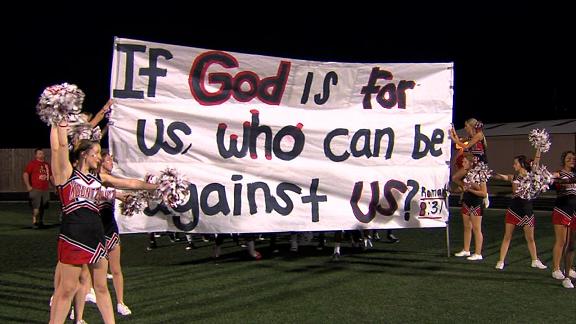
Every new story about creationist teachers or praying cheerleaders gets lots of attention, but the news we should really care about involves the humdrum topics of taxes and school funding. As creationist hero William Jennings Bryan put it in the 1920s, “The hand that writes the paycheck rules the school.” In Alabama, conservatives passed a law allowing taxpayers to write their paychecks in a different way. Yesterday, the state Supreme Court started hearing arguments about this new conservative strategy. This story is one we should all follow as if it were interesting. After all, it promises to give an answer that no praying cheerleader ever could: Will conservative taxpayers be able to rule the school?

Don’t look at us: Study school-funding laws!

Don’t look at us: Study school-funding laws!

The Alabama Accountability Act allows taxpayers to divert their tax money away from public schools and toward private ones. Alabama is not alone. More than a dozen states have similar laws on the books. What the justices decide in Alabama might direct debate about these laws nationwide.

Of course, not all the laws are the same. As the National Council of State Legislatures reported, as of April 2014, 14 states had some sort of tax-direction law. In general, these laws allow people to shift some of their taxes to scholarship funding organizations (SFOs). Instead of the tax money going to the government, it goes to these organizations. In turn, the SFOs defray the cost of private school for selected students.

Why should we care? Some critics of these laws insist that the laws are intended to break down the wall of separation between church and state. By allowing students to attend private religious schools, some say, these laws use tax dollars to pay for religious indoctrination.

In Georgia, for example, enemies of that state’s law have worried that students will be sent to conservative schools.  At some schools, foes announce, students are forced to pray and banned from supporting homosexual rights.

Conservative supporters of the laws, such as the Virginia-based Institute for Justice, insist that these laws are the last best chance for low-income students. With tax-funded scholarships, low-income students will be able to escape failing public schools. The real issue, according to the Institute for Justice, is the “right of all . . . parents to send their children to the school of their choice.”

Historically, since the 1930s conservatives have agreed that public schools have been taken over by a grasping, out-of-touch academic elite. Any effort to weaken public schools and strengthen private ones has been seen by many conservatives as a win. As I argue in my upcoming book about twentieth-century educational conservatism, this notion has been both enormously influential and widely shared among very different sorts of conservatives.

Religious conservatives have insisted that secularizing “humanists” like John Dewey have taken over public education. Free-market conservatives have worried that the same power-drunk Keynesian economics that dominated public policy between 1930 and 1980 had turned public schools into intellectual cesspools. Patriotic conservatives fretted that sneaky subversion had become the public-school norm. And we can’t forget, of course, that white racial conservatives considered desegregated public schools to be worse than no schools at all.

This sort of tax-direction law is the most recent strategy conservatives have used to move students out of public schools. Will it work? We should all be riveted to the noises coming out the Alabama Supreme Court. Their decision could set a precedent other states will have to notice.

Here’s How We Get a Creationist in the White House

It will take more than six twenty-four hour days. Months ahead of time, the team to put Ben Carson in the White House has been assembled and is feverishly working to get a solid creationist in the White House in 2016.

As Eliana Johnson reports in National Review Online, Carson hasn’t announced his candidacy, but his team is now interviewing thirty-five potential staffers for a possible White-House run. When Johnson asked Carson if he were serious, Carson dodged. “We believe in being prepared,” Carson said,

And that requires a sophisticated and complex infrastructure if I decide to run. . . . It’s like the Boy Scouts: Be Prepared.”

Does Carson think he can win? He told Johnson that the recent mid-term elections pushed him closer. “People are starting to wake up,” Carson told her.

Conservatives love Carson. His rags-to-riches tale and unapologetic religious conservatism, along with his stop-complaining messages to his fellow African Americans, have endeared him to the conservative wing of the party.

That doesn’t mean he has a chance. In the past, conservative hard-liners have entered the primaries even if they don’t think they’ll win. Their goal, in some cases, has been to move the party in a more conservative direction. By running as an unyielding social conservative, Carson will force other GOP hopefuls to tack toward the right.

And whether he wins or not, Carson will bring a dose of good old-fashioned Seventh-day Adventist creationism to the race. Seventh-day Adventism, as historian Ron Numbers argued so convincingly, played a leading role in converting American religious conservatives to a young-earth creationism.

Have you read it yet?

Have you read it yet?

Of course, just because Carson is a member of that staunchly young-earth creationist denomination, it doesn’t mean that he would emphasize those beliefs from the White House. After all, similar fears were raised by conservatives when Catholics such as Al Smith (1928) and John F. Kennedy ran for President. Each candidate had to assure voters that policy would not be dictated from the Vatican.

But Carson has taken a different approach. Instead of distancing himself from the rather extreme form of creationism that is official dogma in his church, Carson has publicly embraced it. In an interview last year, Carson doubled down on his SDA creationism. “I’ve seen a lot of articles,” Carson explained,

that say, ‘Carson is a Seventh-day Adventist, and that means he believes in the six-day creation. Ha ha ha.’ You know, I’m proud of the fact that I believe what God has said, and I’ve said many times that I’ll defend it before anyone. If they want to criticize the fact that I believe in a literal, six-day creation, let’s have at it because I will poke all kinds of holes in what they believe. In the end it depends on where you want to place your faith – do you want to place your faith in what God’s word says, or do you want to place your faith in an invention of man. You’re perfectly welcome to choose. I’ve chosen the one I want.

Maybe I’m viewing the world through evolution-tinted glasses, but I can’t help but think that such a firm statement of YEC belief will be off-putting for many voters. But even if Carson can’t win the race, he can pull his fellow Republican prospects into more firmly creationist positions. By standing firm on a six-day recent creation, Carson can make the entire GOP field friendlier to creationism.

Can YOU Pick the Right Decade?

I guess I should see a doctor. Reading the news from Highland Park, Texas, I had a dizzying sensation of whirling around in time, not sure if it was 2014 or 1974. The Dallas-area controversy over school readings sounded so similar to one that happened forty years ago, I’ve come up with a reader challenge: Can you put the quotations below in the right decade?

Here’s some background: As I describe in my upcoming book, in 1974 Kanawha County, West Virginia was roiled by a ferocious controversy over a new set of language-arts textbooks. Conservative protesters worried that the books had an anti-American tone. They worried that the books promoted a vicious sexuality, an angry rebelliousness, and an unhealthy sense of anti-authoritarianism. Until the books were removed, parents boycotted the region’s public schools. It got ugly. Buildings were firebombed, cars and school buses were attacked, and two people were shot.

From Trey Kay, "The Great Textbook War."

From Trey Kay, “The Great Textbook War.”

This year, as the New York Times reports, an eerily similar protest took off in Highland Park, Texas. In that fancy Dallas suburb, a short list of books were pulled from school shelves. Parents had complained that the books promoted a precocious deviant sexuality. After counter-protests, the district’s superintendent put the books back in schools.

So here’s the challenge: Can you guess the right decade for the quotations below?  Each quotation comes from a conservative challenge to school textbooks.  And the bigger challenge: Can you figure out if this means we are trapped in a never-ending cycle of educational culture wars?

QUOTATION 1: The books include “seduction, rape, child pedophilia, whether oral sex is sex, premarital sex as normative, reincarnation, or that those in authority over them approve of foul language.”[1]

QUOTATION 2: “I found this book to be crass, vulgar, and indecent for students.”[2]

QUOTATION 3: Offensive textbooks are “negative, racist, impulsive, and in some cases right-down vulgar.”[3]

QUOTATION 3: “The book introduces ideas . . . such as beastiality [sic], and sexual penetration by an object, among others.”[4]

QUOTATION 4: “In all of these books . . . I’ve seen many references to God and to Christianity . . . and every time it’s been derogatory.” These books “ridicule Christianity again and again.”[5]

QUOTATION 5: “A child’s formal education should expose him to a broad spectrum of views, but explicit and vulgar writings are not warranted.”[6]

QUOTATION 6: One objectionable book “seeks to frighten children of authority figures, asks children to criticize their parents and invasion of privacy is almost commonplace throughout.”[7]

QUOTATION 7: The offensive books “dwell at length on the sexual aspects of human relationships in such an explicit way as to encourage promiscuity.”[8]

How did you do?  Could you place the conservative protests in the right decade?  Without cheating?

More important, what does it say about our continuing battles over proper education that these parent protests sound so similar?

**********************************************************************************************************

[1] From the NYT article, 2014

[2] From conservative committee member minority report, 2014

[3] June 13, 1974: conservative protester speaking at school board meeting in Kanawha County.

[4] From conservative committee member minority report, 2014

[5] Conservative leader Alice Moore, speaking at school board meeting, June 27, 1974.

[6] From conservative parent protest website in Highland Park, 2014

[7] Judith Casto, “3 basic Kanawha book objections evident,” [sic no caps] The Herald Advertiser [Huntington, WV], November 24, 1974, 41, 44.

[8] Elmer Fike, “Textbook Controversy in Perspective,” Elmer’s Tune, n.d. [fall 1974].


Happy Thanksgiving: Our Culture-War Holiday

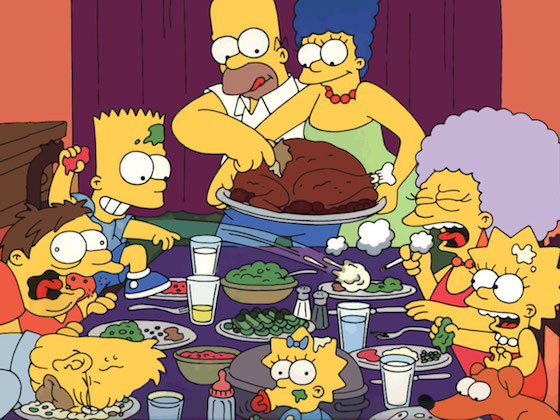
Ah, Thanksgiving…when families gather to eat birds, watch football, and shout at each other. The Thanksgiving tradition of fighting over issues such as gay rights, abortion, taxes, and school prayer has been hallowed by generations of angry get-togethers. After all, when you put a bunch of people around a table, related only by genetics, and feed them too much tryptophan and wine, culture-war fireworks are bound to happen. Today we’ll share some of the punditry about Thanksgiving culture-war battles we’ve gathered from minutes of browsing the interwebs.

I Disagree with You, but I Respect your Commitment to your Position!

I Disagree with You, but I Respect your Commitment to your Position!

1.) Progressives Use Thanksgiving to Convert Conservatives:

At National Review Online, Katherine Timpf cocks a snook at “ridiculous” progressive suggestions for fixing conservative family members. Progressives, Timpf warns, are out to get conservatives this year. Some progressives threaten to turn the Macy’s parade into a feminist diatribe. Others will blather on about the fact that many Americans don’t celebrate Christmas. Some might seize upon the progressive missionary opportunities of the occasion, buttonholing conservative relatives on the issue of climate change, then following up with an email from the Union of Concerned Scientists. If conservative evangelical or “Tea-Party” relatives try to belittle gay marriage or Obamacare, some progressives advise their minions to take conservatives down with prepared statements from the government or the book of Leviticus. And, of course, just to make sure everyone suffers from indigestion, there is at least one progressive pundit out there advising folks to use Thanksgiving to laud the Common Core.

2.) How to Win a Thanksgiving Argument with Conservative Relatives:

At Policy.mic, Gregory Krieg offers a progressive how-to guide for culture-war arguments. Your conservative “bloviating cousin,” Krieg warns, will certainly bring up some culture-war issues. Krieg offers ways to put conservatives in their places on issues such as the Ferguson riots, Obamacare, Obama’s immigration plans, Bill Cosby’s alleged serial rapes, legalizing marijuana, and more. In each case, we’re told, there are factual, reasonable rebuttals to the sorts of “unreasonable, knee-jerk opinions” conservative relatives will be spouting.

3.) How to Publicly Shame your Conservative Uncle:

From an Iowan progressive, we see a few tips on ways to beat your conservative uncle in holiday arguments. It’s important, progressive Iowan Trish Nelson warns, not to “appear too thoughtful—conservatives may confuse this for weakness.” After pounding your conservative relative with piles of facts to explode his ill-considered myths, Nelson promises,

your conservative Uncle will be roasting in his own myths and half truths, so forgive him if he’s a bit thrown off. Take your time and be patient, let him fully cook, and patiently explain the error of his ways.

4.) Again with the “Crazy Right-Wing” Uncle!

I don’t know why uncles are the repository for conservatism this year, but from the LA Times Joel Silberman offers progressive advice on handling a conservative uncle. Don’t fall for the temptation to be polite, Silberman suggests. It is a “patriotic” act to pick fights with your conservative relatives at Thanksgiving. Why? Because these days we don’t often get a chance to engage with people from the ‘other side’ of culture war issues. [Editor’s Note: Unless, of course, we read and comment in the pages of ILYBYGTH!] To be fair, Silberman is not advising the sort of knock-down, drag-out, drumstick-wielding family kerfuffle that I remember so fondly from my childhood. Instead, he suggests that everyone guide their discussion with “respect and know when to stop, and remember that relationships are more important than righteousness.”

Good advice, and a good place to stop. But just like every Thanksgiving fighter ever, I can’t resist getting in one last word. Instead of preparing arguments to win Thanksgiving showdowns, what if we progressives all spent time learning the best arguments our conservative relatives might make? Certainly nothing is less productive in culture-war battles than sitting back smugly and assuming our mastery of “facts” will soon bring our “myth”-laden opponents to their knees.

Rather, why not take an ILYBYGTH approach? Why not do some homework to learn why intelligent, informed conservatives might hold the positions they hold? Why not assume that people of good will might disagree sincerely on abortion, Obamacare, homosexual rights, evolution, and even the Common Core?

After all, the way to quiet a jerkface loudmouth uncle is not to publicly shame him. Rather, it might be more productive if we all studied the best arguments our culture-war opponents might make. Instead of asking: How can I trounce that argument? What if we asked: Why might someone believe that? Or, most important, what if we asked: How can we enjoy all of our blessings without screaming at each other?

Conservatives LOVE Science

Or at least they like it very much.  Or maybe they love it, but they’re not in love with it.  That’s the argument coming out of Dan Kahan’s Cultural Cognition project these days.

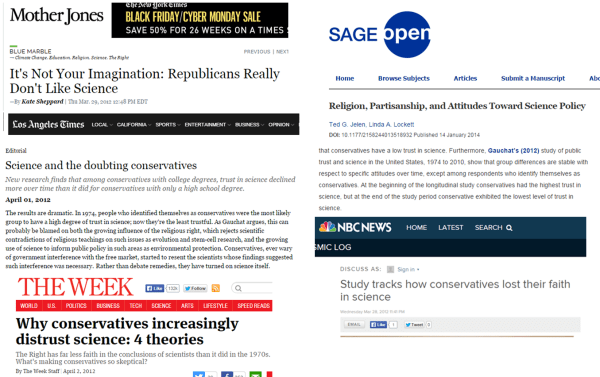
Professor Kahan takes issue with the slanted punditry that has latched on to recent analyses of social attitudes toward science. Too often, commentators inflate their claims about the extent to which self-identified “conservatives” have lost faith in scientists and scientific institutions.

Kahan's Kollage of Kwestionable Klaims

Kahan’s Kollage of Kwestionable Klaims

As Professor Kahan points out, a closer look at those findings gives a much different picture. In a nutshell, since 1974 there has been a noticeable decline in the number of conservatives who say they feel “a great deal” of confidence in the leaders of scientific institutions. Some wonks seized on this finding to claim that conservatives were anti-science.

Nertz, says Professor Kahan. The number of conservatives who say they feel “a great deal” of confidence in scientists may have declined, but the total number of conservatives who say they feel either “a great deal” of confidence or “only some” confidence in science has remained fairly steady.

Even more compelling, Kahan notes that these same conservatives rank “science” near the tops of their lists of social institutions they trust. Since 1974, only medicine or the military has outranked science as the number one most trustworthy social institution among conservatives. Other institutions, , such as organized labor, the President, the Supreme Court, education, TV, and, yes, even religious institutions and big corporations, have ranked lower on conservative rankings of trustworthiness.

You heard that right.  Overall, conservatives have consistently voiced greater trust in the institution of science than in the institution of religion.  Conservatives since 1974 have evinced more trust in science than in big business.

Check out Kahan’s argument for yourself. He has charts and graphs ‘n’ stuff, so you know it’s true.

From the Archives: Christian Comix against Communism

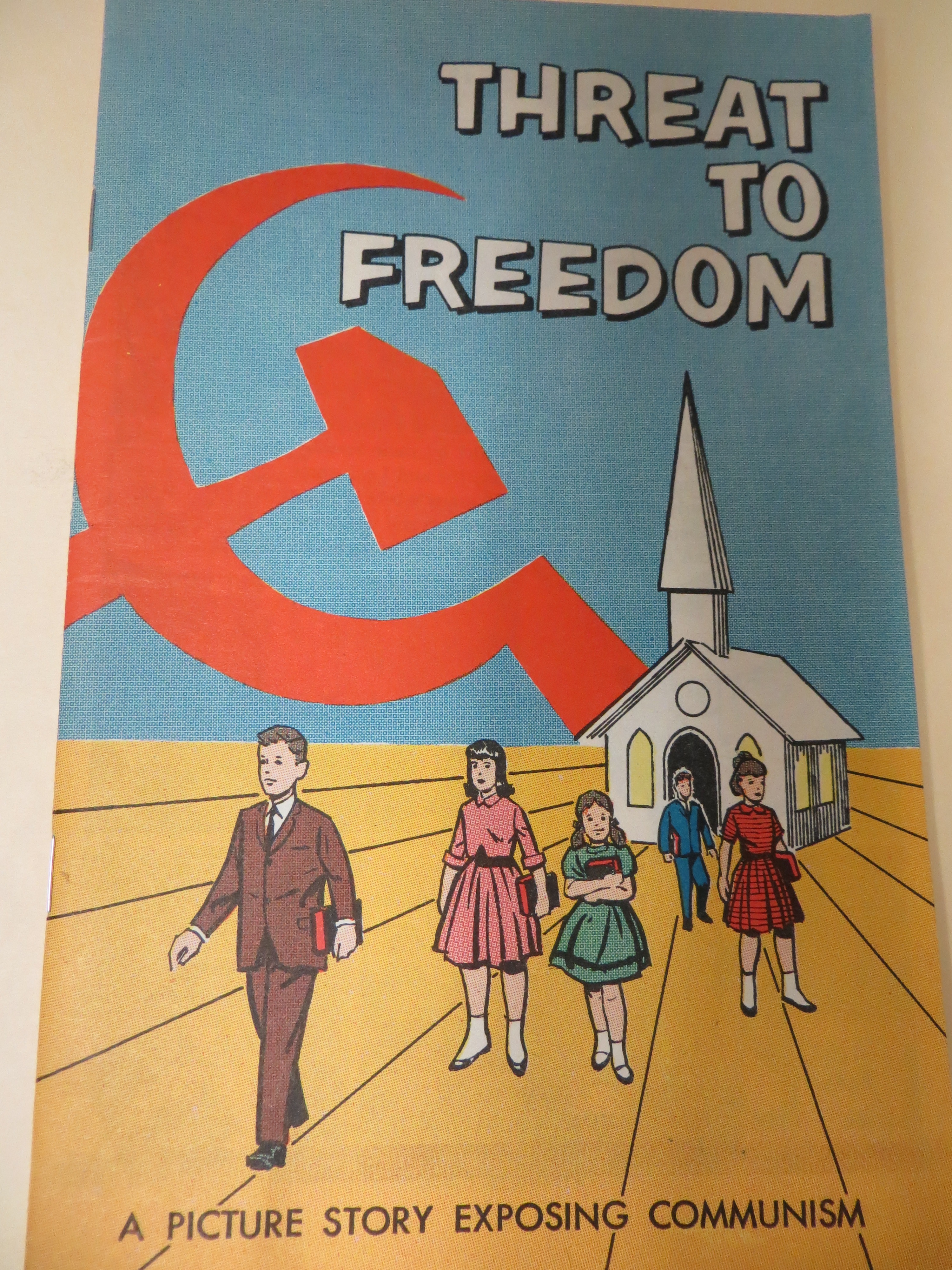
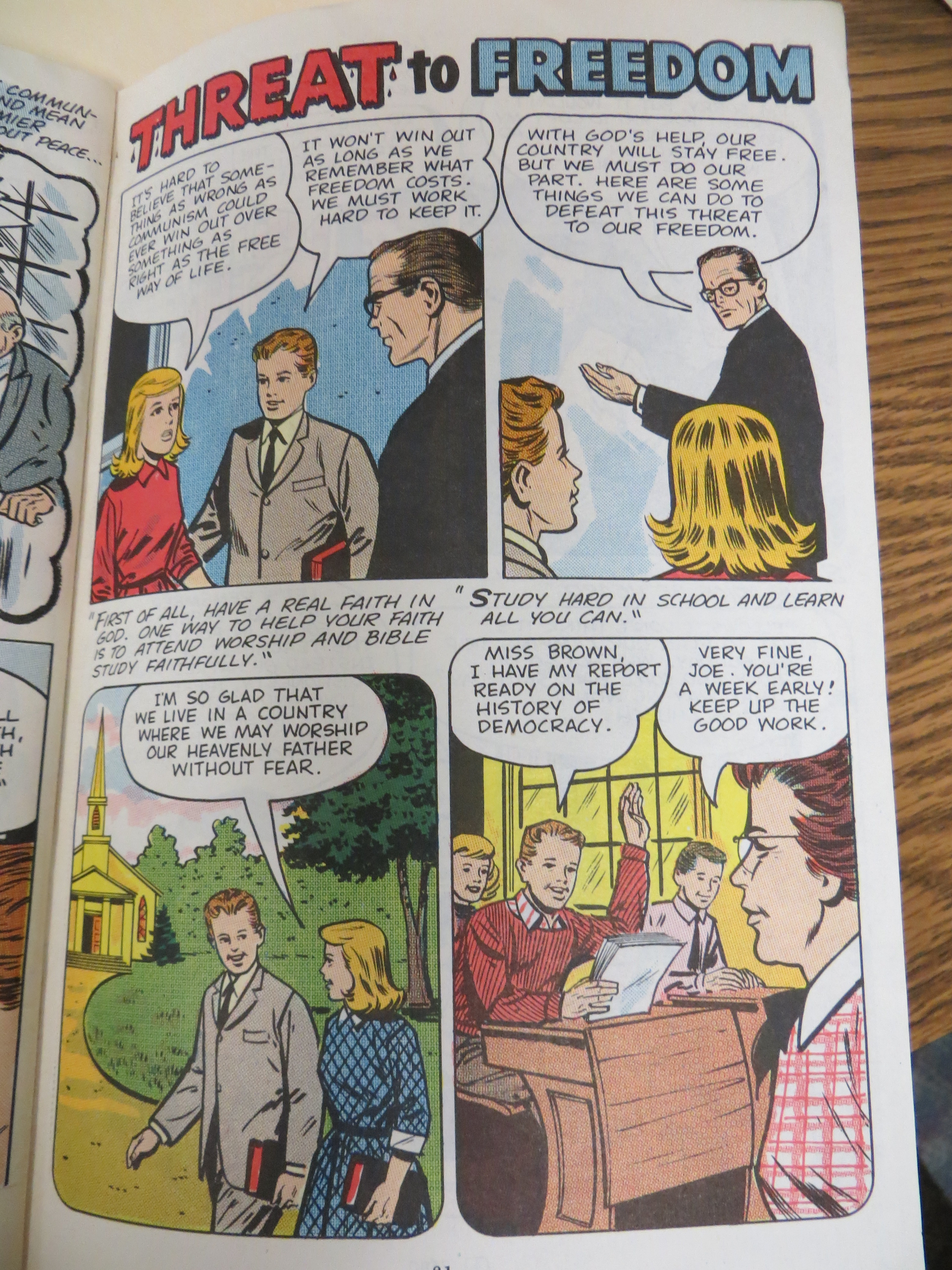
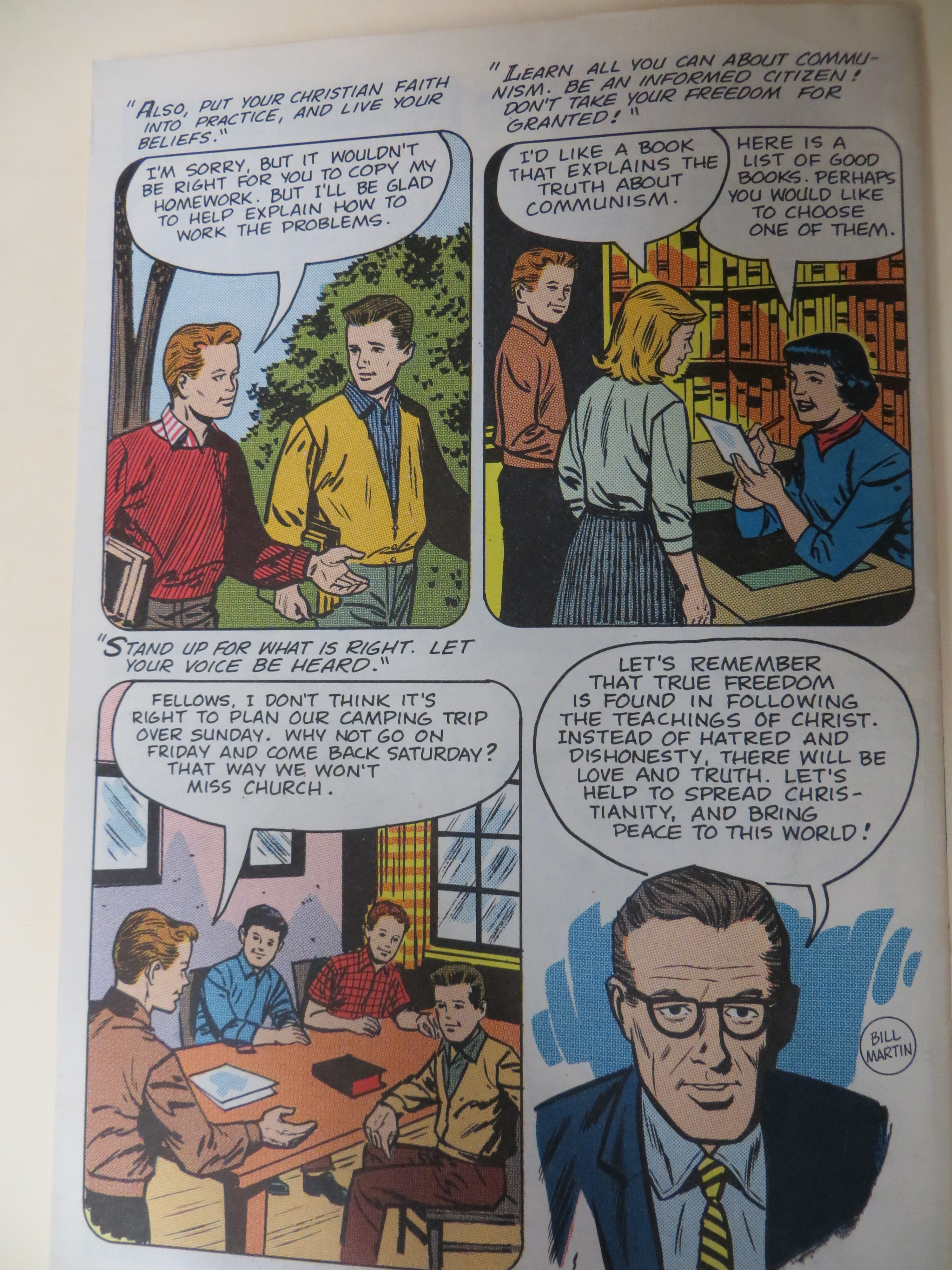
In this century, it can be difficult to remember the way most Americans used to feel about communism. As I describe in my upcoming book, the campaign against communism had an enormous influence on American education, one that is hard to overemphasize. As I work this week in the abundant archives of Bob Jones University, doing research for my next book, I’ve come across reminders of the ways conservative Christians saw communism as an existential threat. This evening, I’d like to share a few snippets from just one of those historical artifacts, c. 1965.

As the comics below demonstrate, for many conservative evangelicals, this was not just a question of politics, but of religion. Communism represented an aggressive atheism, the apotheosis of perverted human pride.

Other conservatives, of course, did not worry as much about religious issues. As historian George Nash has argued, the many meanings of communism allowed conservative intellectuals to coalesce around a vibrant anti-communism. Libertarians could join with Burkeans, who could clasp hands with religious conservatives and free-market conservatives. All could agree that the fight against communism outweighed any differences they might have among themselves.

coverIMG_1649IMG_1650

Are Teach-Bots “Conservative?”

When Arnold Schwartzenegger played a robot, it was the mean, human-killing kind (at first). But when he played a teacher, it was the cute, love-them-kids kind. But in the real world, we will soon have machines performing crucial teaching tasks. Will this be embraced by conservatives?

Hasta la Vista, Human Teachers...

Hasta la Vista, Human Teachers…

According to Politico, the company that is in charge of producing Common-Core-related standardized tests has promised to introduce computer grading. The company, Pearson, wants computers to grade student essays in order to cut down on the costs of test processing. In fact, those algorithm-guided grading programs were an essential part of Pearson’s original contract with the Partnership for Assessment of Readiness for College and Careers (PARCC), the folks behind the Common Core tests.

Caitlin Emma of Politico reports that those robo-graders have been delayed without explanation. Pearson’s original plan was to phase in computer grading. This year, all Common-Core tests would be graded by humans. Next year, two thirds would be done by computer. After that, computers would “read” and evaluate all student essays.

For us here at ILYBYGTH, this raises a tricky question: Is this plan “conservative?” As we’ve seen, conservatives have been bitterly divided over the plans to introduce Common Core curricula. Some conservatives have insisted that the CCSS are the best, most conservative way to reform education. Others have called the new standards a “progressive beer bong,” or a socialist plan fomented by “Obama administration left-wing bureaucrats.”

So what will conservatives say about robo-grading? I can imagine some free-market types will embrace the new technology. If computers can grade tests quickly, efficiently, and accurately . . . why not? This will represent, after all, the triumph of business principles in the hopelessly sclerotic world of public education, some might say.

On the other hand, conservatives might be aghast at the dehumanization of the process. It is one thing to use machines to grade multiple-choice answer sheets, but another thing entirely to have them grade essays. For one thing, conservatives might agree that computer grading is simply inaccurate. Conservative critics might side with progressive pundits who insist that computers can’t possibly evaluate the complex meanings of student writing.

My hunch is that this issue will divide the traditional “conservative” constituency. I’ve argued that the Common Core has forced a re-shuffling of what it has meant to be “conservative” on educational issues. This question of computer grading will only deepen that divide among conservatives.

School Politics Cracks the Race Wall

The unions like the one on the left...

The unions like the one on the left…

Who backs market reforms of schools? Conservatives, of course, and rich people. Oh, and African American voters. The race for superintendent of public instruction in California is suggesting a dramatic realignment of electoral politics. But those conservative dreams might not be warranted.

As we’ve explored in these pages (here and here, for example), white conservatives have long dreamed of shaking off their racist reputations. In school politics, it seems those efforts have finally begun to bear fruit.

It has not been easy. The conservative, or, to be more precise, the more conservative candidate for New York City mayor tried to woo non-white voters with similar school appeals. That candidate, Joe Lhota, blasted Bill de Blasio for his opposition to charter schools. Such schools, Lhota insisted, were the only educational hope for “minorities and inner city children, and children of immigrants.”

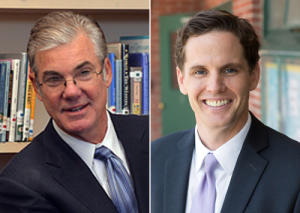
In New York City, it didn’t fly. But the race in California is much different. According to the San Jose Mercury News, one candidate for superintendent has cobbled together a coalition of super-rich backers and conservative voters, plus Latino and African American support.

That candidate, Marshall Tuck, is running neck-and-neck with the establishment choice, incumbent Tom Torlakson. Tuck’s success is built on his appeal to both the rich and the poor. The teachers’ unions have spent plenty to support Torlakson, but Tuck has still managed to outspend them, thanks to his deep-pocketed backers among the usually conservative California business elite.

Non-white voters like Tuck’s plan. According to a recent poll, Tuck leads by 38% among African American voters and 13% among Latinos. Why? One expert thinks that such voters want more charter schools, more vouchers, and less power for teachers’ unions.

Could this be the realignment conservatives have long been dreaming of? A chance to appeal to the conservative feelings among non-white voters? A chance to split off non-whites from the clutches of the Democratic Party and get them voting Republican on issues such as gay rights, abortion, and school choice?

After all, there have been similar epochal realignments in electoral politics. Most famously, FDR managed to convince African Americans to vote Democrat. Since the days of Abraham Lincoln, African Americans had been solidly Republican. Or, more recently, Reagan wooed “lunchpail” Democrats to the side of the GOP.

Could we be on the verge of a similar realignment? One in which conservative non-white voters ditch the Democrats in favor of the more conservative GOP? And if so, will school politics lead the charge?

There are a couple of things that should temper the hopes of conservative poll watchers. First, this California race is non-partisan. Both candidates are Democrats. So conservative African Americans and Latinos can vote for the more conservative candidate without abandoning the party of FDR and LBJ.

Second, though Tuck is the candidate with the more conservative positions, he’s not calling himself that. Instead, as with much of school politics, Tuck is calling his marketization plan the side of “school reform.” And his election fund, filled by mega-rich donors, officially calls itself “Parents and Teachers for Tuck.”

In this case, non-white voters seem to like the market idea that conservatives have long promoted. But they like it when it comes in a Democratic Party wrapper. They like it when it is called the progressive choice, not the conservative one.

Will non-white voters soon flock to the conservative banner? Maybe, but this race shows they might only do so if conservatism calls itself something else.

Only Religious Colleges Can Still Do It

Higher-ed types have a deskful of crises to pick from.  There’s the sexual-assault crisis, the student-debt crisis, the MOOC crisis.  One of the biggest of these crises doesn’t seem to attract its share of attention, though it threatens a bigger transformation of higher education than any of the rest.  And when it comes to this crisis, Christopher Noble of Asuza Pacific University suggests that only religious college might have the solution.

The crisis we’re talking about is the crisis in the humanities.  As Noble notes in the Chronicle of Higher Education, fewer and fewer students are signing up as English majors, or philosophy majors, or history majors.  The reasons aren’t too hard to find.  These days, a college degree is an increasingly expensive document.  And young people want to make sure that their work will turn into a well-paid job.  That’s not a guarantee with an English degree, the way it might be with a chemistry degree or engineering degree.

But Noble offers a ray of hope.  Many secular students these days are fully literate in a verbal culture, not a print culture.  For such students, Noble reflects, the humanities might rightly seem “obsolete.”  But this is not true of conservative religious students.  Those students, Noble argues, are hard-wired to embrace the humanities.  As Noble puts it,

Suppose . . . that there existed a large group of middle-class and upper-middle-class prospective customers in the educational marketplace who shared an intense prior commitment, consciously or not, to the obsolete textual worldview. That group of customers already believes, before ever setting foot in a classroom, that a ragamuffin set of ancient texts, a collection of dissonant poetic voices in unfamiliar languages, holds the key to human meaning.

Suppose further that those customers come to learn how much humanistic study will improve their facility with ancient texts. Envision consumers for whom hermeneutical skill and ancient wisdom, rather than technical expertise, constitute the nonnegotiables of a college education. Imagine a “people of the book” in the era of the book’s demise. Such is the condition of observant Muslims, Jews, and Christians in developed countries today.

Could it be true?  Could conservative religious colleges provide not only a religious haven, but a haven for the humanities?  If so, as Professor Mark Bauerlein of Emory University has pointed out, we’ll have to recognize the painful historical irony.  Bauerlein concludes with some satisfaction that many secular humanities professors are in fact

aggressively secular,  hostile to any expression of faith outside church and home. . . . If the humanities spring from a religious impulse, or at least need it to thrive, then the irreligious, irreverent postures of humanities professors are suicidal.

Certainly, following this logic, it seems that secularizing scholars might have eaten their own tails.  But is that really the case?  Aren’t there plenty of wholly secular reasons why some students will continue to embrace the humanities?

In my case, my interest in vigorously secular thinkers led me backwards.  Because I wanted to understand Sartre, I had to read Heidegger.  And because I wanted to understand Heidegger, I went back to Hegel.  And Hegel didn’t make much sense until I had spent time with Kant, Descartes, and Spinoza.

In my case, at least, none of my appetite for studying the humanities came from a religious impulse.  Not consciously, at least.  Am I the odd duck?  Or are Bauerlein and Noble simply hoping against hope for some ratification of their love for conservative religious colleges?