Don McLeroy’s Long Game

What do Phyllis Schlafly, Moses, and country/western music have in common? They all get happy shout-outs in new history textbooks in Texas.  Or at least, that’s what conservative education leaders wanted.  As Politico reported yesterday, new history textbooks in Texas are causing a stir.  But this time, it is liberal activists, not conservative ones, who are denouncing the textbooks as biased and ideological.

What Hath McLeroy Wrought?

What Hath McLeroy Wrought?

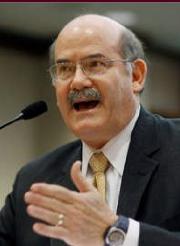
The new textbooks were written to satisfy new standards approved years ago by the Texas State Board of Education.  Back then, conservatives on the board, led by the genial Don McLeroy and the obstreperous Cynthia Dunbar, pushed through new standards that warmed the hearts of conservative activists.

No one who watched Scott Thurman’s great documentary about these Revisionaries can forget the moments when the SBOE debated including more country-western music and less hip hop.  More positive statements about Reagan and the National Rifle Association.  More happy talk about America’s Christian past and less insistence on the horrors of racial segregation.

The Revisionaries

The Revisionaries

As Don McLeroy said at the time, “America is a special place and we need to be sure we communicate that to our children. . . . The foundational principles of our country are very biblical…. That needs to come out in the textbooks.”

Now those changes in the Texas standards have shown up in new social-studies textbooks.  As Stephanie Simons reports in Politico, liberals have complained that the new texts are woefully biased.  In some spots, the books apparently knock Affirmative Action.  They pooh-pooh the benefits of taxes.  They imply that racial segregation was really not so bad.

For those who know the history of America’s educational culture wars, this seems like a drastic turnabout.  Throughout the twentieth century, conservative school activists complained that they had been locked out of educational influence by a scheming leftist elite.  Textbooks and standards, conservatives complained, had been taken over by pinheaded socialist intellectuals.

In one of the most dramatic school controversies of the twentieth century, for instance, conservative leaders lamented the sordid roots of new textbooks.  That battle took place in Kanawha County, West Virginia, across the tumultuous school year 1974-1975.  Conservatives were disgusted by the sex and violence embedded in new literature textbooks.  But some of them weren’t surprised.

Conservative leader Elmer Fike told readers that the textbooks were bound to be rotten.  In Fike’s opinion, conservatives didn’t even need to read the books.  As he explained,

You don’t have to read the textbooks.  If you’ve read anything that the radicals have been putting out in the last few years, that was what was in the textbooks.

As the Kanawha County battle ground on, California’s conservative celebrity schoolman Max Rafferty came to town.  Rafferty, too, told a crowd of West Virginians that they shouldn’t put any faith in textbook publishers.  Those publishers, Rafferty explained, only wanted to make a buck.  As he put it,

They have no particular desire to reform anybody, do anybody any good or find a pathway to heaven.

These days—in Texas at least—the shoe is on the other foot.  The conservative standards that the state adopted in 2010 have pushed market-conscious textbook publishers to come up with books that meet them.  And at least some conservatives are delighted with the success of their long game.  As conservative school board member David Bradley told journalist Stephanie Simon, liberals who complain about biased textbooks can lump it.  “They need to put on their big-girl panties,” Bradley crowed, “and go run for office.”


FROM THE ARCHIVES: AL Take Manhattan

What do conservative activists want out of education?  Like progressive thinkers, most conservatives have historically hoped for more than just classroom solutions to educational problems.  Like progressives, the conservatives I’ve studied have imagined “education” as a broad-ranging, all-encompassing process for young people.
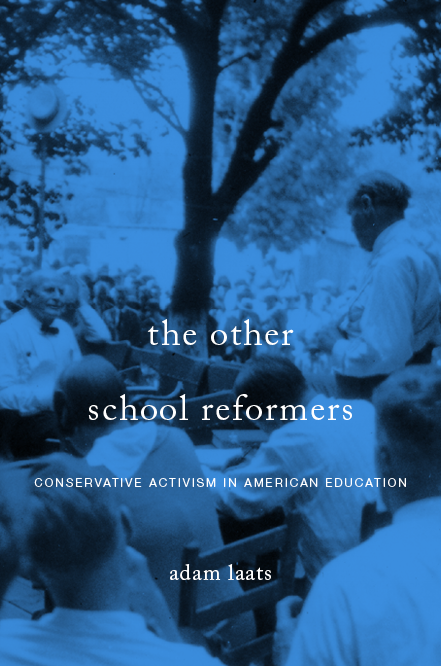
Coming soon...

Coming soon…

As I clean up my files for my upcoming book, I’ve rediscovered lots of archival documents and images that I couldn’t include.  Today, I’d like to share some of the material from the American Legion’s educational activism in the 1930s.  Like other conservatives, the leaders of the AL argued for an educational policy that encompassed far more than school reform.  Activists in the AL wanted to provide a wholesome intellectual and social atmosphere for young people in order to save them from the clutches of subversives, progressives, and anti-Americans.

American Legion activists in the 1930s thought that education could provide a wholesome moral defense against socialist and communist subversion.  Time after time, AL leaders exhorted local posts to engage in a range of activities to provide wholesome and patriotic activities for young people.  This included classroom work, but also ranged far beyond.

As the AL’s Americanism Handbook put it in 1930,

While the communist organizes his young pioneers, his youth movement in colleges, and so forth, let us do some organizing.  Let us organize Boy Scout troops, ROTC units and boys’ baseball teams, if you please.  Let us win and hold the confidence of our boys through such work.  While the communist scatters literature among the youth of the land to teach it disrespect for parental authority, let us preach the doctrine of love of parents and love of home.  While the communist ridicules the ethics of religion, let us teach its beauty and comfort and hope.  While the communist preaches its cowardly philosophy of dissipating the fruits of labor and capital, let us strive to inculcate the manly principles of energy, ambition and thrift in the hearts of our people.  While the communist, in the guise of the professional pacifist, spreads his doctrine to palsy the arm of our national defense, let us keep our people informed on matters pertaining to the need and necessity of national defense.
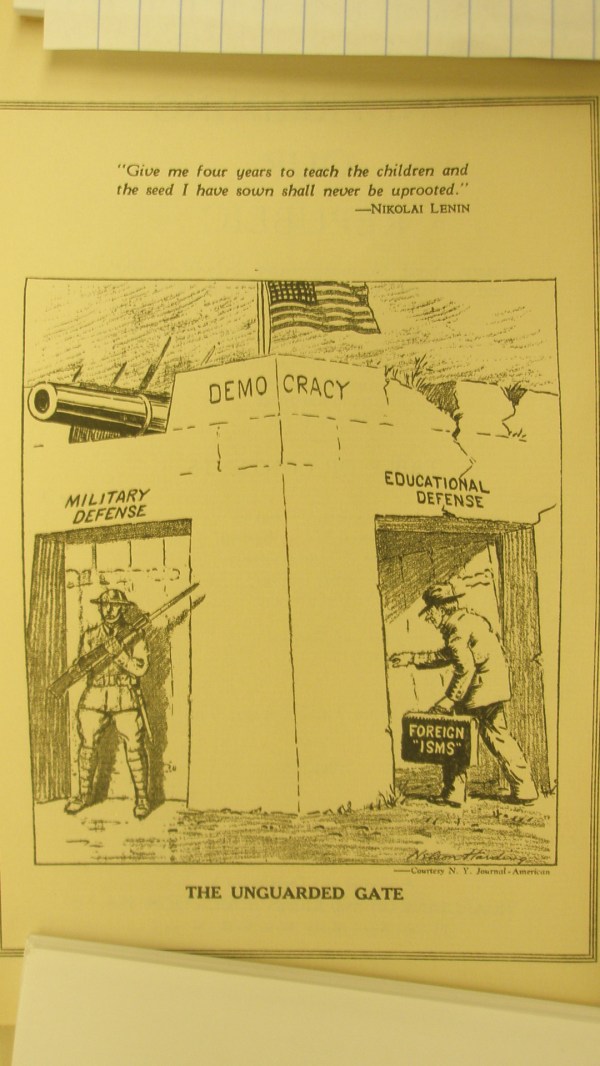
From a 1941 AL pamphlet

From a 1941 AL pamphlet. The original appeared in a Hearst publication.

The most active educational leader in the Legion during the 1930s was the AL’s Director of the National Americanism Commission, Homer Chaillaux.  In a suggested speech Chaillaux sent out to AL leaders around the country, he spelled out the AL’s broad educational philosophy.

First of all, the AL worked to fight subversion in the classroom.  As Chaillaux put it,

It is a well known fact that un-American groups, radical pacifists, communists and others operating under more or less misleading nom de plumes, are using the schoolrooms throughout the nation for the dissemination of their poisonous propaganda.  Therefore, we believe that it is only right and proper that organizations interested and engaged in the promotion of Americanism should be permitted to go into the classrooms with activities designed to build up a greater love and appreciation for the sacrifices made by our forefathers and for our form of government, and for the things which have made possible the growth of our nation.

But this was not only a schoolroom campaign.  Chaillaux described the wide-ranging activities carried on by the AL: ROTC programs, Boy Scouts, baseball leagues and other sports leagues, oratorical contests, essay contests, and Sons of the American Legion clubs.  In all its “Youth Activities,” Chaillaux explained, “the Legion seeks to coordinate the mind and the muscle through a group of activities designed to build physical and mental alertness.”

Chaillaux asked,

Does the Junior Baseball program aid in any way in counteracting communism and other un-American activities?  That question has been asked a number of times.  And the best answer, I believe, is found in a clipping taken from the “Gazette,” Gastonia, North Carolina, under date of July 31, 1934.  We quote the clipping herewith:

‘We in Gaston County know from four or five years experience what a valuable and beneficial movement this baseball program has been.  It had its beginning in Gaston County in the summer of 1929, the summer that the communist uprising had put Gaston County so unfavorably before the public.  Seeds of unrest and bitter partisanship had been planted here that spring by the agitators from the slums of New York and the classic halls of certain New York universities.  We had just gone through the sickening and humiliating trial of the gangsters accused of killing the chief of police here: The county was torn to pieces.

‘Along came this Junior Baseball, enlisted the boys from the textile settlement of the county and there began a movement which has been of the most wholesome influence in the county.  It has been the best insurance against a recurrence of similar troubles in the county.  These boys are learning how to be square and clean shooters, fair and above board in their play and in their dealings with each other and with their superiors.  From the Legionnaires who are sponsoring the movement, they are learning principles of Americanism that they will never learn from books.’

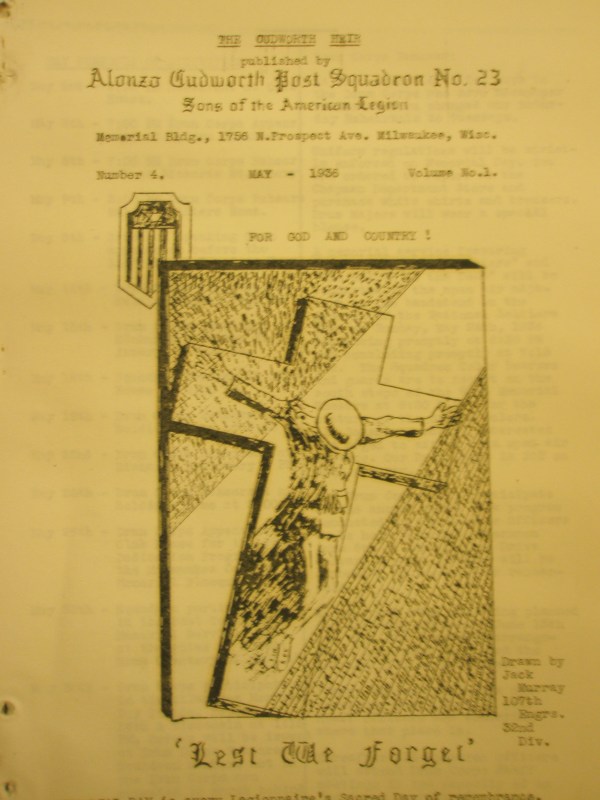
Local posts embraced these efforts.  And though it may seem heavy-handed and dictatorial, it seems as if many young people really did enjoy these subversion-fighting activities.  During my research, I spent some time in the files of one Joseph Hrdlick, an active member of an AL post in Milwaukee.  Lucky for me, Hrdlick kept copies of some of the youth activities in which his post engaged.  In Hrdlick’s papers, we find examples of a magazine the local Sons of the American Legion post produced during the 1930s.  We also see mementoes from activities such as the SOTAL marching band.  In this case, the Milwaukee boys marched all the way to New York City, a town not often revered among anti-communist activists.

It’s always hard to distill how the average person felt about these activities, but at least Mr. Hrdlick seemed sincere and enthusiastic in his efforts to help his young SOTAL minions.
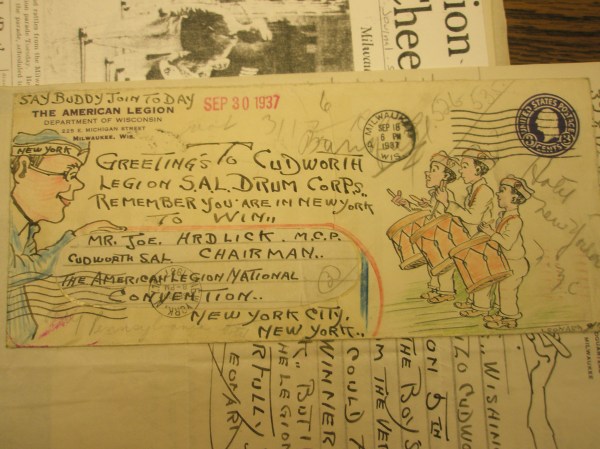
If they can make it there...

If they can make it there…

A SOTAL newsletter
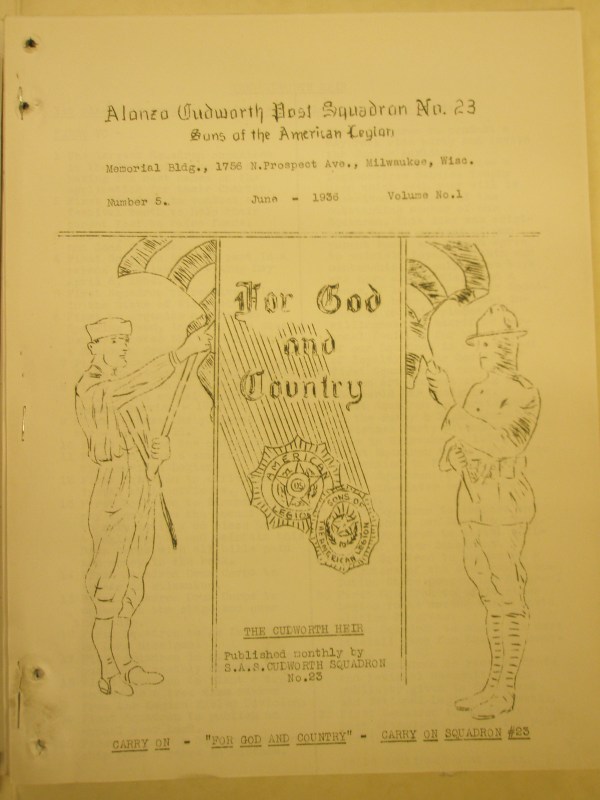
A SOTAL newsletter


A SOTAL newsletter

…another newsletter cover

Other AL archives from the 1930s contain similar gems.  In the Historical Society Archive in Madison, a hundred miles or so west of the Milwaukee collection, I found some examples of student work in AL-sponsored essay contests from the 1930s.

One winner from 1939, in her essay “What America Means to Me,” wrote these stirring words,

Just to look upon the map of America gives me a thrill! . . . America is a free country.  It is a haven for political refugees who could not find the freedom they desired in their homeland. . . . America is a land of opportunity, and yet—as there are in every country—there are those who will criticize and tear down our ideals and laws.  Their’s [sic] is a destructive criticism; hindering, instead of helping, our lawmakers.

This rhetoric sounds like precisely the sort of anti-subversive, patriotic, engaged attitude that the AL hoped to sponsor in young people nationwide.  Again and again, AL activists worked to reform the education of America’s youth.  They looked hard at classrooms, textbooks, and teachers.  But they didn’t stop there.  Like all sorts of educational reformers, these conservative activists worried about the end product of education.  Of course, they weren’t the only ones.  As I argue in my upcoming book, this sort of conservative activism formed a complex tradition throughout the twentieth century.

But in every case–whether it was the American Legion, the Daughters of the American Revolution, Pro America, the World’s Christian Fundamentals Association, or any of the dozens of local groups and individuals that campaigned for more conservative education in the twentieth century–the archives included far more fascinating tidbits than I could include in the three hundred pages I had to work with.

As I keep cleaning up my files, I’ll post other archival gems that didn’t make the final cut…

Will the REAL Conservative Fan of the Common Core Please Stand Up

Are the new(ish) Common Core Learning Standards “conservative?” Some say yes, some say no. But even among those who say yes, we see a split. Leading conservative educational thinker Sol Stern offers one “conservative” vision of the Common Core, while Michael Petrilli gives another. And their differences can tell us a lot about the complicated world of conservative educational thinking.

Among some conservatives—some of them literally from an earlier generation—the new standards seem obviously objectionable, simply because of their provenance. Phyllis Schlafly, for example, emerged from the 1970s to bash the Common Core as a power grab by “Obama administration left-wing bureaucrats.” Some pundits from a newer generation agree. Glenn Beck and Michelle Malkin warn that the new standards are turning American kids into “guinea pigs.”

But among those conservatives who like the Common Core—or at least think the new standards are the least-bad option—we see different emphases. Both Stern and Petrilli agree that the new standards will offer a more rigorous academic experience. But Stern suggests that such rigor is the core of the conservative case for the Core, while Petrilli says that academic rigor is only one aspect of the conservative argument in favor of the new standards.

Writing in the pages of the New Criterion, Stern defends the Common Core as the best “chance of restoring traditional academic content to the classroom.” As Stern explains,

As a conservative, I remain convinced that, faults and all, the Common Core still presents a golden opportunity and a challenge for states and school districts to rethink what is taught in their classrooms. The Standards are more than just a list of learning objectives and skills that American students are expected to achieve by the end of each grade level. The most hopeful part of the new Standards is that they reject the instructional malpractice that prevents the public schools from fulfilling their historic mission of producing literate American citizens who know something about their country’s history and its republican heritage. Contrary to the conservatives’ complaints, the Common Core is, in fact, a document that the founders would approve.

Michael Petrilli does not disagree. He thinks the Common Core will indeed help re-introduce academic rigor to public schools. But as he argued a while back in the pages of the Weekly Standard along with co-author Chester Finn, the real score of the Core is elsewhere. As Petrilli tells the story, the road to the Common Core began back in the days of Bill Bennett, Reagan’s second secretary of education.

Petrilli argues that the new standards fulfill a generation-long conservative plan to make schools more measurable, more interchangeable. With such standards in place, free-market conservatives have thought, public schools could be freed from the dead hand of left-leaning teachers’ unions. Parents could be offered a market-friendly menu of charter schools and voucher-funded private schools.

In Petrilli’s words,

Standards do a good job of clarifying the public’s expectations for schools, and signaling to parents and taxpayers whether the campus down the street is educating its students poorly or well. But standards-based reform has never had a suitable answer for failing schools. It can identify them but has had little success turning them around.

Choice, on the other hand, is great at creating new school options, places that can replace the failures and give needy kids decent alternatives. Yet market-based reform needs reliable consumer information for it to lead to strong outcomes—information that standards and tests are excellent at providing.

We might describe this difference in conservative emphases as a difference between a “classroom” approach to conservative school reform and a “systemic” approach. Or maybe a “traditionalist” versus a “free-market” approach.  And, again, we don’t want to make these plans sound entirely exclusive.

But it seems as if Stern is arguing that the heart of “conservative” reform must be with an intellectual change in the way kids are taught. Stern excoriates pedagogical ideas such as “balanced literacy.” Instead, Stern celebrates the approach of anti-progressive E.D. Hirsch. Instead of looking at structural reforms, Hirsch and Stern wanted conservative reforms to begin in the classroom. Students needed to learn basic cultural information, to focus on “Core Knowledge.”

Petrilli, on the other hand, emphasizes a different approach. Academic rigor is important, Petrilli argues, but it is only one of the reasons for conservatives to support the Core. At least as important, Petrilli says, is the boost the standards will give to school choice. Without what Petrilli calls “true external standards,” it will always be impossible to introduce a true educational marketplace. After all, how can parents know what school is the best if there are not measures that compare schools in a fair way?

In any case, these conservative pleas in favor of the Common Core might be too little, too late. Recent polls have indicated plummeting popular support for the new standards. In spite of the smart arguments of intellectuals like Stern and Petrilli, parents might decide that these standards are just too iffy.


Just the Facts, Ma’am

What should good history teaching look like?  As we’ve noted here at ILYBYGTH, conservative critics have warned that the new Advanced Placement US History framework pushes a “consistently negative view of the nation’s past.”  Now, two big historical associations have defended the guidelines.  But those associations are downplaying a central reason why so many conservative critics object to the APUSH framework.

Anyone with ears to hear can’t miss the conservative concern about the tenor of the new APUSH framework.  From the Republican National Convention to the blogosphere to the stuffed-shirt crowd, conservative pundits have teed off on the new guidelines for the advanced history classes.

Time and again, conservative activists such as Larry Krieger have warned that the new guidelines leave out key documents such as the Mayflower Compact and teach children that America’s history is the story of white exploitation, greed, and genocide.

The National Council for History Education and the American Historical Association have published letters in defense of the APUSH guidelines.  Mainly, these history groups insist that the new framework is not biased.  As the AHA puts it,

The AHA objects to mischaracterizations of the framework as anti-American, purposefully incomplete, radical, and/or partisan.

The 2012 framework reflects the increased focus among history educators in recent years on teaching students to think historically, rather than emphasizing the memorization of facts, names, and dates.  This emphasis on skills, on habits of mind, helps our students acquire the ability to understand and learn from key events, social changes, and documents, including those which provide the foundations of this nation and its subsequent evolution.  The authors of the framework took seriously the obligation of our schools to create actively thinking and engaged citizens, which included understanding the importance of context, evidence, and chronology to an appreciation of the past.

But there is a minor theme in these defenses.  In the snippet above, the AHA signatories mention that good history education goes beyond the “memorization of facts.”  Similarly, the NCHE insists, “The point of education is not simply to acquire a specific body of information.”

But for many conservative activists and their supporters, the definition of education is precisely the acquisition of knowledge.  And that definition has proven enormously politically powerful over the years.  Please don’t get me wrong—I’m an ardent supporter and sometime member of both the NCHE and the AHA.  But these letters downplay the culture-wars significance of what Paolo Freire called the “banking” model of education.

Not that conservative critics aren’t concerned with the partisan tone of the new guidelines.  That is certainly a key motivating factor for many, I’m sure.  But behind and beyond those worries lies a deeper conservative concern with the definition of education itself.  Not all, certainly, but many conservatives want education in general to remain the transmission of a set of knowledge from teacher to student.

This notion of proper education is so deep and so profound that it often goes unarticulated.  Conservatives—and many allies who wouldn’t call themselves conservative—simply assume that education consists of acquiring knowledge, of memorizing facts.  And this assumption lurks behind many of the big education reforms of our century.  The test-heavy aspects of the No Child Left Behind Act and the new Common Core standards rely on a notion of good education as the transmission of information.  If a student has really learned something, the thinking goes, a test can find out.

For over a century, progressive educators have railed against this powerful assumption about the nature of education.  But for just as long, conservative activists have worked hard to keep this idea of education at the center of public schooling.  As I argue in my upcoming book, conservatives have been able to rally support for this “banking” vision of proper education in every generation.

In the 1930s, for instance, one leader of the Daughters of the American Revolution defined education precisely as a body of ideas that “shall be transmitted by us to our children.”

And in his popular 1949 book And Madly Teach, pundit Mortimer Smith insisted that true education consisted precisely of transmitting the children “the whole heritage of man’s progress through history.”

Similarly, in 1950, an angry letter-writer in the Pasadena Independent insisted on the transmission model as the only proper method of education.  As this writer put it,

Children have the right to learn by being taught all and more than their parents and grandparents learned—one step ahead instead of backward, through each generation.

Perhaps the most articulate advocate for this notion of traditional, transmissive education was California State Superintendent of Public Education Max Rafferty.  In his official jobs and his syndicated newspaper column, Rafferty insisted that the only worthwhile definition of education was the transmission of knowledge from adult to child.  Two fundamental principles of “common sense” in education, Rafferty argued in 1964, were the following:

  • Common sense told us that the schools are built and equipped and staffed largely to pass on from generation to generation the cultural heritage of the race.

  • Common sense took for granted that children could memorize certain meaningful and important things in early life and remember them better in later years than they could things that they had not memorized.

We could list a thousand more examples.  This tradition among conservative activists has remained so powerful that it often goes without saying.  And it lurks behind conservative agitation against each new generation of progressive educational reform.

So when groups such as the AHA and the NCHE defend the new APUSH guidelines, they should spend more time explaining and defending their notion that good education relies on more than just the memorization of facts.  For many parents and teachers, the transmission of those facts is precisely the definition of good education.

Creationism, Conservatism, and the Common Core

What does creationism have to do with the newish Common Core Learning Standards? Some conservative activists and politicians are rejecting both in a knee-jerk attack on educational reform. In one new educational bill in Ohio, conservatives simultaneously threw out the Common Core and opened the door to creationism. But this isn’t just a question of creationism. Rather, this is a symptom of a broader conservative attitude toward public schooling.

Not just science, but history and literature are also targeted in this conservative educational power grab.

We first became aware of this new bill in Ohio thanks to the watchdoggery of the folks at the National Center for Science Education. The NCSE, naturally, worried first about the apparent opening of Ohio’s public-school science classes to intelligent design and creationism. Ohio’s House Bill 597 would insist on new standards that specifically “prohibit political or religious interpretation of scientific facts in favor of another.”  The sponsor of the bill, Andy Thompson of Marietta, told the Cleveland Plain Dealer that he included that language to allow school districts the freedom to include a variety of ideas about evolution, not to mandate that districts include intelligent design or creationism.

Representative Thompson wants the Common Core OUT and conservative curricula IN.

Representative Thompson wants the Common Core OUT and conservative curricula IN.

But the anti-Common Core bill also includes a broad-spectrum attack on the purportedly progressive nature of school curricula in other subjects as well. The original draft of the bill specified that 80% of the literature taught must be from American or British authors before 1970, though Thompson quickly backpedaled from that goal. But why was such a target included in the first place? As I detail in my new book, conservatives since the 1970s have looked skeptically at the trend toward “multicultural” literature. Conservative leaders from Max Rafferty to Bill Bennett have insisted that proper education—conservative education—must be based on the classics of our Western civilization. Anything else, they insisted, dooms children to a savage unawareness of their own cultural heritage.

In history, too, the Ohio bill insisted that history instruction include

the original texts and the original context of the declaration of independence, the northwest ordinance, the constitution of the United States and its amendments with emphasis on the bill of rights; incorporate the Ohio constitution; define the United States of America as a constitutional republic; be based on acquisition of real knowledge of major individuals and events; require the study of world and American geography; and prohibit a specific political or religious interpretation of the standards’ content.

Here also we hear echoes of long-time conservative worries. From Lynne Cheney to Dinesh D’Souza, it has become a commonplace of the conservative imagination that leftist history has taken over public education. As I argued recently in a commentary in History News Network, conservatives assume that students are taught that American history is the record of cruel white hate crimes against Native Americans, women, and African Americans. The Ohio bill hopes to rectify this America-bashing by mandating “real knowledge,” not just hate-filled Zinn-isms.

As we’ve seen time and again, conservatives are not united in their thinking about the Common Core. Some conservatives love them….or at least like them. Others blast the standards as yet another attempt at sneaky subversion from Washington.

In this new Ohio legislation, we see how some conservatives combine their loathing of the Common Core with a grab-bag of other conservative educational goals: Less evolution in science class, more America-loving in history class, and less multiculturalism in literature class. Taken together, conservatives such as Ohio’s Andy Thompson hope to broaden the anti-Common-Core juggernaut into a more ambitious conservative panacea.


Kids: You’re Not Really Gay

What should conservatives tell gay kids?  One writer suggests that kids should learn that they’re not really gay.  But that writer, Michael Hannon, also wants us to tell non-gay kids that they’re not really straight.

Hannon’s original argument suggested that the construction of the notion of sexual identities in the nineteenth century doomed conservative Christians to a double danger.  First, it led some people to identify as homosexuals.  According to Hannon, such an identity enshrines sinful behavior as the core of a person’s identity.  To Hannon, anyway, it seems there is no moral way to have sex as a homosexual, since gay marriage is not for him a moral possibility and sex outside of marriage is immoral.

But heterosexuality is just as bad.  By allowing conservatives who identify as heterosexuals to rest satisfied that they had the “right” sexual identity, heterosexuality left people clueless about the abundant dangers of the entire idea of sexual identity.

In other words, if I understand him correctly, Hannon hoped religious conservatives would take their argument up one level.  Instead of suggesting that homosexuality was sinful and heterosexuality was not, Hannon wants us to recognize that the concept of a sexual identity—any sexual identity—was deeply problematic.  As he elaborated in a recent follow-up, Hannon argued that the real goal of religious people must not be Hollywood’s marriage-as-happy-ending, but a more complicated goal of spiritual friendship.

This is not the usual semi-hysterical “homosexual agenda” talk we hear from some religious pundits.  Over and over, conservative activists have warned that “sneaky” homosexuals are using public schools to infect young minds with gayness.  Hannon is making a much more subtle argument.

To be clear, Hannon does indeed think that homosexuality tends to promote sinful behavior.  As he put it,

Self-describing as a “homosexual” tends to multiply occasions of sin for those who adopt the label. . . .  Whereas the infusion of the theological virtues sets the Christian free, identifying as homosexual only further enslaves the sinner. It intensifies lust, a sad distortion of love, by amplifying the apparent significance of concupiscent desires. It fosters a despairing self-pity, harming hope, which is meant to motivate moral virtues. And it encourages a strong sense of entitlement, which often undermines the obedience of faith by demanding the overthrow of doctrines that seem to repress “who I really am.”

But this is not the only problem of sexual identities.  Too many conservatives, Hannon charges, accept heterosexuality as a healthy sexual identity.  They yearn for boy-meets-girl and scorn boy-meets-boy or girl-meets-girl, but in essence such conservatives miss the point.  Encouraging young people to understand themselves as primarily sexual beings—gay or straight—puts too much emphasis on sexual identities entirely.

What should young people hear about sexual identities?  Neither that they are inherently gay nor straight, Hannon says.  Rather, that sex is part of humanity, but never should make up the core of a person’s identity.

Critic John Corvino doesn’t buy it. According to Corvino, Hannon seems to be

asking for something much more difficult for us moderns to imagine: a world without sexual orientation as we understand it. Yet it’s hard to see how to avoid the closet as a necessary first step toward this goal. Worse, one worries that aiming for this goal would at most achieve a disastrous middle ground: a world where orientation categories were still salient but where the taboo against voicing them would leave those with same-sex desires lonely and miserable.

How about you?  Do you think Hannon’s argument has legs?  Can religious conservatives get out of their culture-war pickle by moving away from a condemnation of homosexuality and instead to a broader distaste for sexual identities as a whole?


Are Conservatives Secretly Racist?

No matter how much they may deny it, conservative intellectuals and activists these days are often accused of being secretly racist.  Influential African American conservatives such as Thomas Sowell, Clarence Thomas, and Ben Carson are accused of being suckers and “Uncle Toms.”  As an article in the New York Times argues, perhaps the racial strife in Ferguson, Missouri will give conservatives a chance to prove their anti-racist claims.

Is this the "conservative" side? ...

Is this the “conservative” side? …

As I argue in my upcoming book, racial thinking among white conservatives as a whole has changed dramatically over the course of the twentieth century.  In the 1920s, school battles did not pit conservatives as the “racist” side against “anti-racist” progressives.  Indeed, in fights about evolution in the 1920s, mainstream scientists such as Henry Fairfield Osborn often supported the white-supremacist notions of writers such as Madison Grant.  White conservatives in the 1920s were mostly guilty of what we would call racism, but then again, so were white non-conservatives back then.

By the 1950s, mainstream conservatives had changed their thinking on racial issues dramatically.  First of all, the tumult over school desegregation led some conservative intellectuals such as William F. Buckley Jr. to support “states’ rights” over racial desegregation.  And in the massively resisting South, white resistance to desegregation often became coupled with a conservative anti-communism.

But outside the South, white conservatives often tried to insist that their opposition to school desegregation was not due to racism.  In Pasadena, for example, a progressive superintendent’s plan to desegregate the district met with ferocious opposition from conservatives.  But those conservatives insisted that they were not racist.  They insisted that their opposition to desegregation did not mean that they thought non-whites were inferior.

...Or is THIS the "conservative" side?

…Or is THIS the “conservative” side?

Similarly, in the school controversy that engulfed Kanawha County, West Virginia in 1974, white conservative activists insisted that they were not racist.  They opposed new textbooks that included passages from racial firebrands such as Eldridge Cleaver and George Jackson.  But, as conservative leader Elmer Fike put it,

The protesters do not object to authors because they are black, but they do believe convicted criminals and revolutionaries like Eldridge Cleaver should not be recognized.

Since then, mainstream white conservatives have worked hard to prove that their conservatism does not make them racist.  Does this new racial firestorm in Missouri give them a new chance to prove their sincerity?

In a recent article in the New York Times, journalist Jeremy W. Peters suggests it might.  Peters cites the nervousness of conservative leaders such as Rand Paul, Ted Cruz, and Erick Erickson.  All three conservatives, Peters notes, have spoken out against the massively militarized police response to the unrest in Ferguson, Missouri.  Peters says that this sort of conservatism marks a shift.  Since the late 1960s, conservatives have traditionally been the side of law and order.  These days, Peters wonders, conservatism might find itself embracing instead a renewed emphasis on limiting the power of government.  What conservative, Senator Paul might ask, wants to see a militarized police force bearing down on protesting citizens?

But the Missouri conflagration suggests another important question as well.  If conservatives really are the anti-racists many of them claim to be, this Ferguson situation might offer white conservatives a chance to side with African American conservatives as a united anti-racist conservative voice.  Legitimate protests against overweening government power could certainly rally conservative support, white and black.

And if conservative activists want to prove that they are not secretly racist, what better way to do so than to side with the protesting citizens of Ferguson, Missouri?


How Much Sex Is Too Much for Kids?

What should teenagers be learning about sex?  It is a perennial question at the center of our educational culture wars.  A recent controversy from California’s Bay Area shows how this old battle has changed, and how it has stayed the same.  This time, parents in Fremont, California objected to a sex-ed textbook they found too racy.  After parent protests, the district pulled the book.

Too titillating?

Too titillating?

As I note in my upcoming book about educational conservatism in the twentieth century, the pattern seems familiar: A textbook includes explicit information about sex.  Parents object.  The administration buckles, allergic to any whiff of controversy.  Progressives lament the parents’ Victorian attitudes toward sex. Conservatives crow that their children are being pimped by an educational establishment that does not respect their values.

That script certainly seems to be playing out in Fremont, but there are some wrinkles.  The textbook, Your Health Today, contained a twenty-page section on sexual behavior.  As the parent petition protested, this section included information about more than just the mechanics of sex.  It told students about

sexual games, sexual fantasies, sexual bondage with handcuffs, ropes, and blindfolds, sexual toys and vibrator devices, and additional instruction that is extremely inappropriate for 13 and 14 year-old youth.

And, as in similar controversies in the past, the protesting parents quickly reached out to national conservative activist organizations for support.  In this case, Fremont parents contacted the conservative Christian Pacific Justice Institute for back-up.

But the “conservative” parents made clear that they did not oppose sex ed in general.  What they did not like was the inappropriate college-level sex ed this book contained.  Parent activist Asfia Ahmed told the Christian Post that the problem was not sex ed as such; the problem was that this book in particular “speaks to adults; it does not speak to teens and adolescents.”

Predictably, progressive commentators accused conservatives of being trapped in the past.  As one writer noted, “It’s frustrating that this is still controversial.” I personally agree. I’m a teacher and parent. I want my students and daughter to have frank, explicit information about sex. And I think that such information needs to include some sense of the wide variety of sexual behaviors that are common in our society. It needs to include the basic fact that sex should be pleasurable and should never be coerced.  Perhaps most tricky, I think that public schools have a duty to convey this information.  After all, with pregnancy and HIV on the line, these are literally life-and-death subjects.

But the notion of some anti-conservatives that these issues have been resolved in the past demonstrates the dunderheadedness of my fellow progressives. Some progressive commentators seem to think that these debates have already been settled. Whether the issue is sex ed, school prayer, or creationism, progressives often express surprise that these questions are “still” controversial. Such attitudes demonstrate the ignorance of progressives.

Conservative notions about sex ed in public schools have always had a decisive influence on the goings-on in those schools. In this case, for instance, we see how quickly the administration caved to parent protests. Here and elsewhere, the notion that there is some healthy connection between kids and sex is a very touchy one in our society. Conservatives need only say that a book goes too far to have that book quickly yanked by the district.

Perhaps the hard-hitting journalists of the Today Show made the most salient point about this story. They interviewed some of the young teenagers who would have read this textbook. As one told them, “Like ewwww. . . . I don’t really feel like I need to know about that right now.”


Creationists Love Angry Science Teachers

Why would America’s leading young-earth creation ministry go to the National Education Association convention?  After all, Answers In Genesis castigates the NEA for its “godless, liberal agenda.”  AIG frets that the NEA combats conservatives’ right to homeschool their children and to teach godly creationism.

But that anti-God bias is exactly why the creationists go every year.  Answers In Genesis tries to engage NEA attendees with the gospel of creationism.  The creationist outreach at the NEA convention hopes to explain the goals of creationists and melt the hard hearts of some secular teachers.

The folks at AIG are not the first conservatives to try such tactics.  For generations now, the National Education Association has been perceived by conservative education activists as the enemy.  The NEA is seen as promoting secularism and a wrong-headed moral relativism.  As conservative gadflies Mel and Norma Gabler argued in the 1970s, the NEA had always tried to get public schools to teach that “there was no absolute transcendental God, Bible, or system of beliefs.”

And even long before the Gablers, conservatives tried to maintain their influence with the NEA.  As I note in my upcoming book about conservative educational activism in the twentieth century, the patriotic school activists in the American Legion pioneered this approach.  For the stalwart conservatives in the American Legion, the NEA offered the best way to influence American public education.  Therefore, they held their noses and collaborated on American Education Week.  Starting in 1921, the Legion and the NEA encouraged schools nationwide to focus on a certain theme for a week.  They tried to get everyone in every community engaged with their public schools.  For the conservative leaders of the American Legion, this was a way to promote patriotism and religion in public schools.  For the leaders of the NEA, this seemed like a good way to direct the public’s attention toward its schools.

For conservatives, then, the NEA has long been a target.  Generations of conservatives have hoped to influence the NEA with conservative educational ideas.  Does it work?  The conservative creationists at AIG seem to think so.  One missionary to the NEA relates the story of “Tom,” a hostile secular science teacher.  After spending time with the creationists at the NEA convention, Tom was able to understand more about the wholesome gospel mission of the creationists.  Walls were broken down, hearts were touched.


The Left Seizes Science

You’ve heard the howls from creationists over Neil deGrasse Tyson’s recent Cosmos series.  But did you know non-creationist conservatives also get cheeved at Tyson’s science punditry?

Science Snob?

Science Snob?

The creationist complaints make sense.  The hugely popular new science series pointedly called out young-earthers for their belief in a newish universe.  The series also insisted on the creation of species through evolution.

But the complaints of non-creationist conservatives might not seem so obvious.  In the pages of National Review, Charles C.W. Cooke took Tyson to task for his leftism, not just for his love of evolution.  Cooke accuses Tyson and others of his ilk of a puffed-up condescension, of glibly associating liberal politics with superior intellect.

Too many of these self-righteous faux-nerds, Cooke writes, wrap their insouciance in the mantle of science.  For these Tyson fans and wanna-bes, being smart does not mean doing actual intellectual work, but rather simply adopting a pre-packaged list of things to dislike.  As Cooke puts it, that list includes anything

southern, politically conservative, culturally traditional, religious in some sense, patriotic, driven by principle rather than the pivot tables of Microsoft Excel, and in any way attached to the past.

This sort of prejudice against anything recognizably conservative likes to call itself the side of “science,” Cooke argues.  Yet among progressives, real science often takes a beating.  “Progressives . . . ,” Cooke says,

believe all sorts of unscientific things — that Medicaid, the VA, and Head Start work; that school choice does not; that abortion carries with it few important medical questions; that GM crops make the world worse; that one can attribute every hurricane, wildfire, and heat wave to “climate change”; that it’s feasible that renewable energy will take over from fossil fuels anytime soon . . .

Yet in spite of this demonstrably unscientific attitude, Cooke laments, the Left insists on calling itself the “reality-based” party.

Cooke is not the first to complain about such things.  In the first generation of creation/evolution controversies, anti-evolution activists worked hard—and failed—to claim “science” for their side.  As I noted in my 1920s book, leading anti-evolutionist William Jennings Bryan maintained his membership in the staunchly pro-evolution American Association for the Advancement of Science.  He refused to allow that leading science group to be wholly taken over by fans of evolution.

Similarly, prominent 1920s fundamentalist activist William Bell Riley fought hard to keep his generation of Neil deGrasse Tysons from pushing conservatives out of the world of science.  As Riley put it in a 1927 speech, the creation/evolution debate was not a debate between

Experts on the one hand, and, as someone has said, ‘organized ignorance,’ on the other.  This is not a debate between the educated and the uneducated.

Like Bryan in the 1920s and Cooke in 2014, the conservative Riley was loath to cede the scientific and intellectual high ground to evolution-lovers.

One of the results of that first decade of evolution controversies was the formation of durable cultural associations, the associations about which Cooke complains.  Since the 1920s, “science” has become indelibly associated in the public mind with progress, with social experiment, with iconoclasm.  Politically, if not logically, all of those things are part of the broad package of cultural leftism.  And, like it or not, conservatism has been associated time and again with obstructionism and heedless obscurantism.

For conservative pundits like Cooke, trying to fight that tradition will be an uphill battle.