Who Owns the Children with Guns?

Can a school tell parents what their kids can do outside of school?  On private property?

Conservatives say no.  But they seem to say no for very different reasons.

Conservative intellectuals argue that the state must not overreach.  The average conservative-in-the-street, however, seems to cling to ancient notions that children are not persons.  At least that’s the message we hear in one story from Virginia Beach.

This is a story that has attracted its share of media attention.  According to NBC News, a school district suspended three middle-schoolers for shooting other students with toy pellet guns.  The students were not at school with the toy guns, but rather waiting for the school bus.

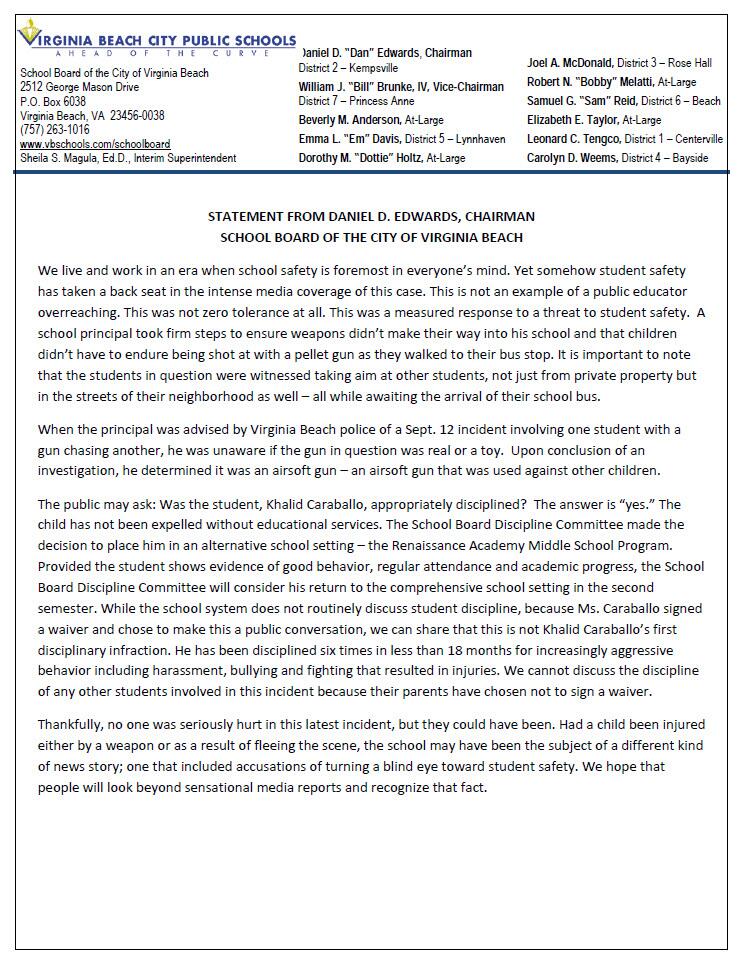
Virginia Beach School Board Chairman Daniel D. Edwards defended the decision.  “This is not an example of a public educator overreaching,” Edwards insisted in a public statement.

Conservative commentator Charles E. Cooke demurs.  In the pages of The National Review, Cooke blasts the school decision as a typical and terrifying example of “tyranny.”  School, Cooke insists, has no role in punishing students for something that occurred outside of school, on private property.  “In free societies,” Cooke argues,

schools are not designed to serve as a mandatory means by which the Bismarckian state may seek to shape the young, but instead to act merely as a service to which parents can choose to send their kids for basic education if they so wish.

Cooke’s essay illustrates this key tenet of conservative thinking, a central reason why today’s conservatives are so keen on educational issues.  Many American conservatives these days yearn for a smaller government.  School is one of the most commonly encountered faces of government.  As a result, school becomes the target of conservative ire.  Even more complicated, schooling for the young is mandatory.  Along with taxes, schooling is one of the most common ways government tells Americans directly what they must do.

This story also dishes up a very different example of the complicated ways Americans tend to think of children and schooling.  According to WAVY.com, one of the parents of the children involved insisted that her child was her property, at least until he got on the bus.  “My son is my private property,” Solangel Caraballo told the local TV station.  “He does not become the school’s property until he goes to the bus stop, gets on the bus, and goes to school.”

Caraballo’s outrage doesn’t come from the same intellectual tradition as that of Cooke’s.  Cooke worries about an overreaching state.  Caraballo, on the other hand, is perfectly willing to have the state assert ownership of her child, but only once the kid gets on the bus.  Until then, the kid is private property, wholly owned by his parents.

What are we to make of this kind of thinking?  If children are private property, what does that mean about their rights?  If they are not property, how can they be kept from voting (not until age 18 in the USA), or driving (not until @ 16), or drinking alcohol (not until 21)?  If they are not property, how can they legally be forced to attend school if they don’t wish to?  What sort of legal twilight zone do children inhabit, not fully legal persons, yet something different from a washing machine or a pair of pants?

Most important, how common is this kind of thinking?  How many Americans continue the ancient tradition of thinking of their children as their property?  Of thinking of their children as property at all, property that they can transfer to the control of the school?


A Conservative Takedown of Testing and Charters

Progressive education folks foam at the mouth when they talk about the new power of testing and charter schools.  Will conservatives join them?

We see recently a furious conservative condemnation of the current education “reform” mania. [The essay originally appeared last July in Crisis.]

Veteran history teacher Steven Jonathan Rummelsburg offered a conservative rationale for opposition to the Michelle Rhee/Waiting for Superman school reform crowd.

Those folks want to make public schooling more responsive.  They argue that schools should have more wiggle room to fire weak teachers; charter schools should be able to slash red tape to provide effective education for any child left behind.  Such reformers often also promise to hold teachers and schools “accountable” by mandating rigorous testing of students.  Such tests, the argument goes, will force teachers and schools to pay attention to the academic performance of all their students.

Progressive critics have teed off on this reform ideology for a while now.  Some have warned that charter schools are nothing but a capitalist scheme to siphon money away from public education.  And the mania for testing, progressives warn, represents a perversion of the promise of American public education.

Rummelsburg gives a different rationale for this same suspicion.  Placing hope in the panacea of charter schools, Rummelsburg argues, is a mistake.  Waiting for any kind of public-funded superman, Rummelsburg insists, misses the point.  The real responsibility for education must remain with the family, not with the government.  And standardized testing reduces the true goal of education to a series of bubbles filled in.

Rummelsburg doesn’t pull any rhetorical punches.  As he puts it,

Waiting for “Superman” illustrates how severely broken public education is and brings up the real issues of school reform and the voucher system. However, the “magic bullet” of charter schools is not the answer. A transfer of money and power from the dreadful public classrooms to charter schools is a bit like transferring the administrative duties of running Nazi death camps from the Germans to the Belgians, yet still the need for reform is beyond dire. However, reform is futile if the goal remains a high standardized test scores.

Ouch.  Will more conservatives join Rummelsburg’s condemnation of the current reform agenda?


Vouchers: The Path to the White House

How can a conservative candidate get elected in 2016?

According to a recent story in the Weekly Standard, the conservative path to 1600 Pennsylvania Ave. may be paved with school reform.

Image Source: Governor Jindal's webpage

Image Source: Governor Jindal’s webpage

Louisiana Governor Bobby Jindal and former Florida Governor Jeb Bush stood side by side at a Washington press conference to denounce federal interference in conservative school reform efforts.

In Louisiana, that has meant a Department of Justice crackdown on the state’s aggressive voucher program.  The federal government has warned that Louisiana’s voucher system may violate racial desegregation laws.  For a while now, left-leaning pundits have warned that the voucher scheme swipes public school funding and gives it to conservative religious schools.  Diane Ravitch has concluded that Louisiana’s privatization program will drive a stake through the heart of quality public education.

Such criticisms don’t deter Governor Jindal.  He has insisted that the program represents the best educational hope for low-income students in his state.

Michael Warren of The Weekly Standard suggests vouchers may also represent Governor Jindal’s best hope for higher office.  As Warren notes,

the Obama administration’s attempt to thwart the voucher program has also been a gift for Jindal, who may run for president in 2016. Since the DOJ filed its lawsuit on August 18, Jindal has been campaigning loudly and publicly against the suit and, more broadly, for conservative education reform.


Do White Conservatives Hate Black People?

What is the connection between conservatism and school segregation?  A new “retro report” in the New York Times about the desegregation project in Charlotte, North Carolina assumes that “conservatives” obviously opposed desegregation.  Is that connection really as obvious as it seems?

The desegregation documentary describes Charlotte’s experience.  In the 1970s, Charlotte and surrounding Mecklenburg County became the focus of a newly aggressive court-ordered busing program.  Schools and school districts, the Supreme Court ruled, must do more to ensure racial balance in public schools.

The initial reaction in Charlotte was furious, but the program eventually became the poster child for busing.  So much so that a federal judge ruled in 1999 that the district had fulfilled its deseg obligations.  At least partly as a result, the Charlotte-Mecklenburg schools are now resegregated by race and income level.

For historians of race and education, the story is not news.  But for those of us trying to understand the meanings of “conservatism” in American education, the way it is told is important.  The New York Times piece includes comments by journalist B. Drummond Ayres Jr. In that “Reporter’s Notebook,” Ayres offers an explanation for the winning campaign to resegregate America’s schools.  As Ayres explains,

White parental anger was the most obvious cause of this rollback. But an equally important factor was the election of two conservative Presidents, Richard Nixon and Ronald Reagan. They did not oppose the nation’s move toward racial equality, but as conservatives they favored a slower, more measured approach to desegregation and underscored that approach by appointing staunch conservatives to the Supreme Court and lower Federal courts. Concurrently, Congress took a more measured approach to desegregation, too, as voters began sending more and more anti-busing conservatives to Capitol Hill. [Emphasis added.]

In this telling, “conservatives” have been the brake on the progress of racial desegregation.  Politicians who considered themselves conservative had a prescribed opinion toward school desegregation.

Is that a fair accusation?  Did conservatives as a rule really push for slower desegregation?  More interesting, how did conservatism come to be perceived as the side of white racial status-quo-ism?

In my current book, I explore two twentieth-century school controversies in which race and school deseg played leading parts.  The first took place in Pasadena, California, in 1950, the second in Kanawha County, West Virginia, in 1974.

In Pasadena, a “progressive” school superintendent added racial desegregation to his list of progressive reforms.  Conservatives kicked him out.  In Kanawha County, a new textbook series included provocative excerpts from black militants such as Eldridge Cleaver.  Conservatives boycotted to demonstrate their dissatisfaction with the books.

Each time, the conservative side became the side of anti-black racism.  But in each case, conservatives insisted they were not racist.

In Pasadena, for example, one woman stood up at a heated school-board meeting and denied all charges of racism.  She opposed the desegregation plan but said she could not be racist, since one of her closest friends was African American.

In Kanawha County, too, book protesters often insisted they were not racist.  Teacher and activist Karl Priest, for example, has insisted for decades that the conservative protesters embodied the true anti-racist position.

But evidence contradicts these conservative anti-racist claims.  In Pasadena, conservatives rallied political support based on opposition to race mixing in public schools.  Conservatives accused the progressive superintendent of raising taxes and dumbing down white schools by including students of other races.  If that’s not racism, what is it?

And in Kanawha County, as documentarian Trey Kay has shown, conservatives really did see the book protest as a race war.  Steve Horan remembered in 2010 that a rumor spread among white conservatives in 1974: African Americans planned to invade.  The men readied their guns.   Women and children took shelter in church basements.  If that’s not racism, what is it?

There seems to be at least some justification for journalists’ assumptions that “conservatism” stands staunchly opposed to racial integration in schools.

But it is also important to recognize the complexity of conservative attitudes toward race and schooling.  It is not enough to simply say that “conservatives” block school desegregation because they dislike black people.

The case of Kanawha County helps make this more complicated point.  Many of the conservative leaders of the protest, such as Karl Priest and Avis Hill, belonged to conservative churches with a thoroughly biracial membership.  If that’s not anti-racism, what is it?

And conservative leader Alice Moore built her anti-textbook arguments on the work of African American activist Stephen Jenkins.  Jenkins had argued that textbooks that included only violent writings by African Americans actually represented the true anti-black racism.  Those who wanted to oppose the depiction of African Americans as violent anti-American criminals, Jenkins argued, needed to oppose the wrong-headed push for “multiculturalism.”  If that’s not anti-racism, what is it?

Across the country, “conservative” anti-busing protesters made similar claims to be the true anti-racists.  In Boston, for example, as Ron Formisano has shown, “conservative” anti-busers in the 1970s accused “liberal” federal judge Arthur Garrity of being the true racist.  Garrity had ordered busing to achieve racial balance in Boston’s schools, yet he lived in the affluent lily-white enclave of Wellesley, where his children would attend all-white schools.  Who was the racist in that scenario?

Did conservatives oppose busing and forcible school desegregation?  In most cases, yes.

Will we understand conservatism in schooling if we explain that position as simple racism?  In most cases, no.

White conservatives seem, in many cases, to have been motivated by anti-black racism.  But in almost all cases, that racism was only one component of a complex conservatism that also included issues of school funding, textbook content, religious rights, classroom practice, and a host of other issues.

Calling it “racism” and walking away doesn’t do enough.  Ayres deserves credit for noting that leading conservatives often supported anti-racist policies.  Conservatives often insisted that they opposed forcible busing and forcible integration.  They did so as part of a complicated conservative worldview, one that looked toward the status quo–including but not by any means limited to the racial status quo–for support.

So did white conservatives hate black people?  Did conservatives oppose school desegregation out of disdain for non-whites?

In some cases, probably.  But it is not very useful to assume that such racist attitudes are the end of our discussion.  Rather, understanding the complex attitudes toward race among conservatives–as among Americans as a whole–requires a more careful understanding of a complex conservative ideology.


They’re Coming for your Children

Beware!  The State is coming for your children.

That is the reminder recently from some conservative Christian commentators.

As we’ve noted here at ILYBYGTH, the struggle for control over children between parents and the state has a long and bitter history.

The cover of Sam Blumenfeld's 1981 Is Public Education Necessary depicted a teen being forcibly abducted from his home by agents of the State.  His crime?  Learning outside of government schools.

The cover of Sam Blumenfeld’s 1981 Is Public Education Necessary depicted a teen being forcibly abducted from his home by agents of the State. His crime? Learning outside of government schools.

Recent warnings have come from Elizabeth Mitchell of Answers in Genesis and Roger Kiska of the evangelical Alliance Defending Freedom.

The lesson from Germany is stark, both insist.  In that country, homeschooling parents have had their children taken away by the government.

Mitchell tells the story of the Wunderlich family.  By German law, the four children of this homeschooling family were arrested for violating a school-truancy law.  Mitchell warns that such threats are not limited to Germany.  “Those of us,” she insists,

who maintain that the Word of the Creator of the universe can be trusted from the very first verse work to provide answers to equip children and adults to understand science as well as the suffering in the world in the light of God’s Word. At the same time, we as Bible-believing Christians must not take for granted our freedom to speak the truth. . . .  we need to remain vigilant to guard against encroachments that chisel away at the freedoms we have in our own country.

Writing for the Alliance Defending Freedom, Kiska similarly warns, “today, the suppression of parental rights to teach and influence their own children isn’t restricted to overtly fascist regimes.”  In Sweden and Germany, “a land once shrouded under the Nazi flag,” homeschooling families have been attacked by government forces.  Such threats are not limited to Europe, Kiska insists.  He asks,

So, could Europe’s degree of intolerance and crackdown on homeschooling reach American shores anytime soon? It all depends on how vigilant we are in opposing decisions like the one in New Hampshire—and it’s precisely why ADF is fighting to protect parental rights in that case and abroad so that a very nasty cancer is not allowed to grow.

For outsiders like me, this anti-state rhetoric can seem strangely hyperbolic, even a “paranoid style.”  But dismissing these fears as mere social neurosis misses the point.  For many Americans of a conservative bent, the dangers of government aggression are of primary concern.  So, for instance, when pundits such as Allison Benedikt make an aggressive case for public education, many conservative writers express alarm.

This is more than just a paranoid style.  This is a thorough-going distrust of government power.  This distrust lies at the heart of conservative thinking in the United States.  Many conservatives still relish the pithy expression of this central idea by Ronald Reagan.  As Reagan put it, the most terrifying words in the English language are these: “I’m from the government and I’m here to help.”

For some conservatives, that government “help” might include the forcible abduction of children.  Folks like me might scoff at the extreme paranoia of such ideas, but we will be wise to understand that such warnings resonate with large numbers of Americans.


Required Reading: Christian Jihadis and Presbyterian Ayatollahs

The Christian terrorists are coming for you.

That has long been the hysterical message about “dominionism” present in American media and even academic writing.  But is it true?

In an illuminating recent article in the Journal of Religion and Popular Culture, Michael J. McVicar analyzes the ways “dominionism” has been used as a rhetorical cudgel over the past thirty years.

Though McVicar specifies he’s not trying to offer an authoritative biography of dominionism, nor a prescription for handling dominionism, his article still offers a helpful guide to the ways this bogey has developed, among evangelical Protestants and among the broader culture.

As McVicar recounts, in the 2012 presidential primaries accusations of “dominionism’s” influence flew fast and furious.  Michele Bachmann and Rick Perry in particular stood accused of close ties to dominionism.  For many in the media, that implied a vague sort of theological imperialism, a desire to impose religious strictures on American public life.

McVicar traces the talk about “dominionism” back to criticism by evangelical writers in the 1980s of two Christian movements, Rousas J. Rushdoony’s Christian Reconstruction movement and Earl Paulk Jr.’s Kingdom Now movement.  Leading evangelical authors insisted that such movements did not and could not represent mainstream evangelical theology.

Most important, McVicar argues, these evangelical criticisms served to propagate the labels “dominionism” and “dominion theology.”

Soon, writers outside of evangelical circles appropriated evangelical critiques.  In the late 1980s and early 1990s, McVicar writes, secular critics “appropriated much of the evangelical press’s criticism of dominion theology while simultaneously reframing it within the discourses of political progressivism and cultural pluralism.”

Soon, McVicar argues, scholar/activists such as Sara Diamond popularized a caricature of dominionism as the “central unifying ideology for the Christian Right.”

Much of the treatment of “dominionism” in these journalistic and academic treatments has contributed to a frenzy over the connections between conservative Christianity in America and violent, militant religion in other parts of the globe.  For some, “dominionism” serves as proof that all conservative Christians secretly want to take over secular institutions.  For others, “dominionism” is nothing but a bogey of progressive nightmares.

McVicar pushes a more subtle line.  There is such a thing as dominionism, he avers.  However, talk about dominionism usually tells us more about the speaker than about the subject.  Evangelical critics have defined dominionism out of bounds for evangelical belief.  Secular and progressive critics have defined dominionism out of bounds for civil American culture and politics.

Of course, as regular readers of ILYBYGTH are keenly aware, these issues of definition and boundary construction are central to school politics.  I’ve argued in these pages that anti-dominionist rhetoric is more often a blunt instrument than a real effort to shape policy.  If conservatives want to establish schools that include prayer or Bible reading, for example, critics can accuse them of anti-American “dominionism.”  If conservatives want to restrict the teaching of evolution or of sexual information, critics can accuse them of creeping “dominionism.”

Such talk doesn’t help make better schools.  But understanding this kind of talk and the way it has developed historically does promise to help us understand how American education really works.

McVicar’s website tells us that he is working on developing these arguments in a book under contract with the University of North Carolina Press.

We’ll look forward to it.

Further reading: Michael J. McVicar, “‘Let Them Have Dominion:’ ‘Dominion Theology’ and the Construction of Religious Extremism in the US Media,” Journal of Religion and Popular Culture 25.1 (Spring 2013): pp. 120-145.


Decadence and the Fall of American Public Education

Things today ain’t as good as when I was young.

That’s the central notion, the vaguely articulated impulse, the often-unexamined presumption behind a good deal of conservative educational rhetoric.  Schooling these days has declined from glory days of the past.

In an essay in The American Interest, Charles Hill warns of the real consequence of decadence in American life.

As Hill notes, the idea of civilizational decline and fall is an old one.  Yet Hill insists that it retains explanatory power; Hill makes the case that twenty-first century America is sliding into a dizzying downward spiral.  Everything from technologically induced “screen culture” to awkward proletarianization of elites can be better understood as part of a lamentable decadence.

As Hill concludes,

Around the turn of the 19th to the 20th century, “decadence” arose as a romantically thrilling elitist fashion, providing a “sweet spot” in which a privileged, self-selected class could revel in dissolute practices while applauding their own cultural superiority. At the turn of the 20th to the 21st century something akin has emerged—call it a democratized form of decadence—among a far wider swath of the population, with the support of government and approbation of the cultural elite. Many observers have gazed upon such phenomena, then and now, and have seen mainly the sources of shifts in the art world. We move from the 1913 New York Armory Exhibition to mainstreaming of “street art” a century later rather effortlessly. But if what is at stake is world order, with national character and identity as its foundation stone, and democracy as the procedurally and practically most efficacious political form, then the fate of the art world may be the least of our concerns.

The essay is worth reading in its entirety.

Of particular interest here are its implications for American education.  Hill makes a few points about this himself.  For one thing, he notices the disturbing intellectual ramifications of “screen culture” especially among the young.  A generation accustomed to viewing people on computers, tablets, TVs, and phones, able to view without being viewed, Hill argues, adds a “new dimension” to old ideas about decadence.  Weaned on screen culture, Hill says, young people “can become oblivious to others.”

In a nuts-and-bolts way, Hill notes the way our current decadence has squeezed out learning in favor of training.

Of more consequence than the specific educational ramifications argued by Hill is the sense of decline Hill articulates.

As I’ve argued elsewhere, it is nearly impossible to understand the conservative impulse in American educational thought and activism without grasping the power of the idea of decadence.  Leading conservative intellectuals—even ones from very different backgrounds—have all grounded their educational philosophy on a notion that the educational system in the United States has ground down in a systematic pattern of decline.

In his landmark work Capitalism and Freedom, for example, free-market theorist Milton Friedman insisted that American public education entered a noticeable period of decline after the American Civil War when the government “gradually” (page 85) stumbled into the near-total “‘nationalization,’ as it were, of the bulk of the ‘education industry’”(page 89).

Conservative education leader Max Rafferty agreed about the decadence, but argued for a different time and cause.  The problem really began, Rafferty believed, in the 1930s, when “Dewey-eyed” reformers injected a deeply flawed notion of education into the American cultural bloodstream.  Instead of learning heroic truths and facing moral challenges, students in post-1930 “life-adjustment” classrooms only learned to revel in their own inability to determine right from wrong.  Such decadent teaching and learning, Rafferty argued in his 1963 book Suffer, Little Children, produced a weak generation, unable to combat the existential threat from “a race of faceless, godless peasants from the steppes of Asia [that] strives to reach across our bodies for the prize of world dominion.”

Though he viewed the goals of education very differently from Rafferty and Friedman, creationist leader Henry Morris agreed that public education had declined dramatically.  The root of the problem, Morris argued in his 1989 book The Long War Against God, lay in a one-two punch of Unitarianism and secularism.  The first blow had come in 1869, when Unitarians took over Harvard University.  Their example led American education away from its roots in what Morris considered to be authentic Christianity (pages 46-47).  The second decisive weakening came later, with John Dewey’s rising influence in public education.  That influence, Morris argued, led public schools away from religion into a markedly anti-religious humanism.

These examples could be multiplied nearly endlessly.  William J. Bennett, for instance, has argued with his Index of Leading Cultural Indicators that American culture as a whole—especially including its public schools—has declined terrifyingly since 1960.

It is taken as an article of faith among many conservative educational thinkers and activists that education today is worse than it has been.

This is more than the common griping about “kids these days.”  This is more than the old story about how when I was young I had to walk to school barefoot, through ten feet of snow, uphill both ways.

To understand conservative thinking about education, we have to understand this assumption of decadence.  Not many activists articulate this sentiment as clearly as the intellectuals described here.  Not many offer the careful examination of the meanings of decadence expressed by Charles Hill’s recent essay.

But behind many of the policies promoted by educational conservatives lurks this ubiquitous sentiment: things today are worse than they have been in the past.  Schools today are worse than they have been in the past.


Jesus, Measles, and the Fight against Science

Does Jesus want your children to get measles?

A recent outbreak at a Texas mega-church highlights the tangled connections between faith, schooling, and science.

The fight against evolution gets all the headlines, but as this story shows, the connections between religion, education, and science can get a lot more convoluted.

As journalist Liz Szabo reported in Religion News Service, Eagle Mountain International Church in Newark, Texas, seems to be ground zero for a recent measles outbreak.  Twenty-five people in all have been sickened, fifteen of whom have direct connections to the church.

A visitor to the church from an unnamed country in which measles are common seems to have sparked the mini-demic.  Pastor Terri Parsons has warned of the connections between vaccinations and autism, a connection mainstream scientists have decisively pooh-poohed.  However, Pastor Parsons has also now encouraged members of the EMIC community to get vaccinated against measles.

According to the RNS story, the infected young people are all home-schooled and apparently unvaccinated.

So does Jesus want children to get measles?  Of course not.

But skepticism runs deep among conservative Christians.  In this case, conservatives did not trust mainstream science’s claims that immunizations were a good idea.  Nor did they trust the state board of education enough to agree that all children of a certain age must get the measles vaccine.


Kicking Out the Christians: Duck Dynasty and “Facial Profiling”

Christians are a persecuted minority!

That’s the claim we hear over and over again from conservative religious folks.

Today we get some surprising evidence that bearded holy men of the Christian faith really are punished unfairly.  Duck Dynasty star Jase Robertson was apparently kicked out of the Trump Hotel in New York City when an employee assumed he was homeless.

jase-robertson4

Robertson. Image Source: A&E

As the Christian Post reports, Robertson didn’t take the incident too seriously.  He called the episode a case of “facial profiling.”

It was not Robertson’s Christian faith, but rather his appearance, that apparently led to this embarrassing incident.  The big reality-show star didn’t make a fuss.  But other conservative Christians like the Robertson family have consistently complained that they are treated like despised minorities in American culture.

In 1980, for example, evangelical superstar Jerry Falwell called conservative Fundamentalists “the largest minority bloc in the United States.”[*]

These feelings among conservative Protestants have been especially strong in debates over public education.  Since the 1920s, conservative evangelical Protestants have complained that their rights have not been respected.  To cite just one example, in 1965 evangelical editor John R. Rice lamented the fact that conservative Christians were not only a minority, but a minority that had been consistently singled out for unique persecution.  “Why not have freedom in America as much for one minority as another?” Rice asked.  “Why not observe the rights of Bible believers as well as the rights of the infidels in the churches and infidels in courts or schools?”[†]

We have seen despised-minority rhetoric again and again in conservative calls to include creationism in public-school science classes.  In the early 1980s, creationists pushed laws that would include both evolution and creationism, in order to protect the constitutional rights of minority creationist students.  Laws such as Arkansas’ Arkansas’ Act 590 of 1981, for example, emphasized that such rules would “protect academic freedom . . . [and] freedom of religious exercise.”[‡]

Creationists have also often complained that their views are ignored out of an anti-scientific zeal to punish minority dissent.  In 1984, for example, creationist Jerry Bergman published his expose of anti-creationist persecution in American higher education.  Bergman himself claimed to have been denied tenure at Bowling Green State University solely for his religious beliefs.  “Several universities,” Bergman lamented,

state it was their ‘right’ to protect students from creationists and, in one case, from ‘fundamentalist Christians.’ . . . This is all plainly illegal, but it is extremely difficult to bring redress against these common, gross injustices.  This is due to the verbal ‘smoke-screen’ thrown up around the issue.  But, a similar case might be if a black were fired on the suspicion that he had ‘talked to students about being black,’ or a woman being fired for having ‘talked to students about women’s issues.’[§]

Kicking out a bearded Christian holy man from a fancy New York hotel won’t offer much clarity to this old dispute.  Jase Robertson himself did not seem at all offended that a hotel employee took him outside to a park when Robertson asked for directions to a bathroom.

Other conservative evangelical Protestants, however, have not laughed off this kind of thing so lightly.  In controversies about the nature of America’s public square, including its public schools, conservative Christians have consistently insisted that they had been treated like persecuted minorities.

It makes me wonder if Jerry Falwell was ever kicked out of a fancy hotel.


[*] George Vecsey, “Militant Television Preachers Try to Weld Fundamentalist Christians’ Political Power,” New York Times, January 21, 1980, A21.


[†] John R. Rice, “White Minorities Have Rights, Too,” Sword of the Lord 31 (3 September 1965): 1.


[‡] “Act 590 of 1981: General Acts, 73rd General Assembly, State of Arkansas,” in in Marcel C. LaFollette, ed., Creationism, Science and the Law: The Arkansas Case (Cambridge: MIT Press, 1983), 15.


[§] Jerry Bergman, The Criterion: Religious Discrimination in America (Richfield, MN: Onesimus Press, 1984), 43.

From the Archives: Conservatives, Historical Knowledge, and the Political Process

Guest Post by Kevin B. Johnson

How could American History bother conservatives?

Most people probably believe that sex education and evolutionary biology are the most contentious subjects taught in school.

But conservative activists have also targeted American history.  Why?  Because as historians such as Jon Zimmerman and David Blight have argued, America teeters on a culture-war divide in its understanding of its own history; a culture-war divide no less contentious than questions about sex and God.

Nowhere has this battle over the nation’s history been more bitter or grueling than in Mississippi.

A look at the record of conservative activism in the Magnolia State may shed some light on the continuing battle over the nature of history.  It also demonstrates the ways conservatives have scored their greatest successes.  In Mississippi, at least, conservatives managed to win by promoting one central idea: historical knowledge, properly understood, is static and unchanging.

As the Cold War split nations into the Free, Unfree, and Third Worlds, Americans began scrutinizing their communities in search of suspected communists and subversives. In Mississippi, these searches involved the content in state-approved social studies textbooks. Civic-patriotic organizations such as the American Legion, the Sons of the American Revolution (SAR), the Daughters of the American Revolution (DAR), and the Mississippi Farm Bureau Federation led the charge in exposing objectionable historical knowledge presented in social studies texts.

The civic organizations were not alone in controlling textbook content. In the 1940s Mississippi began providing students with schoolbooks; lawmakers also set up the State Textbook Purchasing Board charged with governing the screening and selection of all texts. In the Cold War context, however, many civic organization leaders believed the state’s education professionals were ill-suited for this job and challenged their role in screening school materials.

A few key figures spearheaded the effort to guard historical knowledge. Mississippi State College education professor Cyril E. Cain, for example, found reading and “doing” history to be a mystical-spiritual experience. In 1949, Cain learned about the California SAR calling for removal from that state’s schools the Building America textbook series. America and its democratic system was not part of a process, the SAR argued. Rather, American democracy had been built and perfected in comparison to rival governments.

Through the Mississippi Patriotic Education Committee, Cain called upon other conservatives guard against the historical knowledge contained in schoolbooks. He wrote to the state regent of the Mississippi DAR—Edna Whitfield Alexander, asking for collaboration between their two organizations “for the common cause of defending America” from textbook authors who espoused “alien ideologies.”

For the next twenty years, Alexander became the South’s preeminent textbook activist. She developed her organizational skills through the Mississippi DAR, which held significant power in the 1950s and 1960s. Many DAR members’ husbands served in state government or were the state’s business leaders; the DAR owned numerous radio stations throughout Mississippi. A segregationist society like other civic clubs, its members naturally opposed perceived egalitarian messages in textbook treatments of history, civics, and economics. History was the DAR’s domain and it held what they believed was magnificent power to order present-day society.

Gaining the attention of Mississippi’s leaders, especially Mississippi House Speaker Walter Sillers, Jr, by 1958, Alexander and DAR activists officially recorded their objection to the content in dozens of state-approved books.

The following are just a few examples:

“Laconic treatment of the South…did not mention Fielding Wright as Vice-Presidential nominee of the States Right party…praises Federal aid to education…Booker T. Washington picture is much later than Thomas Jefferson [sic]” –review of United States History, American Book Company, 1955 reprint.

“This slanted-against-the-South book makes no mention of the fact that Russia offered to help the North [during the American Civil War]” –review of The Making of Modern America, Houghton-Mifflin, 1953.

“…records a good bit of history—some of which we are not too proud, and conspicuously omits some of which we are very proud like religious freedom!” –review of Your Country and the World, Ginn & Company, 1955.

“…advocates creation of a state of social equality…” –review of Economic Problems of Today, Lyons and Carnahan, 1955.

“Formerly history was largely concerned with kings, monarchies, laws, diplomacy, and wars…Today history deals with the entire life of a people. So now were are told that history must change along with this changing world and George Washington, Valley Forge, and the U.S. Constitution are no longer worthy of recognition to be ignored so far as our children’s history books are concerned.” – wrote a DAR reviewer of The Record of Mankind, published by D. C. Heath, 1952.

The DAR, in addition, opposed books citing renowned scholars such as Henry Steele Commager, Charles Beard, Allen Nevins, Gunnar Myrdal, Arthur Schlesinger, John Hersey, in addition to Mississippi writers like Hodding Carter, Ida B. Wells, and William Faulkner.

These comments sent to Sillers demonstrate the DAR’s view of History.  In the DAR vision, History should be dominated by pro-South, segregationist, and patriotic biases. The reason for teaching history in the Cold War context, the DAR and others agreed, was to instill in school children loyalty to state and country.

The DAR, under Alexander’s leadership, began a concerted lobbying effort. In 1959, Alexander informed the Mississippi Superintendent of Education and head of the State Textbook Purchasing Board, Jackson McWhirter “Jack” Tubb, that “youth must be taught Americanism in its purest form if this Republic is to survive.”

The American Legion and the Mississippi Farm Bureau Federation became important DAR allies. These civic clubs conducted official studies of Mississippi’s approved books and found that many “cater to alien ideologies contrary to the Mississippi way of life.” Boswell Stevens, a Legionnaire and president of the state’s Farm Bureau, believed social studies curricula should cultivate among students adoration of quintessential American values like Jeffersonian individualism, capitalism, and patriotism.

During state elections in 1959, the lobbyist coalition collaborated by staging exhibits of objectionable texts in the lobby of the Robert E. Lee hotel in Jackson. After Sillers intervened the DAR moved the exhibit to the lobby of the state capitol in time for the 1960 legislative session.

Lawmaker-members of American Legion and the Farm Bureau dominated the Legislature, passing amendments to state laws pertaining to textbook screening and adoption. The amendment gave the governor, recently elected Ross Barnett, appointment power over the state’s education professionals on these important textbook screening committees.

These conservative victories were not unopposed, however.  Newspapers editorials considered the DAR efforts as a “witch-hunt” and the state’s teachers association believed that textbook reviews were best left to education professionals.

But politics—in this case, staunchly conservative politics—trumped the claims of journalists and teachers.  Conservative activists also managed to stymie complaints from academic historians. In 1975, for example, James W. Loewen and several co-authors of the history text Mississippi: Conflict and Change had to file a federal lawsuit against Mississippi for adoption of their revolutionary new textbook. Loewen even commented at the time that most of the state-approved books were merely “didactic chronologies.”

Loewen’s lawsuit demonstrated the deeply entrenched nature of conservative visions of History in Mississippi.  For decades, conservative activists had succeeded in establishing state sanction for their vision of History: a static, unchanging field of facts, uniquely useful for promoting patriotism and instilling a love for traditional Americanism.


Kevin Boland Johnson is a doctoral candidate in American history at Mississippi State University and a dissertation fellow with the Spencer Foundation. His dissertation, “The Guardians of Historical Knowledge: Textbook Politics, Conservative Activism, and School Reform in Mississippi, 1928-1988,” explores numerous education reform efforts designed either to constrain or improve public school social studies curricula. You can reach Kevin at kbj41@msstate.edu.