If You Don’t Like It, Get Out: Hasidim and Schooling in Rockland County

“The hand that writes the paycheck rules the school.”

That was the line of William Jennings Bryan in the 1920s.  As I describe in my 1920s book, the conservative Presbyterian leader hoped to purge American public schools of theologically suspect notions, especially evolution and atheism.

Almost a century later, we can see a case in which religious conservatives have put this saying into action.

But William Jennings Bryan would have been surprised.  The conservatives in this case are not Protestants, but Hasidic Jews.

Journalist Benjamin Wallace-Wells offers a spellbinding account of the takeover of the public-school system in Rockland County, New York by Hasidic Jews.  Over the past several years, the ultra-orthodox Jewish sect has moved in large numbers into towns such as Ramapo.  Members of the community have used their demographic dominance to win control over the East Ramapo school board.  Since community members send their children to private schools, the school board has shifted funding from those public schools to private yeshivas, most commonly in the forms of special-education services.  Public-school funding has also been cut to the bone and beyond.

Public school students, Wallace-Wells describes, often have a hard time filling their schedules, since so many teachers have been laid off.  When non-Hasidic parents and activists complain, the president of the school board has a simple message: “You don’t like it?  Find another place to live.”

According to Wallace-Wells, the origins of the public-school takeover came from the unlikely field of special education.  Hasidic parents noticed that many of their children needed special-education services.  Yet they could not—for religious reasons—attend the pluralist public schools where such services were provided.  As a result, the Hasidic community won spots on the school board.  That school board then allowed students with special-education needs to receive needed services at private religious schools.

Many of the foes of conservative educational activism and policy worry about a “fundamentalist takeover” of public education.  What would it mean if conservatives won control of public schools?  In this fascinating essay we can see one example of conservative takeover in action.


Conservatives Look South

If educational progressives these days tend to wave Finland’s flag, perhaps educational conservatives will start to wave Mexico’s.

Mexico’s new president, Enrique Pena Nieto, has made aggressive moves against his country’s powerful teachers’ unions.  Most dramatically, the government arrested teachers’ union leader Elba Esther Gordillo, “La Maestra.

Gordillo had long been famous for her lavish lifestyle, suspicious on her relatively frugal official salary.

La Maestra in 2005

La Maestra in 2005

By moving against the teachers’ union, President Pena Nieto made some powerful enemies.  The Mexican union had ultimate power over teachers’ jobs, often creating hereditary no-work positions.

But by attacking the union he has also gained some influential friends and admirers.  The Heritage Foundation, for instance, a leading conservative think-tank in the United States, lauded Pena Nieto’s move as the first step toward “meaningful education reforms.”  In the United States, after all, conservatives like those at the Heritage Foundation have long attacked the pernicious anti-market power of teachers’ unions.

This conservative admiration for Mexican education policy has not always been the case.  As historian Ruben Flores of the University of Kansas argues in an upcoming book, a century ago it was educational progressives who fell in love with the Mexican education system.  Back then, according to Flores, United States progressives admired the centralization and efficiency of the Mexican system.

Today, it is union-bashing conservatives who look south.


Testing, Testing, 1, 2, 3…

Some conservative commentators these days swing school tests around like bludgeons.  Testing and more testing is often the conservative answer to school woes.

William J. Reese reminds us that school testing has a much longer history than most of today’s school culture warriors tend to recognize. (Full disclosure: Bill was my PhD director and is still a good friend.  But I’d still want everyone to buy his book even if I didn’t know the guy.)

testing wars in the public schools

Get your copy today!

In an op-ed in this morning’s New York Times, Reese offers a reminder from his new book that testing wars have a history as old as public education itself.

In the 1840s, it was the conservative side that opposed standardized, written tests, according to Reese.  Progressive reformers such as Horace Mann hoped to undermine the power and authority of stuffy school masters.  Traditionally, those masters administered oral exams to each student.  Reformers claimed written tests could abolish prejudice and subjectivity.  Written tests, progressives promised, would shake the cobwebs out of conservatives’ school power.

To be fair, there are plenty of thoughtful conservatives around today who echo this nineteenth-century anti-testing conservatism.  But we still often think of testing as a typically conservative notion.  Those tests, after all, are often sold as a way to hold left-leaning teachers’ unions’ feet to the fire.  Bill’s essay and book remind us that testing itself has long been used as a club to beat up conservative education curmudgeons.


CSCOPE Blues: Or, How I Learned to Stop Worrying and Love the Curriculum

**Warning: This post contains selections from textbooks that include potentially offensive language.**

Just when conservative Texans thought it was safe to go back to their public schools, they are told that a new curriculum will pervert their children’s values.

The culprit this time is CSCOPE, a curriculum “management system” designed in 2005-2006 and currently used in many Texas school districts.  The goal of the system was to streamline curricular decisions and align classroom teaching with state tests.

Recently, the curriculum has come under conservative fire.  Conservatives in Texas accuse the system of being President Obama’s plan to teach “our children how wonderful socialism is and that communism is even better.”  Nationally, pundits such as Glenn Beck have blasted the teaching system as a smear campaign against the nation’s founders.  The liberal Texas Freedom Network has publicized local attack ads that have accused CSCOPE of delivering “Communist, Marxist, Progressive, Leftist Dogma, Propaganda, and Indoctrination at the expense of taxpayers!”

Tea-Party_CSCOPEad

Source: TFN Insider

The Texas Freedom Network complains that such accusations veer dangerously into the “bizarre” and “paranoid.”  TFN writers point out that many Christian schools in Texas have adopted CSCOPE.  The curriculum system, the TFN argues reasonably, has long been used without a whisper of protest, even in conservative private schools.

Unfortunately for liberals like me and the TFN crew, animosity against CSCOPE is about more than just one set of classroom lessons.  This conservative crusade is about more than just CSCOPE, but involves a long and intractable history of suspicion against curricular systems in general.  Throughout modern American history, conservatives have worried—often with a great deal of justification—that curriculum systems hoped to do more than educate children.  In many cases, curricula have hoped to inject dramatic cultural change into America’s schools.

Many of the accusations, like the newspaper ad from Marble Falls and Burnet, seem outlandish and irrelevant.  But such sentiments often reflect the rightward edge of a widely held notion that school culture seeks to pervert the morals of the young.  In those cases, reasonable protests like that of the Texas Freedom Network do not make much of an impact.  Once a curriculum has become an object of conservative ire, the issue has grown beyond the details of any specific school lessons.  It has become a fight over the cultural control of American schools.

We saw this same dynamic in the 1970s.  When the school district of Kanawha County, West Virginia considered a new set of textbooks, wild rumors spread about the content of those books.  In some cases, distributed fliers included materials that were not in the books under consideration.  One flyer included instructions on the use of condoms from Sol Gordon’s Facts about Sex for Today’s Youth (1973).  In that book—again, not part of the series under consideration—Gordon explained sexual ideas in a frank manner.  The circulated flyer included excerpts meant to highlight this frankness.  “Some ‘street’ words for vagina,” Gordon wrote,

Are ‘box,’ ‘snatch,’ ‘cunt,’ ‘hole,’ ‘pussy.’  It is not polite to say any of these expressions.  However, since they are sometimes used, there is no need to be embarrassed by not knowing what they mean.

Many parents in Kanawha County objected to this sort of language.  The fact—as many liberals protested at the time—the fact that such language did not appear in any of the new textbooks did not change the political discussion.  Conservative parents objected as much to the tendency of school books in general as to the content of any specific books.  As conservative leader Elmer Fike wrote at the time of the controversy, “You don’t have to read the textbooks.  If you’ve read anything that the radicals have been putting out in the last few years, that was what was in the textbooks.”

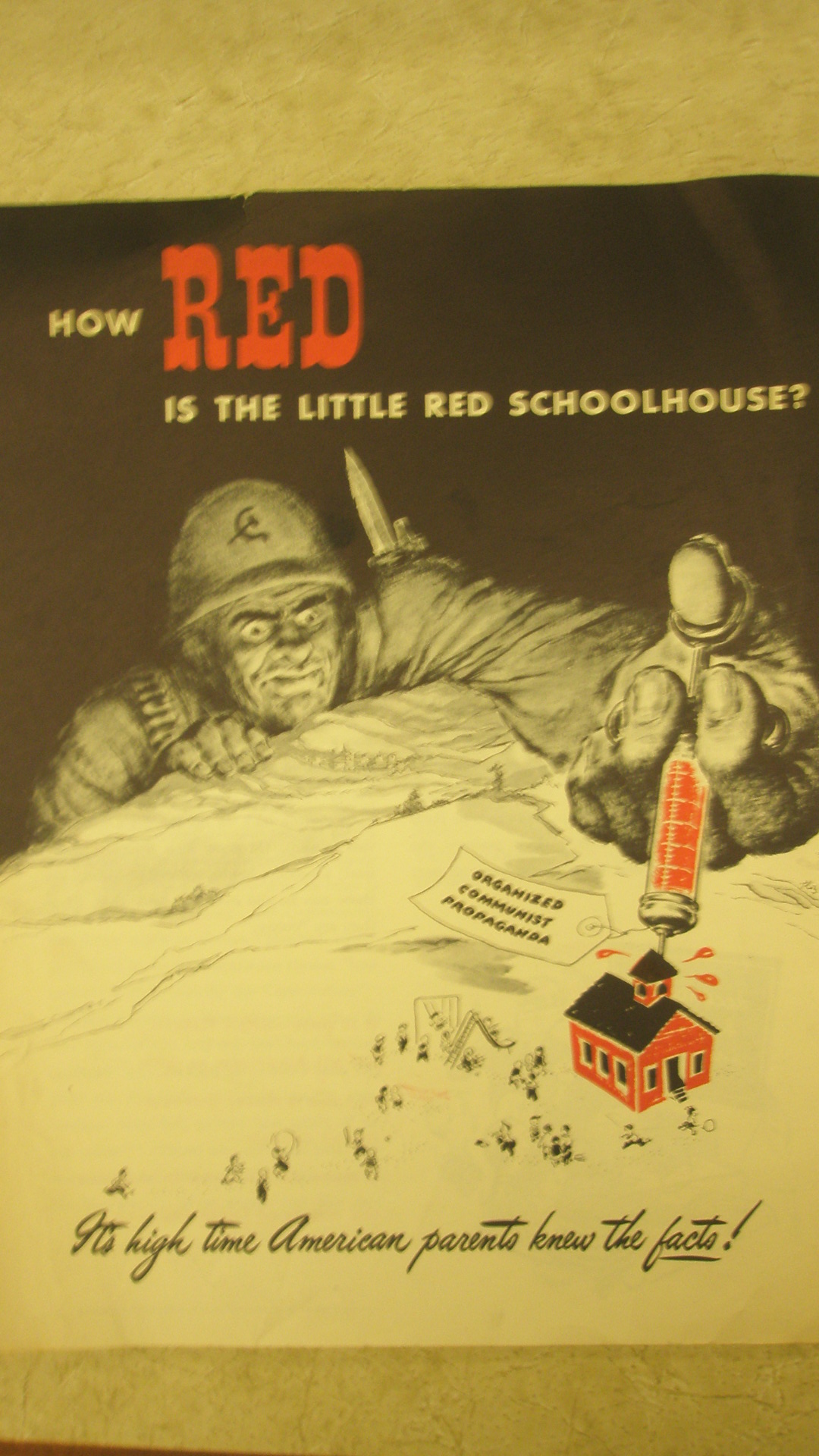
This sense that textbooks and school curricula might set out deliberately to change the morals of young people has a longer history, too.  The source of the cultural danger may have shifted, but at the start of the Cold War conservatives fretted about the threat from subversive communism in school books.  One pamphlet from 1949 Chicago asked, “How Red is the Little Red Schoolhouse?”

Cover imageA decade earlier, Harold Rugg had to defend his popular textbook series from charges of socialist, collectivist subversion.  As Rugg complained, many of his critics had never read the books themselves.  Conservatives, Rugg charged, would say, “I haven’t read the books, but—I have heard of the author, and no good about him” (Rugg, That Men May Understand, 1941, pg. 13).

Seventy-plus years later, Rugg’s books do not seem particularly subversive.  But just as CSCOPE’s critics bundle every anti-American rumor into the Texas curriculum system, so Rugg’s critics blamed him for every anti-patriotic sentiment of the day.

Most important, once school materials get a reputation for left-leaning propagandizing, whether it is Rugg’s books in 1940, or the Interaction series in Kanawha County in 1974, or the CSCOPE materials in 2013, the books seem sure to attract ferocious and effective political attack.  Sometimes, as in the newspaper ad from Marble Falls and Burnet, these attacks seem far-fetched.  But behind even such far-fetched notions lies a germ of uncomfortable truth.

Curriculum developers often DO want to introduce culturally challenging and provocative ideas into America’s schools.  Howard Rugg wanted his books to help along a sweeping “social reconstruction.”  One of the editors of the book series under consideration in Kanawha County dreamed that the controversial books might lead to “further innovations in schooling” [James Moffett, Storm in the Mountains, 1988, pg. 5].

Though CSCOPE insists it is “not designed to show favor toward any special interest group/ organization,” conservative critics can claim some justification for their worries.  For generations, curricula have been introduced to public schools that HAVE hoped to show favor to certain ideas.

CSCOPE might offer an ideologically balanced, pedagogically efficient way for Texas school districts to streamline their teaching systems.  But once it has acquired the reputation for leftist indoctrination, the writing is on the wall.

No matter how fervently the Texas Freedom Network or other supporters might protest, history has shown that in cases like this, among conservatives, school curricula are guilty until proven innocent.


The Culture War Is Over: Conservatives Lost

Gay Marriage will not wreck traditional marriage, Rod Dreher argues.  Instead, the rapid mainstreaming of gay marriage simply proves that traditional marriage was wrecked long ago.

In his recent piece in The American Conservative, Dreher channels Philip Rieff to argue that conservative Christians have already lost the culture wars.  The notion that people exist first and foremost as individuals replaced a sense of people as part of a Christian community long ago.

The current debate over gay marriage only serves as a mopping-up action by anti-Christianity.  The Christian sexual ethic, Rieff argued back in the 1960s, was not merely one rule imposed by Christianity.  Rather, the Christian sexual ethic represented the core of Christianity’s revolutionary anti-pagan cosmology.  Sex was not merely an expression of individual desire, but of God’s cosmic plan.  When Western culture abandoned that sexual ethic, Rieff argued, it offered nothing in its place.

Homosexuality and the issue of gay marriage, Dreher notes, do not change this pattern, but only complete it.  Dreher bases his case on data from Robert Putnam and David Campbell.  These political scientists noted in their 2010 book American Grace a striking demographic correlation between acceptance of homosexuality as morally neutral and a rapid decline in church membership.  When young people see homosexuality as just another way to be sexual, they do not switch to a liberal church.  Instead, they leave institutional Christianity altogether.

As Dreher argues,

Gay marriage signifies the final triumph of the Sexual Revolution and the dethroning of Christianity because it denies the core concept of Christian anthropology. In classical Christian teaching, the divinely sanctioned union of male and female is an icon of the relationship of Christ to His church and ultimately of God to His creation. This is why gay marriage negates Christian cosmology, from which we derive our modern concept of human rights and other fundamental goods of modernity. Whether we can keep them in the post-Christian epoch remains to be seen.


Who Owns the Children?

Do parents own their children?  Does the government?

A recent MSNBC promo has put this perennial conservative issue back in the headlines.  Glenn Beck, Sarah Palin, Rush Limbaugh, and others have denounced the sentiments of the ad.

Yesterday conservative pundit Glenn Beck accused liberal-leaning MSNBC of finally exposing their “radical goals” to steal children from parents.  The plan all along, Beck argues, has been for “progressives” to seize government control of the most intimate family decisions.

The specific MSNBC promo to which Beck objected contained this ideological smoking gun:

We have never invested as much in public education as we should have because we’ve always had kind of a private notion of children. Your kid is yours and totally your responsibility. We haven’t had a very collective notion of these are our children. So part of it is we have to break through our kind of private idea that kids belong to their parents or kids belong to their families and recognize that kids belong to whole communities.

This thirty-second promo by Melissa Harris-Perry contains the proof that liberals want to take children away from their parents and raise them in dysfunctional public schools.  His fears, Beck insisted, had been proven right by this “terrifying” video.  Though he recognized he might be called a “conspiracy theorist,” Beck insisted that this short video contained all the proof he needed of a vast left-wing plot to steal children into indoctrination centers.

Sarah Palin chimed in too, tweeting that MSNBC’s notion that children don’t belong to parents was “Unflippingbelievable.”

Rush Limbaugh predicted that soon children could be forced to mow everyone’s lawns, not just their own.  This notion, Limbaugh concluded, was as “old as communist genocide.”

The idea that “progressives” have set their sights on sneakily seizing control of America’s children has long ideological roots.

Back in the 1970s, for example, the influential conservative activists Mel and Norma Gabler asked fundamental questions about the nature of the textbooks under consideration in their home state of Texas:

To WHOM does the child belong?  IF students now belong to the State, these books are appropriate.  IF students still belong to parents, these books have absolutely no place in Texas schools.  The author clearly states that these books are designed to change the behavior, values, and concepts of the child, based on the premise that the teacher is NOT to instruct, but to moderate, and to ‘heal.’ [Gablers, What Are They Teaching Our Children, pg. 119]

Similarly, Connie Marshner, affiliated at the time with the Heritage Foundation, argued in 1978, “A parent’s right to decide the direction of his child’s life is a sovereign right, as long as the child is subject to his parent.  Educators have no business creating dissatisfaction with and rebellion against parental wishes” (Connie Marshner, Blackboard Tyranny, pg. 38).

But such notions go back much further in the conservative consciousness.  One leading conservative activist in 1951 Pasadena warned a state senate investigating committee that the root cause of public school problems was “a definite elimination of parental authority, undermining of parental influence.”

And back in the 1920s, the US Supreme Court ruled that parents had a right to educate their children in private schools if they chose.  The reason, the court ruled in Pierce vs. Society of Sisters (1925), is that “The child is not the mere creature of the state.”

Beck’s, Palin’s, and Limbaugh’s outrage are nothing new.  Conservative activists have long been convinced of a far-reaching plot to substitute state control of children for that of parents.


So ARE Colleges Liberal?

H/T: Andrew Hartman

Among some conservatives, it is a simple truism that American colleges have swerved dangerously to the left.  But have they?

We’ve reported lately on news from the National Association of Scholars, who reported that universities had been taken over by liberal bias.  And news from Colorado, where conservative politicians pushed a program to bring a real live conservative scholar to the Boulder campus.

Conservatives insist on it.  But do college campuses really lean left?

In a recent review for The American Prospect, Jennifer Ratner-Rosenhagen offers concrete answers from Neil Gross’s Why Are Professors Liberal and Why Do Conservatives Care? 

Turns out there are more registered Democrats among the professoriate than among the general public, 51% versus 35%.  But “liberal” doesn’t necessarily track evenly with “Democrat.”  A more interesting 8% of professors identify as “radical.”  Gross concludes that some 50-60% of professors can fairly be identified as “liberal,” compared to 17% of the general public.

Gross concludes, however, that this liberal lean does not turn American universities into doctrinaire re-education centers.  Professors tend to sort out their political from their professorial interests.  As Ratner-Rosenhagen puts it,

Why Are Professors Liberal provides evidence that college does not make students more liberal. Rather, time at the university gives students analytical and rhetorical resources to strengthen the political leanings they had when they entered. While it is true that college graduates tend to be more liberal than those their age who didn’t attend college, college-goers tend to be more liberal than their non-college-going peers. So it’s a wash.

As Ratner-Rosenhagen writes, the book offers a careful and moderate set of conclusions sure to anger both liberals and conservatives. Sounds like it is worth a read.

Illiberal Arts Colleges

What should liberal-arts colleges teach?  The conservative National Association of Scholars warns that elite schools such as Bowdoin have mutated into anti-liberal-arts indoctrination centers.  Instead of guiding students through the rigors of arts and sciences, NAS suggests, schools such as Bowdoin train students only to mouth hackneyed slogans.  Instead of guiding students through the difficult work of mastering an intellectual tradition, Bowdoin sends its professors off to conduct research and releases students to wander in an intellectual meadow.

Bowdoin is not the first college to come under criticism from NAS recently.  The conservative higher-ed association also published a study of the ways American history is taught at the University of Texas—Austin and Texas A & M University.  At those prestigious schools, NAS concluded, an ideologically slanted focus on race, class, and gender had supplanted traditional interest in diplomatic, religious, and political history.

The Texas report naturally generated some opposition.  Diplomatic historian Jeremy Suri, now of UT—Austin but formerly from my alma mater, called the NAS study “misleading, and frankly dumb.”

The kerfuffle at Bowdoin had its roots in an awkward golf game.  Thomas Klingenstein, who calls himself a “conservative” “Wall-Streeter,” described his golf game with Bowdoin President Barry Mills.  Mills had told a Bowdoin audience that they needed to address the problem of liberal bias on Bowdoin’s campus.  Too many of Bowdoin’s graduates, Mills suggested, would otherwise never be able to make sense of this “Glenn Beck, Sarah Palin moment in our history.”  Klingenstein accused Mills of understating the problem of liberal bias at Bowdoin and many other schools.

During the golf game, Mills and Klingenstein disagreed on the scope and nature of the problem.  For instance, according to Klingenstein, Mills believed former Harvard President Larry Summers got what he deserved for suggesting that women might have some sort of innate difficulty with science.  Klingenstein disagreed.  Klingenstein also disagreed with Mills’ definition of the goals of “diversity.”  While “inclusion” was a worthy goal, Klingenstein argued, “diversity” had come to include “too much celebration of racial and ethnic difference (particularly as it applies to blacks), and not enough celebration of our common American identity.”

As a result of this “civil” disagreement on the links, Klingenstein supported the NAS inquiry into Bowdoin’s ideological slant.

As Peter Wood describes in the preface, the NAS Bowdoin study had three aims:

The first is to provide an accurate, vivid, and up-to-date account of what Bowdoin attempts to teach its students.  The second is to analyze whether that teaching has been compromised by contemporary ideology. . . . Our third purpose is to look at elite higher education in America using Bowdoin as a representative example (pg. 14).

In the end, the NAS report concludes, since a 1969 decision to abandon general-education requirements, Bowdoin has decayed into a state of “internal disorder” (pg. 356).  Though the report notes that Bowdoin still offers an excellent array of courses and that a diligent student could still get a thorough education, since 1969 Bowdoin had made the all-too-common problem of making each student

the autonomous authority on the content of his education.  Having turned the student into a consumer with complete freedom of choice, it became insurmountably difficult to declare that the college itself had both the better insight and the authority to require students to meet some substantive general education requirements (pg. 356).

Compounding this problem, research needs of the faculty came to overshadow faculty teaching requirements, the NAS report concludes.

In the end, the study argues, Bowdoin gives “privileged prominence to some political ideologies and squelches opposition to those views” (358).  Instead of true diversity, Bowdoin embraced a deeply flawed interpretation of the laudable intellectual goal of “critical thinking,” according to the NAS study.  All students will be drilled in such shibboleths as “The importance of diversity, respect for ‘difference,’ sustainability, the social construction of gender, the need to obtain ‘consent,’ the common good, world citizenship, and critical thinking” (359).  But such notions, often worthy in themselves, were not part of a process of “open debate.”  Bowdoin students, instead, learn to repeat mantras and “certainties on some of the most contentious issues of our time” (359).  As a result, the NAS study warns, “When critical thinking is most necessary, it is most absent” (359).

The NAS study is titled, “What does Bowdoin teach?”  It concludes with a punchy list of things that Bowdoin does not teach:

Intellectual modesty.  Self-restraint.  Hard work.  Virtue.  Self-criticism.  Moderation.  A broad framework of intellectual history.  Survey courses.  English composition.  A course on Edmund Spenser.  A course primarily on the American Founders.  A course on the American Revolution.  The history of Western civilization from classical times to the present.  A course on the Christian philosophical tradition.  Public speaking.  Tolerance towards dissenting views.  The predicates of critical thinking.  A coherent body of knowledge.  How to distinguish importance from triviality.  Wisdom.  Culture (pg. 360).

Ouch.  Not just Bowdoin, but liberal-arts education as a whole stands accused.  We can be certain that defenders of Bowdoin’s vision of education will soon offer a rejoinder to this conservative broadside.


Gay Marriage and School Bathrooms

Will same-sex marriage turn public schools into orgies of sexual confusion?  Ken Ham of Answers in Genesis has connected the dots.

The Supreme Court is wrestling with two cases about same-sex marriage.

Conservatives have long insisted that same-sex marriage would lead to a breakdown in the value of marriage itself.  One commenter recently called same-sex marriage the threshold of an “abyss of nihilism.”

Ham’s analysis sexualizes that nihilism and brings it right into public schools.  Ham, America’s leading young-earth creationist, insists that same-sex marriage is only part of an “evolving sexual agenda.”  (Ham is a smart guy, so I am confident he chose that word—“evolving”—intentionally.)

In Ham’s recent piece, he argues that the next step after gay marriage will be a profound and aggressive attack on all traditional gender norms.  As evidence, he cites recent public-school guidelines in Massachusetts.  As we’ve noted on ILYBYGTH, these new school rules allow students to identify their own gender identity and require schools to respect those identifications.

As Ham writes, the trickiest part of this school rule has become bathrooms.  If a student was born a boy but identifies as a girl, Massachusetts schools must respect that choice. Ham worries about a boy who pretends to identify as a girl just to get access to the girls’ locker room.

Ham is not the first conservative thinker to make this connection between same-sex marriage and a sexual free-for-all in public schools.  But for those of us non-conservatives who try to understand conservatism in American education, Ham’s argument offers two important reminders.  First, schools are tied into every culture-war argument.  Though marriage laws seem relatively distant from education policy, conservative (and liberal) arguments against same-sex marriage often rely on the harmful effects gay marriage will have on children and schooling.  Second, for those outside the orbit of American creationism, Ham’s argument underscores the fact that creationism is an outgrowth of conservative Christianity, not the root.  Besides Ham’s use of the word “evolving” to damn the same-sex marriage “agenda,” this article does not talk about creationism or evolution.  Rather, Ham concludes that the main reason to oppose same-sex marriage and the abandonment of gender rules is more broadly Christian.  As Ham argues,

As Christians, we should affirm our children’s God-given genders and cultivate godly masculinity and femininity in them, rather than encouraging them to abandon the gender God gave them in the womb . . .

For Ham, as for many creationists, Christianity comes first.  Creationism is only one important element of the crusade.  Ham himself has often reminded readers of this fact.  Nevertheless, it is common for outsiders like me to pigeonhole Answers in Genesis as narrowly interested in establishing the case for a young earth.

As Ham’s recent argument proves, AiG’s sort of young-earth creationism has a much broader conservative agenda.


From the Archives: August Heckscher and Conservative Multiculturalism

Could American conservatives embrace their own, distinctly conservative vision of “multicultural” education?

Thanks to Brad Birzer at The Imaginative Conservative, we find a resurrected 1953 argument that forces us to wonder.  This essay, by historian and parks administrator August Heckscher II, insists that true conservatism must never be an “ideology,” but rather

a way of thinking and acting in the midst of a social order which is too overlaid with history and too steeped in values, too complex and diverse, to lend itself to simple reforms. It is a way of thought which not only recognizes different classes, orders, and interests in the social order but actually values these differences and is not afraid to cultivate them.

Heckscher himself could not claim conservative credentials.  He worked in the Kennedy administration and gushed at the progressivism of Woodrow Wilson.  As one conservative commentator complained about Heckscher on the American Conservative, Heckscher was merely “another liberal Democrat explaining to Conservatives politely, but firmly, the need for them to shut up and get out of the way until certain debatable ‘reforms’ are irrevocably in place.”

Yet other conservative thinkers, notably the editors at The Imaginative Conservative and The American Conservative, consider Heckscher’s 1953 polemic worth revisiting fifty years later. Today’s Burkean, traditionalist conservatives were likely attracted by Heckscher’s Burkean, traditionalist definition of true conservatism.

It seems too strange to be a coincidence that Heckscher’s essay came out in the same year as Russell Kirk’s Conservative Mind.  Kirk transformed American conservative intellectual life by promoting this sort of Burkean traditionalism.

Heckscher, like Kirk, insisted that American conservatism must be, and has always truly been, more than simply rock-throwing at government expansion.  True conservatism, Heckscher wrote, would embrace programs such as social security, if those programs were “conceived as a means of strengthening local ties, strengthening the family, and strengthening the true spirit of inde­pendence in the citizens.”

At ILYBYGTH, our attention was drawn to Heckscher’s comments about the nature of truly conservative education.  Heckscher offered a 1950s preview that sounds strangely familiar.  Since the time of Herkscher’s essay, we have become accustomed to “multicultural” ideology in education.  But we generally have not thought of this as a particularly conservative idea.  Here is Heckscher’s vision:

Education in conservatism can come, I suggest, in part from a schooling that makes men aware of the values in a community, and tolerant of their differences. It can come in part, also, from the common everyday discipline of living in an environment where multitudinous groups think in their own ways and set a varying hierarchy of values upon the goods of life. In such a community the doctrinaire approach is impossible. Rationalism cuts athwart the basic understandings which hold all together; and the search for a unique solution would drive men to distraction were it not aban­doned for a spirit of practical accommodation and acceptable com­promise. The diversity with which the citizen learns to live sanely comes by degrees to seem a virtue; and the climax of the wise man’s education is when he turns about and begins consciously to preserve and nourish the institutions in which diversity has been bred. That is the moment, too, in which he becomes a conservative.

Recognizing the value of diversity, in other words, is the sine qua non of truly conservative education.  Since the time of Heckscher’s 1953 essay, “multiculturalism” has earned a negative reputation among many conservative intellectuals.  Many conservatives might line up more happily with Arthur Schlesinger Jr.’s blistering 1990s critique of multiculturalism than with Heckscher’s 1953 endorsement.

But in the context of Heckscher’s Burkean vision, this definition of proper education needs another look.  In the twenty-first century, when we hear a call for “diversity” and a non “doctrinaire” inclusion of “multitudinous groups,” our minds jump first to the sort of “multiculturalism” heralded by scholars such as James Banks.  Banks and other education scholars argued that good education must emphasize the contributions of many different cultural groups.  At its heart, this sort of multiculturalism suggests a radical egalitarianism.  Cultures are different, but all deserve equal respect.  This approach, Banks promised, would not only be good for students of minority ethnic groups, but for all students.  A multicultural curriculum, in this vision, would help overcome America’s history of white Christian hegemony.

Read in the context of his full essay, Herkscher’s call for multicultural education looks much different.  The various voices Herkscher wants to hear are those of different “classes, orders, and interests.”  Herkscher’s conservative multiculturalism does not seek to overcome or diminish those differences between classes and orders, but rather to cherish and promote those differences.

A conservative, Heckscher seems to be saying, learns that every class, every social group, has its intrinsic value as part of a well-ordered society.  Every member of each class must learn to think of himself or herself not primarily as an individual acting in isolation, but as an individual representative of his or her social class.  Harmony comes from valuing the diverse contributions of each group, not by trying to make each group equal.

This is a profoundly different sort of multiculturalism than the explicitly racial vision promoted by later generations of multicultural educators.  The ultimate vision of a harmonious and hierarchical society differs radically from the later multiculturalists’ ultimate vision of an egalitarian utopia. Today’s “multicultural” ideologues might recoil in horror at the notion that education should teach people to see society as a hierarchical structure in which every person must find his or her proper place.

Evidence from Heckscher’s career, too, supports the notion that Heckscher’s multicultural vision differed markedly from multiculturalism’s later incarnation.  As New York City Parks Commissioner between 1967 and 1972, Heckscher applied his vision of social justice in tricky circumstances.  According to his 1997 obituary, Heckscher removed a Black Panthers flag when it had been raised instead of the Stars and Stripes.  Other officials, including the police commissioner, had refused to confront the Panthers, fearing violence.  But Heckscher simply walked alone to the flagpole, took down the flag, and presented it to the African American crowd.  He told them not to put it up again.

Conservatives today might embrace Heckscher’s personal bravery and refusal to truckle to race-based bullying.  But they might also consider the educational ramifications of Heckscher’s 1953 essay.  What would a Burkean multiculturalism look like?  Could students learn to value different groups and classes, not as a way to overcome hierarchy, but as a way to preserve it?