Obama-Core?  More like Conserva-Core!

Who’s to blame?  In this year’s ferocious presidential debates, GOP candidates are falling all over themselves to point fingers about the Common Core State Standards.  Jeb Bush, who still supports the standards, has come under withering attack from folks such as Mike Huckabee, who used to.  A new report from the liberal-leaning Brookings Institution lays out the real history of the standards.  It’s true: If we have to assign praise or blame for these standards, we should be looking to the right.

Report author David Whitman does a nice job of detailing the story back to the 1980s. Still, I can’t help but be miffed when he says that this is a “surprising” story, one that “few are familiar with, and even fewer have written about.”  Of course, as SAGLRROILYBYGTH are well aware, your humble editor has been trumpeting this history in these pages and in venues such as Time Magazine.

Conservative intellectuals, too, have done what they can to draw attention to this history.  In the pages of The Weekly Standard, for instance, free-market maven Michael Petrilli has told the story to anyone who will listen.

Such complaints aside, however, Whitman’s report is still worth reading.  He details the history of the Common Core standards themselves.  As he describes correctly, in the 1980s the drive for “high standards” was a leading conservative issue.  As Ronald Reagan’s second Secretary of Education, William J. Bennett pushed hard to make these standards a reality.

In the 1990s, Lamar Alexander continued the conservative push for more rigorous state standards.  Alexander never envisioned increasing federal control of local education.  Rather, he saw these standards as an appropriate way that the federal government could provide help to state governments as they hammered out their education policies.

Whitman also argues convincingly that conservative opposition to the standards is really about something else.  The standards themselves are fairly popular when they are not called “Common Core.”  Whitman blasts conservative politicians for using “the big lie technique” to smear the standards, to create misinformation among the public.  As Whitman cites, many Americans think the standards force children to learn about sex and evolution, when they really don’t.

Make no mistake about it: Whitman’s report is a partisan attack on conservative opposition to the Common Core.  And the SAGLRROILYBYGTH know that I generally don’t go for knee-jerk partisanship.  In this case, however, Whitman has his historical facts straight.

The Common Core was meant to be a conservative initiative.  It was meant to push schools toward more rigorous learning, away from touchy-feely progressive nostrums and toward ol-fashioned book learnin.

Whitman’s liberal glee at pointing out this irony is overdone at times, but his argument is still solid.  The Common Core represents an historic win for educational conservatives.  Why won’t they admit it?  Why do conservatives love to lose when it comes to education policy?
Why Don’t Conservatives Like to Win?

You’ve heard the news by now: The College Board revised its framework for the Advanced Placement US History course.  Recently in the pages of the Wall Street Journal, Daniel Henninger crowed that this reversal proved that conservatives could influence national education policy.  Unfortunately, Henninger makes the same mistake as every other pundit out there.  He seems to think that conservatives at some point in the past lost their influence over national education policy.  It just ain’t so.

Franklin's In, "neo-Marxism's" out.

Franklin’s in, “neo-Marxism’s” out.

For those of you who were napping, a quick reminder: Under pressure—significant pressure—from conservative thinkers and lawmakers, the College Board agreed to revise these standards for its AP US History course.  Conservative thinkers had complained that the old framework put too much emphasis on

such abstractions as ‘identity,’ ‘peopling,’ ‘work, exchange, and technology,’ and ‘human geography’ while downplaying essential subjects, such as the sources, meaning, and development of America’s ideas and political institutions. . .

Henninger argues that, with the conservative revision, the new framework is “about as balanced as one could hope for.”  More interesting for our purposes, he argues that this conservative victory is “an important political event.”  He thinks it “marks an important turn in the American culture wars. . . .”  To Henninger, this conservative victory is a new thing, a change in the ways American culture and politics work.  Until now, Henninger intones, conservative ideas about proper education were

being rolled completely off the table by institutions—‘Washington,’ the courts, a College Board—over which [conservatives] had no apparent control.

Until now, Henninger tells us, conservatives had not been able to influence national education policy.  Only “neo-Marxist” experts decided on what vulnerable young minds would learn.

Balderdash.

Perhaps Henninger’s problem is his limited range.  To be fair, he only says that this has been the case since 1992.  As SAGLRROILYBYGTH are well aware, America’s educational culture wars have a vital history that stretches back across the twentieth century.  Henninger ignores it at his peril.

As I argue and detail in my recent book, since the 1920s conservative activists have been able, time and time again, to derail, defang, and water down progressive curricula and textbooks.

But here’s the real kicker: We can’t really single out Henninger for short-sightedness.  For almost a century now, both progressive and conservative intellectuals and activists have assumed that conservatives had been kicked out of the conversation.

You read that right.  Ever since the 1920s, conservative and progressive reformers alike have committed the same sort of Henningerism.  They have assumed in the face of historical fact that “The Schools” had been taken over by progressive ideas and curricula.

To cite just one example of this trend, consider the case of progressive textbook impresario Harold Rugg.  Rugg was a progressive’s progressive, committed to pushing the nation in leftist directions by seizing control of its public schools.

In the 1930s, it looked as if he had succeeded.  Millions of schoolchildren read his tendentious textbooks.  At the end of the decade, however, conservative activists in the American Legion and elsewhere organized to block such progressive “subversion.”

They succeeded.  Just like today’s College Board, school administrators and textbook publishers in the 1930s fled in horror from the potential controversy over Rugg’s books.  Sales plummeted.  Schools hid them away.  School boards thought about burning them.

Seems like any right-thinking observer would conclude that conservative activists could exert significant control over the national curriculum, right?

In fact, Rugg himself concluded that the progressives had won, that a shiny progressive victory was just around the next corner.  As he wrote in his 1941 memoir, progressive schooling

has already begun to shake the old and inadequate out of our educational system and to lead to the building of a new school to implement democracy.  Nothing save a major cultural catastrophe can now stop its progressive advance. It was utterly inevitable that workers in education would find the vast library of documented data produced on the other frontiers and use it in the systematic reconstruction of the schools.

You might think that conservative activists would dispute Rugg’s rosy left-wing prediction.  But they didn’t.  Instead, conservatives at the time performed their own odd Henningerisms.  One of the leaders of the anti-Rugg fight, Alfred Falk of the Advertising Federation of America, warned a friend that left-wing educational thinking had taken over schools years before, all part of a “deliberate plan worked up by a well-defined group of left-wingers and educators, collaborating for a number of years on this huge project of reconstructing our society.”

We could multiply these examples of Henningerism endlessly.  Time and time again, long before 1992, conservatives have concluded incorrectly that they had been kicked out of the schools.  And progressives gleefully agreed.

It brings us to our interesting question: Why do conservatives and progressives agree—in the face of vast reams of historical evidence to the contrary—that conservatives are have been locked out of national education policy-making?

Why The Donald?

There’s not much that conservative and progressive intellectuals can agree on. But one thing unites thinkers across the culture-war divide these days: Why do so many people like Donald Trump? Fred Barnes at the conservative Weekly Standard visited a focus group of Trump fans to find out. Maybe the answer lies deep in the heart of American culture and history.

What's to like?

What’s to like?

For those of you who are just emerging from under your summer rocks, Trump has grabbed everyone’s attention with his successes in recent presidential polls. He has uttered outlandish statements, calling Mexicans rapists, implying that women reporters can’t handle the job, and ridiculing John McCain’s war record.

Conservative pundits have scrambled to distance themselves—and conservatism itself—from Trump’s brand of schlock.  Erick Erickson disinvited The Donald from a GOP debate.  George Will has denounced “[e]very sulfurous belch from the molten interior of the volcanic Trump phenomenon.”  Crunchy conservative Rod Dreher has scratched his head in bemusement as he’s watched the emergence of “Trumpenstein Monster.”  As Barnes asks, what is it about Trump that attracts people?

The twenty-nine assembled fans like more than Trump’s policies. They like Trump. As Barnes puts it,

Their tie to him is almost mystical. He’s a kind of political savior, someone who says what they think.

Will such Trumpies stick with the Donald all the way? Of the assembled group, most said they’d stick with Trump if he ran for president as head of a third party. They viewed Trump as a non-politician, someone who tells it like it is regardless of the consequences.

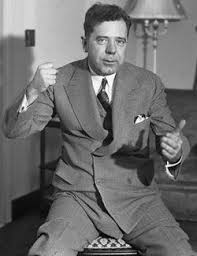
Maybe it isn’t so difficult to understand Trump’s attraction. People on both sides of the political spectrum have always rooted for brash, in-your-face candidates. Those who know their history can’t help but think of Huey Long, the governor, senator, and sometime presidential candidate from Louisiana. Long’s antics put The Donald’s to shame. Has Trump ever gotten beat-up in the bathroom of a bar for attempting to urinate between the legs of another gentleman? Has Trump ever greeted a foreign ambassador wearing nothing but silk pajamas?

Trumping Trump

Trumping Trump

The more outlandish the behavior, the more people like it. The more offensive the ideas, the more people respect them.

Does Trump stand a chance at becoming president? I’ll say it: No. This sort of behavior plays well in primaries, but in the end, Americans still prefer boring presidents.

Us & Them Visits the Gablers

Who’s in charge of American public education? Some folks say that “progressive” ideas took over education back in the 1930s. John Dewey and his ilk, these folks insist, turned American education in progressive directions. But what about all the ferocious and successful conservative input into what schools teach? In the latest episode of Trey Kay’s Us & Them, Trey looks at the influence of Mel and Norma Gabler since the 1960s.

What Norma says goes...

What Norma says goes…

Trey only has a half-hour to work with, so he couldn’t include the longer historical context. For those in the know, however, Texas’s culture-war battles over textbooks and curriculum go back far longer than the 1960s, and they have changed in bigger ways than he has time to delve into.

Nevertheless, everyone interested in culture wars and education should spend a half-hour with the new Us & Them episode. Trey talks with former Texas board of ed chairman Don McLeroy, as well as with liberal critic Kathy Miller.

Throughout the 1990s and early 2000s, Texas’s fights over textbooks attracted attention nationwide. Conservatives pushed for more traditional visions of American greatness. Liberals fumed that Texas’s culture-war politics doomed schoolchildren to a skewed vision of the past. (For the best introduction to those fights, be sure to check out Scott Thurman’s documentary The Revisionaries.)

Before those recent battles, however, Mel and Norma Gabler made themselves famous as mom-and-pop culture-war heroes. Beginning in the 1960s, the Gablers insisted on their rights to speak at the hearings of the Texas State Board of Education. They compiled damning lists of factual errors in adopted textbooks. More important, they insisted on revisions to make textbooks more traditional, more religious, and more patriotic.

As you might expect, the Gablers play a leading role in my recent book about conservative educational activism. Long before they waged their gadfly campaign, however, similar culture-war fights roiled educational politics in Texas and elsewhere. Going back to the 1920s, Texas demanded and received special editions of its textbooks. The board demanded the excision of evolution and anti-Southern history. The board only adopted what one publisher in 1926 called “tactfully written” books that did not mess with Texas.

Indeed, when the Gablers became involved, they looked to several existing organizations for guidance and inspiration. As I recount in my book, the first group they looked to was the Texas chapter of the Daughters of the American Revolution. Since the 1920s, the DAR had played a leading role in textbook publishing and culture-war monitoring. In 1951, for example, the Texas DAR mobilized its thousands of members to make sure that schools and textbooks “taught the principles embraced by our forefathers.” That year, the Texas DAR claimed to have sent 1,695 of its members to observe history classrooms across the state.

If we hope to understand culture-war politics, in Texas and elsewhere, we need to be aware of this longer history. We also need to understand the ways 21st-century ed politics have changed. Throughout the twentieth century, conservative activists like the Gablers envisioned themselves as outsiders, charging hard to block the work of a progressive educational establishment. Like the Gablers and the DAR, conservative groups such as the American Legion successfully blocked textbooks they didn’t like.

By the 21st century, however, things had changed. Some conservative intellectuals have argued that dominant efforts in recent education policy, such as the Common Core standards and the No Child Left Behind Act, were actually inspired by conservative ideas and intellectuals. As Michael Petrilli and Frederick Hess of the American Enterprise Institute claimed about NCLB, that law “sketched a vision of reform informed by conservative intuitions and insights.”

Instead of the Gabler-style outsider approach, conservatives these days can claim to have taken over key parts of the educational establishment.

No one can gainsay the enormous influence of the Gablers on educational culture wars in the twentieth century. Everyone who is interested will benefit from listening to the Us & Them episode. Just remember to keep it in historical context!

Today! GOP Candidates Talk Education

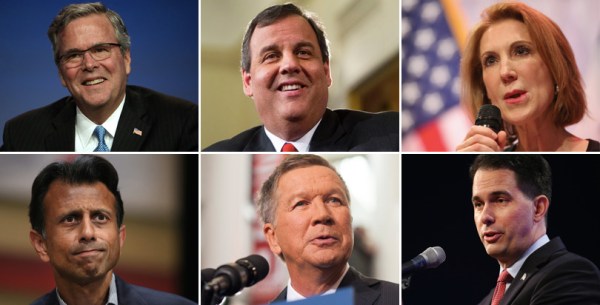
What does it mean to be conservative about education? What ed policy will get voters excited? Today at 8:50 (Eastern Time, USA), you can watch live as a handful of Republican presidential candidates talk education.

The discussion will be hosted by The Seventy-Four. It will include Jeb Bush, Chris Christie, Carly Fiorina, Bobby Jindal, John Kasich, and Scott Walker.

Who is the conservative choice?

Who is the conservative choice?

As Carolyn Phenicie points out, these six candidates have very different interpretations of good ed policy. Jeb Bush supports the Common Core standards; Bobby Jindal has sued the federal government over them. There are some common themes that unite them. All of the candidates, for example, support greater privatization of public schooling. All of them would like to water down the power of teachers’ unions.

As I argued in my recent book, it has never been simple to define what it has meant to be “conservative” about education. It has never been easy for conservative politicians to figure out how to mobilize voters about schools. (If you don’t have time for the whole book, you can get a taste of the argument in this Time op-ed.)

In the early twentieth century, for example, most self-styled conservatives had absolutely no problem with an increased federal role in education. Back then, conservatives hoped the federal government could use its influence to make public schools more traditional, more Protestant.

What points will this year’s candidates make? They will likely emphasize their loathing for federal dictation of local school policy. They will likely point to their credentials as education leaders. Yet none of them will be likely to argue that as president they will not implement any education policy. None of them will make the point that federal officials should not have education policies.

As it has been for the last fifty years, conservative politicians these days are in the tricky position of insisting on a leadership position in education, even though they also insist that education should be in the hands of state and local officials.

Conservatives Win US History Fight . . . Again

Why is this so hard to get through our thick skulls? American schooling is not in the hands of progressive teachers and ed-school professors like me. It just isn’t. If we needed any more proof of it, take a look at the College Board’s decision to change its framework for the Advanced Placement US History course. As has always been the case, conservative complaints this time around have been about the implications and tone of classroom materials. My hunch is that many people wouldn’t see what the big deal was about.

Throughout the twentieth century, as I argued in my last book, American conservatives battled—and won—time and time again to control textbooks. Any whiff of progressive ideas was snuffed out before it could become the norm in American classrooms.

A set of progressive social-studies textbooks in the 1930s quickly became libri non grata after conservatives mobilized against it. In the 1970s, another set of progressive textbooks sparked a school boycott in West Virginia that caused a future secretary of education to speak out against progressive-type textbooks.

Now, according to an article in the Washington Post, the College Board has revised its framework for its AP US History class after ferocious conservative complaint. As we’ve discussed in these pages, conservative intellectuals and activists pushed hard to win this prize.

But here’s the kicker: I bet most casual readers of the new framework wouldn’t notice the differences. Now as in the past, the arguments are generally about tone and implication, rather than large-scale differences in content.

In the 1930s, conservative critics of Harold Rugg’s progressive textbooks admitted that most readers probably wouldn’t see the problem. Leading conservative critic Bertie Forbes called the Rugg books “subtly written” so that only an expert could notice the anti-American “insidious implication.” Another anti-Rugg leader warned that Rugg’s books were “very subtle,” not obviously anti-American, but packed with “weasel words” meant to subvert American values.

During the 1970s fight over textbooks, conservatives similarly admitted that a regular patriotic American reader might not see the problem at first glance. But as one conservative leader told an interviewer, the books were all bad, since they had been written with “the attitudes of evolution and all that.” Another conservative admitted that he did not even feel a need to read the actual textbooks. “You don’t have to read the textbooks,” he wrote.

If you’ve read anything that the radicals have been putting out in the last few years, that was what was in the textbooks.

Every time, conservatives have warned, it takes an expert eye to detect the problem with sneaky progressive textbooks.

This time around, too, conservative intellectuals protested against the tone and implication of the new history framework. As a group of leading thinkers wrote in their June protest letter, the rejected history framework

Is organized around such abstractions as “identity,” “peopling,” “work, exchange, and technology,” and “human geography” while downplaying essential subjects, such as the sources, meaning, and development of America’s ideals and political institutions, notably the Constitution. Elections, wars, diplomacy, inventions, discoveries—all these formerly central subjects tend to dissolve into the vagaries of identity-group conflict. The new framework scrubs away all traces of what used to be the chief glory of historical writing—vivid and compelling narrative—and reduces history to a bloodless interplay of abstract and impersonal forces. Gone is the idea that history should provide a fund of compelling stories about exemplary people and events. No longer will students hear about America as a dynamic and exemplary nation, flawed in many respects, but whose citizens have striven through the years toward the more perfect realization of its professed ideals. The new version of the test will effectively marginalize important ways of teaching about the American past, and force American high schools to teach U.S. history from a perspective that self-consciously seeks to de-center American history and subordinate it to a global and heavily social-scientific perspective.

The problem is not that the un-revised new framework didn’t teach US History. The problem, according to conservative thinkers, is that it taught history with a certain attitude, a certain approach.

Is the new framework more conservative? Leading intellectuals seem to think so.

Take the ILYBYGTH challenge: Read the revised framework for yourself. Does it seem “conservative” to you? Where? How? Can you find the differences in tone and approach that conservatives demanded?

How NOT to Get a Conservative in the White House

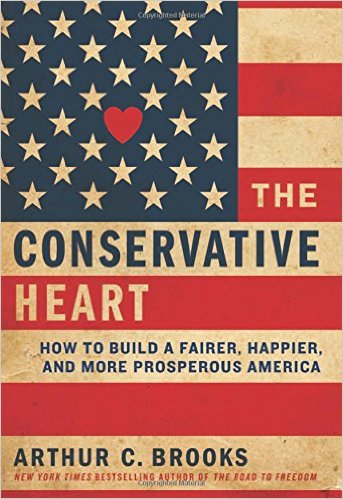
Do conservative politicians need to have more heart? Do they just need to find snappy, appealing slogans to describe their existing economic policies? That’s the argument, apparently, in Arthur C. Brooks’ new book, The Conservative Heart. I’m no conservative myself, so I hope conservatives listen to Brooks. Because his argument just doesn’t match reality.

SAGLRROILYBYGTH will not be surprised to hear that I don’t really know what I’m talking about. I haven’t read Brooks’ new book. Based on the recent review by N. Gregory Mankiw in the New York Times, though, I feel justified in saying nertz to Brooks’ diagnosis.

Heart attack...

Heart attack…

Both Brooks and Mankiw hail from the free-market-conservative American Enterprise Institute. According to Mankiw, Brooks thinks that conservatives do not have a problem with policy. Rather, they have a problem with publicity.

As Mankiew recounts, President Obama is able to rally support for a minimum-wage hike by saying simply, “It’s time to give America a raise.”

Free-market conservatives, on the other hand, mumble through a complicated but correct four-point rebuttal. By the end, Brooks thinks, Americans just aren’t listening.

This Casssandresque portrait of market conservatives might be flattering to conservatives, but it just doesn’t match political reality. It’s not that overly nerdy conservatives lose their audiences mid-way. Rather, the public never even starts listening.

The problem for conservatives is not that they have too much Spock and not enough Kirk. Conservatives’ main problem has not been their overly logical public image. Rather, conservatives have struggled and failed to portray themselves as something different from their elitist, racist twentieth-century roots.

They need to do more to overcome their twentieth-century history. There are plenty of non-white conservatives out there, but they tend to think that voting for the GOP will be a betrayal. With good reason: This year, GOP presidential candidate Donald Trump insults Mexicans and Mexican-Americans. Last year, ham-handed GOP leaders denounced a voter-registration drive in Ferguson, Missouri.

It is not only these recent events that work against conservatism. Conservatism in the United States has always been perceived (with plenty of justification) as a movement of elite white racists. As I argued in my recent book about twentieth-century conservatism, by the end of the century conservative activists tried to refute their reputation for racism. It didn’t work.

When conservative leaders denied their racism, non-white voters did not believe them. In 1974-75, for example, most of the leaders of the conservative school boycott movement in Kanawha County, West Virginia adamantly denied that they were racist. Folks such as Avis Hill pointed out that he went to church with lots of African Americans. Conservative teachers such as Karl Priest pointed out that he coached a mixed-race basketball team.

Nevertheless, local African American leaders were not impressed. The Reverend Ronald English, for example, conceded that most of his African American friends and congregants were just as conservative as the book protesters. But because of the legacy of conservative activism; because of the presence of a weak and wilted Ku Klux Klan in support of the boycott; because many of the authors of the “offensive” books were African Americans, very few African Americans supported the conservative boycotters.

This legacy continues. In spite of Mr. Brooks’ recommendations, non-white voters—even staunchly conservative ones—will hate to vote for the party of white racism, even if those GOP leaders speak from the heart.

What should conservatives do?

They need to do more than simply insist that they are no longer racist. This will involve promoting non-white leaders such as Bobby Jindal, Nikki Haley, and Ben Carson. This will involve policing their own ranks to prevent any winking at old-fashioned white racism. This will involve highlighting cross-racial areas of conservative agreement on cultural issues such as abortion, same-sex marriage, and creationism.

Can it work? It can and has. When President Reagan appealed to working-class ethnic whites, he swept into the White House with the support of such “Reagan Democrats.” The next big conservative winner will do something similar. He (or she) will undercut the traditional lock between non-white voters and the Democratic Party. He or she will speak from the heart, for sure, but that heart will have to prove somehow that it has had an authentic conversion. Otherwise, voters just won’t listen.

Pro-Life: From Liberal Catholics to Conservative Protestants

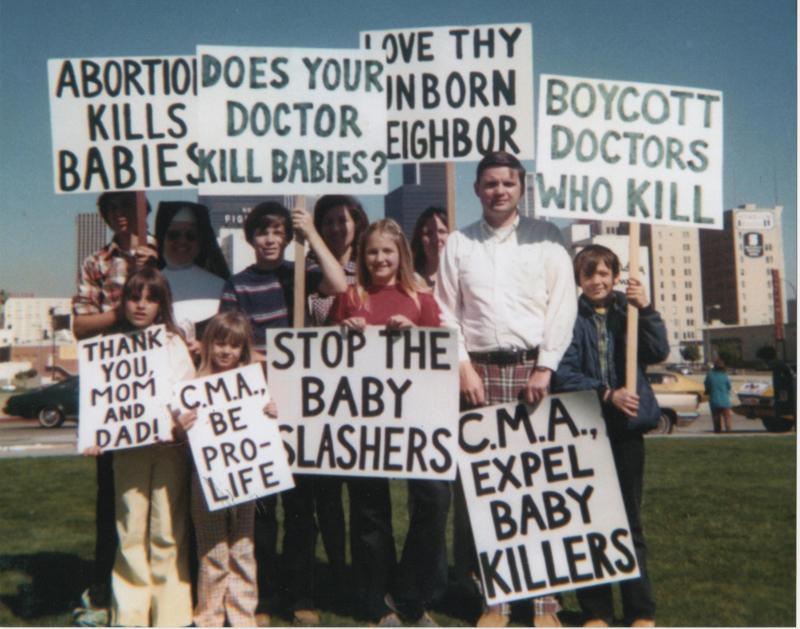
Who are the folks who stand outside of family-planning clinics these days, warning young women that some planning services are nothing but the cruelest form of murder? As historian Daniel Williams argues in a recent article in the journal Religions, the “pro-life” movement shifted from its early roots as a socially liberal Catholic cause to a politically conservative Protestant one.

Is this kind of thing inherently "conservative?"

Is this kind of thing inherently “conservative?”

For those of us interested in the historical development of America’s culture wars, Williams’s article is a must-read. As he explains, in 1972 the first generation of pro-lifers pulled from the civil-rights and anti-war wing of liberalism. At the time, Williams argues, “it seemed unthinkable that anyone would equate the pro-life cause with political conservatism.”

What happened?

As anyone with a pulse is well aware, these days the pro-life movement is firmly in the hands of culturally and politically conservative evangelicals.

Williams argues that pro-life Catholicism had its roots in the 1930s. Back then, Catholic intellectuals and activists often tied their theological arguments against abortion to the dominant New Deal liberalism of Franklin Delano Roosevelt.

After Vatican II’s liberalizing reforms in the early 1960s, liberal Catholics forged even tighter bonds between liberal Catholicism and secular Great-Society anti-poverty programs. As Williams recounts, anti-racist liberals tied new abortion laws to genocide against African Americans.

Around the time of the landmark Roe v. Wade decision in 1973, liberals began shifting their thinking. Instead of an issue of the rights of an oppressed and voiceless minority, abortion became a question of women’s rights.

On the conservative side, anti-abortion activism lost its connection to anti-war and anti-poverty campaigns. It lost its overwhelming connection to liberal Catholicism. Instead, it became wrapped in the Protestant-dominated language of “family values,” Williams writes.

For many of us who follow culture-war politics, it can come as a shock to read Williams’s re-creation of recent evangelical history. Even up to and during the early 1970s, many conservative evangelical organizations and intellectuals did not take a recognizably pro-life position.

Everyone interested in the full story should check out Williams’s article as well as his other work. It serves as a reminder that the seemingly hard-and-fast positions of our culture-war trenches have actually shifted dramatically over the years.

And for many of us, it prompts important questions:

  • Does pro-life seem inherently “conservative?”
    • Why?
  • Do some SAGLRROILYBYGTH who consider themselves “liberal” also consider themselves “pro-life?”
    • Why?
  • If you are “pro-life” and conservative, do you think the two go together?
  • Would it be possible these days to be a real pro-life liberal?
  • Is there something different about Catholic pro-lifers vs. Protestant ones?

Teaching Kids about Rape

How can we lessen the horrible frequency of sexual assault in colleges? The New York Times wants us to start in middle school. Their proposal suffers from a terrible case of Manhattan-itis.

NYT editors pointed to studies from Illinois and New York that seem to bolster their case. When kids learn to communicate their feelings, when they learn explicitly about safe places and violence, the amount of “sexual harassment” and “inappropriate touching” drops.

Manhattan, Kansas

Manhattan, Kansas

It makes sense to me personally. As a teacher and a parent, I’ve seen the positive results when young people learn to speak openly and frankly about all aspects of sex.

But as a historian, this proposal seems to willfully ignore reality. The NYT editors note that “some parents may object to their children learning about sexuality in middle school and even before.” Yet they seem not to worry about such predictable objections. If such programs succeed in the Netherlands, the editors assert, they can work here.

As I argued in my recent book, folks like these NYT editors (and me) have always woefully misunderstood the true political and cultural equations of schooling in the US of A. Things that may seem possible in a clinical trial are just not possible on a wider scale.

Consider just a few examples from recent history. In March, for instance, Kansas considered a law that would open teachers to prosecution for teaching children about sex—even from an approved sex-ed curriculum. That’s right: Teachers who taught explicit sexual terms could be prosecuted as sexual predators if they taught their classes as those classes were designed to be taught.

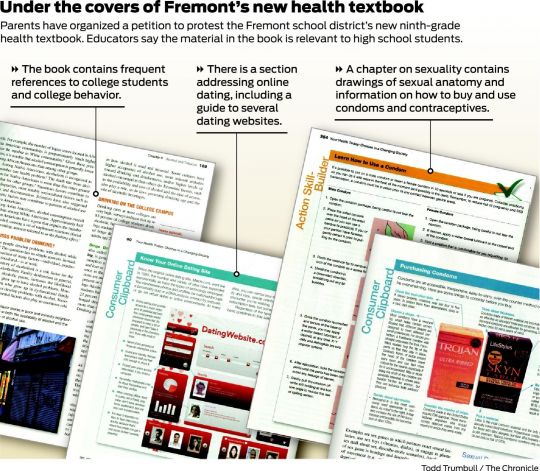
This is not just another case of something being the matter with Kansas. Last summer, parents in the San Francisco Bay Area protested about a sex-ed textbook that taught their middle-schoolers about sex. The problem was not that the textbook was not accurate. The problem was not that the material might not help students get a fuller and better understanding of sexuality.

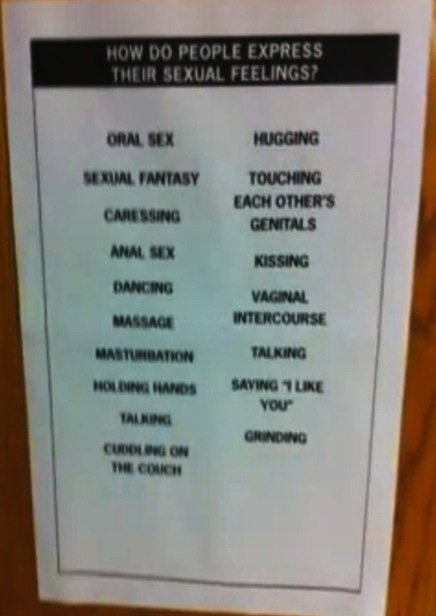
The problem, rather, was more fundamental. Parents in these United States do not want their children to learn about sex in an explicit way. They do not want their children to know about rape, sexual assault, and other things.

And this is the problem with the New York Times editorial. The central question is not whether or not such programs are effective. The central question is not whether or not such programs work in the Netherlands. Rather, the most important question—and one that the New York Times sidesteps—is how to implement such programs in the face of the predictable and powerful opposition they are sure to elicit.

Too titillating?

Too titillating?

We have a difficult time understanding a seeming paradox: Americans want their schools to do more than teach kids things that are true. In many subjects, Americans insist that their schools help keep children ignorant. Or perhaps a better term is innocent. Sex, evolution, lynching . . . there are a host of truths that public schools are meant to un-teach. Not only can schools not do a good job teaching these things frankly and fairly, but in practice—considering the political realities—many schools are expected to do a good job of keeping children ignorant of such things.

Rule of thumb: schools won’t do anything you wouldn’t feel comfortable doing in a formal toast at a church wedding. Is it possible to use such a platform to speak frankly about sexual assault? Yes, and in some schools (and some weddings) it is done. But by and large such tactics are not considered acceptable by Americans. Teaching a child to say “vagina” and “penis” is difficult enough. Any hope to convince parents of the need to teach kids to say “rape” and “sexual assault” must be far more fraught with difficulty than the New York Times admits.

Gay Marriage and Christian Resistance

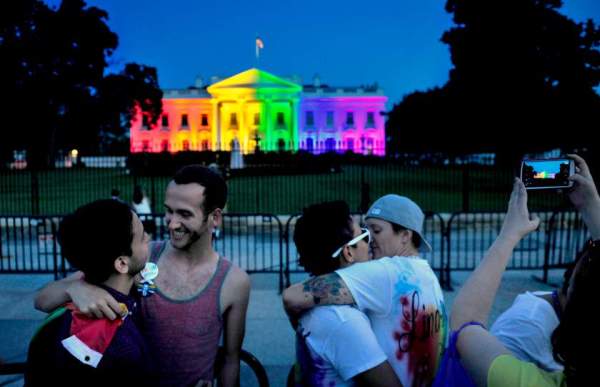
What is a conservative Christian to do? The US Supreme Court’s decision in favor of gay marriage has sent shock waves across America. Will conservative Christians accept this decision? Or, as some have warned, does this move our culture war over sexuality one step closer to real war?

More rainbows than a box of Lucky Charms...

More rainbows than a box of Lucky Charms…

Of particular interest at ILYBYGTH these days, the new ruling will likely meet its first test at conservative religious colleges. As we’ve noted (and as the New York Times eventually noticed) the SCOTUS ruling has brought up questions about the limits of acceptable dissent in higher ed. Can schools discriminate against homosexual “practice?” As I’m writing about in my current book, the same tension played out in the 1970s, when Bob Jones University insisted on its religious right to racial discrimination. It seems colleges will be the first institutions to feel pressure to accommodate demands to end institutional discrimination against homosexuals.

The reaction to the SCOTUS decision has been fast and furious among conservative evangelicals and other Christians. Rick Scarborough of Vision America told the New York Times that the decision must be resisted. “If they change the playing field and make what we do out of bounds,” Scarborough said,

we will disobey; we will disrespect this decision. . . . We’ll treat it like Dred Scott and other decisions courts have handed down over the years that counter natural law. God made a male and a female, and no amount of surgery is going to change that.

Similarly, Robert Jeffress told the Christian Post that the decision proves America’s persecution of Christians. As the Rev. Jeffress put it,

I think today’s decision is just one more step in the marginalization of conservative Christians. I made this argument and have been ridiculed for doing so, but I think it is very legitimate. The Nazis did not take the Jews to the crematoriums immediately. . . . The German people would not have put up with that. Instead, the Nazis begin to marginalize the Jewish people, make them objects of contempt and ridicule. Once they changed the public opinion about the Jewish people, then they engaged the [Holocaust]. . . . Once secularists have made Christians objects of contempt, I think it will be very easy to revoke other rights that they have as American citizens.

And in the pages of World Magazine, Ryan Shinkel advocated Christian resistance to an overweening state and society. “The movement for marital restoration is beginning,” Shinkel wrote just before the SCOTUS decision,

and the chance for moral courage and a life daring to be countercultural is at hand. By continuing to speak up for religious freedom, the restoration of a marriage culture, and dignity of the family in the face of potential setbacks at the Supreme Court, we can become the Nietzscheans who hammer the libertine and atomistic idols of our age.

Secular folks like me, progressive people who celebrate the SCOTUS decision, might blanch at these dire warnings. Some of my friends and colleagues might take these statements as proof that conservative Christians will never admit to marriage equality. But folks like us need to listen also to the other voices of conservative Christians.

In the Washington Post, for example, Russell Moore of the Southern Baptist Convention suggests Christians calm down. It is a terrible ruling, Moore agrees. And it does indeed push conservative evangelicals into a dissenting position that might seem “freakish” these days. But so what? Moore wants conservatives to “embrace a freakishness that saves.”

Similarly, Mark Galli of Christianity Today worries that evangelicals will react badly. “The temptation,” he writes,

is to go off and sulk in our holy corner. Or to dig in our heels and fight harder. Or to lash out in anger. Or to despair. We can do better.

The goal for Christians, Galli writes, is to take confidence that they are on the right side, God’s side. This decision provides another healthy—if intensely uncomfortable—opportunity for Christians to re-engage with important questions above love, marriage, and the proper relationship between Church and society. Though some conservatives might offer extreme rhetoric, Galli warns, evangelicals in America “are far from living at the margins.”

If we are to make sense of the culture-war rhetoric surrounding this SCOTUS decision, we need at least to remember some historical precedent. As I’ve argued elsewhere, for generations evangelical Christians have been battered by landmark SCOTUS decisions that seem to kick them out of public life. In every case, evangelical pundits have insisted that each new SCOTUS decision changed America from a Christian nation to a persecuting Babylon. In every case, however, evangelicals have continued to wield enormous cultural and political power.

Will this decision be any different? Will this decision really change the balance of power in America’s continuing culture-war debates?