What Is the REAL Deal with Fundamentalists and the Big Eclipse?

As Bart Simpson put it best, “The ironing is delicious.” Secular folks like me blast kooky fundamentalists for their wacky ignorance of science, while we ourselves show a curiously stubborn ignorance about what fundamentalists really believe. Tomorrow’s big eclipse gives us another example of the way most outsiders don’t understand conservative evangelical culture.

What are fundamentalists thinking about tomorrow’s eclipse? It might be tempting to agree with the right-wing watchers at Americans United for Separation of Church and State. The AU folks stumbled across a blog post from Billy Graham’s daughter Anne Graham Lotz. Lotz worried that the eclipse is meant as a warning of God’s impending judgment on the USA. Foolish Americans, Lotz warned, are blithely

preparing to mark this significant event with viewing parties at exclusive prime sites. The celebratory nature regarding the eclipse brings to my mind the Babylonian King Belshazzar who threw a drunken feast the night the Medes and Persians crept under the city gate.  While Belshazzar and his friends partied, they were oblivious to the impending danger.  Belshazzar wound up dead the next day, and the Babylonian empire was destroyed.

At Americans United, Rob Boston warned that this sort of blather proved the sad truth about “fundamentalist Christians these days.” Folks like Lotz, Boston wrote, wallow in their

utter repudiation of science. It’s not that they can’t understand it – they choose not to try. Furthermore, they often heap disdain upon it.

Now, I’m no fundamentalist and I’m not worried that the eclipse is a fulfillment of Joel 2:31 or Ezekiel 33:1-6. In fact, I don’t really care what the Bible says about eclipses or anything else. But as I work on my new book about American creationism and my soon-to-be-released book about the history of evangelical higher ed, I can’t help but protest that Boston’s viewpoint is astoundingly ironic. Secular anti-fundamentalists like Boston (and me) need to do more to understand the real relationship between conservative evangelical religion and mainstream science. Too often, it’s not that we can’t understand it, it’s that we choose not to try. And then we often heap disdain upon it.

…oh, the ironing!

In fact, even the most conservative radical creationist institutions in these United States are acting remarkably similar to mainstream institutions in their embrace of tomorrow’s eclipse as a way to bring science to the masses. To be sure, it’s a very different sort of science, what ILYBYGTH calls “zombie science,” but it is nearly the opposite of an “utter repudiation” of science. Radical creationists LOVE science; they engage in endless missionary outreach to bring their vision of real Biblical science to the benighted secular and moderate-evangelical multitudes.

At Answers In Genesis, for example, radical creationist missionaries are falling all over themselves to help curious people view the eclipse and draw the correct scientific lessons from it.

At fundamentalist Bob Jones University in Greenville, South Carolina, administrators are pulling out all the stops to use the eclipse to spread the word. Located right in the path of totality, BJU is hosting a huge party, with speakers explaining the proper way to understand the relationship between the Bible and science.

bju eclipse

Belshazzar at BJU?

Bryan College, too, another creationist stalwart, is throwing a viewing party on campus, with faculty experts offering lectures on the proper fundamentalist way to understand eclipses.

Are these radical-creationist institutions saying the same thing as secular institutions about the eclipse? Of course not. No secular scientific experts care much about the Bible’s explanation of eclipses. But just as secular scientific organizations are using eclipse mania to attract attention to their programs, so too are these creationist groups crowing about their scientific expertise and their many scientific resources.

So, even though some conservative evangelicals are warning people away from viewing parties and eclipse-related hubbubbery, many more are using the eclipse as a way to explain their vision of the proper relationship between God and science.

The Dog That Didn’t Bark

Heading for the beach? Be sure to take along some classic beach reading: Chapter Three of our Teaching Evolution in a Creation Nation!NCSE TECN excerpt

The National Center for Science Education has posted an excerpt from our book on its website. I hope this brings in some new readers.

Now all you cheapskates out there can get a taste of our book without plunking down twenty bucks to read the whole thing.

In this chapter, I make my case that the crucial period in our twentieth-century battles over creationism and evolution education was not the 1920s with its Scopes Trial, or the 1960s with its flood of young-earth creationist activism. Rather, if we really want to understand the creation/evolution debate, we have to understand what happened on both sides between 1930 and 1960, when the battle moved out of the headlines.

At least, that’s the argument I try to make in this chapter. It’s no surprise to SAGLRROILYBYGTH, but I firmly believe that both sides in our current creation/evolution debate will benefit from understanding a little bit more about each other and about the history of their disagreement. And now, thanks to the National Center for Science Education, maybe a few more science geeks and teachers will check out our book.

Created in Nothing Flat

Okay, I’ll bite: What is the difference? News from Denver brings us back to an old chestnut: What is the difference between young-earth creationists and other dissident-scientists such as flat earthers? Certainly, there are differences in political power—we have a young-earther in the White House these days—but is there anything more than that? Or is it all just an accident of history?

The story from Denver’s flat-earth community points out some of the obvious superficial differences. At least in Denver, flat-earthers tend to be far more about government conspiracies than biblical hermeneutics.

And prominent creationists have always insisted that their beliefs have nothing to do with a flat earth. Back in the 1920s, for example, fundamentalist leader William Bell Riley fumed and fussed that his anti-evolution activism had nothing to do with “‘a flat earth’ . . . ‘an immovable world’ . . . [or] ‘a canopy of roof overhead.’” Those outdated scientific ideas, Riley insisted, were only used to poke fun at people who rejected the false science of evolution.

These days, too, young-earth creationists at Answers In Genesis insist that their scientific ideas have nothing to do with a flat earth. AIG’s Danny Faulkner admits that there are some similarities between the two views, since both have been ridiculed by people who don’t understand them. In the end, though, Faulkner concludes that most flat-earthers are either kooks or insincere.

Officially, AIG contends that since the spherical nature of the earth can be observed directly, the question of the earth’s shape belongs in the realm of “observational science.” That is, we can trust the mainstream facts in this case, even if we can’t trust scientists who speak ignorantly about “historical science.”

For those who know the history, though, the idea of a flat earth has had a remarkably similar history to the notions of a literal worldwide flood and a six-day creation.

As creationist-history guru Glenn Branch has described, in the 1920s the two movements had enormous similarities. Back then, most anti-evolution activists did not believe in a literal six-day creation. They did not insist that the earth was only about 6,004 years old. But a vocal minority did. Spearheaded by the indefatigable activism of George McCready Price, the ideas of a young earth and “flood geology” grew until they became in the 1960s key litmus tests for fundamentalist faith. (For more on that story, check out Ron Numbers’s masterpiece, The Creationists.)

As Branch describes, back in the 1920s flat-earthers also represented a small minority of the anti-evolution crowd. Like the young-earthers, flat-earthers could claim an energetic and charismatic spokesperson, Glenn Voliva. Voliva crusaded against the notion of a spherical earth. Like George McCready Price, Voliva insisted that he had the Truth, a truth evolutionists and round-earthers were too prejudiced to admit.

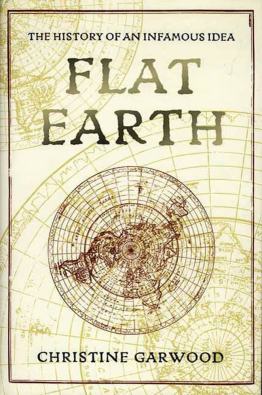
At the time of the Scopes Trial, Voliva hustled to Dayton, Tennessee to help prosecute John Scopes. Voliva’s hope, according to author Christine Garwood, was to “eliminate the twin heresies of evolution and a spherical earth.”flat earth garwood

But that’s where the two ideas went their separate ways. Whereas the outlandish notion of a literally young earth came to be accepted as true by large minorities of Americans, the outlandish notion of a flat earth became an internet quirk adopted by basement-dwelling conspiracy theorists.

So I ask again: What is the difference? I have a few ideas that I’m including in my current book about American creationism. In short, I think the answer lies not in dissident science, but in the mainstream world. By the 1960s, fundamentalist Protestants faced a new choice: Embrace mainstream evolutionary thinking and find a way to reconcile it with evangelical belief, or reject mainstream evolutionary science utterly and create a new creationist science.

When it came to evolution, the choice seemed simple, to many fundamentalists at least. Either kowtow to secular science or remain steadfast to young-earth beliefs.

Flat-earthers, though, never offered such a stark and simple choice. Belief in a flat earth (or a geo-centric solar system, for that matter) had always been embraced by some Biblical conservatives, but it never became a litmus test of orthodoxy.

At least, that’s the argument I’m trying to make in my new book.

What do you think?

Wait…WHAT Is “A” For?

A is for Activist. Or…no wait, turns out A is for Apologetics. No matter what your cultural politics, it seems everyone wants to indoctrinate the children. As SAGLRROILYBYGTH know, that’s just not how education really works.

Here’s what happened: I couldn’t help but notice the odd coincidence I stumbled across recently. From the progressive-y-est progressives to the staunchest fundamentalists, everyone seemed to be shilling similar sorts of books for young people—books meant to inoculate children politically or theologically against their environments.

a is for activist

A recent story in the New York Times describes the trend among lefties. Board books such as A Is for Activist have sold tens of thousands of copies. As one bookseller noted, prog parents seem to want to protect their children from Trumpism. As she put it,

When racist, misogynistic and hateful rhetoric has become mainstream, offering affirming and respectful messages to my children seems more urgent than ever.

The books offer cute lines for young readers, stuff like this:

‘F’ is for Feminist. For fairness in our pay.

‘J’ is for Justice! Justicia for all.

L-G-B-T-Q! Love who you choose.

Who buys such stuff? Progressive parents who worry that their children might not come to these conclusions on their own. As one mother told the Times,

Because we are a white, heterosexual, cisgender family living in a racially homogeneous area…we strove to have people of color in our books, or families, maybe, with two dads or two moms.

Will it work? Not really. But that doesn’t mean it isn’t shared across culture-war trench lines.

Among his summer outreach projects, for example, creationist impresario Ken Ham announced a new set of books for fundamentalist youth. Instead of A being for Activist, though, Ham’s books make A for Apologetics. (B, by the by, is for “Biblical Authority.” C is for “Chronological.”)AIG ABC

If we ignore the content of his warnings, Ham’s attitude sounds almost identical to that of the nervous progressive parents. Why do parents need new ABC books? Because, Ham warns, his “national research” has determined that too many fundamentalist children end up abandoning their faith. In these perilous times, Ham warns, parents and churches need new resources to help keep their children on the straight and narrow.

On both sides, parents are nervous about the future beliefs of their toddlers. Both sides worry that their environments are politically or religiously dangerous. And both sides hope that a well-placed book will make the difference between faith and failure.

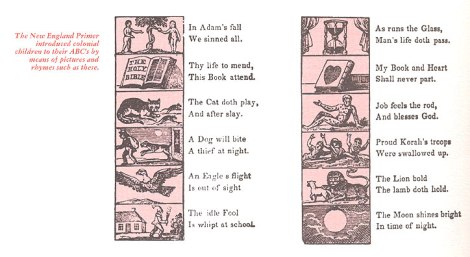
And, of course, both sides are wrong. Books matter. But no book can turn any child into something he or she is not. No kid today, for example, would turn into a Puritan if he or she stumbled across the New England Primer.

NewEnglandPrimerAtoM

Whoops! Turns out “A” is actually for “Adam’s Fall.”

Rather, books—like formal schooling itself—are only a small part of the education of young people. If progressive parents raise their children in a homogenous, anti-diversity community, their children will probably think those values are right on. And if fundamentalists raise their children to inquire deeply into their faith, those children will probably grow up to do so.

The Surprising History of Turkey’s Creationism

A devilish Jewish conspiracy? A beloved Christian import? Recent news from Turkey builds on the surprising evolution of creationism in that country.

Here’s what we know: Alpaslan Durmus, the Turkish education minister, denounced evolution as “beyond their [students’] comprehension.” It will be removed from K-12 textbooks. Durmus explained that the government thought evolution was too “controversial;” that students “don’t have the necessary scientific background and information-based context needed to comprehend.”

Turkish education minister cuts evolution

Evolution’s out

That’s not the surprising part. After all, even when Turkish official textbooks did discuss evolution, they were hardly fair, balanced, or free of religious bigotry. According to The Financial Times, earlier Turkish textbooks warned students that Darwin “had two problems:  first he was a Jew; second, he hated his prominent forehead, big nose and misshapen teeth.” The books mocked Darwin’s lack of formal education, noting strangely that he preferred to spend his time with monkeys in the zoo.

For a while, then, Turkey’s public schools have catered to popular bigotry about evolutionary ideas. Turkey is hardly alone. Evolution is deeply unpopular in many Muslim-majority countries. According to Salman Hameed of Hampshire College, fewer than a fifth of Indonesians, Malaysians, and Pakistanis say they think evolution is true. Only eight percent of Egyptians do. Turkey is no exception. Just as in the United States, evolutionary theory is widely denounced, even if it is not widely understood. Anxious leaders curry favor with conservative religious populations by throwing Darwin under the bus.

It is not news, then, that Turkey’s government is trying to win support among religious voters by eliminating evolution from textbooks. We might be surprised, however, by the history of cross-creationist connections that have long linked Turkey’s Islamic creationists to San Diego’s Christian ones.

The_Creationists_by_Ronald_Numbers

A worldwide flood of creationism

As historian Ronald Numbers described in The Creationists, in the mid-1980s the minister of education in Turkey wrote to the San-Diego based Institute for Creation Research. Turkey’s schools, the minister wrote, needed to “eliminate the secular-based, evolution-only teaching dominant in their schools and replace it with a curriculum teaching the two models, evolution and creation, fairly” (pg. 421).

The relationship between powerful Turkish creationists and American creationists thrived. In 1992, a Turkish creationism conference invited ICR stalwarts Duane Gish and John Morris as keynote speakers.  Professor Numbers also describes the founding in 1990 of the Turkish Science Research Foundation (Bilim Arastirma Vakfi, or BAV).  In Numbers’ words, “For years BAV maintained a cozy relationship with Christian young-earth creationists, feting them at conferences, translating their books, and carrying their message to the Islamic world” (pg. 425).

However, Numbers concluded, “the partnership between the equally uncompromising Christian and Muslim fundamentalists remained understandably unstable” (425). Numbers cited the rhetoric of American creationist leader Henry Morris: “Mohammed is dead and Jesus is alive!” As Numbers noted acerbically, such talk was “hardly calculated to win Muslim friends” (425).

It’s not shocking, then, that Turkish and American creationists keep one another at arm’s length, in spite of American outreach to Turkey and lavish and expensive efforts by Turkish creationists to woo American scientists.

Here’s the last question: Will Turkey’s recent move finally convince pundits to stop saying that the United States is the only country in which creationism thrives? Will creationism finally be seen as the world-wide conservative impulse that it really is?

HT: V(F)W; JC

Free Speech Firestorm Jumps the Creationist Gap

Everyone supports free speech. But these days, academic “free speech” has become the latest creationist tactic to wedge creation-friendly science into schools. Mostly, that has been a K-12 effort, but it seems like creationist tactics have piggybacked their way into higher education.

The latest incarnation comes from the University of Wisconsin. Conservative lawmakers have promoted a bill to protect free speech on campus. To be fair, the conservatives who push Wisconsin’s bill insist that it has nothing to do with classroom topics, creationist or otherwise. The target, they insist, are leftist radicals who won’t allow conservative speakers on campus.

Wisconsin free speech

Let creationism ring?!!?!???

In Wisconsin’s case, the headline-grabbing incident was a talk by conservative pundit Ben Shapiro. In November 2016, Shapiro was shouted down for about twenty minutes before campus police kicked out the shouting protesters. Conservative lawmakers hope their bill will guarantee a balanced ideological environment; an infusion of conservative ideas on campus. The bill is patterned after other campus free-speech bills, inspired by the Goldwater Institute in Phoenix.

To this reporter, though, it seems like the current higher-ed furor over free speech has leaped the curricular gap. Here’s what I worry about: Campus free-speech efforts will be used to protect the “free speech” of creationists and other conservative folks locked out of mainstream science. Attempts to box out creationist ideas will be stymied.

Full disclosure: I can’t even pretend to be neutral on this one. I love my alma mater and I quake at the notion that lawmakers would pass any sort of law demanding or prohibiting certain forms of teaching. It’s not just an intellectual or political thing, either. If big granting organizations such as the National Science Foundation or the National Institutes of Health think UW is shackled by creationist science, they will be less likely to fund UW-based projects. Alumni will shy away from sending in donations. Students will be less likely to bring their tuition dollars. In short, the possible negative ramifications of a move like this could be huge.

But at this point, my dear SAGLRROILYBYGTH, you may be asking yourself a smart question: What does this conservative political move to welcome conservative speakers have to do with creationism?

First, the background: For years now, creationists have pushed for “academic freedom” bills in K-12 schools. The idea is to protect teachers and students from harassment or discrimination if they choose to voice their creationist ideas. Seattle’s Intelligent-Design mavens at Discovery Institute, for example, have offered the following language in their “academic-freedom” petition:

Teachers should be protected from being fired, harassed, intimidated, or discriminated against for objectively presenting the scientific strengths and weaknesses of Darwinian theory. Students should be protected from being harassed, intimidated, or discriminated against for expressing their views about the scientific strengths and weaknesses of Darwinian theory in an appropriate manner.

The idea is to mandate the intellectual rights of creationists in K-12 schools, to protect teachers and students from any sort of negative reaction to their zombie science. If successful, these bills put science education in a legal gray area. A school can’t insist on teaching mainstream science. Teachers can’t insist that students learn it.

We’ve seen glimmers of this sort of creationist “academic freedom” dispute in higher ed, too. Remember Eric Hedin at Ball State? He earned tenure after facing charges of preaching intelligent design. Or Mark Armitage at Cal State Northridge? He successfully sued after facing discrimination for his creationist publications.

The Wisconsin bill, however, introduces a new element to these creationist “academic freedom” battles in higher education. According to Madison’s Capital Times, the bill’s sponsor is a convinced young-earth creationist. His bill would create a Council on Free Expression. Creationist students who feel persecuted could file complaints with this Council.

In the give-and-take in the Wisconsin legislature, skeptical Representative Terese Berceau questioned Jesse Kremer, the bill’s sponsor, on this question. What if, Berceau asked, a student in a geology class argued that the earth was only 6,000 years old?

“Is it okay for the professor to tell them they’re wrong?” Berceau asked during the lengthy session on May 11.

“The earth is 6,000 years old,” Kremer offered.  “That’s a fact.”

Representative Kremer insisted the new law would not affect classroom discussions. But he affirmed that a creationist student—any student—who felt discriminated against could take his or her complaint to the Council on Free Expression.

Again, I know I’m not thinking clearly and calmly on this one. I’m nervous about the possible ramifications of Kremer’s bill and I’m likely to make creationist mountains out of conservative molehills.

Am I being overly paranoid? Or will conservative free-speech bills end up giving creationist students in college the ability to jam up the works of mainstream science classes? Will efforts to set up an intellectual preserve for conservative ideas on campus end up giving creationists more control over college classes? And, most important, will that new creationist influence stymie the mainstream science that usually goes on in Madison?

They Love You but They’re Going to Brexit

I admit it: I don’t get out much. I live in the USA. I study the history of the USA. I spend my time trying to understand parts of the USA that just don’t make any immediate obvious sense to me—things like creationism and fundamentalism. So my ears perked up when I heard that the new “kingmakers” in the UK were guided by “a mixture of old-time religion and secular nativism.” Based on the flurry of news about them, they certainly sound like US-style religious culture-warriors.

DUP

Look familiar?

But I don’t know much about it. Here’s what I’m reading: After Theresa May’s drubbing in the recent election, her Conservative Party has had to partner up with the Democratic Unionist Party from Northern Ireland. The DUP is an odd duck in Europolitics. As one European journalist described them, they don’t fit in in Europe, but “to an American, especially from the deep South, the party would seem much more familiar.”

After a quick look, it does sound eerily similar, but not exactly the same. The DUP are against LGBTQ rights; they are anti-abortion; they are climate-change deniers. Many of its leaders are regular church-goers; many leaders are creationists. Due to the turbulent and violent recent history of Northern Ireland, they also have ties to right-wing paramilitary groups.

Like many American fundamentalist groups, the DUP was founded by a Presbyterian hard-liner. The Reverend Ian Paisley—in yet another connection to historical American fundamentalism—was motivated by a political and theological anti-Catholicism.

Carl McIntire 1970

Carl McIntire, American Fundamentalist, 1970

Of course, there are big differences. Being anti-Catholic in Ireland is a world away from being anti-Catholic in Texas. Being a “militant” Presbyterian in a warzone is different from being a “militant” Presbyterian in New Jersey.

Yet the connections still seem palpable. According to The Economist, at least, the DUP is motivated by the same sense of usurped proprietary nationalism that fuels American fundamentalist outrage. As that paper put it,

What unites many voters of Protestant heritage, whether religious or not, is a feeling that the tide of history has, in some mysterious and unfair way, turned against them. . . . The DUP speaks to the fears and aspirations of those voters—sometimes in subliminally religious language and sometimes in more secular tones.

Educate me, SAGLRROILYBYGTH: Am I missing something? We hear time and time again that no other post-industrial society fuses together God and society the way American conservatives like to do. From what I can tell, the theocratic dreams and creationist textbooks of the DUP sound awfully similar.

Conspiracy and American Jihad

Michael Gerson is right. Feverish conspiracy theories have become “a kind of discrediting madness” among American conservatives. But it’s not only a problem on the right. Progressives are prone to embracing outlandish conspiracy theories, too. (*Paging Louise Mensch*) What are we supposed to do, then, whether we’re progressive or conservative, when we see evidence of a real, frightening conspiracy? Of prominent preachers calling for American jihad and civil war?

In general, it’s difficult for a historian like me to get too worked up by hyperbolic claims of conspiracy. It’s not that historians don’t see plenty of conspiracies in the archival record. Rather, as I’ve argued in these pages before, digging into archives shows us lots of evidence of real conspiracies. It is precisely the abundance of conspiracies that keeps us calm. There are so many conspiracies afoot, operating at cross-purposes and usually in bungling fractious competition with one another, that the ultimate goals of such conspiracies foil themselves.

When my progressive friends have warned of theocratic fundamentalist or creationist conspiracies, I’ve replied time and again that fundamentalists and creationists are among the most divided groups in America. The notion that they could combine to impose a Handmaid’s-Tale sort of theocracy simply doesn’t match the historical record.

I was flummoxed, then, by a recent Jim Bakker video.

Remember Jim Bakker? Of PTL Ministries? In a recent video circulated by Right Wing Watch, Bakker insisted that any impeachment of Trump would lead to a “civil war in the United States . . . Christians will finally come out of the shadows” to fight for what’s right.

Even for a mild-mannered historian like me, it’s hard not to be disturbed by such threats of American jihad. And it’s easy for secular people like me to see more evidence everywhere we look. We know, for example, that a whopping 81% of white evangelical voters voted for Trump. Those of us who study evangelical history might politely argue about the meaning of evangelical support for Trump, as John Fea and I did a while back, but it’s not too difficult to make a case that Bakker’s violent Trumpism might have plenty of support.

So should we freak out?

Not yet. Here’s why: Clearly, violent extremism is real and dangerous. Whether from Portland, the PTL, or campus radicals, we can’t afford to pooh-pooh the threat of real theo/political/racial violence. But in order to recognize and fight the danger of extremism we need to avoid the temptation of lumping together all those with whom we disagree.

Rather, we need to understand and encourage the diversity within every group. It is hard for secular progressives like me to truly understand, but no one will be more horrified by Bakker’s jihadist rhetoric than other evangelical Protestants. If we leap to assume that Bakker’s extremism represents the thinking of all white evangelicals, we turn our greatest potential anti-extremist evangelical allies into imagined pro-Bakker extremist enemies.

Are conspiracies real? Are Bakker’s fulminations dangerous? Yes, and hell yes.

The proper response, though, is not to score cheap points against conservative evangelicals by using Bakker’s words against them. The real goal should be to recruit anti-Bakker allies from among his many evangelical opponents.

How Many Americans REALLY Believe in a Young Earth?

The new numbers are out. And they are, well, new. But before we leap to any conclusions about the numbers of Americans who believe in a recent divine creation of our species, we need to look at the full story.

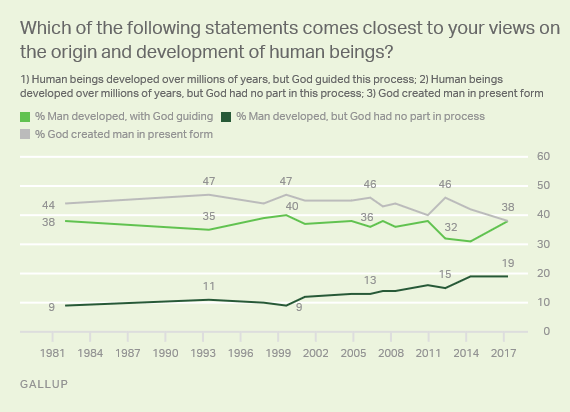
Here’s what we know: The new Gallup poll about creationism shows a dip in numbers of respondents who think humanity was created in “pretty much its present form” within the past 10,000 years or so. Since the 1980s, the number has hovered at about 44-47% of respondents. This year, it dropped to only 38%.

gallup data 2017

Are we getting better at science? Or only getting better at answering poll questions?

We might want to say that the radical form of young-earth creationism is losing steam. And it might really be. But there’s a more nuanced conclusion we can draw if we scratch a little deeper at the numbers.

Before we begin, though, we need to lodge a complaint about terminology. Gallup calls people “creationists” only if they believe that humanity was created in its current form within the last 10,000 years. Sure, those folks are creationists, but so are the many people who believe God created humanity over a longer stretch of time. Calling only young-earth types “creationists” means taking sides in a family feud between branches of the evangelical/creationist family, as I’m arguing in my current book about evangelical higher education. I don’t think the Gallup folks really mean to do that and they should take a hard look at their terminology.

But let’s put those gripes to one side for now. Gallup gives us some demographic info about the YEC respondents. Not surprisingly, a large majority of people who go to church every week (65%) opted for a recent direct creation of humanity. And exactly half of non-Catholic Christian respondents did.

This demographic info helps us see a more likely real portrait of Americans’ beliefs about the origins of our species. When we ask more targeted questions about people’s beliefs, we get a far more complicated picture. Political scientist George Bishop of the University of Cincinnati crunched some different polling data from Harris. Of those who picked Gallup’s recent-creation option, Bishop found, over half (56%) also believed that dinosaurs had gone extinct over 65 million years ago. Over half (54%) also believed that all non-human animals share common ancestors.

In other words, among the people who picked Gallup’s recent-creation-of-humans option, lots of them also believe in evolution and an ancient earth.

Other poll questions have come up with similarly confounding results. The 2009 Harris poll, for example, found that only 29% of respondents agreed that “Human beings evolved from earlier species.” But a much larger 53% of respondents said they “believe Charles Darwin’s theory which states that plants animals and humans have evolved over time.” With such drastic differences, it’s hard to know what Americans truly believe.

So what can we make of all these higgledy-piggledy poll results? Here’s what I think: If we want to know how many people want to identify politically as young-earth creationists, then Gallup’s numbers are trustworthy. Lots of active evangelicals know that they are supposed to think that our species has been created recently.

But if we want to know what people really think about evolution and creation, the Gallup numbers are not very helpful. In most cases, as I’m arguing in my current book about American creationism, people don’t really have clear, coherent ideas about evolution and creation. Most of us hold in our heads a grab bag of ideas and beliefs, facts and falsehoods.

We don’t find it difficult, for some reason, to believe in both Adam & Eve and evolution. We don’t find it challenging to accept the notion of an ancient earth while still holding on to our belief in a recent creation. In short, what Americans believe about creationism and evolution is far more jumbled than what we tell pollsters we believe.

Shame on You!

Okay, kids, time to fess up. Some of you students at conservative schools have been trying to cheat on your exams…haven’t you. Here’s how we know: Our editorial page here at ILYBYGTH lets us see the terms people type into their Google machines. Lately, as final-exam time swings near, we’ve noticed a definite uptick in the number of hopeful plagiarists.

search terms

What are you looking for?

It is often fun and enlightening to read the search terms. Mostly, they are from people interested in the same issues that trouble SAGLRROILYBYGTH: higher education, creationism, evangelicalism, conservatism, etc.

Here are some of the recent examples:

  • does hillsdale college teach evolution

  • is the moody institute anti catholic?

  • gay pride rainbow painted on wheaton bench

I hope those searchers found what they were looking for. Sometimes, the search terms themselves make for a kind of interwebs poetry. Once, for example, your humble editor was touched by this plaintive search:

  • Can a creationist and evolutionist be in love?

Obviously, too, some of our searchers will probably move on disappointed. Lots of people, for example, are just looking for information and don’t give a whoot for all our ILYBYGTH culture-war dickering.

For example, the person who searched for “Kentucky attractions” probably didn’t find what she was looking for.

But none of that is what we’re talking about today. In the past week or so, your humble editor has noticed a definite trend. Check out the search terms below and tell me I’m not seeing would-be plagiarism:

  • Discuss the value of traditional education;

  • What are the main problems of evolutionary theory? How do alternate ideas such as theistic evolution, progressive creation, day-age creationism, and gap theory fall short of a biblical understanding;

  • In a mid-length essay (5-7 pp.) describe the historical development of traditional education;

  • Essay creationism superior.

To me, these look obviously like test questions. And not just any tests. The kinds of schools that want students to write these sorts of essays can only be conservative religious schools. Right? Only students at conservative religious schools would be likely to be asked to write out the problems with evolution. Or the values of “traditional education.”

It wouldn’t be the first time that students at conservative schools worked hard to cheat their way through their morally elevating curricula. During the research for my current book about evangelical higher education, for example, I came across one sad-sack letter in the Moody Bible Institute archives.

In 1931, an alumnus wrote to the MBI administration with a fulsome confession. When he was a first-year student, he had cheated on every “examination, mid-term and final, through-out the year.” He had never been caught. He had never even been accused. But this student was so “conscience stricken” he pleaded with the administrators to take away all his credits.

They obliged.

Perhaps someday the cheaters and plagiarists who are hoping to evade their work by dipping into the ILYBYGTH archives will meet a similar fate. Don’t say I didn’t warn you!