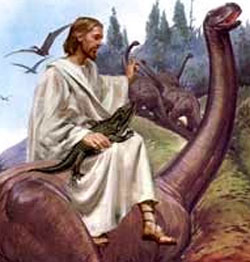
So Jesus WAS on a Dinosaur…?

We just don’t know what we’re talking about.

Could've happened...?

Could’ve happened…?

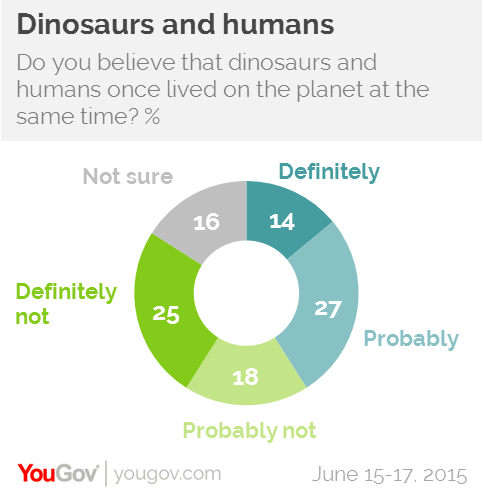
A new poll inspired by the hit movie Jurassic World suggests that Americans don’t know much about much. Thanks to the ever-watchful folks at the National Center for Science Education, we see some startling responses to a simple question: Did humans and dinosaurs live at the same time?

As YouGov explained,

YouGov’s latest research shows that 41% of Americans think that dinosaurs and humans either ‘definitely’ (14%) or ‘probably’ (27%) once lived on the planet at the same time. 43% think that this is either ‘definitely’ (25%) or ‘probably’ (18%) not true while 16% aren’t sure. In reality the earliest ancestors of humans have only been on the planet for 6 million years, while the last dinosaurs died out 65 million years ago.

Ouch.

For evangelicals, the numbers are even more skewed. A clear majority (56%) of evangelical Protestants think humans and dinosaurs co-existed. Only 22% of evangelicals thought that dinosaurs and humans did not.

...doh!

…doh!

As the National Center for Science Education points out, there are a couple of possible wrinkles in this poll. Most scientists these days consider birds to be dinosaurs. Is that what the respondents meant? The NCSE charitably suspends judgment, but it seems obvious to your humble editor that most of us just don’t know what we’re talking about.

Good Seats Still Available!

The 2015-2016 lineup at Binghamton University is looking like another winner. Dan Kahan of Yale Law School has just agreed to come up in the spring for a talk about his work with science communication.

We had a very exciting year last year, too. Michael Berkman visited from Penn State. Professor Berkman gave a great talk to our Evolution Studies program about his work with evolution education. Then in May, Jonathan Zimmerman from New York University delivered our annual Couper Lecture. Professor Zimmerman blew our minds with some of the most provocative ideas from his new book, Too Hot to Handle.

Are you a Kentucky Farmer?

Are you a Kentucky Farmer?

Folks who spend a lot of time with science, creationism, and public perceptions will be familiar with Professor Kahan’s work. His Cultural Cognition Project has explored exciting new directions in the tricky field of science communication. As Professor Kahan will tell you, we’re all Pakistani doctors; we’re all Kentucky farmers.

Details of Professor Kahan’s talk to follow. It will likely be a Monday evening in the early months of 2016. As always, the seminars hosted by Binghamton’s stellar Evolution Studies Program are free and open to the public.

Can’t wait.

Creationism Then & Now

Do you read Ted Davis? For folks interested in the creation/evolution debates, Professor Davis has long produced essential historical analyses of the various voices of creationism in all their befuddling complexity. I was reading one of Professor Davis’ essays on the Biologos Forum recently and it raised some perennial questions: Can we compare the dissenting science of today’s creationists to the scientific ideas of long ago? Can today’s creationists claim a long legacy of prestigious scientific antecedents?

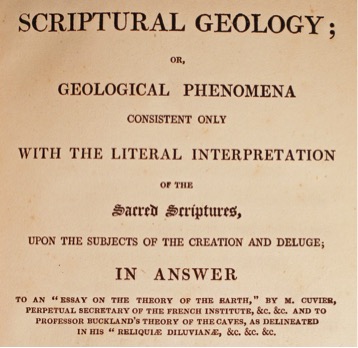
Cutting-edge creation science, c. 1827

Cutting-edge creation science, c. 1827

Davis is writing these days about science and creationism in antebellum America. In this post, he explains the school of “Scriptural Geology” that attracted religious scientists in the early 1800s. Scholars such as Princeton Seminary’s Samuel Miller and Anglican minister George Bugg rebutted new(ish) ideas of an ancient earth.

Professor Davis pointed out the remarkable similarities of their 19th-century arguments with the 21st-century arguments of today’s young-earth creationists. As Davis put it,

Readers familiar with Henry Morris or Ken Ham will find many of their ideas, expressed in substantially the same ways and for the same reasons, in the pages of Bugg’s book.

Now, Professor Davis would be the last person to ignore historical context or to misunderstand the historical changes that have wracked the world of creationist scientists. Yet his comparison to the Scriptural Geologists to Answers in Genesis or the Institute for Creation Research points out the radical changes that have taken place in the realms of creationism and science.

In the 1820s, discussions of the age of the earth still had some fading legitimacy among mainstream scientists. Even as late as the 1920s, when American politicians such as William Jennings Bryan insisted that “Darwinism” was losing scientific prestige, their claims made some sense. In the 1920s, for example, mainstream scientists had not yet cobbled together the modern evolutionary synthesis. They had not yet figured out how to reconcile the mechanism of natural selection with the maintenance of beneficial mutations.

As I describe in my upcoming book, mainstream science has changed enormously over the course of the twentieth century. Positions that made some scientific sense in 1827, or 1927, lost those claims as the 20th century progressed.

As an obvious result, there yawns an enormous gulf between the work of George Bugg and that of Ken Ham or Henry Morris. Today’s young-earth creationists are forced to take the role of utter scientific outsiders. They are forced to dismiss the entirety of mainstream evolutionary science as deluded.

Of course, as Professor Davis explains, earlier “creationists” such as Miller and Bugg also felt like scientific outsiders. But their position was radically different. Saying nearly the exact same thing, as always, can mean very different things, depending on when one says them.

Wal-Mart and the Death of College

Don’t be fooled. Just because the rumors of Sweet Briar College’s death have been greatly exaggerated, don’t think that small colleges have any reason to be optimistic. And for small conservative religious colleges, there is an even more difficult problem. They need to perform an impossible feat—get more religious and less religious at the same time.

Adorable but unaffordable?

Adorable but unaffordable?

As I’m arguing in my current book, fundamentalist and evangelical colleges and universities have always faced all the same challenges of mainline schools, plus many unique ones. The situation today is exactly the same. Conservative religious colleges face the same sorts of Wal-Mart-style challenges of scale, plus the additional constraints of remaining true to religious orthodoxy.

Though its affluent alumni seem to have saved Sweet Briar College, small evangelical and fundamentalist colleges have been winking out like dead fireflies lately. The reasons are clear. Just as the Wal-Martification of retail stores has made Mom-and-Pop stores impossible, so have the twentieth century’s slow academic revolutions made small colleges impossible. Many of them just don’t seem to know it yet.

What happened at Sweet Briar? The numbers just didn’t add up. Writing in the pages of Inside Higher Ed, Scott Jaschik quoted a gloomy financial report:

A report last month by Moody’s Investors Service said, “In Sweet Briar’s case, challenges included small scale, which, combined with weakening demand, declining pricing flexibility and an insufficient endowment, led to an unsustainable business model.” Some of the very qualities that make alumnae so loyal also make it hard to balance the books, Moody’s said. “Sweet Briar’s model of providing highly personalized education with small class sizes is expensive, as indicated by educational expenses per student of approximately $42,000,” said the report. “Although this cost structure is commensurate with the other rated women’s schools, standing at the median, colleges either need greater pricing flexibility, larger endowments or more gift revenue to sustain the model.”

Small colleges are trapped in a terrible pickle. To survive, they have to achieve a certain minimum size. Otherwise, they can’t afford to offer all the programs and services that students these days expect from a college. But they can’t achieve that minimum size if they keep their prices high. Students will go elsewhere if they are charged the full sticker-price. If schools lower prices, however, they will also die.

In Sweet Briar’s case, activist alumni pledged to raise 12.5 million dollars to keep the school running. That’s a lot of moolah. And no school—not even one with wealthy and involved alumni—can expect to survive only on the good wishes of its past students.

For conservative evangelical schools, the outlook is even more gloomy. In order to attract students, they must continue to demonstrate beyond question their religious orthodoxy. In some cases, such as the controversies lately at Bryan College, Mid-America Nazarene, and Northwest Nazarene, this will mean clamping down on faculty who seem to be moving in a liberal direction. At the same time, however, in order to attract students, they need to widen their pool of potential students. That means offering more programs and more courses. It also means opening up to students from different religious backgrounds. After all, if tuition dollars are getting harder to find, it will get harder and harder to turn paying students away.

Some fundamentalist schools are thriving in this difficult environment, at least for now. Most prominently, Liberty University in Virginia is raking in the dough. By making itself into a leader in online education, Liberty has managed to grow at a breakneck pace in the past decade.

Raking in mountains of dough...

Raking in mountains of dough…

As its online offerings increase, however, Liberty has to somehow demonstrate that it has not watered down its strict religious requirements. Those requirements, after all, are the school’s primary raison d’etre. Even as it pumps money into its football team and its all-year faux snowboard hill, Liberty’s leaders need to watch out for the creeping liberalism that tends to accompany higher-ed growth.

I’m happy for those folks who love Sweet Briar College. But their impressive display of life-support should not give comfort to other college leaders. The fundamental financial situation has not changed. Small colleges have to remain small to maintain their traditional style of teaching, but they have to grow in order to be financially solvent.

Small evangelical colleges face those same impossible challenges, plus some unique ones. They have to remain orthodox in order to keep their niche, yet they have to broaden their appeal in order to survive at all.

I’m glad I’m not in charge of one of those schools.

Mixing It Up with Pope Francis

Confused by the incessant culture-war back and forth on the issue of climate change? Usually, it’s pretty easy to pick a side. Since, as Yale Law School’s Dan Kahan argues, what we “believe” about issues such as evolution, vaccinations, and climate change tells us more about who we are than what we know. Usually, those of us who consider ourselves progressives push for more and faster action on climate change. Those who consider themselves conservatives pooh-pooh the urgency of the issue. Yesterday, Pope Francis threw a St.-Peter’s-size monkey wrench into the works with his encyclical about the environment. In this searing statement, the pope challenged all of us to take a stronger stand about the changing climate.

Is THIS what conservatives should drive? . . .

Is THIS what conservatives should drive? . . .

Now, I admit, I have not read the full document. It weighs in at 184 pages and I’ll be sure to put it at the top of my reading list. Analysis by the New York Times paints a picture of a fairly radical stand by the Argentinian pope. In short, Pope Francis went further than tut-tutting the bromides of climate science. The pope blamed affluent throwaway culture for the dangerous changes that have already begun. What are we to do? Not just consume smarter, but change our feelings of entitlement and our endless apotheosis of appetite.

Climate change, the pope wrote, is nothing less than “one of the principal challenges facing humanity in our day.” It is not enough for us to merely cap-and-trade carbon emissions. It is not enough for us to merely “grow” our way out of the dilemma. The pope’s message is clear, and rather startling in its Greenpeace-scented tones. Those of us who follow culture-war-related developments are more accustomed to the Vatican as a world headquarters for staunchly conservative thinking on issues such as abortion and gay rights.

The new Popemobile?

The new Popemobile?

What does this mean for our climate-change culture wars? It will certainly mess up any bright lines between “conservative” and “progressive” orthodoxies. Of course, we’ve seen conservative intellectuals at places such as Front Porch Republic and The American Conservative who have long promoted this sort of less-is-more conservatism. But by and large, American conservatives might be more likely to agree with Richard Viguerie, who called Pope Francis’ statement a “confusing distraction.”

As Josh Rosenau of the National Center for Science Education has pointed out, American Catholics have been divided on the issue of climate change. “Traditional” Catholics in the USA have tended to be split on the issue and generally have been more interested in preserving traditional religious practices than in environmental activism. Could Pope Francis’ statement push them to action?

More broadly, might the pope’s statement encourage American conservatives to consider tackling climate change as a conservative mission? What about conservative Christians who are not Catholic? Some American evangelicals have openly attacked environmentalism as a “green dragon.” Others have talked about an evangelical environmentalism, calling it “creation care” or respect for the “doctrine of dominion.” Still others have voiced more complicated positions. American creationists, for example, have wondered about their theology of climate change. At the young-earth creationist ministry Answers In Genesis, for instance, readers are told that climate change is certainly a real phenomenon. But should we worry? Here is AIG’s advice:

should we be alarmed about climate change? Not at all. Yes, climate change is real, but according to the true history book of the universe, we should expect it as a consequence of the cataclysmic Flood. Also, Earth—and Earth’s climate—was designed by the all-knowing, all-wise Creator God. He built an incredible amount of variety into the DNA of His creatures so that they could survive and thrive as Earth’s environments change. Surely the God who equipped life to survive on a changing Earth also designed Earth with the necessary features to deal with environmental changes.

No one doubts the pope’s credentials as a smart, earnest, conservative Christian thinker. Might his encyclical spark a dialogue between conservative Catholics and other conservative Christians about the issue of climate change? Could an inter-Christian, inter-conservative dialogue move conservative Christians towards the pope’s position?

NASA Puts Creationists to Work!

Forget about creationism in public schools for a minute. Is it true that the US Government hires young-earth creationist scientists? Can it be true that leading scientific agencies such as NASA employ people who believe that the universe was created within the past 10,000 years?

All in a day's work?

All in a day’s work?

In the past, we’ve heard of government geologists who hold to young-earth creationist beliefs. But today we see a claim by young-earth impresario Ken Ham that NASA employs “many” creationist scientists. Is it true?

Ken Ham, the force behind leading young-earth ministry Answers In Genesis, wants to be clear. He is not talking about folks like John Glenn. Glenn, world-famous astronaut and sometime Senator, recently attested to a more moderate vision of creationism. Apparently, sixteen years ago, Glenn had claimed, “to look out at this kind of creation out here and not believe in God is to me impossible.” Recently, he offered a slightly different explanation of his creationist beliefs. “I don’t see,” Glenn attested,

that I’m any less religious by the fact that I can appreciate the fact that science just records that we change with evolution and time, and that’s a fact. It doesn’t mean it’s less wondrous and it doesn’t mean that there can’t be some power greater than any of us that has been behind and is behind whatever is going on.

Teach evolution, Glenn insisted. There’s no reason we can’t do that in our public schools without hurting children’s religious belief.

Not so fast, Ham warned. If we accept the premises of deep time and evolution, we have to call God a liar, and we have to ignore reams of scientific evidence that points to a newer creation.

Luckily, Ham reports, the labs of NASA are freighted with true creationist scientists. When he gave a talk to the “Bible Club” at NASA’s Goddard Space Flight Center in 1994, Ham says, he was “thrilled to meet many scientists who were also biblical creationists!”

Now, maybe it’s my secular bias, but I have a hard time believing that NASA really employs a sizeable population of young-earth creationists. In the past, I’ve defended the notion that young-earth creationists are not necessarily “ignorant,” as so many secular people like to claim. We have scads of evidence that smart people can be trained in scientific careers and hold to a belief that the universe is fairly new.

But Ham’s claim that NASA is teeming with young-earth creationists seems to be a different case. In the day-to-day work of NASA—a work I admit I know nothing about—it would seem difficult to reconcile a belief in a newish universe with basic assumptions about space exploration.

The claim seems to put Mr. Ham in a difficult position. If NASA really does employ “many” creationist scientists, then NASA can’t fairly be accused of anti-creationist prejudice. But Answers In Genesis insists that mainstream scientists are uniformly blinded to the truths of creationist science by willful prejudice.

On the other hand, if NASA doesn’t really employ “many” creationist scientists, then Ham’s claim doesn’t stand up. He mentioned one of NASA’s creationist scientists by name, one Bill Daniels. If it’s the same person, Bill C. Daniels of New Smyrna Beach, Florida worked as a “project equipment manager” for NASA, according to Daniels’ obituary. Is it possible that NASA’s Bible Club was full of employees who did not have to engage with the scientific paradoxes of young-earth belief in an organization dedicated to exploring an ancient universe?

Dissenters, Not Ignoramuses

[Editor’s Note: As SAGLRROILYBYGTH are well aware, I’ve just completed work on a new book about creationism and evolution education in the United States.  Based on that effort, the education editor of Anthropology Now invited me to contribute some thoughts about the implications of the creation/evolution controversy.  Below I’m reprinting that essay in its entirety, with the permission of Anthropology Now.  You can also find the essay in its original form in the April 2015 edition of that magazine. Thanks to Zoe Burkholder and Maria Vesperi of AN.]

Physical anthropologists have long been on the front lines of debates over evolution. In the Texas textbook tumult over the past decade, for example, Ronald Wetherington of Southern Methodist University has gone head-to-head with creationists over the content of science textbooks. There is no debate over the science, Wetherington has argued. There is simply no way humanity’s origins can be traced to two bashful ancestors in an idyllic garden, 6,000 years ago.[1]

Image courtesy of Scott Thurman, The Revisionaries

Wetherington thinking it over. Image courtesy of Scott Thurman, The Revisionaries

Yet the fight goes on. Creationists insist on including their religious beliefs in public-school science classes. Mainstream scientists protest. All too often, the debate has forced folks such as Wetherington to attack the scientific pretensions of creationism. How would it be possible, mainstream scientists insist, for the earth to only have a short history? For humanity to trace its lineage from the Garden of Eden? The genetics just don’t line up. The fossils don’t line up. Nothing fits.

This sort of back-and-forth about the possibilities of science goes nowhere. More false debates pitting mainstream scientists against creationist scientists in a choreographed and predictable non-dialogue about the proper nature of science are not needed. One side calls the other a bunch of ignoramuses. Creationists retort that they are the only real scientists in the room.

Creationists may or may not be ignorant about evolutionary theory, but there is a better way to understand creationism, as primarily a form of religious dissent. Of course, notions of religion and religious dissent have always played a part in creation/evolution debates. Court decisions, especially, have tended to reject creationists’ claims on the basis that they represent a religious viewpoint, not a scientific one. Even those decisions, however, have pushed creationists to insist on their status as scientific dissenters above all. For everyone’s sake, including that of creationists themselves, creationism should be viewed first and foremost within the tradition of religious dissent in the United States.

This approach offers hope for moving the long debates over creation and evolution in a more productive direction. In the end, centering the debate on religious dissent rather than on scientific truth could offer two promising new policy goals. First, it would require both sides to agree on different goals for evolution education. Public schools would be tasked with clarifying their expectations and demands. While students from every background must be helped to understand evolution, their beliefs about that knowledge are their own business. As religious dissenters, creationists have the right to preserve their religious beliefs. Second, for public-school teachers to teach dissenting students, teachers themselves must be taught some basic principles about cultural difference and inclusion. Here is where anthropologists can get involved. Teachers should study not only biology and geology, but also ethnography and principles of cultural anthropology. Science teachers must understand the cultural beliefs of religious dissenters in order to welcome those dissenters into science classes. And teachers should be trained to understand their own cultural perspectives, to see the dissent of their students as a cultural strength, not a deficit to be corrected or an ignorance to be attacked.

Anthropologists can be helped by historians. As every historian is well aware, the US educational system has a long, spotty record of handling religious dissent. All too often, public schools have crammed hegemonic notions of proper culture and theology down the throats of minority students and families. In the 19th century, as historian Carl Kaestle has argued, Protestant school leaders often pooh-poohed the objections of Catholic dissenters. In the 1830s, Protestant school leaders in cities such as Boston, New York, and Philadelphia dismissed Catholic complaints about textbooks that ridiculed the Pope and described Catholics as inquisitors and anti-Christians.[2] Even into the 20th century, as David Wallace Adams has shown, minority groups felt the heavy hand of the dominant culture. At Native American Indian boarding schools, Adams found, non-native teachers made it their mission to squash the religion of their native charges. School founder Richard Henry Pratt wanted to “kill the Indian and save the man.”[3]

As the 20th century progressed, religious dissenters scored some successes in major court cases. Perhaps most influential, the US Supreme Court ruled in Abington School District v. Schempp (1963) that students had the right to dissent from religious practices in public-school classrooms. Even if families were allowed to opt out of prayers and Bible readings, the Court decided, such religious practices involved the government too closely in private religious beliefs.[4] Other federal courts have underlined the rights of religious dissenters in public schools. One Tennessee district court ruling in 1979 spelled it out: “if that which is taught seeks either to disparage or to encourage a commitment to a set of religious beliefs, it is constitutionally impermissible in a public school setting.”[5] It is not enough anymore for public schools to allow minorities to attend. It is not enough to permit dissenters to share in parts of the public-school culture. Public schools, rather, must welcome dissenters and minorities as equal members.

That new consensus can be applied to the status of creationist dissenters. Their beliefs should not be mocked or dismissed out of hand. But while dissenting religious beliefs must be respected, religion should never inform the public-school curriculum. Students of all backgrounds, dissenting or not, must be exposed to the very best knowledge on offer. They should be helped to understand that knowledge, even if it contradicts their home religions. At the same time, they must not be forced to believe anything that they find theologically repugnant.

Although creationists and mainstream scientists have disagreed bitterly for generations, they have often agreed on one fundamental—but mistaken—notion. Both sides have repeatedly defined the struggle as a scientific one, rather than a religious one. Many creationists insist that their religiously motivated understanding of the origins of humanity represents a scientific vision. And many mainstream scientists engage on just this issue: Which model represents the better scientific explanation? These debates—fascinating but ultimately pointless and unproductive—roiled in the 20th century and continue into the 21st.

Monkeys and Modernity

The first generation of evolution/creation debates in the 1920s set the tone for those that followed. One of the leading anti-evolution voices of that generation, William Jennings Bryan, insisted that evolution was first and foremost bad science. Bryan proudly and pointedly maintained his membership in the American Association for the Advancement of Science. In the pages of the New York Times in 1922, Bryan insisted that his anti-evolution position represented a deep love of true science. “We do not ask,” Bryan told readers, “for the exclusion of any scientific truth, but we do protest against an atheist teacher being allowed to blow his guesses in the face of the student.”[6] Those who insisted on forcing such false ideas on America’s students, Bryan mocked, were nothing but irresponsible “pseudo-scientists.”[7]

"Are you know or have you ever been...an ignoramus?"

“Are you know or have you ever been…an ignoramus?”

Mainstream scientists met Bryan on the field of science. They often insisted that his was not real science, yet allowed the discussion to focus too often on such definitions. One of Bryan’s primary public antagonists in the 1920s was Princeton biologist Edwin Conklin. Conklin called Bryan a “non-scientific person,” someone utterly unqualified to assert the boundaries of scientific knowledge.[8] Conklin poured out a good deal of time, sweat and ink in his attempt to prove that creationism did not count as real science. Real science, he wrote, was the “freedom to seek and to find truth. . . . confident that even unwelcome truth is better than cherished error.”[9] Real scientists never shied away from uncomfortable conclusions, while Bryan’s sort—scientific usurpers—began with false conclusion and worked backwards.

Perhaps the defining moment of these battles over evolution and creationism came in the summer of 1925. The Scopes Trial in July of that year focused the world’s attention on the question of evolution and creationism, religion and science. Bryan battled famous atheist Clarence Darrow in the sweltering heat of Dayton, Tennessee. The trial brought public attention to the question, but did not do much to resolve the issues. Too often, debates still focused on questions of science.

For example, in the months following the trial, the first celebrity creation scientist from the United States debated the issue with journalist Joseph McCabe. In this debate, held in London in September 1925, leading creationist George McCready Price pilloried evolution as a scientific travesty. The theory made sense, Price told the assembled crowd, “for the times of comparative ignorance of the real facts of heredity and variation and of the facts of geology which prevailed during the latter part of the nineteenth century.” To real scientists, though, Price insisted that evolution could not hold water. Any believer in evolution, Price concluded, would “wake up some fine morning and find that he needs an introduction to the modern scientific world.”[10]

Price never mentioned the need to protect the rights of religious minorities. He did not argue in 1925 that evolutionary theory might outrage the religious sensibilities of dissenters such as himself. Yet it is without doubt that Price’s scientific vision emerged from his religious faith. Price was a member of the Seventh-day Adventist church, a denomination founded in the aftermath of William Miller’s failed 1844 apocalyptic visions. The prophetess of the denomination, Ellen G. White, founded the group largely on her visions of the beginning and end of time. In the beginning, White attested, God created the universe in six literal days. For orthodox Seventh-day Adventists such as Price, faith demanded a young Earth, a worldwide flood and a six-day special creation by God.[11]

Such debates at the start of the modern culture-war controversies over the teaching of evolution defined the issue mainly as one of science and science education. Not that activists did not also discuss the religious aspect of these debates—Conklin, for example, accused Bryan of pushing for “medieval theology” in place of real science—but too often the debates implied that the central questions were scientific ones.[12]

The More Things Change…

Contemporary debates feature similar definitions and boundaries. In February, 2014, for instance, today’s leading young-Earth creationist Ken Ham debated the prominent science-educator Bill Nye, “The Science Guy.” In that debate, Ham insisted that mainstream science had lost its way. Creationists such as himself, Ham told the crowd, had a better grasp of the impossibility of “historic” science. Real science, Ham informed Nye and the world, did not make leaps of illogic about past events. Mainstream scientists made a fundamental error when they limited themselves to the echo-chamber of flawed evolutionary reasoning.

Bill Nye played along. The simplest facts of real science, Nye insisted, proved the utter baselessness of young-Earth creationism. Nye referred to the local Kentucky limestone as just one example of the many that made the case. “We are standing,” Nye said, “on millions of layers of ancient life. How could those animals have lived their entire lives in just four thousand years?” The briefest introduction to the principles of geology or biology proved the power of evolutionary theory beyond any reasonable doubt.[13]

Even in the 21st century, creationists insist that their religious beliefs are better science  and mainstream scientists (and “Science Guys”) agree to define the fight as one about the proper boundaries of science. For their part, creationists these days are in a strategic pickle. Courts have ruled against teaching religious views in science classes. Most significantly, the US Supreme Court’s 1987 decision in the case of Edwards v. Aguillard specified that creationism could not be taught in public schools. Such beliefs, the court ruled in a 7-2 decision, represented religion, not science. However, the majority decision stipulated that dissenting visions of science could be taught if they represented better science instead of simply better religion.[14] Thus creationists can hope to include creationism in public-school science classes only if they can demonstrate that their science is better than mainstream teachings. Mainstream scientists, too, still hesitate to dispute creationism on religious grounds. After all, it is easier to attack the scientific pretensions of what philosopher Philip Kitcher has called “dead science” than it is to critique an opponent’s religious beliefs.[15]

While courts have repeatedly concluded that creationism is primarily a religious belief, both creationists and mainstream scientists have continued their endless rounds of debate. But embracing the definition of creationism as a form of religious dissent instead can reveal new approaches to the controversies. Dissenters in public schools have a contentious but clearly defined tradition of rights and responsibilities. They must be treated respectfully and knowledgeably, but their beliefs do not grant them the right to dictate curriculum for the entire school. Dissenters must be allowed to specify why they find curricular material offensive, but simply calling something offensive does not automatically guarantee that it should be excluded from public education.

Two general rules of thumb will help public schools walk this fine line, teaching evolution to everyone, yet respecting the beliefs of those who dissent for religious reasons. First, teachers should make their goals clear. When it comes to evolution education—or any other form of public education, for that matter—the goal should be for students to understand the material, not to adopt any sort of belief about it. In the case of evolution, all students from all backgrounds would be expected to learn the outlines of evolutionary theory. But teachers would be required to avoid implying that students should believe anything in particular about human origins or the age of the universe. And again, teachers would need to know more about the home cultures of dissenting students. Educating teachers about creationism in its cultural context would help smooth away unnecessary conflict between evolution educators and dissenting creationist students.

Creationists Get On the Bus

Along with their arguments about the superiority of their science, some creationists have long argued for their rights as religious dissenters. Most famously, in 1978, creationist scholar Wendell Bird argued for the rights of creationists as a minority in the pages of the Yale Law Review. “Exclusive public school instruction in the general theory of evolution,” Bird insisted, “abridges free exercise of religion.”[16] Other creationist activists and writers have similarly insisted on their rights as beleaguered minorities. In the mid-1980s, for instance, creationist Jerry Bergman complained that he had been denied tenure at Bowling Green State University due to his creationist beliefs. “A similar case might be,” Bergman claimed, “if a black were fired on the suspicion that he had ‘talked to students about being black,’ or a woman being fired for having ‘talked to students about women’s issues.’”[17] Speaking in the mid-1990s, creationist activist Duane Gish took a similar stance. When he learned he was one of only two creationists invited to a scientific dialogue, Gish erupted, “I will proceed to take one of the two seats on the back of the bus reserved for the creationists in this meeting.”[18] No one believed more strongly in the definition of creationists as put-upon minorities than these creationists themselves. If the benefits of that position can be made clear, perhaps other creationists would embrace a definition as religious dissenters.

Even if they do, however, it remains a question whether it be possible for creationist students to learn about evolution without embracing it as a belief. Can students be asked to understand something if they are not asked to believe it? Some scattered evidence suggests this is already happening. Anthropologist David Long, for example, studied a small group of about 30 undergraduate biology students at a large public university. Many of them came from creationist backgrounds. Those students reported no trouble in learning and understanding evolution without changing their religious beliefs. One student told Long:

I take those really big classes, because it’s really easy to excel in those huge classes. I mean, I got like a hundred on every test. You have to be an idiot pretty much not to. If you just sit, and you listen to what they’re saying, and you know how to take tests, it’s very easy to do well in those classes.[19]

Of the students from creationist backgrounds in Long’s sample, only one abandoned her creationist beliefs while studying biology at a public university. And that student had already begun to abandon her faith before she left high school.[20] Learning evolutionary science, Long found, did not lead to religious conversions.

Similar results occur in high schools. One study of roughly one hundred public-school biology students found that a three-week unit on evolution did not force creationist students to abandon their beliefs. Indeed, though students in this study learned a good deal about evolution, many of them became more firmly convinced of their creationism by learning about evolution. After the unit on evolution, for instance, students improved their performance on a test about basic evolutionary principles. More of these same students, however, agreed or agreed strongly—after studying evolution—with the statement, “Genesis is the best account of how the Earth was created and populated with life.”[21]

Americans in general already seem to separate knowledge from belief when it comes to evolution. In 2012, the National Science Board (NSB), which is part of the National Science Foundation, experimented with the wording of its questions about general science knowledge. Only 48 percent of respondents agreed with the statement, “human beings, as we know them today, developed from earlier species of animals.” But when the NSB prefaced that statement with the phrase, “According to scientists,” 72 percent of respondents agreed.[22] In short, significant numbers of Americans know what the science says about evolution. They simply choose not to agree that it is true.

Finally, students learn better when they feel some connection to their teachers. Teachers who can connect culturally with their students will have an easier time teaching anything, from evolution to arithmetic. As education scholar Gloria Ladson-Billings has argued, “Teachers who practice culturally relevant methods. . . . see themselves as part of the community and they see teaching as giving back to the community. They help students make connections between their local, national, racial, cultural, and global identities.”[23]

For teachers who come from non-creationist backgrounds, the effect of a short course in cultural anthropology could be profound. For one thing, it would introduce teachers to the idea that the world of creationism includes a vast kaleidoscopic array of beliefs and cultures. It would be useful to know how a Baptist creationist student might differ from a Seventh-day Adventist or from a Gulenist. More important, an introduction to the foundational principles of cultural anthropology can help science teachers understand that difference is not deficit. Simply because creationist students do not accept evolution, they are not necessarily naively ignorant about evolution. Indeed, as David Long has noted, many students from creationist backgrounds perceive any discussion of evolution as “troublesome or even dangerous.”[24] Good teachers want to help students, not terrify them. A primer on the principles of cultural anthropology can help teachers connect with creationist students more productively.

None of this will make creation/evolution controversies go away. There is no magic wand here. But by placing the educational discussion more squarely on the rights and responsibilities of religious dissent, we may drain some of the venom from our achingly repetitive school battles.  

Notes

[1] See Scott Thurman’s documentary, The Revisionaries (2012).

[2] Carl F. Kaestle, Pillars of the Republic: Common Schools and American Society, 1780-1860 (New York: Macmillan, 1983).

[3] David Wallace Adams, Education for Extinction: American Indians and the Boarding School Experience, 1875-1928 (Lawrence: University Press of Kansas, 1995), 52.

[4] Abington School District v. Schempp, 374 U.S. 203 (1963).  (accessed January 11, 2015).

[5] Wiley v. Franklin 474 F. Supp. 525 [E.D. Tenn. 1979] at 531.(accessed January 11, 2015).

[6] William Jennings Bryan, “God and Evolution,” New York Times, February 26, 1922, 11.

[7] William Jennings Bryan, In His Image (New York: Fleming Revell, 1922), 69.

[8] Edwin Grant Conklin, “Bryan and Evolution,” New York Times, March 5, 1922, 1.

[9] Edwin Grant Conklin, The Direction of Human Evolution (New York: Scribner’s, 1921), v–vi.

[10] George McCready Price, “Is Evolution True?” in Ronald L. Numbers, ed., Creation-Evolution Debates (New York: Garland Publishing, 1995), 160.

[11] See Ronald L. Numbers, The Creationists: From Scientific Creationism to Intelligent Design, expanded edition (Cambridge, MA: Harvard University Press, 2006), 91-93.

[12] Conklin, “Bryan and Evolution,” 1.

[13] Video of the debate from February 4, 2014 is still available at http://debatelive.org/ . See the author’s commentary and discussion at “Time for Ham on Nye!” I Love You but You’re Going to Hell, February 4, 2014,  (accessed June 2, 2014).

[14] Edwards v. Aguillard, 482 US 578 (1987)  (accessed April 14, 2014).

[15] Philip Kitcher, Living with Darwin: Evolution, Design, and the Future of Faith (New York: Oxford University Press, 2007), 8.

[16] Wendell R. Bird, “Freedom of Religion and Science Instruction in Public Schools,” The Yale Law Journal 87 (January, 1978): 518.

[17] Jerry Bergman, The Criterion: Religious Discrimination in America (Richfield, MN: Onesimus Press, 1984), 43.

[18] Duane T. Gish, “The Scientific Case for Creation,” in Frank Awbrey and William Thwaites, eds., Evolutionists Confront Creationists: Proceedings of the 63rd Annual Meeting of the Pacific Division, American Association for the Advancement of Science, Vol. I, Part 3 (San Francisco: Pacific Division, American Association for the Advancement of Science, 1984), 26.

[19] David E. Long, Evolution and Religion in American Education: An Ethnography (New York: Springer, 2011), 36.

[20] Ibid., 75.

[21] Anton E. Lawson and William A. Worsnop, “Learning about Evolution and Rejecting a Belief in Special Creation: Effects of Reflective Reasoning Skill, Prior Knowledge, Prior Belief and Religious Commitment,” Journal of Research in Science Teaching 29:2 (February 1992): 143-166.

[22] National Science Board, Science and Engineering Indicators 2014, “Chapter 7: Science and Technology: Public Attitudes and Understanding,” National Science Foundation, February 2014  (accessed January 11, 2015). See also “Evolution in Science and Engineering Indicators 2014,” National Center for Science Education Blog, February 18, 2014  (accessed January 11, 2015).

[23] Gloria Ladson-Billings, The Dreamkeepers: Successful Teachers of African American Children (New York: Wiley, 1997), 25.

[24] Long, Evolution and Religion in American Education, 15.

From the Archives: A Creationist Mother’s Day Puzzler

What’s a Presbyterian to do? Especially at the staunchly conservative Princeton Seminary at the end of the nineteenth century, Presbyterian intellectuals wrestled with the questions posed by their creationist theology. One problem remained particularly stubborn and particularly relevant to Mother’s Day.

B.B. Warfield was no liberal. He was largely responsible for the “Princeton Theology” that bequeathed to American fundamentalism a vital notion. Along with his colleague A.A. Hodge, Warfield argued that we must read the Bible as inerrant in its original autographs. That is, later translators may have messed things up here and there, and we may certainly err in our understanding of the Bible, but real orthodoxy requires us to believe that the inspired writers of the Bible did not make mistakes.

All about Eve...

All about Eve…

Among the many gems in Bradley Gundlach’s book about Princeton and the “evolution question,” we find Warfield’s notes about Eve and evolution.

In the late 1800s, Warfield and the other lions of orthodoxy at Princeton wondered what evolutionary ideas meant for orthodox belief. Could an evolutionary theory fit in with a universe that had been planned for eternity by an all-knowing God? If evolution could be separated from its materialistic assumptions, could it be used as a way to understand God’s plan for humanity?

As Professor Gundlach argues, time and again Princeton’s conservative thinkers said yes. They objected to the assumptions that some people wrongly associated with evolution—that it was random, directionless, and atheistic, for instance. But they embraced the notion that God had developed all life from earlier forms. Just as a tree rests within the potentiality of a seed, so all life may have developed from simpler forms, the Princetonians insisted.

In short, most Old Princetonians embraced what has been called “theistic evolution,” a notion similar to what some folks today call “evolutionary creationism.”

There was one tough sticking point, however. As Professor Gundlach describes, in Warfield’s lectures on anthropology from the late 1800s, he struggled with the theological implications of evolution. Warfield asked himself and his students if a God-guided evolution was

consistent with the Biblical account of the origin of things in general & of man in particular.

According to Gundlach, Warfield answered with a qualified yes. The only problem Warfield saw was at the root of Mother’s Day. As Warfield explained in his anthropology class,

I am free to say, for myself, that I do not think that there is any general statement in the Bible or any part of the account of creation, either as given in Gen I & II or elsewhere alluded to, that need be opposed to evolution. The sole passage which appears to bar the way is the very detailed account of the creation of Eve.

The rest of the Genesis account of creation, Warfield believed, could be read without doing violence to its original meaning as a poetic description of evolution. But Eve was different. The Mother of Humanity was made by a special divine act, in language starkly different from that of the rest of Genesis.

For Warfield, at least, evolution need pose no problem for Christians. Only the question of Eve needed to be resolved.

Yearnin’ for the Good Ol’ (Earth) Days

How old is the planet? For some creationists, it may seem like an ancient bit of Christian orthodoxy that God created the whole thing less than ten thousand years ago. But we see more proof today that the idea of a young earth is a relatively novel idea among conservative Christians.

Anyone who has done their homework knows the story. As historian Ronald L. Numbers outlined in his definitive book The Creationists, most conservative Christians believed in an ancient earth until the 1960s. Even in the hottest days of anti-evolution controversy in the 1920s, fundamentalist leaders usually felt no need to believe in a young earth.

As 1920s fundamentalist leader William Bell Riley put it in 1927, there was not

an intelligent fundamentalist who claims that the earth was made six thousand years ago; and the Bible never taught any such thing.

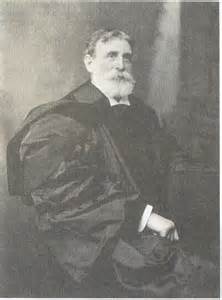
As I make my way through Bradley Gundlach’s excellent book Process & Providence, I came across a similar example from the 1800s. Back then, Princeton Seminary was the redoubt of thinking creationists. In 1856, the school’s journal offered a short review of a new book by David N. Lord, Geognosy, or the Facts and Principles of Geology against Theories.

In his long book, Lord argued that mid-nineteenth-century geologists often missed the boat. Such foolish pseudo-scientists, Lord wrote, mistook the boundaries of their own science and slid into both scientific and theological error when they suggested that the earth must have existed for millions of years.

Antique appreciation...

Antique appreciation…

Today’s conservative creationists might think that any self-respecting creationist would applaud Lord’s work. And the guardians of orthodoxy at Princeton did, to an extent. They described Lord’s goal as “elevated and holy.” His conclusions, however, did not sit well with the Old Princetonians.

In a way that might be surprising to today’s young-earth creationist crowd, the theologians at Princeton assailed Lord’s attempt to defend Scripture by attacking emerging geological science. Why? Not because they doubted the inerrant nature of the Bible. No, the Princetonians instead refused to allow their religion to be bound and hampered by any possible scientific discovery.

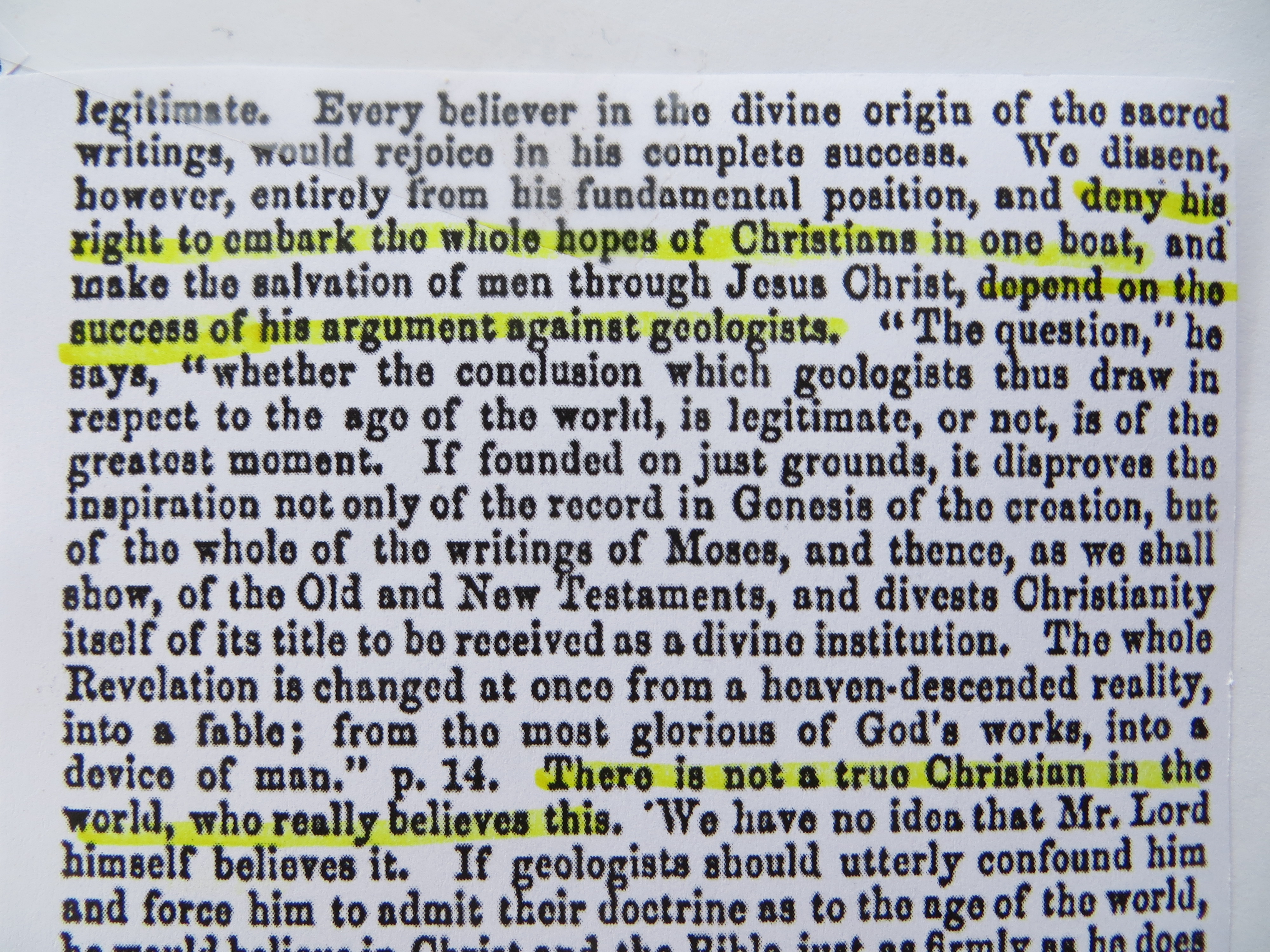
They “dissent,” the reviewers wrote, from Lord’s

Fundamental position, and deny his right to embark the whole hopes of Christians in one boat, and make the salvation of men through Jesus Christ, depend on the success of his argument against geologists.

Lord had argued that the new geology threatened to disprove Genesis. It was imperative, Lord wrote, for thinking Christians to disprove geology instead. Balderdash, huffed the Princetonians: “There is not a true Christian in the world, who really believes this.”Good old days 2 PRIME

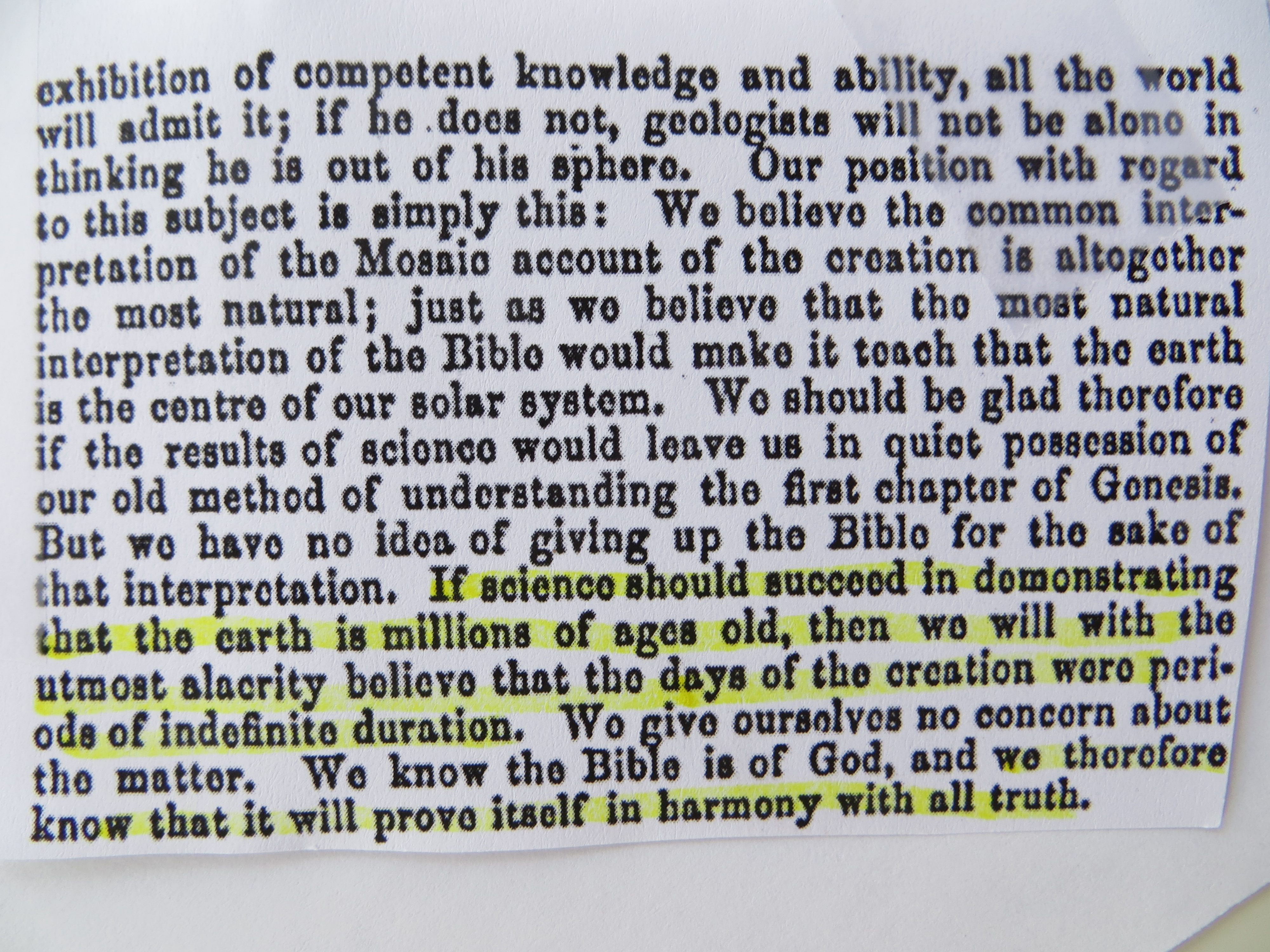
Instead, the old-earth creationists at Princeton insisted that creation was an established fact, whichever way the scientific winds might blow. “If science,” they concluded,

Should succeed in demonstrating that the earth is millions of ages old, then we will with the utmost alacrity believe that the days of the creation were periods of indefinite duration.

Creationism and Job Security

Creationism is more than just an idea, more than just a choice. In the United States, creationism represents a complete set of dissenting institutions: Schools, churches, publishing houses, summer camps, etc. These institutions do more than create an intellectual subculture. As we are reminded this morning, they also provide the nuts-and-bolts support creationists need in order to thrive.

For some of us outsiders, it can be difficult to understand how a creationist can remain so firmly entrenched in her beliefs when the claims of mainstream science seem so compelling. Recently, for example, Professor Dan Kahan drew attention to the ways creationist students can do well in mainstream science classes. He described the case of “Krista,” a high-school senior who excelled in her biology class while holding on to her creationist beliefs.

Krista wants to be a veterinarian. And, as Kahan points out, she might not be able to maintain her “cognitive dualism.” If she doesn’t, though, Kahan insists it will not be due to some sort of “logical or psychological contradiction.” To the contrary, Kahan concludes, Krista’s eventual “upsetting incompatibility” will be the result of

an imperfection in the constitution of an aspiring Liberal Republic of Science that hasn’t yet acquired the knowledge, created the institutions, and cultivated the public mores necessary to quiet the forms of cultural status competition that force diverse citizens to choose between using their reason to know what is known by science and using it to express their defining moral commitments (Elsdon-Baker 2015; Hameed 2015; Kahan 2015; Kahan in press).

In other words, if future Krista is forced to choose between the mainstream science she uses in her day job and the dissenting science she uses in her faith life, it will be because the United States has several competing scientific authorities. Our society, Kahan argues, has not yet figured out a way to decide between the scientific claims of creationism and the scientific claims of mainstream evolutionary science.  People like Krista (and the rest of us) are forced to rely on authorities to tell them which science is appropriate for them.

In her day-to-day life, though, Krista will likely be able to get by without straddling the boundaries between these competing scientific realms. More likely, Krista will continue her science career without ever needing to wrestle with its apparent contradictions. Her potential success will be due at least in part to the fact that creationists have successfully created institutions and cultivated creationist mores that allow creationists to use mainstream science without giving up their theological reservations. Perhaps even more important on the day-to-day level, Krista may succeed as a creationist veterinarian because her job might depend on it.

In academic realms, at least, creationism can be a big career boost. It has always been thus. As Bradley Gundlach has described in his great book Process & Providence, creationist colleges have often guaranteed steady work for creationists. In 1878, back when Princeton University and Princeton Seminary remained dedicated to a religious interpretation of emerging evolutionary science, school leaders worked hard to woo top creationists. The school took unprecedented measures to lure John William Dawson away from McGill University in Montreal. At that time, Dawson was one of a dwindling band of scientists with mainstream credentials who still disputed the transmutation of species.

Take this job and love it...

Take this job and love it…

Dawson didn’t come. But Princeton’s herculean efforts to get him demonstrate the possible career upside of creationism. If a geologist, or a veterinarian, or a science teacher can represent a dissenting creationist idea, then he or she will be uniquely attractive to the many institutions that insist on creationism.

Don’t believe it? Check out this morning’s job post on Ken Ham’s blog. As Ham explains, he doesn’t usually post such things, but he recently met with a school administrator from Kansas City. That school principal needed a science teacher, and he only wanted one who signed on to Ham’s brand of young-earth creationism. The school required a teacher who knew creation science and was “trained in apologetics.”

For students like Krista, as Professor Kahan argues, belief in a young-earth need not lead to any sort of intellectual discomfort at all. And, as this job posting reminds us, Krista might feel significant practical incentives to ignore any discomfort she might feel.

Commitment to a young earth and a special divine creation might, after all, offer increased job security in the nationwide network of dissenting creationist institutions.