Creationism, Conservatism, and the Common Core

What does creationism have to do with the newish Common Core Learning Standards? Some conservative activists and politicians are rejecting both in a knee-jerk attack on educational reform. In one new educational bill in Ohio, conservatives simultaneously threw out the Common Core and opened the door to creationism. But this isn’t just a question of creationism. Rather, this is a symptom of a broader conservative attitude toward public schooling.

Not just science, but history and literature are also targeted in this conservative educational power grab.

We first became aware of this new bill in Ohio thanks to the watchdoggery of the folks at the National Center for Science Education. The NCSE, naturally, worried first about the apparent opening of Ohio’s public-school science classes to intelligent design and creationism. Ohio’s House Bill 597 would insist on new standards that specifically “prohibit political or religious interpretation of scientific facts in favor of another.”  The sponsor of the bill, Andy Thompson of Marietta, told the Cleveland Plain Dealer that he included that language to allow school districts the freedom to include a variety of ideas about evolution, not to mandate that districts include intelligent design or creationism.

Representative Thompson wants the Common Core OUT and conservative curricula IN.

Representative Thompson wants the Common Core OUT and conservative curricula IN.

But the anti-Common Core bill also includes a broad-spectrum attack on the purportedly progressive nature of school curricula in other subjects as well. The original draft of the bill specified that 80% of the literature taught must be from American or British authors before 1970, though Thompson quickly backpedaled from that goal. But why was such a target included in the first place? As I detail in my new book, conservatives since the 1970s have looked skeptically at the trend toward “multicultural” literature. Conservative leaders from Max Rafferty to Bill Bennett have insisted that proper education—conservative education—must be based on the classics of our Western civilization. Anything else, they insisted, dooms children to a savage unawareness of their own cultural heritage.

In history, too, the Ohio bill insisted that history instruction include

the original texts and the original context of the declaration of independence, the northwest ordinance, the constitution of the United States and its amendments with emphasis on the bill of rights; incorporate the Ohio constitution; define the United States of America as a constitutional republic; be based on acquisition of real knowledge of major individuals and events; require the study of world and American geography; and prohibit a specific political or religious interpretation of the standards’ content.

Here also we hear echoes of long-time conservative worries. From Lynne Cheney to Dinesh D’Souza, it has become a commonplace of the conservative imagination that leftist history has taken over public education. As I argued recently in a commentary in History News Network, conservatives assume that students are taught that American history is the record of cruel white hate crimes against Native Americans, women, and African Americans. The Ohio bill hopes to rectify this America-bashing by mandating “real knowledge,” not just hate-filled Zinn-isms.

As we’ve seen time and again, conservatives are not united in their thinking about the Common Core. Some conservatives love them….or at least like them. Others blast the standards as yet another attempt at sneaky subversion from Washington.

In this new Ohio legislation, we see how some conservatives combine their loathing of the Common Core with a grab-bag of other conservative educational goals: Less evolution in science class, more America-loving in history class, and less multiculturalism in literature class. Taken together, conservatives such as Ohio’s Andy Thompson hope to broaden the anti-Common-Core juggernaut into a more ambitious conservative panacea.

 

Do You BELIEVE in Evolution?

It’s a deceptively simple question and it lies right at the heart of the creation/evolution controversies.  Unfortunately, Keith Blanchard’s recent opinion piece on the subject seems to miss the point.  Not because Blanchard doesn’t understand the issues, but because he deliberately hopes to change the conversation.  But it’s not that simple.  In at least two important ways, we need to wonder more deeply what we mean when we say we “believe” in evolution.

Can you BELIEVE this???

Can you BELIEVE this???

Blanchard writes from the heart of mainstream science.  We shouldn’t say we “believe” in evolution, Blanchard writes.  As he puts it,

if someone asks, “Do you believe in evolution,” they are framing it wrong. That’s like asking, “Do you believe in blue?”

Evolution is nothing more than a fairly simple way of understanding what is unquestionably happening. You don’t believe in it — you either understand it or you don’t…

Of course, we see what he means.  I even agree with his position.  But IMHO, this line or argument is nearly entirely beside the point.  It puts us evolution-supporters in the silly position of insisting that there is no debate about evolution.  Like Blanchard, we mean that the scientific facts of evolution are not open to debate, any more than is the fact of gravity or the fact of blue.

But so what?  How does that position get us anywhere?

Because there IS a debate about evolution, obviously.  Lots of influential people do not accept the facticity of evolution.  They do not accept that evolution explains the deep history of species on this planet.  Therefore, it matters to say that we believe in evolution.  Saying we “believe” in evolution, politically, means taking a stand about educational politics and cultural politics.

On a more basic level, too, saying that we believe in evolution has a value beyond Blanchard’s knee-jerk empiricism.  After all, in our society, we believe all sorts of things about which we only have a tentative or tenuous understanding.  For instance, when we have a serious medical malady, we trust in what medical experts tell us.  Not blindly, of course, but we talk to several experts and decide on a treatment course that seems to make sense to us.  We don’t necessarily understand every jot and tittle of the medical science.  But we take the life-or-death advice of doctors.  When it matters, we trust our experts.

And that is also the case here.  Saying we “believe” in evolution means something different than saying we understand its meaning.  Saying we “believe” in evolution means we trust a certain set of authorities over others.  Not blindly, of course, but in general outline.  So, for instance, when the National Center for Science Education mounts its Project Steve, I’m convinced.  The sheer numbers of mainstream scientists who publicly announce their “belief” in evolution convinces me.

After all, for educated folks these days, the un-interpreted evidence of our senses has long been suspect.  Blanchard writes that we should all trust the “evidence of [our] own senses.”  If we do so, he concludes, we’ll be convinced about the fact of evolution.  But educated people know that their senses might mislead them.  After all, the intuitive case for creationism is very strong.  Things seem to have been created according to some system, some plan.  Creationists might regularly appeal to people’s senses to prove their point, along the lines of Paley’s watchmaker.

As careful studies have proven, people who reject evolution don’t necessarily have a spottier understanding of science.  Contrary to what Blanchard says, people can and often do understand evolution yet reject it.  Michael Berkman and Eric Plutzer, for example, concluded from their large-group study of science teachers that creationists have an edge beyond the logic of folks like Blanchard.  Even among those Americans who understand that mainstream scientists agree on evolution, Berkman and Plutzer found, a large majority prefers that public schools teach both evolution and creationism.  That’s right: Even those Americans who know what mainstream science says about evolution still want schools to teach creationism.

In a world like that, Blanchard’s argument seems at best irrelevant.  Insisting that evolution is a simple fact, either to be understood or not understood, makes no sense in these circumstances.  On the other hand, if we say we “believe” in evolution, we’re doing something important.  Something with necessary political weight.

But there is one sense in which we should not try to “believe” in evolution.  Not Blanchard’s sense, but a more nuts-and-bolts kind of meaning.  As I’m arguing in an upcoming book with co-author Harvey Siegel, public schools need to get out of the belief business when it comes to evolution education.  That is, the goal of evolution education must not be to convince students to “believe” in evolution.  Rather, the goal should be to make sure all students understand it.

In a way, this is what Blanchard is saying, but I wonder if he would recoil in disgust from the implications.  Blanchard wants people to understand evolution.  We don’t “believe” in something that is obviously true.  We don’t “believe” in facts of nature.

In contrast, our prescription for public schools is that teachers adopt the goal of leading students to an understanding of evolution, and no more.  Students should be led to understand the principles of evolution, its mechanisms, and its evidence.  If they then choose not to “believe” evolution, that is an entirely private matter, beyond the realm of public school goals.

I don’t know for sure, but I suspect that this sort of “understanding-not-belief” is not what Blanchard has in mind.

What about you?  Do you “believe” in evolution?  What does it mean to “believe” it, rather than to just “know” it?  Or, from the other direction, what does it mean to “dis-believe” it, even if you understand it?


Creationists Love Angry Science Teachers

Why would America’s leading young-earth creation ministry go to the National Education Association convention?  After all, Answers In Genesis castigates the NEA for its “godless, liberal agenda.”  AIG frets that the NEA combats conservatives’ right to homeschool their children and to teach godly creationism.

But that anti-God bias is exactly why the creationists go every year.  Answers In Genesis tries to engage NEA attendees with the gospel of creationism.  The creationist outreach at the NEA convention hopes to explain the goals of creationists and melt the hard hearts of some secular teachers.

The folks at AIG are not the first conservatives to try such tactics.  For generations now, the National Education Association has been perceived by conservative education activists as the enemy.  The NEA is seen as promoting secularism and a wrong-headed moral relativism.  As conservative gadflies Mel and Norma Gabler argued in the 1970s, the NEA had always tried to get public schools to teach that “there was no absolute transcendental God, Bible, or system of beliefs.”

And even long before the Gablers, conservatives tried to maintain their influence with the NEA.  As I note in my upcoming book about conservative educational activism in the twentieth century, the patriotic school activists in the American Legion pioneered this approach.  For the stalwart conservatives in the American Legion, the NEA offered the best way to influence American public education.  Therefore, they held their noses and collaborated on American Education Week.  Starting in 1921, the Legion and the NEA encouraged schools nationwide to focus on a certain theme for a week.  They tried to get everyone in every community engaged with their public schools.  For the conservative leaders of the American Legion, this was a way to promote patriotism and religion in public schools.  For the leaders of the NEA, this seemed like a good way to direct the public’s attention toward its schools.

For conservatives, then, the NEA has long been a target.  Generations of conservatives have hoped to influence the NEA with conservative educational ideas.  Does it work?  The conservative creationists at AIG seem to think so.  One missionary to the NEA relates the story of “Tom,” a hostile secular science teacher.  After spending time with the creationists at the NEA convention, Tom was able to understand more about the wholesome gospel mission of the creationists.  Walls were broken down, hearts were touched.


Leading Historian Would Vote for Hitler

He just flew in from New York...

He just flew in from New York…

HT: MM

Would you vote for Philip Hitler? Jonathan Zimmerman would. At least, that’s what he told the funny man on The Daily Show the other day.

It’s a pretty funny bit. But more important, it’s great to see our leading educational historian getting to yuk it up with Jon Stewart’s minions.

If you’re not up on the world of educational history, you may not know Jon Zimmerman’s work. But for historians, Zimmerman’s the king. Kind of like the Derek Jeter of educational historians, except Zimmerman shows no signs of quitting.

When I started my graduate work, Zimmerman’s book Whose America pointed me toward the study of culture-war issues in educational history. And now, as part of Zimmerman’s book series on the history and philosophy of education, I’m working with philosopher Harvey Siegel on a volume about the ups and downs of evolution education. So Zimmerman has been hugely influential in my career, and I’m sure every other ed historian out there could say something similar.

And now it looks as if he’s moving into the comedy business. Fantastic.


Green Eggs and (Ken) Ham

Do you think of Dr. Seuss as a “fundamentalist” author?  Me neither.  But the fundamentalists want to claim him for their own.

Marvin Olasky of World Magazine offered recently a top-ten list of good children’s books.  Topping the list was Dr. Seuss’ Horton Hatches the Egg for its staunchly pro-life message.  The story, according to Olasky, presents Horton as a “pro-life hero.”

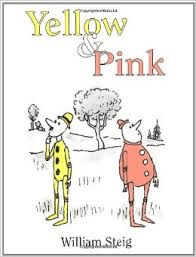
And that’s not all.  Olasky celebrates the conservative message of other leading mainstream children’s books as well.  William Steig’s Yellow & Pink tells more than just a cute story about puppets.  The two central characters wonder about their origins, with the evolution-y story of Yellow losing out to the creation-y story of Pink.

Where do we come from?

Where do we come from?

Dr. Seuss apparently didn’t like the pro-life associations of his Horton character.  But the creationism of William Steig is hard to miss in this book.

Makes me wonder—was Steig’s Shrek also some sort of creationist parable?


The Left Seizes Science

You’ve heard the howls from creationists over Neil deGrasse Tyson’s recent Cosmos series.  But did you know non-creationist conservatives also get cheeved at Tyson’s science punditry?

Science Snob?

Science Snob?

The creationist complaints make sense.  The hugely popular new science series pointedly called out young-earthers for their belief in a newish universe.  The series also insisted on the creation of species through evolution.

But the complaints of non-creationist conservatives might not seem so obvious.  In the pages of National Review, Charles C.W. Cooke took Tyson to task for his leftism, not just for his love of evolution.  Cooke accuses Tyson and others of his ilk of a puffed-up condescension, of glibly associating liberal politics with superior intellect.

Too many of these self-righteous faux-nerds, Cooke writes, wrap their insouciance in the mantle of science.  For these Tyson fans and wanna-bes, being smart does not mean doing actual intellectual work, but rather simply adopting a pre-packaged list of things to dislike.  As Cooke puts it, that list includes anything

southern, politically conservative, culturally traditional, religious in some sense, patriotic, driven by principle rather than the pivot tables of Microsoft Excel, and in any way attached to the past.

This sort of prejudice against anything recognizably conservative likes to call itself the side of “science,” Cooke argues.  Yet among progressives, real science often takes a beating.  “Progressives . . . ,” Cooke says,

believe all sorts of unscientific things — that Medicaid, the VA, and Head Start work; that school choice does not; that abortion carries with it few important medical questions; that GM crops make the world worse; that one can attribute every hurricane, wildfire, and heat wave to “climate change”; that it’s feasible that renewable energy will take over from fossil fuels anytime soon . . .

Yet in spite of this demonstrably unscientific attitude, Cooke laments, the Left insists on calling itself the “reality-based” party.

Cooke is not the first to complain about such things.  In the first generation of creation/evolution controversies, anti-evolution activists worked hard—and failed—to claim “science” for their side.  As I noted in my 1920s book, leading anti-evolutionist William Jennings Bryan maintained his membership in the staunchly pro-evolution American Association for the Advancement of Science.  He refused to allow that leading science group to be wholly taken over by fans of evolution.

Similarly, prominent 1920s fundamentalist activist William Bell Riley fought hard to keep his generation of Neil deGrasse Tysons from pushing conservatives out of the world of science.  As Riley put it in a 1927 speech, the creation/evolution debate was not a debate between

Experts on the one hand, and, as someone has said, ‘organized ignorance,’ on the other.  This is not a debate between the educated and the uneducated.

Like Bryan in the 1920s and Cooke in 2014, the conservative Riley was loath to cede the scientific and intellectual high ground to evolution-lovers.

One of the results of that first decade of evolution controversies was the formation of durable cultural associations, the associations about which Cooke complains.  Since the 1920s, “science” has become indelibly associated in the public mind with progress, with social experiment, with iconoclasm.  Politically, if not logically, all of those things are part of the broad package of cultural leftism.  And, like it or not, conservatism has been associated time and again with obstructionism and heedless obscurantism.

For conservative pundits like Cooke, trying to fight that tradition will be an uphill battle.


A Christian in the Lion’s Blog

Okay, be honest: How many of us are brave enough to try talking with people who really really hate us?  I talk a good game, but in real life I hardly ever interact with people very different from me.  Recently on the arch-evolutionist/atheist blog Why Evolution Is True Don McLeroy tried to defend his religion.  I don’t agree with McLeroy’s ideas about God or science, but I have to give him credit for his willingness to talk civilly with his culture-war enemies.

You may remember Dr. McLeroy as the Texas dentist who came to educational power a few years back on the Texas State Board of Education.  Viewers of the documentary The Revisionaries will remember some of McLeroy’s positions.  He wanted less evolution and more country music.  He wanted less hip-hop and more Ronald Reagan.

Those of us outside the world of young-earth creationism were wowed to hear McLeroy teach his Sunday-school class the verities of his religion.  How did all those animals fit on the ark?  Easy! How was it possible that all the evidence of an ancient earth was wrong?   No problem!

And some viewers poked fun at McLeroy for his anti-expert opinions.  “I disagree with the experts,” McLeroy famously intoned in The Revisionaries.  “Someone has to stand up to them.”  To many skeptics, this sort of attitude demonstrated McLeroy’s willful ignorance.  Why WOULDN’T we want experts to decide our school curricula, critics asked incredulously?  As I argued at the time, however, McLeroy’s ideas about proper expertise have a long and storied history among educational conservatives.

In his recent appearance on Why Evolution Is True, McLeroy defends his Biblical epistemology.  McLeroy had pointed out elsewhere that 500 witnesses had attested to Jesus’ rebirth.  For McLeroy, that seemed to be important evidence.  Not surprisingly, the commenters of WEIT tore McLeroy apart.  Some did it politely, calling him “Dr. McLeroy.”  Some did not, referring to him as “Donnie-boy.”

The crux of the disagreement concerned the nature of evidence and how we can know something.  For McLeroy, Paul’s biblical statement that 500 witnesses had seen the Risen Jesus seemed conclusive.  As the readers of WEIT pointed out—and I wholeheartedly agree—there are enormous holes with this sort of knowing.  How can we know Paul really consulted 500 other witnesses?  How do we trust what Paul thought he saw?  Indeed, how can we know Paul was a real person at all?  For folks like me and the commenters on WEIT, such evidence does not count as convincing.

For folks like Dr. McLeroy, the Bible’s writings carry greater weight.  If the Bible attests to something, we know with confidence that it is true.  If the Bible says God created the universe in six days, then we have no need to doubt it.  We can trust that it is true.  Indeed, if we don’t trust that it is true, we risk calling God Himself a liar.

'Cause the Bible Tells Me So...

‘Cause the Bible Tells Me So…

Obviously, these two very different attitudes toward knowledge have a difficult time communicating with each other.  But there seems to be a cottage industry of efforts to do so.  Conservative theologian Doug Wilson and atheist-at-large Christopher Hitchens spent some time together in the film Collision.  As Wilson and Hitchens found out, there is not much point in shouting at each other.  Each side misunderstands the other in such fundamental ways that time is better spent chatting politely and drinking beer.

In his recent appearance, Don McLeroy thanked WEIT commenters for their opinions, and promised to read the books suggested.  But he did not seem likely to be convinced.  Nor did WEIT readers seem likely to turn to the Bible the next time they had a question about science, history, or politics.  Nevertheless, McLeroy pointedly maintained his famous good-natured politeness.

In the end, that might be the extent of dialogue we can expect across these profound culture-war chasms.


Protect Children from Jesus

Have you heard the Good News?  If you live in Portland, Oregon, your children might hear It in their public schools.  Or they might not.

Activists in Portland have protested against the school-based evangelical outreach of the Child Evangelism Fellowship.  According to protesters, the CEF is inflicting damaging psychological messages on unwary children through its aggressive Good News Clubs.  For their part, the evangelists claim to be the victim of anti-religious discrimination.  Do parents have the right to kick out Christians?  Do evangelists have the right to preach to children?

These are big and potentially scary questions.  Each side in this case is warning that the other side is using sneaky tactics to target children.  But that kind of rhetoric belies the fairly restricted nature of this protest.  In this case, at least, the activists on each side are actually limiting themselves to fairly modest goals.

Save Our Children from Jesus!

Save Our Children from Jesus!

The Child Evangelism Fellowship has been active for a long time.  This summer, it planned to expand its Good News Clubs into more schools nationwide.  These clubs invite children to come to meetings at which they learn prayers and conservative Protestant doctrine.  In a 2001 decision from a town in my backyard, the US Supreme Court ruled that the Good News Clubs must be allowed to use public-school facilities after school hours if other groups are allowed to do so.  A few clarifications: the Good News Clubs are not active as part of the school day; public schools are free to ban ALL after-school activities if they choose; and Good News Clubs are not mandatory for children.  Still, for the CEF, the Supreme Court’s decision came as a welcome shot in the arm.

Portland protesters were not impressed.  This summer, the Protect Portland Children group mobilized to warn Portland parents away from Good News Clubs.  Due to the SCOTUS decision, the PPC is not trying to ban the clubs, but only to encourage parents to keep their kids away.  Why?  According to Katherine Stewart, a parent and author of an anti-CEF book, kids exposed to the Good News Clubs come away with a terrible message.  As Stewart told The Oregonian recently,

I started to hear about how kids attending the clubs were targeting their peers for what I can only describe as faith-based bullying and bigotry. The kids attending the clubs would say they knew the religion of the Good News Club “must be true” because they learned it in school. As one little six-year-old girl said to her classmate, “They don’t teach things in school that aren’t true.”

One Seattle activist agreed.  She insisted she was not anti-religion, but rather only opposed to the sneaky way the CEF attracted kids to their clubs, and to the terrifying message spread by those clubs.  As she put it, “Good News Clubs teach dark, divisive and potentially traumatic doctrines that are unique to fundamentalist forms of Christianity.”

Not surprisingly, conservative evangelical Protestants are defending the Good News Clubs. Creationist leader Ken Ham argued that this anti-gospel activism represented just another tactic in the continuing culture wars. “Many secularists,” Ham warned,

are deliberately and aggressively targeting our children and Christian ministries that teach the truth of God’s Word to children—and for a reason! They are going after the hearts and minds of this and coming generations, and if they continue to do so successfully, they’ll win the culture.

Ham’s interest makes sense.  After all, as he points out, anti-creationism activists have insisted that teaching creationism amounts to “child abuse.”  This Portland parent protest makes similar claims.  The protesters warn that this sort of religious message can be “psychologically harmful to children.”

According to protesters, both the tactics of the Good News Club and its message are dangerous to young people.  Learning that one is sinful and destined to eternal damnation, some parents feel, is not the proper religious message for children.  And luring those children to after-school activities with promises of treats and prizes seems immoral.

For their part, CEF activists claim that their clubs teach only the central doctrines of Christianity.  Whatever protesters may assert, according to the CEF, the Good News really is good news.  Schools with active Good News Clubs report improved student behavior and school environment.  Students act more kindly toward one another.  Students act more politely and thoughtfully about their behavior.  Who would have a problem with that?

But let’s clarify the issue: Portland protesters are NOT trying to block Good News Clubs from Portland schools.  And Good News Clubs are not part of the public-school day.  In spite of heated rhetoric, this case will not decide whether or not conservative Christian doctrines are dangerous for children.  This case will not decide whether or not evangelists can preach in public schools.

Nevertheless, activists on both sides are bringing out the big guns: Both sides warn that the other side is targeting their children.  That is a scary thing.  But neither side in this case really hopes to stop the other side from doing so.  Rather, each side seems to be limiting itself to more immediate goals.  Protesters are encouraging Portland parents simply to keep their kids home.  And evangelists are simply running an afterschool club and hoping to encourage kids to attend.

In my opinion, this is exactly where these discussions belong.  Evangelists should be free to spread whatever non-violent messages they choose.  And parents should be free to encourage others to keep their kids away.  If parents think Christianity is psychologically damaging, they should certainly tell their friends and neighbors about their concerns.  And if conservative evangelicals think that their message is the only way to avoid eternal damnation, they should certainly be free to tell anyone they like about it.


Creationist Credentials and the Toilet-Paper Doctorate

What does it take for a creationist to earn a PhD?  As arch-anti-creationist Jerry Coyne pointed out yesterday, not a whole lot.  Coyne looked at the embarrassingly weak doctoral work of young-earth creationist Kent Hovind.  This sham dissertation leads us to ask again about the paradoxical relationship between creationism and credentials.

patriot bible university

Hovind’s Alma Mater

It does not take a creationist-hater like Professor Coyne to find big problems with Hovind’s doctoral work.  Hovind cranked out a hundred awkward pages of claptrap about creationism under the auspices of Patriot Bible University of Del Norte, Colorado.

Intelligent creationists might cringe at this sort of hucksterism, with good reason.  It allows even the most accomplished creationists, such as Harvard-educated Kurt Wise, to be lumped together with this sort of snake-oil academic flim-flam.

Throughout the history of the creation/evolution debates, creationists have struggled to prove their intellectual bona fides.  It hasn’t been easy.  For the first generation of modern anti-evolutionists, it came as a surprise to find that their ideas no longer held sway at leading research universities and intellectual institutions.

As Glenn Branch of the National Center for Science Education demonstrated recently, this 1920s revelation led anti-evolutionists to scramble for certifiable creationist experts.  The most famous anti-evolutionist of the 1920s, William Jennings Bryan, groped awkwardly among scientists to find some who opposed “Darwinism.”

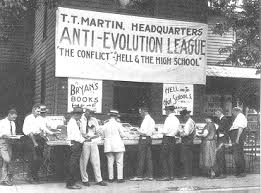
Bryan wasn’t alone.  As I note in my 1920s book, all the anti-evolution activists of the 1920s were obsessed with demonstrating that creationism[*] had expert support.  T.T. Martin, for example, who attracted attention with his eye-catching booth at the 1920s Scopes monkey trial, listed his expert supporters relentlessly.  In his book Hell and the High School, 67 out of 175 pages consisted of nothing more than lists of anti-evolution experts and their backgrounds.

Experts! Experts! Get Yr Experts Here!

Experts! Experts! Get Yr Experts Here!

Another anti-evolution activist from the 1920s showed similar determination.  On a typical page of Alfred Fairhurst’s Atheism in Our Universities, Fairhurst included only 23 original words.  The remaining 107 consisted of quotes from “leading writers on evolution.”

Writing in 1922, Arthur Brown used the same tactic.  He piled up impressive-sounding lists of experts and scientists who disputed evolution.  Why should readers accept evolution, Brown asked, when it had been discarded by the likes of

world-renowned men like Virchow of Berlin, Dawson of Montreal, Etheridge of the British Museum, Groette of Strassburg University, Paulson of Berlin, Clerk Maxwell, Dana, Naegeli, Holliker, Wagner, Snell, Tovel, Bunge the physiological chemist, Brown, Hofman, and Askernazy, botanists, Oswald Heer, the geologist, Carl Ernst von Baer, the eminent zoologist and anthropologist, Du Bois Reymond, Stuckenburg and Zockler, and a host of others. . . .  It seems to be a fact that NO opinion from whatever source, no matter how weighty or learned, is of any account with those who are consumed with the determination to reject the Bible at any cost, and shut God out of His universe.

As I traced in my 1920s book, following the work of historian Ron Numbers, this impressive-sounding list did not really make the point Brown hoped it would.  The names he listed came from earlier generations or from scientists who agreed with evolution’s broad outlines but disagreed on details.  But Brown, like Bryan, Martin, Fairhurst, and virtually all other creationist activists felt compelled to establish the academic credentials of anti-evolutionists.

Hovind’s case reminds us of this peculiar conundrum of credentials among creationists.  One does not have to be an evolutionary bulldog like Professor Coyne to find Hovind’s academic pretensions silly and reprehensible.  Hovind’s work certainly gives skeptics such as Professor Coyne an easy route of attack.

For those of us who don’t care to attack or defend creationism, though, Hovind’s doctoral ouvre offers different lessons.  Once a dissenting group has been turned away from mainstream institutions, credentials become both more precious and easier to attain.  At least since the 1920s, that is, anti-evolutionists have scrambled to find expert backing for their beliefs.  But once creationism had been kicked out of elite research universities, it became far easier for creationists to claim credit for academic work at bogus universities.  If universities themselves are suspect, in other words, the ridiculousness of diploma mills like the Patriot Bible University becomes less damning.

[*] The term “creationism” is an anachronism here.  Anti-evolutionists in the 1920s did not call their beliefs “creationism” yet.  But I’ll use it just to keep things readable.

US Government Employs Creationist Scientists

Thanks to the ever-watchful Sensuous Curmudgeon, we learn of plans to open a new, enormous creation museum near Boise, Idaho.  But in exploring the announcement of this planned mega-museum, we came across an interesting tidbit: Two of the creationist scientists involved in this project worked for the US government as geologists.  Does this mean that the government is funding creation science?  And does it prove the creationist claim that their experts are engaged in “real” science?

As reported yesterday by the Boise Weekly, the Northwest Science Museum has big ambitions.  Its founders want to open an enormous display area, 300,000 to 450,000 square feet.  They hope to build a full-size replica Noah’s Ark that could rival the plans of the more-established Creation Museum in Kentucky.

Big Plans for Boise

Big Plans for Boise

Whether or not the Idaho creationists succeed in their lavish plans, they will likely end up adding another stop to those who want to tour the nation’s many creation museums.  More interesting, the announced plans also raise crucial questions about creationism and government support for religion.

In their attempt to raise funds for their new project, the leaders of the Boise museum published a prospectus that includes information about themselves.  According to this document, the leadership team includes two experienced geologists.

Douglas J. Bennett, founder of the museum, has degrees in geology and science education from Boise State University.  For the past eighteen years, Bennett has worked as a geologist for the US Bureau of Reclamation.  Similarly, museum founder Brent Carter earned a degree in geology from a large public university and worked for 42 years as a geologist for the same US Bureau, retiring with the title of Chief Geologist of the Pacific Northwest Region.

More than the opening of a new creation museum, these careers raise important questions for those of us interested in issues of evolution and creationism.

First, some might suggest that long governmental careers for these ardent and active creationists implies government support for religion.  But does it really?  After all, the government likely hired them to do specific jobs.  They had the necessary qualifications.  Whatever they chose to do in their private lives wouldn’t be any of the government’s business.  Nor would the government be supporting these men’s religious work, as long as each geologist didn’t do his creationist research while on the clock.

More interesting, we have to ask what these careers tell us about the intersection of mainstream science and creation science.  In the recent debate between leading creationist Ken Ham and leading science pundit Bill Nye, Nye repeated his charge that creationism blocked kids from learning science.  Ham retorted with several examples of successful creationist scientists and engineers.

The careers of Bennett and Carter seem to help the creationist case.  After all, if they have both had successful careers as geologists, how can we say that creationists can’t do science?  One might suggest that the sorts of engineering tasks these creationists engaged in were not primary science.  But it seems to me a stretch to say that these creationist geologists did not have careers specifically in the science that is contested.  In other words, both of these men worked as geologists, though their religious beliefs gave them very non-mainstream ideas about that geology.

Consider—again from the museum prospectus—the tasks Bennett claimed to have worked on for the US government.  As part of his job, Bennett

Performed surface and subsurface geotechnical studies and exploration programs utilizing diamond drill, power-auger, test pits, tunnels, and other processes to secure data for seismotectonic, ground-water, and other special studies of dams, reservoirs, canals, tunnels, spillways, power plants, and related structures.

One might say that none of this engineering work includes primary geological research.  And if it did, someone who believed in a young earth and a recent world-wide flood would be at a crippling disadvantage.  But anti-creationists sometimes make a different point.  Bill Nye, for instance, has warned that a creationist nation will soon fall behind in technology and engineering.

The careers of Bennett and Carter seem to demonstrate the weakness of that argument.  Indeed, Nye argues that creationism will turn kids away from science-related careers.  But in the case of these two men, at least, it was precisely their religious beliefs that led them to careers in geology.

So does this case show government support for creationism?  Not really.  But it does offer evidence that creationism does not necessarily deter young people from going into science-related careers.  Indeed, because of the tumult over the nature of biology and geology, perhaps creationist beliefs actually drive some young people into careers in science.