
If I want my child to have her faith protected at college (and I don’t), where should I send her? Sometimes the answer can be surprising, as new evidence keeps reminding us. Maybe the environment at “secular” colleges isn’t so hostile after all.
As my current research is hammering home to me, one of the most powerful themes among conservative evangelicals and fundamentalists in the twentieth century has been that mainstream education can be dangerous. Children, conservatives have believed, will learn evolution, secularism, and loose morals at most schools and colleges.
As a result, conservative evangelicals have founded and protected a network of explicitly fundamentalist colleges, schools such as Wheaton College, Bob Jones University, Biola University, and many others.
As a professor at a large public university, though, I can’t help but wonder if our “secular” universities are really such hostile places for conservative Christians. Don’t get me wrong: I am likely one of the secular, skeptical, left-leaning academic types many conservatives worry about. But are folks like me the only sorts of professors allowed at big research universities?
A new talk by Jeff Hardin of the University of Wisconsin—Madison helps shatter that stereotype. Hardin spoke with journalists a few weeks back at the Ethics and Public Policy Center about the proper way to talk about creation, evolution, and evangelical religion.

C’mon back, Christians!
Hardin’s academic credentials are impeccable. He is a biophysicist at a leading research university. He has a PhD from Berkeley. He has published widely, including authoring a mainstream textbook. He now chairs Madison’s zoology department. And he is an evangelical Christian.
The main thrust of Hardin’s talk was the many differences between and among “creationists.” One can be a young-earth creationist like Ken Ham, or one can be an evolutionary creationist like Hardin himself. There are intelligent design folks, progressive creationists, and even run-of-the-mill unreflective creationists. Hardin wanted his audience of prominent journalists to be more aware of these nuances. He wanted them to avoid talking about “creationists” as an undifferentiated mass of young-earth believers. Certainly, an important point.
For our purposes, Hardin himself presents a more interesting idea. For many conservative evangelicals, mainstream colleges represent an onslaught of secularist ideas. Conservative religious students at such schools, evangelicals have assumed, must prepare themselves to be battered by hostile skeptical professors and an amoral campus culture.
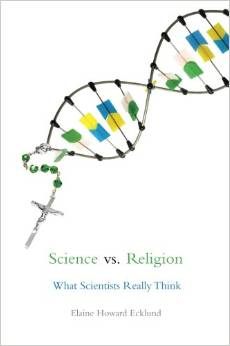
Don’t know much about religion…
And of course there is some truth to such stereotypes. As sociologist Elaine Howard Ecklund has argued, elite academics at schools like Madison tend to be ignorant or even hostile to conservative religious faith. Like all stereotypes, though, there are important exceptions. In his talk, Hardin tells a story of his work at Madison. An evangelical graduate student came to him one day. As Hardin tells the story,
he spilled his heart out in this meeting, and he explained that he was very close to jettisoning his Christian faith when he came to the university because he realized what he had been told about science didn’t square with what he learned at the university, and so he felt that he was pushed into an impossible position: either accept his Christian faith and jettison what he was learning about science or, conversely, accept was he was learning about science and cut loose his Christian faith. He seemed to be in an impossible situation. And so we talked about options and I helped him think through a lot of these issues.
For this student, at least, attending a leading “secular” college did not mean his faith was battered and attacked. This student found an evangelical mentor at a school that has been infamous among fundamentalists since the start of the twentieth century, as I recount in my 1920s book.
So what is the most “Christian” college out there? Is it a staunchly evangelical school that insists all faculty conform to a fundamentalist statement of faith? Or it is a pluralist school that offers young scholars a range of mentors and intellectual futures?
Hardin helps demonstrate that our so-called secular universities are not quite so secular. A better word to describe them might be “pluralist,” since they include students and faculty members of a variety of religious backgrounds.




 I Love You but You're Going to Hell