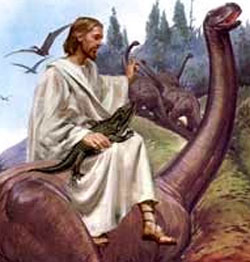
So Jesus WAS on a Dinosaur…?

We just don’t know what we’re talking about.

Could've happened...?

Could’ve happened…?

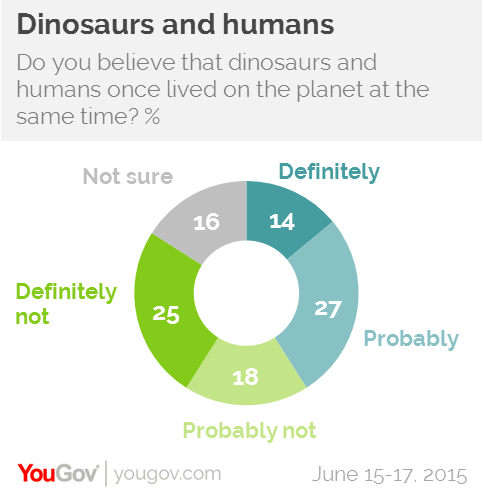
A new poll inspired by the hit movie Jurassic World suggests that Americans don’t know much about much. Thanks to the ever-watchful folks at the National Center for Science Education, we see some startling responses to a simple question: Did humans and dinosaurs live at the same time?

As YouGov explained,

YouGov’s latest research shows that 41% of Americans think that dinosaurs and humans either ‘definitely’ (14%) or ‘probably’ (27%) once lived on the planet at the same time. 43% think that this is either ‘definitely’ (25%) or ‘probably’ (18%) not true while 16% aren’t sure. In reality the earliest ancestors of humans have only been on the planet for 6 million years, while the last dinosaurs died out 65 million years ago.

Ouch.

For evangelicals, the numbers are even more skewed. A clear majority (56%) of evangelical Protestants think humans and dinosaurs co-existed. Only 22% of evangelicals thought that dinosaurs and humans did not.

...doh!

…doh!

As the National Center for Science Education points out, there are a couple of possible wrinkles in this poll. Most scientists these days consider birds to be dinosaurs. Is that what the respondents meant? The NCSE charitably suspends judgment, but it seems obvious to your humble editor that most of us just don’t know what we’re talking about.

Gay Marriage and Christian Resistance

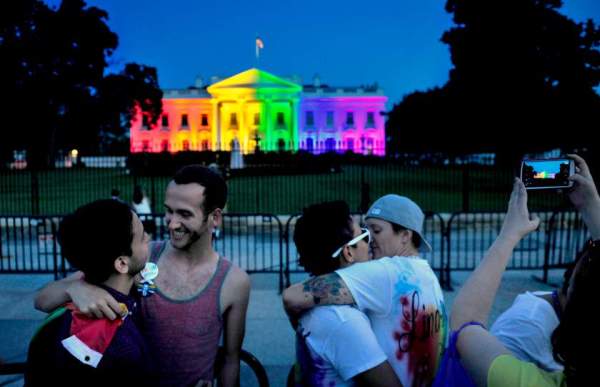
What is a conservative Christian to do? The US Supreme Court’s decision in favor of gay marriage has sent shock waves across America. Will conservative Christians accept this decision? Or, as some have warned, does this move our culture war over sexuality one step closer to real war?

More rainbows than a box of Lucky Charms...

More rainbows than a box of Lucky Charms…

Of particular interest at ILYBYGTH these days, the new ruling will likely meet its first test at conservative religious colleges. As we’ve noted (and as the New York Times eventually noticed) the SCOTUS ruling has brought up questions about the limits of acceptable dissent in higher ed. Can schools discriminate against homosexual “practice?” As I’m writing about in my current book, the same tension played out in the 1970s, when Bob Jones University insisted on its religious right to racial discrimination. It seems colleges will be the first institutions to feel pressure to accommodate demands to end institutional discrimination against homosexuals.

The reaction to the SCOTUS decision has been fast and furious among conservative evangelicals and other Christians. Rick Scarborough of Vision America told the New York Times that the decision must be resisted. “If they change the playing field and make what we do out of bounds,” Scarborough said,

we will disobey; we will disrespect this decision. . . . We’ll treat it like Dred Scott and other decisions courts have handed down over the years that counter natural law. God made a male and a female, and no amount of surgery is going to change that.

Similarly, Robert Jeffress told the Christian Post that the decision proves America’s persecution of Christians. As the Rev. Jeffress put it,

I think today’s decision is just one more step in the marginalization of conservative Christians. I made this argument and have been ridiculed for doing so, but I think it is very legitimate. The Nazis did not take the Jews to the crematoriums immediately. . . . The German people would not have put up with that. Instead, the Nazis begin to marginalize the Jewish people, make them objects of contempt and ridicule. Once they changed the public opinion about the Jewish people, then they engaged the [Holocaust]. . . . Once secularists have made Christians objects of contempt, I think it will be very easy to revoke other rights that they have as American citizens.

And in the pages of World Magazine, Ryan Shinkel advocated Christian resistance to an overweening state and society. “The movement for marital restoration is beginning,” Shinkel wrote just before the SCOTUS decision,

and the chance for moral courage and a life daring to be countercultural is at hand. By continuing to speak up for religious freedom, the restoration of a marriage culture, and dignity of the family in the face of potential setbacks at the Supreme Court, we can become the Nietzscheans who hammer the libertine and atomistic idols of our age.

Secular folks like me, progressive people who celebrate the SCOTUS decision, might blanch at these dire warnings. Some of my friends and colleagues might take these statements as proof that conservative Christians will never admit to marriage equality. But folks like us need to listen also to the other voices of conservative Christians.

In the Washington Post, for example, Russell Moore of the Southern Baptist Convention suggests Christians calm down. It is a terrible ruling, Moore agrees. And it does indeed push conservative evangelicals into a dissenting position that might seem “freakish” these days. But so what? Moore wants conservatives to “embrace a freakishness that saves.”

Similarly, Mark Galli of Christianity Today worries that evangelicals will react badly. “The temptation,” he writes,

is to go off and sulk in our holy corner. Or to dig in our heels and fight harder. Or to lash out in anger. Or to despair. We can do better.

The goal for Christians, Galli writes, is to take confidence that they are on the right side, God’s side. This decision provides another healthy—if intensely uncomfortable—opportunity for Christians to re-engage with important questions above love, marriage, and the proper relationship between Church and society. Though some conservatives might offer extreme rhetoric, Galli warns, evangelicals in America “are far from living at the margins.”

If we are to make sense of the culture-war rhetoric surrounding this SCOTUS decision, we need at least to remember some historical precedent. As I’ve argued elsewhere, for generations evangelical Christians have been battered by landmark SCOTUS decisions that seem to kick them out of public life. In every case, evangelical pundits have insisted that each new SCOTUS decision changed America from a Christian nation to a persecuting Babylon. In every case, however, evangelicals have continued to wield enormous cultural and political power.

Will this decision be any different? Will this decision really change the balance of power in America’s continuing culture-war debates?

Christians & Caitlyn

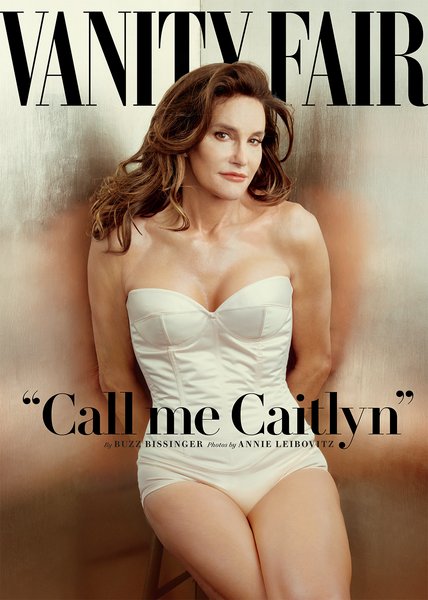
What are conservative evangelical Christians to do? Mainstream American culture seems to be celebrating our newfound openness about sexuality and gender identity. Caitlyn Jenner is feted and adored, not stigmatized and isolated. Should evangelicals join in the celebration? In the pages of Christianity Today, evangelical psychologist Mark Yarhouse lays out his vision of the proper Christian response to transgender issues. Will it work? Can it lift evangelical churches above the culture-war fray?

First, the usual caveat: I’m no evangelical. I’m just a mild-mannered historian interested in culture-war issues. Today’s article by Professor Yarhouse will help outsiders like me understand one way conservative evangelicals might understand those issues.

Good news for the Good News?

Good news for the Good News?

Yarhouse works at Regent University in Virginia, where he directs the Institute for the Study of Sexual Identity. For evangelicals, Yarhouse argues, there are three common reactions to today’s discussions about gender dysphoria.

First, some Christians think of it as a question of “integrity.” God created us male and female, some think, and we need to respect that.

Or, Christians might think of gender dysphoria as a “disability.” Like depression or schizophrenia, gender dysphoria is a mental-health issue. It is not a moral question, Yarhouse argues, though the decisions people make as a result of their mental-health issues can certainly have moral consequences.

Finally, Yarhouse notes, many mainstream Americans see gender dysphoria through the lens of “diversity.” Seen this way, transgender persons should be celebrated for their bravery and moral courage.

In language that some conservative folks might find disconcerting, Yarhouse thinks there is value in all three of these approaches. Churches must continue to value ideas about gender integrity, he believes. Understanding maleness and femaleness must be part of any attempt to live Christian lives. But he thinks evangelicals should also approach transgender people with “empathy and compassion.” Not least, Yarhouse values the notion that transgender people should be welcomed and celebrated, just as every person who comes to every church should be welcomed and celebrated.

As he puts it,

When it comes to support, many evangelical communities may be tempted to respond to transgender persons by shouting “Integrity!” The integrity lens is important, but simply urging persons with gender dysphoria to act in accordance with their biological sex and ignore their extreme discomfort won’t constitute pastoral care or a meaningful cultural witness.

The disability lens may lead us to shout, “Compassion!” and the diversity lens may lead us to shout “Celebrate!” But both of these lenses suggest that the creational goodness of maleness and femaleness can be discarded—or that no meaning is to be found in the marks of our suffering.

Most centrally, the Christian community is a witness to the message of redemption. We are witnesses to redemption through Jesus’ presence in our lives. Redemption is not found by measuring how well a person’s gender identity aligns with their biological sex, but by drawing them to the person and work of Jesus Christ, and to the power of the Holy Spirit to transform us into his image.

Churches, Yarhouse argues, must rise above “culture wars about sex and gender that fall closely on the heels of the wars about sexual behavior and marriage.”

Now, I’m not an evangelical and I’m not a transgender person, so I’m probably getting this wrong. But as an outsider, I can’t help but feel underwhelmed by Yarhouse’s prescription. I can’t help but notice that many conservative evangelical communities are influenced at least as much by their conservative identity as by their evangelical one. For many thoughtful conservatives, the rush to embrace transgender people as part of a “new normal” seems pusillanimous. Even if they recognize the Christian weight of Yarhouse’s arguments, they still feel bound to defend traditional gender rules and norms.

And from the other side, if I were a transgender individual, I don’t think I’d feel fully welcomed into a church that still insisted on maintaining a respect for the “integrity” of male-female gender duality. That is, even in the best-case scenario, if a Yarhouse-ite church allowed me to become a member, but maintained a strong sense that I was suffering from a disability and that I was somehow going against the integrity of God’s gender plan, I don’t think I’d rush to join.

Am I off base? Do conservative Christian readers find Yarhouse’s ideas compelling? Do transgender folks?

Christians and the Gay Bandwagon

There’s no question that American attitudes toward homosexuality are changing at a dizzying pace. Conservative evangelical Americans are changing, too. A recent article in the New York Times described a high-level meeting between concerned evangelicals. As I found in the archival research for my new book, evangelicals used to feel an almost murderous fear and hatred of homosexuality. That is no longer the case. But conservative evangelicals still have a hard time justifying their growing acceptance of homosexuality.

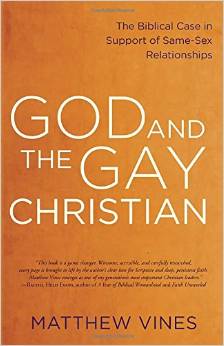
The NYT article describes a meeting at Biola University in California between Matthew Vines and a collection of influential evangelicals. The young Mr. Vines came to public attention recently with his Christian plea for acceptance, God and the Gay Christian. What is the proper evangelical attitude, the discussants asked—the Biblical attitude—toward homosexuality?

A lonely worker in the Vines-yard?  Or the wave of the evangelical future?

A lonely worker in the Vines-yard? Or the wave of the evangelical future?

The fact that this discussion took place at all shows the enormous changes in evangelical America on the subject. But the article raises a perennial question: Why are evangelicals changing? Is it just to keep up with changes in mainstream culture? Do evangelicals simply shift their interpretation of Bible passages when it becomes culturally convenient?

At the outset, I should clarify my position. I’m no evangelical and I have always had trouble understanding how anyone could think other people’s sexuality was their business. For me, the issue of gay rights has always gone beyond big questions of marriage rights to more basic claims to equality. In short, I believe, no one should have to apologize or explain their sexuality. I do think this is the moral high ground, but I recognize that it didn’t take any moral courage for me to get here. The way I grew up, it would be weird for me not to feel this way. I’m sure that if I grew up in different circumstances I would feel very different about it. Nuf sed.

At Biola, organizers invited Mr. Vines to talk about homosexuality and evangelical belief along with a panel of influential figures, including Biola professor and public intellectual Sean McDowell, local pastors Rev. Caleb Kaltenbach and Rev. Ian DiOrio, and Christian radio host Frank Sontag. For hours, the men talked about homosexuality and Biblical belief. Is it possible for evangelicals to understand Romans 1 in any other sense? In that oft-quoted passage, Paul explicitly condemned homosexual practice.

A majority in the room seemed disposed to embrace a change in evangelical attitudes. Vines himself is gay. Kaltenbach has a gay father and two gay mothers. DiOrio has a gay brother and worked in a gay nightclub. But those are not theological reasons.

Evangelicals are in a different position from secular folks. They can’t simply change their beliefs because it seems polite. Rather, they base their ideas on their readings of Scripture. Of course, intelligent evangelicals understand that our interpretation of Scripture can be wrong, even if Scripture itself can’t be. So while secular conservatives such as Dick Cheney can change their minds without much soul-searching, conservative evangelicals need to justify their change in terms of Biblical interpretation.

The Rev. Kaltenbach explained this evangelical dilemma. “In Romans 1,” Kaltenbach told the NYT,

I cannot get past where Paul says that the actual act of having sex with someone of the same gender is a sin. I can’t get past that. And believe me, with two parents who are gay, you’ve got to know I tried, even exegetically through the Greek.

Evangelicals don’t only have to change their minds. They have to justify that change by changing their interpretation of Scripture. And they have to do it fast. There can be no doubt, after all, that evangelical minds are changing. Even to host a respectful meeting between an openly gay evangelical and relatively sympathetic listeners marks the vast break from the past.

Buried in the Biola archives is evidence of a shockingly different attitude toward homosexuality. In the early 1950s, a former Biola student faked his own death in order to avoid exposure as a homosexual. Once the story was out, the student wrote an apology to Biola. He apologized for being a “filthy so-and-so,” and promised that prayer had cured him of his “perverted urge.”

Biola’s administration offered a public explanation of this student’s scandalous behavior:

He has for a number of years been a victim of a vicious condition of inherent baseness and depravity. The Bible clearly describes the condition in Romans One. We give it a more common name of ‘homosexuality.’ Socially it is condemned. Spiritually it is sin. It is impossible to have part in this sordid thing without paying the penalty of mental distress and mental illness that may even lead to more vicious acts, including murder. . . . Surely the devil has taken some measure of control of this man and we need to pray for him.

Of course, in the 1950s evangelical Americans weren’t the only ones with vicious and shockingly angry attitudes toward homosexuality. The US State Department purged homosexuals, since homosexuality was seen at the time as a national security risk.

For conservative evangelicals, however, changing norms carry a different moral weight. It is not acceptable to simply change one’s mind. Rather, conservative evangelicals need to remain true to the primacy of Scripture. If the Bible teaches X or Y, conservative evangelicals need to respect that.

The question facing Mr. Vines and other evangelical gay-rights activists is clear: Will evangelicals find a way to change their minds?

The Creeping “Christian” Coup

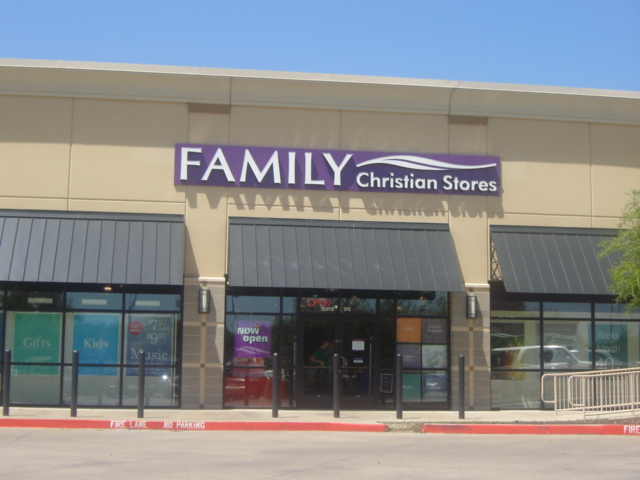
Take a stroll around America and you’ll see bajillions of “Christian” book stores, “Christian” schools, “Christian” churches. Of course, these institutions represent a certain sort of Christianity, a conservative evangelical Protestant one. There are lots of Christians who do not fit this definition of “Christian.” But a new set of survey data from the Pew Research Center for Religion and Public Life shows that the gap between the two seems to be narrowing. There are fewer Christians overall, but “Christians” are doing just fine.

Anytown, USA

Anytown, USA

So get ready for it. In the next week or so we’ll hear lots of exclamations about the recent Pew numbers. We’ll be told that the United States is becoming less Christian. As the folks at Pew tell us,

The Christian share of the population is declining and the religiously unaffiliated share is growing in all four major geographic regions of the country. Religious “nones” now constitute 19% of the adult population in the South (up from 13% in 2007), 22% of the population in the Midwest (up from 16%), 25% of the population in the Northeast (up from 16%) and 28% of the population in the West (up from 21%). In the West, the religiously unaffiliated are more numerous than Catholics (23%), evangelicals (22%) and every other religious group.

Does this mean we’ll see an abatement in culture-war scuffles over religion? Will America disagree less about abortion? Gay rights? School prayer? Evolution?

Not likely. In fact, we should expect the opposite.

Here’s why: Christianity’s share of the overall population might be dwindling, but evangelical Christianity has shrunk, if at all, by a much smaller percentage. In the words of the Pew report,

The new survey indicates that churches in the evangelical Protestant tradition – including the Southern Baptist Convention, the Assemblies of God, Churches of Christ, the Lutheran Church-Missouri Synod, the Presbyterian Church in America, 0ther evangelical denominations and many nondenominational congregations – now have a total of about 62 million adult adherents. That is an increase of roughly 2 million since 2007, though once the margins of error are taken into account, it is possible that the number of evangelicals may have risen by as many as 5 million or remained essentially unchanged.

I don’t know why the pollsters lumped Missouri Synod Lutherans in with evangelical denominations, but they certainly belong in the conservative camp. In any case, as anyone who knows the long history of our culture wars is aware, the fiercest fights have usually been between liberal and conservative Protestants.

Many of our liberal and secularizing culture-war leaders have come from mainline Protestant denominations. These days, for example, from the United Church of Christ, the denomination formerly known as Congregationalism, The Reverend Barry Lynn heads the liberal Americans United for Separation of Church and State. In the 1920s, as I argue in my first book, liberal Protestants such as Edward Birge and Edwin Conklin led the fight for evolution education.

If that sort of liberal Christianity continues to dwindle, it is entirely possible that Americans will come to agree that to be a “Christian” means adhering to a conservative evangelical Protestant faith. It might even snowball. The new Pew numbers show that evangelicalism is the only major religious group to pick up adherents from other churches. As they put it,

The evangelical Protestant tradition is the only major Christian group in the survey that has gained more members than it has lost through religious switching. Roughly 10% of U.S. adults now identify with evangelical Protestantism after having been raised in another tradition, which more than offsets the roughly 8% of adults who were raised as evangelicals but have left for another religious tradition or who no longer identify with any organized faith.

If evangelical Christianity bucks the trend of shrinking Christian identification, it makes sense to think that soon more and more Americans will identify evangelicalism with Christianity as a whole. What might that mean?

It’s impossible to predict, of course, but I’ve got a couple of hunches. First, we’ll see a stronger distinction between liberal evangelical Protestants and conservative ones. There is a strong tradition of politically progressive evangelicals, but its story tends to get swamped when people talk about evangelicalism.

Second, we’ll see a continuing weakening of the racial divisions between conservative evangelicals. As the new Pew report asserts, “Black Protestant” groups are also growing. But the Pew pollsters don’t differentiate between very different sorts of African American evangelicals. If evangelicalism becomes more of a stand-in for Christianity as a whole, pollsters will begin to connect conservative evangelicals across the race line. The interesting questions will become how many conservative evangelicals there are out there, not how many “Black Protestants.”

Third, and for SAGLRROILYBYGTH perhaps the most interesting, we will likely see a heating-up of culture-war rhetoric. Conservative evangelicals will frame themselves more and more vociferously as the voice of “Christianity.” With smaller numbers of liberal Christians to naysay, the identification of conservative evangelicals with the entire Christian community will become ever tighter.

Jesus and American Sniper

HT: SD

Every smart Christian knows that real religion is bigger than any one country, any one patriotic tradition. But in the United States, conservative evangelicalism has become so tightly bound with traditions of patriotism and national pride that it can be difficult to separate the two. Just ask Randy Beckum.

Until Monday, Dr. Beckum served as both University Chaplain and Vice President for Community Formation at Mid-America Nazarene University, a small-ish holiness school in Kansas. After a controversial chapel talk, Beckum found himself out of a job. Beckum had wondered aloud if America’s fascination with the film American Sniper meant that “our culture is addicted to violence, guns, war, revenge and retaliation.”

Evangelical Christians need a reminder, Beckum said, that

We have to be very careful about equating patriotism with Christianity.   We never say God and…anything.  God is above all, everything else is underneath. I love my country and am thankful for freedom. But the earliest Christian creed was very politically incorrect and dangerous. Jesus is Lord and Caesar is not. We have put “our way of life”/freedom on the top rung.

For those of outside of the world of MidAmerica Nazarene University, these seem like rather unremarkable sentiments. But at that school, they sparked a firestorm of controversy. As one MNU student tweeted, “So your [sic] saying that my long list of family members in military [sic] are not good Christians?”

MNU President David Spittal denied that Beckum’s removal from the VP job had anything to do with the patriotism controversy. But Blake Nelson, a “resident educator” at MNU, objected. As Nelson wrote in an open letter to the MNU community,

When one exercises his or her right to wrestle with big questions, and is demoted the next week, it feels as if we have all been demoted. If someone’s job security isn’t safe in the aftermath of their wrestling with the Word of God, none of us are safe. No matter what language it is couched in, a demotion like this creates fear where there should be freedom. Whether or not it was intended to be, this is an implicit attack on free expression. If it looks like a duck, and quacks like a duck, it’s probably a duck. The message is clear. This is a censure.

For conservatives throughout the twentieth century, too, it has been difficult to separate patriotism from religious sentiment. As I argue in my new book, educational conservatives have long blended the two into an organic whole. Conservative Texas leaders Mel and Norma Gabler, for example, always linked creationism, traditional Protestantism, patriotism, and free-marketism in an seamless conservative fabric.  As an admiring biographer wrote in 1986,

They understood why the new history, economics, and social study texts trumpeted Big Brother government, welfarism, and a new socialistic global order, while putting down patriotism, traditional morality, and free enterprise. Simply stated, Mel and Norma realized that the Humanists in education were seeking to bring about the ‘social realism’ which John Dewey and other ideologues had planned for America.”

Dr. Beckum and the MNU community are finding out just how hard it can be for conservatives to separate out their love for Jesus with their love for America.

Hookers for Jesus; or, Fundamentalists on Valentine’s Day

Well…didn’t Jesus hang around with tax collectors and prostitutes? Former sex worker Annie Lobert is promoting her new book, Fallen: Out of the Sex Industry and into the Arms of the Savior. She told The Christian Post recently that romance—real romance—should start and end with the love of Jesus Christ. It prompts us to ask a central but awkward question: Are evangelicals really all that different from the rest of us when it comes to love and sex?

To those of us outside the circle of evangelical Christianity, this sort of religion-ized sexual tell-all can seem like a cheap way for sexually repressed evangelicals to get their jollies. Time and again, as an outsider observing conservative religious culture, conservatives’ attitudes seem like nothing so much as a “health” lecture at a strict Midwestern high school in 1953.

But is that fair?

The pages of evangelical magazines exploded recently with comments about Fifty Shades of Grey. Evangelical women were scolded for reading the book, which one writer condemned as “a written form of pornography, plain and simple.” Other conservatives offer visions of what real Christian romance is, what Fifty Shades of Grace might look like.

To me, such huffing and puffing sounds downright embarrassing. Are conservative Christians really still so flustered over sex that Fifty Shades of Grey can cause such hand-wringing? But then I remember that silly flouncing over FSoG is not at all limited to evangelical culture. Americans as a whole seem to share the desire to half-condemn and half-giggle at the goings-on between the covers of FSoG.

Certainly, non-evangelical writers have also condemned the cartoonish sex and romance of the FSoG movie. And who can forget Saturday Night Live’s funny-because-it’s-true parody of Americans’ goofy obsession with the book?

In my current research, too, I’m struggling to figure out how much fundamentalist sexual angst is different from the sexual angst of mainstream culture, and how much it is largely the same. The archival record at evangelical colleges and universities is full of real anguish over questions of proper courtship and sexuality.

You’ll have to wait for the book to read the full stories, but from one college I find a 1950s story of a gay divinity student who faked his own death to escape from the condemnation he felt as a gay fundamentalist. Faked his own death. And escaped to a new life in Texas. From the 1940s, I read a bittersweet diary of a college student who agonized over her choice of future spouses. She did not feel much attraction for one potential mate, but as she wrote to her mother, a campus speaker turned her around. This speaker told of what true Christian romance should feel like. In this speaker’s case, God

showed him that God’s intent is for the man to be a special means of communicating his love to the woman, and vice versa. It is like the offerings of honey and frankincense. The honey is natural sweetness, and is never to be burned. It stinks. It cannot stand the test of fire. But frankincense smells sweeter the hotter the fire. So the natural love and the divine. His natural love for Irene ebbed and flowed, rising and falling with the state of his soul. But God’s love, in Christ, through Bill, to Irene, was constant—a thing of divine origin and purpose, pure and living. What a revelation!

For this young woman in the 1940s, the fact that she did not feel much actual attraction for her future husband became swathed in layer after layer of indecipherable religious enthusiasm.

To me, that seems awfully odd. As does faking one’s own death and secretly absconding to Texas. But I ask myself: in the 1940s and 1950s, how different were these fundamentalist feelings about sex and courtship from those prevalent in non-fundamentalist America?

Certainly, in the 1950s, almost no one felt comfortable living openly as a homosexual. In the 1940s, the romantic experiences of young heterosexual couples on secular college campuses reeked of unhealthy layers of this or that cultural imperative.

And now, conservative evangelicals fuss and fume about proper sex and relationships.  But so do the rest of us.

To put it bluntly, the question is not: How sexually messed-up are evangelical Christians? Rather, the question is: Are evangelical Christians notably MORE sexually messed up than the rest of us?

Gay + Christian = Celibate: A Long Tradition

What is a gay conservative Christian to do? With plenty of justification, many Americans think that conservative Catholics and evangelicals are anti-gay. A recent article in the Washington Post suggests that homosexual Christians have found a new answer to this conundrum, though those in the know know that there’s nothing new about it.

Michelle Boorstein’s article discusses the spiritual path of bloggers such as Eve Tushnet, whom Boorstein describes as a leader of a

small but growing movement of celibate gay Christians who find it easier than before to be out of the closet in their traditional churches because they’re celibate.

When Tushnet converted to Catholicism, Boorstein describes, she felt as if she were the first gay Christian to choose celibacy. To be fair, neither Boorstein nor Tushnet claims this is brand new.  It is “easier” to be openly gay, Boorstein writes.  But not easy.  As the article discusses, such a decision opens one up to attacks from both sides. Some conservatives hope that God can “heal” homosexuals. Such folks want homosexual Christians to abjure their homosexual identities. From the other side, some gay activists argue that choosing celibacy is a terrible option, a truckling to anti-gay animus among conservatives.

What the article doesn’t examine is the long history of this question among conservative evangelicals. As one might expect, issues of sexuality and sexual attraction have long played a central role at America’s network of conservative evangelical colleges. What should young people do if they feel sexually attracted to their own gender? What should loving Christians tell them in college classes and counseling sessions? In my current round of archival research into the history of these schools, I’m seeing a long tradition of the answer “discovered” by folks such as Tushnet: Gay conservatives can remain true to their religious beliefs and true to their sexual attractions by committing to lifelong celibacy.

Certainly, as Boorstein notes, the language has changed, as have public attitudes. In the past, conservatives did not claim their homosexuality as openly or as proudly. But this does not mean that the celibacy “solution” is at all a new one.

In the 1930s, for example, among the troubles at the Denver Bible Institute was the leader’s insistence that all relationships be “continent.” This leader, Clifton Fowler, was accused of homosexual attractions. Indeed, he was accused of active homosexual sexual relationships. His solution was to insist that all married relationships—apparently all potentially sexual relationships—remain celibate. In that case, the facts were obscured by conflicting accusations on all sides. It seems clear, however, that the celibate “solution” to the perceived dilemma of homosexual attraction among Protestant fundamentalists is nearly as old as American fundamentalism itself.

In a later generation, the language used to discuss homosexuality and celibacy grew slightly more frank, while remaining just as harshly anti-gay. In 1951, a student at Biola College (now Biola University) promised counselors that he would remain celibate. As I read the record, this promise was taken at the time as a satisfactory and traditional “solution” to the problem of gay fundamentalism. Take, for example, the following explanation he offered to his dean:

as to the matter [i.e., homosexuality] that has been at the root of all my grief, I am positive that I am cured. The perverted urge will probably come upon me many times in the future but now that I know giving in to it has cost me all that I held dear, I am certain that I will be enabled to grasp the strength of the Lord to withstand.

Back in 1951, it seems, as in the late 1930s, among these conservative Christians, celibacy seemed an appropriate and acceptable solution to homosexual attractions. The student here did not suggest that being “cured” of homosexuality meant becoming heterosexual. Rather, all he promised was the ability to “withstand” what he called his “perverted urge.”

Continuing into the 1970s, leaders at evangelical schools seemed open to the idea that celibacy could be an acceptable evangelical answer for homosexuals. For instance, in a 1977 interview with Wheaton College’s student newspaper, Wheaton President Hudson Armerding offered this response:

The church should respond in love toward those with homosexuality [sic] tendencies and in humility seek to assist such persons to maintain and develop a life-style that is in obedience to the Word of God.

Armerding did not insist that evangelical homosexuals be “cured” of their sexual identity. Rather, he simply demanded that they find a “life-style”—presumably including celibacy—that went with Armerding’s understanding of God’s Word.

From the 1930s to the 1970s, then, evangelical homosexuals could remain both evangelical and homosexual by living celibate lives. Nor does the notion of celibate homosexuality seem particularly revelatory to evangelical collegians today. Julie Rodgers currently works at Wheaton College as an openly gay celibate Christian. She helps counsel students about sexual issues, among other things.

Certainly, the language these days has changed. Rodgers, for example, openly describes herself as gay. The gay celibate student at Biola College in 1951, in stark contrast, was driven to extremes in his attempt to hide his gay identity. Back in the 1930s, Clifton Fowler never admitted to any homosexual attractions, though there seems ample evidence of it.

Nevertheless, for those in the know, there is nothing new among conservative evangelicals and fundamentalists about the celibate “solution” to homosexual attractions.

Hello, Wheaton!

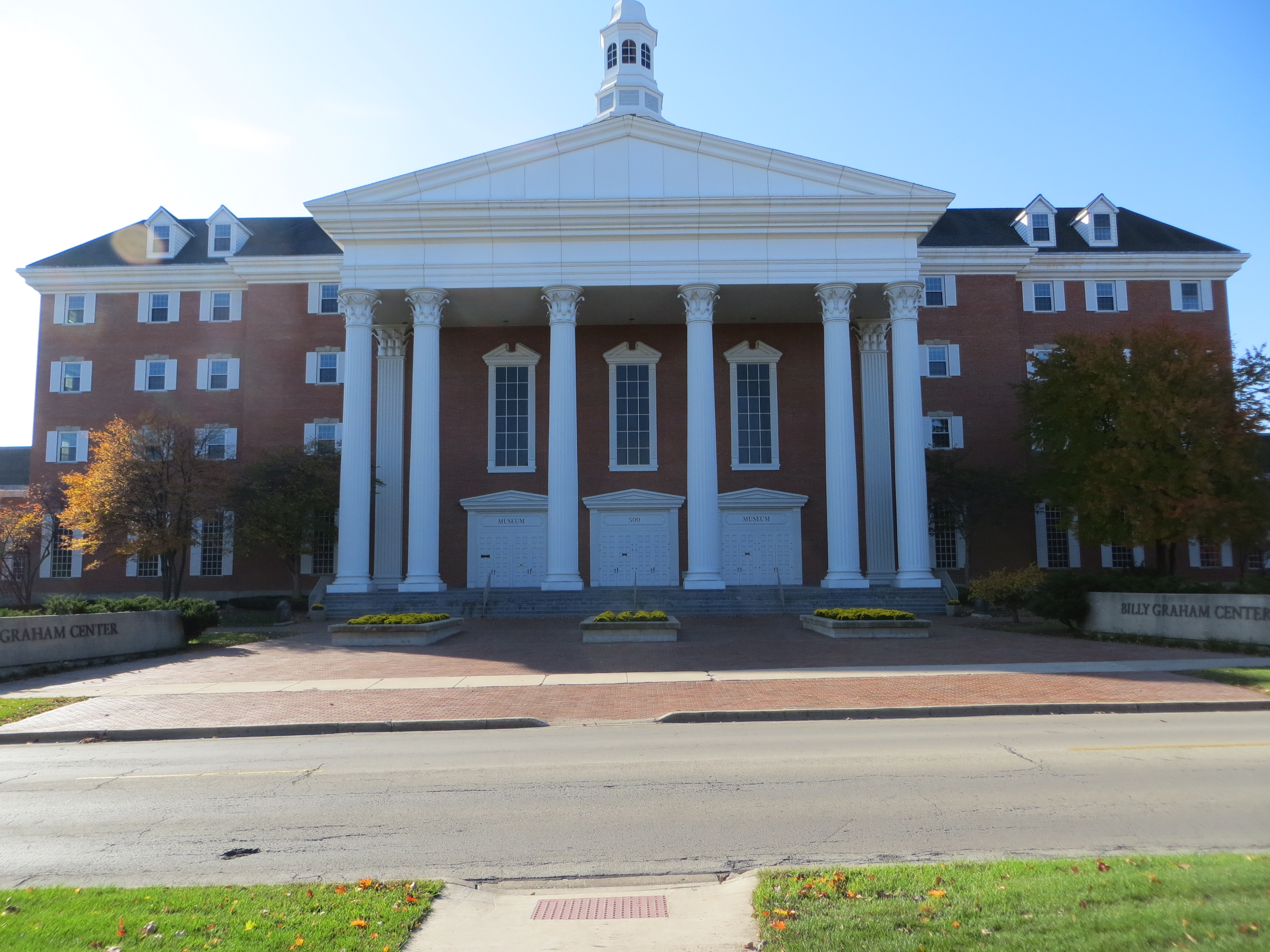
Rolled into sunny Wheaton, Illinois last night to start my research at the fabled Billy Graham Center Archives. Located on the campus of Wheaton College, this archive is like nerd Disneyland. The collections are beautifully organized and intimidatingly expansive.

I'll be here all week...

I’ll be here all week…

What am I doing here? It’s the natural first stop for anyone interested in the history of conservative evangelical colleges. The collections offer two great things. First, Wheaton College itself has been a leading fundamentalist/ evangelical college since the 1920s. It enjoys a unique and uniquely influential history as a leader in the network of conservative colleges. As leading historian Joel Carpenter put it, in the 1920s

There was only one college of thoroughly fundamentalist pedigree . . . that was neither just half-evolved from Bible school origins nor still waiting for the ink to dry on its charter.

That school, of course, was Wheaton. For my current research, I’ll need to dive deep into the history of Wheaton itself. What was life like for students in different decades? For faculty? I also have some specific questions about interesting episodes. For instance, why did Wheaton kick out its fundamentalist president in 1939? Why did the board of trustees add in 1961 a line to the statement of faith that Adam and Eve were real, historical people? What did Wheaton’s version of the “free-speech” movement look like in 1964?

But these archives offer more than just a look at the history of Wheaton itself. Since the school was such an influential leader in the field of evangelical higher ed, its leaders kept in constant contact with other school leaders. In their correspondence, I’ll be digging to discover the issues that motivated school leaders across the entire network of conservative evangelical colleges. This will include prosaic issues such as admissions and accreditation, but also uniquely evangelical issues such as determining which schools remained orthodox and which threatened to slide into liberalism and modernism.

Best of all, decades of work by the archivists at the Billy Graham Center has created an invaluable collection of oral history interviews. Some of these are available online and I’ve been reading them during the past weeks. But many more are only here at Wheaton. In these interviews, alumni of Wheaton and the rest of the conservative evangelical college network remember what life was like at these schools in the 1920s, 1930s, 1940s, and more recently. Why did they decide to go to Wheaton? Or the Moody Bible Institute? Or John Brown College? Or a ‘secular’ public university? Many of these interview subjects offer unique perspectives on what college life was like.

With such a vast collection, I need to pace myself. There’s no way to take it all in during one short visit. Instead, I’ll see what I can discover and make plans to come back soon.


Why Don’t More College Christians Fight Campus Rape?

The fight against sexual assault on college campuses has cranked into high gear. At least one conservative intellectual is asking where the conservatives are in this fight. We could get even more specific: Where are all the campus Christians? Wouldn’t it make sense for conservative religious folks to lead the charge against drunken fornication?

California attracted attention recently for its new “yes means yes” law. Both (or all) partners in any sexual activity must give continuing and explicit consent to every new advance. Just because someone grinds on the dance floor, the reasoning goes, she or he has not consented to sex. Even the White House has gotten involved, launching a task force to investigate campus rape culture.

Allies in the fight against hook-up culture?

Allies in the fight against hook-up culture?

In this week’s Weekly Standard, Heather Mac Donald wonders why more conservatives aren’t participating in the current campaign against campus rape. As she puts it,

Sexual liberation is having a nervous breakdown on college campuses. Conservatives should be cheering on its collapse; instead they sometimes sound as if they want to administer the victim smelling salts.

She argues that the so-called “epidemic” of campus rape is a figment of the overheated leftist imagination. Yet Mac Donald acknowledges that college leftists have succeeded in their fight to redefine sexuality on many college campuses. They have done so, Mac Donald writes, by unintentionally creating a “bizarre hybrid of liberationist and traditionalist values.”

As we’ve seen, some evangelical groups have found themselves at loggerheads with secular schools. Why don’t they jump on this bandwagon? Could campus evangelical groups such as Intervarsity Christian Fellowship build bridges to campus feminists on this issue?

In the past, we’ve seen efforts in this direction. This same not-coalition of feminists and cultural conservatives has struggled to come together to fight against pornography.

Of course, what seems like an obvious partnership has even more obvious reasons to stay separate. Even when both groups staunchly oppose pornography or fornication, their yawning differences tend to split them apart.

The new batch of anti-rape rules, for example, never suggest that casual sex should be avoided. Rather, the rules imply that pleasurable, consensual sex is a valuable experience.  Schools should improve this experience, not eliminate it. In other words, the new campus affirmative consent rules do not hope to limit fornication, but rather to encourage it by making it safer and more pleasurable for all. As one proponent of affirmative-consent laws put it, “good communication between sexual partners can be fun, even sexy.”

It might make conservative campus Christians a little queasy to become political partners with activists who have this sort of attitude about the proper relationship between sexual partners. But historically, conservative evangelicals have managed to forge political partnerships with other groups they found theologically objectionable.

Perhaps the most dramatic example has been in the fight against abortion rights. As historians such as Daniel Williams have demonstrated, at the time of the Roe v. Wade decision, many conservative evangelical Protestants viewed the anti-abortion cause as a peculiarly Catholic issue. Yet over time, the pro-life cause united conservative Protestants with conservative Catholics. Though it may be hard to remember in retrospect, for decades—centuries even—conservative evangelicals viewed the Catholic Church as the embodiment of the Anti-Christ. For evangelicals to team up with Catholics required—for some—an enormous amount of nose-holding.

Couldn’t conservative evangelicals do the same here? They don’t need to agree with the sexual-liberationist ideology that guides many campus activists. Instead, they could partner with feminists to fight campus rape, while maintaining their own very different reasons for doing so.