Thank God You’re Wrong

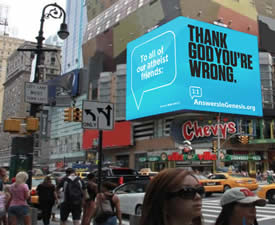
When in doubt, look to the heavens.  These days, your view might be blocked by a billboard from the young-earth creationist outfit Answers In Genesis.

Image Source: Answers In Genesis

From Times Square. Image Source: Answers In Genesis

If you look closely enough, you might see a clue as to why the creation/evolution debates have been so divisive for so long.

According to their press release, yesterday AIG rented billboards in high-visibility sites in New York’s Times Square and San Francisco’s Fisherman’s Wharf.  Soon similar billboards will hit the skies in Los Angeles.

The billboards announce, “To All Our Atheist Friends; Thank God You’re Wrong.”

Image Source: Answers In Genesis

San Francisco. Image Source: Answers In Genesis

AIG leader Ken Ham described the choice of wording.  AIG wanted to be “cordial and engaging,” he explained.  Though these high-profile billboards were an explicit response to Christian-bashing billboards posted by atheist groups, Ham said he wanted to take the high road.

Image Source: Answers In Genesis

An Atheist Billboard. Image Source: Answers In Genesis

“We are not angry at the atheists at all,” Ham wrote.  Instead, AIG feels “burdened” by atheists’ separation from God.

For those new to the creation/evolution debates, it might seem surprising that this latest publicity stunt does not mention creationism, dragons, or zip lines.  After all, AIG has had some success in the past with such creation-focused billboards.

But as Ken Ham repeats, creationism is not the main interest of his organization.  Rather, salvation is the point; creationism is merely the vital theme.

For those of us interested in conservative themes in American education, this distinction matters.

Many non-creationist commentators on the creation/evolution issue assume that if readers can be convinced of the scientific truths of evolution, the debate will be over.  Even the insightful philosopher Philip Kitcher seemed to fall into this trap in his book Living With Darwin.

These AIG billboards demonstrate the difficulty of the issue.  The young-earth creationists at AIG care a lot about creationism, but that is not their central concern.  Their central concern is salvation.  As long as evolution is seen as a threat to salvation, it will never be open to discussion and compromise.

More perspicacious religious minds understand this.  Francis Collins and the BioLogos Foundation set out to prove not only that evolution is true, but that evolution does not threaten salvation.  Without that focus on salvation, creation/evolution discussions will get nowhere.

These AIG billboards do more than attract attention in America’s big cities.  They demonstrate the true heart of the evolution/creation controversy.


Jesus Loves Teaching Evolution

Is there a way to talk about creation and evolution without anger?  Without getting defensive?  Can evangelical Christians teach evolution without alienating their staunchly creationist fellow Christians?

To cut this Gordian knot, Christian biologist Kerry Fulcher offers what he calls his “Pedagogy of Hospitality.”

Fulcher laments the anger and hostility that are so often generated by these questions.  How does he approach teaching evolution in a Christian, creationist environment?

By remembering that love comes first.

Fulcher offers a six-point guide for teaching evolution in a Christian way:

  1. Begin by disarming/diffusing, which creates an openness to listen and discuss vs. feeding the flame that threatens others and causes them to be closed to real dialogue.

  2. Create a reason for the audience to be engaged or care about the topic by helping them understand why open discussion or dialogue about the issue might be helpful to them.

  3. Recognize the complexity of the issue and how an individual’s faith can rightly or wrongly interact with it in foundational ways.

  4. Set the tone of discussion as one of mutual respect for individuals that honors right relationships above right answers.

  5. Set goals of education that promote greater understanding vs. advocacy that promotes winning the argument. This puts us in the uncomfortable position of being OK with others understanding our position without necessarily accepting or believing it.

  6. Honor the individual and their journey by remembering our own – It has taken years and a lot of study and thought to get where I am on this issue, so don’t expect others to make huge leaps in their own positions…be gradual.

Of course, for some pundits on various sides of the creation/evolution debates, Fulcher’s person-first approach raises hackles.  Some creationists might worry that the Bible must always come first, even if some people find it off-putting.  Some evolution advocates might lament this sort of truckling to religious superstition.  The legitimacy of science, they might say, must not be abandoned, even if it hurts the feelings of some religious listeners.

How can someone really understand evolutionary theory, critics might say, without somehow believing it?  Can belief really be separated from understanding?

Though I don’t share Fulcher’s religious faith, I do share his opinion that effective education of any sort must begin by understanding and even loving one’s students.  In the narrow question of evolution education, that means not attacking students’ faiths.  It means beginning and ending with the positive relationships between teacher and student that are at the heart of any good teaching.

We’re All a Bunch of Losers

Both sides in our continuing culture wars assume they are losing.  Why?

We can see some recent examples from smart people on either side of the creation/evolution controversy right here on ILYBYGTH.

Recently, I argued that evolution was winning.  Winning big.

Some of the responses to that argument show that both sides are reluctant to admit they might not be losers in this fight.

For example, Tim, a self-identified homeschooling creationist, agreed that evolution was winning.  As he put it,

Creationists do not want creationism in public schools because it would taught incorrectly. Most pastors do not know how to accurately teach creationism, how in the world would we expect the average person to be able to? Does this in some sense prove evolution is winning? Sure, I could give you that. But we already know it will.

On the other hand, Bunto Skiffler took me to task for dangerously naïve optimism.  As he argued,

I believe General Westmoreland said something similar about our involvement in Vietnam before the start of 1968.

sincerely,
a person who lives in the fiefdom of Texas right now

Why doesn’t anyone want to admit they might be on the winning side?

I think the answer may lie with our very different definitions of winning and losing.

For evolution-promoters like me, creationists seem to be winning when they can impose any sort of non-evolutionary science in public-school classrooms.  Or even in private-school classrooms.  The fact that nearly half of American adults seem to agree with a strongly creationist idea about the origins of humanity makes it seem to folks like me that creationism is winning.

On the other hand, creationists might hearken back to a time when America’s public schools evinced a recognizably Protestant religiosity.  Back when kids in public schools read the Bible—the Protestant Bible, that is—prayed with their teachers, and generally learned that God wanted them to be better students.  Seen from that perspective, today’s public schools with their goals of pluralism and secularism might make it look as if evolution has won the field.

We must also consider the fact that pundits on both sides emphasize their own victimhood.  Reading the produce of Americans United or the Freedom from Religion Foundation makes American public schools seem under siege by powerful religious zealots.  On the other side, browsers of literature from the Alliance Defending Freedom or the Family Research Council might be forgiven for concluding that fire-breathing secularists crush any attempt at including healthy religion in public schools.

In other words, being a loser is attractive.

Each side emphasizes their own loser status in order to mobilize followers.  Evolution activists won’t be motivated to get off the couch if they are told that evolution is winning.  Creationist activists, similarly, might relax if they are told they need only be patient.

We’re all a bunch of losers in this fight.  Except, of course, we’re not.

I’ll say it again: Seen from an historical perspective, evolution education is winning.  If you don’t believe it, read my book.  Creation/evolution struggles have only deadlocked in the past thirty years or so.  In the 1920s, evolution barely made a dent.  Now evolution promoters feel put out if creationists have any influence at all.

Evolution is winning.  I’m not afraid to say it: I’m a winner.


Creationism’s Galileo Moment?

Creationist activist Dr. Don McLeroy said it: Give creationist kids evolution.

Why?

Because the evidence for evolution is so weak, creationist kids will be all the more convinced of the Bible’s truths.

McLeroy’s plea for evolution-heavy textbooks has left us controversy-watchers scratching our heads.  Did he really say that?

McLeroy leapt to national prominence a few years back in his role as chairman of the Texas State Board of Education.  As documented in the indispensable film The Revisionaries, McLeroy used his influence to promote a profoundly conservative vision of proper educational content for Texas schoolchildren.

Image Source: DonMcLeroy.com

Image Source: DonMcLeroy.com

As that film demonstrated, Dr. McLeroy had a knack for confounding the easy stereotypes of “right-wing” educational politicians.  For outsiders like me, it was odd to hear such a friendly, avuncular fellow insist that Texas schoolbooks needed more creationism and less “hip-hop.”

Earlier this week, Dr. McLeroy returned to testify in front of his former colleagues on the Texas school board.  This time, McLeroy surprised everyone by insisting that the board should adopt a new set of science textbooks, books that evolutionary scientists have praised for their evolutionary content.

The Texas Freedom Network has covered these hearings thoroughly.  In general, creationists have been opposing the new science books.

Not McLeroy.

Let the children read the books, McLeroy told the board.  The evidence for evolution is so weak, he insisted, that open-minded children will be convinced of evolution’s ridiculousness.

McLeroy’s testimony was so baffling to board members that a couple of them asked for clarification.  Mrs. Mavis Knight asked him if he was being facetious.  No, McLeroy explained (around minute seven of this ten-minute clip).  He really wanted students to read these evolutionary textbooks.

“Let the students,” McLeroy explained,

the inquisitive students, the ones that are not blind, look at the evidence in these books.  They don’t even give a hint to explain the complexity….Let’s get these books to the kids; let the little young student in the classroom ask, ‘Is this all the evidence that they can give?’ That’s why I think it’ll strike a major blow to the teaching of evolution.

Board member Thomas Ratliff also struggled to understand McLeroy’s position.  Did he really want kids to read evolutionary science?

Absolutely, McLeroy explained.  “I’m hoping a young creationist . . . will sit there and say, ‘Look, is this all the evidence they have? Well maybe God didn’t use evolution to do it.’”

As a stirring conclusion, McLeroy and Ratliff had this back-and-forth:

Ratliff: “So your position is that these books prove that evolution doesn’t happen and you want us to adopt them?”

McLeroy: “No.  I did not say ‘prove.’ I just say the evidence is weak.  I don’t prove anything.  I may be wrong.”

How are we to understand this strange phenomenon?  An arch-creationist plugging for excellent, evolution-rich science textbooks?  And even concluding that he may be wrong?

One commenter on the Texas Freedom Network Insider called McLeroy simply “delusional.”

But isn’t his testimony actually fairly logical?  Consistent?  Even admirable?

After all, creationists have long insisted that evolution falls apart on its own terms.  If they really believe that, doesn’t it make sense to expose people to its ridiculous claims?  After all, if evolutionary science really depends only on prejudice and closedmindedness, as creationists often assert (I’ve tracked this argument here and here, for example) , shouldn’t creationists simply give evolution writers enough rope to hang themselves?

Could McLeroy’s testimony be modern young-earth creationism’s Galileo moment?  When Galileo accepted his punishment for his argument that the earth went around the sun, he is said to have noted, “E pur si muove,”… “It still moves.”  Whatever bad scientists said, the truth was the truth.

McLeroy’s plea to expose children to good evolutionary textbooks can be taken in a similar way.  Supremely confident in the logical weakness of evolutionary theory, McLeroy can push for more and more of it.  Knowing, like Galileo, that whatever bad scientists said, the truth was the truth.

Creationists: We Don’t Want Creationism in Public Schools

We don’t push creationism on America’s public schools.  That’s the word from two very different ends of America’s creationist spectrum.

An intelligent observer might be forgiven for feeling a little confused.  If creationists don’t want creationism in America’s schools, what do they want?

Seen from this outsider’s perspective, this creationist plea demonstrates the important fact that America has not hit a wall with evolution/creation controversies; we are not trapped in a timeless deadlock; evolution and creation are not grappling in an endless, changeless battle.

Evolution is winning.

Don’t believe me?  Consider the recent statements of two leading creationists, two creationists with very different anti-evolution ideas.

Our first creationist voice for keeping creationism out of public schools comes from the leading proponent of intelligent design, Seattle’s Discovery Institute.

According to the conservative Christian World Magazine, the Discovery Institute’s Stephen Meyer has called recently for intelligent design advocates to stop pushing ID on public schools.  In a New York talk about his new book, Darwin’s Doubt, Meyer insisted it would be “imprudent for our side to be pushing intelligent design into textbooks.”

There was no need for such forceful public advocacy, Meyer argued.  Instead, growing doubt among mainstream scientists should be allowed to bubble over into public-school science curriculum.  According to Meyer, “There are too many scientists doing science from this perspective to keep it out of schools.  I’d prefer for it to happen organically.”

At the other end of the creationism spectrum, Ken Ham has called for a similar hands-off policy concerning public schools.  Ham, the founder of the leading young-earth creationist ministry Answers In Genesis, has insisted recently that his group does not push young-earth creationism into public schools.  Why not?  Because mandated creationism, Ham argued, would “likely be taught poorly (and possibly mockingly) by a teacher who does not understand what the Bible teaches. . .”

On the other hand, Ham does hope that public schools will teach a greater variety of ideas about evolution, including young-earth creationism.

For those of us non-creationists hoping to understand American creationism, what lessons can we take out of these statements?

At first glance, such arguments seem merely strategic.  My hunch is that both Meyer and Ham would prefer to see more intelligent design or young-earth creationism in America’s public schools, respectively.  Insisting that they do not push such notions seems nothing more than an attempt to play the role of innocent bystander in creation/evolution fights.

But we can take other lessons from these creationist statements as well.  First of all, both statements demonstrate a recognition that ID or YEC are not currently dominant in America’s public schools.  Dr. Meyer says he does not want to push ID, since that will leave the decisions in the hand of a judge, as happened in the Dover trial.  Mr. Ham worries that mandatory creationism would lead to withering critiques of the creation curriculum by the vast numbers of anti-creationist teachers.

As I’ve argued in my 1920s book, such creationist attitudes represent a wholesale revolution in anti-evolution politics.  In the 1920s, anti-evolution campaigns wanted more than to have creationism included in public schools.  Back then, anti-evolution politicians hoped to ban evolution wholesale.  Not only that, in the 1920s politicians and activists insisted on banning all sorts of ideas that might have challenged traditional Protestant culture.  Consider the “anti-evolution” law that passed the US Congress in 1924.  That law specified that no teachers could engage in “disrespect of the Holy Bible.”  But the law also insisted that DC teachers could not teach that the USA had an inferior form of government.

The sort of “us-too” strategy engaged in by Ham and Meyer demonstrates a very different goal.  Even if they are being duplicitous in their insistence that they do not want to push creationism on public schools, the very fact that they choose to disavow such insistence speaks volumes.

In the 1920s, anti-evolutionists wanted evolution out.  All the way out.  With all its attendant theories of atheism, socialism, sloppiness, and bad manners.  Anti-evolutionists went out of their way to show their vehement condemnation of all things evolutionary.

In the 21st century, in contrast, anti-evolutionists claim only to want a place at the public-school table.

This revolution in anti-evolution strategy demonstrates that there is no long-term deadlock in the evolution/creation struggle.

I’ll say it again: Evolution is winning.

It only appears to be a deadlock if we restrict ourselves to a short historical perspective.  Yet, for understandable reasons, many of the smartest voices in the evolution/creation debates have implied that we are in fact stuck.

Randy Moore, for example, has long been the smartest guy in the room when it comes to the struggle over creationism and biology education.  Yet even he allows himself to imply that evolution/creation has bogged down.  In a recent essay in the BioLogos Forum, for example, Moore opens with the following assertion: “the evolution-creationism controversy has been one of the most abiding controversies in America during the past several decades, public attitudes about evolution and creationism have changed relatively little during that time.”

True enough, but he restricts himself to a relatively short timeline.  Opinions since the 1980s may have congealed, but that does not imply a longterm freeze.

Michael Berkman and Eric Plutzer, too, open their wonderful study of evolution and creationism battles with the assumption that these battles have changed little.  They do not ask IF creation/evolution fights have deadlocked.  They only ask WHY such fights have been so durable.

Today’s statements from Stephen Meyer and Ken Ham demonstrate the dangers of these assumptions.  From an historian’s perspective, attitudes that have stayed the same since the 1980s are not proof of deadlock.  Rather, they appear only to be recent trends.

The fact that leading creationists insist that they do not want to push their theories into public schools tells us a lot.

It doesn’t tell us, of course, exactly how sincere such protestations might be.

But it does tell us that the evolution/creation controversy has changed dramatically over the past century.  Whereas the first rounds of this battle saw anti-evolutionists pound evolution education into the ropes, more recent decades have seen that trend reversed.

It is now creationists who insist they don’t want to push their ideas into public schools.

“Why can’t creationism be included?” is a vastly different question than “Why should schools include evolution?”

Why Do Evangelicals Doubt Evolution?

For outsiders like me, it can seem an utter mystery why intelligent, informed American adults remain skeptical about the truths of evolutionary science.

The BioLogos Foundation recently re-posted a 2010 video by evangelical scientist Jeffrey Schloss to help people like me understand evangelical skepticism.

Professor Schloss offers two main reasons why evangelicals oppose evolution.  The video is short and worth watching.  But the message is misleading.

Schloss argues that evangelical faith depends on the reliability of Scripture.  Accepting any ideas that challenge that reliability, he points out, would force evangelicals to make profound changes in their core religious beliefs.

Also, Schloss notes that some visions of evolution force evangelicals to doubt the omnipotence and benevolence of God.  If evolution implies a purposeless development of life, it must be rejected by evangelicals.

Such insights are important, but in the end they suggest misleading conclusions.

The vast majority of evangelicals who reject evolutionary science do not do so primarily for theological reasons, as Dr. Schloss suggests.  Rather, evangelicals who doubt evolution mostly do so due to their complex cultural identities as members of communities who doubt evolution.  In other words, evolution skepticism should not be understood as one rational decision among others, made by evangelicals (and others) based on reasoned theological considerations.  Rather, those who doubt evolution do so as members of communities reliant on authoritative statements about the theological impossibility of evolution.

In other words, people doubt evolution because they come from churches, families, towns, and denominations that doubt evolution.  They explain their doubt in theological terms, and such explanations are immensely important.  But they are not the primary reasons why people doubt evolution in the first place.

Perhaps this problem will make more sense if we try an analogy.  Historically, some economists suggested that people tend to make rational economic decisions.  By plotting a rational economic forecast, the thinking went, economists could predict the ways homo economicus would behave.  Unfortunately, real people don’t act often enough like homo economicus to make those predictions useful.  Some people do, naturally, but not enough to make homo economicus a useful explanatory tool.

I suggest that Professor Schloss is crafting a similarly misleading picture of homo theologicus.  Professor Schloss suggests that American evangelicals deny evolution due to two important theological considerations.  Doubtless there are some American evangelicals who have done so.  But more people make decisions for other reasons.  The theology is important, but it is not the place to start if we want to understand evolution skepticism.

Professor Schloss is doubtless fully aware of these sociological and cultural reasons for evolution skepticism.  He notes the many factors that go into evolution skepticism.  But by describing two theological ideas as the most important reasons for opposing evolution, he grossly mischaracterizes the nature of American evolution skepticism.

For those of us who hope to improve evolution education, this matters.  If we think of evolution skepticism as a rational theological belief, then we may decide that the best way to spread evolutionary theory is to explain evolutionary theory rationally and repeatedly.  We may be led to believe that reasonable independent actors have chosen evolution skepticism, and may thus be open to rationally and reasonably changing their minds.

That’s not how it works.  As my grad-school mentor Ronald Numbers has shown, the boundaries of acceptable “creationist” belief among evangelicals and other creationists have changed over time.  Such boundaries have not been something each individual evangelical creationist has reasoned out for him- or herself.  Rather, the meanings of evolution skepticism have themselves evolved.  And, as David Long’s ethnographic studies have demonstrated, personal commitments to evolution skepticism are not often changed by exposure to evolutionary theory.

Evolution skepticism is a complex cultural identity.  Americans do not choose to believe in either evolution or creationism in a sort of cultural cafeteria.  Rather, they are born (or adopted) into communities of belief.

Those of us who hope to spread the acceptance of evolutionary science must begin with a thorough and nuanced understanding of evolution skeptics.  Professor Schloss’ overemphasis on homo theologicus does not do that.


Creationist Textbook Fight: A Progressive Victory?!?

Déjà vu all over again.  That might be the sensation for those of us who have followed Texas’ political battles over textbook content.  Recent politicking has demonstrated the continuing influence of creationists in textbook decisions.

But debate-watchers may not realize that these Texas-textbook headlines represent a progressive victory.

Here’s why: Back in the 1920s, states such as Texas adopted state-wide textbook adoption policies precisely in order to make the process more transparent.  Recent work by liberal watchdogs in the Texas Freedom Network demonstrates the long-term progressive success of those 1920s efforts.

Let’s start at the beginning.  As I describe in my 1920s book, debates over the content of Texas textbooks began way back.  In the 1920s, Texas officials insisted that textbook publishers produce “Texas” editions, with large sections on evolution cut out.  More than that, Texas officials demanded textbooks that ratified a Protestant-dominated vision of American history and culture.  Ever since, as I discuss in my current book, conservative activists such as the Gablers have been able to wield outsized influence on the textbook adoption process in Texas.

Yet this long history of conservative influence in Texas textbooks is not merely the story of conservative domination of Lone Star public education.

As Adam Shapiro argues in his excellent new book Trying Biology, progressives in the 1920s fought hard to ensure that these textbook decisions were made openly and publicly.  Previous textbook purchases had been made at the local level.  Sweetheart deals between publishers and school-district officials often left students with low-quality, high-priced textbooks.

Progressive reformers wanted more open discussion of textbook purchasing decisions.  In several states, including Texas, they passed state-wide adoption laws.  In Texas a state board selects a list of approved textbooks, from which districts can choose.  Those deliberations are public events, with legal requirements to share documents and content.

In a sense, therefore, recent headlines about creationist influence on textbook purchases represent a long-term victory for those early progressive reformers.  Liberal activists in the Texas Freedom Network have been able to monitor these deliberations.  The Texas board of education is legally required to provide public access to many of their discussions and debates.  As a result, concerned liberals and science-education types have been able to mount effective and informed protests over creationist influence.

Do progressives have a long history of winning culture-war battles in Texas?  Not really.  Conservative influence in Texas public education remains dominant, as Scott Thurman documented in his film The Revisionaries.  Indeed, the Texas Freedom Network has lamented the delays and obfuscations of conservative officials as the TFN has demanded access to public records.  Nevertheless, the TFN’s strong legal case—their insistence on access to those records—represents the hard-fought victories of earlier generations of progressive activists.


Human Origins at the Smithsonian

What should we do to teach evolution better?  ILYBYGTH contributor David Long addressed that topic a little while back at the Smithsonian Institution.

The panel discussion was part of the Smithsonian’s Human Origins Program’s Broader Social Impacts Committee.  Long, a science education specialist and anthropologist at George Mason University, discussed some of the implication of his work, including his must-read book Evolution and Religion in American Education: An Ethnography.

David spoke for about thirty minutes.  Then the assembled panel offered reflections.

Panelist Connie Bertka of the Smithsonian committee asked the smart question: “What can the scientific community do?”

Fred Edwords of the American Humanist Association offered a striking example of the deep misunderstandings of creationism among outsiders.  Edwords made the point that a good education requires that students emerge different from when they go in.  Naturally.  But Edwords did not seem to recognize that the nature of this educational transformation is precisely the question at issue.  How should education transform young people?  Should education affirm or challenge existing religious or ideological commitments among the young?  Edwords seemed to assume that any good education would lead to a transformation in favor of evolution, in favor of challenging religious traditions.

Nancy Howell, who teaches about religion and science at a Methodist seminary, made the important point that denominational background can’t really be used to predict affinity for creationism or evolution.  That is, people of different sectarian backgrounds often embrace or reject creationism.  At times, people go against the teachings of their own denominations, without even knowing it.  Due to this splintering effect, assumptions about the numbers of creationists based on denominational affiliations must be viewed very skeptically.

At one point, an audience member suggested that creationism can be eliminated by the teaching of “critical thinking.”  Dr. Long replied diplomatically but correctly that we can’t assume too much about the meanings of teaching “critical thinking.”  After all, ardent creationists have long insisted that their programs are the only ones teaching critical thinking.  Young-earth Guru Ken Ham, for example, insists that creationists are the only ones resisting the intellectual bullying of evolution.  Only young-earth creationists,  Ham argues, don’t merely parrot the shibboleths of intellectually empty evolutionism.  Only young-earth creationists, Ham says, are doing any critical thinking when it comes to evolution.

So, in the end, what should we do to teach evolution better?

At the very least, we can take an hour or so to watch this presentation and discussion.


Life, the Universe, and Nothing

Why is there something rather than nothing?

Is it reasonable to believe there is a God?

Has science buried God?

The Australian City Bible Forum recently posted two video discussions about these questions between prominent science-atheist Lawrence Krauss and religious apologist William Lane Craig.

What they didn’t discuss is what should be included in public schools.  Surprisingly, in the end it is the arguments of Lawrence Krauss that suggest a sort of intellectual dictatorship in science classes, a stern refusal to consider the claims of dissent, even when that dissent represents a majority opinion.  Of course, that is exactly the accusation made by leading creationists.  I don’t buy those creationist arguments, but I do want to understand why we can insist that creationist students learn science the way we define it.

The two veteran debaters did not engage in a formal debate on these timeless questions.  Rather, the City Bible Forum offered a “conversation” between the two speakers.  Each speaker had fifteen minutes to lay out his ideas.  Then the two were open to questions.

The moderator called for a “respectful, intelligent discussion.”  To that end, the evangelical organization invited moderators of very different backgrounds.  For the first discussion, the CBF asked TV journalist Scott Stephens.  For the third, a local atheist academic, Graham Oppy.

For those of us interested in understanding the conservative influence of evangelical religion in American public life, the discussions are worth listening to in their entirety.

Here at ILYBYGTH, I don’t really care very much about the nature of science or religion.  I don’t care very much about whether or not the universe was created ex nihilo.  I don’t care—as Craig and Krauss debate—whether or not an infinitely good God can cause the murder of Canaanite children.  Such things are interesting, but they only make up the background, IMHO, for the really interesting questions.  For me, the rubber only hits the road when we get to discussions about the ways these issues influence real life; the ways such ideas change policy in places such as public schools.

For example, the discussions can help illuminate one of the most stubborn mysteries of American public education.  To folks like me it remains endlessly surprising that so many Americans support the use of religion in public school.  As readers are aware, majorities of Americans support the inclusion of creationism in public-school science classes.  Americans also often support the notion that prayer and Bible reading can be parts of a public-school experience.

The wide-ranging discussion between Drs. Krauss and Craig sheds some light on this head-scratcher.  In the first conversation, “Has Science Buried God?” Professor Krauss acknowledges that religious belief is the default psychological state for most people.  Krauss agrees that “we all want to believe.”  Such desires, Krauss argued, only demonstrate our own intellectual weakness and laziness, our willingness to accept the simple in favor of the true.  “We have to work hard,” Krauss admonished, “to overcome that desire to believe.”

Not surprisingly, Dr. Craig disagreed. But more interesting to me is that even Professor Krauss conceded that most people will tend toward religious thinking.  Though Krauss repeated his accusation that teaching young children religious ideas amounted to “child abuse,” he still acknowledged that such ideas made the most sense to the most people.

If that is indeed the case, if most people will tend toward religious explanations of life, then it should come as no surprise that they want to teach such religious explanations to their children in public schools.

Indeed, for folks aware of the sometimes-ugly history of American education, Professor Krauss’ position raises some difficult questions.  For example, ought public schools impose ideas on children if those ideas are inimical to those children’s families?  In the 19th century, educational leaders often argued that the King James Version of the Bible must be read in every public school, in spite of the objections of Catholic leaders.  Since the Bible was the truth, these schoolmen reasoned, every child must be forced to hear it.

Such reasoning does not acknowledge the legitimacy of dissent.  It does not recognize the “public” nature of public education.  In order to include the entire community, authentic public education would have to recognize the legitimacy of the beliefs of the community.

Professor Krauss, no doubt, would protest that science classes must teach science, not religion.  But, as he should also acknowledge, the boundaries of science have at times been difficult to define.

If, as I do, we still want to insist that public schools teach evolutionary science and not creationism, we are left with the sticky question: Who decides what is “science”?  A majority of mainstream scientists?  That, I’m guessing, is how scientists like Professor Krauss would argue.

How will that majority opinion protect the legitimate views of dissenters?

And if we want to rely on majority opinion, what about the much larger popular majority that wants creationism taught as science?

Creationist Rebels in the Classroom

How can we improve evolution education in this country?  Some suggest that new science standards will do the job.  Others suggest evolution educators need to get to creationists’ kids early.

Good ideas.

But there are also proud creationist teachers in schools, folks such as Daniel Brown.[*]  In a World Magazine article about the influence of intelligent-design workshops for teachers, Brown proclaimed,

When the culture tells me I’m not allowed to think outside the Darwinian box, it makes me want to think outside the Darwinian box.

Several teachers described their devotion to include creationism despite pressure to teach evolution.  Brown, for example,

avoids legal quicksand by teaching in a way that prompts students to do their own thinking. As a physics teacher, he doesn’t talk about biology, but introduces the concept of fine-tuning in the universe. For example, the Earth’s atmosphere blocks harmful radiation from the sun but is transparent to the visible light needed for photosynthesis. The Earth is an ideal distance from the sun to host liquid water, and our solar system is ideally placed to avoid dangerous radiation from the center of the galaxy. Brown ends such talks by suggesting to students, “It kind of makes you think!”

Another public-school teacher felt pressured to quit her job.  She told World Magazine she followed a “middle-of-the-road” path, but her principal accused her of infusing her classes with faith.  In the end, she took a less-than-perfect job at a Catholic school.  The school still taught evolution, but at least the teacher was allowed to praise the Lord in class.

So how can we push more and better evolution education into America’s classrooms?  It won’t hurt to have better standards.  It won’t hurt to expose more students to more science.  But we must start by acknowledging the durable and powerful cultural roots of creationism.

For instance, in spite of the tone of beleaguered victimhood of the World Magazine article, these teachers all received training and encouragement this summer at a workshop run by the intelligent-design focused Discovery Institute.  Such programs represent a continuing effort to prevent mainstream science from taking over America’s science classrooms.  Institutions such as the Discovery Institute will likely continue actively to promote various creationist ideas as good science.

Also, we also have to consider the stubborn effective resistance of creationist teachers themselves.  The teachers profiled by World Magazine did not simply stumble onto an intelligent-design dissent.  They eagerly sought out the aid of outside agencies in their continuing fight to promote creationism in their own classrooms.


[*] A pseudonym.