Broun and the Budget

US Representative Paul Broun (R-GA) garnered a lot of attention last year, including a commentary in the Chronicle of Higher Education by yours truly, for his claim that evolution, embryology, and the Big Bang theory were lies from the pit of hell.

Today Broun took to the pages of the New York Times to call for more drastic budget cuts.  Broun calls Representative Paul Ryan’s budget cuts too mild.  Instead, Broun insists, we need to cut the federal government drastically, including eliminating the Departments of Education and Energy.

Broun writes,

Constitutionally speaking, the federal government should not have a role in K-12 public education anyway. Overpaid Washington bureaucrats shouldn’t be deciding how to provide for teachers and students, whose own state and local governments are better equipped to understand their needs. A Heritage Foundation study showed that in 2010, the average salary of an Education Department employee reached $103,000 — nearly double the average public-school teacher’s salary. Let’s phase out a large portion of the department’s roughly $70 billion budget. We can transfer the remaining dollars directly to the states, where they will be used more wisely.

Broun’s missive demonstrates the tight connections between various strains of conservative educational ideology.  Does Broun want less evolution taught in public schools?  Yes.  Does he also want a smaller, leaner, more local government?  Yes.

In Broun’s conservative thinking, these are not utterly separate ideas, but facets of the same good ideas.  If education decisions were made closer to home, Broun argues, they would be made “more wisely.”  Local governments, Broun writes, are “better equipped to understand [teachers’ and students’] needs.”  In short, not only would an elimination the Education Department make good fiscal sense, Broun insists, but it would allow schools to respect the religious views of local creationist parents.


Creationist Mom Reaches Out to Evolution

Sometimes stereotypes have some truth to them.  Then there’s “D.”

D first got in touch with me a couple of months ago.  As she described herself, she is a Christian young-earth creationist homeschooling mom.  She had read about my blog on Ken Ham’s Answers in Genesis page.  I’ll include our brief correspondence to let D speak for herself:

From: D
Sent: Monday, January 21, 2013 8:36 PM
To: alaats@binghamton.edu
Subject: thank you

Hi Dr. Laats,
I have to say that it is very refreshing that you don’t think creationists like myself are complete idiots.  Really, I appreciate that. 
As a young earth creationist that homeschools, I wouldn’t give any Richard Dawkins books the time of day.  If someone is THAT hostile towards me, then I have no interest in what they have to say.  But I look forward to reading your blog when I have a chance because you try to understand where I am coming from, and you don’t think we are completely unable to do any science. 
Thank you,
“D”

I suggested that D might give Dawkins a shot.

From: D
Sent: Monday, January 22, 2013 9:48 PM
To: alaats@binghamton.edu
Subject: Re: thank you

Dear Dr. Laats,
I also agree that we should be looking at the other side, and I do plan to do that.  As a Christian homeschool Mom I am not trying to protect my sons from learning evolution.  The public school is not a place we feel comfortable putting our children because their thoughts and beliefs are not welcome in the classroom.  They would have to follow the advice my father in law got from his father before he joined the Navy, “keep your eyes and ears open and your mouth shut”.  Learning can not take place, in my opinion, in that kind of environment.
I am going to teach my kids about evolution, somehow.  There is a lot of material out there.  I would read Dawkins if I had to, but the amount of information out there that he has published alone is way too much to look at, sort through, and figure out what to teach.  For the sake of time, I’m looking for something comprehensive and succinct, and what a child in high school should know about the subject.  I am familiar with the NCSE website and that is what I plan to use as of now, though it will be guess work to know what all to cover.  
Thanks for your time,
D

I was surprised and happy to hear that D was using materials from the National Center for Science Education to teach her kids.  I think the folks at NCSE would be happy to hear it, too.  The NCSE is a leading voice for evolution education and a staunch opponent of creationism in public schools.  And too often, people like me tend to suggest a stark division between two sides: either Answers in Genesis OR the National Center for Science Education.  D has reminded me that smart people make all kinds of decisions about what to read and what to do with that material.  People choose public schools, private schools, or homeschools for all sorts of different reasons.  D’s work reminded me how quickly and easily we can oversimplify the many approaches people make to these snarled questions of evolution, religion, and education.

Yesterday, I heard back from D:

From: D
Sent: Monday, March 18, 2013 5:09 PM
To: alaats@binghamton.edu
Subject: Hi

Hi Dr Laats,
Well, I wanted to let you know that I checked out the [Dawkins] book The Greatest Show on Earth.  I never would have considered it except for your response.  Dawkins says on page 155 ” it would be so nice if those that oppose Evolution would take a tiny bit of trouble to learn the merest rudiments of what it is that they are opposing.”  I couldn’t believe that I totally agreed with Dawkins about something!  I am happy to listen, minus the hostility.  I don’t sense hostility in this book, which makes it readable.  This has made me realize that I can not get my head wrapped around what evolution IS.  He says we did not descend from monkeys, but we have a common ancestor.  I do understand that we would find no missing links because of the extreme gradual process, that is what I understand from the book, hopefully that is correct.  So I looked on Internet, and I guess I don’t understand phylogenies.  So we did not descend from monkey, but have a common ancestor, and then branched off to chimpanzees and humans etc.  So, it seems to me that we descended from something “monkey like”.  I guess I don’t understand how he can say that we did not evolve from monkeys, whether it was monkeys or monkey like, it seems similar.  Can you shed any light on this please?  As you can see, I am making an honest attempt to understand this so I don’t teach it incorrectly.  Thanks for the help,
D

First of all, my hat’s off to D for engaging with Richard Dawkins’ writings.  It is far too easy for all of us to read only those materials that confirm our own beliefs.  I am optimistic that there may be far more “Ds” out there than we might think: people who have strong beliefs, yet hope to find out as much as they can about the other side.  How many of us can say–like D–that we have taken the time to puzzle through books and websites of people with whom we totally disagree?

As for D’s question about phylogenies, I suggested she check out Dennis Venema’s series about evolution theory on recent pages of the BioLogos Forum.

Any other suggestions for someone like D?


David Long at the Smithsonian

Drop your plans for Friday!

You need to get down to our nation’s scenic capital for a stirring panel discussion of evolution education.

ILYBYGTH contributor David Long will take part, along with participants from the Smithsonian’s “What Does It Mean to Be Human” Broader Social Impacts Committee.

The event will take place at 12:30 in the Baird Auditorium, National Museum of Natural History.  Free and open to the public.  Don’t miss it!

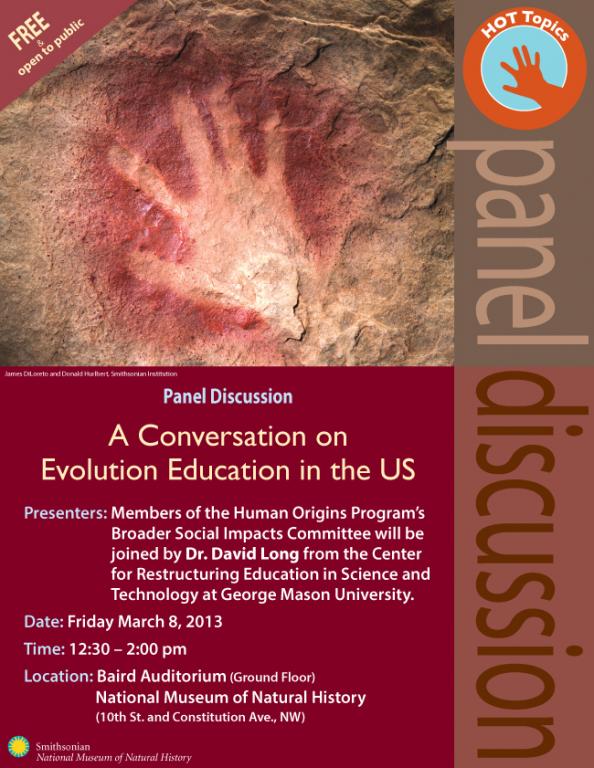
smithsonian flyer

Stanford: Science Teachers Must Value Creationism

Can a science teacher do a good job if she does not value the creationist beliefs of some of her students?

According to Stanford University education scholars, the answer appears to be ‘no.’

Hard to believe?

The Teacher Performance Assessment developed by the Stanford Center for Assessment, Learning and Equity (SCALE) has become the new standard for teacher certification or licensure in twenty-four states and the District of Columbia.

In order to receive certification in these states, new teachers must submit a portfolio of lessons and reflections.  These materials will be judged according to a series of rubrics.

According to one of these rubrics, teachers must acknowledge, value, and incorporate the cultural beliefs and backgrounds of their students.  In “Rubric 3: Using Knowledge of Students to Inform Teaching and Learning,” the Stanford folks provide a ranking of new teachers’ ability to relate to their students.  At the lowest level, new science teachers will be penalized if they don’t include enough knowledge of students’ backgrounds.  Also at this lowest level (Level 1), new teachers will be dinged if the teachers’ “justification of learning tasks . . . represents a deficit view of students and their backgrounds.”  At the higher levels, new teachers are supposed to justify their “learning tasks” by including “examples of personal/ cultural/ community assets.”

In the case of creationist students, it appears new science teachers must not view those beliefs as a “deficit.”  Indeed, to be considered truly proficient, new science teachers are encouraged to include those cultural and community beliefs in their science classes.

For those of us who have observed the creation/evolution struggles from the outside, this new rubric for judging science teachers raises a few vital questions: Was it the intention of the Stanford folks to force new science teachers to value creationist beliefs?  Will new science teachers really be judged negatively if they view creationist beliefs in their classroom as a “deficit view?”  That is, will new teachers really be pushed to see creationism as a legitimate cultural belief, instead of merely a lack of understanding of evolution?

It seems doubtful.  Maybe I’m not giving the SCALE group enough credit, but my hunch is that they did not intend to force science teachers to avoid impugning creationist beliefs in science classes.  Nevertheless, it seems the rubric they’ve created will certainly be read that way.

Inter-faith Creationism?

It is no longer surprising to see deeply conservative religious thinkers reach across religious lines to work together.  Could we soon see effective Muslim-Christian coalitions to support the teaching of creationism?

Perhaps as a model, interfaith creationists could consider Robert George and Hamza Yusuf’s collaboration.  The two leading intellectuals, one Catholic, one Muslim, co-wrote an open letter to hotels, requesting the removal of pornography from television options.

Even more apt, we could consider the fact that American creationism has always used the work of fellow creationist writers from different religious traditions.  In the 1920s, as my grad-school mentor Ronald Numbers argued, Catholic writers such as Alfred McCann were favorites among ferociously Protestant creationists.  More recently, this tradition has continued with the creationist embrace of Jonathan Wells’ work.

Could this tradition of creationist ecumenism work to bridge the Christian-Muslim divide?

There is no doubt that both religions harbor fervent creationists.  A recent article in The Economist detailed recent creationist developments among Islamic populations.  The article cited a study by Salman Hameed of Muslim attitudes to evolution.  That study found that 20% of Muslims in Indonesia, Malaysia, and Pakistan embraced evolution.  In Egypt, only 8% did.

As The Economist article describes, “controversial” Turkish evangelist Adnan Oktar, known as Harun Yahya, has long conducted an energetic creationist campaign in Muslim circles, including a series of conferences in the USA.

Of course, the conservative theology behind both Islamic and Christian creationism creates some barriers.  Orthodox religious thinkers on both sides will be wary of working with people from opposing traditions.

But there has also been a long tradition of cooperation.  As Ronald Numbers pointed out in The Creationists, in the mid-1980s, the Institute for Creation Research received a telephone call from the minister of education of Turkey, requesting teaching materials (Creationists, 2006, pg. 421).  In 1992, a Turkish creationism conference invited ICR stalwarts Duane Gish and John Morris as keynote speakers.  Professor Numbers also describes the founding in 1990 of the Turkish Science Research Foundation (Bilim Arastirma Vakfi, or BAV).  In Numbers’ words, “For years BAV maintained a cozy relationship with Christian young-earth creationists, feting them at conferences, translating their books, and carrying their message to the Islamic world”  (Creationists, 2006, pg. 425).

For a long generation, then, Muslim and Christian creationists have worked together.  The question is not whether such cooperation can happen.  Rather, the question is whether and when these efforts will gather enough support to become a major influence on the politics and policies of creationism and evolution education.


“Science Buff” Pushes Creationism in Missouri

H/T: Sensuous Curmudgeon

Why does dreamy Missouri legislator Rick Brattin want Missouri schools to teach both evolution and intelligent design?  In his words, because “I’m a science enthusiast. I’m a huge science buff.”

Image Source: Riverfront Times

Image Source: Riverfront Times

In an interview last week with St. Louis’ Riverfront Times, the Republican lawmaker explained that he had introduced a new “equal time” bill because true science demanded it.

Those of us hoping to understand conservatism and creationism in America’s schools should pay attention to Brattin’s rationale.  In this interview, Brattin articulated a vision of science, religion, and education that resonates among many creationists and their allies.  Evolution, Brattin claimed, actually played the role of obstructionist religion.  Brattin told the paper, “I’ve had numerous college professors within biology, school science teachers…who say they are not allowed to teach any type of theory [like intelligent design]…. They are banned from the science community.”

As we’ve noted here before, not only creationists but conservatives of various types often complain that they have been excluded from intellectual debate.  These arguments seem to convince Representative Brattin.  As Gallup polls have suggested, calls for equal treatment and fair play do very well among the general populace, as well.

A Visit to a Creationist Homeschool Science Fair

What would a creationist homeschool science fair look like?

Greg Laden at ScienceBlogs described his recent trip to one in Minneapolis-St. Paul.

Laden offered more than just a snarky blanket condemnation of the creationism and science on display.  Some of the exhibits, Laden wrote, were actually pretty good.  In one exhibit, students created and explained plant tissue batteries, for instance.

Some students, though, conducted experiments that disappointed the mainstream scientists.  One student, for instance, made salt stalactites to prove that they could form more quickly than some mainstream scientists believed.  According to Laden, mainstream science already knew that even limestone stalactites could form fairly quickly.  Another student retreated from science to explain animal behavior.  Faced with a question he or she could not answer, one student told Laden that “a certain problem would be solved because ‘God put something in the animal to make that happen.'”

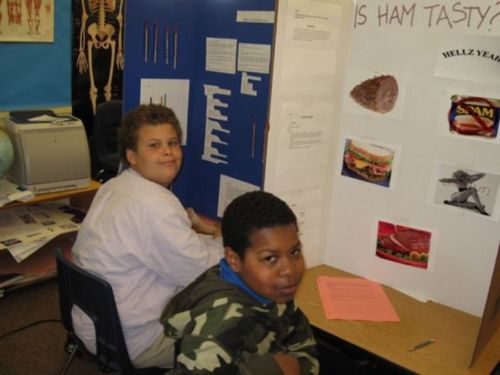
Non-creationist science fair...

Non-creationist science fair: “Is Ham Tasty? Hellz Yeah”

Best of all, IMHO, Laden recognized that some of the weaknesses of student presentations were not due to religious belief, but rather due to the age of the presenters.  As Laden put it, “many of the limitations and shortfalls of the less than stellar posters were typical of small scale school science fairs in general, not peculiar to these students.”

This point is clearly one that could use more study.  We observers of creationism and evolution education often lament the fact that relatively few students learn any real evolutionary science.  But we must remember the broader point: relatively few students learn any real anything in too many of America’s schools.  It is not fair to assume that students’ generally weak grasp of evolutionary concepts is necessarily due to religious dissent.  Rather, we should measure the successful teaching of evolutionary concepts alongside other basic concepts such as the appreciation of literature, the history of the founding of the country, or algebra.  My hunch is that the “shocking” weakness of most American adults in mastering the basic concepts of evolutionary theory might not look so shocking compared to the weakness of American adults in mastering other basic concepts.

Creationists: Randy Moore Wants Your Children!

There is no doubting Randy Moore’s evolution-education credentials.

A professor of biology at the University of Minnesota, Professor Moore has received the National Center for Science Education’s Friend of Darwin award, and the National Association of Biology Teachers Evolution Education award.

Randy Moore, in short, has long been one of the most engaging and engaged voices in the campaign to get more evolution education into America’s schools.

And what is Moore’s most recent argument to make America’s schools more evolution-friendly?

In a remarkable article in the “evolutionary-creationist” BioLogos Forum, Moore and colleague Sehoya Cotner offered two recommendations for improving evolution education:

1.) Let Jesus teach it!

2.) Catch creationist kids young!

Here are their actual words:

“We know of no evidence that the availability of such solely science-focused workshops, seminars, and other forms of evolution-related education will significantly affect what creationism-based biology teachers teach. Since the impediments to better teaching of evolution are primarily the philosophical and religious views of biology teachers, programs that do not address the more personal, ‘non-science’ issues of science educators directly and effectively are likely to have little impact on what students learn in high-school biology classrooms. Instead, if further fact-based instruction in evolution is part of the answer, it is likely to be most effective with young children, who are developmentally primed to seek explanations for natural phenomena. However, evolution instruction is essentially absent prior to high-school biology; by high school, a student’s teleological demands have likely been met by supernatural explanations, creating a cycle of adults who know little about evolution and teach creationism-flavored biology.”

In other words, as Moore and Cotner convincingly demonstrate, simply assuming that the scientific evidence for evolution will convince creationist teachers has not worked, and will not work.  They rely heavily on the research of Penn State political scientists Michael Berkman and Eric Plutzer.  Instead, evolution education needs to get away from the delusion that the scientific evidence alone will do the job.  With adults, effective evolution education, as Moore and Cotner contend, must address “philosophical and religious” issues involved.  This conclusion makes eminent sense.  However, it brings us to an awkward realization: science education must range far beyond science education to be effective science education.  Are creationist teachers to be taught that Jesus wants them to accept evolution?  That seems to be Moore’s and Cotner’s implication, and it raises a host of thorny issues.

The second prong of their policy argument is equally radical.  If “fact-based” evolution education is to work, Moore and Cotner argue, it must reach young students before their families’ influence has become decisive.  In other words, effective evolution education must evangelize aggressively to counter the “supernatural explanations” offered young people by their parents and church leaders.  Effective evolution education must seek to replace those family influences with the influence of scientific evidence.

Randy Moore has long been one of the smartest voices in the field of evolution education.  And his logic in this article seems uncontrovertible.  Yet it raises disturbing questions.  Can evolution educators discuss “philosophical and religious” implications of evolutionary theory?  Doesn’t that amount to sectarian religious education?  In other words, if science educators try to teach that Jesus is not against evolution, isn’t that making a strictly religious argument?

And we need to ask tough questions about targeting young minds:  Can a campaign to reach young creationist kids work?  Is it the place of public education to target family culture and religion?

Revisionaries on PBS

The Revisionaries is coming next week to PBS.

In conjunction with Binghamton University’s Evolutionary Studies Program, we screened the film not too long ago.  At our screening we had a spirited discussion about the nature of science and the politics of education.  Now folks beyond the major metropolitan areas of New York, LA, and Binghamton will have a chance to see it.

Why would you want to, you ask?

For anyone interested in the teaching of American history, evolution/creation, the nature of American conservatism, or even just the functioning of educational and cultural politics, this film is a must-see.  Director Scott Thurman followed the goings-on at the Texas textbook review hearings of 2009-2010.  He spent time with conservative leaders such as Don McLeroy and Cynthia Dunbar.  Thurman gave each of them a chance to explain their educational ideology.  The film shows the campaign for non-evolution to be included in science classes.  Viewers can watch the fight to change the standards for social studies, to include more Reagan and less hip-hop.

According to the National Center for Science Education website, The Revisionaries will be shown as part of PBS’ Independent Lens series, during the week of January 28, 2013.  Check your local listings!

Science at the Creation Museum

Thanks to the ever-watchful Sensuous Curmudgeon, we came across a recent article in Scientific American in which an evolution-believing science teacher journeyed to Answers in Genesis’ Creation Museum outside of Kentucky.

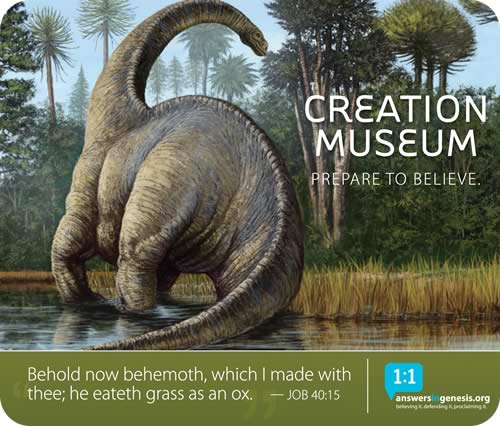
Image Source: Answers in Genesis Creation Museum

Image Source: Answers in Genesis Creation Museum

For folks like me and the author Jacob Tanenbaum, the scientific claims of the museum are impossible to accept.  A science teacher, Tanenbaum recoiled at the misleading scientific claims made by the museum.  “What disturbed me most,” Tanenbaum reported,

“was the theme . . . that the differences between biblical literalists and mainstream scientists are minor. They are not minor; they are poles apart. This is not to say that science and religion are incompatible; many scientists believe in some kind of higher power, and many religious people accept the idea of evolution. Still, a literal interpretation of Genesis cannot be reconciled with modern science.”

Fair enough.  During my trip to the Creation Museum, though, what struck me most powerfully was simply how plausible it all seemed.  For those who did not set out to debunk the information, the museum seemed just as authoritative as Chicago’s Field Museum or any other natural-history museum.

But what Tanenbaum wrote makes sense: the Creation Museum presents a misleading picture of the differences between creation science and mainstream science.

My beef with Tanenbaum is with his own misleading conclusion.  The problem with such creation science education, Tanenbaum argues, is “that 40 percent of the American electorate seems to have forgotten what science is. Considering that our nation put a man on the moon and invented the airplane and the Internet, this development is extraordinary.”

Tanenbaum may be a gifted teacher of mainstream science, but this conclusion suggests that he is not deeply versed in the culture of creation science that he condemns.  For those of us who want to understand creationism, we need to get beyond this naive assumption that creationists don’t know what science is, or that they are somehow hypocritical in their use of technology.

As I argued in a recent commentary in the Chronicle of Higher Education, simple ignorance does not explain American creationism.  Many creationists have studied mainstream science.  In many cases, such as that of leading creation science author Henry Morris, they have earned advanced technical degrees.  And, beyond such stand-out leaders such as Morris, many rank-and-file creationists have extensive science educations.  As political scientists Michael Berkman and Eric Plutzer discovered in their National-Science-Foundation-funded study of high-school biology teachers, of those teachers who espoused a belief in young-earth creationism (i.e., the Creation-Museum type of creationism), fully 55% had earned college degrees in science.   Furthermore, Berkman and Plutzer’s review of other such surveys led them to the following conclusion: “the overall evidence suggests that the high support for creationism in the classroom cannot be attributed primarily, or even substantially, to overall scientific illiteracy in the United States” (pg. 52).

Also, as creationists often remind themselves and their evolutionist foes, belief in evolution is not necessary for sophisticated engineering.  Dobzhansky’s claim that nothing in biology makes sense except in the light of evolution may be true, but that would not stop creationists from traveling to the moon, perfecting airplanes, or inventing the internet.

In the end, I think it makes a big difference whether Americans with creationist beliefs have “forgotten what science is” or if they have a distinctly different definition of science.  Building an anti-creationist argument on the foundation that creationism disables technical education, as does Tanenbaum and other prominent pro-science voices such as Bill Nye, is both a false claim and poor strategy.

Please don’t misunderstand me: this is not a brief for creationism.  However, if those of us, like me, Bill Nye, and Jacob Tanenbaum–who stand outside the borders of creationism looking in–if we really want to understand creationism, we must abandon our own naive assumptions about the meanings of that creationist belief.