Jesus Is the Answer

We Americans don’t have any confidence in evolution.  But we might if Jesus told us about it.  That’s the implication I get from Dan Kahan at the Cultural Cognition Project.

This fits with anecdotal evidence we hear from our evangelical friends and colleagues.  Many folks who grew up in strict young-earth creationist homes reported a life-changing experience at a Christian college.  When they heard about evolutionary theory from a science professor who was ALSO a devoted evangelical Christian, it changed the equation.  Instead of being forced to choose between their religious identity and evolutionary theory, they could accept both without facing a crisis.

Professor Kahan argued yesterday that Americans, in general, do not distrust science or scientists.  Skeptics who complain that Americans do not listen to scientific truth, Kahan says, simply don’t know what they’re talking about.  The evidence just doesn’t show it.  In case after case, Kahan shows, Americans love science.  We want more science and more funding for science.

With issues of climate change and vaccinations, people don’t argue against science.  Rather, Kahan says, people argue about who is a legitimate scientific expert.  People tend to trust more in the credentials of “experts” with whom they agree, or, more precisely, in the credentials of experts with whom they can identify.  As Kahan puts it,

If subjects observed the position that they were culturally predisposed to accept being advanced by the “expert” they were likely to perceive as having values akin to theirs, and the position they were predisposed to reject being advanced by the “expert” they were likely to perceive as having values alien to their own, then polarization was amplified all the more. . . . polarization disappeared when experts whom culturally diverse subjects trusted told them the position they were predisposed to accept was wrong.

When it comes to evolution, creationism, and evolution education, we can’t help but conclude that Jesus should do it.  That is, evangelical Christians and other resistant populations will be more amenable to learning about evolution if they can learn from someone who seems to share their religion.  It makes sense, then, to support the evangelical-friendly approach of organizations such as BioLogos.

On the other hand, Kahan’s argument implies that the angry-atheist approach will actually INCREASE creationist belief.  When evolutionary theory is associated with an anti-religious personality, religious people will tend to reject evolution entirely.


What If Stories, Part VII: Last but not Least

We always save the best for last, right?  Today at the blog of the National Center for Science Education, I make my case: How would the history of creationism be different without World War I?

For those who haven’t been keeping up, the NCSE has asked a handful of historians to give their best guesses.  How did World War I influence the development of creationism?  Of evolutionary theory?

We’ve read about creationism in Turkey and the Netherlands. We’ve read about the influence of the war on German intellectual life.  And about textbooks, the 1920s, and William Jennings Bryan.

So what did yours truly have to add to this discussion?  How do I think World War I changed the course of creation/evolution history?  You’ll have to read my post on the NCSE blog to find out.

What If Stories, Part VI: Evolution in Germany

As we approach the hundredth anniversary of the start of World War I, historians and journalists are asking how life might have been different if the Great War had never happened.

As the National Center for Science Education blog, historians and scientists are wondering how the history of evolution/creation might have been different.  Today, biologist Ulrich Kutschera argues that the war changed the way evolutionary scientists told the story of evolution.  Kutschera notes the work of German zoologist August Weismann, who forcefully and elegantly promoted evolutionary ideas in the years leading up to the war.

August Weismann, the Lost Answer?

August Weismann, the Lost Answer?

Without the war’s shattering effect on Germany and the world, Kutschera writes, Weismann’s legacy would have been very different.  It may have changed everything in the intellectual worlds of creationism and evolution.  How?  You’ll have to read the NCSE post to find out.


What If Stories, Part V: World War I as Game-Changer

What would the history of creationism have been like if World War I had never happened?  Today we read the most far-reaching argument yet in this series at the National Center for Science Education blog.

Much Less than 6,000 Years Ago

Much Less than 6,000 Years Ago

As ILYBYGTH readers are aware, we’ve been following this series of historians’ arguments.  The NCSE asked a tough question, and historians have offered different perspectives and ideas.  Today, Professor George E. Webb suggests that everything would have come out radically different if there had been no Great War.

What would have made such a difference?  You’ll have to read the NCSE post to find out the details.


Ham on Nye: The Debate Continues

He-said-he-said.  Who are we to believe? Bill Nye “The Science Guy” and creationist leader Ken Ham have published reflections on their recent debate.  Nye explains his triumphHam says, not so fast.  To this reader, Ham seems to be on the defensive.

As ILYBYGTH readers recall, the debate itself occurred a couple of months ago.  Bill Nye traveled to Ham’s Creation Museum to tackle the question, “Is creation a viable model of origins in the modern scientific era?”  The debate rollicked over some familiar territory and included some surprises.  Ham focused on his idiosyncratic definition of science, split into authentic “observational” science and illegitimate “historical” science.  Nye piled on the traditional skeptical puzzlers: How could a tree be more than 6,000 years old on a young earth?  Why are there no fossils out of order?  How could an Ark survive?

In the pages of the Skeptical Inquirer, Nye recently offered his reflections on the debate.  He explains his strategy to pile on example after example of young-earth-confounding science.  He explains his decision to spend his first precious ninety seconds on a mild joke about bow ties.  He profusely thanks his advisers, such as the experienced creation/evolution debaters at the National Center for Science Education.  Nye’s tone is profoundly celebratory.  In short, he explains how and why he triumphed.

Perhaps not surprising, Ken Ham took exception to Nye’s comments.  Never one to back away from a challenge, Ham recently published a rejoinder to Nye’s memoir.  To me, Ham’s article seems strangely defensive.  Don’t get me wrong: I’m no follower of Mr. Ham.  But I have defended him against vicious verbal assaults from skeptics.  I have also taken The Science Guy to task for his woeful misunderstanding of the culture of creationism.  But in this case, Ham’s only defense seems to be to niggle around the edges of Nye’s memories.

Ham objects, for example, to Nye’s memory of how the debate came about.  The way Nye tells it, Ham persistently challenged Nye to a debate until Nye agreed.  The way Ken Ham remembers it, however, the whole thing came about at the suggestion of an Associated Press reporter.

Ham also objected to Nye’s repeated suggestion that Ham has a “congregation,” and that all of these museums appeal to “Ham’s followers.”  Such language, Ham protests, seems to be an effort to marginalize Ham’s Answers In Genesis ministry as a fringe cult.  Fair enough.  I would be surprised if Bill Nye knew much about the history of parachurch organizations in American (and Australian) evangelical Protestantism.  For evangelical Protestants, there is often a clear distinction between church and broader organizations that also help the cause.  Missionary groups, Bible leagues, youth organizations, and similar parachurch organizations are a familiar part of the evangelical experience.  Nye really does seem to miss this distinction entirely.  But does it matter?  Does it really hurt Ham’s cause if outsiders think of his work as a “congregation” instead of a “ministry?”  It seems the distinction only matters to members themselves.

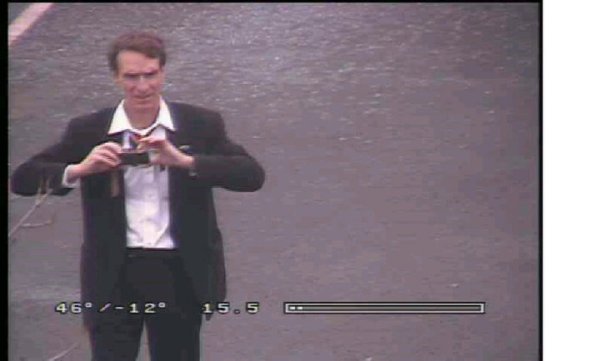
Perhaps strangest of all, Ham claims to catch Nye in an embarrassing distortion of the truth.  Nye insists that he had never been inside the Creation Museum before the debate.  One time when he was in the area, Nye explained, he drove around the parking lot, but the museum itself was closed.  Nye says he saw the “infamous” statue of a dinosaur with early humans outside the museum.  But Ham seems to prove that Nye distorted this memory.  Ham produces a photo that apparently shows Bill Nye outside the Creation Museum in 2011.  Ham even notes a 2011 Facebook post that seems to confirm the date and duration (122 seconds!) of Nye’s visit.  The museum, Ham claims, was indeed open at the time.  Plus, there is no statue outside the museum that depicts humans cavorting with dinosaurs.  How could Nye have seen a statue that doesn’t exist?

Nye's 122 Seconds Outside the Creation Museum

Nye’s 122 Seconds Outside the Creation Museum

These sorts of nitpicks put Nye in an awkward position.  Why would Nye embellish his memories of his 2011 visit to the Creation Museum’s parking lot?

In the end, though, they don’t seem to make a difference.  Throughout this post-debate commentary, Ken Ham takes a decidedly defensive tone.  He pokes holes in Nye’s memories, but he doesn’t really challenge Nye’s central conclusion that the debate was a triumph for mainstream science.


Schools and Science: Good News for Creationists

Whose science gets taught in America’s public schools?  A new study of Oklahoma high-school students finds that students emerge from their Biology classes with a creationist-friendly understanding of evolution.  This study suggests once again that we can’t just ask HOW MUCH science education young people receive.  We must also ask about WHOSE DEFINITION of science is taught.

Looks like more evidence that science in public schools might be far friendlier to dissenting visions of science than we might think.  Communities that include large numbers of creationists may take solace from the implication: Science in schools might mean very different things to different people.

The findings were published recently in the pages of Evolution: Education and Outreach.  Researchers Tony B. Yates and Edmund A. Marek surveyed students at thirty-two Oklahoma high schools.  They administered tests before and after the students took a course in Biology.  Taken as a whole, the students expressed 4812 misconceptions before they took the class.  Afterward, they had 5072.

Yates and Marek pulled those misconceptions from a list of twenty-three common ones, including the following:

According to the second law of thermodynamics, complex life forms cannot evolve from simpler life forms.

And

Evolution cannot be considered a reliable explanation because evolution is only a theory.

Though the students had more misconceptions about evolution after their classes, Yates and Marek claimed, they also came out more confident in their knowledge of evolution.

What’s going on here?  Yates and Marek blamed the teachers.  As they concluded,

teachers may serve as sources of biological evolution-related misconceptions or, at the very least, propagators of existing misconceptions.

Of course, for creationists, this must be a cause for celebration.  What Marek and Yates call “misconceptions,” creationists might call “critical thinking” about evolutionary “dogma.”  In spite of conservative worries that public schools have become godless institutions, hostile to religious belief, this study provides more evidence that teachers represent the beliefs of their local communities.  As political scientists Michael Berkman and Eric Plutzer argued in their book Evolution, Creationism, and the Battle to Control America’s Classrooms, teachers most often teach the values of their communities.  In the case of creationism and evolution, we see more evidence here that teachers do not challenge the religious beliefs of their students.  The science on tap in these Biology classes seems accommodating to skepticism about mainstream evolutionary thinking.


What If Stories, Part III: Schools, Scopes, and the War

What if World War I had never happened?  How would the history of creation/evolution controversies have changed?  That’s the question the folks at the National Center for Science Education blog are asking these days.  In today’s third post of the series, historian Adam Shapiro makes his case for a vastly different story without the Great War to stir the pot in 1914-1918.

Shapiro’s the right person to ask.  His recent book Trying Biology offered a smart new argument about the importance of textbook publishing in the history of creationism in the United States.

So how does Shapiro think World War I changed things in the world of American creationism?  You’ll have to read his NCSE blog post to find out.

What If Stories: Creationism and World War I

Much Less than 6,000 Years Ago

Much Less than 6,000 Years Ago

What if World War I had never happened? As the centenary of the start of that cataclysmic war nears, the National Center for Science Education has asked a group of eminent historians (as well as yours truly) to speculate how things might be different.

The first post in the NCSE series was penned by the Dean of Creationism History, Ronald L. Numbers.* Numbers, the author of the definitive history The Creationists, argues this morning that World War I was central to the shape of the creation/evolution struggles that emerged in the 1920s. As Ron notes, this sort of “counterfactual” game is tricky for historians. There are so many factors at play, such a varied interplay of contingencies and possibilities, that academic historians tend to shy away from guessing what might have happened. Nevertheless, Ron makes a strong case that the 1920s would have looked very different—in terms of creationism—had there been no big war. But does Professor Numbers think there would still have been a creation/evolution battle in the 1920s without a war? You’ll have to read his full post to find out.

I’m looking forward to reading the rest of the posts in this series. My own humble offering will come at the end of the series, I’m told.

* Full disclosure: Ron was my PhD mentor at the University of Wisconsin and is still a personal hero and friend of mine.


Will Creationists Take Half a Loaf?: An Anthropologist’s Response

Guest Post by David Long

David Long is an anthropologist and science educator at the Center for Restructuring Education in Science and Technology at George Mason University.  He is the author of Evolution and Religion in American Education: An Ethnography, based on his PhD dissertation at the University of Kentucky.  The editors asked David to respond to a recent ILYBYGTH post: Will Creationists Take Half a Loaf?

Will historians and philosophers accept that they are not baking or dividing bread?

I conduct research on the American relationship toward science as it plays out in schools.   When I began doing this with professional earnest a few years ago, my intention was much the same as Adam Laats, and many others who work in this area.  Originally, it was my hope that anti-evolution attitudes could be something that we set aside in American life.  Like many scientists and science educators, my unexamined assumption was that knowledge of evolution—as a well-reasoned, scientifically supported argumentation about the state of biological affairs—was something unavoidable.   Science disclosed a truth, and as such public attitudes should come along.

We know this is not the case.  Publics are multiple and working towards different ends. As Adam Laats should know well, the purpose of public schooling in the United States has always been in contention, and there have always been dissenters.  Science as a topic of study has been champion, demon, and utilitarian tool depending on who is reading the message it presents.  More importantly, as I came to see clearly while going to college with creationists as they studied evolution, evolution doesn’t fit within a creationist understanding of the world.  Making it fit changes one’s beliefs.  While this point may prompt quizzical looks, it’s germane to understanding the position Laats and Siegel seem to be holding, and where the weaknesses of that position are.  The conversation I intend to invoke can range wildly across disciplines.  To rein this in, I’ll simply do my gadfly work by commenting on Laats’ assertions toward some better conversation.  Let’s begin:

~ Students in public schools must be taught the best science available. 

This seems like a no-brainer claim about how school should be, except:  We have never had and for the foreseeable future do not have anything close to a teaching force that either knows or is pedagogically effective at teaching “the best science available”. The Devil’s advocate would point out that those who arguably understand the ‘best’ are Ph.D. scientists at the edges of their field. The “best science available” is vast, excruciatingly detailed, and often simply hard to learn.  Scientists rely on science’s authority when looking at the claims of science far afield from their own specialty in ways not unlike the public. Also, what moral warrant do Laats and Seigel draw upon to claim that this ‘must’ be so?  Shouldn’t students have the best of every subject?  A better question for me is why do we not have it currently and how are historians and philosophers fixing this?  I agree with Laats’ intent, but underscore the fact that the pipeline of science teachers is not currently prepared to do so.  It seems odd then to listen to historians and philosophers about a problem whose ‘fix’ lies within science education.  The help is of course welcome, but what practical steps are they taking to improve the concrete situation?

~ Too many scientists and science teachers take this to mean that creationism must be purged from students’ minds. 

As commentary to Laats’ post attested, supported by Berkman and Plutzer, the teaching profession has already produced a pragmatic ‘fix’ to this problem by downplaying evolution where it prompts local political turmoil in schools. Teachers are not well paid, work under a current accountability regime of non-stop, high-stakes standardized testing, and for the science, technology, engineering, and math (STEM) subjects, have an incredibly high professional turnover rate.  Evolution education, from this point of view, is not job no. 1.

For scientists who decry what they perceive as an abandonment of reason in classrooms, the root of their perspectival problem lies in the legacy of positivism which the sciences carry.  The sciences have been fairly slow in acknowledging that the social landscape and playing field of civic discourse has moved on to one that’s strongly post-modern.  Leaving debates about evolution aside, there is likely a bigger issue of general ambivalence toward science which may pose a much greater threat to the health of the enterprise in the coming years.

~ Public schools should tell students nothing about what religious beliefs they should hold.

This statement simply doesn’t correspond with what a critical eye on the political and social content and implicit curriculum of schooling sees.  Many religious and political conservatives reject a form of schooling that has made the policy move to set God aside.  Laats’ and Seigel’s normative position in these regards doesn’t stop creationists from seeing it for what it is—a liberal ideal of church and state separation.  Being mute, or feigning toward a Jeffersonian ideal is a political position—one that tells some conservatives clearly that you are not one of them, nor on the same Godly educational mission.  It’s the same idea of being mute or not regarding marriage equality, abortion, school prayer, etc.  Normative values that we (Laats, etc.) hold aren’t value-neutral.  It also explains a lot of the reasons why many conservatives homeschool their children.

~ In short, the goal of evolution education should be for students to understand or know evolutionary theory, but not (necessarily) to believe it.

What is understanding and what is knowing?   These are epistemological questions.  For me, understanding “inhabits a domain of possibility” as Mark Wrathall describes it, in a way useful for thinking through the logic of many who reject evolution.  For creationists, they cannot imagine a way in which evolution could ever possibly work within the content of their day-to-day lives, for the damage it inflicts on the narrative content of their faith relationship. Seeing it otherwise—in the affirmative—is outside their current domain of possibility.  For those who have come to ‘know’ differently, they are no longer—as a matter of belief—creationists in the way Ken Ham or those like him would hope.  They also, as I show in my book, have incurred social costs in how this new knowledge works within their social lives.  Suddenly being affirmative toward evolution with Grandma and your Youth Group marks you as heretic.

A distinction like Laats and Seigel make may well be a red herring.  A majority of the creationists I have worked with as research participants were excellent test takers and understood the internal logic of evolutionary theory—they just rejected the facticity of it.   The distinction Laats and Seigel draw depends on an overly formal sense of rationalism, which has been shown by Jonathan Haidt and other motivated-reasoning researchers to not be an accurate description of everyday human reason.  The point: Would Laats and Siegel be satisfied with their above distinction if the U.S. were to become radically more creationist?—so much so that public schooling came to outlaw evolutionary theory? Refraining from interrogating belief is easy. Working with students to come to understand the epistemologies they’ve been raised with, and what mediating work those thinking styles do when examining the claims of science is hard.  It is hard work we can’t back away from.

The framing of Laats’ post is instructive, especially in light of my above criticism of historians and philosophers making expert recommendations toward a population that is mostly not listening.  We, through the varieties of American social life, bake the bread that Laats speaks of.  As a nation, we produce creationism as an output of religious tradition, as well as the science educators for whom Laats’ loaf is to be split. But it’s not a clean split—nowhere close to it.  Science teachers sometimes are creationists themselves.  Many more have sympathies far less divisive than the terms of the split.  Most importantly, do historians and philosophers carry moral weight such that they are the bread-breakers?

 

Will Creationists Take Half a Loaf?

Okay, so here’s a deal: If science educators in public schools agree to remain neutral about creationists’ beliefs, will creationists allow teachers to teach their kids evolution?

I don’t rule the world, but if I did, that would be my cure for our creation/evolution battles.  Let me try to spell it out in a little more detail:

I’m working on a short book with philosopher Harvey Siegel, tentatively titled Teaching Evolution in a Creation Nation: Historical and Philosophical Perspectives.  Why would we attempt such a thing?  It wasn’t our idea.  Our little book will be part of a series cooked up by historian Jon Zimmerman and philosopher Randy Curren.  What if, they asked, what if we could get philosophers and historians talking to one another about educational issues?

This past weekend, the authors of these books gathered for a workshop at New York University.  Harvey and I made our case.  The high-caliber intellectual firepower gathered around the table asked lots of difficult questions.  Hardest of all, IMHO, was the one above: Will Creationists Take Half a Loaf?

In essence, given the long history of cultural battles over the teaching of evolution and creationism, Harvey and I make the following argument:

  • Creationism may or may not be science, but it’s not the best science out there.  Students in public schools must be taught the best science available.  At this point in history, that means the modern Darwinian synthesis.  (Bear with me for a minute here.  I know we can argue about what we mean by this, or whether or not that is the best name for mainstream evolutionary theory.  But for the moment, for the sake of argument, let’s proceed.)
  • Too many scientists and science teachers take this to mean that creationism must be purged from students’ minds.  If we consider creationism to be a form of religious dissent, that sort of attitude among mainstream scientists seems both cruel and pedagogically ineffective.
  • Teachers in public schools, therefore, must teach evolution.  Real evolution, not watered down with bogus religiously inspired alternatives.
  • But teachers must not make any claims on the religious beliefs of their students.  If students acquire a reasonable knowledge of evolutionary theory, their teachers will have succeeded.  Full Stop.  Public schools should tell students nothing about what religious beliefs they should hold.
  • In short, the goal of evolution education should be for students to understand or know evolutionary theory, but not (necessarily) to believe it.

One of the big issues that came up in our weekend workshop was whether or not students and teachers could really walk this line between understanding and belief.  How practical is it to ask students to “know” something they don’t “believe?”  But let’s leave that aside for a moment.  The question I’d like to ask this morning is different.

Assuming teachers could embrace this goal of “understanding-not-belief,” do you think young-earth creationists would go for it?  That is, would creationists who hold ideas that differ radically from the mainstream scientific consensus agree to allow their kids to learn evolution, IF the public schools agreed not to meddle with their children’s religious beliefs about evolution?

Smart people are skeptical.  With good reason.  At the recent blockbuster debate between young-earth creationist Ken Ham and science popularizer Bill Nye, for example, Ham did not take the role of a religious dissident, but rather insisted that creationism meant superior science.  Creationists have always insisted that their beliefs are better science, not just a religious dissent from good science.

So I ask again: Will creationists accept public education that teaches real evolution—and only real evolution—in science classes, IF that education remains stubbornly neutral about related religious beliefs?