Do YOU Need Evolution?

Our intrepid editor sat down this week with Prajwal Kulkarni, the genius behind Do I Need Evolution?  Praj agreed to offer some reflections on his recent career as culture non-warrior.

Does He Need Evolution?

Does He Need Evolution?

ILYBYGTH: Why do you care about creationism?

Praj: Thanks for agreeing to interview me Adam. I’m quite honored.

I actually care about creationists much more than I do creationism. They are real people, and many of them are among the smartest, kindest people I know. Also, contrary to popular belief, not all of them want creationism in public schools.

Ta-Nehisi Coates, one of my favorite writers, once described how he did not want more “positive” writing about black Americans. Instead he simply wants to portray them as complex human beings: “I do not wish it to show us “in a more positive light.”…I would have us depicted in all our rancid splendor–boastful and marvelous, rhythmic and self-interested, dumb, clear, hateful, and, on occasion, brave.”

I’m not suggesting an equivalence between media bias against Christians and African-Americans. But I do think we should have a similar goal for evangelical Christians. Creationists can be as complicated and contradictory as all of us, and they are not merely a problem to be solved. The media and scientific community, to put it mildly, do not realize this. I’ve spent a fair amount of time in various church communities. As I’ve gotten to know evangelical Christians as real human beings, I now see that rejecting evolution is not necessarily something to worry about.

Now that I’ve gotten that off my chest, let me finally answer your question about creationism. There are two big reasons I care about the issue.

First, as a (former?) scientist, I’m horrified at our irrational, unscientific arguments. Where did we get the idea that believing in creationism will prevent someone from becoming a doctor or a physicist? Scientific thinking and rationality cannot be modeled as an on-off switch, and suggesting otherwise is unscientific.

Second, I think creationism is really a proxy for deeper disagreements about public education, scientific literacy, scientific authority and expertise, democratic decision-making, religion, etc. I’ve always found those deeper philosophical issues fascinating, and I can’t think of another topic that touches on all of them so strongly.

ILYBYGTH: Can you tell us something about your intellectual background and education?

Praj: Growing up, I think there was an implicit expectation I would be a science person. Both of my parents are doctors, and pretty much everyone on my mom’s side of the family studied science in some way. But even when I was very young, I was attracted to philosophical issues. I also always had somewhat of an unorthodox streak in me. I remember arguing Hindu philosophy with family and friends.

At Penn State, I initially thought I would get a bachelors in engineering of some form and then work in industry. But I fell in love with a modern physics class at the end of my sophomore year. I did my undergraduate thesis in numerical relativity, one of the most abstract and theoretical branches of physics. I thought I wanted to do physics the rest of my life.

Pretty early in grad school, however, I realized that I did not want to do physics research my whole life. I started realizing that I’m much more of a breadth rather than depth person. And so I started studying policy and politics in my spare time. After grad school I worked in Washington, DC in science policy for two years.

I look at my current obsession interest in evolution and creationism as an extension of those previous interests in philosophy, politics, and policy.

ILYBYGTH: As a trained physicist, what’s your opinion on the relationship between “creation science” and “mainstream science?”

Praj: Oh boy…you just opened an ugly can of worms. Philosophers have been debating the “demarcation problem” (how to demarcate science from non-science) for literally thousands of years. You can spend a lifetime reading the scholarship. I’ve just spent several weeks myself!

The short, cop-out (but honest) answer is that I actually don’t find the question very interesting. I realize it’s the question for most people. But suppose tomorrow everyone agrees that creationism isn’t science. The deeper issues I raised above would still exist. That’s where the action is as far as I’m concerned.

But to not cop out and give a real answer…creationism is not science. I do think the science/not-science distinction is a lot more complicated than typically portrayed in the media (you can give yourself a headache reading the debates on naturalism), but that’s true for lots of issues. Since I don’t want to swim in afore-mentioned can of worm, I’m going to leave it at that for now!

ILYBYGTH: Okay, now for the hard one: If there is a creation/evolution culture war going on, aren’t you a traitor?  That is, doesn’t your work with DINE offer aid and comfort to creationists?

Praj: I really don’t think there should be a war. If there is one going one, I guess I’m a conscientious objector. I don’t view either creationists or scientists as the enemy, and it’s problematic to conceive of our fellow citizens this way.

And if I am giving aid and comfort to creationists, then I’m quite happy and proud of myself! I want everyone to be engaged in science and feel they are a part of it. A single belief doesn’t disqualify anyone. I find this with-us-or-without-us mentality is grotesque. Dick Cheney should not be our role model.

Creationism for Liberals

We know the problem with science in America, right?  Ignorant groups cluster around pseudo-scientific claims; people cling to outdated and disproven ideas out of a false sense of moral purity and righteousness.  Worst of all, scheming charlatans profit off this manufactured ignorance.

Same old, same old.  But what if we’re not talking about religious creationists, but rather about secular liberals?  In The Daily Beast, Michael Schulson recently accused shoppers at fancy-pants Whole Foods supermarkets of succumbing to pseudo-scientific claims.  Worst of all, Schulson writes, such folks often do so while feeling intellectually superior to the rest of benighted America.

As Schulson puts it,

From the probiotics aisle to the vaguely ridiculous Organic Integrity outreach effort (more on that later), Whole Foods has all the ingredients necessary to give Richard Dawkins nightmares. And if you want a sense of how weird, and how fraught, the relationship between science, politics, and commerce is in our modern world, then there’s really no better place to go. Because anti-science isn’t just a religious, conservative phenomenon—and the way in which it crosses cultural lines can tell us a lot about why places like the Creation Museum inspire so much rage, while places like Whole Foods don’t.

Read the entire piece.  Schulson describes the more-than-questionable claims of many of the products on sale at Whole Foods.  When he invited a biologist to look at some of the probiotic claims, she offered a quick conclusion about their scientific accuracy: “‘This is bullshit,’ she said, and went off to buy some vegetables.”

Most compelling, Schulson asks why creationist institutions such as the Creation Museum cause such outrage among the mainstream scientific community, while the anti-science on display at Whole Foods doesn’t.  One thing he doesn’t consider is the difference of scale here.  Young-earth creationists claim that the earth is somewhere between six and ten thousand years old.  Such an idea is utterly at odds with the fundamental premises of today’s science.  Claims that probiotics can work medical wonders might be false, but they’re not so enormously out of sync with mainstream science.

But that doesn’t mean that the parallel between young-earth creationism and organic-food fetishism isn’t important and valid.  As I have argued elsewhere, too often anti-creationists take false comfort from calling their creationist foes “ignorant.”  Certainly, some creationists might be naively ignorant, but more significant are those who know modern science and simply reject it.  The real question, IMHO, is not simply who is more ignorant, but rather a question of which cultural authorities people on each side choose to believe.

Along those lines, I appreciate Schulson’s stirring conclusion:

The moral is not that we should all boycott Whole Foods. It’s that whenever we talk about science and society, it helps to keep two rather humbling premises in mind: very few of us are anywhere near rational. And pretty much all of us are hypocrites.

Stuff It, Perfesser…

Ouch.  This is what biologists and geologists must feel like when young-earth creationists get aggressive. In the past, I’ve chided mainstream scientists for their unwillingness to sympathize with creationists.  Now that the topic is US History and I’m the one under attack, I feel more sympathetic to the biologists in the room.

Here’s the story: A couple days ago I posted a short essay in the pages of the History News Network.  I compared the history of neo-Confederate attacks on mainstream US history to the decades of creationist attacks on mainstream science.  Why do textbooks still include hackneyed old myths, I asked.  Why insist that slavery was not a leading cause of the Civil War?  Why claim that thousands of slaves fought loyally for the Confederacy?  Such things just aren’t true, and I reminded my history colleagues (and myself) that we must remain active supporters of real history in America’s classrooms.    

A few commenters took me to task for swallowing the myths of false history.  “Whoever this Laats character is,” one James Bendy remarked,

he’s definitely drinking the Kool-aid of the history revisionists. What he calls “revised history’ is actually the unvarnished truth. Yes, there were thousands of free blacks who fought FOR the South, along with thousands of Asians, Spaniards, Jews, Italians, all kinds of Europeans, and several entire tribes of Native Americans. It’s all documented and proven beyond any doubt.

Another commenter accused me of “egotistical presumption and condescension” along with “narcissism and moral blindness.”

Really?

I hadn’t meant to be provocative, really.  I hoped to remind other historians that they needed to remain actively involved in history education in their local communities.  It was an historian from William and Mary College, after all, who discovered woeful mistruths in a textbook used by fourth-grade public-school students in Virginia.  All of us need to serve as this sort of watchdog.   

My surprise reminds me of the ways generations of mainstream scientists felt after engaging for the first time with anti-evolutionists.  As I note in my 1920s book about the first generation of Protestant fundamentalists, when University of Wisconsin President Edward Birge disputed the scientific accuracy of anti-evolutionism in 1921, he found himself under political attack by the wily William Jennings Bryan.  President Birge went on to warn Princeton biologist Edwin Conklin, if you mention evolution, “you will receive an enormous number of letters and much fool printed stuff.”  

President Birge was one of the first mainstream scientists to tangle with anti-evolutionists.  His lesson to Conklin has been repeated by generations of mainstream scientists who engage with the issue of creationism.  Lamentably, in these durable culture-war controversies, conversation has always taken a backseat to accusations.

The same certainly seems to be true in this case.  There really isn’t a controversy here; not a real one.  Neo-confederate histories rely on half-truths and outright fabrication to “prove” their preferred stories.  Activists rely on political pressure to crush out dissent and promote politically palatable myths instead of real history. 

To be fair, I don’t dispute the notion that this sort of anti-historical meddling goes on from the left, as well.  There’s also not much disagreement among historians that the leftist history peddled by the late Howard Zinn is full of misleading half-truths and exaggerations as well.  Yet Zinn’s People’s History continues to be used by activist teachers in America’s schools.  That’s a shame as well. 

So what’s an historian to do?  Do I have to swallow these insults in order to build bridges across culture-war divides, as I have suggested mainstream scientists need to do?  Or is it more important to fight back, to take on neo-Confederate historians and activists on a point-by-point refutation?

What would Bill Nye do?


Creationist Kids Subvert the Bible

The kids are alright.  That’s the conclusion, anyway, of the Happy Atheist PZ Myers.

Myers took a tour of a recent creationist science fair.  What did he find?  Creationist kids seem to be using the tools of creationist parents against them.

Myers went to the smallish Twin Cities creationist science fair.  Most of the student presentations, he found, seemed like regular science with just a required Bible verse appended.  And that combination, Myers argued, undercut the intended creationist brain-washing of these young Minnesotans.

One student seemed to be comparing the absorbency of diapers to the spiritual absorbency of Jesus.  Another seemed to disprove her Bible verse by feeding a wild bird out of her hand.

Myers’ conclusion:

Whether they like it or not, these kids are being given the tools to kick their tired Christian ideology to the curb.


You Won’t Believe What This Poll Found Out About Dumb Americans

Thanks to the ever-watchful Sensuous Curmudgeon, we see a new poll: Only ¾ of Americans know that the Earth goes around the sun.  Dur.  But this sort of ignorance raises important questions about what it means to know something and, crucially, what it means to not-know.

The poll was conducted in 2012 by the National Science Foundation and apparently shared at the recent meeting of the American Association for the Advancement of Science.  [Editor’s note: we couldn’t find the original poll results themselves, but we found reports of them from sources such as National Public Radio and Phys.Org.]

According to this survey of 2,200 American adults, only 74% correctly answered that the Earth goes around the sun.  For those of us who get depressed about the great US of A, we might take some comfort that similar results have been reported from similar polls in the European Union and China.

But here’s the kicker: There are lots of ways to not-know something.  As Robert Proctor called it a few years back, there are many different meanings to agnotology, the science of not-knowing.  In the case of this survey, we see a crucial detail of great interest to all of us interested in American education and culture.

Though Americans, Europeans and Chinese displayed similar levels of what Proctor might call “native-state” ignorance about the fact that the Earth goes around the sun, Americans had much higher levels of “non-knowledge” about human evolution.  According to the NPR report, 66% of Chinese respondents thought humans had evolved from other animals.  Seventy percent of European respondents thought so.  But only 48% of Americans did.

For those of us interested in education and culture, this suggests a different sort of non-knowledge.  Americans who don’t “know” that humans evolved from animals might simply not know it.  They might be simply, naively ignorant.  But those folks will be joined by large percentages of Americans who don’t “know” humans evolved from animals because they firmly “know” that God created humanity by fiat.

So are Americans dumb?  Yes, of course we are.  But are we DUMBER than Chinese people or Europeans?  This is where it gets tricky.  When knowledge is simply absent, that’s one thing.  But when correct knowledge is knowingly replaced by counter-knowledge, we have a much more complicated situation.


Creation? Evolution? Both? Neither?

Those of us who follow the creation/evolution debates bump up against a frustratingly common factoid.  Article after article, both scholarly and popular, cite Gallup polls as proof that nearly half of American adults espouse a young-earth creationist position.  In fact, we might be better off thinking of a much smaller number.

In the pages of Christianity Today, sociologist Jonathan Hill suggested that the real numbers are much more complicated.  The problem with the Gallup polls are that they force people to pick the position on creation that comes closest to their belief.  We do not find out, for example, how much they care about the issue, or how certain they are about their beliefs.  Most tellingly, we do not find out what other views they also find convincing.  As any social scientist can tell us, people tend to say one thing about their beliefs and believe another.

Hill is not the only nerd to question Gallup’s high numbers.  Josh Rosenau of the National Center for Science Education noted recently that poll numbers change as questions change.  Similarly, political scientists Michael Berkman and Eric Plutzer survey the surveys in their must-read Evolution, Creationism, and the Battle to Control America’s Classrooms.  Not surprisingly, they conclude that the structure of the survey and the wording of the questions can deliver very different perspectives on the numbers of Americans who believe in evolution or various types of creationism.

For example, two polls from 2005 came up with different results on the issue of teaching creationism in public schools.  One poll from Virginia Commonwealth University found that 21% of respondents favored teaching only creationism; one from Harris found 23% support for that position.  Pretty similar.  But the VCU poll concluded that 43% of Americans preferred public schools to teach a combination of evolution and creation in science classes.  The Harris poll put that number at 55%.  That’s a significant difference, one that can’t be explained away by hanging chads.  (For younger readers, “hanging chads” is an hilarious reference to an ancient election conundrum in the USA.)

Furthermore, when pollsters ask Americans different questions, they get—no surprise—different answers.  Gallup pollsters in 1999 asked if people would favor or oppose teaching creationism INSTEAD OF evolution in public schools.  Depending on who did the asking and when (Berkman and Plutzer review a handful of polls from 1999-2005), either a slim majority or a near-majority oppose such teaching.  The numbers vary from 54% opposed to 44% percent opposed.  That’s a big difference.

When Jonathan Hill conducted his BioLogos-funded survey, he found similar complications.  As he explains in the pages of CT, a better survey will allow respondents to separate out their specific beliefs about origins.  A better survey will allow respondents to explain how important each belief is to them.  Hill’s National Study of Religion and Human Origins asked respondents to specify their belief in each of three ideas.  Did humans evolve from other species?  Was God involved?  Were humans created within the last 10,000 years?  The familiar Gallup poll question lumps together all these notions into one young-earth creationist position.

But when Hill separated out these beliefs into three separate questions, he found that only 14% of respondents agreed with all three.  Only 10% called themselves “certain of their beliefs.”  And only 8% said that “it was important to them to have the right beliefs about human origins.”

Hill found similar dwindling numbers on the evolution side.  When pressed, the number of people who firmly and cantankerously cling to a belief that life came from evolution without the interference of any divine entity shrinks considerably.

What does it all mean?  Hill offers a stirring conclusion.  “If only eight percent of respondents,” he suggests,

are classified as convinced creationists whose beliefs are dear to them, and if only four percent are classified as atheistic evolutionists whose beliefs are dear to them, then perhaps Americans are not as deeply divided over human origins as polls have indicated. In fact, most Americans fall somewhere in the middle, holding their beliefs with varying levels of certainty.

Of course, Hill is not just a neutral observer.  As do I, Hill hopes to find a middle ground, and his surveys find one.  Evangelical Christians, Hill suggests, would do well to put battles and controversies to the side, and focus on their broad shared beliefs.  For the wider society, I wonder if we might be able to do the same.


Evolutionists Roast Ham

HT: AS

Thanks to the brilliant Matt Stopera, we also have a series of 22 questions evolution-believers would like to ask Ken Ham.

[If you’re just joining us, you can catch up on the details of the Ham-on-Nye debate here; some analysis here; and some of Stopera’s creationist questions here.]

As a preamble, let me remind readers that I am a “self-identified evolutionist” myself, so my comments here will be more along the lines of family disagreements than were my comments about the creationists’ questions.

I cringe the most when I see the snark inherent in some of these questions.  Worst of all, one questioner asked about the Flintstones.  This kind of question just poisons the well.  If I were a young-earth creationist reading this, it would reassure me that everything I believed about mainstream intellectual/scientific culture is correct. First, this kind of question demonstrates a determinedly hostile attitude toward creationist belief.  Second, it implies that creationists believe things they don’t really believe.  Third, it doesn’t demonstrate any knowledge about evolution or science, only a knowledge of kitschy old TV cartoons.  Finally, it proves that only creationists are willing to talk politely and civilly to those with whom they disagree.  As Ken Ham tried to prove in the debate itself, many creationists believe that evolution believers are “indoctrinated” into believing evolution by fake science that has “hijacked” the name science for its own anti-God purposes.  Closed-minded burns like this Flintstones question demonstrate first and foremost–to any intelligent creationist–that Ham was right.  Evolution, this question implies, is something we’re not even willing to talk about.  All we can do is make fun of those with whom we disagree.  A shameful repudiation of liberal civil values.

Also sad, some questioners chose to make only assertions.  One woman wrote happily, “Science rules!”  Not exactly a proud demonstration of the clear intellectual superiority of the modern evolutionary synthesis.

Happily, other evolutionists asked better questions.  The best point Nye made during the debate, IMHO, was the irrefutability of the fossil record.  Find a single exception, Nye repeated, and you’ll convince me.  The evidence is clear.  Several questioners challenged Ham to address that issue more clearly and directly.

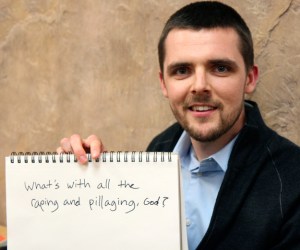
Other evolutionists, surprisingly, focused on religious themes.  As one guy put it, “What’s with all the raping and pillaging, God?”  Now, this doesn’t have anything to do with evolution directly, but I think religious questions are the proper field of discussion here, not scientific ones.  It makes the most sense to me for evolutionists to challenge creationists–especially Ham’s brand of young-earth creationist–on the theological and logical problems with the religious attitudes at the heart of YEC.  Why should we believe in a six-day creation, in other words, and not the rest of the Old Testament?  Of course, intelligent YECs have answers to those questions, but by asking religious questions, IMHO, we keep this discussion where it properly belongs.

Stoperas HamOther questions seem less well thought out.  One person asked, for example, how one could doubt evolution, since there were entire disciplines devoted to it?  That seems like an ignorant question to me.  Why would anyone assume that something that gets studied a great deal must be true?  The history of science can give us plenty of examples of radically untrue notions that attracted lots of academic attention: quantity of angels on pins, phlogiston, phrenology…the list could go on and on.

Some smart questions demonstrated a more understandable ignorance.  One person, for instance, asked, “How can you deny microevolution?”  A good question, but one that shows a lack of knowledge about today’s young-earth creationism.  Creationist scientists these days are actually some of the most ardent advocates of the distinction between “micro-” and “macro-” evolution.  Creationists eagerly agree that microevolution occurred.  In the debate, Ham referred to this as the changing of God’s original “kinds.”

Finally, several of the questions asked about educational issues, the questions near and dear to our hearts here at ILYBYGTH.  Some were silly, such as one who said he required his textbooks to be newer than 4,000 years old.  This is not only silly in the obvious sense that creationists use lots of new textbooks, but in the deeper sense that YECs would call the Bible a “textbook” only in a unique sense.  The Bible to many YECs is indeed a storehouse of knowledge, but it is much more than that.  As Ham argued in the debate proper, the Bible has a unique status, something much more than a textbook.

Another made the great argument, “Keep religion out of my science classes!”  Even better would be if this person added, “Keep YOUR religion out of my science classes.”  This is indeed a strong point.  Whatever one may say about it, even Ken Ham agrees that YEC is a belief based in religion.  Indeed, he goes through verbal (and mental) gymnastics in his efforts to prove that evolution is also a religion.  Both sides agree, though, that science classes in public schools ought not teach religion.  And intelligent YECs admit that their evolutionary beliefs are frankly religious.

OK, nuf sed.  Three cheers for Matt Stopera.  This 22-vs-22 has been at least as illuminating as the debate itself.


Creationists Grill Nye

HT: NBR

What did creationists want to ask Bill Nye?  In Tuesday’s big debate, we heard a series of audience questions, but there must have been many audience members who still wanted to ask more.

Journalist Matt Stopera was there, and he asked self-identified creationists what they would wanted to have asked Nye.  Whatever your analysis of the debate, these questions help us understand what creationists thought of Mr. Nye and his presentation of the evolutionary worldview.

Some of the questions demonstrate ignorance of mainstream evolutionary science.  One respondent, for example, wondered why there were still monkeys if we came from monkeys.  That’s not what evolution says.  This is the sort of simple, naïve ignorance that too many non-creationists think makes up all of creationism.  A couple of other questions asked similarly naïve questions.  How can there be a sunset without God, one asked.  Another asserted that since the world was “amazing,” there must be a God.  It doesn’t take a Bill Nye to poke scientific holes in that sort of naïve creationism.

But that’s not all there is to the intellectual fabric of American creationism.  The other questions show the diversity among creationists.  One question asked simply, “What about noetics?”  Another woman wondered how we can understand salvation if we believed in evolution.  Another challenged Nye: “Are you scared of a divine creator?”  Two people asked about the Lucy fossils.  Some asked what caused the Big Bang.  When this came up in the debate itself, Bill Nye frankly and enthusiastically responded that he did not know, but that non-knowledge and the excitement of discovery lay squarely at the heart of real science.

stopera nye

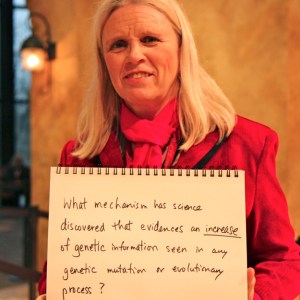
Some of the questions showed that creationists have learned science, but a very different science.  For instance, one woman wanted to know how evolution could account for an increase in genetic information.  This is a question mainstream science can answer, but it is often presented by creationist scientists as a decisive disproof of mainstream evolutionary science.  What does it matter?  It shows that some creationists are not simply unaware of mainstream science.  Rather, their knowledge about evolution has been occluded by a compelling–if not scientifically accurate–counter-knowledge.  This is different from people who just don’t know about evolution.

Several questioners wanted to ask Nye about schools.  “Are you influencing children in a positive way?” one asked.  Why not teach more than one “theory” of origins, a couple more wanted to know.

Thanks to Stopera for sharing this fascinating gallery of creationist conundrums.


Debate Analysis

So, the Ham-on-Nye has come and gone.  For those of you who missed it, you can still watch the debate for a couple of days.  Or you can follow our comments and discussion from last night.

I’m very curious to hear people’s reactions.  For me, as someone convinced that humanity had its roots long ages ago in a process that did not need (or receive) any divine guidance, I certainly did not hear anything from Ken Ham to make me question my beliefs.  Though I did find Mr. Ham to be engaging and warm.  Speaking from the “evolutionist” side, I thought Nye did a good job, though I wished several times that he had taken different approaches.  For example, I think it is a bad strategy to focus on the unlikelihood of Noah’s Ark.  As Steve Carrell can tell you, such questions can all be answered with a steadfast belief in the power of the supernatural.  They do not need to make naturalistic sense.

As I describe in my upcoming book, William James Bryan handled this “village atheist” objection nearly a century ago.  When arch-skeptic Clarence Darrow put Bryan on the stand at the 1925 Scopes Trial, Darrow pressed Bryan on the believability of the Bible.  How could Joshua have told the sun to stand still?  Didn’t Bryan know that such a feat would cause the Earth to melt?  Bryan’s reply shut down Darrow’s attack, IMHO.  As Bryan put it, to cheers from the audience, if Darrow had trouble believing in miracles, the problem lay not with the miracles, but with the man.  It does not seem as if Nye understands this fundamental epistemological attitude among many religious people, not only young-earth creationists.

How about you?  Did any creationist readers find Mr. Nye’s arguments new or worth consideration? 

Were there any other parts of the debate that you found surprising or intriguing?

Personally, I thought the best part of the evening were the last section, when both speakers took audience questions.  Questions two and four were the best.  Each asked Nye to explain a fundamental mystery of origins, to which Nye replied in each case, “Don’t know.  It’s a remarkable mystery.”  Then, in each case, Ham rebutted that it was not really a mystery at all.  It was explained in the Bible.  It was a humorous exchange, and illuminated the difference between mainstream science and Biblical knowledge.

Time for Ham on Nye!

Getting ready to watch the debate.  For those who are just emerging from their winter hibernations, I’m talking about the debate at the Creation Museum between young-earth creationist Ken Ham and “The Science Guy” Bill Nye.  You can watch live via debatelive.org.

I’ll update this post throughout the evening if anything comes to mind.  All are encouraged to put in their two cents in the comments column.

Here are some of the things I’ll be looking for:

  • Will Ham harp on the “observational” vs. “historic” science argument?  If so, will Nye call him out on the non-scientific nature of that argument?
  • Will everyone keep smiling?  If not, who will crack, and how?
  • Along those lines, will the Creation-Museum crowd give Ham an enormous home-field advantage?
  • Will Nye make the bad argument that creationism somehow prevents people from learning mainstream science and engineering?
  • Will Nye demonstrate his lamentable ignorance about the culture and history of American creationism?
  • What will either side say about other sorts of creationism, such as intelligent design, evolutionary creationism, or old-earth creationism?  I’m guessing neither will even mention them.

OK, nuf sed!  I’m going to go eat a taco and open a beer.  See you when the debate gets started.

_____________________________________________________________________________

6:30: While we’re waiting, I encourage everyone to consider looking into the history of creation/evolution debates.  As usual, the best source for these things is with my grad-school mentor Ron Numbers.  Ron’s blockbuster book The Creationists includes great source material about the long tradition of public debate about evolution.  Even more nerdily compelling, Ron edited a collection of debates themselves.  The volume is harder to find, but anyone with a decent-sized university library nearby should be able to find it or request it via inter-library loan.  For all with an interest in the history of these debates, it’s vital reading.

_____________________________________________________________________________

6:30: I gotta give the Creation Museum credit.  The other day when I tried to register to watch, I was a little skeptical that they would have it working properly.  But now they’ve got a nice set up with the format listed along the right side and an exciting countdown clock going.

_____________________________________________________________________________

6:45: We’ve got music!  And a visual of the Nye-Ham weigh-in…  I like the titles: Ken Ham, AIG CEO; Bill Nye “The Science Guy”

_____________________________________________________________________________

6:53: Ugh…whoever wins this debate, it won’t be the person who picked this elevator music…

_____________________________________________________________________________

7:00: Here we go! What’s going on?  A Ken Ham cartoon?  Kids come free–an ad for the Creation Museum.  We’ve been welcomed!  “Hundreds of thousands watching online.”  That’s us!

_____________________________________________________________________________

7:02: Who knew the moderator could make jokes?  Where did we come from?  He came from DC on a plane! Yuk yuk.  And a coin flip?  Perfect for a Broadway Joe Superbowl joke…

______________________________________________________________________________

7:04: Did Ken Ham just say, “I’m a Nazi?”  Oh… “I’m an Aussie…”

Ham’s lead-off: evolutionists have “hijacked” the name of science to squeeze out creationism.

And he’s got experts: Stuart Burgess.  I’m not familiar with Burgess.  Anyone else?

______________________________________________________________________________

7:07: Sure enough, Ham is leading with his main argument: “observational” vs. “historical” science.  Not the best approach.  But a better argument: we don’t need evolution to be good technologists.  A middle path: forcing evolution on school children is actually a religious argument.

______________________________________________________________________________

7:09: Nye’s turn at bat: He leads with a joke about bowties.  And a long anecdote for a guy with only five minutes to talk.  Grandpa and his bowtie.  Maybe that will be a good way to make “evolutionists” seem less terrifying.

Oooh.  Nye is changing the question.  His new version: Does Ken Ham’s creation model hold up?  Looks as if he’s taking on Ham’s observational/historical distinction.  Wow!  Nye is great.

If CSI can tell about the past from clues, then so can scientists.  All of them use the SAME science.

Uh Oh, Nye is breaking out his less-powerful argument that creationists can’t be good technologists or engineers.  That one just doesn’t hold up!

______________________________________________________________________________

7:16: Raymond Demadian.  A young-earth creationist and inventor of the MRI.  Now Danny Faulkner, AIG astronomer with PhD.  This is what worries me about Nye’s argument that creationists BY DEFINITION can’t do science or technology.  It is easy to find people who can poke holes in that assertion.

This bit drives mainstream science bonkers.  This is why the NCSE does its Project Steve.

7:20: Ham’s “We weren’t there” argument just doesn’t do much.  I think Nye’s CSI intro was a great way to predict this and defang it in advance.

NOW A GOOD ONE: a challenge for Nye–can Nye name a single technology that couldn’t be designed by creationists?

And snappy graphics: cartoon Nye vs. cartoon Ham.  The same evidence, interpreted differently.

7:25: Ham spends some time explaining the fact that evolution occurs, but only within biblical “kinds.”  That is, two ur-dogs on Noah’s ark created wolves, foxes, dogs, etc.

7:29: Whoops! Ham insists that public-school science teaches religion, since they teach evolution that has no basis in observational science.  Based on belief, not on observations.

Is it just me, or does Ken Ham seem nervous?  I’m surprised, since he is such a polished performer and public speaker.

7:32: Smart tactic, Mr. Ham.  He takes on Darwin as a racist thinker.  Biblical creationism, in contrast, insists that there can be no real racial differences.  Of course, he doesn’t explore the notion that today’s evolutionary scientists no longer argue that evolution proves the differences between races.  Nevertheless, as a political tactic, this makes good sense for Mr. Ham to focus on.

7:35: not as powerful: Ham keeps insisting (as we thought he would) on the intellectual paucity of “historical science.”  It would be a stronger argument to non-creationists like me if Ham kept it simpler–asked mainstream science to admit that there is SOME belief implicit in mainstream science.  But that belief does not inhere in mainstream science’s use of “historical science.”

7:37: Now Ken Ham enters into the theological roots of his belief system.  “We make no apology” for our religious roots.

7:40: Looking at Texas textbook battles.  Ham says the news slants the coverage, pitting “creationists” against “academics.”  Says that Kathy Miller of the Texas Freedom Network is really the one imposing religion on public school students.  By insisting on evolution, kids are indoctrinated in a belief system instead of discovering truth on their own.

7:42: More preaching to the choir.  Evolution leads to more abortion.

And, what’s the real point?  According to Ken Ham, young people must learn first and foremost that God loves them.

______________________________________________________________________________

7:45: Now it’s time for Nye’s longer presentation.  Starting with limestone.  “We are standing on millions of layers of ancient life.  How could those animals have lived their entire lives in just four thousand years?”

7:48: As an “evolutionist” who reads creationist literature, I can hear the voices of creationist disputing Nye’s anti-flood, anti-young-earth examples–though there might be ancient trees and ancient rock layers.  But that does not refute the central argument of Ham and other YECs that such things are not observed, but assumed.

Oh, wait!  This fossil stuff is great.  There is NO EXAMPLE OF FOSSILS THAT CHANGE THE ORDER OF EVOLUTIONARY THEORY.  A flood would have produced much more turbulence.  Will this convince any YECs in the audience?

7:52: here’s another good one: If animals were all on the Ark, where are the kangaroo fossils on the way from Mt. Ararat to Australia?

How could one family have built an ark so big?  That doesn’t make sense.  Other great shipbuilders could not build a wooden ship that lasted in seas.  How could eight people have built a sea-worthy wooden ship?  Of course, the YEC answer here is easy: God can make anything happen.  I’m worried Nye here is not reaching any listeners.  Same with other arguments that Nye is not making: How could Jonah survive for days in a fish?  Etc.?  The answer is easy, and was the argument made by William Jennings Bryan in the 1925 Scopes Trial: Miracles are easy to believe if one has faith.

Plus, if all 16,000,000 species evolved in the last 4,000 years from the 7,000 “kinds” that went on the ark, that would mean we’d be seeing 11 new species every day.  Where are they?

I wonder if these mind-blowers will cause any creationists in the audience to reconsider their beliefs.  Or will they just dismiss them as bitter ravings from a confused non-Christian.

8:02: Nye overuses the word “remarkable.”  He uses it both in the usual sense, and as a veiled criticism of Ham’s scientific model.

Also, I wonder if Nye’s repetition of his sex argument (he’s making the point that some animals get genetic benefits from reproducing sexually, even in some fish species that are capable of asexual reproduction) will make some YECs uncomfortable.  Implies that Nye is a little too comfortable with sex.

8:13: good call, Mr. Nye.  The US Constitution says we should promote science.  But don’t specify this is only an issue for Kentucky, Texas, and Tennessee!

______________________________________________________________________________

8:14: Time for rebuttals.  Ken Ham first.  How does he rebut radioactive dating?  Dates done by this method produce inconsistent results.  Stuff in the same layers show very different dates.  Plus, dating methods assume constant rates.  How do we know this?

And watch out for Christians who believe in an ancient earth.  Death cannot have happened before Adam’s fall.

______________________________________________________________________________

8:20: Nye’s rebuttal.  Dating methods ARE reliable.  Why is the translated Bible a better source.  To Nye, that reliance on the Bible is “unsettling, troubling.”  But, again, why should it convince YECs if Nye is unsettled?

Nye condemns Ham’s argument as “magical.”  How will that convince someone who agrees wholeheartedly that it is miraculous?

If we use the Bible as a science text, what does that mean?  That Mr. Ham’s words are somehow to be more respected than what people can observe themselves.

Also, evolutionary theory is not racist.  Rather a simple matter of historic ethnocentrism.

______________________________________________________________________________

8:25: Ken Ham counter-rebuttal.  Bears are vegetarian.  But they have savage teeth.  Fruit-bats, too.  That does not prove that lions might not have been vegetarians before the flood.  And why couldn’t Noah have built a better ark than we could later?  Don’t assume that people in the past were not as smart as modern people.

______________________________________________________________________________

8:30: Nye counter-rebuttal.  Says Mr. Ham did not come close to addressing the huge problems with the numbers raised by the idea of a young earth.  Where did all the species come from?  There just isn’t enough time.  Nye says it is not “reasonable” to think Noah and 7 helpers could have built an ark.

What’s the central issue?  Ham says we can’t make assumptions about the past.  Nye says these are legitimate, not just made up.  Why should we accept Ham’s word for it that natural law changed completely four thousand years ago, without leaving any record?

And what about all the billions of religious people who disagree with Ham’s vision of the origins of life?

Whoops!  Says Ham’s model is based on the Old Testament, not the New.  That seems like another reach for Nye.  Those are questions YECs and others have debated for a looooooong time.

Great point: real scientists welcome proof.  If there is proof of a very different fossil record, no one wants to see that more than real scientists.

______________________________________________________________________________

8:35: Q&A from the audience.

Question 1: for Ham: How does creationism account for the celestial bodies . . . moving further apart?

Ham: That’s in the Bible.  God says he is stretching out the heavens.

Nye: Where did we come from?  We all ask it.  Astronomy is a science devoted to this question.  They are not satisfied with an answer from the Bible.

Question 2: For Nye: How did the atoms that created the Big Bang get there?

Nye: We don’t know.  Scientists engage in what we call science in order to find answers.  We do not take anyone’s word for it.  Nor even The Word for it.  This is the heart of real science.  This is the problem with Ham’s approach.

Ham: There is a book that tells us the answer.  “That’s the only thing that makes sense.”  How else would there be matter?  It could only come from “intelligence.”

Question 3: Scientists produce evidence for evolution.  Besides the Bible, what evidence can you produce?

Ham: Don’t make an argument based on what the majority of scientists believe.  We can see from history the danger of relying on the majority of scientific opinion.  When it comes to the past, we can’t know scientifically, we can only know through belief.  We’re honest, mainstream scientists are not.

Nye: If any scientist makes a big discovery, that scientist will be embraced.  Science progresses by seeing what works and by always challenging its own assumptions.  It is not true (totally) that science is dictated by majority belief.

Question 4: for Nye: How did consciousness come from matter?

Nye: “Don’t know. This is a great mystery.”  Science is all about the joy of discovery.  We want to find out the answer to this question.  Something about dogs?  And self-doubt?  We must encourage young people to investigate the question of consciousness.

Ham: Goes for the laugh!  There is an answer, Bill.  It’s all in the Bible.  It is not a mystery.  And if it’s all about discovery, what about life after death?

Question 5: for Ham: What if anything would ever change your mind?

Ham: pause….”I’m a Christian.” As such, he goes by God’s guidance.  The Bible is the Word of God.  You can make predictions based on that.  I can’t prove that to you, but I can say, try it.  See if God will reveal Himself to you if you ask Him.  “No one’s ever gonna convince me that the Word of God is not true.”  But that doesn’t mean they don’t keep learning and asking and inquiring.  Would Bill Nye ever change his mind?

Nye: All I’d need is one piece of evidence.  One fossil in a different layer.  One piece of evidence that stars appear to be far away, but they’re not.  Says he would change his mind immediately.  GREAT ANSWER.

Question 6: for Nye: Is there evidence for the age of the earth besides radiometric evidence?

Nye: Deposition rates, seen by Lyell so many years ago.  Plus, radiometric evidence is very strong.  The weight of the evidence is so strong that creationists need to find a way to disprove it somehow.

Ham: The age of the earth came from studies of meteorites, not earth rocks.  Every dating method is faulty.  But most dating methods say the earth is much younger.

Question 7: For Ham: Can you reconcile the change in the rate continents are now drifting, to the rate they would have had to have traveled 6,000 years ago?

Ham: This also proves my point about historical vs. observational science.  Our researchers look at this often.  Plate movements today don’t necessarily equal the rates in the past.  That is an unwarranted assumption.  We believe in catastrophic plate tectonics.  A big shift at one point in time.

Nye: The evidence for sea-floor spreading is clear.  It leaves a record in the rocks.  We can measure rates of continental drift.

Question 8: for both: favorite color?

Nye: Green.

Ham: Blue.

Question 9: for Nye: How do you balance the law of evolution with the second law of thermodynamics?

Nye: Energy is always lost to heat.  Entropy increases.  Here’s the kicker: the earth is not a closed system.  The sun is always delivering energy.  Day and night.  Ha ha.

Ham: Energy or matter will never produce life.  God imposed information.  Matter could never do it alone.

Question 10: for Ham: Could evidence of an ancient earth make you change your belief in God and Jesus?

Ham: Science could never prove such a thing.  It would be “historical” science and therefore based on possibly faulty assumptions.  Therefore, the question doesn’t make sense.  I believe in a young universe because the Bible says it.  Frankly and openly.  But there is nothing in real science to contradict that.  There is nothing that will make me change my belief.

Nye: You CAN prove the age of the earth using observations.  Ham thinks everyone should take his word for it.  His vision of a book translated into English.  How does he know that life cannot come from something that is not alive?

Question 11: For Nye: Is there room for God in science?

Nye: Billions of people are religious and yet embrace science.  Does anyone here not have a phone?  Anyone here who doesn’t use medicine?  Anyone who doesn’t eat?  Science makes life possible.  That has nothing to do with religion.  People can be religious, for example Francis Collins.  Ham is the exception, not the rule, for religious people.

Ham: God is necessary for science.  I love technology.  All of that has to do only with “observational” science.  God makes science possible, since God created logic and natural processes.  The Bible and science go hand in hand.

Question 12: for Ham: Should the entire Bible be taken literally?

Ham: “Literally” has many different interpretations.  I take the Bible “naturally,” i.e., in the sense in which it was intended.  One can’t insist on Old Testament rules as laws today.

Nye: Only certain parts of the Bible are to be taken literally?  Others are assumed to be just poetry?

Question 13: for Nye: Have you ever believed that evolution was accomplished through way of a higher power?

Nye: The idea of a higher power can’t be proven or disproven.  We can’t know some things.  But intelligent design is a different matter.  ID has a “fundamental misunderstanding of the nature of nature.”  The watchmaker analogy doesn’t hold.  Nature adds complexity through natural selections.  Better designs survive.

Ham: Are there any examples of new functions that arose from genetic material that was present?  It doesn’t happen.  The information has to have been already present.  Information is not created.  Just switched on or off.

Question 14: for Ham: Name one institution. . . other than a church . . . that uses . . . creationism to produce its product.

Ham: Any scientist uses creationism.  They all use the laws of logic, which only make sense in a God-created universe.  Otherwise, how can we count on natural law if we don’t assume an all-powerful creator?  This is the only way to raise a generation of innovative youth.  Teach them to trust natural laws created by God.  Plus, creationist scientists publish in secular peer-reviewed journals.

Nye: Creationism does NOT have a predictive quality.  A Biblical worldview is only shared by a few people. What about everyone else?  Were they condemned?

Question 15: for Nye: If evolution says that humans are getting smarter, what about smart people in the past?

Nye: Wait: that is not evolution.  It does not mean that people are getting smarter.  Natural selection does not mean the best.  It means those that fit in the best.  The right germ could kill millions.  No matter how smart.  Those who are resistant will survive, not those that are smartest.

Ham: Evolution says that some fish will lose their sight.  That’s not an improvement.  Evolution never provides new information, new function.

Question 16: LAST QUESTION: for both: What is the one thing. . . upon which you base your belief?

Ham: Easy.  The Bible.  Salvation relies upon it.  Test it for yourself.  Look at the evidence.  It all proves what the Bible says.  God can prove it to you, too, if you seek after Him.

Nye: I believe in the process we call science.  It is always a process of discovery.  It is a process of always seeking new answers.  We can all do it.  We are all seekers after knowledge.  Closing point: if we abandon science, we will lose out to other countries.  The USA must embrace science education.

______________________________________________________________________________

You can see the whole thing at debatelive.org for several days.

I’m going to bed.  Emotionally exhausted.  I’ll offer some thoughts soon on this debate.  In the meantime, thanks to all for playing along.  Please let us know what you thought.

  • Did one side come out on top?
  • Did anything surprise you?
  • If you started the debate strongly on one side or the other, what was the strongest argument you heard from the other side?  What drove you bonkers?