In the News: Fanaticism, Freedom, and Building Code Violations

It has all the elements of a Left Behind novel: Government thugs storm into a Bible meeting.  They threaten to arrest the pastor and fine his congregants for praying together.  They appeal for community support by accusing Bible-believing Christians of “fanaticism” and “intolerance.”

And that’s the way the story is being told in some of Fundamentalist America’s news outlets, such as Glenn Beck’s Blaze.  It is the tale told by the Bible pastor himself and his wife in recent YouTube videos.

Of course, neighbors and city officials in Phoenix tell a different story.

In any event, this story is worth the attention of all of us who are struggling to understand Fundamentalist America.

In short, as Ray Stern and Sarah Fenske have been following the story in the Phoenix New Times, Michael Salman is battling his neighbors over his desire to build a church in his backyard.  Several years ago, he built a shed-like structure and began hosting smallish worship services there.  He has been in a battle with the city ever since about code violations and his right to freedom of worship and freedom of assembly.

As Alan Weinstein, the director of the Law & Public Policy Program at the Cleveland-Marshall College of Law in Cleveland, commented in 2008,

“Say I just bought a 63-inch TV, and every Sunday at 11 a.m., I have 20 people over my house to worship at the church of the NFL,” Weinstein says. “There are probably football fans who do that every Sunday. And if they don’t stop that, they can’t stop a Bible study that’s meeting once a week, either.”

The city has insisted all along  that the issue is not about religion but about building and fire codes.  The neighbors, too, complain about Salman’s building plans.  They say his proposed church would be too close to a property line.  They say it would change the character of the quiet neighborhood of large homes and large lots.  But they also agree that Salman’s kind of religious zealotry left a bad taste in their mouths.  As Sarah Fenske reported in 2008,

When, at a neighborhood association meeting, one neighbor told Salman he didn’t like the plan, Andrea and Mike Julius watched Salman grow visibly angry. . . .

“It was clear at that point what we were dealing with,” Andrea Julius says. “I don’t want to say someone who seemed possessed, but not a cool-headed person.”

Tom Woods remembers thinking the same thing. When neighbors complained about how his project would affect their property values, Woods says, Salman was dismissive.

“He gave us a lecture on the fact that all of us were going to make money on our property, and if we were true Christians, we ought to be willing to sacrifice a little bit,” Woods recalls. “You can imagine, a few guys in the audience were all over him for that.

“That meeting is where the real animosity started. He made no effort at being conciliatory or cooperative. That really united the neighbors against him,” Woods says. “He was his own worst enemy.”

And Salman’s personal story and theology are somewhat different from what his neighbors might have hoped for.  In his youth, he was a drug-using, gun-toting member of a Phoenix street gang.  He served jail time for shooting up a rival’s house, nearly killing the rival’s mother.  In jail, he experienced a religious conversion.  Upon release, he dedicated his life to his new Bible ministry.  He embraced some beliefs decidedly outside the mainstream, such as the human-government-defying Embassy of God movement.  He also posted a series of sermons on YouTube, including this one in which Salman calls evolution “nothing but hogwash.”

But does that mean he shouldn’t be allowed to have a church in his backyard?  He doesn’t think so.

Does the fact that he wants to build a church mean that he can ignore building codes?  The city of Phoenix and his neighbors don’t think so.

Perhaps the most telling twist in this continuing story is that when Salman recently tried to turn himself in for some jail time, Phoenix authorities refused to arrest him.  As Ray Stern reported in the Phoenix New Times, when Salman reported to jail to serve a pending 60-day sentence, jail officials turned him away.

Salman had an easy explanation: “God granted me an injunction.”  Though Phoenix officials wouldn’t comment, the fear of bad publicity likely had more influence on their decision than the fear of God.

The Bible in America: Reading Prayerfully and Relating Autistically

Here’s a thought experiment: Could fundamentalists accuse the rest of us of a profound intellectual disorder?  Do non-fundamentalists fail to read the Bible properly?

As we’ve been discussing lately, conservative Protestants in Fundamentalist America insist on the importance of the Bible.  But in order to be meaningful, they often repeat, such reading must be done prayerfully.  This injunction is so ubiquitous it almost fades into meaninglessness.  That is, the instruction to read prayerfully is such a commonplace that it almost becomes part of the intellectual wallpaper of Fundamentalist America.  But if we stop and look carefully at the importance of reading prayerfully we might learn a good deal about the nature of the Bible in Fundamentalist America.  For us outsiders, an honest and humble attempt to understand the meaning of prayerful Bible reading might help us understand the meanings of the Bible in Fundamentalist America.

To do so, we need to take a look at what it might mean to read prayerfully.  As the Reverend Craig Ledbetter (to be fair, a voice from Fundamentalist Ireland, but the accent does not seem much different from that of Fundamentalist America) described recently, reading prayerfully means inviting the Holy Spirit to guide our understanding.  Without such a guide, Ledbetter writes, “much . . . will seem only foolishness.”  It means wrestling with the Bible, conversing with it, praying with it.  Anything else will lead to “a God of [one’s] own design.”

Or, as another advocate suggests, reading prayerfully means that the reading must be done with the “major goal . . . that we become more and more satisfied with God. Pray that this encounter through the word produces that fruit.”  Reading the Bible without that prayerful attitude will not result in any sort of meaningful religious experience.

In the words of another non-American Bible-lover, the Archimandrite Justin Popovich, those who do not have their questions answered from reading the Bible “have either posed a sense-less question or did not know how to read the Bible and did not finish reading the answer in it.”

This notion is the heart of our thought experiment.  What if a non-fundamentalist reading of the Bible meant that we simply do not know how to read the Bible?  What if it meant we non-fundamentalists read with some sort of overly “flat” approach?  Could non-fundamentalists be accused of reading with an autistic approach? 

Before we pick it apart any further, let’s start with a few givens.  First of all, autism spectrum disorders are a very diverse group of phenomena.  People with these disorders can think and behave in very different ways from one another.  But let’s take as a given that one distinguishing feature of autism is a tendency to understand other people as object-like.  This does not mean that people with autism are necessarily selfish or aggressive, but only that many people with autism do not relate to other people the way non-autistic people do.  Autistic people often relate in a distinctly unengaged, unemotional fashion.

Here’s another condition we need to set: reading the Bible prayerfully means investing one’s self in the reading.  It is very different from reading for information.  The Bible, read prayerfully, is one part of a dialogue, or even a multilogue.  The voices of the past, the voice of God, the voice of the reader, all can become part of a conversation in which the reader takes a profoundly active role.  Reading prayerfully means doing much more than simply reading to find out what the Bible says.  It means approaching the Bible with an open and humble heart.  It can mean treating the Bible as the inerrant Word of God, but it must mean reading with an understanding that what we read may be beyond our comprehension.  The fault, in that case, must be understood to be more than just an inadequacy of the text, but a failing of the reader as well.  Reading prayerfully means putting other things out of our mind and entering into the reading as if we are entering into an intimate conversation with God.  Reading prayerfully means praying to find understanding in the Bible.

For non-fundamentalist people like me, this is a foreign experience.  I have read the Bible, but I can’t say I’ve ever read it prayerfully.  When I read the Bible, I experience it as I’ve been taught to.  To me, it seems like a sometimes edifying, sometimes brutal, sometimes incomprehensible collection of traditional tales from Jewish and early Christian tradition.  I find it very difficult to understand why the words of this collection of tales should be presumed to be inerrant, just as I find it difficult to understand why one religious leader in Vatican City should be presumed to be able to speak infallibly.  I think there are lots of people who think the way I do.  It does not mean that I am not Christian.  I find it easy to be Christian and yet not look to the Bible as an inerrant collection of God’s word.

But let’s return to our thought experiment.  Many liberals, ex-fundamentalists, and secular people assert that fundamentalists have an infantile intellectual approach to the Bible.  Fundamentalist Bible exegesis is accused of missing the ambiguities and ambivalences that come with a more sophisticated reading.   Instead, this line of argument continues, fundamentalists are intellectually “frozen” into a simple inerrant reading of the Bible.  To be clear, I am not making this argument, only acknowledging that this is a common indictment of fundamentalist culture.  I imagine informed fundamentalists will recognize it as well.

But what if we put the shoe on the other foot?  What if we outsiders tried to imagine how fundamentalists could critique a non-fundamentalist reading of the Bible?  This is where the shaky analogy to autism comes in.  I wonder if fundamentalists could compare a non-prayerful reading of the Bible to autism. 

People like me who do not read the Bible prayerfully could be compared to people with autism spectrum disorders.  By not pouring myself into the reading, by not opening myself up to the possibilities of a new and profound truth coming to me during and through my Bible reading, I am approaching the reading “flatly.”  I’m reading the Bible the way some autistic people relate to other people.  They understand intellectually the concept of other people, but they often do not share the emotional experience of relating to people.

Is non-prayerful reading like that?  Do non-prayerful readers like me understand we can get information from the text, but not relate to the text in a way that prayerful readers do?  So, for instance, by reading the Bible as if it were just another book, do we misunderstand the possibilities of truly relating to the text?  Here’s an example: a non-prayerful Bible reader can certainly find parts of the Bible that seem to contradict one another.  There seems to be two different creation stories in Genesis, for instance.  Or, we can read about Noah drinking and cursing Ham and conclude that these supposed prophets were not so upright after all.  We can find in Abraham’s murderous faith clear signs of undiagnosed mental disorder.  Then we can dismiss the Bible as a parochial collection of outdated tribal tales.  We can wait for the Bible to overcome our skepticism; wait for the Bible to prove itself beyond a rational doubt.  And when it does not do that, we can allow ourselves to feel superior to those who still cling to its stories.

But that treats the Bible as if it were a mere object.  It relates to the Bible the way some autistic people relate to other people.  It does not approach the Bible with the necessary attitude.  Therefore, there is no surprise that the Bible does not share its lessons.  A human relationship in which only one person shares herself would also not prove very fulfilling.

Does it hold water?  I’m not sure.  But at the very least, this thought experiment might help non-fundamentalists see their theology through fundamentalist eyes.  By acknowledging our theological deficiencies from the fundamentalist viewpoint, we can begin to understand how different a fundamentalist understanding of the Bible can be.  We can avoid pat dismissals of fundamentalist intellectualism.  We can steer clear of an all-too-common smugness among secular intellectuals about the possibilities of non-secular intellectual culture.

The Bible in America: Rightly Dividing the Word of Truth, Part II: Dispensational Premillennialism

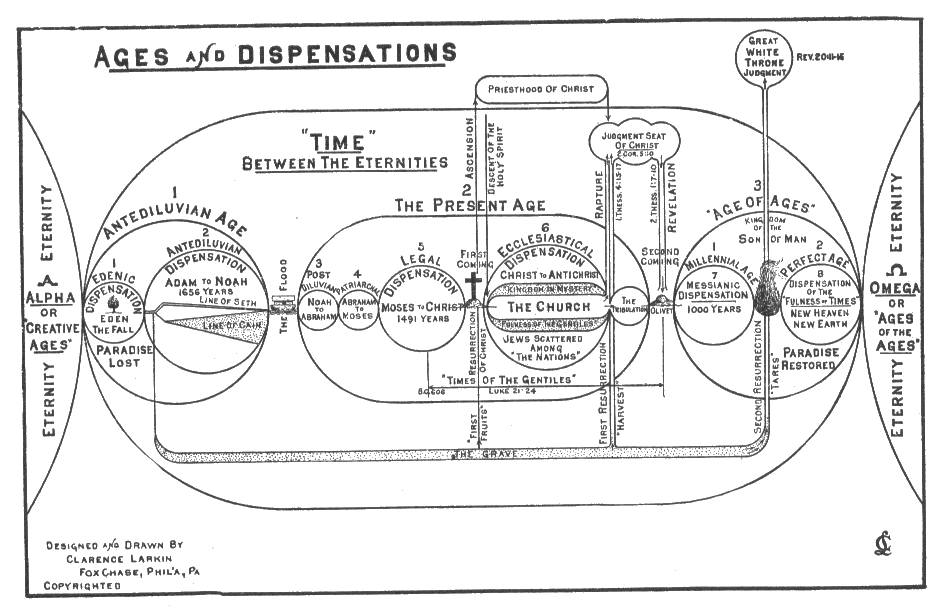
“Daniel and Revelation Compared,” by Clarence Larkin, c. 1919

For most kinds of conservative Protestants, it is difficult to overestimate the importance of the Bible in theology and culture.  After all, at the heart of the Protestant Reformation was a call to return Christianity to reliance on Scripture, Faith, and Grace.  For outsiders trying to understand this segment of Fundamentalist America, a good starting point is an attempt to wrap our heads around a Biblical worldview.

As historian Timothy Weber argued in the early 1980s, one tradition of conservative evangelical Protestantism has long confronted a decisive Biblical dilemma.  In the early twentieth century, this self-identified “fundamentalist” group wrestled with this stubborn paradox: the Bible must be assumed to be clear and comprehensible to all readers, yet readers must be guarded against naïve misinterpretation.  In the end, Weber argued, the first generation of fundamentalist Bible teachers “fought hard to keep the Bible accessible to ordinary believers but in the end made them nearly totally dependent on themselves” (117).

Let me be as clear as possible: in these discussions we are not talking about the wider cultural traditionalist “Fundamentalist America” that usually fills these pages.  Instead, we’re focusing now on a small but influential subset of conservative evangelical Protestants, those few who fit the definition of small-f Protestant fundamentalism.

In the early twentieth century, this group rallied around a particular sort of Biblical interpretation.  Though not without dissent and voluble disagreement, a theology of dispensational premillennialism became for many conservative evangelical Protestants the only proper interpretation of the Bible’s message.

This post will attempt to introduce outsiders to this theology.  As with every topic in the kaleidoscopic world of Fundamentalist America, this introduction will include some broad-brush oversimplifications.  Especially important to remember is that this theology, like every theology or ideology, is constantly changing and subject to intense criticism and disagreement.  Outsiders should never allow themselves to relax into a false sense of self-satisfaction when it comes to understanding such notions.  We at ILYBYGTH write with full consciousness of our inadequate theological background and apologize for our stuttering and awkward presentation of these ideas.  However, with the broad-brush caveat in mind, we can lay out a few basic facts about dispensational premillennialism.

The theology came to the United States in the late 1800s, introduced by theologian John Nelson Darby.  Darby found that he could not convert many American evangelicals to his Plymouth Brethren sect, but his theology became surprisingly influential.

Christians have been arguing about both dispensations and the millennium for thousands of years.  Saint Augustine, for example, noted in his Confessions (Book III, Chapter 7) that naïve Christians complained of inconsistency with Old Testament rules.  “The people of whom I am speaking,” Augustine wrote, “have the same sort of grievance when they hear that things which good men could do without sin in days gone by are not permitted in ours, and that God gave them one commandment and has given us another.”

The answer, for Augustine as for Darby and subsequent generations of Christians, is that sacred history has been divided into discrete dispensations.  For American Protestant fundamentalists, this understanding of the Bible has been taught assiduously for generations.  In the first generation, Bible and prophecy scholars such as James M. Gray of the Moody Bible Institute, A.T. PiersonI.M. Haldeman, and Arno Gaebelein taught readers how to understand the divisions in sacred history.

But no other single work was more influential in teaching the fundamentalists’ new interpretation of Scripture than Cyrus I. Scofield’s annotated study Bible.  This commentary on the King James Version first appeared in 1909 and remains in print.  These days, it is also readily available online.  Scofield’s commentary led many readers to assume a dispensational premillennial reading was part of Holy Writ itself.  To give just one example, in a note to Exodus 19:8 (“And all the people answered together, and said, All that the LORD hath spoken we will do”), Scofield added this dispensational interpretation:

“The Fifth Dispensation: Law.  This dispensation extends from Sinai to Calvary—from the Exodus to the Cross.  The history of Israel in the wilderness and in the land is one long record of the violation of the law.  The testing of the nation by law ending in the judgment of the Captivities, but the dispensation itself ended at the Cross. . . . See, for the other six dispensations: Innocence (Gen. 1:28); Conscience (Gen. 3:23); Human Government (Gen. 8:20); Promise (Gen. 12:1); Grace (John 1:17); Kingdom (Eph. 1:10).”

Another prominent dispensational interpreter and popularizer was Clarence Larkin of Philadelphia.  Larkin’s dispensational charts laid out this theology for students of dispensational premillennialism.

The second half of this term, “premillennialism,” also has a long and storied history among Christians.  Christians traditionally fell into several interpretations of the second coming of the Christ.  Premillennialism, the notion that Christ will return to save a fallen world and usher in a thousand years of earthly peace and justice, remained popular for generations in the early church.  By the third century AD, however, mainstream Christianity welcomed a variety of interpretations of the millennium.  Postmillennialism became influential in American Protestantism throughout the nineteenth century.  In this reading, Christ would return at the end of a thousand years of earthly peace.

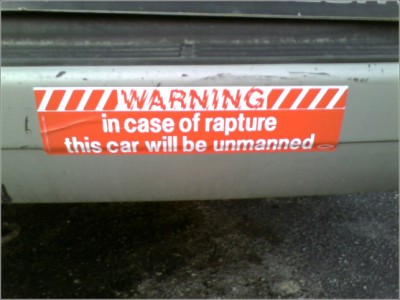
Darby’s theology introduced a new wrinkle into these traditional disputes.  Based on his interpretation of 1 Thessalonians 4:14-18,* Darby argued for a secret rapture of all true believers at the start of the end-times.  For many conservative evangelicals, this notion of a secret rapture has become the standard interpretation of the last days.  And, again, it is vital to remember that these ideas are the subject of intense dispute.  Schools of futurists, historicists, amillennialists, and many others insist on their own vision of the apocalypse.

Bumper Sticker Culture War-ning

For those of us trying to understand Fundamentalist America, simply understanding the basic outlines of dispensational premillennial theology will help.  Believers in this vision of Bible truth will see history and politics as primarily an unfolding of Bible prophecy.  The future, in this theology, is written and clear to all those who rightly divide the word of truth.  As historian Dwight Wilson argued in the 1970s, premillennial belief has had a decisive influence on American foreign policy for generations.  Candidates for the important role of the Antichrist have included Franklin D. Roosevelt, Mussolini, Hitler, and a succession of Roman Catholic Popes.  Central in every interpretation, however, is the decisive role of the state of Israel and the world’s Jews.

Those who view world politics and history through this lens will likely be difficult for outsiders to understand.  They will certainly be less likely to agree to pragmatic solutions or a two-state solution to the Palestinian/Israeli dispute, for instance, since they believe they have read the ending of this story in advance.

For such Bible believers, political activism is not intended to procure half a loaf.  Rather, the goal is to line up on the right side and to watch as prophecy unfolds.  Thus, returning Jews to Israel is an important part of divinely dictated history, but returning Palestinians to that same land is not.  Signing on to the program of a charismatic UN leader might mean condemning innocent souls to hell, not merely wasting aid dollars.  In sum, though it is important not to fall for scare stories about the power of Bible prophecy in determining US foreign policy, it is also important to understand the theological roots of some of fundamentalism’s most distinctive ideas.

*          “For if we believe that Jesus died and rose again, even so them also which sleep in Jesus will God bring with him.  For this we say unto you by the word of the Lord, that we which are alive and remain unto the coming of the Lord shall not prevent them which are asleep.  For the Lord himself shall descend from heaven with a shout, with the voice of the archangel, and with the trump of God: and the dead in Christ shall rise first: Then we which are alive and remain shall be caught up together with them in the clouds, to meet the Lord in the air: and so shall we ever be with the Lord.  Wherefore comfort one another with these words.”

Further Reading: Timothy P. Weber, “The Two-Edged Sword: The Fundamentalist Use of the Bible,” 101-120, in Nathan O. Hatch and Mark A. Noll, eds., The Bible in America: Essays in Cultural History (New York: Oxford University Press, 1982); see also Weber’s Living in the Shadow of the Second Coming: American Premillennialism, 1875-1982 (Chicago: University of Chicago Press, 1987) and Ernest R. Sandeen, The Roots of Fundamentalism: British and American Millenarianism, 1800-1930 (Chicago: University of Chicago Press, 1970); Dwight Wilson, Armageddon Now! The Premillenarian Response to Russia and Israel since 1917 (Berkeley: University of California Press, 1975).

All in the Family: The Westboro Baptist Church

–Thanks to EH

“God Hates Fags.”  That is the line that has attracted so much attention for Fred Phelps and his cultish Westboro Baptist Church.  This is the tiny family-based church from Topeka, Kansas that pickets the funerals of American servicemen and -women.  They insist that such casualties are God’s just punishment for America’s sinful ways.

ILYBYGTH’s attention was drawn to a fascinating interview with Nate Phelps, one of the pastor’s sons.  Nate grew estranged from the family church and has taken to public criticism.  Nate Phelps tells an horrific tale of cruelty and terror justified by dogmatic if erratic Biblicism.

We here at ILYBYGTH have only joked about Phelps’ brand of extreme fundamentalism.  We know it’s not funny, but we also feel that Phelps is not representative of Fundamentalist America.  Rather, as my new hero “Ivan Fyodorovich” perceptively commented during an online discussion about Nate Phelps’ story,

There’s some weird codependent relationship between Phelps and progressives.  I’m here a couple hours away from Topeka in Kansas City, where my sister and her family are heavily involved in an enormous evangelical community (which played prominent role in that revival Perry appeared at in Houston last year) that is activist in the same culturally conservative causes as as WBC is — opposition to gay marriage, anti-abortion, theocratic civil governance, and all part of End Time preperation — and she had never heard of Fred Phelps when I mentioned him a few years ago.  Because WBC is a non-entity in this larger world that is much more active, much more powerful and influential than WBC ever will be.
And yet those of us opposed to this worldview spend so much time on Phelps and so little time on the millions like my sister’s ministry.  The reason for that is that her ministry absolutely doesn’t want the sort of press that Phelps gets.  They are more influential without the press than they would be with it.  But Phelps wants this kind of press, though, because it’s not about being influential in achieving his worldview, it’s about the fact that he’s an evil fuck with a cult who loves the limelight.
The views that we despise in Phelps are views we rightly despise elsewhere.  And I’m not saying that we shouldn’t oppose him, really.  He’s noxious.  But he’s not really the face of the enemy.  In a way, he’s the face the enemy wants us to have of them.  We’re not helping our cause when we place some much importance and attention on Phelps.

In our opinion, Ivan Fyodorovich hits the nail on the head here.  Phelps’ WBC is part of Fundamentalist America.  Fair enough.  But for many outsiders, especially for many anti-fundamentalists, Phelps’ brand of Bible-based noxiousity ends up standing in for the real complexity of Fundamentalist America.  It does not lead to real understanding if we outsiders simply assume that Phelps’ pathology can be taken as a demonstration of the meaning of conservative Protestantism.  Please don’t misunderstand: I’m not trying to justify or dismiss Phelps’ angry sect.  We need to understand Phelps as one of the frightening possibilities of fundamentalism in America.  But we must not fall into the outsiders’ trap of assuming that Phelps is representative of anything except himself.

A much better place to begin would be with Ivan F.’s moving description of his family relationships that helps demonstrate a clearer picture of life in Fundamentalist America.

Required Reading: Growing Up Un-Absurd with The Sword of the Lord

How can we get along with fundamentalists if we don’t embrace fundamentalism?  More specifically, how can we tolerate religious people who will not tolerate others?

Many voluble ex-fundamentalists out there (see a few examples here and here) wrestle with this question.  Some are angry, some bemused, some both.

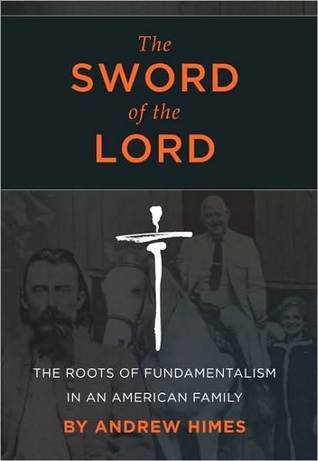
Andrew Himes’ Sword of the Lord: The Roots of Fundamentalism in an American Family (Seattle: Chiara Press, 2011),  offers a unique vision into the world of both fundamentalism and ex-fundamentalism.

Himes is the grandson of John R. Rice.  He was born in 1950 into one of the leading families of post-World War II fundamentalism.  The Reverend Rice led the branch of separatist, revival-based conservative Protestant evangelicalism, the branch that clung resolutely to the label ‘fundamentalist.’  In this sense, Himes’ meaning of ‘fundamentalism’ differs from the broader, cultural traditionalist definition we use at ILYBYGTH.

Himes broke bitterly with his family tradition in high school, but over the years, he came to embrace a more complicated relationship with his family’s vision of fundamentalism.  As Himes puts it, his grandfather remained “one of the kindest, funniest, and most honorable people I knew.”  But Rice also embraced “downright silly” notions of cultural separatism—no card playing, no movies, no short hair for women.  Even worse, Himes argues, his grandfather supported racial injustice in America and imperialist injustices in Southeast Asia. (5) The central dilemma for Himes is the same as it is for ILYBYGTH: How can we love someone whose ideas and policies seem so radically different from our own?

In his attempt to understand fundamentalism and his family, Himes tells the long story of evangelicalism in American history.  Indeed, those familiar with American religious history can safely skip the second and third parts of Himes’ tale.  Himes writes with an engaging style, weaving his own experiences into this long history.  However, his reliance on secondary sources leads him to make a few minor errors.  For instance, he repeats the story that John Scopes of the 1925 “monkey” trial had been teaching evolution for years, (179) when in fact Scopes had a very tenuous record of classroom teaching at all.  Also, Himes overstates the novelty of the Scopes trial in 1925. (180)  By that time, the notion of a media-grabbing “Trial of the Century” had been pioneered by the experiences of dramatic stories like Leopold and Loeb.  These are minor missteps in a tale that sweeps centuries of American history.  However, Himes’ book is also marred somewhat by a number of distracting typos and unclear footnotes.

These quibbles aside, Sword of the Lord is a great introduction to the world of separatist “Big-F” fundamentalism in the later twentieth century.  ILYBYGTH readers will likely appreciate several contributions of Himes’ work.

First of all, the intimate world of John R. Rice offers an eye-opening perspective into life in fundamentalist America.  To cite just one example, Himes tells the story of his childhood spent with colorful evangelists such as C.B. “Red” Smith and Apostle the Premillennial Horse.  This passage is so revealing I’ll quote it at length:

The summer after I turned 12 [c. 1962], C. B. “Red” Smith came to the Bill Rice Ranch and brought along Apostle the Premillennialist Horse.  On the first night of the camp meeting in the open-air tabernacle at the Ranch, Brother Smith himself stepped up to the pulpit and led the singing for the first gospel song.  He was a tall man with curly brown hair, a pink, whiskerless face, and laugh wrinkles around his eyes.  He tilted back his head on the high notes and pointed his chin down at the floor on the low notes, and held back nothing.

            “When we ALLLL get to heaven,” sang Brother Smith, “what a DAY of rejoicing that will BE!  When we ALLLLL see Jesus, we’ll SING and SHOUT the victorEEEEE!”. . .

            “We’ve got a guest speaker in the house tonight,” said Brother Smith with a big grin that showed off a gold-capped tooth.  “He’s a good friend of mine, and he’s come all the way from Jonesboro, Arkansas.” . . .

“Please allow me to introduce Apostle the Premillennialist Horse,” said Brother Smith with a twinkle in his eye.  “Apostle, say hello to all the folks out here.” . . .

            “All right now, Apostle,” said Brother Smith, “what’s our chapter and verse for tonight?”

            Apostle tossed his head, then picked up his right forefoot and stomped deliberately, four times in a row. . . . Apostle shook his head, cocked his ears as if considering, then began stomping his foot again, with Brother Smith counting right along with him: “One, two, three . . . fourteen, fifteen sixteen! Amen!  So that’s Thessalonians chapter four, verse sixteen, is it Apostle?” . . .

            My great-uncle Bill Rice stepped up to the pulpit, waved to the woman seated at the piano, and launched into a spirited rendition of an old revival favorite: “Give me that old-time religion, give me that old-time religion, give me that old-time religion, it’s good enough for me!”

In addition to this kind of illuminating vignette of life growing up in a fundamentalist family, Himes also illustrates the difficulties of changing cultural identities.  For Himes, rejecting fundamentalism meant more than an intellectual decision.  It was more than a theological awakening.  He remembers spending teenaged hours “staring at the animals in the Racine [Wisconsin] Zoo behind rusting iron bars in their drab concrete cages.  I woke in the early morning hours crying piteously, half-remembering the fragments of a dream in which lost souls were dying and God was among the missing.”  (141)

In his youth, Himes swung to the opposite cultural pole, embracing Maoism and leftist radicalism.  In the end, he concluded that he had only “traded in one form of fundamentalism for another, equally rigid, dogmatic, and wrongheaded.” (294)  As a teenager, though, Himes’ transformation pushed him into a “deep pit of self-righteousness and suicidal despair.” (266)

Finally, Himes’ book offers a sympathetic yet critical biography of Himes’ grandfather John R. Rice.  Himes implies that Rice’s doctrinal rigidity may have been a result of his hardscrabble origins.  After all, a childhood spent motherless, left alone to tend for stock animals every year at Christmas, might have led to what Himes calls Rice’s childhood “fear of death and hell—an unsaved boy confronting the terrors of solitude and unknown dangers in a little house under the arc of the great Texas skies.” (105)  That kind of analysis may make sense in Rice’s case, but it doesn’t help us understand the strength and durability of separatist fundamentalism in America.  After all, many ardent fundamentalists had no such childhood, yet they embrace a strict doctrinal orthodoxy.

Childhood trauma aside, Himes offers a fascinating glimpse into his grandfather’s intellectual world.  For instance, Rice was a relative moderate on issues such as race.  In Rice’s time and place, that meant an eventual disavowal of the vigilantism of the Ku Klux Klan.  It meant an insistence that God created all people equally.  But it did not include an embrace of social equality or of the Civil Rights Movement.  As Himes describes, Rice condemned the grisly murder of Emmett Till as a result of interfering activist African Americans. (258)

Rice was also a firm cultural traditionalist, insisting consistently on traditional family life, aggressive anti-communist foreign policies, and anti-abortion activism.  Finally, Himes chronicles the many splits and dissensions among conservative evangelical Protestants.  Rice eventually broke with Billy Graham over Graham’s ecumenism.  Later, Bob Jones Jr. broke with Rice for Rice’s willingness to be yoked with non-fundamentalists.

Those hoping to get the flavor of life in this fundamentalist subculture would do well to read Himes’ book.  By the time of his writing, Himes had overcome much of his bitterness against his grandfather’s faith.  Himes succeeds in his effort to paint a loving portrait without endorsing his grandfather’s ideas.

The Bible in America: Proof-Texting and the Cultural Divide

Quick: What does the Bible have to say about vegetarianism?  …about the war in Iraq?  …about Catholicism?

I don’t know the answers to these questions.  And, without meaning any disrespect, I can honestly say I don’t care.  I don’t think my ignorance on these issues makes me “ignorant.”  I don’t think it makes me uneducated.  I just don’t think the Bible’s opinions on these issues are important.  Don’t get me wrong: I’m not anti-Bible.  In fact, I’m confident I’d be better off if I had spent my youth memorizing the Psalms instead of the lyrics to the Gilligan’s Island theme song.  But I didn’t.  And I don’t feel the loss.

Just sit right back and you’ll hear a tale…

However, many citizens of Fundamentalist America would consider my ignorance deeply embarrassing.  For many conservative religious folks, especially among the Protestant denominations, the ability to cite Scriptural chapter and verse is one sign of an adequate spiritual education. 

This divide fuels America’s culture wars.  Many non- or anti-fundamentalists doubt that fundamentalists are even capable of rational, logical intellectualism.  (Consider a few examples: here, here, here, here, and here.)  The more ardently conservatives dig into their Bibles to prove their points, the more confident anti-fundamentalists become that conservatives have lost all claim to intellectual coherence.    

And many fundamentalists don’t seem to understand that their compilations of Biblical proof-texts carry very little weight outside the borders of Fundamentalist America.  They build arguments against homosexuality  or same-sex marriage based on collections of chapter and verse.  But such arguments are only compelling—or even comprehensible—if we accept the premise of the Bible proof-text in the first place.  As a result, different sides do not speak to one another.  They speak—or yell—past one another, scoring points that only the people on their own side can recognize.    

If we outsiders are to understand Fundamentalist America, we need to understand the proof-text tradition.  Why do religious conservatives care so much what Leviticus has to say about whether or not people should have sex with animals?   Why is it so important that evidence for a young earth can be found not only in Genesis, but also in Mark 10:6, 1 Corinthians 15:26, and Matthew 19:4,5? 

It is not a stretch to say that this style of proof-text argument had been, until the late 1800s or early 1900s, the standard style of theological disputation among Protestants.  In the nineteenth century, European scholars began to look at the Bible in a new way.  By the turn of the twentieth century, leading American Protestant theologians disputed the intellectual usefulness of the Scriptural proof-text.  In 1907, for instance, William Newton Clarke lambasted his more conservative colleagues for their continued reliance on this method.  “Even if,” Clarke argued, “a proof-text method were a good method in itself, it could not be successfully employed now, since the texts of the Bible have suffered such serious though unintended distortion.”  Since liberal theologians had come to disagree with the notion of an inerrant Bible, the method of proving an argument by assembling an overwhelming dose of chapter and verse no longer seemed compelling.

During the twentieth century, however, among Bible-centered Protestants—including self-styled fundamentalists, neo-evangelicals, Pentecostal groups, conservative Lutherans, and others—the proof-text tradition continued.  For those groups who maintained a faith in the Bible as inerrant, it remained convincing to prove every point with an assembly of relevant texts. 

Consider the following doctrinal statement from David Cloud’s Way of Life Ministries.  Each point is proven with an array of relevant texts. 

STATEMENT OF FAITH

Way of Life Literature
P.O. Box 610368, Port Huron, MI 48061
866-295-4143 (toll free), fbns@wayoflife.org
http://www.wayoflife.org


THE SCRIPTURES

The Bible, with its 66 books, is the very Word of God. The Bible is verbally and plenarily inspired as originally given and it is divinely preserved in the Hebrew Masoretic Text and the Greek Received Text. The Bible is our sole authority in all matters of faith and practice. The King James Version in English is an example of an accurate translation of the preserved Hebrew and Greek texts; we believe it can be used with confidence. We reject modern textual criticism and the modern versions that this pseudo-science has produced, such as the American Standard Version, the New American Standard Version, the Revised Standard Version, and the New International Version). We also reject the dynamic equivalency method of Bible translation which results in a careless version that only contains the general ideas rather than the very words of God. Examples of dynamic equivalency versions are the Today’s English Version, the Living Bible, and The Message.

2 Samuel 23:2; Psalm 12:6-7; Proverbs 30:5-6; Matthew 5:18; 24:35; John 17:17; Acts 1:16; 3:21; 1 Corinthians 2:7-16; 2 Timothy 3:15- 17; 2 Peter 1:19-21; Revelation 22:18-19

THE CREATION

We believe in the Genesis account of Creation and that it is to be accepted literally and not figuratively; that the world was made in six 24-hour days; that man was created directly in God’s own image and did not evolve from any lower form of life; that all animal and vegetable life was made directly and made subject to God’s law that they bring forth only “after their kind.”

Genesis 1; Nehemiah 9:6; Job 38:4-41; Ps. 104:24-30; Jn. 1:1-3; Acts 14:15; 17:24-26; Rom. 1:18-21; Col. 1:15-17; Hebrews 1:1-3; 11:3

THE WAY OF SALVATION (THE GOSPEL)

Salvation is by the grace of God alone, which means that it is a free gift that is neither merited nor secured in whole or in part by any virtue or work of man or by any religious duty or sacrament. The gift of God’s grace was purchased by Jesus Christ alone, by His blood and death on Calvary. The sinner receives God’s salvation by repentance toward God and faith in the Lord Jesus Christ. Though salvation is by God’s grace alone through faith, it results in a changed life; salvation is not by works but it is unto works. The faith for salvation comes by hearing God’s Word. Men must hear the gospel in order to be saved. The Gospel is defined in 1 Corinthians 15:1-4.

John 1:11-13; 3:16-18, 36; 5:24; 14:6; Acts 4:12; 15:11; 20:21; Romans 10:9-10,13, 17; Ephesians 1:7; 1:12-14; 2:8-10; Titus 3:3-8; Hebrews 1:3; 1 Peter 1:18-19; 1 John 4:10

CIVIL GOVERNMENT AND RELIGIOUS LIBERTY

We believe that civil government is of divine appointment for the interests and good order of human society; that magistrates are to be prayed for (1 Tim. 2:1-4), conscientiously honored and obeyed (Mat. 22:21; Rom. 13:1-7; Titus 3:1; 1 Pet. 2:13-14), except only in the things opposed to the will of God (Acts 4:18-20; 5:29); that church and state should be separate, as we see in Scripture; the state owing the church protection and full freedom, no ecclesiastical group or denomination being preferred above another. A free church in a free state is the Christian ideal.

We can see the proof-text tradition in David Cloud’s sermons as well. 

The way Cloud and Way of Life use proof-texts is just one example from a galaxy of possible examples out there.  Especially among Bible-based conservative evangelical Protestant groups, the proof-text is the method by which truth is established.  The Bible is the inerrant authority.  In order to make any point, about any subject, the name of the game is proof-texting.  Of course, among many conservative Protestants, the term “proof-text” has taken on negative connotations.  It should not mean that one simply has to slap a bunch of Bible citations together to prove a point.  In this continuing intellectual tradition, the cogency of the argument is based on the proper selection of texts.  How well do the selected texts establish the point at hand?  Does the author use each text in a way that respects the context and original meaning of the selected passage?  Does the author consider relevant passages that might disagree with this interpretation?  Or does a poorly educated pastor merely assume an air of false erudition by throwing Scriptural citations around willy-nilly

To be sure, it is an intellectual tradition that no longer carries weight in mainstream religion and culture.  Though large majorities of Americans might believe that the Bible contains the answers to all of life’s questions, those same majorities do not necessarily agree that the Bible should be the main intellectual authority in all matters.  Indeed, especially galling to many non- and anti-fundamentalists is proof-texters’ assumption that their particular religious tradition should be considered binding in matters of public policy.  In other words, it may be fine for Way of Life to demonstrate the validity of its creed through proof-texts.  But that does not mean that proof-texts can be used to demonstrate the need to teach religious doctrine in science classes. 

These are important arguments.  Proof-texters need to understand that their intellectual tradition does not carry weight outside the borders of Fundamentalist America.  But that is a much different thing than admitting to being non-intellectual or anti-intellectual.  If we outsiders can better understand the tradition of proof-texting, we will be better able to speak intelligently, reasonably, calmly, and even productively with Fundamentalist America.     

FURTHER READING: William Newton Clarke, The Use of the Scriptures in Theology (Edinburgh: T. & T. Clark, 1907); Timothy P. Weber, “The Two-Edged Sword: The Fundamentalist Use of the Bible,” Nathan O. Hatch and Mark A. Noll, eds., The Bible in America: Essays in Cultural History (New York: Oxford University Press, 1982), 101-120.

Atheists Assemble!

Alfredo Garcia at Religion & Politics offered a report recently from Reason Rally 2012.  The rally welcomed 10,000 non-theists to the national mall to celebrate and recognize freedom from God.  As Garcia notes,

life remains hard for non-theists in the United States. There is, of course, the cultural stigma—of being nontheistic in a nation where more than 90 percent of people believe in a higher power. There is only one openly atheist member of Congress, Rep. Peter Stark from California (who had a video appearance at the Reason Rally). Atheists are viewed more negatively than any other U.S. religious group, with less than half of Americans (45 percent) holding a favorable opinion of them. It can be a lonely existence. With no single umbrella organization to bring non-theists together, individuals can feel isolated, compounded by the fact that the various non-theist organizations are often fragmented in their approaches.

There are a couple of lessons here for those of us trying to understand Fundamentalist America.  The first is that conservative religious folks tend to over-emphasize the power and influence of atheism.  Bogeys like Madalyn Murray O’Hair, Robert Ingersoll, and the American Humanist Association have been used by generations of fundamentalist activists as warnings of the growing power of anti-God “forces.”

Second, we can see that the real divide in America’s culture wars isn’t between conservative religious people and atheism.  The atheist side is a small percentage.  The real contenders are between conservative and liberal religious people.  The central issues are between contending visions of the role of religion in public life.  In this fight, atheism punches far above its weight.  That is, many religious people in America support the notion that the public square must be resolutely secular.

Finally, as Garcia insightfully notes, though small, the atheist community has long struggled with the stereotype of the aggressive iconoclast:

It’s the image of the atheist out to pick a fight, the unbeliever who is constantly seeking the next debate. As [Paul] Fidalgo from CFI [Center for Inquiry] put it, O’Hair was an “extremely polarizing” figure who “gained visibility for American Atheists but may have been integral in forming the image of atheism in the U.S. as arrogant.”

And, indeed, as Garcia reports, the reliable Richard Dawkins told the assembled crowd that they must go forth to “ridicule and show contempt” for religious people.  Perhaps the menace of atheism–from the viewpoint of Fundamentalist America–comes from this aggressive, arrogant, in-your-face sort of attitude more than from any sense of growing political clout.

FROM THE ARCHIVES: Fundamentalist Pied Pipers

I’m up to my eyeballs in my book manuscript about conservative educational activism in the 20th century.  There are plenty of recurring themes.  Just like every other sort of activist, conservatives return again and again to images or ideas that work.  On a recent research trip I found another example of a common theme among educational conservatives: the Pied Piper.  For decades, conservatives have warned of Pied Pipers leading children out of their schoolhouses and into damnation.  The specific tune might change.  Sometimes, it is the dangerous sound of evolution.  At other times, it is communism, or atheism, or lack of Bible awareness.  I’ll include a few of the most striking images here.  Enjoy!

EJ Pace, Christian Cartoons, 1922

I thought the cartoon above captured the spirit of the 1920s Protestant fundamentalist school campaigns so well that I used it as the cover of my first book.  It comes from a wonderful book of cartoons by the evangelical artist EJ Pace.

EJ Pace, 1931

This is another gem from EJ Pace.  This one appeared in the newsletter of the Evangelical Theological College, a seminary new in the 1920s.  It later became the Dallas Theological Seminary, a leading training school for conservative Protestant ministers.  Of course, there’s not an actual Pied Piper here, but I’m including it because it has the same theme of students being led from their school (you can see it way in the background) down to the chasm of unbelief in God.  The cartoon was an advertisement for a Bible campaign that never really got off the ground.  The plan was to deliver 1,000,000 Bibles to college students so that they might better resist the intellectual and spiritual dangers of higher education.

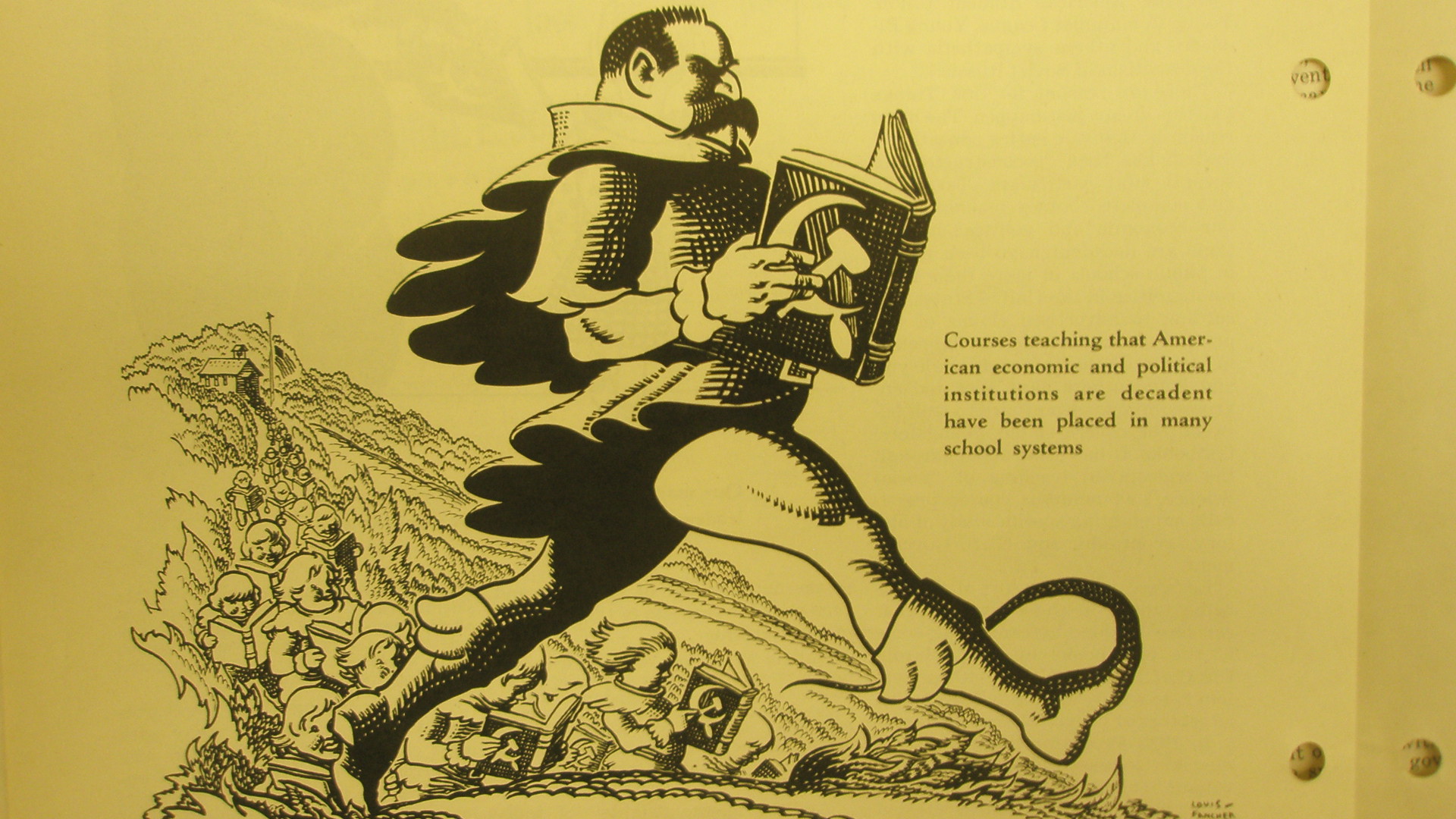
From “Our ‘Reconstructed’ Educational System,” Nation’s Business, April, 1940

Here we see a different sort of Pied Piper.  Instead of evolution or the lack of Bibles, the threat here is communistic school textbooks.  Stalin as Piper is able to lead the students out of their little red schoolhouse down a dangerous path.  In this use of the Pied Piper theme, the danger comes from improper, un-American teaching.  But the basic message is the same.

I imagine there are lots of Pied Piper cartoons floating around out there for all different sorts of educational ideas.  The idea that improper education–whatever that might mean–is leading our young people down a dangerous path is too obvious to be restricted only to patriotic or religious conservatives.  However, I don’t know if any other cartoon could possibly match the excitement of seeing Stalin in tights and pointy-toed shoes.

Required Reading: RJ Snell and a NEW New Christian Right

“Isn’t a ‘Fundamentalist intellectual’ an oxymoron?”

People ask me that question a lot.  There are lots of ILYBYGTH readers out there who are intrigued, but baffled, by the culture of conservative Christianity in America.  Like me, these are mostly folks who came from secular or liberal backgrounds.  Like me, most of these people just don’t have an intuitive grasp of the culture of conservative Christianity in America.

And a lot of those folks (still) assume a connection between conservative Christianity and intellectual sterility.  They tend to agree with Richard Dawkins’ 1989 statement, that if you meet someone who doesn’t believe evolution, that person must be “ignorant, stupid or insane (or wicked, but I’d rather not consider that).”  In this case, some secular or liberal people who don’t understand Fundamentalist America assume that any conservative Christians must be like Dawkins’ creationists.  In this understanding, the very definition of conservative Christianity means accepting a bunch of outdated ideas hook, line, and sinker.

In this vision of Fundamentalist America, conservative Christianity appears like a threatening monolith, a Borg-like* force that insists on transforming America into a goose-stepping echo box.

One of the first steps toward understanding what we’re calling Fundamentalist America is to understand the limits of that stereotype.  If we want to understand FA, we might start by trying to get a sense of the complexity of it.

A recent article by RJ Snell at Front Porch Republic will help.  In “Thoughts toward a New Religious Right,” Snell criticizes the impulse among some conservative Christian political activists to embrace an ethos of individualism too eagerly.

Snell writes,

We’re accustomed to thinking that the greater a being, the less it requires from others, the more it is self-sufficient, but this is only partially true. Shellfish have no friends, while humans need friends to thrive, and this is a mark of our grandeur, not our inadequacy.  

Snell critiqued the last generation of Christian activists for slipping too easily into the myth of the rugged individualist.  In their eagerness to combat an aggressive idea of collectivism, conservative Christians leaped precipitously into its opposite.  In doing so, Snell argues, conservative Christians forgot the central lessons of their own faith.

We outsiders who are hoping to understand the thinking of conservative religion in America could do well to begin with essays like Snell’s.  It is easy to think we understand the meanings of Fundamentalist America once we grasp a few high-profile ideas.  But if we really want to understand, we need to dig into the many different ideas and thinkers that make up its kaleidoscopic vision.

*Nerd alert.

REQUIRED READING: The Irish Way

Over at Religion in American History, Janine Giordano Drake offered a thoughtful review of James Barrett’s The Irish Way.

For outsiders who hope to understand Fundamentalist America, Drake opens her essay with a interesting disclaimer:

People usually laugh when I tell them that, though I went to public school all my life, I didn’t meet a white, self-identifying Protestant until I got to college. Nobody ever “witnessed” to me; there were no “youth groups” around to my knowledge, and certainly nobody told me to read (or adhere to) the Bible. There were no “Christian groups” at my high school, and school prayer was never an issue. I usually don’t know what to say when people think I’m exaggerating. No, I’m not from an Old World immigrant community. I’m a fourth generation New Yorker, and I’m from the suburbs of New York City.

As Drake explains in her review, Barrett’s book offers a vision of multiethnic America that challenges casual assumptions about the historical dominance of white evangelical Protestantism.  I’m not sure how many academic historians these days assume that such was really the case for America’s past, but I agree that such assumptions are common among non-academic folks, and especially among conservative evangelical Protestants themselves.  Or, to be more precise, such assumptions are pointedly insisted upon among a segment of conservative evangelicals.

In any case, Drake describes Barrett’s book as giving us a “thick urban world” dominated not by evangelical Protestants but by Irish Catholics.  In Drake’s words,

The Irish, Barrett argues, were America’s first “ethnic group.” That is, Barrett finds that the Irish effectively taught subsequent ethnic groups how to be both respected as White Americans and simultaneously not-Anglo-Saxon-Protestant. He writes, “The Irish Catholic version of civic identity differed… from that of the WASP mainstream. At its best, it stressed a broad American Catholic identity that nonetheless recognized the integrity and worth of distinct ethnic cultures, and the rights of ethnic minorities to maintain these cultures” (102). In inventing an American way to be ethnic, Barrett argues, Irish Catholic Americans taught subsequent groups how to comfortably sustain their own culture and religion while also becoming American. In many ways, of course, this maintenance/reinvention of one’s ethnicity revolved around rejecting the Anglo-Protestant concept of civic identity that required Protestant religious sensibilities.

For those of us interested in understanding Fundamentalist America, this is a useful reminder of why we need to expand our definition of “fundamentalism.”  When we talk about Fundamentalist America including all sorts of conservative religious folks, including (some of) the urban Irish Barrett’s book describes, we use a definition most academic religious historians would not like.  The traditional academic definition of fundamentalism still insists that the term necessarily includes only a subset of conservative evangelical Protestants.  For academic religious historians, the best working definition of “fundamentalism” still comes from historian George Marsden.  In his 1980 Fundamentalism and American Culture, Marsden defined the term as “militantly anti-modernist Protestant evangelicalism.”

But such a restricted definition ignores the ways conservatives of different faiths have come together in the past generation to form a powerful cultural bloc.  If we leave militant conservative Catholics–some of them the heirs of Barrett’s Irish Way–out of our definition, we won’t be able to grasp the ways Fundamentalist America really works.

Of course, the other option is to change our terminology.  If we called this bloc of traditionalist Americans something besides “Fundamentalist,” we could avoid this whole mess.  For instance, we could call it “Moral Majority” America, or “Christian America,” or “Bible” America, or something.  In my opinion, though, none of these alternatives captures the energy and drive of Fundamentalist America.

To return to Drake’s opening, I certainly would not laugh if she told me that no one at her public school ever asked her to join her prayer circle.  No one ever asked me.  I went to public high school in the very Irish northern suburbs of Boston.  Officially, however, I suppose my family would fit as WASPs, though we were only half “AS” and only very vaguely “P.”  Nevertheless, for most of my life I assumed that the borders of Fundamentalist America remained somewhere far south and west of me.  Only once I began working as a high-school teacher did I realize that I was simply unaware of the fact that I had been living all along deeply within those borders.  My ignorance of the strong culturally conservative presence all around me didn’t mean that it wasn’t there.  It was there among the Irish who trod Barrett’s Irish Way, just as it was among the “WASP” successors to Dwight Moody who still maintained their strong Boston presence.