The Bible in America: How the Bible Works

A lot of people don’t get it.  Why does it matter so much in Fundamentalist America what the Bible says?  After all, the Bible, for a lot of people, is just one collection of ancient writings.  Richard Dawkins concluded his Blind Watchmaker, for example, by calling “the Genesis story . . . just the one that happened to have been adopted by one particular tribe of Middle Eastern herders.”  Dawkins has not been the first to make such accusations.  In the 1920s, sociologist Harry E. Barnes derided the Bible as merely “the product of the folkways and mores of the primitive Hebrews. . . and the personal views of religious reformers of all grades from Jesus to Paul.”  It doesn’t make sense to non-fundamentalists to base social policy or even personal ethics on this collection of cranky commandments from ancient sheep-herders.  Deuteronomy just doesn’t fit with today’s lifestyle, some think.
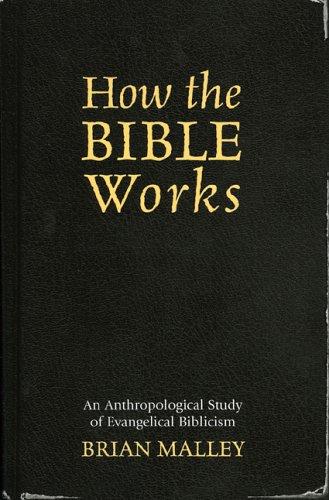
Those hoping to make some sense of the ways Fundamentalist America understands the Bible should take some time with a newish book, Brian Malley’s How the Bible Works.   It is not an attack or expose of fundamentalist foibles.  Rather, it is an ethnographic study of one evangelical community, “Creekside Baptist.”  It is a thoughtful and deeply sympathetic attempt to understand what one group of conservative evangelical Protestants mean when they say “Bible.”  Malley himself is the product of a conservative evangelical Protestant upbringing.  ILYBYGTH readers will likely appreciate his perspective.  He is not out to demonize or lionize the folks he studies.  Rather, he conducted a series of interviews and probed the complicated questions lying at the heart of many conservative Protestants about the Bible and their faith.

In the first section of the book, Malley asks his informants to help him understand labels.  Perhaps most interesting for ILYBYGTH readers, he asks then to explain how they felt about “fundamentalist.”  Here is a taste of some responses:

“the word has gotten such a bad rap, but yes [I consider myself fundamentalist.]  Not in the sense that you hear in the news.  Basically I view those words as being interchangeable—evangelical and fundamentalist.”

Several interviewees said they felt fundamentalist, but that the term had a negative connotation.  For example, in the words of one “middle-aged man”:

“That [‘fundamentalist’] has a more negative connotation to me.  I think of it as a person.  ‘Fundamentalist’ to me today means more of a judging person that has a whole series of rules that they follow and I don’t think that’s right.  I’m not on the other end of the spectrum either, a wild liberal person either.  I guess I don’t live primarily by rules but by principles.  The principles come from the Bible.  But I don’t see myself as what I hear people describing fundamentalist as today.”

Another interviewee, “Stan,” said,

“I don’t like the term because of the connotations that it has.”

            Brian: “Which ones specifically?”

            Stan: “Connotations being I think that if you said that in this country, a fundamentalist would be considered kind of a far-right-wing wacko, and is a way extreme almost to the point of being non-Christian, something other than Christian.  Probably in its true identity, the definition of the word is you believe the fundamentals of Christianity, the basics of Christianity, that term would apply.  But that definition doesn’t apply anymore in this country.”

One young man, “Todd,” offered this explanation:

“Again, ‘fundamentalist’ is another term which I fear has been misunderstood and caricatured and stereotyped widely across modern American culture.  I’m not really familiar with what I consider properly called ‘fundamentalist culture.’  I know a bit of fundamentalist theology, but . . . I think properly understood, especially if you look at historical roots of fundamentalism, it gets down to what are fundamentals of the faith, and I think most fundamentalists and I agree what the fundamentals of the faith are, if you boil it down.”

For these conservative evangelical Protestants, “fundamentalism” had attracted a cluster of unfair meanings.  They generally agreed with what they understood to be fundamentalist theology, but they felt that fundamentalism as a whole had come to include all sorts of other meanings.

But Malley’s main interest in in the ways his respondents felt about the Bible.  Evangelicals, Malley argues, create a many-layered meaning around “Bible.”  One important part of this is what Malley calls “artifactual knowledge.”  Evangelicals know the Bible as a physical thing, a certain kind of book.  As he describes, this kind of knowledge is encouraged among evangelicals.  In the very youngest of children’s groups at Creekside Baptist, two-year-olds are taught to hold a Bible while they sing song such as “Pat the Bible” (to the tune of Did You Ever See a Lassie, or Wheels on the Bus, or Here We Go Round the Mulberry Bush, etc.).  In the words of one teacher of this two-year-old class, the youngsters should learn that the Bible is a special kind of book.  It is something to be cherished and valued.  It is not something to be treated like other books.

Another fascinating point Malley makes is that his respondents don’t think of the Bible as a certain translation of the original documents.  He held up two versions in some of his interviews, one in Greek and one in English.  He asked his interviewees which one they thought was “the” Bible.  Not only did the folks he talked with say they were both equally “Bible,” they thought the very question was nonsensical.  In other words, for this community at least, “The Bible” does not refer only to one specific translation.  Rather, it is understood to be a collection of texts that has been and will continue to be understood in a variety of languages, in a variety of translations.  Not only that, but folks at Creekside Baptist all agreed that the Bible did not actually have to be a printed book at all.  It could be put onto a website or CD.  It could be printed on enormous sheets or in a tiny pocket edition.  But it could NOT be made into a movie.  Movies could be made ABOUT the Bible, but they would not be the Bible itself.  The Bible was print, but it could be print in a variety of formats, languages, and translations.  As long as the text stayed true to the original meanings, any sort of text could be used to create an authentic Bible.

Malley also argues that his respondents have an interpretive Bible tradition, but not a hermeneutic one.  That is, evangelicals define their intellectual and theological world in large part as an interpretation of Biblical texts.  Scholarship and intellectualism mean, in large part, engaging in interpretation and citation of Biblical texts.  This results in the Bible-centered talk that non-evangelicals often find so baffling.  For example, evangelicals will explain their political opinions on topics such as gay marriage by offering Bible citations.  To evangelicals, those citations act as strong intellectual arguments.  If one can back up opinions on any topic with proper citations, one can carry the argument.  But evangelicals are not trained—outside of academic theologians—to engage in hermeneutic acts with and about their Bibles.  That is, Malley’s respondents did not feel a need to apply special interpretive skills to reading their Bibles.  Respondents consistently referred to reading their Bibles not as an act that required intellectual training, but as an act that required devotion.  The challenge was not to learn a set of keys to make sense of the Bible, but rather to learn an attitude toward reading.

Another topic Malley tangles with is the complex meanings of “literalism.”  Some folks outside of conservative Protestant circles misunderstand the notion of a literal interpretation of the Bible.  For Malley’s informants, as for most conservative Protestants, “literalism” does not mean that every word of the Bible must be taken as the literal truth.  In some places, the Bible clearly speaks figuratively, as when Jesus tells his audience they are the salt of the earth.  For Malley’s informants, the important aspect of literalism is a reading of the Bible that gives authority to the Bible itself.  Instead of taking freedom to interpret passages in ways that make the most sense to readers, the Bible must be read in ways that make the most sense in the context of the Bible itself.  Literalism, in this understanding, is more about authority than anything else.  If a passage was intended to be literal, it must be taken that way, even if that seems to contradict with the reader’s experience or desire.  Generally, when the Bible does not mean for itself to be taken literally, as in Jesus’ parables, it makes that abundantly clear.  Readers do not have the right to assume it is speaking symbolically when it does not clearly say that itself.

Malley points out that there are several layers of Biblical interpretation active at the same time in the evangelical world, broadly considered.  Among evangelical scholars, questions of authority and interpretation receive intense scrutiny.  But among the folks he talked to, there was much wider latitude for traditional, passed-along understandings of “Bible” and its meanings.  As Malley argues, “The evangelical tradition solves this problem by maintaining fairly rigorous standards of exegesis in its scholarship and quietly ignoring those standards in the churches.”

So, for example, Malley’s informants at Creekside Baptist could confidently assure Malley that the Bible was authoritative, even if they could not clearly explain what they meant by that when Malley pressed them.  As one way of testing this principle, Malley pressed people to explain why they regarded only some parts of the Bible as authoritative.  He asked, for example, what respondents thought about passages such as Romans 16:116, repeated in 1 Corinthians 16:20, 2 Corinthians 13:12, and 1 Thessalonians 5:26, in which Christians are instructed to “greet one another with a holy kiss.”  Malley interviewees acknowledged that the instruction was in the Bible.  They agreed that the Bible was authoritative.  And they acknowledged that they did not follow that particular instruction.  When pressed to explain the contradiction, respondents argued that such passages were “cultural” commands, meant to apply to people at the time, but not to them.  Or respondents shrugged.  The important point is that Biblical Christians did not feel this kind of apparent contradiction challenged the authority of the Bible, or their justification in considering the Bible authoritative in their lives.

For those living outside of the tradition of evangelical Protestantism, such apparent paradoxes can seem like proof that a Biblical worldview is non-sensical.  Malley doesn’t try to make that leap.  Rather, he is more interested in understanding and explaining how his respondents themselves understand this seeming contradiction.  He is more interested in exploring the fact that it does not appear to be much of a contradiction at all to them.

If outsiders hope to understand Fundamentalist America, this kind of intellectual stretching will help.  Malley’s study of one evangelical community can’t be taken to speak for all conservative Protestants, much less for the broad conservative coalition that makes up Fundamentalist America.  But his book is a good place for outsiders to start.  It will help people from outside the tradition make sense of the many meanings of “Bible” in Fundamentalist America.

FURTHER READING: Harry Elmer Barnes, “Sociology and Ethics: A Genetic View of the Theory of Conduct,” The Journal of Social Forces, III (January, 1925): 214; Brian Malley, How the Bible Works: An Anthropological Study of Evangelical Biblicism (Walnut Creek, CA: Altamira Press, 2004).
In the News: Fundamentalist Religion and the “Liberal Media?”

Fundamentalist America has long had a somewhat uncertain relationship with mass media.  On one hand, lots of prominent conservatives make their mark by bashing the biases they see in what they call the “liberal media.”  For a recent example, check out William Kristol’s challenge to the New York Times regarding its treatment of Andrew Breitbart.  On the other hand, conservatives such as Rush Limbaugh, Glenn Beck, and the late Andrew Breitbart himself have relied on their mastery of mass media in order to win whatever influence they may have.

Conservative religious folks usually complain the loudest about media bias.  Two years ago, for instance, a comment by Fox News’ Brit Hume that golfer Tiger Woods ought to embrace Christianity evoked a teapot tempest of discussions about the anti-Christian bias in most media outlets.

Thanks to Walter Russell Mead at Via Meadia, we come across a new study by scholars at the University of Southern California and the University of Akron.  This survey suggests that there may be more to conservative religious folks’ complaints than just Fox News sensationalism.  This study surveyed 2000 media consumers and 800 producers.  Some of the findings seem to confirm an anti-religious bias among most journalists.  More precisely, they seem to confirm a NON-religious bias.  Among the reporters, only 20% described themselves as “very knowledgeable” about religion.  Also, the category of white evangelical Protestants was notably underrepresented among the reporters surveyed.  Reporters tended to feel that the most important part of religion was its impact on politics (48.1%), while fewer media consumers (37.0%) saw that as the most important religious topic.  Also, the general public tended to think there was far too much sensationalism in religious coverage (66.5%), as opposed to reporters (29.8%).

The survey broke down media producers into categories including “Focused,” “Frequent,” “Infrequent,” and “Non-producers” of religion coverage.  In terms of religious identity, only a small minority of the reporters surveyed (5.1%) called themselves white evangelical Protestants, compared to 20.8% white Catholic, 34.9% white mainline Protestant, and 12.8% unaffiliated.  This doesn’t match the percentage of the general population.  According to the Pew Forum on Religion and Public Life, evangelicals make up just over a quarter of the US population.  If we look a little closer, even among the self-identified white evangelical Protestant reporters, there is a distinct skew toward religious coverage.  White evangelicals made up just over 16% of the “focused” religion reporters, and only 2.1% of the “non-producers.”

What does it all mean?  First of all, as with any such survey, the results mustn’t be overdone.  The fact that a minority of journalists who took part in this survey called themselves “very knowledgeable” about religion doesn’t mean that they are biased against religion, much less against a certain type of religion.  But the fact that white evangelical Protestants are notably underrepresented among this sample suggests that there is a trend among reporters away from evangelical Protestantism.  Especially when the responses are broken out into more detail.  Even among the small minority of evangelical reporters, the percentage of such reporters who are not specifically focused on religious issues shrinks to near-nothingness.  One way to look at this might be to think that evangelicals—when they become journalists at all—tend to restrict themselves to specifically religious issues.  Just as with other minority groups, evangelical reporters might find themselves pigeonholed into just one aspect of their public identity.  In this case, evangelical reporters might be considered to be legitimate only for reporting on religious issues, not for sports, education, politics, or foreign affairs.
Does it mean that the “mainstream media” are unfair to Fundamentalist America?  From this limited evidence, of course, it’s impossible to say for sure.  However, this survey does suggest that reporters tend to look different from the rest of America.  They tend to be less knowledgeable about religious traditions than the rest of America. They tend to be less interested in spirituality than the rest of America.  And they tend to be less often from a white evangelical Protestant background than the rest of America.

As with any sort of bias, it is much easier to be inadvertently biased about groups different from ourselves.  It is even easier to be biased when we know very little about such groups.

Fundamentalist America complains that most reporters don’t “get” them.  This study seems to support that complaint.

FROM THE ARCHIVES: Fundamentalists and Federal Aid to Schools

If only Rick Perry could have remembered what he planned to abolish, he might have won the 2012 Republican Presidential primary.  If he had won, he might really have carried out his threat to get rid of the federal Department of Education, along with Energy and Commerce.  Or maybe not.  After all, Ronald Reagan had also promised to eliminate the Department of Education.  In the end, Reagan merely treated the department shabbily.  These days, it seems every self-respecting conservative insists that the Federal Department of Education is an outrage.  Devvy Kidd of WorldNetDaily, for example, insists the department “must be abolished” due to its “chilling” trend toward “communism.”

This hostility toward federal money for local schools has not always been a bedrock belief of American conservatives.  In the 1920s, as Douglas Slawson’s terrific 2005 book The Department of Education Battle describes, the fiercest opponent of a cabinet-level federal department of education was the Catholic Church.  It follows, then, that one of the fiercest PROponents of such a department was the 1920s Ku Klux Klan.  The 1920s Klan, after all, focused much more intensely than did later Klans on fighting the power of the Catholic Church.  It also focused much of its public activism on defending its vision of the “Little Red Schoolhouse.”  For God and Country, the 1920s Klan argued, the USA needed a cabinet-level Department of Education.

By the late 1940s, however, opposing federal aid to local schools had become an article of faith among American conservatives.                        

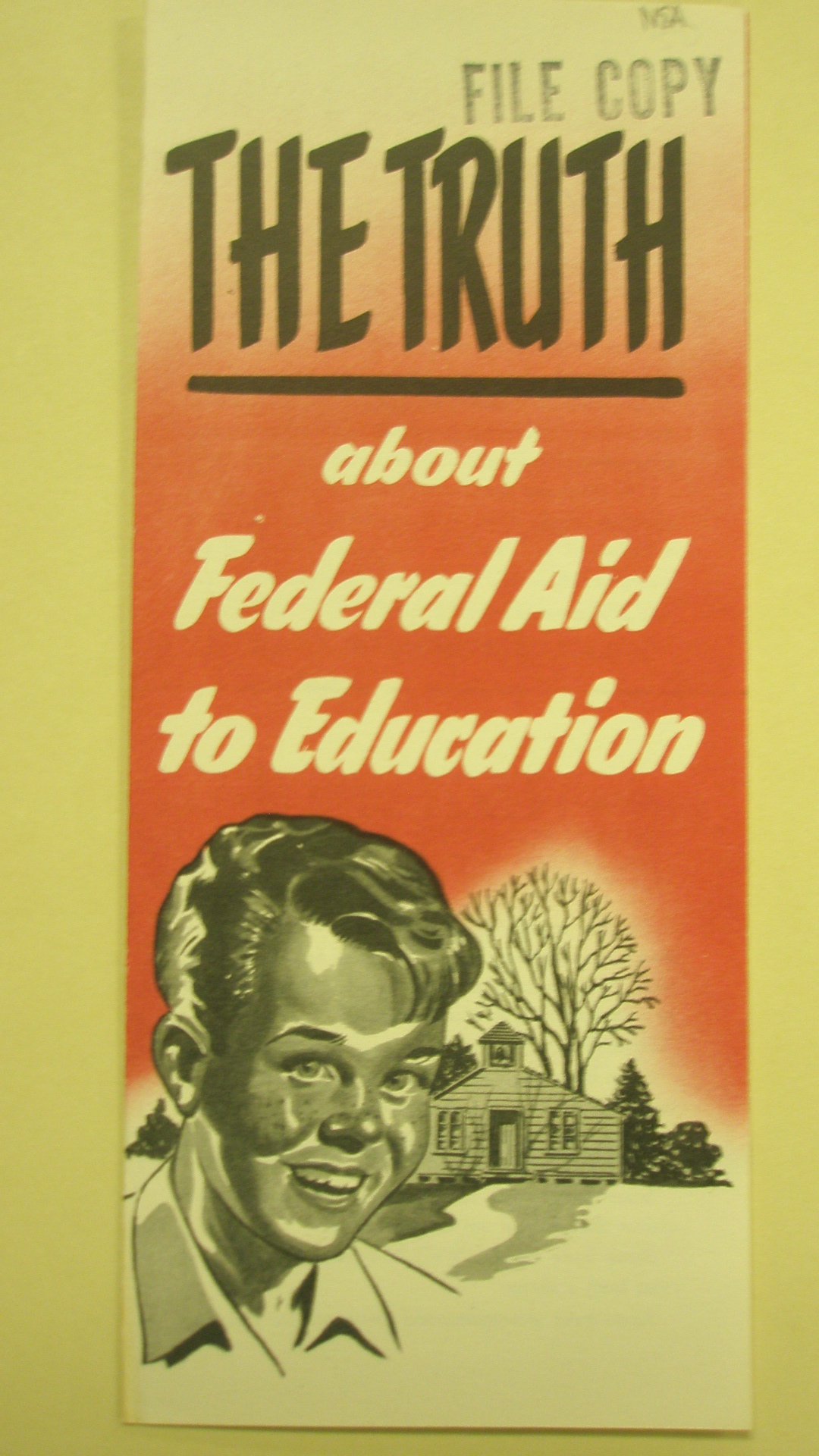
Perhaps because the National Education Association fought so fervently for more federal funding for local schools, as we can see with this 1948 NEA brochure, conservatives insisted that such aid would be merely the camel’s nose under the tent.  Such aid would inevitably include more federal control over local schools.

As one earnest Daughter of the American Revolution warned her conservative sisters in 1943,

“The citizens of the United States do not want the Federal Government to supervise education from the cradle to the grave, from nursery school to adult education. . . .  It is not difficult to see another huge arm of the Federal Government in the making, and more chains being forged to shackle the unthinking. . . . socialist-minded educators would use the funds to build ‘a new social order’ and . . . training in fundamentals [will be] neglected.”

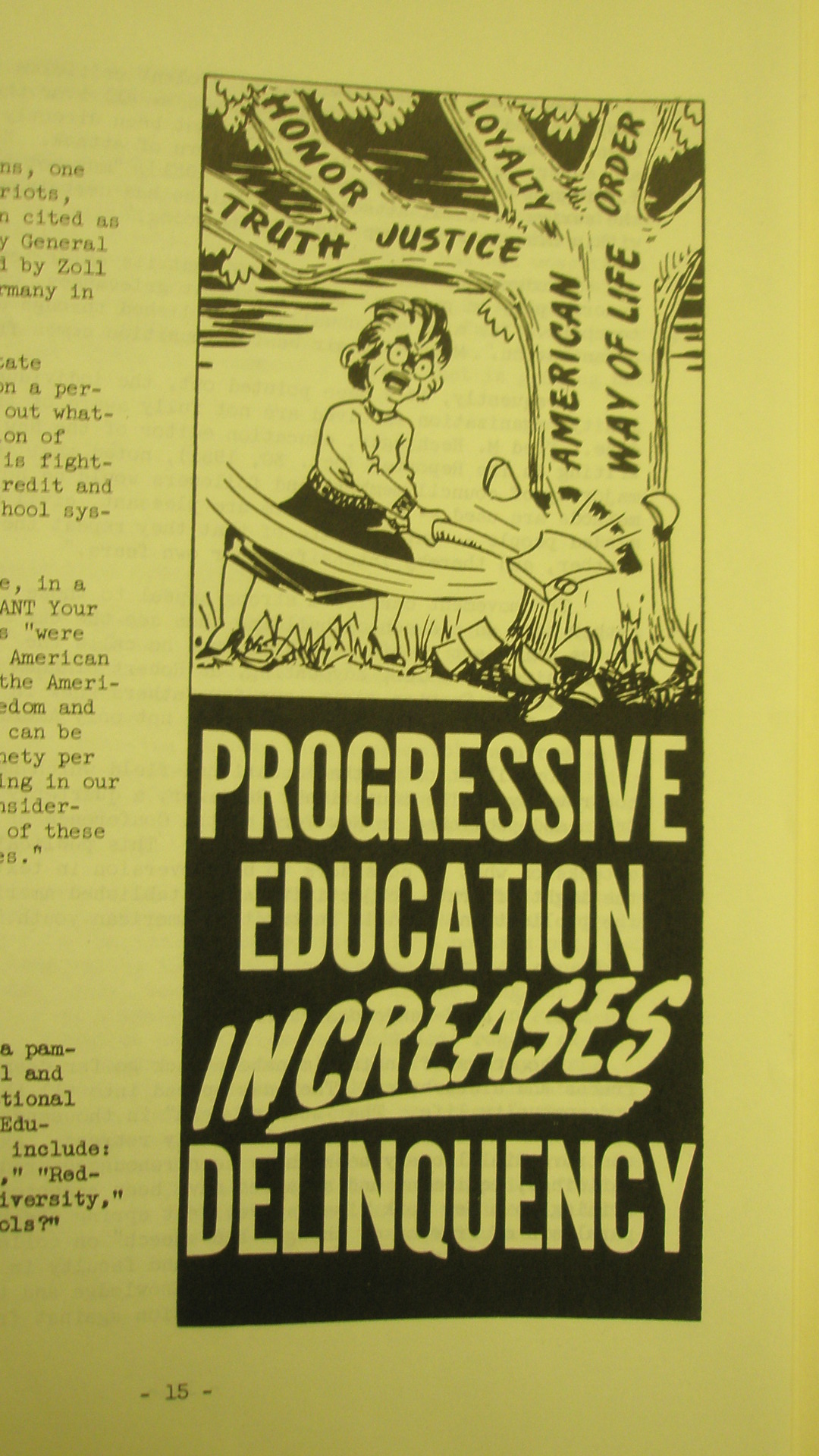
Other conservatives in the 1940s and 1950s agreed.  Allen Zoll, a professional right-wing activist and founder of the National Council for American Education, published a couple of hugely influential pamphlets in the 1940s. 

In one of them, “Progressive Education Increases Delinquency,” Zoll warned readers that contemporary education no longer taught students the traditional, fundamental values of American society.  He insisted,

The tragic and terrifying thing about all this is that it represents not merely rebellion against a moral code, but denial that there can be any binding moral code.  It is a fundamental revolution in human thinking of the first order: it is mental and ethical nihilism.  If it goes on unchecked, it will mean not merely tragedy for millions of individuals, it will mean the disintegration and final extinction of the American society.”

In another pamphlet from the late 1940s, “They Want YOUR Child,” Zoll warned that the NEA’s drive to secure federal funding for local schools was a conspiracy of the darkest order, a “conspiracy against the American way of life, against everything that we hold dear, . . . probably the most completely organized, ruthless design against other people ever set in motion in all human history.”

Inevitably, Zoll insisted, federal aid to local schools would lead to federal control over local schools.  Once schools fell for that trap, they would be controlled by an aggressive mind-controlling educationist bureaucracy.  The scheming of “progressive” educators such as Theodore Brameld, William Heard Kilpatrick, and George Counts would soon lead to a softening of the youth of America, a start of the slide to socialism, secularism, and destruction.

Some conservatives in the 1950s took this fight against federal funding one step further.  Although they never represented a majority conservative viewpoint, some insisted that all public monies for schools represented government tyranny.  One eccentric proponent of this maximalist position in the 1950s was R.C. Hoiles.  Hoiles had earned a pile of money—one journalist in 1952 estimated $20,000,000—with his Western media empire.  In his editorials for his newspapers, Hoiles argued that all public schools implied government tyranny.  In one from The Marysville-Yuba City (CA) Appeal Democrat, February 28, 1951, for example, Hoiles argued,

“Very few people realize to what degree the government has grabbed the authority to indoctrinate the youth of the land.  We cannot reverse our trend toward socialism as long as the youth of the land comes in contact and is trained by teachers who believe that they have a right to do collectively what they know would be immoral if done by an individual.  In short, the youth of the land is coming in contact with men who are communistic in their thinking, if we properly define communism.  Here is a good definition of communism written by David Baxter.  ‘Communism is the conclusion that more than one person, or a majority of persons, have a right to do things collectively that it would be wrong and immoral for one person to do.’  Can anyone improve upon this definition of communism?

            “According to this definition, is not every believer in tax-supported schools a believer in communism, whether he knows it or not?”

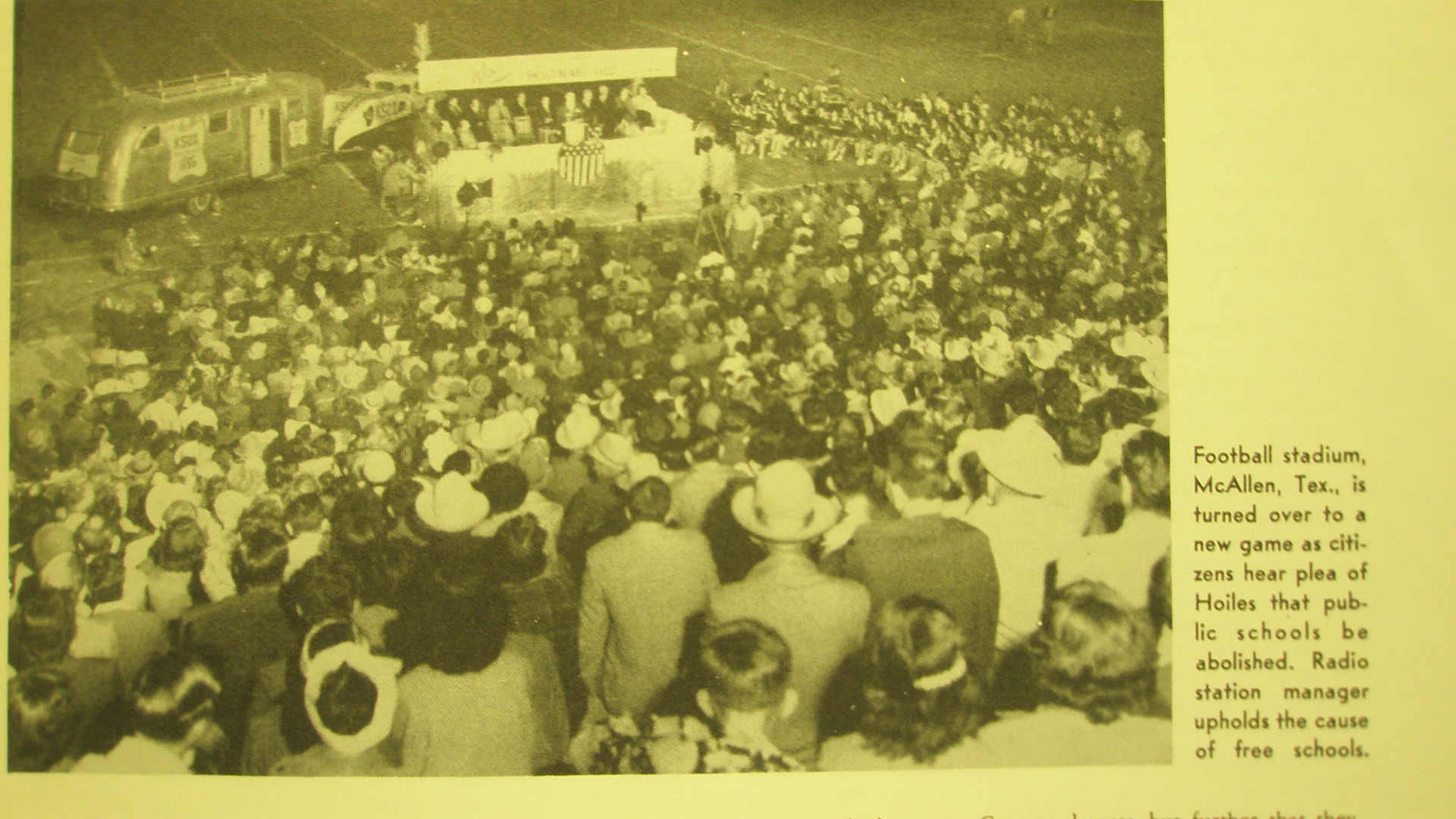
Hoiles also issued a standing challenge to debate this issue.  On February 2, 1952, a radio personality took him up on his offer.  Thousands of people crammed into the football stadium to hear the debate between Hoiles and Roy Hofheinz.  Among the rhetorical gems Hoiles unloaded at that debate included the following:

“Every board of education is government; therefore, it is force.  It is not reason or eloquence—IT IS FORCE!  It is a fearful master—it certainly does not seem rational that understanding and education can be promoted by the force of a policeman . . . “

“There are many ideas as to what is a good government.  But only one idea can be taught in government schools.  And that idea cannot be anything unfavorable to existing government institutions.  It would be impossible to find any teaching in government schools unfavorable to government schools.  It would be impossible to find anything taught in government schools unfavorable to existing state administration.  We cannot now find anything taught in government schools really unfavorable to New Dealism.

            “We believe it would be next to impossible to find anything taught that preaches old-fashioned American individualism as against our modern New Deal fraternalism in government.  Thus we believe that government schools’ teaching in regard to government must favor administration policies, whatever they may be.  Hitler and Hirohito used government schools to promote their regimes. 

            “Stalin is using Russian government schools to promote his regime.  Karl Marx made free public schools one of the points in his famous ‘Communist Manifesto.’  Any government delights in having schools to propagandize its doctrine.” ….

“It has often occurred to me that if an overwhelming majority of Americans really favor the present system of education, it should not be necessary to compel anyone to support it.  A system as sound and popular as tax-supported public schools are supposed to be should be well supported on a voluntary basis.” 

Funding of schools will likely always be a contentious issue.  Taxpayers, especially those who have no children or send their children to private schools, have a dollars-and-cents reason to oppose public schooling.  Perhaps the powerful tradition in Fundamentalist America of opposition to federal funding—or even to any public funding—of local schools can be reduced mainly to a desire to keep more money from the hands of the tax man.  But there also seems to be a deeper ideological connection.  Since the 1940s, at least, fighting against federal funding for local schools has become an article of conservative faith among some citizens of Fundamentalist America.

FURTHER READING: Douglas J. Slawson,  The Department of Education Battle, 1918-1932; Public Schools, Catholic Schools, and the Social Order (University of Notre Dame Press, 2005; Madeleine P. Scharf, “The Education Finance Act of 1943,” Daughters of the American Revolution Magazine 77 (October 1943): 635-637.

FROM THE ARCHIVES: Bible in America: The Power of Books

A few years back I stumbled across a remarkable Bible campaign.  Beginning in 1921 and continuing throughout the twentieth century, Bible evangelists based at Chicago’s Moody Bible Institute delivered Bibles, New Testaments, and tracts to underserved regions.  This campaign, which began as part of the Bible Institute Colportage Association and eventually became part of the Moody Literature Mission, delivered millions of Bibles and religious literature to the Southern Appalachian region, as well as the Ozarks, western logging camps, Louisianan Catholic schools, prisons, hospitals, and other venues in which missionaries thought people were hungry for the Word. 

            At the time, I focused my study on the missionaries’ use of Appalachian public schools as a distribution network for this religious literature.  I published some of my findings in an academic journal [“The Quiet Crusade: The Moody Bible Institute’s Outreach to Public Schools and the Mainstreaming of Appalachia, 1921-1966,” Church History 75:3 (September 2006): 565-593.] 

            Looking over my notes as I thought about the meanings of the Bible in Fundamentalist America, I came across my collection from this research.  As usual, there was a lot more material than what I could use in the article. 

            For the next few posts, I’ll pull up various pamphlets, brochures, and other materials from this archival collection.  Most of the material is available at the Moody Bible Institute in downtown Chicago.  The people there were very accommodating and friendly on my visits, and the archive is certainly worth a visit if you’re in the area. 

            I won’t argue that these materials somehow capture any single essence of fundamentalist attitudes about the power of the Bible.  That would be far too simplistic.  But I do believe that the attitudes toward the Bible expressed in these materials give a window into a commonly held fundamentalist vision of the nature of Holy Scripture.  As we’ll see, the Bible missionaries from Chicago believed the Word had a unique power.  The Gospels, to them—and, I argue, to many fundamentalists in the 1920s and since—meant more than just a collection of edifying religious messages.  As we’ll see, many of these Bible missionaries held a fundamentalist belief in the saving power of this powerful text. 

The most powerful book, fundamentalists agree, is the Bible.  Among conservative Protestants, the Bible is often considered to have supernatural power on its own.  The Chicago book missionaries of the Bible Institute Colportage Association and Moody Literature Mission were no exceptions.  They believed the Bible could transform lives.  But the Chicago book missionaries also believed in the power of non-Biblical literature.  Especially as a counterweight to an expanding pulp press, Bible-friendly fiction could be an important way to save souls.  In this post, I’ll describe an example of each type of book that the Chicago book missionaries distributed.

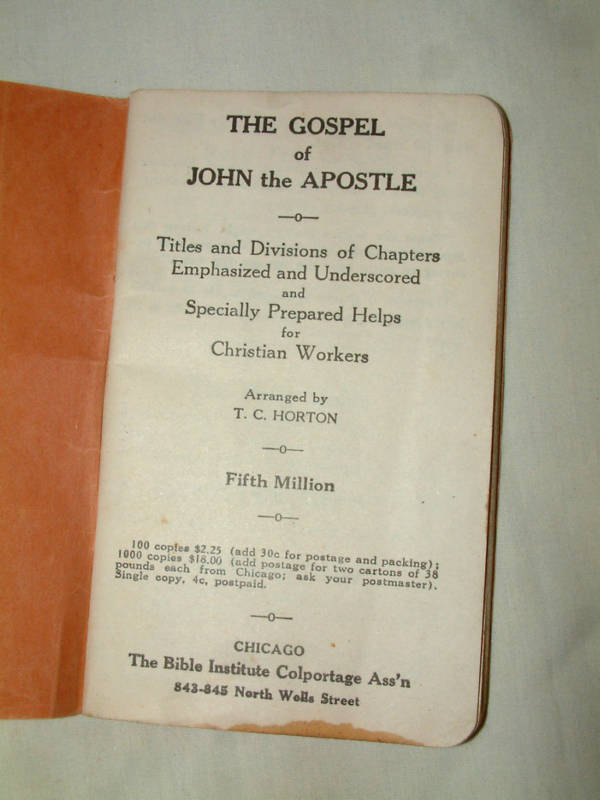
First, the Bible.  The most commonly distributed Bible book wasn’t the entire Bible, but rather a special edition of the Gospel of John.  This edition was edited by TC Horton in 1922.  At the time, Horton was at the peak of his career.  He was a minister and organizer in the Los Angeles area.  He was best known in 1922 as the editor of the Kings Business, the magazine of the Bible Institute of Los Angeles (now Biola University).

Horton’s attitude toward this little volume was clear from the verse on the front cover.  Sorry, it’s hard to read in this photo, but the verse says,

  Here is a little book for you!

                        Just take it, now, and read it through.

                        Page sixty-six, verse thirty-one,

                        Believe it, and the work is done!

If any curious reader followed this clue, he or she would find the following verse: “But THESE ARE WRITTEN, THAT YE MIGHT BELIEVE THAT JESUS IS THE CHRIST, THE SON OF GOD; AND THAT BELIEVING YE MIGHT HAVE LIFE THROUGH HIS NAME.”

In case readers didn’t follow the cover clue, Horton repeated the message on the inside cover.  Horton insisted that the Gospel of John was “the incomparable piece of English Literature.”  But it was not only good literature.  It was inspired by God in order specifically to convert people to Biblical Christianity.  If only people would read these words, Horton believed, their lives would be transformed.  As Horton insisted, this supernatural power was the reason why this Gospel “should be placed, as far as possible, in the hands of every man, woman, and child in the world.”

As we’ve seen, fundamentalists in America have embraced this mission.  In a campaign that sometimes seems bewildering to non-fundamentalists, Bible missionaries have worked to get people to see these Gospel words.

The files of the book missionaries shed some light on this attitude toward the saving power of Gospel words.  The first director of the Bible Institute Colportage Association, William Norton, told stories of the instant power of the words of the Gospel.  In 1921, Norton told a story of a man given a Gospel tract.  At first, the man ignored it.  “Coming to a hedge,” Norton related, “he stuck the tract into the hedge.”  However, thanks to the awesome power of the words of the Gospel, “it was too late; his eyes had caught a few words of the tract which led to his conversion.”  In another story from 1921, a vicious murderer found a copy of a Gospel tract.  “Through reading the Gospel of John this man saw the error of his way, changed his manner of living, and moved to the Bear Creek community in Scott County, Tenn.”

For Bible missionaries like the ones from Chicago, this power of conversion came from the power of the Gospels.  The words were inspired by God to lead to this kind of conversion.  It only made sense, then, to distribute those words as widely as possible.  This attitude toward the words of the Gospel has informed the outreach of Fundamentalist America in ways that remain bewildering to folks who don’t understand the impulse.  But if we can understand this book, these words, as inspired by God to lead people to salvation, we can understand something about the Fundamentalist desire to get these words in front of as many people as possible.  For the Chicago book missionaries, this meant delivering hundreds of thousands of copies of these tracts and Gospels to children across the nation.

Among fundamentalists, only the Bible had the kind of supernatural power that could lead people to instant conversion, merely by seeing the words.  But other kinds of books, too, could help.  The Chicago book missionaries also distributed hundreds of thousands of copies of short novels.  These books weren’t as powerful as the Bible, but they could still work to combat the trend toward sin in popular literature.  As one missionary warned in 1937, they needed uplifting books “during these difficult days when much pernicious literature is being widely distributed by religious cults, atheistic organizations and anti-Christian societies, whereby many are being deceived and destroyed.”

Back in 1921, William Norton had called these books “true-to-the-Bible literature.”  One of the most popular was Rosa’s Quest, originally published in 1905.

In this story, a poor girl is lost in a big city.  Her Christian mother had died, and just before she died she told Rosa to find her in the “beautiful land.”  Unfortunately, the girl lacked any Christian education.  She wandered around the city, rebuffed by nominal Christians who did not reach out to her.  Finally, a missionary on a city bus explains the Word of God to Rosa.  Rosa is converted, then adopted by a wealthy secular family.  In the end, Rosa converts all of her new family using the Gospel.

In the eyes of Bible missionaries, books like this did not have the same supernatural power as the Gospel itself.  They could not change lives simply by being read or heard one time.  But missionaries still reported that the books could help save souls.  One missionary in 1921 reported that the children she worked with were “very enthusiastic” about Rosa’s Quest.   One child from Madison County, Kentucky, wrote to the BICA to thank them for the free books, and noted that he felt “like little Rosa in Rosa’s Quest.  I have found the way to heaven.”  Another recipient wrote in 1937,

“FROM KENTUCKY: ‘In the year 1929, one of my friends loaned me some of your books entitled “Little King Davie,” “The Way Home,” “The Robber’s Grave,” “A Peep behind the Scenes,” and others.  I was thirteen years of age.  God definitely spoke to me through the books and gave me a peep behind the curtains which hid my heart.  In the same year I received a heart-felt experience from God, and also a call into His service.  I am now a missionary in the mountains of Kentucky.”

For the conservative Protestant missionaries of the Moody Bible Institute, books had power.  Some of them, if they contained the actual words of the Gospels, could have supernatural power.  Those words, distributed in books, tracts, and leaflets, emblazoned on billboards, eventually printed on Tim Tebow’s face, could change a life in an instant.  Other books, like Rosa’s Quest, merely provided information about how such change could happen.  They did not save lives the same way the Gospel could, but they kept young people from reading literature that could confuse them or lead them into sin.


Governor Haley and the Changing Face of Fundamentalist America

Governor Nikki Haley of South Carolina has a new book out.  The cutely titled Can’t Is Not an Option may be a bald-faced bid for the 2012 Republican vice-presidential nomination, but it can also tell us something about the ways Fundamentalist America is changing.  The book itself sounds sugary, but Haley’s personal story is compelling.

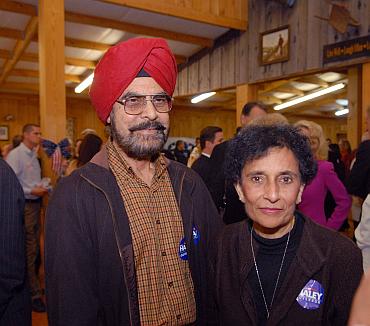
Haley is an Indian-American child of immigrants.  The fact that a dark-skinned female politician whose father wears a turban can succeed as a conservative Republican politician in a state known for racism and evangelical Protestantism means a lot. 

Haley joins a small but growing list of non-white conservative heavy hitters: businessman/politician Herman Cainwriter Dinesh D’Souza, politicians Bobby Jindall and Allen West, and jurist Clarence Thomas, among others.  Such a showing, especially among African Americans, makes a good deal of sense from a fundamentalist perspective.

Conservative intellectuals, notably those at the Heritage Foundation, have made a concerted strategic effort to overcome fundamentalism’s traditional connection to white supremacist ideology.

But although it may make strategic sense, it is a tall order politically.  African Americans have been tightly linked to the Democratic Party since the 1930s.  Before that, African American voters stuck just as close to the Republican Party, the Party of Lincoln.  For most of American history, the vortex of race and race consciousness has overwhelmed all other identity issues, pushing most African Americans to vote first as African Americans, and only second as conservatives, liberals, secularists, religious, etc.

But beyond party politics, African Americans tend toward a deep fundamentalism.  Gallup polls consistently demonstrate this.  For example, one 2005 poll showed that about seven in ten African Americans called themselves “evangelical” or “born again” Christians.  African Americans, according to a 1999 Gallup/CNN/USA Today poll are significantly more likely (85%) to support school prayer than are whites (69%).  This conservative religiosity among African Americans has influenced cultural attitudes among African American young people as well.  A 2002 poll found that only 8% of African American teens say they drink alcohol, compared to 25% of white teens, likely due to higher rates of conservative religiosity.  Among non-whites in general, according to a 2003 poll, only 52% think that premarital sex is morally acceptable, compared to 59% of whites.

Race is a tough issue for fundamentalists.  There are plenty of fundamentalist whites who seem to cling to traditionalism in their white supremacist ideology, just as they cling to traditionalism in religion, education, and culture.  But non-whites, in large majorities, are fundamentalists in everything except party politics.  If more non-whites like Nikki Haley continue to emphasize their cultural conservatism, and if they tie that cultural conservatism to political conservatism, then more and more non-whites may continue to embrace all the meanings of Fundamentalism.

In the News: Tebow in Fundamentalist New York

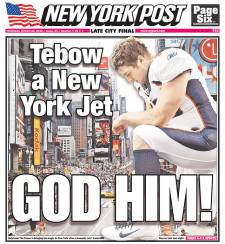
I know I’m not alone in hoping for some kind of Tim Tebow media blackout.  I was hoping the end of the football season, especially with the Broncos’ defeat, would bring some quiet to the Tebow-as-Christian-in-a-strange-land stories.  But Tebow’s move to the New York Jets brought a new round of media focus on Tebow’s style of loud public Christian-ness.

IMHO, the most interesting comment on the Tebow move came from Paul Moses at dotCommonweal.  Moses noted that the New York press tended to gasp at the incongruity of an extravagantly Christian celebrity in the extravagantly pagan Big Apple.

Moses pointed out,

The Times put it this way: “Tebow is also a somewhat incongruous fit: an outspoken Christian playing  in a city known for its extensive night life and a member of a  franchise made famous by the bachelor stylings of Joe Namath and  currently known for the profane speeches of its coach, Rex Ryan.”

And this, from the National Enquirer: “It is unclear how the pie-eyed pundit of the pigskin will respond to the multitude of temptations New York has to offer.”

Moses took such papers to task for assuming too much about life in New York City.  New Yorkers are a decidedly religious group.  Moses cited a Gallup poll from 1991 in which a majority of respondents–53%–said they prayed at least once a day.  The problem, Moses claimed, is that too many people equate Manhattan with the entirety of New York City.  In Manhattan, 17% of poll respondents claimed to be atheists.  In the Bronx, that number dwindled to 1%.

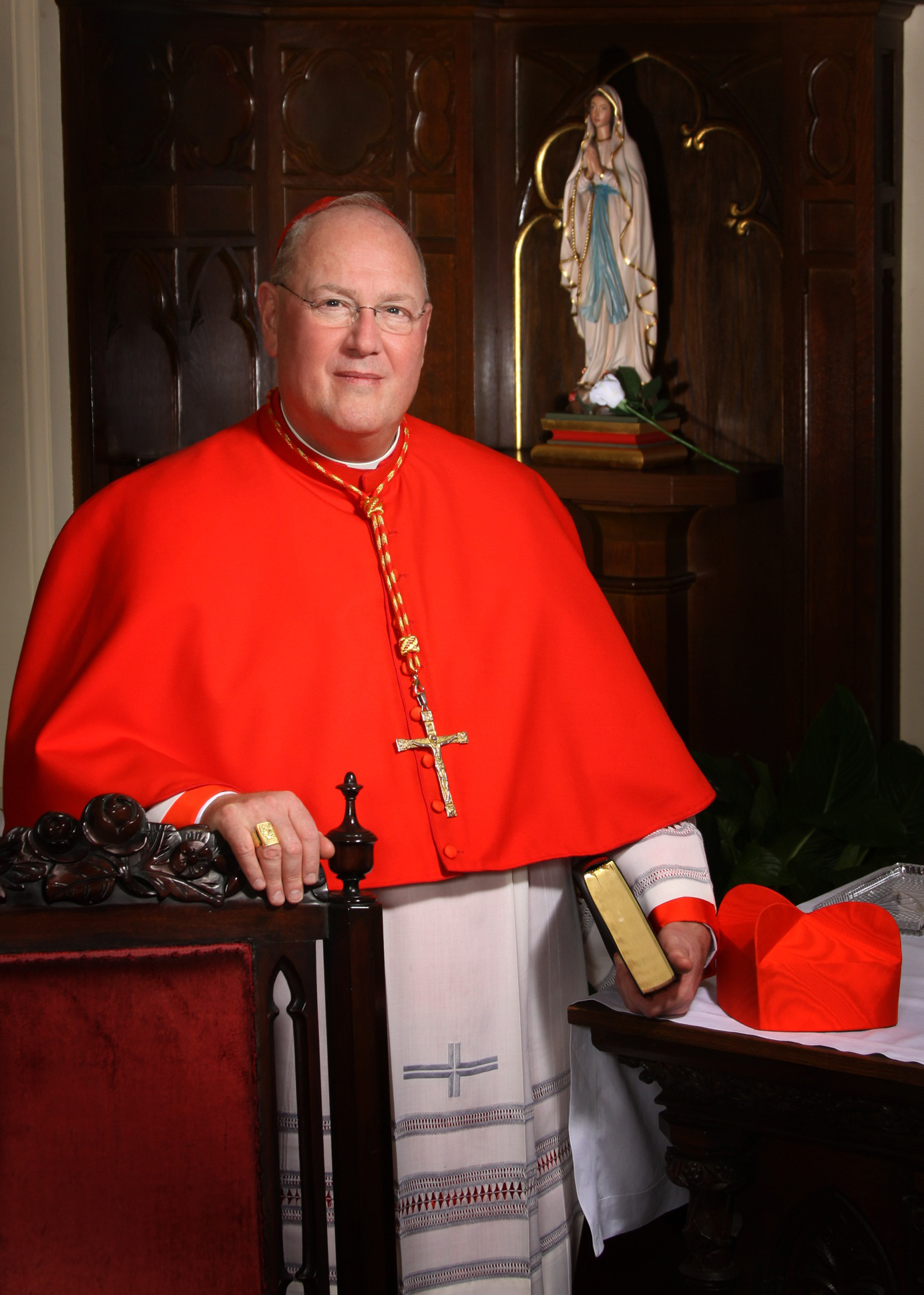
As we’ve pointed out here before, people who do not know much about Fundamentalist America often assume that religiosity goes up only with distance from big cities, education, and indoor plumbing.  It is just not true.  The myth might come from the association in the United States of conservative evangelical Protestantism with conservative religion as a whole.  But if we look at other conservative religious folks, New York City has as much of a claim to fundamentalism as anywhere else.  In the Catholic Church, for example, New York City is now home to genial Archbishop Timothy Dolan.  Dolan’s blog and very public presence inject a strain of conservative religiosity into life in the Big Apple.  And, of course, outside of Christianity, New York City is host to innumerable conservative religious groups.  The old joke about the hayseed who comes to New York and is surprised by the number of “New York Amish” demonstrates that New York has its own profound tradition of deeply conservative culture and theology.

Even within the bounds of conservative Protestantism, large urban areas have always served as strongholds.  True, someone wanting a Protestant fundamentalist education could go to Bob Jones University in lovely Greenville, South Carolina.  Or she could go to Liberty University in Lynchburg, Virginia.  But she could also head to Los Angeles to Biola University, or to Chicago’s Moody Bible Institute or Wheaton College.

The roots of this commonly held misperception, I think, come from the utter dominance of conservative evangelical Protestantism in some rural areas.  When folks from the big city drive around in fly-over country, they are shocked by the public dominance of this type of fundamentalism.  But such folks ought to look closer at their own cities.  Look for storefront Pentecostal churches.  Look for big cathedrals.  Look beyond the stereotypes of cities as home only to nightlife and paganism, and you’ll notice a deeply religious urban America.

There might be a few translation difficulties as Tebow  moves from the Bible Belt to the Big Apple, but there will not be any lack of fundamentalists ready to greet Tebow as he (if he?) makes his New York Jets debut.

IN THE NEWS: Ignorance or Disdain? Fundamentalists, Science, and Alternative Intellectual Institutions

The folks at Scienceblog recently reviewed the findings of Gordon Gauchat, a postdoctoral fellow at University of North Carolina.  In his study, Gauchat found that Americans who self-identify as conservatives trust “science” less in 2010 than conservatives did in 1974.  In contrast, self-identified liberals and moderates kept a stable attitude toward “science” during that period.

So what do these findings tell us?  On first glance, it might seem as if conservatives simply don’t like science.  After all, we’ve seen a rush to denigrate climate-change science and evolution among 2012’s Republican Presidential candidates.  This confirms some culture-war stereotypes, which paint Fundamentalist America as the hillbilly redoubt of Nascar, meth labs, married cousins, and a hatred for all forms of higher learning.

But the study needs a second look.  The level of respondents’ education had an inverse relationship to their reported trust of “science.”  That is, conservatives who had more education tended to trust science less.  This is not about anti-intellectualism or anti-science, at least not as such.

Let me suggest an historical analogy.  I’m not sure if it’s got legs, but I think it’s worth thinking about if we want to understand the phenomenon of educated conservatives maligning “science.”

In the Glory Days of American liberalism, a deep distrust of the cultural and political establishment took hold among the well-educated Left.  With the founding of the Students for a Democratic Society in 1962, some of the best-educated young people in the country announced their disdain for the establishment world of universities, governments, and research centers.  These earnest, intelligent young leftists would have responded to a survey that they did not trust mainstream intellectuals.  As they agreed in their 1962 Port Huron Statement, SDS disdained academic culture. They attacked their “professors and administrators,” as tools of The Man who

“sacrifice controversy to public relations; their curriculums change more slowly than the living events of the world; their skills and silence are purchased by investors in the arms race; passion is called unscholastic.”

Did this disdain for the culture of higher education mean that the intellectuals of SDS were anti-intellectual?  No, what it signaled was an active disdain for the dominant culture of American higher education.

In less than a decade, this anti-establishment impulse among well-educated young leftists had careened down a startling path and mutated into a very different animal.  By 1970, the scattered remnants of SDS had resorted to bombing the Pentagon, army bases, and—accidentally—themselves.  Leftist disdain for the establishment had morphed from the smiling, fist-shaking intellectualism of the 1963 SDS meeting pictured above into the gleeful nihilism of Abbie Hoffman pictured below.

So what might this analogy tell us about the feelings of today’s conservatives and fundamentalists about mainstream science?  For one thing, it suggests that the proper term here is not “ignorance,” but “disdain.”  Well-educated American fundamentalists are not ignorant about mainstream science, but they feel a deep disdain for it.  That disdain has increased in the last generation as alternative intellectual institutions have propagated an anti-establishment culture.

Other studies have supported this intuition.  As we reviewed here recently, Jonathan Haidt’s Righteous Mind included a survey of 2000 respondents.  In this study, self-identified conservatives and moderates were very good at predicting the moral responses of liberals.  Self-identified liberals, on the other hand, could not guess what conservatives might say.  This suggests that Fundamentalist America is well aware of what liberals think, but liberals have allowed themselves to become ignorant of other intellectual options.

Let’s return to our analogy to see if it helps explain this phenomenon.  If fundamentalists in 2010 share the disdain for mainstream intellectual culture that was espoused by well-educated young leftists in the early 1960s, what might be the results?

In the case of the Left, this divorce from academic culture was merely a trial separation.  Most of the student radicals of the 1960s and 1970s ended up the boring center-leftists of the 1990s.  The academically inclined among them founded or joined friendly academic centers hoping to eliminate racism or poverty or war.  The more talented and lucky managed to open new fields of study and press for new visions of education, promoting successful “ethnic studies” programs and multicultural education initiatives.  For a small minority of 1960s/70s leftists, those who followed the logic of anti-establishment culture to its bitter 1970s conclusion, this meant increasingly bizarre forms of dress and behavior, meant to signal distance from the establishment.  For a tiny fraction, this meant political and cultural violence, such as bombs at the Pentagon and Days of Rage.

What will it mean for fundamentalists?  If the historical analogy holds any weight, this distancing between mainstream science and fundamentalists will lead a small fringe on the Right to continue its violent campaign against America.  Like the violent Weather Underground, some fundamentalists will likely follow the logic of separation from mainstream culture to a violent conclusion.  But for the overwhelming majority of conservatives and fundamentalists, if the historical analogy holds any weight, it will mean the continuation of a trend toward alternative intellectual institutions.  Many conservative and fundamentalist intellectual types will find congenial homes in the widening world of the academy and private foundations/think-tanks.  Since the 1970s, indeed, we have seen a proliferation of conservative think tanks and foundations, such as the Heritage Foundation.  In recent years, these conservative alternative intellectual centers have offered well-educated fundamentalists a happy home in which to continue their intellectual work while continuing to feel a deep disdain for mainstream intellectual culture.  In some cases, this has included a disdain for mainstream science.  For example, a new intellectual center at Biola University, the Center for Christian Thought has promised to offer

“scholars from a variety of Christian perspectives a unique opportunity to work collaboratively on a selected theme. Together, they develop their ideas, refine their thinking, and examine important cultural issues in a way that is informed by Scripture. Ultimately, the collaborative work will result in scholarly and popular-level materials, providing the broader culture with thoughtful and carefully articulated Christian perspectives on current events, ethical concerns, and social trends.”

Just as the 1970s witnessed a huge increase in Left-friendly academic centers and fields of study, so this widening cultural distance between educated fundamentalists and mainstream science and academic life should lead to an increase in fundamentalist-friendly academic centers like this one.  It will lead to a deepening division between types of well-educated people; it will force Americans to confront their notions that there is one “correct” version of science and intellectualism.

***Thanks for the reference to Tim Lacy at USIH  ***

The Bible in America: Harry Potter and the Demons of Gergesenes

Adult nerds have a new reason to dress up in funny costumes and line up outside of bookstores for days on end.  Seems J.K. Rowling has announced plans to publish a new novel for adult audiences.  She has apparently not released the details of this plan.  As of this writing, we don’t know if it will be about grown-up wizards looking for magical answers to middle-age troubles like underwater mortgages and sagging physiques, or if it might be an “adult”-adult novel in which bodices will rip.

Whatever it is about, Rowling will be hard pressed to improve upon her record of publishing success.  Rowling’s series of Harry Potter novels charted a meteoric path through the worlds of publishing and culture.  All told, by early 2012 her seven young-wizard books sold some 400 million copies.  That’s a lot.  Predictably, academic types rushed to analyze the cultural impact of the phenomenon.  Some argued that the Potter novels succeeded on such a grand scale because they captured the deep mythic memory of our cultural heritage.  Harry represented the powerful trope of the fairy-tale prince and the archetypal Hero.  Others wondered whether the novels could shed light on contemporary Britain’s struggles with “the legacy of a racial and class caste system.”

In any case, it seems hard to argue with the notion that these enormous sales figures tell us something about the nature of American culture.  Though it’s true enough that some measure of the runaway success of these books is due simply to the faddishness of Americans, it also seems reasonable to think that something in the books resonated with something deep in American culture.  The books fascinated so many people because something in the books made sense to Americans.  We identify, perhaps, with the young Harry, when he was surrounded by hostile blowhards who neither understood him nor appreciated him.  Or maybe we feel like the older Harry, when he was struggling to understand himself as an adult with new powers and daunting responsibilities.

In any case, something about Harry Potter means something in American culture.  The sheer numbers of its publication can tell us that.

If that is true—and by now you may have guessed where I’m going with this—then we must also recognize fundamentalists’ claims that the Bible is not just another book.  If Harry Potter’s enormous publication numbers mean that the books struck a chord with American culture, then the staggering publication numbers of the Bible must mean it says even more about that culture.  Consider a few numbers.  The American Bible Society, muggles all, was founded in the early nineteenth century to distribute Bibles and tracts to the population.  Between its founding in 1826 and 1979, the ABS distributed three BILLION Bibles and tracts.  THREE BILLION.  Those are Sagan-esque numbers, and they put Rowling’s sales figures to shame.  In just one year, 1979, the ABS distributed 110 million bibles and tracts in the USA alone.

If literature scholar Rebecca Sutherland Borah is at all correct in her surmise that the fan communities of the Harry Potter novels can tell us a good deal about the ways communities can form around a shared devotion to Rowling’s texts, how much more of a cultural indicator is the Bible?  Fan communities of Harry Potter may camp out overnight to receive each new installment of the series, but fan communities of the Bible have worked for centuries to help all people of all nations hear the Word.

Consider the work of the Gideons, for instance.  If you’ve spent any time in America, you’re familiar with the ubiquitous Gideon Bibles placed in nearly every hotel room in the country.  The organization began in the late nineteenth century, founded by a small group of Wisconsin businessmen.  They decided they could best spread Christianity by using their travels to spread the Bible.  Starting in 1908, they began distributing Bibles and New Testaments to hotels around the world.  By 2012, they claimed to have given out over 1.6 billion Bibles and testaments.

Granted, they’ve had a century to do so.  Nevertheless, the devotion of such Bible distributors as the Gideons and the ABS demonstrates the reverence with which many fundamentalists hold the Bible.  Mere distribution of the text itself is seen as the most effective type of missionary work they can achieve.

And the success of their efforts has been impressive.  Taken by numbers alone, the Bible really is America’s book.  No other book can come close to rivaling the Bible’s physical presence in the United States.
Nor is this due to devoted missionary distribution networks alone.  The Bible also sells well.  I spent some time recently with a guy who had an easy first job: selling Bibles door-to-door in Texas.  It was easy work, he described, since everyone he met could be convinced that they needed a Bible.  Even though they already had one.  Or several.  ‘Like selling beer at a baseball game,’ he told me.  ‘Heavy to carry around, but not hard to convince people they could use another.’

A glimpse at some sales numbers for the Bible seems to bear this out.  Not only in Texas, but around the country.  For example, there have been 2500 different English-language editions published between 1777 and 1957.  When a new version, the Revised Standard Version, came out in 1952, it sold an average 1,000,000 copies annually for at least a generation.  Similarly, the Kenneth Taylor Living Bible paraphrase sold 25,000,000 copies in its first eleven years of publication.

People buy the Bible.  People distribute the Bible.  We don’t know for sure from these facts what the Bible actually means to people, but we would be a little kooky to assume it doesn’t tell us anything.  If the monstrous sales of the Harry Potter books means something about American culture, then surely the even more startling sales and publication history of the Bible means even more.  It is hard not to agree with leading historians Mark Noll and Nathan Hatch when they insist, “the cultural history of America is unthinkable without the Bible.”


FURTHER READING: The Ivory Tower and Harry Potter, edited by Lana Whited (University of Missouri Press, 2002); Nathan O. Hatch and Mark A. Noll, eds., The Bible in America: Essays in Cultural History (New York: Oxford University Press, 1982).


FROM THE ARCHIVES: Bible in America: Bible Evangelism to the Crabgrass Frontier

A few years back I stumbled across a remarkable Bible campaign.  Beginning in 1921 and continuing throughout the twentieth century, Bible evangelists based at Chicago’s Moody Bible Institute delivered Bibles, New Testaments, and tracts to underserved regions.  This campaign, which began as part of the Bible Institute Colportage Association and eventually became part of the Moody Literature Mission, delivered millions of Bibles and religious literature to the Southern Appalachian region, as well as the Ozarks, western logging camps, Louisianan Catholic schools, prisons, hospitals, and other venues in which missionaries thought people were hungry for the Word. 

            At the time, I focused my study on the missionaries’ use of Appalachian public schools as a distribution network for this religious literature.  I published some of my findings in an academic journal [“The Quiet Crusade: The Moody Bible Institute’s Outreach to Public Schools and the Mainstreaming of Appalachia, 1921-1966,” Church History 75:3 (September 2006): 565-593.] 

            Looking over my notes as I thought about the meanings of the Bible in Fundamentalist America, I came across my collection from this research.  As usual, there was a lot more material than what I could use in the article. 

            For the next couple-few posts, I’ll pull up various pamphlets, brochures, and other materials from this archival collection.  Most of the material is available at the Moody Bible Institute in downtown Chicago.  The people there were very accommodating and friendly on my visits, and the archive is certainly worth a visit if you’re in the area. 

            I won’t argue that these materials somehow capture any single essence of fundamentalist attitudes about the power of the Bible.  That would be far too simplistic.  But I do believe that the attitudes toward the Bible expressed in these materials give a window into a commonly held fundamentalist vision of the nature of Holy Scripture.  As we’ll see, the Bible missionaries from Chicago believed the Word had a unique power.  The Gospels, to them—and, I argue, to many fundamentalists in the 1920s and since—meant more than just a collection of edifying religious messages.  As we’ll see, many of these Bible missionaries held a fundamentalist belief in the saving power of this powerful text. 

For many fundamentalist evangelists, the merest exposure to the words of the Gospel can have a saving power.  It can serve as an inoculant to sinful doctrines and sinful ignorance.  For example, one post-World War II brochure trumpeted its success in exposing students in public schools to the Word.  These students were described as “otherwise unreached boys and girls.”  By giving them Bibles, these missionaries proclaimed they had been “introduced to the way of salvation for the first time, with many of them accepting Christ as their personal savior.”

In the view of these fundamentalist missionaries, the dangers to these students—depicted as white, fairly affluent suburbanites—came from both ignorance and false doctrine.  This brochure warned of other missionaries: “Jehovah’s Witnesses, Mormons, Catholics and Seventh Day Adventists,” all of whom were “making devastating inroads among these gospel-hungry communities.”  In the view of these Bible missionaries, young people did not need anything beyond the Bible to be protected from this threat.  If these students could simply be exposed to the “true message of eternal life” from the Bible, missionaries would be able to “capture them for the Lord Jesus before they are ensnared by the evil one.”

There is a good deal here of interest for those who hope to understand Fundamentalist America.  As I write, the 2012 Republican presidential primaries are slogging along, with (Catholic) Rick Santorum fighting (Mormon) Mitt Romney and (Converted Catholic) Newt Gingrich for the vote of the Fundamentalist Faithful.  Romney’s Mormonism sometimes comes up as an issue for conservative Protestant voters.  We don’t see as much, though, about the threat of Santorum’s Catholicism.  We have wondered here about this “Fundamentalist Mystery.”  This brochure from sixty-odd years ago paints a very different picture of the relationship between fundamentalist Protestants and conservative Christians of other groups.  The relationship between the two has long been tense.  Some historians have argued that it was only the “pro-life” movement that emerged in the 1970s that brought the two together.  But there had been other rapprochements, with prominent Catholics such as William F. Buckley Jr. leading a broader conservative movement in the years after World War II that attracted many Protestants as well as Catholics.

In this Protestant brochure, written around the same time that Buckley began his long career as the intellectual darling of Fundamentalist America, Catholics, Mormons, Seventh day Adventists and Jehovah’s Witnesses are not seen as part of a broad conservative coalition, but rather as deadly, aggressive threats to the health of America’s unreached masses.

For those outsiders who hope to understand Fundamentalist America, another interesting lesson from this brochure is the perceived power of the Gospel among these literature missionaries.  This point is so central to this tradition that it usually went unremarked, but if we want to understand Fundamentalist America, we need to explore the meanings of this Biblicism in a little more detail.  First of all, we need to note that this tradition is strongest only in this segment of today’s broad Fundamentalist coalition.  Conservative Catholics, for example, don’t historically place the same emphasis on the miraculous power of Bible text.  For these Chicago book missionaries, however, the assumption was that the words of the Bible, especially those of the four Gospels, had the power to effect soul-saving conversions on anyone who read them.  The challenge, then, for the missionaries was only to get the Word out there.  If these white suburban schoolkids could somehow be persuaded or cajoled into looking at the Gospels, their souls would be saved.  Again, this assumption is so powerful among a segment of today’s Fundamentalist Americans that it usually goes without comment.  But it explains a good deal that is puzzling to non-fundamentalists.  So, for example, when people at sporting events hold up signs with Biblical chapter and verse—either as Broncos’ quarterback Tim Tebow or just as a guy in the bleachers—the hope is the same.  If they can simply convince people to look at John 3:16, the tradition goes, sinful or ignorant people will be eternally saved.  This is the impulse behind much of the fundamentalist effort to Biblicize public space.  If students in public schools can be exposed to the words of the Bible, they will be saved.  If billboards can proclaim the words of the Gospel, readers will be saved.  If court sessions can start with a Bible reading, sinners will be saved.  All of these goals only make sense once we understand the enormous power some Fundamentalists grant to the words of the Gospel.  The merest exposure is presumed to have eternal power.

Another interesting point about Fundamentalist America that this brochure reveals is its presumption about its readers.  This is a fundraising brochure that trades on its readers’ sense of duty.  The duty is to save as many souls as possible.  The public schools, in this brochure, present an “opportunity” to reach many imperiled young souls with only a small effort and expense.  The central point of this public-school campaign is that students in schools are likely to be reading.  Why not help make that reading material Biblical?  At least among this particular postwar Fundamentalist community, the missionaries did not need to explain that their readers should want to save souls.  Instead, the assumption was that Fundamentalists worked in contest with other spiritual missionaries—Mormons, Catholics, Seventh day Adventists, and Jehovah’s Witnesses—to capture as many souls as possible.

This Fundamentalist requirement to save souls helps explain some of the puzzle of Fundamentalism.  Many non-fundamentalists have complained about the aggressive nature of Fundamentalist America.  In the 1920s, for instance, famous atheist Clarence Darrow put it something like this, “I don’t mind them going to heaven their way, but I don’t want them to stop me going to hell my way.”  Other non-fundamentalists, these days, say they don’t understand why fundamentalists care if other people do things like marry same-sex partners.  Once we see the centrality of soul-saving outreach to the Fundamentalist tradition, we can get a better sense of the reason for this aggressive insistence on the morality of everyone, not only the Fundamentalist community itself.

Finally, this brochure shows us the ways some Fundamentalists starting seeing whitebread suburban America as the newest “mission field” for their outreach work.  In the nineteenth and early twentieth centuries, a lot of this outreach was directed away from mainstream middle-class American life.  Earlier fundamentalists assumed that the core of American middle-class culture was safely aware of the Gospels, safely educated and inoculated from the spiritual dangers of life.  Of course, some of those folks might still choose a life of sin, but at least they knew the saving message of the Gospels.  After World War II, some fundamentalists—like these Bible missionaries—began to see their role in American culture differently.  Their missionary outreach no longer had to be only to “outsider” groups, whether that be in sub-Saharan Africa, Latin America, Asia, among immigrant communities in big American cities or among isolated mountain families in places like the Southern Appalachians.

Instead, some fundamentalists started to see themselves as surrounded by a vast mission field.  Even in affluent white communities they began to see their role as one of outreach and salvation.  Much as later fundamentalists such as Jerry Falwell would complain that they were a minority group, so these postwar evangelists saw themselves as one missionary enterprise among others, competing for the souls of middle-class white kids in suburban public schools.


Bible in America: RAH interview with Robert Alter

Fundamentalists don’t always make the best historians.  American fundamentalists tend to insist on an American past that is far too rosy.  When she was still an up-and-coming Presidential nomination contender, for example, Michele Bachmann insisted that the Founding Fathers had “worked tirelessly” to end slavery.   Though she later tacked away from her statement, noting that she meant John Quincy Adams, it doesn’t take a slanted leftist historical perspective to notice that her claim is just not true.  The Founding Fathers may have accomplished a good deal.  Some of them may even have tried to improve the conditions of slaves, or to hurry the day when human chattel slavery would be abolished.  But overall, the issue of slavery was one that the Founders explicitly pushed off on a later generation.

However, as we’ve noted here in the past, one of the historical claims of fundamentalists in America lines up more neatly with the findings of non-fundamentalist academics.  On the Religion in American History blog, Randall Stephens recently interviewed scholar Robert Alter about his newish book, Pen of Iron: American Prose and the King James Bible.

Alter’s book is focused on the ways Biblical themes and language infuse American literature and culture.  In the RAH interview, he makes the point that American culture in the past was thoroughly Biblicized:

“In nineteenth-century Protestant America, the Bible, almost always in the King James Version, was a constant companion for most people. They not only heard it in church, but very often it was regularly read out loud in the family circle at home.”

Fundamentalists often make the case that America is and should remain a Christian, Biblical society.  They insist on a vision of American history in which early European settlers and Founding Fathers planned to create a Christian Nation.  (For the leading example of these kinds of arguments, check out David Barton’s Wallbuilders articles.)

Academic historians have noted that these historical claims must be treated carefully.  John Fea, for instance, has argued that there was indeed a good deal of Christian intent among the founding generation, but this is often used by activists in unfair and ahistoric ways.

However, it is only fair to notice that in some cases, the vision of the past promoted by fundamentalist activists lines up neatly with that of non-fundamentalist scholars.  According to Robert Alter, at least, American culture in the past really was thoroughly infused with the KJV Bible.