I Owe, I Owe

It was a squeaker, but it worked. I promised my editor I’d deliver the manuscript for Fundamentalist U by Monday, and I just mailed it in today. Coupla days to spare. Whew!

If I were cooler, I would copy Brendan Pietsch’s world’s-coolest acknowledgements page. But I’m not. I’ve accumulated a bunch of debts—financial, intellectual, and otherwise—and I feel a need to express my gratitude the ol-fashioned way.
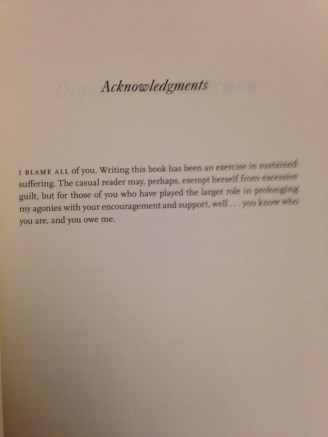
pietsch acknowledgements

How the cool kids do it these days…

First, the Spencer Foundation footed the bill. Their program for small research grants allowed me to spend the academic year 2014-2015 working full time on this book. I was able to travel to six of the schools I’ve been studying. Without this grant, I would never have been able to put this book together. Thank you Lyle!

There are plenty of other people that also made the book possible. Most important, the archivists at the schools I visited often bent over backward to help me find materials. At Biola, for example, Stacie Schmidt and Sue Whitehead allowed me to work right in their office. They also helped me get permission to use some of the cartoons from Biola’s periodicals that will appear in the book.

At Wheaton, Keith Call helped me find a ton of stuff. He also spent time sharing with me his one-of-a-kind experience with and knowledge of the world of evangelical higher ed. Since my visit, too, he has kept me in the loop about some of the goings-on at Wheaton and elsewhere.

Robert Shuster at the Billy Graham Center kept the room open late for me and helped me dig through the vast resources of their oral history collections. I depended on those oral histories to find out what life was like at fundamentalist colleges for students.

Down South at Bob Jones University, Patrick Robbins over-extended himself to help me locate materials. He has been doing so for years and I’m extremely grateful.

In Chicago, Corie Zylstra and Nikki Tochalauski allowed me to linger late in the Moody Bible Institute archives. They also shared their experiences as students and workers at the most famous Bible Institute in the world.

Even at schools I couldn’t visit in person, friendly archivists were willing to spend time and energy talking to me about my research. At the late Tennessee Temple University, for example, Keith Woodruff took time and risked carpal tunnel syndrome emailing back and forth with me.

One of my local schools, Summit University (the former Baptist Bible of PA) let me use their terrific collections of fundamentalist and evangelical periodicals.

It didn’t work, but I appreciate the efforts of two of my academic heroes, Jon Zimmerman and Ron Numbers, to try to help me get an additional fellowship to fund my work on this book.

And when it came to the book itself, my fellow nerds helped me out enormously. Most especially, Tim Gloege and Dan Williams read several parts of the book and helped me with their enormous expertise. I also conned a group of A-list experts to help me improve the book. The book covers a lot of territory, so I shamelessly braced friends, acquaintances, and even people I only knew by reputation.

First, I reached out to higher-ed historians such as Roger Geiger, Christopher Loss, and Ethan Schrum. The book also wrestles with questions of the nature of conservative evangelical Protestantism, so I asked Molly Worthen, John Fea, Bill Trollinger, and Brendan Pietsch for expert help. There’s a lot about creationism in there, too, and Ron Numbers and Michael Lienesch agreed to read sections and point out my blunders. Then, of course, there are the group of experts specifically in the history of evangelical higher education and I asked them all for their time: Jared Burkholder, Michael Hamilton, and Chris Gehrz. To top it all off, I also pestered other smart people I knew to give me their opinions, including L. Herbert Siewert, Tim Lacy, and David Bernstein.

Thanks to all…but that’s not all. I’m also grateful to all the SAGLRROILYBYGTH for taking part in our conversations about evangelicalism, college, fundamentalism, conservatism, and etc. etc. etc. over the past few years.

What happens next?

It will still be a while before the book hits shelves. The folks at Oxford will give my manuscript some copy-editing. Then they’ll put together a set of proofs, set as the actual pages will look. Once we get to that stage, I’ll pore over the proofs to write my index.

It all takes time and patience. When will the book finally be published? Hard to say exactly, but it’s usually about twelve to eighteen months. I’ll keep you posted.

Why Do Schools Cover Up Rape?

Is it the “private” part? Or is it the “fundamentalist” part?

As SAGLRROILYBYGTH are well aware, we’ve gone back and forth in these pages about the troubled history of evangelical colleges and sexual assault. Leading fundamentalist institutions such as Bob Jones University have finally admitted to their own shocking denialism. At BJU and other fundamentalist schools, a cocktail of “purity-culture”-fueled attitudes and diehard loyalism fostered a legacy of abusive cover-ups.

As we see again today, though, fundamentalist schools are depressingly similar to non-fundamentalist schools when it comes to institutional cover-ups. Plenty of closed-mouth schools relegate the suffering of sexually abused students to secondary status.

In the New York Times, Alan Feuer relates the charges against Choate. Choate Rosemary Hall is an uber-elite boarding school in Connecticut. As Feuer reports, decades of student complaints about abusive teachers were hushed up. Predatory teachers were transferred or disciplined, but never reported or arrested.

choate

Idyllic? …or menacing?

It’s not that students didn’t complain. One student contracted herpes from her teacher. The school allowed the teacher to finish out the school year, then the teacher transferred to a different private school in Colorado. Another student was coerced into having sex with a teacher by threats of bad grades and bad college recommendation letters.

In one case, according to the outside report released last week, a student who accused his former faculty advisor was told that the situation was complicated. After all, grateful alumni had just donated hundreds of thousands of dollars to honor the teacher. Had the teacher been sexually aggressive with students? Maybe, the school’s alumni director wrote, but “his teaching did reach a lot of kids since 1944, and I’d rather let it go at that.”

The problem, it seems, ranges far beyond the insular world of fundamentalist schools. As Yvonne Abraham noted in the Boston Globe, “you have to wonder how parents could ever again entrust their children to this school — or any boarding school.” She repeats the central question from attorney Roderick MacLeish: “Do these schools have the moral authority to continue to exist?”

Of course, the details of every nauseating case are different. Catholic schools suffer from their antiquated celibacy rules for clergy and their ingrained institutional denialism. Football schools suffer from their anything-for-the-win tradition of hero worship. Private academies like Choate suffer from their addiction to alumni loyalty. And fundamentalist schools suffer from their slanted gender assumptions and us-against-them mindset.

The depressing truth, though, is that when it comes to sexual abuse, fundamentalist schools are more similar to than different from the rest of the school universe. Institutional loyalty trumps care of students. Complainers are hushed up. Abusers are talked to, not punished.

The problem is more deeply ingrained than any of us want to acknowledge. It lies at the heart of the way schools work. In addition to teaching and caring for students, schools have to control them in a variety of ways. Once students are in that kind of situation, the possibilities for abuse will always surface. From fundamentalism to football to financial contributions, schools have always had plenty of reasons to hush up allegations of sexual abuse.

Why do schools cover up rape? Two reasons. First, schools rely on taking power and authority away from students. If every student were allowed to accuse every teacher, the authority structure of schools would collapse. And second, schools are at heart self-perpetuating institutions. Like most institutions, they will tend to protect themselves first and their students later.

Which Christian College Should My Kid Attend?

Looking for help picking an evangelical college? I’ll save you some time: I can’t help. And the worse news is that no one is sure how to categorize them. However, there are some guides out there.

I’ve been receiving inquiries lately from concerned parents. They’ve been looking for good evangelical colleges for their kids and they’ve stumbled across this humble blog. So they’ve asked me for help picking the “right” evangelical school.

Now, it’s true we talk a lot in these pages about evangelical higher education. My book about the twentieth-century history of such schools is almost finished. But I’m sorry to say I can’t offer any tips or strategies about how to pick the right evangelical college.

I wish I could help. I’ve got a kid in high school and I’m wondering about where she’ll go to college and how we’ll pay for it. I’m sure she won’t be going to an evangelical school of any sort, but besides that, I’m at a total loss. For evangelical Protestants, this tricky decision is made more difficult by the wide array of evangelical schools out there. There’s a wide variety in evangelical colleges and there always has been.

Evangelical families have to consider questions of location, price, academic prestige, size, and etc., just like the rest of us. But if they’re planning to attend an evangelical college—or as they tend to call themselves, a “Christian college”—they have to consider other factors as well. Is School X or Y too liberal? Too conservative? Too dispensationalist? Too Calvinist? Is it too friendly to same-sex partnerships? Too unfriendly? Too obsessed with young-earth creationism? Not obsessed enough? Etc.!

I’m not jealous. It can be exhausting and expensive to get the real scoop about any campus. They all tell us they are the best in everything and it can take some digging to find out what life is really like for their students. This is why the nebulous concept of “prestige” weighs so heavily in these decisions.

And I’ve got some bad news. Just like other sorts of college rankings, even the most well-informed experts can’t agree on how to categorize Christian colleges.

Among historians, at least, there has always been some dispute about whether different schools should be considered “fundamentalist” or “new-evangelical.”

Writing from the campus of Bob Jones University back in 1973, for example, historian George Dollar tried to list different sorts of evangelical schools: “militant Fundamentalist” ones, “moderate” ones, and the “modified or new-evangelical group.” He warned, however, that his lists had some problems. Even new-evangelical schools had some “hard-line Fundamentalists who take good stands individually.”

The View from Greenville: George Dollar’s Categorization of Evangelical Colleges (1973)
Militant Fundamentalist Moderate New-Evangelical
Bob Jones Philadelphia College of the Bible (now Cairn University) Barrington College (now part of Gordon College)
Midwestern Baptist Bible College Cedarville University Fuller Seminary
Baptist Bible College in PA (Now Summit University) Biola Wheaton College
Calvary College in Kentucky Westminster Seminary Gordon College
Clearwater Christian College in Florida Tennessee Temple University (now defunct) Houghton College
Faith Theological Seminary Moody Bible Institute King’s College
Central Baptist Seminary in Minnesota John Brown University Oral Roberts University

A decade later, another evangelical historian tried to offer a similar guide. William Ringenberg warned that there was no simple and definitive way to classify schools. The “fundamentalist” side of the family could be identified generally by their emphasis on revivalism, authoritarian leadership, focus on religious purity over academic freedom, and political conservatism. What evangelical schools counted as “fundamentalist” to Ringenberg? Liberty, Bob Jones, Baptist Bible of Missouri, and the now-defunct Tennessee Temple schools.

Around the same time, leading evangelical historian Timothy Smith offered another guide. For Smith, the list of “independent fundamentalist” schools included Biola, Grace College in Indiana, Northwestern College in Minnesota, Bob Jones, and Liberty.

Clearly, even the best-informed experts haven’t agreed on what counted as a “fundamentalist” school. How are the rest of us supposed to know what to think?

Plus, it’s been a while since then. Some of the schools have folded, others have combined, and certainly some have changed their focus. King’s College, for example, moved to the Big City and began to emphasize culture-war involvement. New schools, too, such as Patrick Henry College, offer a new kind of conservative evangelical higher education.

But the dilemma for evangelical families remains. Since there is such a wide spectrum among the expansive evangelical family, how can students and parents know if any particular school matches their own beliefs and attitudes?

Here’s the good news: There are guides out there to help. The expansive Council for Christian Colleges and Universities, for example, has a school guide for families to consider. Christianity Today also publishes a Christian-college guide. If families are committed to young-earth creationism, they can turn to YEC-specific guides like the one at Answers In Genesis.

Just as in the world of non-evangelical higher education, though, our best bet is to talk to people we know and trust. Visit campuses. Ask hard questions. Talk to alumni. Talk to students and faculty.

And then relax. Our kids are not just silly putty, vulnerable to any wacky idea or dangerous trend that might drift across their phone screens. All colleges, whatever their faith background or academic atmosphere, offer a lot of opportunity to their students.

Nailing Jello to the Wall…Again

Whatever you do, don’t invite an historian to lunch. They’ll ruin your meal with their endless disputes about stuff no one else cares about. In this case, it’s the definition of American fundamentalism that has us in a tizzy. Why is it so problematic?

These days, as SAGLRROILYBYGTH are sick of hearing, I’m just about finished with my book manuscript about conservative evangelical higher education. In the book, I’m arguing that colleges, universities, seminaries, and Bible institutes did more than most institutions to define evangelicalism. And I’m offering a new definition that will probably get me disinvited to more lunches.

It’s not as straightforward a question as you might think.

Back in the 1930s, the first academic history of Protestant fundamentalists—Stewart G. Cole’s History of Fundamentalism—defined fundamentalism as a “cult;” a blight on American society led by “disturbed men” who suffered from a “psychotic condition.” Ouch.

Soon, leading religious historian H. Richard Niebuhr (the famous theologian’s brother) gave academics a definition that was less vicious, but offered the same basic outlines. Fundamentalism, Niebuhr wrote, was a hillbilly affair, surely destined to wither in the sunshine of modernity.

Sutton

What is fundamentalism? “Radical apocalyptic evangelicalism.”

In 1954, another academic history of fundamentalism suggested a similar explanation. Norman Furniss’ book The Fundamentalist Controversy assumed that fundamentalism meant a lack of knowledge about modern life, a head-in-the-sand stupidity.

These early definitions of fundamentalism were so far removed from reality that it was only a matter of time before a new generation of historians threw them out. Just as a 1960s class of historians from non-elite backgrounds offered new and better histories of minority ethnic groups and working classes, so too did historians from evangelical backgrounds redefine their own tradition.

Most influential, Ernest Sandeen argued that fundamentalism was best understood as the modern rebirth of an old evangelical theological tradition, premillennialism.

George Marsden counter-argued. Yes, premillennialism was vital to fundamentalism, but it was not enough. In his 1980 book Fundamentalism and American Culture, Marsden lay out the definition of fundamentalism that most nerds still use today. What is fundamentalism? Marsden noted that we need to include revivalism, premillennial theology, common-sense philosophy, and a vague but vital political and cultural conservatism.

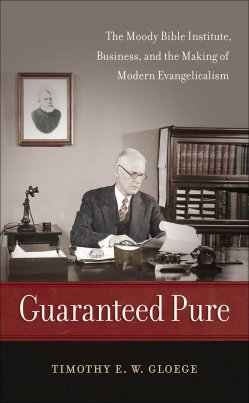
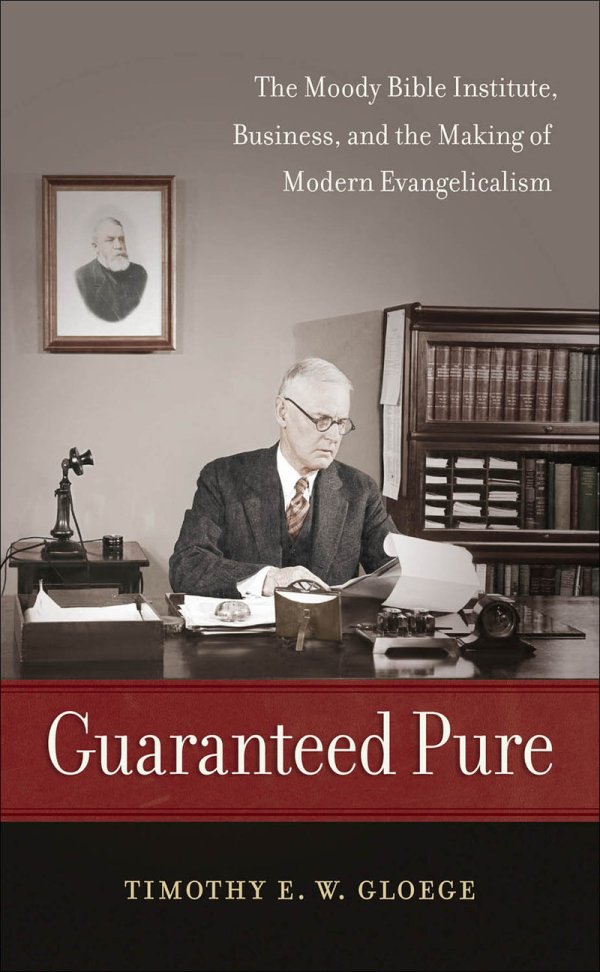
Gloege Guaranteed Pure

Or maybe a “grammar. . . a corporate evangelical framework.”

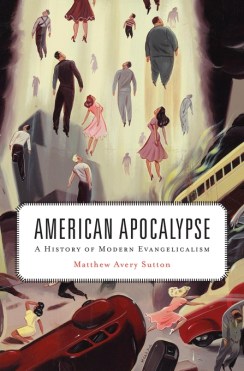
In the past few years, ambitious historians have re-opened the case. Matthew Sutton, for example, fresh off his blockbuster academic hit Aimee Semple McPherson, took on the challenge of defining American fundamentalism. Yes, fundamentalism is a blend of influences, Sutton argued in American Apocalypse, but it’s not just a jumble. If we want to understand fundamentalism, Sutton insisted, we need to understand that the defining feature of the radical evangelical experience has been its fixation with the end times.

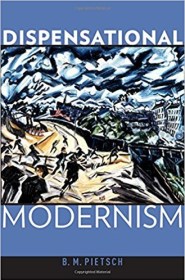
Sutton isn’t alone in wondering what it has meant to be fundamentalist. Kathryn Lofton has pointed out (sorry, subscription required) that fundamentalists and their arch theological enemies were both “commonly modern.” Brendan Pietsch has demonstrated that one of the signature methods of fundamentalist Bible-reading—the dispensational lens—is a profoundly modern approach.

Most compelling, from my point of view, has been Timothy E.W. Gloege’s definition. Like me, Gloege focused on evangelical higher education, in his case, the earlier history of the Moody Bible Institute. From that lens, it seems clear that it will always be self-defeating to offer any simple theological definition to fundamentalism. Why? In short, fundamentalism worked as a set of goals, not a system of doctrine. Fundamentalism was a kind of least-common-denominator coalition, not a list of beliefs or a systematized theological vision.

Fundamentalists, Gloege argues, were united by their dream of creating a new, modern sort of orthodoxy, laid out on the model of the modern corporate business organization. But that approach left fundamentalists dangling when it came to traditional orthodoxy. They did not and would not mimic traditional denominational orthodoxies by agreeing on a systematic theology, because they were never willing to compete with denominations. At the same time, however, most fundamentalists valued and venerated the idea of a traditional Christian orthodoxy.

pietsch disp moder

Nothing old…

At the Moody Bible Institute, at least.

I’m still tweaking my argument, so you’ll have to wait until Fundamentalist U comes out to see the deets. (It will be soon, I promise.) It seems clear to me, though, that if we really want to understand the history of American fundamentalism and evangelicalism we will have to ditch our impulse to copy the theological creeds offered time and again by fundamentalists themselves.

If we don’t, we keep bumping up against unsolvable dilemmas:

  • What do we do with people like J. Gresham Machen, the breakaway Princeton Calvinist who said he was and wasn’t a fundamentalist?
  • What sense can we make of a fundamentalism that never agreed with itself on what fundamentalism required? For example, Bob Jones College forced its students to participate in dramatic plays, while Wheaton College banned such things. How can we step in and say one was right?
  • What IS the theology of fundamentalism? Calvinism? Yes. Arminian revivalism? Yes. Dispensational premillennialism? Yes. Amillennialism or postmillennialism? Yes.

It’s tempting to wade into these disputes with a hindsight definition. We might want to say Professor Machen was not a fundamentalist, but rather a Calvinist, or a creedal conservative, or a denominational conservative. All those are also true, but they sidestep the central difficulty that Machen was considered a fundamentalist during the peak of the 1920s controversies, including by himself.

We might want to say that fundamentalism was one core belief, fringed by an accumulation of disputed ideas. If we do that, we can say that both Bob Jones College and Wheaton were fundamentalist, but they disagreed on some non-essential details. That’s a smart approach, but it avoids the main problem—both sides insisted that their positions on student drama were CENTRAL to their fundamentalist identity.

We might try to say that one theology represented real fundamentalism, while others only thought they were fundamentalist.  Those others weren’t real fundamentalist theologies; they were confused. But this mistakes the central fact that both dispensationalists and non-dispensationalists worked together and considered themselves fundamentalists. Except when they didn’t. It ignores the fact that Calvinists, revivalists, and lots of others all taught at fundamentalist schools. Maybe not happily, but loosely united in their self-image as fundamentalists. Usually.

In short, there’s no way to untie this knot, definitionally. Instead, we need to cut it; we need to take a different approach to understanding fundamentalism. At least, that’s what I’m arguing in the book. And it’s not easy. It takes me about 128,000 words to make my case.

See? This is why I don’t get to leave the house much. Not many people find this kind of thing as interesting as full-time historians.

One Big Unhappy Family

Normal people might be forgiven for saying ‘Enough already.’ The Larycia Hawkins case at Wheaton College has been poked and prodded by commentators and armchair pundits from every conceivable angle, including my own humble contribution at History News Network about Wheaton’s relevant history. But just one more word from me before I let the subject drop: Does this purge help heal the rift between fundamentalist universities?

In case you’ve been living life and not keeping with the latest, here’s a quick refresher: Professor Hawkins was fired for her statements that Muslims and Christians worship the same God.

Commentators have offered a full spectrum of analysis. One Wheaton professor defended his school. Crunchy conservative Rod Dreher also spoke up for Wheaton’s right to police its theological borders. A former student said Wheaton’s decision was in line with evangelical tradition. And perhaps most intriguing, historian extraordinaire Michael S. Hamilton told the Chronicle of Higher Education that Wheaton doesn’t like it when people don’t fit into its white, Northern, fundamentalist tradition.

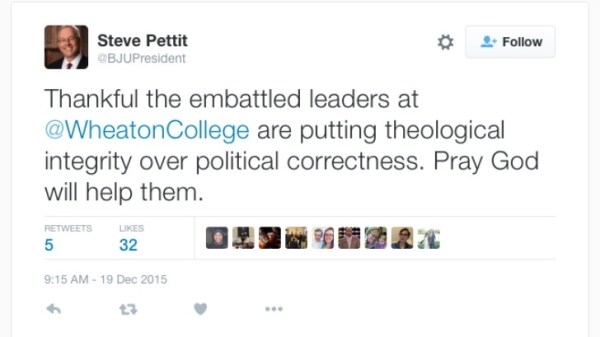
In all the hullaballoo, I missed an important piece in this evangelical jigsaw puzzle. Just as Wheaton decided to suspend Professor Hawkins, they got some support from an unlikely source. President Steve Pettit of Bob Jones University tweeted his support for the beleaguered administration.

pettit tweet BJU supports Wheaton firing dec 2015

Are they all on the same page again?

As I noted recently, my current research into the history of evangelical colleges has revealed continuing tensions between the two schools. I won’t rehash the whole story here, but in brief, a stormy rivalry in the 1930s developed into an outright breach in the 1970s. By that point, BJU had become the flagship university of steadfast separatist fundamentalism, while Wheaton represented the best of a broader conservative evangelicalism.

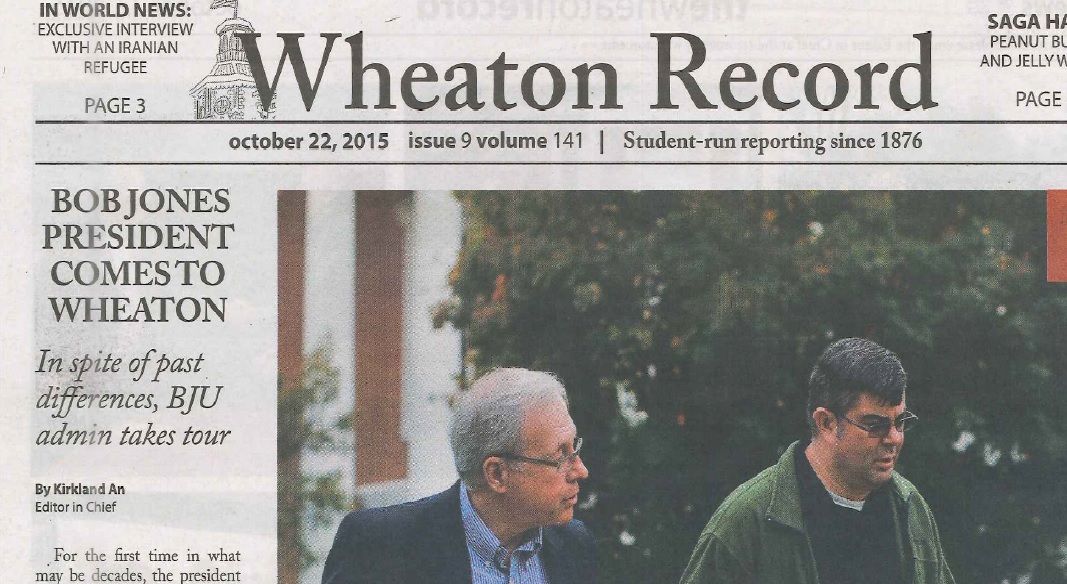
Maybe things have changed. President Steve Pettit of BJU recently visited Wheaton’s campus, a remarkable thaw in the deep freeze between the two schools. Now President Pettit is extending his support to Wheaton’s “embattled” leaders in this difficult time.

What does that mean?

Might it mean that President Pettit hopes Wheaton will move closer to its fundamentalist roots? At Bob Jones University, fundamentalism had often meant ruthless purges of dissenting faculty and administration. Since its founding in the 1920s, Bob Jones University has maintained a steady record of firing anyone who does not agree with the administration. As founder Bob Jones Sr. memorably expressed it in a chapel talk,

We are not going to pay anybody to ‘cuss’ us. We can get ‘cussin’ free from the outside. . . . We have never been a divided college. . . . We are of one mind in this school. We have not always had smooth sailing, but we have thrown the Jonah overboard. If we get a Jonah on this ship, and the ship doesn’t take him, we let the fish eat him! We throw him overboard. . . ‘United we stand, divided we fall.’ That is the reason that in this school we have no ‘griping.’ Gripers are not welcome here. If you are a dirty griper, you are not one of us. . . . God helping us, we are going to keep Bob Jones College a kingdom that isn’t divided and a house that stands together.

I’ve got no inside scoop here, but I can’t help but wonder: Does Wheaton’s recent faculty purge put it back on the “fundamentalist” side of this long-lived divide?

Fundamentalist U: The Original “Safe Space”

It’s not a new idea. In spite of what journalists and pundits might suggest, today’s push on college campuses for “safe spaces” has a century-long tradition. The schools I’m studying these days—conservative evangelical colleges, universities, and Bible institutes—have always promised to provide “safe spaces” for young people.

We’ve talked before about the ways the recent spate of college protests might best be understood as an “impulse to orthodoxy.” Sometimes the ferocity of student protests seems woefully out of proportion to the alleged offenses at elite schools such as Yale and Claremont McKenna College.

At Yale, for example, two faculty members were berated and hounded for their suggestions that some Halloween costumes might be acceptably offensive. And at Claremont McKenna, a top administrator was driven out for her worry that non-white students might have a legitimate reason to feel unwelcome on her campus.

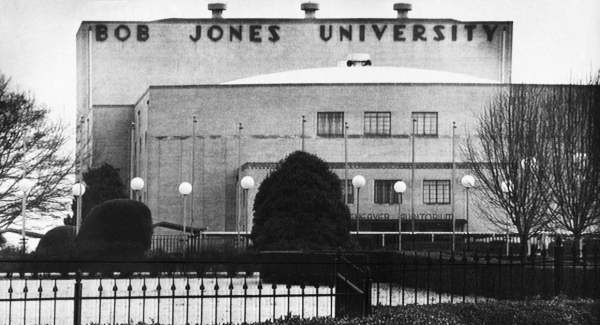
BJU BALMER

You’ll be safe here…

The moral outrage of students, however, makes perfect sense as a defense of a moral orthodoxy. As with any orthodoxy, deviation is not just disagreement. Orthodox thinking raises seemingly mild disagreement into existential threats. Those who veer in the smallest degree from orthodoxy must not only be ostracized. Their heterodox notions must be denounced in the most ferocious terms in order to emphasize one’s own continued loyalty.

Seen in terms of orthodoxy, talk of “safe spaces” makes perfect sense. In the orthodox mindset, challenging ideas raise the specter of unacceptable deviation. Young people must be protected from threatening ideas until they are well-enough schooled in orthodoxy to protect themselves.

Today’s protesters might not like the company, but the network of Protestant fundamentalist schools that emerged in the 1910s and 1920s made such “safe spaces” its raison d’etre.

In the 1920s, for example, President James M. Gray of Moody Bible Institute in Chicago told parents to send their fundamentalist children to his “safe space” for two years of Bible training before they went on to a traditional four-year college. Why? In his words,

It renders [a student] immune to the evolution and modernistic germs, while it enables him to examine them in the light of the Christian revelation as he could not have done before.

A few years later, school founder and evangelist extraordinaire Bob Jones promised parents a new sort of college, one that would offer a totalized “safe space.” In the June, 1928 edition of Bob Jones Magazine, Jones promised,

If you fathers and mothers who read this magazine have children to educate, and you wish them to attend a school which will protect their spiritual life, send them to the Bob Jones College. The fathers and mothers who place their sons and daughters in our institution can go to sleep at night with no haunting fear that some skeptical teacher will steal the faith of their precious children.

This tradition of fundamentalist “safe spaces” continues today. As young-earth creationist impresario Ken Ham argued last year in response to my questions,

We are burdened to help parents choose a college wisely that does not put stumbling blocks in their children’s way that could lead them to doubt and ultimately disbelieve the Scriptures.

If some ideas are indeed sacred, then young people do indeed need “safe spaces” in order to preserve their impulse to orthodoxy. For fundamentalists, it was easy to declare their schools “safe spaces,” since they wanted explicitly to protect young people from certain heterodox ideas.

It is much harder, of course, for non-fundamentalists to make the same point. Students who want “safe spaces” without acknowledging their impulse to orthodoxy don’t have the same explicit rationale. They want the results of fundamentalist higher education without being able to acknowledge their desire for it.

Power on Campus: Fundamentalists Have the Last Laugh

It doesn’t make a lot of sense. At places such as Yale, Claremont McKenna, and Missouri, presidents are resigning and faculty are trembling. Ham-fisted protesters are demanding an end to free speech. Halloween costumes have become a disguise for racial oppression. To regular joes and pundits alike, this burst of campus outrage can seem puzzling. But there is one group to whom this phenomenon would make perfect sense.

A brief review of the cases:

The episodes can tell us a good deal about the real levers of power on campus. Who doesn’t have power? Administrators charged with insensitivity toward systematic racism and oppression. They get the boot, and fast, if they seem to oppose racial inclusivism.

Who else doesn’t have power? Students who want bread-and-butter economic reforms of higher ed. Even when a million students protested for lower tuition and lower student debt, it didn’t generate the same feverish buzz as these recent racial protests. To my knowledge, no university president has resigned because his or her school is expensive.

Who else is out? Even protesters against racial insensitivity, if they try to use physical coercion. When that happened recently at Missouri, for instance, the offending bully resigned and even sympathetic leftist pundits agreed that the protesters weren’t “always-wise.”

Just as informative, these protests tell us who really has power on campus. Who has it? Football teams. Duh. But even those athletes are energized by a surprising fact.

The real power on campus these days comes from an ancient but complicated moral idea. We might call it “the impulse to orthodoxy.” It can be tricky to understand, especially since no one is talking about it in those terms. The impulse to orthodoxy includes a moral two-step: Not only must people behave in a moral way, but they must actively seek out and root out those who fail to understand the proper reasons for moral action.

How does this ancient idea work in today’s campus protests? The successful campus protests these days insist not only that school leaders fight racism. More telling, protesters are fired up by the idea that they are under a moral imperative to expose and exclude all those who do not adequately understand the nuances of systematic racism.

At Missouri, for example, system president Tim Wolfe eventually resigned due to a perceived lack of administrative action against repeated racial incidents. The protesters wanted more than new policies. They wanted Wolfe out. Why? Because Wolfe personally seemed to misunderstand or even belittle complaints about systematic racism. One student leader went on a much-publicized hunger strike until Wolfe was kicked out. The student, Jonathan Butler, explained that only the ouster of Wolfe would make the school “a better place.”

At Yale, too, the impulse to orthodoxy has caused some observers to scratch their heads. On one level, it seems like a slightly hysterical protest about a fairly reasonable request. Faculty masters Nicholas and Erika Christakis suggested that students might relax about Halloween costumes. So what’s the problem? Morally orthodox students could not stand Christakis’s suggestion that they simply “look away” from offensive outfits. For the orthodox, looking away from immorality is as bad or worse than the immorality itself.

A similarly insufficient zeal damned an administrator of the elite Claremont McKenna College in California. Dean of Students Mary Spellman wrote a sympathetic email to a student who complained about racial insensitivity. So what’s the problem? Spellman included a line about non-white students who “don’t fit our CMC mold.” To protesters, such language smacked of a hidden, intolerable insensitivity.

In all these cases, school leaders and faculty are under attack for two reasons. First, they are accused of displaying an inadequate understanding of and zealousness about racial inclusivity. The oft-confusing part, though, comes from the second reason. The impulse to orthodoxy demands that such inadequate agreement be tirelessly sought out and ruthlessly purged. It is not enough to apologize. Campus protesters feel free to use any coercion, stamp out any speech, if those things seem to promote immorality.

Today’s racial protesters will be surprised at the people who might understand them best: Protestant fundamentalists. As I’m finding out as I research my new book, the history of fundamentalist higher education is mostly the story of a similar impulse to orthodoxy. Beginning in the 1920s, it was not enough for fundamentalists simply to protest against secularization of the academy. It was not enough simply to disagree with the theological implications of evolution. Rather, for fundamentalists since the 1920s, it was necessary to demand that schools purge all such things. When that didn’t work, fundamentalists opened their own schools, places such as Wheaton College, Bob Jones University, and Bryan College.

Throughout their histories, fundamentalist colleges have taken drastic action to purge any hint of compromise. In 1961, for example, Wheaton scientist Russell Mixter had to offer elaborate apologies to those who thought he might have accepted mainstream evolutionary theory.

These days, similar drastic action is wracking the campus of Bryan College. Faculty who seem not to be sufficiently zealous in their embrace of a young earth are being shown the door.

Of course, the specific moral ideas are extremely different. At fundamentalist colleges, the dangerous trends were toward theological modernism and evolutionary science. At today’s elite mainstream colleges, the moral imperative demands the removal—root and branch—of those who don’t sufficiently act against systematic racism.

Yet the impulse remains the same. The moral imperative of orthodoxy requires more than just a certain set of ideas. It implies a tireless and ruthless dedication to root out all those who do not adequately understand or embody those ideas.

Required Reading: Gloege on MBI

It’s not just a metaphor, not just a handy way of speaking. According to Timothy Gloege, fundamentalism acts like a business because it was founded like a business. In his terrific new book Guaranteed Pure: The Moody Bible Institute, Business, and the Making of Modern Evangelicalism, Gloege digs into the history of America’s premier Bible Institute to uncover the reasons for these tight connections. Along the way, he tells us a lot about the history of evangelicalism and of evangelical higher education.Gloege Guaranteed Pure

As SAGLRROILYBYGTH are sick of hearing, I’m up to my ears in writing my new book about fundamentalist/evangelical higher education. And Guaranteed Pure is the best book on the subject I’ve read in a long time.

For those in the know about evangelicalism and evangelical education, the centrality of MBI doesn’t need explaining. Started in the 1880s by Bible evangelists and their corporate backers, MBI became a juggernaut of publishing, broadcasting, and education. By the mid-twentieth century, MBI loomed large among evangelicals as a brick-and-mortar institution, a solid headquarters for a fundamentalist movement that often ran on shoestrings and prayers. As Gloege puts it near the end of his story (pg. 227), “It is difficult to think of an interwar fundamentalist that did not have or attempt to establish some connection to MBI.”

For those who are unfamiliar with these histories, Gloege’s book would be a great place to start. He offers vivid and fully realized portraits of central personalities such as Reuben Torrey. He fleshes out the complicated relationship between different types of conservative evangelicals around the turn of the twentieth century, from California Pentecostals to Minneapolis Fundamentalists and everything in between.

No matter how well you know these connections, you’re sure to find something enlightening in Guaranteed Pure. For example, Gloege offers the best history I’ve read of the emergence of The Fundamentals, a twelve-volume series of books that is often seen as the first articulation of emerging fundamentalism.

As Gloege recounts, the big-business ethos that emerged in the end of the 1800s did more than just set the tone for the founding of Moody Bible Institute. Rather, leaders such as Henry Crowell of Quaker Oats applied the same emerging modern attitudes toward marketing and profits to MBI as he did to oatmeal. That didn’t mean Crowell was cynical or insincere. Rather, it merely helps us make sense of the sometimes-strange career of early fundamentalism.

For example, every attempt to define early fundamentalism clearly quickly runs up against seemingly insuperable problems. Historian Matthew Sutton, for instance, in his recent book American Apocalypse offered a compelling definition. The thing that set radical evangelicals apart from other religious traditions, Sutton argued, was their overweening concern with the coming apocalypse. In Sutton’s words, it was “fundamentalists’ anticipation of the soon-coming apocalypse [that] made them who they were” (pg. 3).

True enough, but we quickly run into problems. There were leading intellectuals such as J. Gresham Machen who explicitly didn’t fit that label, yet who were considered—even by themselves—to be the brains of the fundamentalist impulse. And there were leading fundamentalist schools such as Bryan University (later Bryan College) that considered and rejected a statement about the coming premillennial apocalypse in their all-important creed.

Professor Sutton knows these things, but by asserting a theological definition on a wide-ranging movement he was forced to trim some edges here and there.

Gloege offers a way out of this pickle. Instead of giving us a rigid definition of fundamentalism, Gloege instead defines it in action. As he puts it (pg. 3),

Fundamentalism is often described in terms of manifestos and theological propositions. Yet at MBI at least, the life force of the movement was its corporate evangelical framework, which operated at a more foundational level. It functioned as a set of unexamined first principles—as common sense. Once developed, these principles became for conservative evangelicalism what the rules of grammar are to a conversation: something used rather than analyzed.

How could Machen be a fundamentalist intellectual if he hemmed and hawed about the fundamentalist movement? How could Bryan University be a fundamentalist school if it eschewed fundamentalist end-of-the-world theology?

Easy. They could be fundamentalists if everyone knew they were. They could be fundamentalists if it seemed like common sense to include them.

Gloege’s priceless contribution in terms of pinning this sort of definitional jello to the wall is not the only major contribution of his book. For those of us interested in evangelical higher ed, Gloege’s business context makes some things clear in new ways.

For example, evangelical colleges are famously anxious about the public image of their students. Depending on the decade, students were not allowed to smoke, drink, dance, or attend plays or movies. Even when they were not at school. Why? Because students were not seen as consumers of evangelical education, they were seen as its product. They were its advertisements, its guarantors of purity.

As Gloege describes, in the 1910s MBI published a painstakingly detailed student guide. Every aspect of student life was regulated, theoretically at least. Why was this so important? In Gloege’s words (pg. 159),

the students and faculty were themselves a form of promotion for the institute. MBI served as a sort of test kitchen demonstrating the effectiveness and purity of its message. No longer conceptualized primarily as workers learning on the job, students were treated as products of the Bible Institute.

Of course, such big-business thinking permeated all sorts of institutions at the time, not just MBI or evangelical colleges. As historian Roger Geiger argues in his new history of American higher education, not only MBI but all institutions of higher education were undergoing a transformative triple revolution during this same period.

Indeed, Gloege could easily have expanded his argument beyond the walls of the MBI. As I’m arguing in my new book, too, there’s no better way to make sense of fundamentalism and evangelicalism in the twentieth century than by uncovering the history of its most important institutions.

Do I Need to See the Light?

Joel Carpenter is. Mark Noll is. George Marsden is. Ron Numbers is was. John Turner is. John Fea is. I’m not. Does it matter?

Many of the best academic historians of evangelicalism and fundamentalism grew up as part of an evangelical church. Indeed, among academic historians in general, since the 1960s it has been seen as a big plus to have a personal background with the group(s) we study.

It’s not universal. As far as I know, Matthew Sutton didn’t. Molly Worthen didn’t. Tanya Luhrmann didn’t. And if they did, it is not a big part of their public persona. In other words, they write as scholars of evangelical religion, not necessarily as evangelical scholars of evangelical religion.

This is more than just “PC” cliquishness. Historians are sobered and humbled by their own history. Though African American historian WEB DuBois clearly debunked the dominant but false histories of Reconstruction way back in the 1930s, white historians didn’t catch up until the 1960s.

With fundamentalism in particular, non-evangelical historians did a terrible job. Until the 1970s, mainstream historians told us that fundamentalism died after the Scopes Trial of 1925. It had done nothing of the sort, of course. A new generation of evangelical historians such as Ernest Sandeen and George Marsden knew it hadn’t, since they had grown up with it.

Having a background in the world of conservative evangelicalism gives historians an ear for the language and a feel for the connections between groups. When I was stumbling through my graduate work at Wisconsin, for example, my mentor Ron Numbers was able to point me toward super-rare creationist documents from the 1930s. How did he know about them? They were written by his grandfather!

That sort of connection is something we outsiders can never acquire.

As outsiders, though, we non-evangelical historians enjoy some benefits. For us, there are no pre-existing good guys or bad guys. We aren’t embarrassed by the rhetorical excesses of 1920s fundamentalists. They don’t have anything to do with us! We don’t feel a need to demonstrate how different such hellfire preachers are from our own intellectual roots. To us, it’s all archival material.

In short, evangelical historians will always have insights I lack. But they will also have hang-ups and assumptions I’m free from.

Recent discussions on this blog have pointed out the continuing importance of these questions. When I noted the recent visit of Bob Jones University President Steven Pettit to the scenic campus of Wheaton College, I was mostly interested in the turbulent historical relationship between the two schools. At least one commentator, however, accused me of trading in “guesswork and gossip.” I didn’t mean to suggest that BJU was somehow “moving toward neo-evangelicalism.” Many readers within the world of fundamentalism and evangelicalism have very strong feelings about such things. I don’t.

As I plow forward with my new book about conservative evangelical colleges and universities, I need to keep these issues in mind. I need to remind myself that I might be missing out on subtleties of tone or implication that are obvious to those raised within this tradition. I need to watch for connections that are not made explicit to outsiders, but are nevertheless glaringly obvious to those in the know.

Time to Bury the Fundamentalist Hatchet?

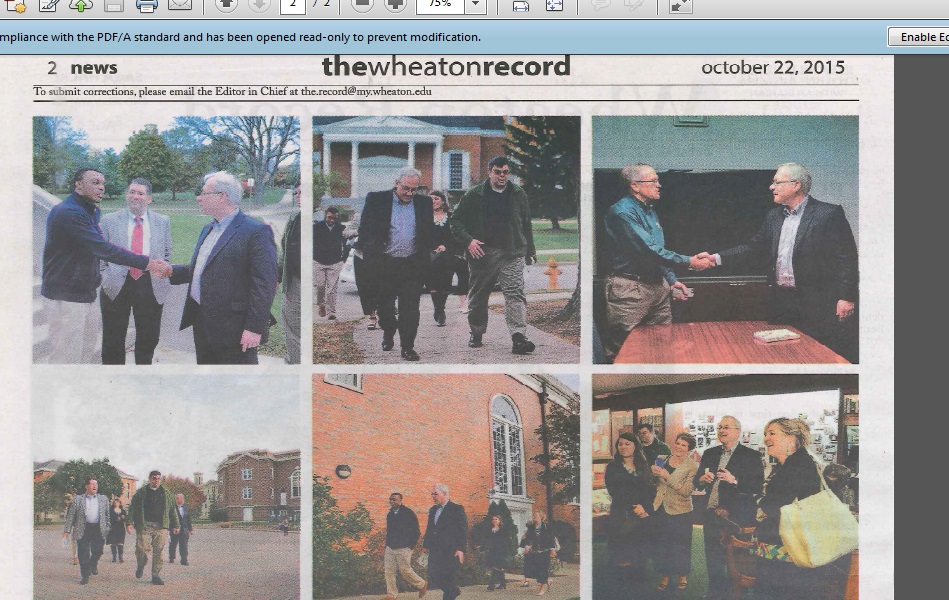
Maybe there’s hope for us all. In the world of evangelical higher education, the relationship between fundamentalist Bob Jones University and evangelical Wheaton College has always been a rocky one. According to a story in the Wheaton Record [sorry, not available online], last week BJU president Steve Pettit visited Wheaton’s campus, the first time a Jones leader has done so in a long time. There were smiles all around. Does this mean that the times they are a-changin?

Smiles, everyone, smiles...

Smiles, everyone, smiles…

For those who don’t know their history, last week’s visit may have seemed like no big deal. The leader of one evangelical college visited another evangelical college. What’s the big whoop? As I’m discovering in the research for my new book about the history of conservative evangelical higher education, this détente may signal an important shift in the worlds of fundamentalism and evangelicalism.

Since the beginning in the 1920s, leaders of the two schools fought viciously. BJU founder Bob Jones Sr. accused sitting Wheaton president J. Oliver Buswell of jealousy. Jones wrote,

Dr. Buswell and his field staff working under him were putting out propaganda everywhere that Bob Jones’ credits had no value and that we were misrepresenting facts when we told students that our graduates were admitted to leading graduate schools. . . . [Buswell is a] conceited, frustrated, ambitious, disappointed man.

Ouch. For his part, Buswell retorted that he had never said such things, had never been anything but friendly and helpful to Jones’s new school. What he had done, Buswell admitted, was protest against the sin-friendly policies at Bob Jones College. For those who don’t know their Wheaton history, it may come as a shock to find out that in the early days, Wheaton accused Bob Jones of not being fundamentalist enough. Wheaton’s President Buswell had critiqued Bob Jones’s new school in a review of a book of Jones’s sermons. The sermons themselves were first-rate, Buswell wrote.

But Dr. Jones, let me ask you a question or two. Your own educational program is reeking with theatricals and grand opera, which lead young people, as I know, and as you ought to know, into a worldly life of sin.

Double ouch.

Things never got much better from that point on. Bob Jones Jr., son of the founder and second president of Bob Jones University, told a story of his father’s traveling days. One time, Jones Sr. was on a train with some Wheaton students. One of the students, “trying to be very smart,” asked Jones how Bob Jones College could allow dramatic productions and still call itself fundamentalist. As Bob Jones Jr. explained,

Wheaton used to turn up their self-righteous noses at our drama, but they played inter-collegiate football, which we had had to give up at Bob Jones University because we found the people were betting on our games, littering our campus with whiskey bottles when they came out to see us play; and we found that inter-collegiate athletics were a definite blight to our spiritual lives.

By the 1970s, the relationship turned from one of frigid civility to outright hostility. In 1974, Bob Jones III officially changed the status of Wheaton in BJU’s internal coding system from “Friendly” to “Unfriendly.” Jones’s secretary explained the shift in an internal memo:

The above school or organization has been coded “F”; however, Dr. Bob III, has changed the code now to “U” to make our coding system more consistent. It has been a problem for some people because an organization or school would be coded “F” but we would treat them like “U” people.

From that point on, BJU officials would not even maintain their polite façade of cooperation with Wheaton officials. In 1977, an administrator from Wheaton wrote to Bob Jones III to ask for guidance in establishing a student drama program. He asked if Jones would offer some tips from its long experience with such programs. Through a secretary, Jones informed the Wheaton official, “because of the Neo-Orthodox position of Wheaton College, we are unable to give you the assistance you request.”

Pettit visits wheaton 2

No self-righteous noses here…

Given that protracted and ugly history, President Pettit’s visit to Wheaton’s campus seems revolutionary indeed.

Have things turned a corner? Does President Pettit’s visit really signal a thaw in this long evangelical cold war? Several signs point to yes.

First of all, Pettit is no Jones. For the first time in the history of BJU, the school is not led by a direct descendant of the founder. Maybe that gives Pettit a little more wiggle room to ignore family feuds.

Also, BJU is changing. It now claims accreditation as well as athletic teams. It has apologized for its history of racism.

Wheaton is changing, too. As did BJU in the 1970s and 1980s, Wheaton has tussled with the federal government. Just as BJU did in the 1980s, Wheaton insists that its religious beliefs must give it some leeway when it comes to federal rules.

If Wheaton sees itself pushed a little more out of the mainstream, and Bob Jones University pushes itself a little more toward that mainstream, they might just meet somewhere in the middle. There will always be some jealousy between these two giants of evangelical higher education, but it seems possible that the worst of the fundamentalist feud may have passed.