Can a College Be Christian?

After Ben Carson’s stupid and hateful comment that the USA should not have a Muslim president, Baylor theologian Roger Olson noted that we really could not have a Christian president, either. In my current work about evangelical colleges, I’m struggling to define what it meant to be Christian at school, too. It raises an ancient question: Can an other-worldly religion (successfully) run worldly institutions?

Olson noted that the only sincere evangelical to sit in the Oval Office in recent decades has been Jimmy Carter. And Carter, Olson argued, was a terrible president. Not by accident, either, but because he was an honest-to-goodness Christian. As Olson put it,

I am not cynical, but neither am I naïve. America is no longer a true democracy; it is run by corporations and the super-rich elite. Occasionally they don’t get their way, but, for the most part, they do. One reason they do not seem to is that they do not agree among themselves about everything. So, sometimes, a president, a senator, a congressman, has to choose between them in decision-making. But, in the end, the policy remains that “What’s good for business is good for America” even when what’s good for business is bad for the working poor (to say nothing of the destitute).

No, given how modern nation states work, I do not think a real Christian, a true disciple of Jesus Christ who seeks to put first the kingdom of God and God’s righteousness, can be president of the United States or any modern nation state.

The deeper question of belief and institutional necessity is one I’m wrestling with these days. As I write my new book about the history of evangelical higher education, I find myself struggling to offer a satisfactory definition of what it has meant to be a fundamentalist. It’s a question that has bedeviled historians (and fundamentalists) for a good long while, so I feel I’m in good company.

For good reasons, historians have insisted that we need a fairly narrow definition of fundamentalism. In his great book Revive Us Again, Joel Carpenter argued, “more generic usage obscures more than it illumines” (page 4). Carpenter was leery of commentators who slapped a “fundamentalist” label on any and all conservatives or conservative Protestants. As he argued,

Labelling movements, sects, and traditions such as the Pentecostals, Mennonites, Seventh-day Adventists, Missouri Synod Lutherans, Jehovah’s Witnesses, Churches of Christ, black Baptists, Mormons, Southern Baptists, and holiness Wesleyans as fundamentalists belittles their great diversity and violates their unique identities (4).

If we need a straightforward definition for those reasons, Matthew Sutton’s recent definition of fundamentalism as “radical apocalyptic evangelicalism” will do the trick. Certainly, fundamentalist theology was defined by its vision of end-times as well as by the centrality of those apocalyptic visions to the movement.

But such definitions don’t seem to match the ways fundamentalism has been defined in its leading institutions. At the colleges I’m studying—schools such as Wheaton College, Bob Jones University, Bryan College, Biola University, The King’s College, and similar schools—there’s more to the school than just theology.

When these schools called themselves “fundamentalist” (and they DID, even relatively liberal schools such as Wheaton), they meant more than theology. They meant more than just “radical apocalyptic evangelicalism.” They meant more than just “not-Mennonite-or-Pentecostal.”

Defining fundamentalism as it was used in fundamentalist institutions is a trickier issue than simply defining fundamentalist theology. By and large, when schools talked about themselves as “fundamentalist,” they meant that the professors and administration all signed on to fundamentalist theology. But they also meant that the students would have a vaguely conservative atmosphere in which to study. No smoking, no dancing, no etc. They also meant that students would be controlled and guided in their life choices. And they also meant that students would be more likely to socialize with similarly fundamentalist friends and future spouses.

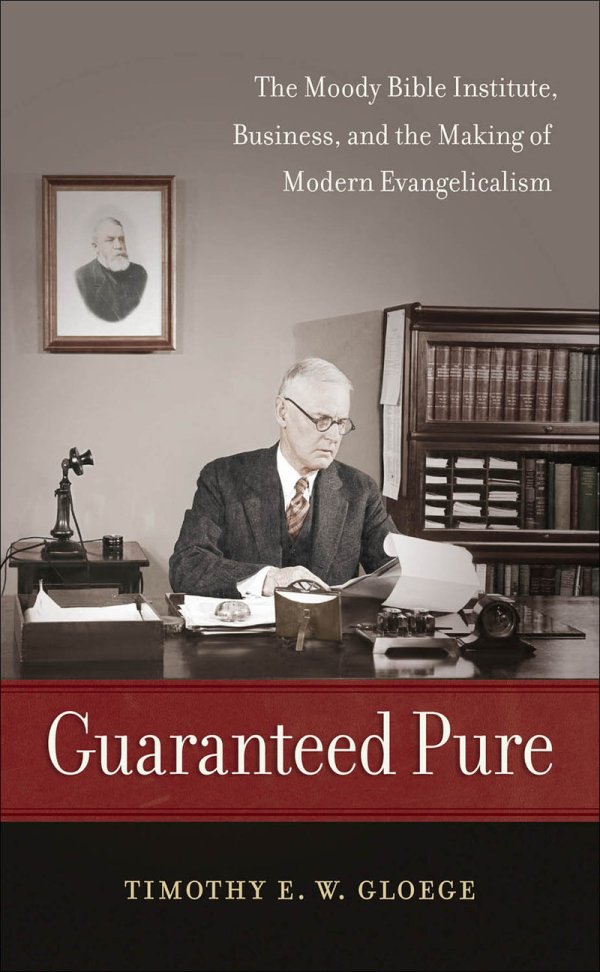
I’m not sure how to define that kind of fundamentalism. I like the way historian Timothy Gloege has done it in his new book about the Moody Bible Institute. Gloege focuses on what he calls the “corporate evangelical framework” that guided MBI since its founding in the 19th century.
What did fundamentalism mean in Chicago?

What did fundamentalism mean in Chicago?

As Gloege argues, at a school like MBI, fundamentalism was more than a set of “manifestos and theological propositions.” Rather, it worked as a set of “unexamined first principles—as common sense.” Fundamentalism, Gloege writes, is better understood as a certain “grammar” than as a list of religious beliefs.

That kind of definition seems closer to the ways it was used in the schools I’m studying.

Roger E. Olson argues that it will be impossible for any sincere evangelical Christian to be president. There are simply too many worldly factors that violate the otherworldly morality of Christianity. Similarly, evangelical colleges have not defined themselves merely along theological lines. They couldn’t. Instead, they have defined what it has meant to be a “fundamentalist” based on a range of factors. Of course, they care about student religious belief. But they also care about student fashions, patriotism, diets, and social lives. And such things were usually considered a central part of making a school authentically “fundamentalist.”

Can a college be Christian? In the sense that Roger E. Olson is asking, I guess not. Just as every president has to violate evangelical morality, so every institution of higher education has to consider a range of non-religious factors in order to survive.
The Kids Aren’t Alright…with Transgender

My Fellow Progressives: What if time isn’t on our side? We tend to think that each new generation will get cooler, more tolerant, more progressive. But what about those stubborn conservative kids who consistently disprove our assumptions? A new student protest in Missouri shows once again that young people are not somehow automatically progressive.

Who is the future here?

Who is the future here?

Academic historians learnt this lesson the hard way. Beginning in the 1930s, liberal academics assumed that the fundamentalists of the 1920s had melted away in the glare of modernity. In their liberal imaginations, historians such as Norman Furniss explained that fundamentalism had died away, a vestige of an older, stupider time.

For many liberal historians, the fact that they no longer saw fundamentalists on their campuses or in the headlines of their newspapers proved their case. It backed up their assumptions that the modern world would squeeze out people who embraced a decidedly old-fashioned way of reading the Bible.

Of course, fundamentalists hadn’t died away after the 1920s. Beginning in the later 1950s, evangelists such as Billy Graham brought the fundamentalist tradition back to America’s headlines and center stage. It took a new generation of historians, many of them raised in fundamentalist families, to explain what had happened. Writers such as Ernest Sandeen, George Marsden, and Joel Carpenter demonstrated the continuing strength and vitality of American fundamentalism.

Protestant fundamentalism, these historians showed, was a thoroughly modern phenomenon. In the face of progressive assumptions that people would naturally become more secular and more morally sophisticated, lots of Americans actually became more religious and more firmly moored in Biblical morality.

Progressives today share a similar short-sighted demographic hangover. Many of us, even those of us too young to have lived through the social movements of the 1960s, remember the vibe of youth power. As Andrew Hartman has argued so eloquently in his new book, the ideas of the 1960s fueled much of the later culture war vitriol. In the face of much evidence to the contrary, it was often assumed by 1960s culture warriors (and their successors) that youth was somehow naturally progressive.

Not your father's GOP...

Not your father’s GOP…

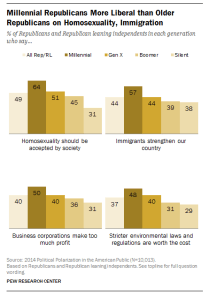
To be fair, my fellow progressives aren’t entirely wrong. We tend to assume that young people will be less anti-gay, less racist, less conservative, and we can point to good poll data to back it up. As Pew reported last year,

in addition to the [Millennial] generation’s Democratic tendency, Millennials who identify with the GOP are also less conservative than Republicans in other generations: Among the roughly one-third of Millennials who affiliate with or lean Republican, just 31% have a mix of political values that are right-of-center, while about half (51%) take a mix of liberal and conservative positions and 18% have consistently or mostly liberal views. Among all Republicans and Republican leaners, 53% have conservative views; in the two oldest generations, Silents and Boomers, about two-thirds are consistently or mostly conservative.

But there’s a big problem embedded in these kids of poll data. Though many young people tend toward more liberal views, there are still enormous percentages of people who buck the trend. The recent protest in Missouri can illustrate the ways young people can and will embrace socially conservative ideas.

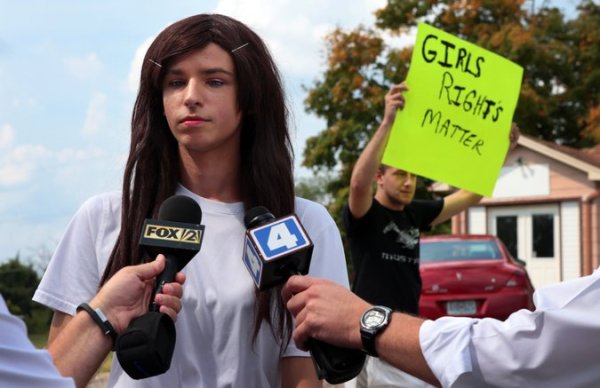
In that case, a transgender high-school senior, Lila Perry, had been allowed to use the girls’ bathroom. Students walked out in protest. The students and their parents, supported by outside groups such as the Alliance Defending Freedom, tend to consider Lila to be still male, in spite of her identification as female. As one activist parent put it, his daughters encountered an “intact male” in the locker room.

In spite of what we might expect, we don’t see in this case progressive young people fighting against the bureaucracy. Instead, the bureaucracy in this case moved quickly to establish a policy protecting the rights of transgender students. In reply, conservative students insisted on the rights of “real” girls to be protected from such students.

If history is any guide, as more young people become progressive, the conservative holdouts will become more firmly attached to their conservative principles. Conservative young people will become more likely to take action. Protests like the one at Hillsboro High School will become more common.

Can Fundamentalist Colleges Survive?

We might be on the cusp of another academic revolution. Over the centuries, what people have expected out of college has changed time and time again. Every time it changes, schools have to adapt or die. With the announced closure of Clearwater Christian College, we see another small conservative evangelical liberal-arts college bite the dust. This seems to be more than just bad management or weak organization.  It looks like yet another shift in what people mean when they say “college.” Can small, private liberal-arts schools keep up?

Going the way of the dodo?

Going the way of the dodo?

Clearwater’s students aren’t the only conservative evangelicals scrambling to find a new home. Tennessee Temple also recently announced its closure. Northland has shut its doors. And outside the bounds of fundamentalist higher education, Sweet Briar College in Virginia caused a fuss when it announced its demise, even with a plump $85 million endowment.

Colleges have always opened and closed and these recent happenings might not mark a trend. But it seems likely that the stern financial logic of mainstream higher education is also compelling at conservative religious schools such as Clearwater, Northland, and Tennessee Temple.

Scott Jaschik of Inside Higher Ed thinks that small liberal arts colleges in rural areas face an existential threat. Students just don’t want to live thirty miles from a Starbucks. They want to go to schools that prepare them for specific careers such as business, health care, or education. The idea of sequestering oneself for four years to contemplate the big ideas in extended bucolic adolescence seems less and less attractive to young people.

Higher education as a whole is not under siege. Some institutions, after all, are thriving. My beloved Binghamton University sees ever-increasing student applications. We can’t build dorms fast enough. In the realm of fundamentalist colleges, too, big enterprises such as Liberty University and Cedarville University are gobbling up students and dollars by the millions.

Historian Roger Geiger’s terrific new book gives us a big-picture perspective on these seismic changes. The higher-education system as we know it is not very old. Only by about 1940 did the system we know come to dominate. Before that time, a slew of higher-ed institutions competed for students and dollars. “Technical institutes,” “normal schools,” “academies,” “female institutes,” and a mess of other schools attracted students. Between the 1890s (ish) and the 1940s, these institutions offered students an array of educational services. In general, they did not insist on completion of high school as an entrance requirement. Some of them did not offer bachelor’s degrees, but rather some sort of training, perhaps accompanied by a certificate of some sort.

By the end of World War II, however, our modern higher-ed system had jelled into place. Schools that did not adapt simply closed down. Students no longer wanted to attend an “institute” that did not offer a bachelor’s degree. Schools that still offered high-school-level work were not seen as real colleges.

That revolution took place in fits and starts over fifty years. Perhaps the wave of school closings we see today reflects the culmination of another fifty-year revolution. Beginning in the 1960s—the decade, not incidentally, in which Tennessee Temple, Northland, and Clearwater were all founded—many traditional notions of “college” began to break down. The idea that a school would serve an authoritative role in dictating students’ educational and lifestyle experiences experienced a thumping defeat. Students themselves came to expect a greater role in running their own educations and their own personal lives.

The idea of college came to tilt more in the direction of student-directed career preparation and away from the notion of a moral and personal formation imposed by authoritative deans and professors. Of course, as Professor Geiger points out, both things have always been part of higher education, but the balance has often shifted. Starting in the 1960s, the college ideal has begun to shift away from one that would favor a small, controlled, rural setting. Instead, in order to be a successful college, schools had to provide a dizzying array of possible professional training and they had to do so in a bustling environment.

Again, it is not that colleges haven’t always offered professional training, but rather that the primary goal of a lot of students and their families seems to have been shifting over the past fifty years. Not enough people still want to pay for college as an incubatory experience. Schools such as Clearwater, Northland, and Tennessee Temple that started as the educational vision of a specific charismatic religious leader can no longer attract a critical mass of students. Young people and their families just aren’t as interested in imbibing one particular formative idea; they want a buffet of career-training and personality-forming possibilities.

Loving your Homosexual Neighbor: Hell or Rapture?

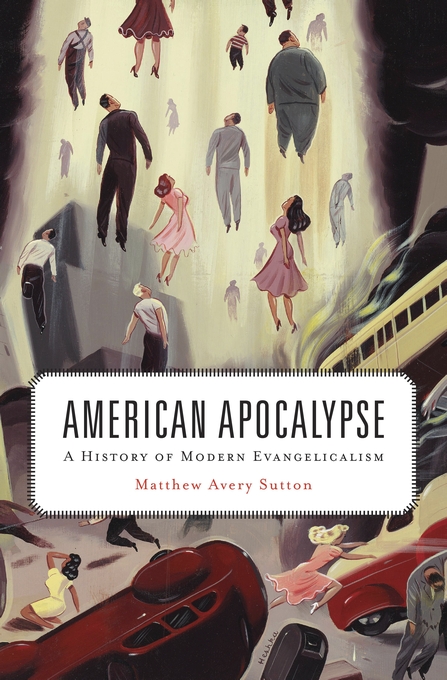
Why are our culture wars so durable? In his new book American Apocalypse, historian Matthew A. Sutton argues that the answer lies in the end of the world. But more evidence keeps piling up that there is a different answer, a better explanation. For some conservative religious people, the culture wars are about more than just winning elections or improving schools. The fight for America’s soul is nothing less than a battle to save people from eternal torment.

I Love You but It's the End of the World...?

I Love You but It’s the End of the World…?

Professor Sutton’s book is really terrific. He examines the history of what he calls “radical evangelical” belief as it emerged in the twentieth century. Unlike most historians, he doesn’t ignore important aspects of the radical evangelical family, such as Pentecostals and African Americans. The part that I’m struggling with is Prof. Sutton’s definition of radical evangelicalism. At its heart, Sutton says, American fundamentalism can be understood as

radical apocalyptic evangelicalism. . . . fundamentalists’ anticipation of the soon-coming apocalypse made them who they were.

In other words, Professor Sutton thinks that the heart and soul of fundamentalist belief comes from beliefs about the imminent and cataclysmic apocalypse. Our American culture wars are so virulent, he explains in chapter four, because fundamentalists and other radical evangelicals believe that they will be judged soon by a righteous God. They must fight against immoral movies, immoral booze, and other immoral trends because such things are part of the seductive Satanic lure of the end days.

Certainly, ideas of Bible prophecy and apocalypse are central to fundamentalist belief. But are they really as central as Professor Sutton contends? Are there other ideas that are even more important?

We stumbled across an evangelical warning this morning that raises the question again. In the pages of World Magazine, conservative evangelical Andree Seu Peterson explains why fundamentalists can’t relax. She does not mention the coming apocalypse. To Peterson’s way of thinking, there is a different reason why fundamentalists must continue fighting culture wars.

Peterson warns that things have changed fast in the last ten years. For conservatives, the question of homosexuality used to be cut-and-dried. Ten years ago, she says,

homosexuality was fringy and dangerous and you were dead set against it. Today homosexuality is the guy grilling steaks next door, waving to you over the picket fence, calling, “How about those Phillies!”

Conservatives might be tempted to accept homosexuals as part of God’s family. Christians might be tempted to love their neighbors, as Christ commanded. In secular terms, we might say, conservatives might feel pressure to adapt their beliefs to changing cultural norms.

Such thinking is dangerous, Peterson warns. Not because the world will be ending soon, but for a more basic reason, a reason more fundamental to fundamentalists. If you really care about your neighbor, Peterson explains,

If you want to talk about “love your neighbor,” need we mention that neighbors don’t let neighbors go to hell? … What good is all the good will you reap now when in the future Mr. Steak Griller next door curses you from across the chasm for your quiet complicity in his damnation?

When it comes to culture wars, this I-Love-You-but-You’re-Going-to-Hell logic is the equivalent of a perpetual motion machine. Whenever religious conservatives might be tempted to relax, to get along, to go with the flow, they can remind themselves of the eternal dangers of compromise. Even when it seems as if the kind thing to do, the loving thing to do, is to meet our neighbors in the middle, such apparent kindness, to some religious conservative, is a terrible mistake.

For some conservative religious people, culture-war issues are not just about accepting our neighbors’ “alternate lifestyles.” If they were, then we could all just get along. As Peterson tells the tale, we could all just smile and wave at one another, then go our separate ways. But for some conservatives, the culture wars have eternal stakes. If they don’t win, they will be guilty of sending people straight to hell.

Is that related to the apocalypse? Sure. Sorta. If Jesus will be returning sometime soon, suddenly and without warning, then these questions of damnation become even more urgent. But it is the damnation itself that is the crucial idea.

For those of us outside the circle of conservative evangelical belief, it can be difficult to understand the vital importance of the idea of damnation to evangelicals. For those of us who don’t believe in a real and terrifying hell, it can be easy to miss the enormous implications of such an idea. The apocalypse is only scary because of the threat of eternal damnation. The culture wars are only worth fighting if we can save some souls from such torment. Missionary work is only crucial because we need to spread the light as far as we can. Indeed, rather than defining fundamentalism as the radical evangelical belief in the apocalypse, we might better define fundamentalism as the radical evangelical belief in a real, eternal, and difficult-to-avoid Hell.

Certainly everyone interested in the nature of fundamentalism and culture wars should read Professor Sutton’s book. And maybe someone can explain to me what I’m missing. It seems to me, though, that the central idea to understanding what makes fundamentalists unique is hell, not just the coming apocalypse.

Bush at Liberty: “Seven Thousand Acres of Shared Conviction”

He didn’t have much choice. These days, any front-runner for the Republican Party presidential nomination seems required to make a speech at Liberty University. But when Jeb Bush gave his commencement address at Liberty this week, he did not have to emphasize one of American fundamentalism’s deepest-held convictions. But he did.

As the sophisticated and good-looking regular readers of I Love You but You’re Going to Hell (SAGLRROILYBYGTH) are well aware, I’m working on a book about the history of schools like Liberty. And among the issues I’m struggling with are the distinctive traditions that set off fundamentalist and evangelical colleges from other religious schools.

Certainly, as Roger Geiger outlined in his definitive new history of American higher ed, in the United States every religious group has scrambled to establish its own colleges and universities. It has become a way for religious groups to confirm their legitimacy and American-ness.

So, for Catholics, and Lutherans, and Methodists, and Nazarenes; for Muslims, and Jews, and Mennonites…every religious group has its own network of schools that train its young people in its distinctive faith traditions as well as in professional skills and the liberal arts.

Unlike most of those other traditions, however, the network of fundamentalist colleges that developed since the 1920s has seen itself not only as a haven from a hostile wider American culture, but more specifically as an enclave of true Americanism. Unlike most other conservative Protestants, even, fundamentalists have a fairly unique proprietary feeling about the US of A.

Back in the day, brainy Catholic kids might have gone to Georgetown or Boston College, either to become priests or just become educated Catholics. And they did so in order to study in an intellectual refuge from the relentless anti-Catholicism that permeated mainstream culture for so long.

Since the 1920s, brainy evangelicals and fundamentalists have gone to Bob Jones or Wheaton or Liberty, either to become pastors or just to become educated evangelicals. But these evangelical schools were not seen as islands set off from a hostile mainstream America. Or, to be more specific, they were seen as islands, but only in the sense that they represented a last resort of true Americanism. Such schools often talked about their need to preserve a slice of the true America.

Since the 1950s, those schools that aligned with the more moderate “evangelical” wing of fundamentalism tended to downplay this tradition. Schools who clung to the “fundamentalist” label—such as Bob Jones, Pensacola Christian College, the late Tennessee Temple University, and Liberty—often doubled down on their sense of usurped Americanism.

When Governor Bush made his Liberty speech, he made the usual paeans to religious freedom and religious liberty. But he also went the extra rhetorical mile to endorse Liberty’s sense of itself as an outpost of true Americanism. As Bush put it,

How strange, in our own time, to hear Christianity spoken of as some sort of backward and oppressive force. Outside these seven thousand acres of shared conviction, it’s a depressing fact that when some people think of Christianity and of Judeo-Christian values, they think of something static, narrow, and outdated. We can take this as unfair criticism, as it typically is, or we can take it as further challenge to show in our lives the most dynamic, inclusive, and joyful message that ever came into the world.

“Seven thousand acres of shared conviction”! A phrase surely calculated to warm the hearts of Liberty’s leaders. The implication, clearly, is that Liberty represents an enclave of purity, a reservation for America’s Moral Majority, which promises to preserve American values until that day that they can be spread back into the rest of America’s 2,432,000,000 acres.

The Coming Split at Conservative Colleges

Is your school for bigots?…Or for apostates? That’s the choice that conservative school leaders have faced throughout the twentieth century. And it is coming round again. As the US Supreme Court hears arguments about same-sex marriage in Obergefell v. Hodges, conservative religious schools and colleges should gear up for another divisive debate over equality and theology. If SCOTUS rules in favor of same-sex marriage, will evangelical and fundamentalist schools face a return to the hot tempers of 1971?

More bad news for conservatives...

More bad news for conservatives…

The case itself is a combination of cases from four states. In short, SCOTUS is trying to decide two issues: whether or not the Constitution requires states to allow same-sex marriage; and whether or not same-sex marriages in one state must be recognized by all states.

Conservative Christians have made their feelings clear. Among the hundreds of friend-of-the-court letters are one from the US Conference of Catholic Bishops and one from Governor Mike Huckabee’s advocacy group.

At the Christian Post this morning, we see nervous worries about the possible fall-out for conservative Christian schools. Justice Samuel Alito made an explicit reference to the precedent on every conservative’s mind: the Bob Jones University case. Back in 1970, the leaders of BJU refused to allow racial integration on their South Carolina campus. As a result, the Internal Revenue Service took away BJU’s tax-exempt status. By 1983, BJU had taken its case all the way to the Supreme Court. It lost.

Alito asked Solicitor General Donald Verrilli if the precedent would apply:

JUSTICE ALITO:  Well, in the Bob Jones case, the Court held that a college was not entitled to tax­exempt status if it opposed interracial marriage or interracial dating.  So would the same apply to a university or a college if it opposed same­ sex marriage?

GENERAL VERRILLI:  You know, I ­­ I don’t think I can answer that question without knowing more specifics, but it’s certainly going to be an issue. ­ I don’t deny that.  I don’t deny that, Justice Alito.  It is ­­ it is going to be an issue.

Conservatives worry that this might mean the end of religious schools and colleges. Should religious schools refuse to provide housing for same-sex married couples, the federal government could revoke their tax-exempt status. For most schools, that would mean a sudden and impossibly steep tax bill. When schools are already teetering on the brink of financial insolvency, it could certainly mean the end.

But that’s not all. If history is any guide, Christian school leaders should also prepare for another kind of crisis. Back in the 1970s, fundamentalist schools endured a vicious and destructive split over Bob Jones University’s position on racial segregation.

As I’ve been finding in the archives this past year, even schools that agreed with BJU’s fundamentalist theology sometimes disagreed with BJU’s position against interracial marriage. At the Moody Bible Institute, for example, leaders decided to cancel an invitation to pro-BJU fundamentalist leader John R. Rice. The decision subjected MBI’s leaders to withering criticism from fundamentalists nationwide.

Reporters and observers have noted that SCOTUS’s decision in this case might raise questions for leaders of conservative religious schools. Those leaders should also consider another likely outcome. If SCOTUS’s decision puts pressure on school leaders to recognize same-sex marriages, it might lead to another in a long line of bitter fights among schools.

Will conservative evangelicals and Catholics submit to the law of the land? Or will they resist, citing a higher authority? Will conservative schools lose their conservative credibility if they give in to the new cultural ethos?

It’s not going to be an easy choice. If I were the president of a conservative Christian school or college, I’d get myself ready for a lose-lose decision. Do I want my school to be labeled a bunch of fanatical bigots? Or would I prefer to join the ranks of schools that don’t take their religions very seriously?

More Proof that Conservatives Won’t Win

Every once in a while a progressive pundit will howl a warning about the fundamentalist conspiracy. Watch out, we’re told, rich and sinister conservatives are organizing a vast army to mount an electoral coup of this great land. We see more proof today that these warnings are more fantasy than reality. The nature of conservative religion tends to work against any insuperable fundamentalist coalition.

The end is near...

The end is near…

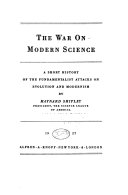
From the beginnings of America’s modern culture wars, fundamentalist-watchers have warned of the coming fundamentalist storm. In his 1927 book, The War on Modern Science, Maynard Shipley warned that the fundamentalist “forces of obscurantism” threatened to overthrow real learning. As Shipley put it,

The armies of ignorance are being organized, literally by the millions, for a combined political assault on modern science.

Ever since, science writers have warned of this impending threat. Isaac Asimov, for instance, warned in 1981 of the “threat of creationism.” Such unified anti-scientists, Asimov believed, had made great strides toward setting up “the full groundwork . . . for legally enforced ignorance and totalitarian thought control.”

Yikes.

But these Cassandresque warnings tell us more about Asimov and Shipley than they do about real fundamentalists. In practice, the nature of conservative Protestantism in America has usually made any sort of collective action impossible.

In the 1950s, to cite only the most obvious historical example, fundamentalists split from evangelicals over the question of Billy Graham’s crusades. Fundamentalists refused to embrace Graham’s wildly successful outreach, in spite of Graham’s conservative theology. Why? Because Graham also worked with liberal and progressive Protestants. Instead of making a pragmatic decision to support Graham as the least-bad option, fundamentalists instead clung to a purer separatism.

Conservatives' best hope?  Or biggest threat?

Conservatives’ best hope? Or biggest threat?

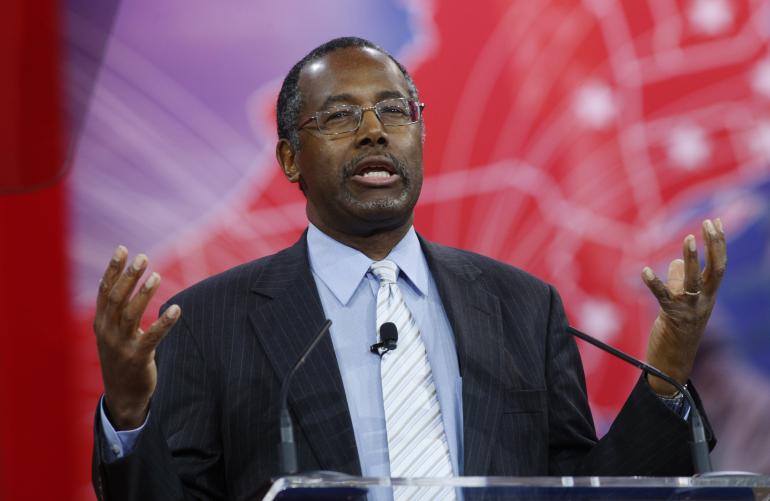
These days, too, conservative Protestants often refuse to win. Most recently, we see a protest among conservative Calvinist Southern Baptist pastors against conservative Seventh-day Adventist Ben Carson. As we’ve noted in these pages, Dr. Carson is a profoundly conservative religious thinker. And he seems like the best hope of religious conservatives in the 2016 elections.

Yet as Christianity Today reports, Southern Baptist conservatives have dis-invited Carson from their annual meeting. Carson’s Seventh-day Adventist beliefs, some SBC pastors noted, put him at odds with Baptist orthodoxy.

They’re right, of course. Seventh-day Adventism holds to many peculiar theological doctrines, including those in the prophetic writings of Ellen G. White.

But the refusal of Calvinist Southern Baptists to welcome a prominent Seventh-day Adventist helps demonstrate why Isaac Asimov and Maynard Shipley could have relaxed. Among conservative Protestants, suspicion and even virulent hatred of theological near-neighbors have long roots. The notion that a fundamentalist army—a creationist army—is organizing in conservative colleges and meetings just doesn’t match reality.

Could conservatives win? Sure. But intra-conservative clashes like this show how difficult it is for conservative Protestants to act together.

Racist Fundamentalists…It’s Complicated

Sometimes the archives can make things too complicated. White fundamentalists have always been accused of racism—a charge they’ve vehemently denied. But what do we do when an African American fundamentalist agrees with the racism of his white fellow fundamentalists?

First, a quick historical sketch: Since the 1920s, as I argued in my first book, fundamentalism got tangled up with ideas about Southern Pride. Conservative religion has often become part and parcel of a broader cultural conservatism, one that included support for racial segregation and white supremacy.

Racist? Or just fundamentalist?

Racist? Or just fundamentalist?

By the 1970s, leading white fundamentalists became some of the most public supporters of racial segregation. Most famously, Bob Jones University steadfastly clung to its whites-only policy long after many white Southerners and white fundamentalists had grudgingly moved on. Some historians, such as Randall Balmer, have insisted that white racism among fundamentalists was the real root of the so-called New Christian Right that emerged in the 1970s.

I disagree. There is no doubt that white fundamentalism—especially in the South—has long had close ties to white racism. There is more to the story, however, than quick condemnations of conservative religion as a front for white supremacy.

In my recent work at the archive of the Moody Bible Institute, I came across a document that reminds us how messy history is. In 1970, the leaders of Moody dis-invited prominent fundamentalist John R. Rice from Moody’s big annual Founder’s Week event. Why? Because Rice had come out in support of the segregationist policies of Bob Jones University.

As President William Culbertson informed members of the Moody community,

Moody Bible Institute has for 85 years welcomed young people of all races and nationalities to its tuition-free training in the Bible. Through times of changing social mores the policy has always been to emphasize the salvation from God by which all men who believe are made one in Christ. We have sought, and do seek, to apply the spiritual principles set forth in the Word of God to the practical problems of our culture. We believe that there is nothing in the Bible that forbids interracial relationships. We are absolutely opposed to injustice and exploitation. We are dedicated to the proposition that we are debtors to all men.

Moody Bible Institute, Culbertson told anyone who would listen, still agreed wholeheartedly with John R. Rice’s fundamentalist theology. Moody refused to compromise with those who would modernize the Bible or water down fundamentalist religion. But Moody could not be seen as part of a racist, segregationist movement.

Naturally, John R. Rice and his supporters blasted this decision. More evidence, one Rice supporter charged, that Moody had

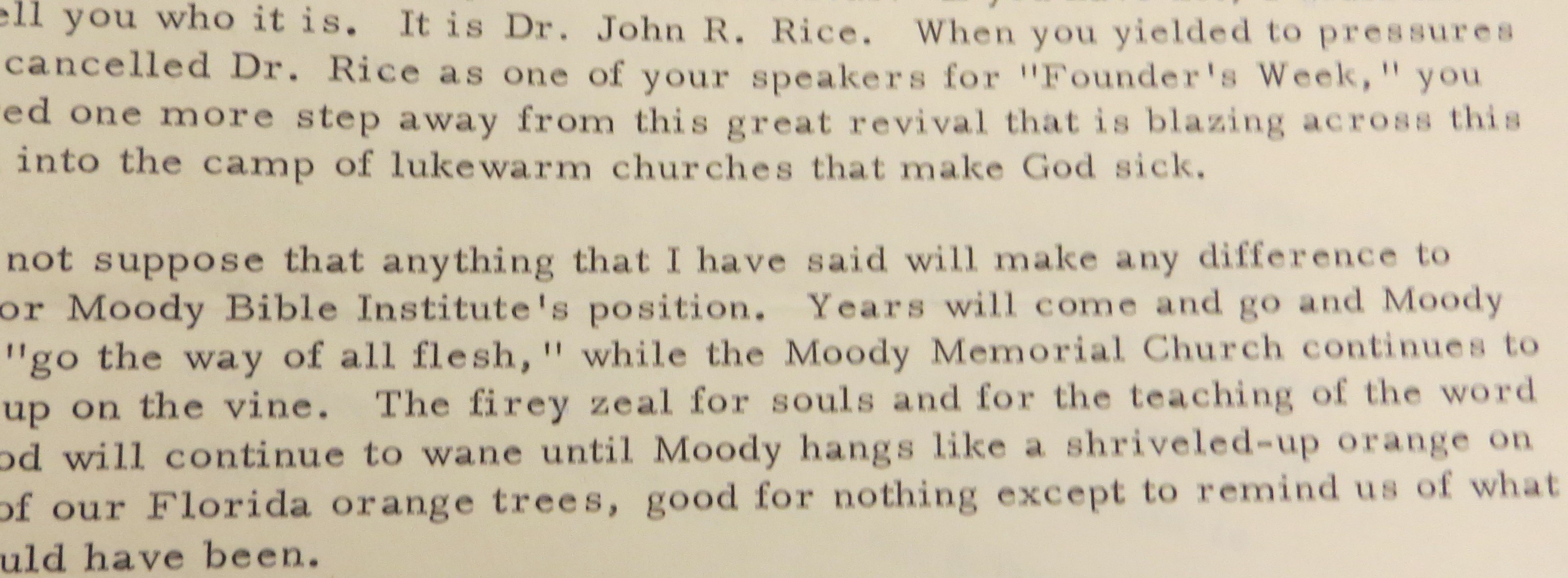
moved one more step away from the great revival that is blazing across this land into the camp of lukewarm churches that make God sick. I do not suppose that anything that I have said will make any difference to you or Moody Bible Institute’s position. Years will come and go and Moody will ‘go the way of all flesh,’ while the Moody Memorial Church continues to dry-up on the vine.

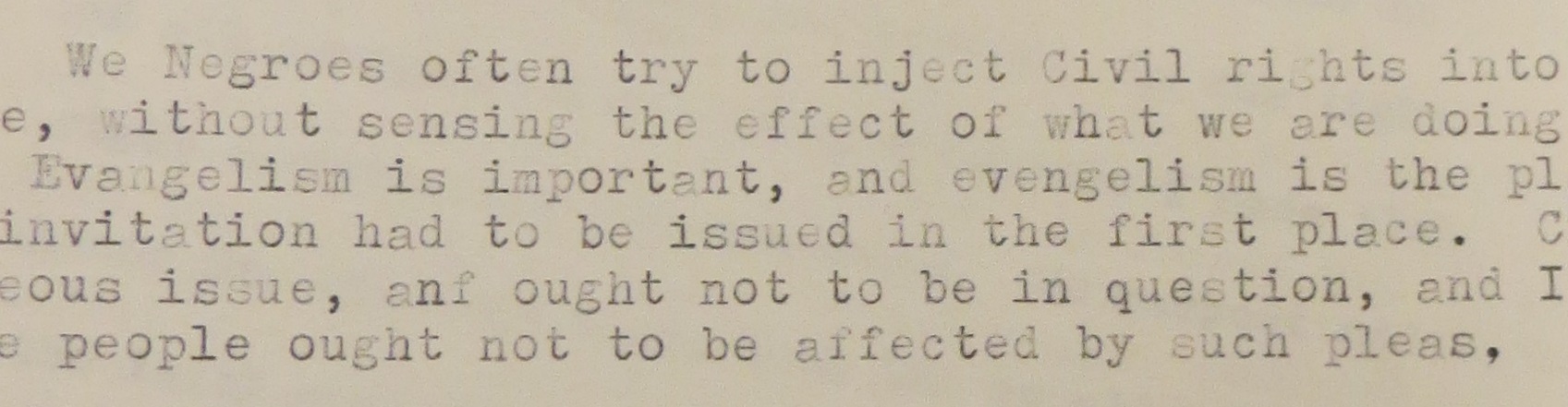
Among the fat stack of angry letters supporting John R. Rice, one stands out. It came from William H. Dinkins of Selma, Alabama. Dinkins was an African American fundamentalist and, in his words, someone who “stand[s] with Dr. Rice for fundamentalism and the old-time religion and all that goes with it.” Too often, Dinkins charged, “We Negroes [sic] . . . try to inject Civil Rights into every circumstance, without sensing the effect of what we are doing.” When it comes to religion and the Word of God, Dinkins continued, “Civil Rights is an extraneous issue, and ought not to be in question, and I feel that responsible people ought not to be effected by such pleas.”

The view from Selma, 1971

The view from Selma, 1971

Dinkins’s letter raises difficult questions about race and religion. First of all, we wonder if this letter was legitimate. Could someone have faked it in order to create an impression of biracial support for racial segregation? If not, we wonder how common such sentiments have been. As historian Jeffrey Moran has argued, white fundamentalists have long tended to ignore their African American co-religionists, at best. And, as John Dittmer and others have showed, in the early days of the Civil Rights movement many African American leaders in the Deep South supported segregation, at least temporarily and pragmatically.

In the early 1970s, was there really any support for racial segregation among African American conservatives? Did fundamentalism trump race?

Schools of Social(ist) Work

America’s colleges and universities have become left-wing indoctrination factories. At least, that has long been a favorite conservative complaint. Today in the pages of the Weekly Standard we see another example of the “closing of the campus mind.” Why do so many conservatives seem to take such intense pleasure in the supposed leftist domination of American higher education?

Bearded weirdos...

Bearded weirdos…

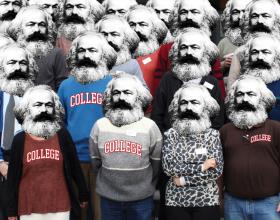
In today’s Weekly Standard, Devorah Goldman shares her horror story from Hunter College’s School of Social Work. As a conservative, Ms. Goldman was asked politely not to participate in class discussions. She had to hold her tongue as she read anti-conservative textbooks. She had to hold her tongue as professors imposed racist, ideologically slanted ideas on her classes.

Goldman’s story of abysmally closed-minded universities seems to resonate among conservative intellectuals. As we’ve seen recently, some conservative academics have interpreted recent events as the death knell for conservative thinkers at mainstream universities. Elsewhere, critics have wondered if higher education as a whole has been irredeemably lost to true open-mindedness.

As a non-conservative who writes a lot about conservatism and education, these complaints raise two difficult questions for me.

  1. First, why do so many conservative thinkers seem to emphasize the leftism of colleges? That is, why do conservatives seem to take such bitter joy from an exaggerated assumption that they are no longer welcome in higher ed?
  2. Second, why don’t these conservative intellectuals recognize the long tradition of conservative laments about higher ed? In every case, it seems as if conservatives think higher ed has just recently switched over to the dark side.

Let’s take the second of these questions first. As Ms. Goldman’s story shows, every conservative complaint implies that the closing of the college mind is a recent phenomenon. But conservatives (and liberals, for that matter) have been protesting against the goings-on at mainstream colleges for almost a century.

In 1987, for example, Chicago’s Allan Bloom scored a surprise best-seller with his Closing of the American Mind. Bloom worried back then that universities had become nothing but indoctrination factories.

Even earlier, conservative godfather William F. Buckley Jr. began his long career with an indictment of the culture at his alma mater. In God and Man at Yale (1951), Buckley blasted the sneering secularism and lax morality of his school.

Some people think Buckley invented modern conservatism, but the same themes go way back. In the 1930s, for instance, Congressman Hamilton Fish excoriated leading schools as subversive breeding grounds for communists. Fish named names. Columbia, New York University, City College of New York, the University of Chicago, Wisconsin, Penn, and North Carolina, Fish charged in 1935, had become “honeycombed with Socialists, near Communists and Communists.” As I note in my new book, Fish and other anti-communist conservatives in the 1930s assumed that leading colleges had recently been hopelessly lost to left-wing collegiate cabals.

Back in the 1920s, too, religious conservatives warned each other that recent events had caused the loss of mainstream colleges. As I’m digging into in my current research, fundamentalists such as Bob Jones Sr. convinced themselves and anyone who would listen that 1920s trends had moved college into the enemy camp. Too many schools, Jones charged, attacked the faith of conservative students. As Jones put it,

I had just about as lief send a child to school in hell as to put him in one of those institutions. We are spending millions of dollars on education in this country, but if that is the kind of education we are going to have we would be better off without our universities and colleges.

In every case, each generation of conservative activist has implied that these lamentable changes were recent occurrences. In every case, conservatives suggest that higher ed “these days” has been taken over by left-wingers. If this is such a long and strong tradition among conservatives, why do they keep insisting it is a recent phenomenon?

And why do conservatives seem so eager to emphasize their own victimhood? I don’t doubt Goldman’s story. I can imagine that some teachers and some schools really do insist on an ideological conformity. But there are plenty of other schools that do not. Why don’t conservatives spend more mental energy trumpeting their own dominance of some forms of higher education?

Recently, for example, conservative academic extraordinaire Robert George praised his school’s new academic-freedom rule. Why don’t more conservative intellectuals join Professor George in proclaiming the continuing academic clout of conservative or conservative-friendly ideas?

Some might think that conservatism only dominates less-prestigious schools. Ms. Goldman, for example, would likely have had a very different experience at a less prominent school of social work. But as the case of Professor George makes clear, leading schools such as Chicago and Princeton have long served as congenial homes for conservative intellectuals.

Instead of tearing their hair and gnashing their teeth due to the supposed loss of higher education, why don’t conservative intellectuals celebrate their continuing influence at many leading colleges?

University Apocalypse

Are conservative religious academics forced these days to live “deeply closeted” lives? Have elite universities become so hostile to conservative religious thought that openly acknowledging their religion would be career suicide for academics? In the aftermath of the recent debate over gay rights and religious freedom in Indiana, one elite academic shares his worries in the pages of The American Conservative.

We have to ask: Are things really so dire for conservative academics?

Private?  or Closeted?

Private? or Closeted?

First, though, some context. Readers may remember Jonathan Zimmerman’s (liberal) plea to include more conservatives on campus. And leading schools such as Colorado University have adopted programs to bring conservative thinking to liberal colleges. Both conservatives and non-conservatives agree: Good universities need to recruit actively among a wide diversity of intellectual types.

New voices say it’s not happening.

Crunchy conservative Rod Dreher recently shared his conversation on these issues with an anonymous professor at an elite law school. This professor worried that the “overculture” had reacted with frightening intellectual totalitarianism to the recent Indiana case. At leading colleges, “Prof. Kingsfield” warned, religious conservatives are no longer welcome.

“A college professor who is already tenured is probably safe,” Dreher tells us, summing up “Kingsfield’s” story.

Those who aren’t tenured, are in danger. Those who are believed to be religious, or at least religious in ways the legal overculture believes constitutes bigotry, will likely never be hired. For example, the professor said, he was privy to the debate within a faculty hiring meeting in which the candidacy of a liberal Christian was discussed. Though the candidate appeared in every sense to be quite liberal in her views, the fact that she was an open Christian prompted discussion as to whether or not the university would be hiring a “fundamentalist.”

“Kingsfield” also argues that conservative schools will likely face increasing pressure from accrediting bodies. He cites the recent experience of Gordon College. In that case, a re-articulation of a long-standing school policy against sexual activity among students—including homosexual students—created a firestorm of controversy.

Rod Dreher included as a follow-up several emails from academics claiming to have been discriminated against in higher ed.

Do you buy it?

There are a few caveats we need to keep in mind. First, Professor “Kingsfield” seems to be talking about trends at elite colleges. I’ve been told many times by the sophisticated and good-looking regular readers of I Love You but You’re Going to Hell (SAGLRROILYBYGTH) that their experiences in non-elite colleges have been very different. One correspondent, for instance, told me that his colleagues in a large second-tier state school explicitly taught their students to teach in a conservative religious way.

Also, we need to remember that we’re only talking about one conservative tradition here. Generally, non-religious conservatives have had a very easy time fitting into the culture at elite universities. Folks such as the late Milton Friedman, surely, have not faced any sort of career danger for their conservative ideas.

In my experience, my fellow progressive academic folks really do often combine a shocking ignorance of conservative religious culture with a casual contempt for conservative religious ideas. One of the reasons I started this blog, in fact, was due to the fact that so many of my fellow progressives seemed utterly hostile to and uninformed about American conservatism.

On the other hand, my beloved medium-sized public university seems fairly welcoming to religious conservatives. Perhaps because I talk too much about conservatism and fundamentalism, more than one of my faculty colleagues have shared their religious beliefs and background. They don’t trumpet their beliefs, but they don’t hide them either.

My colleagues keep their beliefs private. That’s not the same thing as keeping them “deeply closeted,” though. Are things really so bad for conservative religious academics?