Christians CAN Think

Just because someone is a Christian, he or she is not therefore incapable of reasonable thought. That’s the argument recently from Provost Stanton Jones of Wheaton College. But is this true everywhere? Or only in the hallowed halls of Wheaton itself?

Jones was responding to a hatchet job from University of Pennsylvania English Professor Peter Conn. As we noted at the time, Conn accused Wheaton and other evangelical colleges of scamming their way into intellectual respectability. No school that demanded a faculty statement of faith, Conn argued, should be eligible for federal student aid. It was an intellectual and constitutional outrage.

In the discussion in these pages, commenters mostly took Conn to task for closedmindedness. Provost Jones takes a different approach. Not only are Wheaton faculty free to think and research, Jones writes, but they are actually freer than most faculty at non-religious schools. And their work will ultimately be more productive than that of their unfortunate colleagues at those schools.

Those researchers who fit in with the “contemporary intellectual tides,” Jones argues, might feel very free indeed at non-religious colleges. But for those who dissent, the “free” academic environment feels deadeningly constricting. A Bible-believing Christian professor, for example, might not feel entirely comfortable in a rigorously pluralist university like mine. “When we hire colleagues away from nonreligious institutions,” Jones asserts,

we often hear they feel intellectually and academically free here for the first time in their professional careers, because they are finally in a place where they can teach from and explore the connections between their intellectual disciplines and their religious convictions.

That’s not all. Jones uses the tools of postmodern academic life to undermine Conn’s attack. If “truth” is something we can only put in ironic quotation marks, we will be severely limited in our search for it. As Jones puts it,

Purely skeptical and unfettered inquiry is likely to simply chase itself in circles. Disciplined, rigorous, and self-critical inquiry grounded in a thoughtful understanding of one’s particularities can contribute to a vigorous and diverse intellectual marketplace.

Christian academics at schools such as Wheaton, Jones writes, are freer and more productive than their fettered colleagues at secular schools.

We should note, Jones only defends the rigor of academic work at his own school, Wheaton College. Conn’s attack was a broad-brushed condemnation of conservative Protestant colleges in general. Jones does not insist that other evangelical colleges offer conducive research homes for top-notch academics. I can’t help but wonder if this is mere oversight, or an unwillingness to vouch for the academic chops of evangelical higher education in general. Seems like Provost Jones is confident of the high-caliber intellectual firepower at Wheaton, but maybe not so sure of the strength of other evangelical schools.


Close Down Religious Colleges!

Can someone learn to examine ideas critically at a religious college?  To reason and think deliberately and without coerced conclusions?  And if not, should those schools receive federal tax-funded support?  Peter Conn of the University of Pennsylvania says no.

In a recent commentary in the Chronicle of Higher Education, Professor Conn calls attention to the way religious schools receive accreditation.  The problem, Conn believes, is that accrediting bodies scrupulously avoid judging the religious content of some colleges.  As a result, religious schools such as Wheaton and Bryan receive regional accreditation.  Their students are then eligible for federal financial aid.

There lies the problem, according to Conn.  Schools such as Bryan and Wheaton require their faculties to sign statements of belief.  At such colleges, Conn argues, “the primacy of reason has been abandoned by the deliberate and repeated choices of both its administration and its faculty.”

The problem is not that “religious fundamentalists” convene colleges. The “scandal,” Conn writes, is that accrediting bodies legitimize such anti-intellectual organizations. Further, once such schools are accredited, tax dollars go to support their students.

I hate to speak so harshly, but Conn’s argument seems pigeon-headed to me. I’m not religious; I don’t work at a religious college. But my research has centered on the ways conservative Protestant schools have worked to construct a sub-cultural identity as “evangelicals” or “fundamentalists.” And unless I’m missing some nuance of Conn’s essay, he seems to have very little idea what he’s talking about.

In my 1920s book, I looked at the ways the first generation of self-labeled fundamentalists founded and operated schools such as Bob Jones University and Dallas Theological Seminary. In my current research, I’m looking more broadly at the twentieth-century history of evangelical higher education.

To suggest that such schools ought not be accredited due to mandatory faculty creeds seems ridiculous.  After all, as a faculty member at a large public university, I have to sign a loyalty oath.  Does that make me unfit to teach young minds?  Does that make my research anti-intellectual, bound by previous ideological commitments?

More profoundly, the notion that people who agree to a religious creed cannot conduct rigorous research seems a woeful misunderstanding of the nature of religious belief.  In particular, it demonstrates a shocking ignorance of the history of religious colleges in the US.

I know some readers feel more strongly about the pernicious nature of fundamentalism.  Does anyone agree with Conn’s conclusion?  He writes,

The retrograde battle that religious fundamentalists are waging against science has become a melancholy fact of our contemporary cultural life. Legislators around the country conspire to find academic room for the oxymoronic charade called “creation science.” According to Rep. Paul Broun, a Georgia Republican who sits on the House science committee, evolution is a lie “straight from the pit of hell.” By effectively endorsing such blinkered sentiments through its accreditation process, American higher education is betraying itself, and providing aid and comfort to those who would replace reason with theology.


Conservatives and Campus Rape

No one defends rape.  But these days conservative intellectuals often defend students accused of rape.  Why?  What is “conservative” about defending accused rapists?  And what does it have to with higher education?

This is a different question than a similar one we’ve asked lately.  At some conservative religious colleges, we’ve seen a debate over the relationship between theology and sexual assault.  I’ve asked if religion might deter some students from booze-fueled assault.  I’ve also wondered if the top-down authoritarian culture of many fundamentalist schools might encourage assault.

In this discussion, however, we see secular conservatives complaining about the process by which colleges handle accusations of assault.

For instance, columnist George Will attracted a firestorm of controversy when he suggested that assault victims win extra privileges on college campuses.  Liberal-dominated campuses, Will accused, were learning that “when they make victimhood a coveted status that confers privileges, victims proliferate.”

Other commentators also take the system to task.  Legal scholar David Bernstein worried that the bar for proving guilt had been lowered to dangerous levels.  At some universities, Bernstein commented, any touching that did not have explicit approval could count as rape or assault.  By that measure, Bernstein argued provocatively, only prostitutes and their clients were safe from accusations of rape.

Peter Berkowitz, too, demanded a revision of campus assault rules.  In a case from Swarthmore College that attracted a great deal of attention, Berkowitz insisted that the accused rapist did not get a fair hearing.  Too many “elite” schools, Berkowitz argued,

convene kangaroo courts to adjudicate accusations of grave crimes that should properly be left to the police and government prosecutors. Although they cannot sentence students to jail time — the cavalier manner in which these proceedings treat evidence would never pass muster in the criminal justice system — the campus bureaucracies nevertheless impose penalties capable of upending students’ lives.

None of these writers condones sexual assault. Their gripe is with the process by which those assaults are handled. Too often, being accused equals being condemned. Too often, campus committees do not respect the American traditions of being innocent until proven guilty. Each of these writers warns that a rush to convict—even with the best intentions of protecting the innocent—risks trampling the rights of the accused.

But there’s also a deeper rumbling in these essays that points to an important element of conservative thinking. In each case, by attacking campus procedures, these conservative writers condemn the leftist-dominated culture of higher education as a whole.

Peter Berkowitz, for example, located this discussion within a broader problem. Elite schools, Berkowitz wrote, have struggled with

the hollowing out of the curriculum, the aggressive transmission of a uniformly progressive ideology, the promulgation of speech codes, and the violation of due process in campus disciplinary procedures.

And George Will blamed “academia’s progressivism” for its current sorry state. “Academia,” Will concluded, “is making itself ludicrous.” But left-leaning professors and administrators brought it on themselves, Will believes. Colleges have asked for ridiculous rules and short-sighted policies, Will said, “by asking for progressivism.”

There is something more going on here than just procedural complaints. Conservatives are not only complaining about the rights of accused students. Rather, these arguments about sexual assault are part of a longer conservative tradition of fretting about university leftism. For these conservative writers, recent cases of sexual assault serve as yet another example of college radicals gone wrong.


Conservative College Cheapskates

Cheap college for all!  That’s the call of the conservative American Legislative Exchange Council (ALEC).  ALEC members will consider a proposal to mandate public university education for under $10,000.  So why is this a “conservative” idea?

The conservative group’s annual meeting agenda just came out.  Members will be asked to consider several model bills about education, including two that support expansion of charter schools.  No surprise there.  Many free-market conservatives, way back to the 1950s work of free-market guru Milton Friedman, have wanted to reform education by introducing market principles.

ALEC's Get-Together

ALEC’s Get-Together

But I’m puzzled by the higher-ed model bill.  ALEC proposes the “Affordable Baccalaureate Degree Act,” a model bill that will require public universities to offer cheaper college educations.  In the words of the proposed bill,

The Affordable Baccalaureate Degree Act would require all public four-year universities to offer bachelor’s degrees costing no more than $10,000, total, for four years of tuition, fees, and books.  The Act would require that ten percent of all public, four-year university degrees awarded reach this price-point within four years of passage of this act.

To achieve this price-point, universities would be instructed to capitalize on the opportunities and efficiencies provided by (1) web-based technology and (2) competency-based programs.

Simple enough.  There has been oodles of talk lately about the problem of burgeoning student debt.  This proposal would at least introduce a new way to talk about the price and value of college education.

I don’t know the history of ALEC’s model bill, but it looks to be modeled on a similar bill in Texas.  Two years ago, Texas Governor Rick Perry—a decidedly and self-consciously “conservative” politician—introduced a similar affordable-college law.

But here’s my question: What is “conservative” about this proposal?  I know there are conservatives and then there are conservatives, but ALEC has traditionally been a champion, in its words, of “Limited Government, Free Markets, [and] Federalism.”

On first glance, it isn’t clear how this college model bill would limit government or help free markets.  Isn’t the price of college education part of a free market?  Wouldn’t a government imposition of a price cap increase the role of government and decrease the fluidity of the free market?

Here’s my hunch: The key to understanding the “conservative” elements of these bills lies in two important words, “efficiencies” and “competency.”  As I argue in my upcoming book about the history of conservative activism in education, conservatives have long looked skeptically at the way higher education has been run.  Just as conservatives have often insisted that teachers’ unions exert an unhealthy stranglehold on K-12 schooling, they have also often insisted that higher education has been taken over by sclerotic bureaucracies and leftist ideologues.

By forcing colleges and universities to offer credit for “competencies,” free-market conservatives might hope to shatter the grip of college bureaucracies.  Too often, conservatives might argue, college rules have insisted that students spend a certain amount of time in seats, parroting back academic drivel instead of learning real skills.  If students can demonstrate competency in life skills—running a business, maybe, or opening a charter school—those “competencies” should get college credit.

Similarly, by promoting “efficiencies” in higher education, free-market conservatives might hope to force lazy and pampered college faculty to use new technology to deliver information and skills more quickly and cheaply.  Since public universities are funded at least in part by government money, forcing them to run more quickly and cheaply could be seen as crucial part of conservatives’ desire to slim down big government.

That’s my guess, in any case.  To those who know their higher-education history, though, it is surprising to hear cheap public education promoted as a “conservative” cause.  During the late 1960s and early 1970s, after all, accessibility and affordability were hallmarks of leftist activism in higher education.

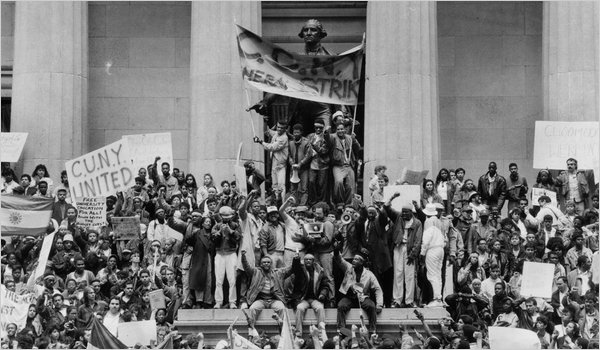
Perhaps the best example of this is the history of City University of New York.  During the 1920s and 1930s, CUNY, especially City College of New York, was known as the “Ivy League of the Proletariat.”  Top students crowded into CCNY, especially Jewish students excluded from Ivy League colleges.  It was an elite institution, admitting only the most qualified students.  Back then, it was also free.  If you could get in, you could go.

Do these CUNY tuition protesters look "conservative" to you?

Do these CUNY tuition protesters look “conservative” to you?

In the late 1960s, student activism forced a change in admissions policy.  To fight elitism and cultural prejudice, leftist activists pushed through an open admission policy.  Back then, it was leftist student radicals who called for cheap college for all.

Does ALEC’s model bill signal a shift?  Is it now a “conservative” cause to limit the cost of public higher education?


Kicking Christians Out of College

Does being an evangelical Christian automatically make one an anti-gay bigot? If so, can tolerant universities still allow such groups among their students? Those are the tricky questions highlighted in a recent New York Times article about evangelical culture and higher education. As the NYT story noted, this clash between pluralist campuses and “exclusivist” religious groups seems like a tough nut to crack.

But is it fair to assume that all evangelical students are bigots? That opposition to gay marriage pushes students beyond the bounds of polite society? To put it in the most provocative terms: Are evangelical student clubs being ousted because they are seen—sometimes unfairly—as being anti-gay?

The story opens with an update from Bowdoin College in Maine. At that elite liberal-arts school, the tiny evangelical student club has been cut off from official university support. Why? Because, like many evangelical student groups, the Bowdoin group insisted that leaders must be Christians themselves. This led to what the NYT article called a “collision between religious freedom and antidiscrimination policies.” At Bowdoin, as at many other schools, leadership at university-sponsored clubs must be open to all students, regardless of race, religion, or sexual identity.

The official question in the Bowdoin case is not about homosexuality or same-sex marriage. But it would be easy for a casual reader to miss that. The article mentions other schools in which evangelical students have gotten into trouble for anti-gay activity. At Vanderbilt, for instance, one Christian fraternity kicked out a gay member. Indeed, it was precisely that anti-gay activism that led Vanderbilt to force student groups to sign antidiscrimination pledges.

But Bowdoin’s student group does not seem particularly fervent about issues of homosexuality or same-sex marriage. At least according the article, the evangelical club at Bowdoin does not have a single party line about the morality of gay marriage. It’s hard to see a group as anti-same-sex marriage if some of its members support same-sex marriage.

Some studies have suggested that the faculty leaders at universities tilt decidedly against evangelical students. One 2007 study of university faculty concluded that evangelicals were “the only religious group about which a majority of non-Evangelical faculty have negative feelings.” And, as Rice sociologist Elaine Howard Ecklund found, faculty at elite schools often have a very skewed notion of evangelical belief. It does not seem like a stretch to think that these faculty prejudices might tip university policy.

For their part, evangelical intellectuals have struggled long and hard to prove that their opposition to gay marriage and, in some cases, to homosexual sex does not make them bigots. Perhaps the most vocal pundit on the issue, Ryan T. Anderson, insisted that conservatives had legitimate reasons for opposing gay marriage. But too often the other side wouldn’t listen. “Marriage re-definers,” Anderson complained in 2013,

don’t tend to say what many opponents have said, that this is a difficult question on which reasonable people of goodwill can disagree. No, they’ve said anyone who disagrees with them is the equivalent of a racist. They’ve sent a clear message: If you stand up for marriage, we will, with the help of our friends in the media, demonize and marginalize you.

Don’t get me wrong: I am personally fervently in support of same sex marriage rights. I’m opposed to locking anyone out of access to influence because of their sexual identity, religion, race, or other causes. But it seems as if universities would do well to uncouple these issues of club leadership, religious belief, and homosexual rights.

Could a student club demand religious beliefs of its leaders, while still welcoming gay and lesbian students to become leaders? Is it fair for universities to assume that evangelical belief automatically implies anti-homosexual attitudes?


Required Reading: Faces of Fundamentalism

When I first saw notice for Jona Frank’s book I worried it was another callow safari-style tour of fundamentalism in America.  I worried that the photographer hoped to shock and titillate non-fundamentalists with photographs from a bizarre subculture.  While Right: Portraits from the Evangelical Ivy League does include some elements of that cultural-tourist mindset, overall Frank offers a rich collection of portraits that are well worth exploring.

The book is a collection of portraits of the students at the new Patrick Henry College.  The students at PHC usually come from conservative religious homeschooling families.  The raison d’etre of the school, after all, is to get conservative kids into influential positions in politics and culture.  When I first saw promo photographs from the book, it looked to me as if Frank hoped to emphasize the distinctive subcultural elements of these students.  Many of the students appear awkward and over-dressed.  Some look distinctly overstuffed and uptight, as if they are surprised to find themselves in twenty-first century America.

Juli, whose career goal is to be a homeschooling mom.

Juli, whose career goal is to be a homeschooling mom.

After spending some time with the book, I feel Frank deserves more credit.  She wrestles explicitly with these issues in her conclusion.  As she writes, the “assuredness” of PHC students “confuses me.”  As she put it,

I had vague notions that I would marry and have a family when I was twenty-two, but both were far off.  What I wanted was exploration, travel, stories, youth hostels and road trips, part-time jobs and film school.  Before commencement I yearned for freedom.  This is part of being young in American, or so I believed until I went to Patrick Henry.

It has to be a lot of pressure to have a daily conversation with yourself about how you will impact the world.  In some ways, it’s the summer of ’69 at PHC, and they experiencing their own counterculture.  Of course, they are not ripping off their shirts and taking LSD.  It’s much quieter, but it’s not less complex.  The world is a complicated place.  It’s at odds with the homes they grew up in, and they are holding fast to the ideals of a life they believe is right.

In this passage and elsewhere, Frank demonstrates her awareness of her own limited perspective.  Just because we make certain assumptions about what “college” is supposed to be like, we must not impose those assumptions on everyone.  This is true whether students attend a button-down fundamentalist school like Patrick Henry or whether students are working two jobs while taking classes at a local community-college campus.

For those of us trying to understand conservative thinking and practice in education, Frank’s book also contains valuable samples of student work and wonderfully lengthy interviews with students.  One student sample, by “Grace M.,” reported on David Aikman’s biography of George W. Bush.  As this student reported dutifully, as “Dubya” matured,

It became obvious that his faith and religious convictions were a pleasant aroma to Americans.

Maybe not the best prose, but no worse than much of the student work from the non-fundamentalist schools in which I’ve worked.

Some of the students sound as if they are simply parroting the party line.  Jeremiah, for example, related his understanding of the purpose of PHC.  The school’s mission, he told Frank, included

Impacting government, impacting the media, impacting Hollywood, the culture, the arts. . . . Now our heaviest focus is on government, but the long-term goal is to impact the media, the arts, television, and the movies.

To my ears, this sounds like the sort of indoctrination I’d fear at a fundamentalist school.  Teachers say something, and students repeat it.  But, to be fair, when I listen to many of my undergraduate students here at a highly selective pluralist public university, they often also sound as if they are just repeating back what they’ve been told.

And we see some evidence that PHC dives deeper into true intellectual diversity than do many secular schools.  Another student, Juli, explained why they read so many non-Christian and even anti-Christian writers.  Such writers as Nietzsche, Juli explained

May be absolutely wrong, but they are not foolish, so we can’t just mock them.

How many students at pluralist universities would say the same thing about writers they disagree with?  How many students even read the work of conservative intellectuals as part of their training?  As former New York mayor Michael Bloomberg recently accused, have too many mainstream colleges turned into liberal indoctrination mills?  Have fundamentalist schools like PHC become more intellectually diverse than mainstream colleges?

To be sure, Frank’s book also contains glimpses of more disturbing tendencies at PHC.  One student accused the leadership of being “Draconian, totalitarian, in regard to students and faculty.”  And Frank includes an image of a repressive-sounding “Bride’s Guide.”  Young women are offered the following tidbit of complementarian advice: “Be a Woman Who Is Willing to Give Up All your Dreams.”

To outsiders like me, that sounds shockingly sexist.  To her credit, Frank includes this sort of depressing anti-feminism alongside photographs of an engagement party in which the women seem joyful and wholly at peace with their complementarian commitments.  Frank seems aware that the “Bride’s Guides” might fulfill my stereotypes of harsh fundamentalist impositions, but she also seems aware that the students at PHC often confound my stereotypes by embracing such rules freely and healthily.

Of course, a book can only be so long, but I wish that Frank had explored the theme of institutional growing pains more deeply.  She notes the generational divide at work here.  Many of these students came from families who see themselves as homeschooling pioneers.  But in being part of the first decade of life at PHC, these students also take a role as pioneers.  As I explored in my 1920s book and plan to treat at more length in my upcoming higher-ed book, fundamentalist universities are similar to other organizations in many ways.  The first generation, under the direct leadership of a charismatic founder, has a unique set of challenges and problems.  PHC still lingers in that first phase of development.  It seems to me that Frank could have taken more time to explore that tension.

She might have looked at the history of evangelical higher ed, in which each successive generation has opened a new school meant to be a “fundamentalist Harvard.”  In the 1920s, it was Bob Jones University.  In 1970, it was Liberty University.  How does PHC echo those experiences?  How is it unique?  Frank seems disappointingly uninterested in those questions, or unaware of them.

Instead, Frank seems to play along with the school’s claim to be part of something new, a new “evangelical Ivy League.”  Why, when she is careful to hold the school’s other assumptions at arm’s length, does Frank simply accept this kind of description?  After all, a school founded in the past five years can’t fairly be compared to the Ivy League.  Those institutions have a unique place in elite circles.  No student from the real Ivy League would say that no one knows about their college, as one of the PHC students complained about PHC.  Though PHC’s students might have ambitions of taking a fast track to elite positions, the school itself is more bluster than reality at this point.  To accept the founder’s (and students’) claim that PHC represents the very best of evangelical higher education is to make a woeful misapprehension of the state of American evangelical culture.

Such quibbles should not deter readers from getting their hands on a copy of Frank’s book.  For those interested in exploring the world of conservative education, Right will be well worth your time.


 

Bloomberg Bashes College Liberal Orthodoxy

It’s not news when conservative intellectuals complain about liberal orthodoxy at America’s colleges.  But recently former New York Mayor Michael Bloomberg told Harvard’s commencement audience that colleges needed to include more conservative voices.

The conservative intellectual world has long been aghast at the purported liberal bias of American higher education.  After all, it was in many ways William F. Buckley Jr.’s enfant-terrible critique of Yale that launched the post-war conservative fusion movement.  More recently, as we’ve noted in these pages, conservatives in Colorado managed to insert a prominent conservative into the faculty of that state’s flagship university.  And conservatives have offered prescriptions to heal America’s blighted leftist ivory towers.

In this commencement season, the world of higher education has been aflutter with commencement cancellations.  Rutgers pulled the plug on Condoleeza Rice, Brandeis said thanks but no thanks to Ayaan Hirsi Ali, and Asuza Pacific University cancelled Charles Murray’s talk.

Mayor Bloomberg warned that universities must welcome a real intellectual diversity.  Chanting and protesting to shut out conservative voices, Bloomberg warned, threatened the very purpose of the university.  “In the 1950s,” Bloomberg told Harvard,

the right wing was attempting to repress left-wing ideas.  Today on many college campuses it is liberals trying to repress conservative ideas even as conservative faculty members are at risk of becoming an endangered species.

Not surprisingly, conservatives have embraced Bloomberg’s theme.  Richard D. Land of the Southern Evangelical Seminary agreed heartily in the pages of the Christian Post.  Bloomberg, Land enthused,

has done the nation a great service by speaking bold truth to intolerant power.

Liberal intolerance was prevalent when I was a Princeton undergraduate in the 60s. It has become far worse in the intervening decades. Too many students are being brainwashed and indoctrinated, instead of educated, in our nation’s colleges. Unless such dangerous trends are reversed, it will increasingly imperil everyone’s liberties – personal, civil, and religious.

Similarly, Glenn Beck gushed, “you have to respect his willingness to speak so definitively about the intolerant culture at far too many universities and colleges.”

As I argue in my upcoming book, conservatives have worried about the ideological slant of America’s elite colleges throughout the twentieth century.  Now they have a prominent ally in former mayor Bloomberg.

Bad News for Everyone

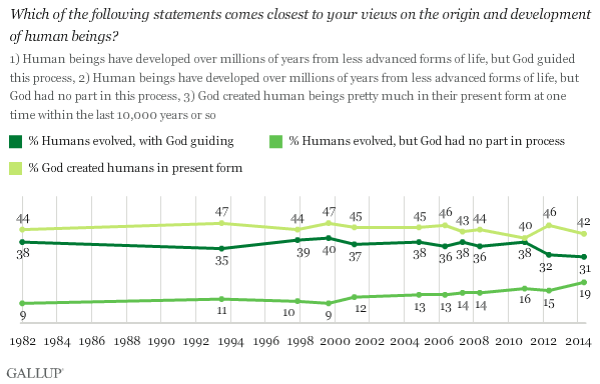
Have you seen it yet?  The new Gallup poll on creationism and evolution is out.  The numbers are about the same as they have been for the past thirty years.  But beyond those numbers, the backgrounds of Gallup’s respondents has some bad news for creationists.  It also has bad news for evolution-lovers.

Stable Numbers Since the 1980s

Stable Numbers Since the 1980s

Since the 1980s, Gallup’s pollsters have been offering respondents three options about the origins of humanity.  This time, 42% chose the young-earth creationist option: “God created human beings pretty much in their present form at one time within the last 10,000 years or so.”  In contrast, 31% chose “Human beings have developed over millions of years from less advanced forms of life, but God guided the process.”  A whopping 19% selected “Human beings have developed over millions of years from less advanced forms of life, but God had no part in the process.”

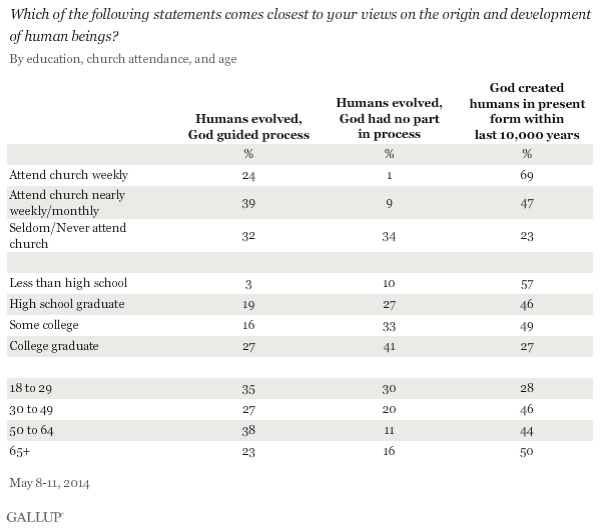
Those numbers have remained fairly stable for the past generation.  But another result of the recent poll numbers needs some examination.  The young-earth position is much more common among less educated adults.  For those with less than a high-school diploma, 57% selected the young-earth option.  A far smaller proportion, only 27%, of Americans with a college degree chose the young-earth explanation.

"Organized Ignorance?"

“Organized Ignorance?”

This is bad news for everyone.

For creationists, these numbers suggest that more education means less creationism.  Throughout the lifespan of American creationism, creationist intellectuals have fought a rearguard action against accusations of ignorance.  In 1927, for example, Minneapolis fundamentalist leader William Bell Riley told a reporter,

Every time I hear the argument that this is a controversy between experts on the one hand, and, as someone has said, ‘organized ignorance,’ on the other, I smile.  This is not a debate between the educated and the uneducated.

Riley’s smile grew more and more strained as the 1920s wore on.  And later generations of creationists found it even more difficult to take the intellectual high ground.  These numbers mean bad news for them.

But the numbers mean bad news for evolution mavens, too.

Though more college grads embrace a non-young-earth understanding of the origins of humanity, 27% is still a significant number.  It means that over a quarter of adults who have been to college—educated adults, that is—select a young earth as the best explanation.  Over a quarter!  Some of those, to be sure, may attend what young-earth creationists embrace as “Creation Colleges.”  Ken Ham of Answers In Genesis, for example, publishes a list (and a map!) of schools that he views as faithful to the Bible’s obvious meaning.

But many of those college-educated young-earth creationists likely attend non-creationist colleges as well.  As anthropologist David Long demonstrated in his study of creationists at a large public university, studying biology at a secular university does not tend to shake the faith of creationist students.  Of his interview subjects, only one abandoned her creation faith as she majored in biology.  And it wasn’t the science that convinced her.  She had already begun to move away from her faith in high school, due to an early pregnancy and the sour reaction of her church community.

As I argued a while back in the pages of the Chronicle of Higher Education, anti-creationists are too fond of calling all creationists “ignoramuses.”  Certainly, some folks must embrace creationism because they just don’t know better.  But many educated adults DO know about evolution.  They simply choose young-earth creationism instead.  That is a troubling fact that anti-creationists have always had a hard time dealing with.


A Conservative Commencement Address

College is crap.  So says the godfather of the modern conservative intellectual movement.

Though it wasn’t technically a graduation address, Russell  Kirk’s 1978 address to Hampden-Sydney College has the feel of one.  But it’s an idiosyncratic feel.  Kirk told the assembled students that college had gone to hell in a handbasket.  What could save it?  A renewed dedication to the “higher” part of higher education.

Russell Kirk kick-started the modern conservative intellectual movement with his 1953 blockbuster The Conservative Mind.  In that book, Kirk argued for a long and illustrious intellectual history for modern conservatism, reaching back through America’s finest men of letters and founding fathers to Edmund Burke.

In his 1978 address, Kirk bemoaned the state of American higher education.  Most schools had wallowed in the “educational follies” of recent trends.  The proper purpose of college, Kirk argued, was to train leaders in both profession and morality.  Since the end of World War II and new mass enrollments, colleges had lost their sense of purpose.  Kirk offered a four-part explanation of this decadence.

First, colleges no longer knew what they were for.  Instead of keeping their sights fixed on “knowledge and virtue,” universities tried to be all things to all people.

Second, colleges no longer laid out a menu of intellectual growth for students.  Colleges gave up on prescribing a course of knowledge.  Instead, in the name of freedom, colleges offered a vapid “cafeteria-style curriculum.”

Third, colleges had grown recklessly and heedlessly.  As Kirk put it,

Culturally rootless, anonymous, bewildered, bored, badly prepared for higher studies, other-directed, prey to fad and foible, presently duped by almost any unscrupulous or self-deceived ideologue, a great many of the students at Behemoth University came to feel defrauded and lost; only the more stupid did not suspect that anything was wrong with their condition.

Fourth, the decline of primary and secondary education meant that most college students no longer came prepared. Progressive fads had enervated education to such an extent that most students only knew how to fit in, not to stand out.

The central problem has been the rush to enroll, Kirk concluded.  Too many students go to college, with too little sense of purpose and too little preparation.

The cure, Kirk insisted, is to return to proper education for leaders in all professions.  With a core of truly educated people, American society and culture could rebound.  As he put it,

I am suggesting that college ought not to be a degree-mill: that it ought to be a center for genuinely humane and genuinely scientific studies, attended by young men of healthy intellectual curiosity who actually possess some interest in the development of mind and conscience. I am saying that the higher learning is meant to develop order in the commonwealth, for the republic’s sake. I am arguing that a system of higher education, which has forgotten these ends, is decadent; but that decay may be arrested, and that reform and renewal still are conceivable.

Though critics might cry “elitism,” Kirk concluded, his vision was anything but. The current vision of college as processing-plant cranked out cadres of quarter-educated elites. These dimwits moved society in preposterous directions, madly confident all the while that their elite education had prepared them for leadership.

As we wind up commencement season, I can’t help but wonder how Kirk’s lament would have gone over as a graduation speech.  It lacks some of the traditional encouraging rhetoric of that genre.  Would be-gowned professors and deans be able to sit on the stage and nod sagely as Kirk blasted their life’s work?


Hell and Harvard

It looks as if Harvard will not host its Black Mass after all.  The school had planned to allow a Satanic group to perform its signature ceremony as a gesture toward inclusion and free speech.  Conservative reaction to the event tells us something about conservative ideas about higher education.

Naturally, many Catholics, conservative or otherwise, protested the plan.  The Black Mass, after all, is a deliberate inversion of the most sacred Catholic ritual.  According to some reports, Satanists in the Harvard mass boasted that they had acquired a consecrated Eucharistic wafer to mock and humiliate in their performance.  Harvard alumnus Father Roger Landry pleaded with Harvard president Drew Gilpin Faust to cancel the ceremony.  Harvard, Landry argued, would not allow a mock lynching in the name of free speech.  Nor would Harvard allow racist verbal assaults.

But other conservatives criticized the event for different reasons.  This sort of bizarre public performance, some conservatives argued, demonstrated just how deeply elite colleges have veered out of the cultural mainstream.  Schools such as Harvard, some conservatives say, have lost all sense of what is normal in real life.

In the pages of National Review, for instance, AJ Delgado did not attack Satanism.  But he did attack elite higher education.  The perverted reasoning that led Harvard to accommodate such a hateful attack on Catholicism, Delgado argued, demonstrated the ways “the Ivy League continually sinks to shockingly low depths.”

Oklahoma representative Rebecca Hamilton elaborated on this theme.  “Harvard,” Hamilton insisted,

and its little troupe of elite schools are not healthy for this country. They create a 1% that is disconnected from and hostile to the rest of us. They are, in many ways, predatory.

As I argue in my upcoming book, educational conservatives have long insisted that elite colleges had lost their way.  At times, historians have accused conservatives of being “anti-intellectual” due to this tradition.  But that’s not the case.  Conservatives in general are no more anti-intellectual than anyone else.  But throughout the twentieth century conservative activists and intellectuals specifically lamented the perverted ideas dominant at elite universities and institutions.

In the 1930s, for example, conservatives attacked schools such as Columbia University for coddling communists and subversives.  It was not “college” in general that had gone wrong, conservatives argued.  But elite schools in particular had strayed from educational tradition.  US Congressman Hamilton Fish, a founder of the American Legion and dedicated red-hunter, listed in 1935 the schools that had become “honeycombed with socialists, near communists, and communists.”  Watch out, Fish warned, for Columbia, New York University, City College of New York, the University of Chicago, the University of Wisconsin, the University of North Carolina, and the University of Pennsylvania.  Such elite schools had gone off the rails.

Harvard’s flirtation with Satanism seems to have confirmed this theme among conservative activists and intellectuals.  Higher education is a good thing, most believe.  But the kooky garbage on offer at elite schools such as Harvard demonstrates the problem with the upper crust of academia.