Can Christian Colleges Say the R-Word?

Do conservative Christians encourage rape?  It’s a difficult thing to talk about, but it is a question these days at the center of discussions about conservatism, Christianity and higher education.  Most recently, blogger Samantha Field related the stories of students at Pensacola Christian College who had been punished by the school after suffering sexual assaults.  The accusations have attracted enough attention that PCC has felt obliged to make a public denial.  The school said it has been “harassed and victimized” by these accusations.  PCC, the school insisted, has always acted in accordance with the law.

This is not only an issue at Pensacola Christian College.  As journalist Kiera Feldman argued in a recent New Republic article, a similar culture of institutional arrogance prevails at Patrick Henry College.  And Bob Jones University has gone back and forth with its efforts to examine its own culture.  More broadly, Billy Graham’s grandson attracted attention a few months back for asking if evangelical Protestants had a worse record of dealing with sex abuse than did the Catholic Church.

These are difficult questions to ask.  For an earlier post about this issue, I’ve been called insensitive (fair, and I apologize again), ignorant (sometimes fair, sometimes unfair) and guilty of condoning or excusing cover-ups (utterly unfair).  What I asked was whether or not these accusations of institutional misconduct rely on stereotyped assumptions about conservative evangelical Protestants.  In other words, is there something specifically about the religion of these schools that is somehow to blame?  Or is it an institutional culture at these conservative schools that blames victims and excuses criminals?  Is there something about the Christian nature of these schools that promotes and excuses rape?  Or is this a question of institutional mismanagement?  Finally, we have to ask, is this whole thing somehow more aggravated at these schools than it is at secular or pluralist schools?

After reading more about these cases, it seems the attitude toward rape of school leaders really is wrapped up intimately with their institutional tradition, and maybe even with their theological tradition.  It seems this is more than just another case of fundamentalist-bashing.  In the past, I have defended young-earth creationists against accusations that they are guilty of criminal abuse.  I’ve chided secular journalists—with whom I’m generally sympathetic—for misrepresenting the claims of young earth creationists.  These cases from conservative colleges seemed to me, at first, to represent similar sorts of knee-jerk anti-fundamentalist stereotyping.  I didn’t try to cast doubt on the sincerity of the victims, to be clear, but I did ask whether the accusations against the schools unfairly tied belief in an inerrant Bible to cases of institutional misconduct.

I do not come from a conservative evangelical or fundamentalist background.  But for a living, I study conservative educational activism, especially the educational thinking of conservative Protestants in the United States.  I’m aware of the history of American fundamentalism, including the ways theology has been profoundly combined with hierarchical gender notions.  As I wrote in my 1920s book and as Margaret Bendroth argued in hers, in its early decades American fundamentalism relied on notions of male dominance and female submissiveness.

We know that all colleges these days are struggling with proper ways to handle sexual assault cases.  The charges against schools such as Patrick Henry College, Pensacola Christian College, and Bob Jones University suggest that the campus culture at these conservative schools makes that difficult task much harder.  It seems the fundamentalist culture of these schools has intensified the already brutal culture on many secular college campuses.

This does not mean that every fundamentalist condones sexual assault, of course.  This does not even mean that every student, faculty member, or administrator of these schools agrees with the overall school culture.  Nor can we even say with confidence that this culture is somehow a necessary outgrowth of the theology of the schools, rather than primarily a question of hierarchical, closed-off, inflexible administrative structure.  But it does seem that the dominant atmosphere of these schools needs to share blame in this aggravated culture of condoning and excusing sexual assault.

The best comparison, it seems to me, is the atrocious record of the Catholic Church with its recent sex-abuse scandals.  No one says that every Catholic—let alone every Catholic priest—is part of this scandal.  Nor do we even say with confidence that this is something caused directly by the theology of the Catholic Church.  And we can of course point out that far more non-Catholics committed sex abuse than did Catholic priests.  But such objections miss the point.  There was something profoundly wrong with the way the power structure of the church handled those cases.  It seems there’s a similar connection here between institutional structure and moral accountability.

Those few who might use these cases to suggest that Christianity as a whole is a rape-centered religion are just as wrong as they have ever been.  And we must remember that there is a wide variety in conservative evangelical colleges.  A culture that dominates at BJU, PHC, or PCC will be very different from the culture at other evangelical schools such as Wheaton.  But even remembering those important caveats, there is something deeply troubling with the institutional power structure in these fundamentalist schools.

What will colleges do to respond?  As I’ve argued elsewhere, these schools rely on their reputation as havens of religious orthodoxy in a secularized society.  As the first Bob Jones insisted when he founded Bob Jones College in the 1920s,

Fathers and mothers who place their sons and daughters in our institution can go to sleep at night with no haunting fear that some skeptical teacher will steal the faith of their precious children.

Today’s school leaders, no less than the founders, must be able to say confidently that students will be theologically and physically safe.  How can they reassure parents and future students that they have responded to these accusations?
Creation, Evolution, and College Marketing

Bryan College is having a rough time.  The school is experiencing angst as it wrestles with a new policy about the origins of humanity.  The leadership is insisting that members of the school community must adhere to a newly rigid position on origins.  All members of the college community, it seems, will be asked to sign off on a doctrinal statement recognizing that Adam & Eve represented the real, historical ancestors of all humanity.  Traditionally, faculty and students had been encouraged, or at least permitted, to embrace a relatively wide scope of Biblical opinions about the age of the earth and the historicity of Adam & Eve.

Some commentators have argued that this represents a false dilemma for Christians, or even that Bryan’s misery proves the failure of religion in the modern world.  But there is a simpler explanation.

Those familiar with the history of Bryan College can’t help but note the ironies here.  As I point out in my 1920s book, the founding of Bryan College was stymied by William Jennings Bryan’s unorthodox brand of conservative evangelical Protestantism.  Not only did the original Bryan not embrace the notion of a young earth, but Bryan was loud and proud about his postmillennial interpretation of Scripture.  For the growing fundamentalist movement in the 1920s, Bryan’s old-earth position was not remarkable or problematic.  Many leading fundamentalist thinkers in the 1920s had “liberal” positions about the age of the earth.  But Bryan’s postmillennial beliefs caused some worry.  Could “fundamentalists” be postmillennialists?  Such debates threatened to derail the funding of the new university in the 1920s.

Such arguments based on the history of Bryan College are relevant in today’s disputes.  The current leadership of the school insists that their new statement of faith is really only a clarification of their traditional creed.  Indeed, it would have to be, since part of that original charter stipulated that the creed could never be altered.

Faculty members at Bryan differ, however.  As we’ve noted in these pages, faculty members such as Bryan Eisenback have crafted innovative school curricula that hope to teach evolution to Christians in a Christian way.  As described in a recent article in Chattanooga’s Times Free Press, Eisenback has been accused of teaching both evolution and creationism.  As Eisenback described to the TFP,

In my view, God gave us science to learn about the physical world.  When people embrace that, science is our way of understanding God’s handiwork, so to speak, then science isn’t threatening. It becomes exciting.

As usual, Josh Rosenau of the National Center for Science Education offered a sensible argument in the pages of the TFP.  Bryan’s leadership, Rosenau noted, seemed to be staking out a hard-line position unnecessarily.  “The evangelical position,” Rosenau argued, “doesn’t have to be an outright rejection of human evolution. There are ways to be a Bible-believing literalist without being at odds with science.”

Less convincing was the cackling triumphalism of science pundit Jerry Coyne.  In the pages of The New Republic, Coyne argued that the mess at Bryan College resulted from a necessary clash between advancing science and retreating religion.  “Bryan is fighting a losing battle,” Coyne crowed,

but it will be a long battle. These vestiges of superstition, and of blind adherence to it, will eventually disappear as America becomes more secular. There will always be Biblical literalism, but I’m confident it will slowly wane. But it will wane not with the changing of minds, but over the corpses of its adherents, as the older generation dies off and the younger, exposed to secularism and doubt on the internet, begins to ask questions.

I’m an avid reader of Coyne’s blog, but I don’t see how his argument makes sense.  The “older generation” he refers to is many generations derived from the founders of Bryan College.  A pile of the corpses of adherents to Bryan College’s conservative theology would be too high for any young people to climb over!

Corpse imagery aside, there’s a more important point to be made here.  College presidents want most of all to see their institutions thrive.  As the Chattanooga TFP article makes clear, the problem at Bryan College started when prominent young-earth creationist Ken Ham accused the college of falling away from Biblical orthodoxy.  The leadership of Bryan College faces a worrying prospect.  What if conservative evangelical parents no longer trust the orthodoxy on tap at Bryan?  What if they no longer agree to send their children and their tuition dollars to the school?

More than nuances in Biblical scholarship or evolutionary theory, college presidents must consider such things.  The dangers to the bottom line from the condemnation of Ken Ham are real and substantial.  Unless the leadership acted to shore up the impression of orthodoxy, they must have worried that their institution would become just another failed small religious college.

Let me be clear: I have no inside knowledge of the goings-on at Bryan College.  But it seems as if the simplest explanation here is probably the right one.  Beyond keeping the faith true, college presidents must worry about keeping the lights on.  In today’s climate, a bad review from the likes of Ken Ham could easily spell the end of any conservative evangelical school.


Lesbian, Feminist . . . Christian?

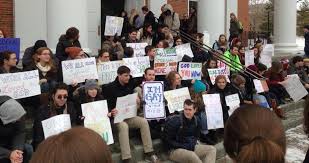
Student demonstrations aren’t big news.  But recently evangelical Christian students at evangelical flagship Wheaton College came out to agitate for, well, for coming out.

Student Demonstration at Wheaton

Student Demonstration at Wheaton

Wheaton College had invited Rosaria Champagne Butterfield to give a chapel talk.  Students protested that Butterfield’s message, her “train-wreck conversion” story, promoted damaging messages about homosexuality and Christian faith.

Butterfield attracted attention last year with her conversion story in the pages of Christianity Today.  As she told the story, she was a happy, moral, engaged citizen who happened to be a lesbian.  In her earlier career as a feminist academic, she pitied and pilloried evangelical Christianity for its anti-woman, anti-homosexual attitudes.  But after engaging with a local evangelical pastor and his family, Butterfield felt herself drawn to the faith.  She felt herself drawn to Biblical truths, to promising obedience before asking for understanding.  She fought against this conversion.  As she put it,

But the Bible got to be bigger inside me than I. It overflowed into my world. I fought against it with all my might. Then, one Sunday morning, I rose from the bed of my lesbian lover, and an hour later sat in a pew at the Syracuse Reformed Presbyterian Church.

As we’ve seen in these pages, the tangled mess of morality, sexuality, and Christianity has caused heartache and abuse, and college campuses often become the stage on which these questions find themselves played out.  Last month, Butterfield’s chapel talk at Wheaton College became the focus of a silent student demonstration.  Christian students at the evangelical school wanted the world to know that Christianity did not require “healing” from homosexuality.  Student Justin Massey told the student newspaper,

We feared that if no conversation was added to the single message of the speaker that students who are not very well informed were going to walk into chapel, hear the message, and have misconceptions confirmed or that students who are LGBT would be told that this story is the absolute way that things happen.

After the chapel talk, Butterfield met with student demonstrators.  The student newspaper published a short interview.  Butterfield explained that she was a feminist on issues such as equal pay for equal work, but that feminism as a “worldview” did not work.  She insisted that she viewed sexuality through a Biblical lens, one that condemned both homosexuality and homophobia as sins.

Students disagreed.  They thought Butterfield misinterpreted the Bible, and that her attitude gave a pass to the sorts of patriarchal sexual abuse cases that we’ve discussed in these pages.

For those of us outside the world of evangelical Christianity, the discussion was illuminating.  First of all, we see how both sides of the issue use the Bible to buttress their arguments.  Students at Wheaton did not lambaste Butterfield for making arguments based on an ancient book.  Rather, they insisted that Butterfield relied on bad interpretations of that text.  Also, we see, as the student protesters insisted, that there is “more than a single story” about sexuality in evangelical higher education.  Some of us were surprised recently to find that Christian professors do not universally condemn homosexual students.  Many of us, like Dr. Butterfield in her earlier life, assume that homosexuality is something on which evangelical Christians agree.  This story shows us the true complexity of sexuality in evangelical thinking.


Jesus College and the Rape Smear

I’m no fan of Patrick Henry College.  But I’m even less of a fan of the cultural politics of smearing.  Smears are the biological weapons of cultural warfare; they poison the ground for generations.

Last week we read with interest an “expose” of the rape-friendly campus at the attention-grabbing conservative school.  Rape is a terrible problem.  And campus rape seems to have taken on a life of its own.  But the author of this article seemed more intent on smearing Patrick Henry and conservative religious people in general than she did in exploring the real issues.

This sort of smear attack is doubly dangerous. First, smears like this convince the already convinced that their Christian enemies must be fought tooth and nail.  After all, the article implies, conservative Christians support rape.  What kind of monsters are they?  Second, conservative Christians will easily be able to point out the unfair guilt-by-association tactics this writer resorts to.  For Christians, this sort of smear simply provides more proof that Bible-loving Christians are a beleaguered minority, under unfair attack from an aggressive, hostile, secularizing liberal elite.

Let me be crystal clear: I am not defending Patrick Henry College.  I am not saying that the administration and students did or did not react badly to allegations of sexual assault.  I am not saying that assaults did or did not take place.  I am certainly not saying that allegations of sexual assault need not be taken seriously, nor that female victims ought to blamed.

But the author of this article, Kiera Feldman, repeatedly resorts to insinuation and smear in an attempt to demonize this conservative Christian institution.  The article tells the story of Claire Spear, a freshman, who was attacked by a fellow student.  Feldman also describes the case of Sarah Patten, who was assaulted on campus.  Feldman accuses the college administration of pooh-poohing the incidents.  More powerfully, Feldman implies that the conservative Christian campus culture actually encourages male-on-female sexual assaults.

To build her case, Feldman relies on some tried-but-false McCarthyite tactics.  Patrick Henry College, Feldman notes correctly, was opened in 2000, in large part to provide a congenial collegiate home for the burgeoning numbers of conservative Christian homeschooled kids.  But Feldman asserts with wild inaccuracy, “Underlying homeschooling culture is the Christian patriarchy movement.”  Of course, some Christian homeschoolers—even some members of the ILYBYGTH community—have had horrific experiences with this sort of quiverfull-esque homeschooling monstrosity.  But to imply that homeschooling culture is dominated by this sort of attitude demonstrates woeful ignorance about the true contours of American homeschooling.

Similarly, in her attempt to tar Patrick Henry as a hotbed of rape culture, Feldman mentions Missouri Senator Todd Akin’s terrifying discussions of “legitimate rape.”  As far as I can tell, Akin has absolutely no connection to Patrick Henry College, but Feldman mentions Akin’s accursed name, only to point out that Patrick Henry College “sponsored similar ideas.”  This is the smear tactic at its worst.  Did you know, for example, that the Communist Manifesto listed a graduated income tax as one of the ten top goals for communists?  Therefore, President Wilson must clearly be a communist, since he sponsored such a tax a century ago.

Campus rape is a real problem.  The most common statistic we hear is that one in five female students will experience some sort of sexual assault during their school experience.  This is an issue that has justifiably attracted the attention of activists and politicians.  For instance, state senators in California have introduced a bill that would mandate consent for every sexual act as the new legal standard.

But this problem is not somehow related to the Christian theology of school such as Patrick Henry.  Indeed, even if we take Feldman’s numbers of assaults to be accurate—which the administration of the school vigorously denies—it seems Patrick Henry has been a remarkably safe school, compared to other colleges.  Indeed, as the California legislators pointed out, complaints about assault and rape at schools such as UC-Berkeley and Occidental College far outstrip the complaints Feldman chronicles at Patrick Henry.

Indeed, it might seem more accurate to ask if Patrick Henry’s conservative culture PREVENTS sexual assault.  After all, the drinking, partying lifestyle that seems to be such a big part of student life at many secular schools will find no home at Patrick Henry.  As Caitlin Flanagan recently described in the pages of The Atlantic, fraternities and sororities at public and more secular schools have astonishing rates of sexual assault and injury.

Not that such things would excuse Patrick Henry’s administrators if they did downplay the seriousness of sexual assault charges.  But it must give readers pause.  If the Christian culture at Patrick Henry encourages sexual assault, as Feldman implies, surely we’d expect to see more cases pop up at Patrick Henry than at secular schools.  That’s just not the case.

How the Apostle Paul Beat Out Beyonce

Can MOOCs be Christian?  That’s the question explored in a recent Christianity Today post.

When Harvard University offered a free-online course in early Christianity, a “massive open online course” or MOOC, so many people took part it nearly blew up the system.  As instructor Laura Nasrallah related in HuffPo,

The day the course launched was astonishing—like drinking from a fire hose. The edX discussion threads couldn’t handle the amount of people who were commenting, and crashed and slowed down. More people participated on Poetry Genius that day than ever before—the apostle Paul beat out Beyonce!

As the CT post explores, some Christian universities are exploring the MOOC model.  But there is some disagreement about the value of the platform.  Could this be a great way to reach more students with the Christian higher-ed message?  Or does this do violence to the need for face-to-face personal contact in a truly Christian intellectual environment?

Christian universities aren’t the only folks struggling with the notion of the MOOC.  As we’ve noted, a variety of conservative intellectuals have also disagreed about the desirability of MOOCing.  Some free-market types have salivated over the notion of bureaucracy-free, low-cost, open colleges.  Other conservatives have worried that MOOCs will abandon the traditional element of character-formation in higher education.

Harvard University has not been a bastion of conservative Protestantism since at least 1805.  Nevertheless, its course on early Christianity seems to be one of the most popular academic experiences of the MOOC era.


Outlaw Colleges

Why do so many otherwise right-thinking Americans embrace leftist ideas?  For generations, conservative intellectuals have blamed the skewed perspective of American colleges and universities.

This morning in the pages of National Review Online, Victor Davis Hanson offers a ten-point condemnation of the American higher educational system.

For those unfamiliar with the real history, it might be tempting to assume that conservatives turned against the higher-education system during the campus tumults of the 1960s and 1970s.  Free speech movements, hippies, sit-ins, campus radicals occupying dean’s offices…there was certainly enough reason for conservatives to look askance at campus culture in those years.  But conservative intellectuals and activists had worried about the state of higher education long before that.

In the 1920s, for example, religious conservatives worried that mainstream campuses converted faith-filled young people into atheists and skeptics.  As I describe in my 1920s book, the first generation of fundamentalists realized that college determined culture.  William Jennings Bryan, for example, often trumpeted the findings of James H. Leuba.  Leuba had studied the beliefs of college students, and in his 1916 book The Belief in God and Immortality, Leuba concluded that the number of self-identified religious believers declined during college years.  In speech after speech in the 1920s, Bryan used Leuba’s numbers as proof that college wrecked faith.

Bryan wasn’t the only one.  Throughout the 1920s, evangelist Bob Jones Sr. warned of the dangerous effects of typical college curricula on young people.  One of the reasons Jones founded his own uniquely religious school, he explained in sermons, was because too many young people became college “shipwrecks.”  He told the story of one hapless family who had scrimped and saved to send their beloved daughter to

a certain college.  At the end of nine months she came home with her faith shattered.  She laughed at God and the old time religion.  She broke the hearts of her father and mother.  They wept over her.  They prayed over her.  It availed nothing.  At last they chided her.  She rushed upstairs, stood in front of a mirror, took a gun and blew out her brains.

In the 1930s, too, conservatives fretted that college corrupted culture.  Beyond the ranks of religious conservatives, activists in patriotic organizations such as the American Legion warned that colleges had been subverted by anti-American socialist moles.  As I argue in my upcoming book, worries about the subversive state of higher education became a central tenet of their conservative ideology.  For instance, in 1935 New York Congressman, red-hunter, and American Legion co-founder Hamilton Fish attacked the state of higher ed.  He named names, including Columbia, New York University, City College of New York, the University of Chicago, Wisconsin, Penn, and North Carolina.  These elite schools, Fish warned, and many others, had become “honeycombed with Socialists, near Communists, and Communists.”  A less prominent American Legion writer echoed this sentiment.  “Colleges all over the land” Legionnaire Phil Conley warned in a 1935 article, had begun teaching “the overthrow of our government . . . through subterfuge and through destroying faith and confidence in our democratic institutions.”

Long before “The Sixties,” then, conservatives concluded that colleges and universities threatened to shatter the cultural cohesion that had made America great.  These days, too, conservative intellectuals often condemn the state of higher education.  Of course, just as with earlier generations of conservatives, today’s conservatives may find many different reasons to worry about what goes on in America’s campuses.  Publications such as Minding the Campus and from the National Association of Scholars offer conservatives forums for sharing their complaints about the state of higher ed.

In the pages of National Review Online, we read one summary of conservative complaints about college today.  Victor Davis Hanson calls the state of higher education criminal.  He damns “virtual outlaw institutions” that take students’ money mainly to line their own pockets and fuel the narcissistic lifestyles of fat-and-happy professors and administrators.  “If the best sinecure in America,” Hanson concludes,

is a tenured full professorship, the worst fate may be that of a recent graduate in anthropology with a $100,000 loan. That the two are co-dependent is a national scandal.

In short, the university has abjectly defaulted on its side of the social contract by no longer providing an affordable and valuable degree. Accordingly, society can no longer grant it an exemption from scrutiny.

Hanson offers a ten-point brief.  College can be saved, he argues, if these senseless traditions are subjected to radical reform.  First, abolish tenure.  Second, rationalize hiring.  Third, take ideological garbage out of the curriculum.  Fourth, add transparency to the admissions process.  Fifth, cut the fat out of administration.  Sixth, remove the useless teaching credential.  Seventh, add national competency tests for faculty.  Eighth, publish school budgets.  Ninth, eliminate expensive and unnecessary university presses.  Finally, open campuses to real free speech.

Taken together, Hanson suggests, these radical reforms promise to renew the promise of American higher education.  Without them, American students and their families will continue to be held at intellectual and financial knife-point by the highway robbers known as professors and administrators.

How bout it?  Have you experienced college strife?  For those readers who come from conservative religious backgrounds, did your college experience shatter your faith?  Or did college turn you from a patriotic youth into a skeptical adult?  And what about Hanson’s broader challenge?  Do colleges take students’ money and offer only a skewed ideological indoctrination in return?


In Defense of the Lecture

Outside of dunce caps or ferule-slapping, it would be hard to find a teaching technique that has been more roundly disparaged by generations of progressive educators than the lecture.

Stultifying and obsolete, ineffective and time-wasting, the “sage-on-the-stage” approach to education has long been Pedagogic Enemy Number One for progressives.

Not so fast, writes Collin Garbarino in the pages of First Thoughts.  In spite of snarky progressive claims to the contrary, Garbarino argues, the lecture “worked in the fourteenth century, and it still works today.”

Garbarino is responding to an interview in The Atlantic with technophile David Thornburg.

Thornburg used a 1350 painting to illustrate the continuing ridiculousness of lectures.  In the painting, students sleep, chat, and otherwise while away the time while a puffed-up Henry of Germany imparts some Teutonic knowledge on Bologna’s university students.

Image Source: First Thoughts

Image Source: First Thoughts

Hold the phone, Garbarino challenges: Take another look at that painting.  Sure, many students are not listening.  But many are.  The front rows are packed with students avidly drinking in Henry’s wisdom.

Don’t blame the lecture for shoddy education, Garbarino argues.  After all, as Garbarino points out, we don’t blame books for ignorance; we don’t attack all blog posts because most of them are stupid.  Garbarino suggests two proper targets for reform: disengaged students and weak lecturers.

As in Bologna in 1350, some students benefit from lectures, others do not.  The lecture as a format is an efficient and practical way to educate, Garbarino says.  The fact that some students choose not to participate does not mean that the format itself is no good.

Similarly, lots of lecturers are terrible.  They are more concerned with publishing than with preparing scintillating lectures.  Or they may lack that ineffable something that makes someone a compelling speaker.  But just because some lecturers do a bad job of it does not damn the lecture entirely, Garbarino argues, any more than terrible books imply that we should no longer read.


Christian College Embraces Atheist Student

What would happen to an atheist student at a conservative Christian college if his professors and peers found out about his lack of faith?  Turns out, not much.

That was the experience of Eric Fromm, at least, at Oregon’s Northwest Christian University.  Fromm, the student body president at the 600-student school, worried about the reaction when he “came out” as a non-believer.

According to a story in the Eugene Register-Guard, the school community has turned out to be supportive.  Michael Fuller, NWCU’s vice president for enrollment and student development, said there was no conflict between Fromm’s views and the school’s religious mission.  “I want students like Eric here,” Fuller told the Register-Guard,

students who are looking to explore their faith and willing to look hard and make their faith their own. . . . If we all had our wishes, we wish Eric would be a strong Christian man. . . .  We’re an open and welcome community, and we meet students exactly where they’re at.

Those of us from outside the world of conservative Christian higher education might be surprised by Fuller’s and NWCU’s open attitude.  After all, Fromm himself wondered what kind of reception he’d get when he publicized his atheism in the school paper.

Maybe we shouldn’t be.  After all, Fromm’s story is not unique.  ILYBYGTH readers may remember the testimony of Brandon Ambrosino, who reported his experiences at Liberty University.  Ambrosino, like Fromm, fretted over his decision to come out as homosexual at the rigorously conservative Liberty.  Like Fromm, Ambrosino found his faculty mentors downright supportive.

If the mission of many conservative colleges is to provide a “safe” theological environment for students, one that will support their faiths, then we’d expect faculty and administration to take a harsh line against students who thwart that mission.  An atheist student or an openly gay student would seem to introduce threatening elements into that safe environment.  That would seem doubly true if the atheist were popular and influential, as Fromm seems to be.

In practice, however, conservative schools seem well able to handle student dissent.


College Is Dumb

What do college kids learn about these days?  It is a question about which conservatives have fretted for a long time.

Most recently, the Heritage Foundation warns that too many students, especially at America’s elite universities, are filling their heads with the mental junk food of Lady Gaga and zombie thrillers.  Worst of all, according to Mary Clare Reim on Heritage’s education blog, elite schools don’t seem to do much to encourage more substantial mental work.  For hefty tuition fees, Ivy League schools seem happy to have pampered youth meander lazily through fluff classes such as

“The Fame Monster: The Cultural Politics of Lady Gaga”; “Blame It on the Bossa Nova: The Historical Transnational Phenomenon”; “The Sociology of the Living Dead: Zombie Films”; “Fairytales: Russia and the World.”

Students are given the freedom, Reim laments, to fill their college years with nothing but such interesting but ultimately impractical mental games.

Reim cites a recent study from the American Council of Trustees and Alumni (ACTA).  The ACTA graded schools on how much core curriculum they require for their students.  By this measure, Harvard, Yale, and Stanford all get Ds.  Baylor and Colorado Christian University, on the other hand, move to the head of this class.

Reim’s worries place her in a storied tradition of nervousness among American conservative thinkers.  Since at least the 1920s, conservatives have worried that college students are being sold an intellectual bill of goods.  Classes are watered down, or worse, pernicious ideas are snuck in as the latest academic fad.

In the 1920s, for instance, William Jennings Bryan warned that elite schools such as Wellesley, Yale, and the University of Wisconsin filled the heads of students with pernicious nonsense.  In a dispute with Wisconsin’s president in 1921, Bryan snarkily suggested that Wisconsin should post the following warning sign:

Our class rooms furnish an arena in which a brutish doctrine tears to pieces the religious faith of young men and young women; parents of the children are cordially invited to witness the spectacle.

In 1935, one American Legion writer warned that “colleges all over the land” had been taken over by left-leaning numbskulls.

In 1950, one anonymous letter-writer wrote in to the Pasadena Independent to offer an explanation of why so many classes were so stupid.  If young people didn’t learn basic facts and skills, they would become easy prey for what this conservative writer called “propaganda leaders.”

In other words, keeping young people dumb was more than just laziness or faddishness.  Among conspiracy-minded activists, dumbing down colleges could work to prepare America for failure.

More recently, too, conservative intellectuals often assume that the content of higher education—especially at the most elite schools—ranges from sex-soaked to subversive.  Peter Collier, for example, in a recent article in the Weekly Standard, warned that left-wing ideas had taken over at Teachers College, Columbia University, beginning in the 1980s.  Under the name of “critical pedagogy,” Collier wrote, academics had “slowly infiltrated leftist ideas into every aspect of classroom teaching.”

Given the possible intellectual threat posed by socialism and blundering leftism, it seems conservative intellectuals might be happy to see courses that are merely stupid.


Keep Your Kid Conservative

Watch out!  Going to school might ruin a perfectly good conservative child.

That’s the message this morning from pundit and school-founder Dennis Prager.

In the pages of National Review Online, Prager gives conservative parents advice about how to keep their kids conservative.

The danger is clear, Prager warns.  Those who believe in “traditional American values” must fight a “war” with “the media and the schools” for control of their children’s minds.

Kids must be told repeatedly and explicitly about the propriety of conservative ideas.  Not only that, they must be intellectually inoculated against the sorts of left-wing propaganda they will be subjected to in college.  One way to do that is to get high-schoolers to spend some time in the world of work before college.  By seeing a slice of the real world, young people will be protected from the drivel that passes for academic thought these days, Prager claims.

Another option is to have young people spend a year or so after college studying their faith.  After all, he says, leftism itself is an influential faith on college campuses.  Students who are grounded in their own religious traditions will have a better chance of resisting the siren call of college leftism.

In general, Prager writes, young people who are taught character, not given a false sense of “self-esteem,” have the best chance to remain sensibly conservative.

Overall, Prager tells conservative parents, don’t fret.  “It is not all that hard,” he says, “to produce a son or daughter able to withstand left-wing indoctrination.”  It just takes some doing.