HateMyProfessor.com

HT: JG

Can fundamentalist colleges trust their faculty? We see this week an unfortunate blow-up in the continuing saga of power struggles at Bryan College in Tennessee. Does this bitter squabble between president and faculty represent an inherent problem for conservative evangelical schools? The history of these colleges suggests something along those lines.

According to Chattanooga’s Times Free Press, Bryan President Stephen Livesay has doubled down on his fight for control. As we’ve documented in these pages, for the past few years the college has gone back and forth in its struggle, with faculty approving a no-confidence vote last spring, and members of the board resigning this past summer.
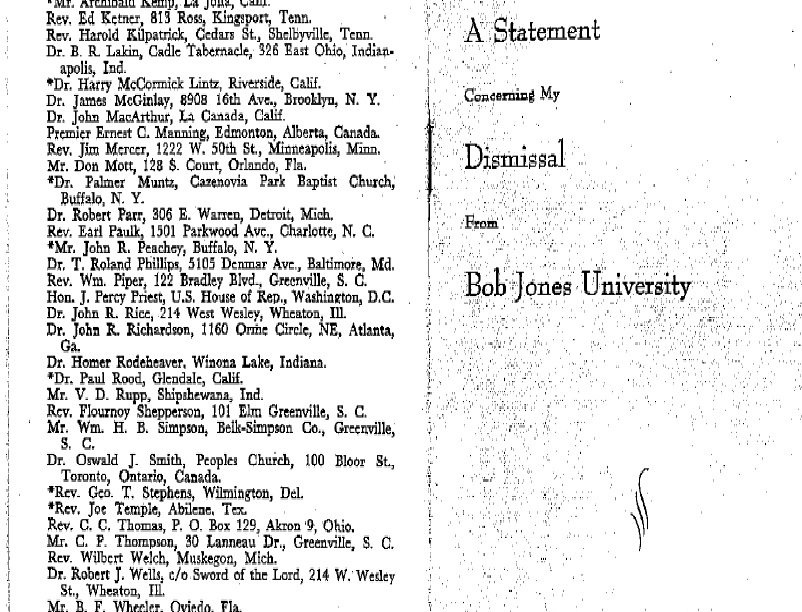
He said, he said, c. 1953

He said, he said, c. 1953

As SAGLRROILYBYGTH are sick of hearing, I’m up to my elbows in my new book about the twentieth-century history of conservative evangelical colleges. Time and again, administrators and trustees have demonstrated a deep distrust of their faculty.

In the 1930s, for example, Bob Jones College purged a suspect group of teachers. One of the fired faculty, Joseph Free, penned a protest letter. He had previously worked at three different colleges, Free wrote,

two of them orthodox. (But not obnoxious.) My loyalty was never questioned. . . . It simply never occurred to me that I was not free to express my opinions and I did express them. How was I to know that loyalty meant dictatorship?

Perhaps more famously, this pattern was repeated at Bob Jones University in the 1950s. Ted Mercer was fired in the summer of 1953, accused of a host of crimes including planning a “revolt of many faculty members.” Mercer himself claimed to have been blindsided by his dismissal. Maybe he had become too popular with students and faculty. Perhaps Bob Jones Sr. was too zealous in his jealousy of other administrators. In any case, Mercer went on to a long career at Bryan College.

The abiding distrust of faculty at fundamentalist colleges has not been unique to Bryan and Bob Jones U. At Wheaton College as recently as 1961, faculty scientists were pressed into a needless and humiliating mea culpa. After a conference on evolution and creationism in 1960, anxious trustees forced Wheaton administrators to tighten the school’s official position on the origins of humanity. No longer would it suffice for faculty to agree that God created. Since 1961, they have had to affirm that Adam and Eve were real historical personages and the true parents of the species. Professor Russell Mixter had to affirm his orthodoxy over and over again in order to allay the fears of Wheaton’s guardians of orthodoxy.

Nor was Dr. Mixter’s ordeal out of the ordinary at Wheaton. As historian Michael S. Hamilton wrote in his brilliant 1994 study of Wheaton’s history, the board of trustees has always been distrustful of the faculty. In Hamilton’s words, trustees have believed “the faculty represented the single greatest danger to maintaining the college’s Christian character.”

As usual, Hamilton’s history proves prescient. According to the Times Free Press, new rules at Bryan College seem intended to crush any whisper of faculty independence. New rules restrict professors’ ability to call meetings, for example. As the TFP explains,

Under this new policy, a faculty member is required to go through a seven-step process that includes approval from the Academic Council, a written rationale stating the purpose of the meeting and a waiting period of at least a week.

This sort of contrived impotence may seem shocking to those unfamiliar with the unique traditions of fundamentalist higher education. Within that charmed circle, however, it seems like nothing more than a new take on an old tradition: When the going gets tough, the faculty get blamed.
Fundamentalist Colleges Save Lives

Maybe they were right. One of the hallmarks of conservative evangelical colleges has always been a clampdown on student behavior. The goal was to protect student morals, but a side benefit seems to have been protecting student health. A new study finds…surprise, surprise…that smoking pot and binge drinking lead to more risky sex among undergrads.

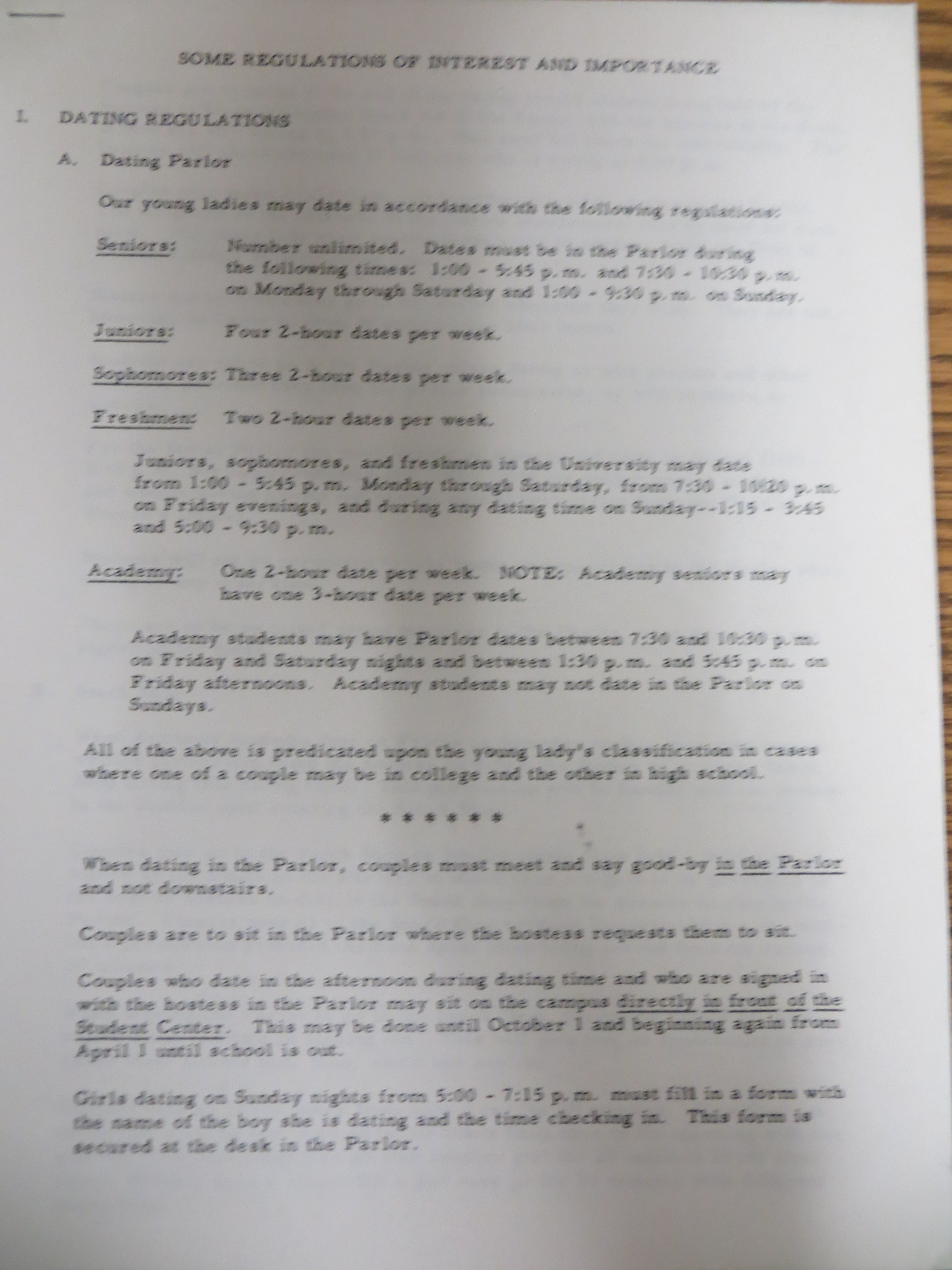
A hundred years ago, conservative evangelical Protestants reeled from the horror stories oozing out of America’s elite colleges. Fundamentalist preachers warned their flocks that colleges in the 1910s no longer protected students’ faith or morals. As a result, fundamentalists founded their own network of rigidly conservative schools. In addition to fundamentalist theology, all of these colleges adopted draconian rules for students: No smoking, no dancing, no drinking…and certainly no unmarried sex.

The view from 1931, Bob  Jones-style.

The view from 1931, Bob Jones-style.

As I work on my new book about the history of these schools, I’m struggling to make sense of these ubiquitous student rules. It’s easy enough to find the paper trail in the archives. At Bob Jones College, for example, founder Bob Jones Sr. placed the burden of avoiding sex on women.

Jones explained his thinking in an open letter from the 1920s:

The Bob Jones College discourages extravagance in dress AND INSISTS UPON MODESTY.

We request our girls to wear simple dresses in classes. We have a laundry where these dresses can be laundered.

The girls in the Bob Jones College voted to wear their dresses two inches below the knee cap. This is short enough for style and long enough for decency.

The girls in the Bob Jones College last year had the reputation of being the most attractive group of girls in the country, and as a whole, they dressed very simply.

There is one regulation which we wish our girls to thoroughly understand. WE DO NOT ALLOW OUR GIRLS TO WEAR EACH OTHERS CLOTHES. The only exception is in the case of sisters.

Bob Jones College was not alone in the effort to control sex by controlling women. One student who attended Wheaton College in the 1920s remembered a similarly strict regime of sexual policing. “Well,” this former student remembered in a 1984 interview,

The control was rather tight. Of course, that was in those days when . . . when the separation of the sexes was very strict, and the . . . the regulations were . . . dress regulations and so forth were quite strict.

Did students find ways to get around these rules? Of course. It’s harder to find, but as I delve into the archives of these colleges I find examples of students being punished for drinking, smoking, attending movies, and, of course, hooking up. One student at Bob Jones College was caught climbing out of his girlfriend’s dorm window at midnight. He said they had been praying together. A student at Wheaton remembered his roommate speaking to his girlfriend through a system of prison wall-taps.

All in all, though, the draconian system of student rules meant a different campus experience than at non-fundamentalist colleges. Over the years, the rules have loosened up, but they remain more restrictive than at other schools.

What has been the result? On the one hand, the system of sexual policing seems to pushed sex on campus into dangerous and degrading directions. Bob Jones University, for example, admitted its terrible and terrifying record of ignoring and even tacitly encouraging sexual abuse and victimization.

But we can’t help but think that stricter rules against drugs and alcohol must do something to protect students, as well. Don’t get me wrong: I’m no apologist for evangelical universities. I’m not evangelical myself; I don’t work at an evangelical college; I don’t dream of a school in which students don’t use drugs or have sex.

However, there seems to be demonstrable evidence that drinking and using drugs leads to risky behaviors. The researchers at Oregon State found direct connections between smoking pot, binge drinking, and unhealthy sexual practices. Students who used more drugs on any given day were more likely to have sex without a condom, for example.

The stricter rules about drugs and sex at evangelical colleges were put in place to protect student morals, not their health. As I’ve argued before, if we want to understand conservative attitudes about sex, we need to shift out of the medical mindset. However, perhaps there has been a positive side-effect.

I would love to see a study like this in which researchers looked at student behavior at a variety of schools. Did school rules against booze and sex discourage risky behaviors? Or did the added illicitness simply push students to take more risks?

Creation College Scorecard

How can you do it? How can outsiders push colleges to do more of what they want? The rage these days is to issue rankings. Since colleges are ferociously competitive and many of them are teetering on the brink of insolvency, college leaders are willing to do what it takes to move their colleges up any ranked list. Everyone from President Obama to young-earth impresario Ken Ham is issuing their own unique college scorecards.

Whom can a creationist trust?

Whom can a creationist trust?

In each case, influential outsiders promise that their scorecards offer students and parents a helping hand. President Obama, for example, insisted that his new scorecard was “meant to help students and parents identify which schools provide the biggest bang for your buck.” Ken Ham, too, promises that his Answers In Genesis ministry now has

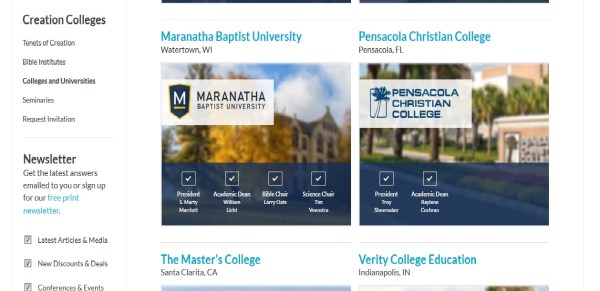
resources to help young people (and their parents) with the upcoming college years. In addition to our annual College Expo weekend for students thinking about attending a Christian college (which will be here at the Creation Museum this November 6 and 7), we have just updated our special CreationColleges.org web site. It helps young people (and parents) narrow the overwhelming process of choosing a college even more.

These scorecards, though, do more than just provide information. They pressure schools to move in a certain direction. If college presidents want to move their schools up the list of rankings, they will make changes based on the scorecard’s values.

And college presidents DO want to move their schools up the rankings. Any rankings. Colleges and universities these days are locked in a death-struggle for students and tuition dollars. If they can’t attract ever-increasing numbers of applicants, they won’t survive.

President Obama wants schools to pay more attention to student finances. His recent scorecard compares schools based on their financial performance: How much do average graduates earn? How much debt to students accumulate?

Ken Ham is playing the same game. His recently updated Creation College guide offers families information about the ways colleges measure up to Ham’s definition of creationist orthodoxy. Students can see if a school teaches young-earth creationism. They can also see if the president has agreed, and if other key leaders in the Bible and Science Departments have signed on.

Clearly, some conservative evangelical colleges will be tempted to do whatever it takes to get Mr. Ham’s stamp of approval. Some, like Bryan College, have already tightened their statements of faith and pushed out controversial teachers. Others will consider making similar moves.

Don’t like it?  Then why not try putting together a college scorecard of your own?  You could rank colleges based on whatever criteria you choose.  What are the most Benedict-Option-friendly colleges?  What are the most progressive colleges?  What colleges are the best for teaching evolutionary science?  Etc.!

The Handwriting on the Wall for Christian Colleges

It doesn’t look good.

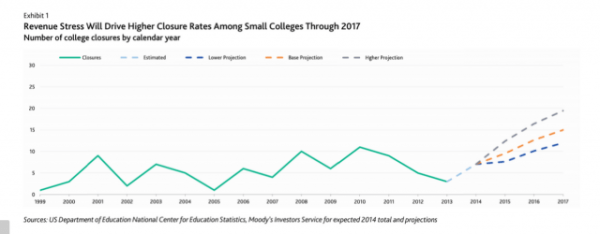
For small colleges of any sort, the future looks grim. A new report from Moody’s (the investor service, not the Bible institute) offers some scary predictions about the iffy future of small schools. For conservative evangelical colleges, however, this looming financial crisis also represents a uniquely religious crisis. Will small evangelical colleges be able to resist the growing pressure to become more radical in their orthodoxy?

Look out, Daniel!

Look out, Danny!

Inside Higher Education describes the sobering financial outlook. In the next few years, college closings will likely triple. Why? Fewer students means fewer tuition dollars, which means fewer scholarship dollars, which means fewer students. Rinse and repeat.

Among conservative evangelical schools, we’ve already seen the trend. Former evangelical schools such as Northland University, Tennessee Temple, and Clearwater Christian have all closed their doors. In some cases, the “Wal-Marts” of Christian colleges have emerged even stronger. Cedarville University, for example, has offered to accept all students from Clearwater Christian. As with non-evangelical schools, the big will likely get bigger and the small will get gone.

For small evangelical colleges, this presents a double pickle. In desperate need of more students, schools will likely become extra-timid about offending conservative parents and pundits. As I’ve argued before, young-earth impresarios such as Ken Ham already exert outsize influence on college curricula. If Ham publicly denounces a college—which he likes to do—you can bet young-earth creationist parents might listen.

We’ve seen it happen at Bryan College. Rumors of evolution-friendly professors caused administrators to crack down. Any whiff of evolutionary heterodoxy, and schools might scare away potential creationist students.

At other evangelical colleges, too, as we’ve already seen in schools such as Mid-America Nazarene or Northwest Nazarene, administrators desperate for tuition dollars will be tempted to insist on a more rigidly orthodox reputation.

Things aren’t looking good for small colleges in general. But conservative evangelical schools face this special burden. In order to attract the largest possible number of students in their niche, they might have to emphasize more firmly the things that make them stand out from public schools. In the case of conservative evangelical schools, that distinctive element has always been orthodoxy.

In the past, well-known schools such as Bryan College might have relied on their long history as staunchly conservative institutions. They might have assumed that conservative evangelical parents would trust their orthodoxy, based on their long-held reputation as a bastion of conservative evangelical education. These days, no-holds-barred competition for students will mean that every school must guard its image far more aggressively.

Can a College Be Christian?

After Ben Carson’s stupid and hateful comment that the USA should not have a Muslim president, Baylor theologian Roger Olson noted that we really could not have a Christian president, either. In my current work about evangelical colleges, I’m struggling to define what it meant to be Christian at school, too. It raises an ancient question: Can an other-worldly religion (successfully) run worldly institutions?

Olson noted that the only sincere evangelical to sit in the Oval Office in recent decades has been Jimmy Carter. And Carter, Olson argued, was a terrible president. Not by accident, either, but because he was an honest-to-goodness Christian. As Olson put it,

I am not cynical, but neither am I naïve. America is no longer a true democracy; it is run by corporations and the super-rich elite. Occasionally they don’t get their way, but, for the most part, they do. One reason they do not seem to is that they do not agree among themselves about everything. So, sometimes, a president, a senator, a congressman, has to choose between them in decision-making. But, in the end, the policy remains that “What’s good for business is good for America” even when what’s good for business is bad for the working poor (to say nothing of the destitute).

No, given how modern nation states work, I do not think a real Christian, a true disciple of Jesus Christ who seeks to put first the kingdom of God and God’s righteousness, can be president of the United States or any modern nation state.

The deeper question of belief and institutional necessity is one I’m wrestling with these days. As I write my new book about the history of evangelical higher education, I find myself struggling to offer a satisfactory definition of what it has meant to be a fundamentalist. It’s a question that has bedeviled historians (and fundamentalists) for a good long while, so I feel I’m in good company.

For good reasons, historians have insisted that we need a fairly narrow definition of fundamentalism. In his great book Revive Us Again, Joel Carpenter argued, “more generic usage obscures more than it illumines” (page 4). Carpenter was leery of commentators who slapped a “fundamentalist” label on any and all conservatives or conservative Protestants. As he argued,

Labelling movements, sects, and traditions such as the Pentecostals, Mennonites, Seventh-day Adventists, Missouri Synod Lutherans, Jehovah’s Witnesses, Churches of Christ, black Baptists, Mormons, Southern Baptists, and holiness Wesleyans as fundamentalists belittles their great diversity and violates their unique identities (4).

If we need a straightforward definition for those reasons, Matthew Sutton’s recent definition of fundamentalism as “radical apocalyptic evangelicalism” will do the trick. Certainly, fundamentalist theology was defined by its vision of end-times as well as by the centrality of those apocalyptic visions to the movement.

But such definitions don’t seem to match the ways fundamentalism has been defined in its leading institutions. At the colleges I’m studying—schools such as Wheaton College, Bob Jones University, Bryan College, Biola University, The King’s College, and similar schools—there’s more to the school than just theology.

When these schools called themselves “fundamentalist” (and they DID, even relatively liberal schools such as Wheaton), they meant more than theology. They meant more than just “radical apocalyptic evangelicalism.” They meant more than just “not-Mennonite-or-Pentecostal.”

Defining fundamentalism as it was used in fundamentalist institutions is a trickier issue than simply defining fundamentalist theology. By and large, when schools talked about themselves as “fundamentalist,” they meant that the professors and administration all signed on to fundamentalist theology. But they also meant that the students would have a vaguely conservative atmosphere in which to study. No smoking, no dancing, no etc. They also meant that students would be controlled and guided in their life choices. And they also meant that students would be more likely to socialize with similarly fundamentalist friends and future spouses.

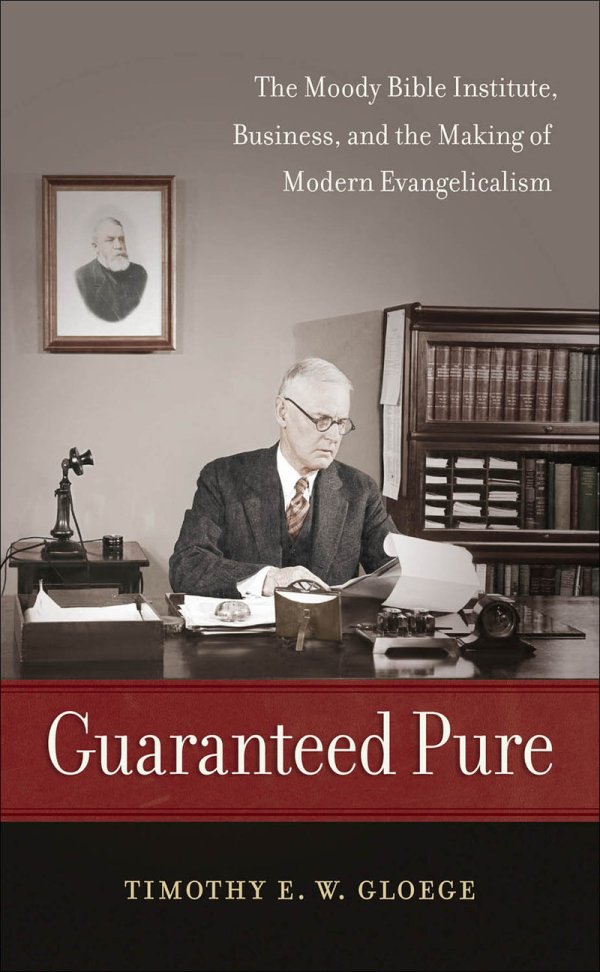
I’m not sure how to define that kind of fundamentalism. I like the way historian Timothy Gloege has done it in his new book about the Moody Bible Institute. Gloege focuses on what he calls the “corporate evangelical framework” that guided MBI since its founding in the 19th century.

What did fundamentalism mean in Chicago?

What did fundamentalism mean in Chicago?

As Gloege argues, at a school like MBI, fundamentalism was more than a set of “manifestos and theological propositions.” Rather, it worked as a set of “unexamined first principles—as common sense.” Fundamentalism, Gloege writes, is better understood as a certain “grammar” than as a list of religious beliefs.

That kind of definition seems closer to the ways it was used in the schools I’m studying.

Roger E. Olson argues that it will be impossible for any sincere evangelical Christian to be president. There are simply too many worldly factors that violate the otherworldly morality of Christianity. Similarly, evangelical colleges have not defined themselves merely along theological lines. They couldn’t. Instead, they have defined what it has meant to be a “fundamentalist” based on a range of factors. Of course, they care about student religious belief. But they also care about student fashions, patriotism, diets, and social lives. And such things were usually considered a central part of making a school authentically “fundamentalist.”

Can a college be Christian? In the sense that Roger E. Olson is asking, I guess not. Just as every president has to violate evangelical morality, so every institution of higher education has to consider a range of non-religious factors in order to survive.

Government Pretends Conservative Schools Don’t Exist

To be fair, it goes both ways. As I’ve argued here, there, and everywhere, conservative intellectuals have long disputed the influence of the federal government in education. Now, President Obama jabs back: A new college scorecard simply left leading conservative schools off its list. The message is clear, and creepy even for non-conservatives like me.

In President Obama’s release of the new guide to colleges two weeks ago, he promised,

Americans will now have access to reliable data on every institution of higher education.

EVERY institution. If you don’t see a school on the list, it doesn’t exist.

Except they do. And the ones that were left off have glaring similarities. All of them are robustly conservative schools. Schools such as Grove City College in Pennsylvania, Hillsdale College in Michigan, Christendom College in Virginia, New Saint Andrews College in Idaho, and Wyoming Catholic College.head-in-sand

The schools were left off because they refuse to accept federal dollars for their students. Because of that, they do not have to file student data with the federal government. Because of that, the feds don’t have the information they need to put these schools on the scorecard.

Naturally, the schools themselves didn’t like it. According to the Washington Post, Paul McNulty of Grove City College issued the following statement:

However well-intentioned, the Scorecard as it exists now is incomplete and does not fully disclose comprehensive data that families need to make informed decisions. For now, the Department should, at the very least, include a disclaimer that the Scorecard is not comprehensive or reflective of all college and universities.

Hillsdale College had it worse. When the student newspaper inquired as to why Hillsdale was left off the list, it was told that the school granted a plurality of certificates, not degrees. Hillsdale told Fox News that it just wasn’t true. Hillsdale students are almost all in degree programs.

I’m no conservative, but I think these schools have every right to complain. To my mind, the creepy part of this story comes on two different levels.

First, I worry about any ranking of higher education based mainly on economic factors. I don’t think anyone intended for this scorecard to be the only measure of educational quality, but President Obama made no secret of the values inherent in this scorecard. As he put it,

You’ll be able to see how much each school’s graduates earn, how much debt they graduate with, and what percentage of a school’s students can pay back their loans…

That’s helpful information, but I don’t like the implication that such factors are the proper way to measure higher education. Even worse, any scorecard that claims to rank all colleges really should. By leaving out conservative schools who have not played ball with the federal government, this scorecard seems to be making a crude power play.

Again, I don’t agree with the guiding philosophies of any of these schools, but I think they have every right to be included in any list of “every” college out there.

Progressive Microaggressions

HT: DK

Are we progressive professors guilty of our own species of microaggression? Fredrik deBoer says yes.

DeBoer teaches at Purdue and blogs about culture and higher ed. In a recent post, deBoer worried that his progressive colleagues seem strangely willing to mock and belittle their conservative students. Not in the classroom. In spite of conservative laments about overt professorial hostility, deBoer claims that most left-leaning faculty “are so sensitive to the impression that they’re biased against their conservative students that they bend over backwards to accommodate them.”

But deBoer accuses his allies of a curious blind spot. They tend to mock conservative students on Facebook and other social-media outlets. DeBoer comes to the smart conclusion:

People are really, really invested in consistency and fairness. And if academics don’t make a huge improvement in projecting them, they will be the razor with which our throats are slit.

He’s referring to two particular recent episodes. At Duke, some conservative students protested against a leftist summer reading assignment. At North Carolina, a student accused the school of coddling terrorists.

As deBoer reports,

many academics I know have reflexively, unthinkingly laughed off these conservative complaints. They’ve bombarded social media with “lols” and “wtfs.” They’ve mocked these students as rubes. They’ve given every outward appearance of not even attempting to evaluate these students’ claims with the same care, sensitivity, and fairness that they evaluate the claims of progressive students invoking the language of trauma and triggers. In other words, they’ve rushed to confirm every complaint conservative critics of the academy have made, and the most damning one in particular: that we treat our progressive students with more kindness and approval than our conservative students, and that we use the formal procedures of the university to do it.

I wholeheartedly agree with Dr. DeBoer’s warnings, but I think he could take it one step farther. Not only do my fellow progressive academics tend to assume too much about their campuses and their social-media worlds, but they do so out of a woeful and widespread ignorance. Some of us assume that young people will somehow naturally sympathize with left-leaning ideas. We couldn’t be more wrong.

If the campaign against microaggressions has any moral heft, it is because it is at heart a campaign against ignorance. Yet as sociologists such as Elaine Howard Ecklund have argued, many scholars display shocking ignorance about their own students.

Even if we progressive professors are polite to our conservative students, are we guilty of microaggressions that only the students themselves notice? Do we betray our own ideals by failing to learn more about our students’ backgrounds? Are there things we don’t even notice about our classes that might make conservative students feel unwelcome?

Why Do People Go to College?

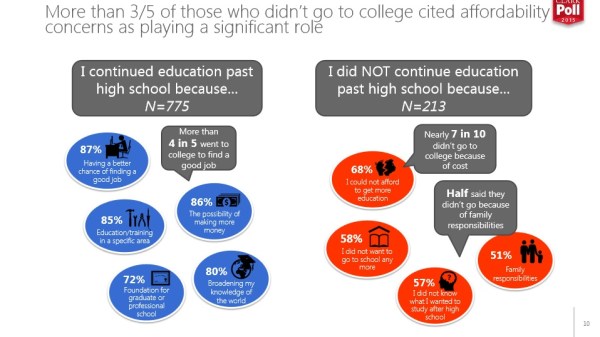
Do young people go to college to become better people? Or to earn more money? The obvious answer, it seems, is “Yes.” A new poll from Clark University suggests that most young college graduates went to school for both economic and mind-expanding reasons.

What do you wanna do with your life?

What do you wanna do with your life?

Jeffrey Jensen Arnett and his colleagues at the storied Clark University polled 1,000 adults between the ages of 21-29. The results confirmed the argument of historian Roger Geiger, who concluded that attending college has always been about “knowledge, careers, and culture.”

Large majorities of respondents wanted a better economic future. But they also wanted to increase their “knowledge of the world.” And, of course, many of the bolder respondents admitted that they were attracted by “the potential to have fun.”

Polls like this provide yet more evidence that the death of the humanities has been greatly exaggerated. As smart people have pointed out, people still go to college for more than pecuniary reasons. Young people still want to have their minds blown. College students certainly hope their degree will help them make more money, but that’s not the only reason they go to college.

Is THIS the Future for Christian Colleges?

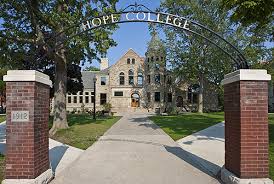
Now what do we do? That is the question plaguing conservative college administrators nationwide. Since the Supreme Court decision in favor of same-sex marriages, many evangelical schools have wondered if they will have to change the way they do things. In Michigan, Hope College has announced its accommodation with the ruling. Will other Christian colleges do the same thing?

The gateway to the future?

The gateway to the future?

As the Sophisticated and Good-Looking Regular Readers of I Love You but You’re Going to Hell (SAGLRROILYBYGTH) are well aware, questions of homosexuality and same-sex marriage have long bedeviled evangelical colleges. For non-evangelicals, it might come as a surprise to hear that the issue is contentious. After all, at most evangelical schools, the official doctrine clearly and resolutely condemns homosexual activity.

Yet at all sorts of schools, the campus community is much more welcoming. At Gordon College recently, the president’s reminder that the school officially bans “homosexual practice” brought furious protests from students and faculty. Even at the far more conservative Liberty University, faculty members do not always take the harsh tone we progressives might expect.

As our Supreme Court decided the constitutionality of state bans on same-sex marriage, many evangelicals fretted that their decision would trash traditional rules on their campuses.

At Hope College in Michigan—a school in the Reformed Church tradition—the leadership and campus has experienced similar turbulence on the issues of homosexuality. In 2010, for example, the administration provoked protests when it banned the film Milk. More recently, the campus has welcomed homosexual student organizations, though the administration has continued to endorse the Reformed position on homosexuality.

In its most recent announcement, the school’s leaders have declared their intention to abide by the SCOTUS decision. From now on, same-sex married partners of college employees will be eligible for the same benefits as heterosexual partners. The administration again affirmed its respect for the Reformed Church’s official doctrine that homosexuality is a sin. That does not mean, however, that the school will contravene the law.

Is this the path other schools will follow? Unlike pluralist colleges, evangelical schools face intense pressure to stay true to traditional beliefs and norms. As Professor Michael Hamilton wrote in his study of Wheaton College,

The paradigm that has dominated Wheaton through the century holds that colleges, more than any other type of institution, are highly susceptible to change, and that change can only move in one direction—from orthodoxy toward apostasy. . . . The very process of change, no matter how slow and benign it may seem at first, will always move the college in a secular direction, inevitably gathering momentum and becoming unstoppable, ending only when secularization is complete.

Hope College may find itself the front line for this debate within the Reformed Church in America. The church as a whole has gone back and forth for decades about the proper Christian reaction to homosexuality. Is it better to embrace the sinner? Or to drive out the sin? Conservatives within the RCA will doubtless take this announcement as proof that Hope has gone soft. Progressives will celebrate it as a small step towards equity.

Other evangelical schools will face similar scrutiny. If they openly welcome homosexual students, faculty, and staff, they will be subject to withering condemnation from conservatives. If they don’t, however, they’ll risk being sidelined, branded as anti-gay bigots.

Wal-Mart and the Death of College

Don’t be fooled. Just because the rumors of Sweet Briar College’s death have been greatly exaggerated, don’t think that small colleges have any reason to be optimistic. And for small conservative religious colleges, there is an even more difficult problem. They need to perform an impossible feat—get more religious and less religious at the same time.

Adorable but unaffordable?

Adorable but unaffordable?

As I’m arguing in my current book, fundamentalist and evangelical colleges and universities have always faced all the same challenges of mainline schools, plus many unique ones. The situation today is exactly the same. Conservative religious colleges face the same sorts of Wal-Mart-style challenges of scale, plus the additional constraints of remaining true to religious orthodoxy.

Though its affluent alumni seem to have saved Sweet Briar College, small evangelical and fundamentalist colleges have been winking out like dead fireflies lately. The reasons are clear. Just as the Wal-Martification of retail stores has made Mom-and-Pop stores impossible, so have the twentieth century’s slow academic revolutions made small colleges impossible. Many of them just don’t seem to know it yet.

What happened at Sweet Briar? The numbers just didn’t add up. Writing in the pages of Inside Higher Ed, Scott Jaschik quoted a gloomy financial report:

A report last month by Moody’s Investors Service said, “In Sweet Briar’s case, challenges included small scale, which, combined with weakening demand, declining pricing flexibility and an insufficient endowment, led to an unsustainable business model.” Some of the very qualities that make alumnae so loyal also make it hard to balance the books, Moody’s said. “Sweet Briar’s model of providing highly personalized education with small class sizes is expensive, as indicated by educational expenses per student of approximately $42,000,” said the report. “Although this cost structure is commensurate with the other rated women’s schools, standing at the median, colleges either need greater pricing flexibility, larger endowments or more gift revenue to sustain the model.”

Small colleges are trapped in a terrible pickle. To survive, they have to achieve a certain minimum size. Otherwise, they can’t afford to offer all the programs and services that students these days expect from a college. But they can’t achieve that minimum size if they keep their prices high. Students will go elsewhere if they are charged the full sticker-price. If schools lower prices, however, they will also die.

In Sweet Briar’s case, activist alumni pledged to raise 12.5 million dollars to keep the school running. That’s a lot of moolah. And no school—not even one with wealthy and involved alumni—can expect to survive only on the good wishes of its past students.

For conservative evangelical schools, the outlook is even more gloomy. In order to attract students, they must continue to demonstrate beyond question their religious orthodoxy. In some cases, such as the controversies lately at Bryan College, Mid-America Nazarene, and Northwest Nazarene, this will mean clamping down on faculty who seem to be moving in a liberal direction. At the same time, however, in order to attract students, they need to widen their pool of potential students. That means offering more programs and more courses. It also means opening up to students from different religious backgrounds. After all, if tuition dollars are getting harder to find, it will get harder and harder to turn paying students away.

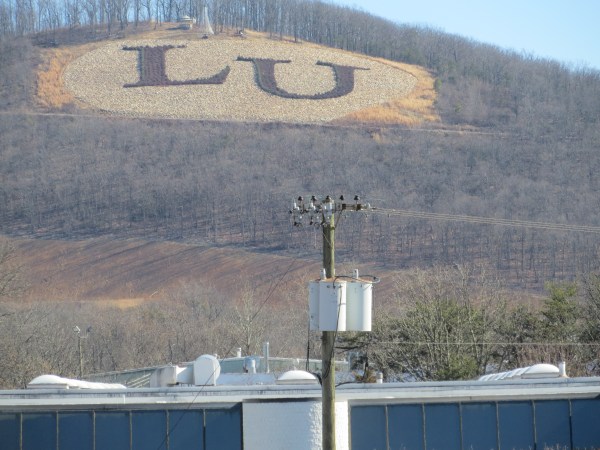
Some fundamentalist schools are thriving in this difficult environment, at least for now. Most prominently, Liberty University in Virginia is raking in the dough. By making itself into a leader in online education, Liberty has managed to grow at a breakneck pace in the past decade.

Raking in mountains of dough...

Raking in mountains of dough…

As its online offerings increase, however, Liberty has to somehow demonstrate that it has not watered down its strict religious requirements. Those requirements, after all, are the school’s primary raison d’etre. Even as it pumps money into its football team and its all-year faux snowboard hill, Liberty’s leaders need to watch out for the creeping liberalism that tends to accompany higher-ed growth.

I’m happy for those folks who love Sweet Briar College. But their impressive display of life-support should not give comfort to other college leaders. The fundamental financial situation has not changed. Small colleges have to remain small to maintain their traditional style of teaching, but they have to grow in order to be financially solvent.

Small evangelical colleges face those same impossible challenges, plus some unique ones. They have to remain orthodox in order to keep their niche, yet they have to broaden their appeal in order to survive at all.

I’m glad I’m not in charge of one of those schools.