College Sex

More bad news: Sexual assault is more than just another crime on college campuses. It is a crime that has been woven into the fabric of college life itself. Will it cause an exodus to conservative colleges?

The Washington Post recently released the findings of its new poll of college life. After surveying 1,053 students and interviewing fifty, the pollsters concluded that a quarter of college women had suffered “unwanted sexual incidents in college” and a fifth had endured “sexual assault.” That is bad news. The worse news is that the cause of these alarmingly high numbers is college itself. Part of what Americans want out of college has long been a licentious student atmosphere. For Frank the Tank and millions of other Americans, the allure of college includes binge drinking, casual sex, and “streaking the quad.”

These numbers have become—like most contentious issues in education—something of a culture-war football. As the Washington Post report points out, different polls have come up with very different results. The Post poll used a broad definition of sexual assault. Victims are those who have experienced

five types of unwanted contact: forced touching of a sexual nature, oral sex, vaginal sexual intercourse, anal sex and sexual penetration with a finger or object. . . . assailants used force or threats of force, or they attacked while their victims were incapacitated.

It is this last phrase that has caused the statistical battle. Last year, a government Bureau of Justice Statistics claimed that only 6.1 out of 1,000 college students experienced sexual attacks, a lower number than non-college students of the same age. But the BJS poll did not include sex that occurred when people were too drunk to give consent.

These days, there are orthodox positions on campus sexual assault. Progressives generally push for harsher punishments for perpetrators. Conservatives often lament the absence of due process on campuses. Hardening culture-war positions can be tested with high-profile cases: Do you think Emma Sulkowicz is a hero or a kook? Do you think Lee Bollinger is a monster?

All sides agree, however, that today’s student culture contributes to the problem. It is normal for students to binge drink. It is normal for students to engage in casual sexual encounters. In such an environment, it can be devilishly difficult to determine if and when students crossed a line from casual drunken sex to incapacitated sexual victimization.

For college leaders, this situation presents an unsolvable puzzle. As historian Roger Geiger has argued, by 1890 most schools participated in the emergence of the modern student lifestyle. Instead of days packed with required chapel visits and several recitations, modern colleges and universities offered students an array of possible majors and a much freer daily schedule. As a result, now-familiar student organizations such as fraternities and athletic teams became important parts of college experiences.

What Geiger called the “collegiate revolution” soon became an expected part of a full college experience. University leaders these days might huff and puff about fighting binge drinking. They might offer counseling and classes about appropriate sexual behavior. But if school leaders really cracked down on the drunken partying that leads to so much of this sexual assault, they’d quickly find themselves out of a job. Alumni donors insist on it. Potential students look for it. Like it or not, one of the expected parts of a college education these days is irresponsible behavior.

As SAGLRROILYBYGTH are well aware, I’m working on a book these days about a dissenting group of colleges and universities. These conservative evangelical schools—schools such as Wheaton College in Illinois and Bob Jones University in South Carolina—have often participated in many elements of modern academic life. For example, like mainstream schools, fundamentalist colleges divided their work into academic disciplines. They encouraged faculty research. They insisted that students complete high school before entering college. All of these things seem obvious to us, but they all came as revolutionary changes between roughly 1870 and 1920.

But fundamentalist schools resolutely refused to accept some of the revolutionary changes at mainstream colleges. For instance, they did not agree to the emerging concept of academic freedom for faculty. At fundamentalist colleges, professors had to agree every year to various school creeds. For students, fundamentalist college life also looked very different. Though most fundamentalist schools allowed student clubs and athletic teams, most of them banned fraternities. They also banned smoking, drinking, and sex.

Fundamentalist colleges have plenty of problems of their own when it comes to sexual assault. Most egregiously, as we’ve noted in these pages, some schools have accused victims of causing the problem. Others have participated in the kinds of shameful cover-up common among mainstream colleges as well.

Yet students at fundamentalist and conservative evangelical colleges will not likely suffer from the same sort of drunken, incapacitated sexual assault that seems so depressingly common at mainstream schools. I’ve been accused of ignorance and insensitivity for pointing this out in the past.

I still can’t help but wonder, though: If the sort of sexual assault reported in the WP poll really shocks people, will the teetotaling atmosphere on conservative campuses begin to seem more attractive? Will secular or liberal Protestants think about enrolling their children at conservative schools just to avoid drunken hookups and assaults?

Academic Impostors

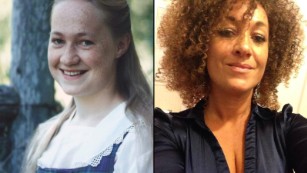
What does Rachel Dolezal have to do with Woodrow Wilson? Her story has been poked and prodded from every angle, it seems, except one. In important ways, this is a story about higher education. Universities have always had non-academic categories that they have preferred. Students and faculty—like Dolezal and President Wilson—have always allowed schools to think they fill those categories, even if they don’t.

Dolezal then & now...

Dolezal then & now…

If you haven’t heard about Dolezal yet, congratulations. Her strange tale of a white woman passing herself off as an African American leader has attracted bajillions of comments from all over the punditocracy. In very brief form, here are the highlights: Dolezal has served as the successful chapter leader of the Spokane NAACP. She has either allowed people to think of her as African American, or has even checked that box herself. She may have performed some Facebook fakery to make her family look more African American. She attended graduate school with a full scholarship at the historically black Howard University. She teaches African American Studies classes at Eastern Washington University. Recently, her very white parents outed her as white. The family had split over Rachel’s accusations of abuse. Rachel had fought for custody of one of her younger brothers.

As journalists have noted, this story has raised tricky questions about race and racism in the United States. Conservative commentators have wondered why people can be transgender but not transracial. The NAACP has issued a statement affirming that its leaders can be from any racial background.

As SAGLRROILYBYGTH are well aware, I’m up to my eyeballs in research for a new book about the history of American higher education. To my tired eyes, one angle of this story jumps out and I haven’t heard any other nerds talking about it. As a student and as a teacher, Dolezal’s imposture has reaped significant rewards. If nothing else, her story can give us another example of the ways preferred categories have always affected higher education.

At Howard University, according to Dolezal’s father, Rachel allowed the school to assume she was African American. They gave her a full scholarship for her graduate program in art. She also teaches part-time at Eastern Washington University in the Africana Education Program. It is not certain that she lied to the people who hired her there, but the director of the program told the New York Times he thought she was black.

It seems evident that Dolezal would not have had the same opportunities at Howard or EWU if she had not been perceived as African American. Academic positions, especially in relevant areas such as Africana Studies, usually have explicit preferences for members of underrepresented groups.

Now, don’t get me wrong, I’m not against hiring preferences in higher education. I agree that personal background can be an important factor when it comes to teaching and scholarship and universities are correct to prefer some candidates based on non-academic qualifications. IMHO. Indeed, I only got my job because of my experience as a secondary-school teacher.

The interesting point, rather, is that these non-academic preferences can tell us a lot about the nature of higher education, the non-academic values of colleges. In the past, elite schools used to prefer Christian professors, for example. This is where Woodrow Wilson comes in. When Wilson, future POTUS, was elevated to the Chair of Political Economy and Jurisprudence at Princeton University in 1890, he received a forceful letter from Princeton President Francis Patton. To keep his chair, Patton warned, Professor Wilson would need to be far more explicit in his Christian testimony.

Patton worried in a letter to Wilson

That in your discussion of the origin of the State you minimize the supernatural, & make such unqualified application of the doctrine of naturalistic evolution & the genesis of the State as to leave the reader of your pages in a state of uncertainty as to your own position & the place you give to Divine Providence.

Princeton, Patton insisted, was determined to “keep this College on the old ground of loyalty to the Christian religion.”

Even at the time, as Patton’s language suggested, such Christian orthodoxy was becoming rarer and rarer in American higher education, at elite schools at least. Patton wanted to hire only Christian scholars. Wilson, for his part, allowed Patton to think he agreed, though Wilson’s later work never embodied the sort of loud-and-proud supernatural thinking Patton desired.

What does any of this have to do with Rachel Dolezal? Back in the 1890s, if one wanted a job at Princeton, one was wise to allow school leaders to think one supported orthodox Calvinism. These days, if one wants a job in a university, one is wise to allow school leaders to think one is a member of an historically underrepresented group.

Back then, conservative schools such as Princeton and Yale were clinging to an older tradition of explicitly Christian education. These days, schools are scrambling to include a wider diversity of racial backgrounds.

Wilson’s career was certainly not hurt by his willingness to let Patton believe his Presbyterianism was stronger than it really was. Dolezal—until this ugly scandal, of course—has not been hurt by people’s assumptions about her racial background.

Can Fundamentalist Colleges Survive?

We might be on the cusp of another academic revolution. Over the centuries, what people have expected out of college has changed time and time again. Every time it changes, schools have to adapt or die. With the announced closure of Clearwater Christian College, we see another small conservative evangelical liberal-arts college bite the dust. This seems to be more than just bad management or weak organization.  It looks like yet another shift in what people mean when they say “college.” Can small, private liberal-arts schools keep up?

Going the way of the dodo?

Going the way of the dodo?

Clearwater’s students aren’t the only conservative evangelicals scrambling to find a new home. Tennessee Temple also recently announced its closure. Northland has shut its doors. And outside the bounds of fundamentalist higher education, Sweet Briar College in Virginia caused a fuss when it announced its demise, even with a plump $85 million endowment.

Colleges have always opened and closed and these recent happenings might not mark a trend. But it seems likely that the stern financial logic of mainstream higher education is also compelling at conservative religious schools such as Clearwater, Northland, and Tennessee Temple.

Scott Jaschik of Inside Higher Ed thinks that small liberal arts colleges in rural areas face an existential threat. Students just don’t want to live thirty miles from a Starbucks. They want to go to schools that prepare them for specific careers such as business, health care, or education. The idea of sequestering oneself for four years to contemplate the big ideas in extended bucolic adolescence seems less and less attractive to young people.

Higher education as a whole is not under siege. Some institutions, after all, are thriving. My beloved Binghamton University sees ever-increasing student applications. We can’t build dorms fast enough. In the realm of fundamentalist colleges, too, big enterprises such as Liberty University and Cedarville University are gobbling up students and dollars by the millions.

Historian Roger Geiger’s terrific new book gives us a big-picture perspective on these seismic changes. The higher-education system as we know it is not very old. Only by about 1940 did the system we know come to dominate. Before that time, a slew of higher-ed institutions competed for students and dollars. “Technical institutes,” “normal schools,” “academies,” “female institutes,” and a mess of other schools attracted students. Between the 1890s (ish) and the 1940s, these institutions offered students an array of educational services. In general, they did not insist on completion of high school as an entrance requirement. Some of them did not offer bachelor’s degrees, but rather some sort of training, perhaps accompanied by a certificate of some sort.

By the end of World War II, however, our modern higher-ed system had jelled into place. Schools that did not adapt simply closed down. Students no longer wanted to attend an “institute” that did not offer a bachelor’s degree. Schools that still offered high-school-level work were not seen as real colleges.

That revolution took place in fits and starts over fifty years. Perhaps the wave of school closings we see today reflects the culmination of another fifty-year revolution. Beginning in the 1960s—the decade, not incidentally, in which Tennessee Temple, Northland, and Clearwater were all founded—many traditional notions of “college” began to break down. The idea that a school would serve an authoritative role in dictating students’ educational and lifestyle experiences experienced a thumping defeat. Students themselves came to expect a greater role in running their own educations and their own personal lives.

The idea of college came to tilt more in the direction of student-directed career preparation and away from the notion of a moral and personal formation imposed by authoritative deans and professors. Of course, as Professor Geiger points out, both things have always been part of higher education, but the balance has often shifted. Starting in the 1960s, the college ideal has begun to shift away from one that would favor a small, controlled, rural setting. Instead, in order to be a successful college, schools had to provide a dizzying array of possible professional training and they had to do so in a bustling environment.

Again, it is not that colleges haven’t always offered professional training, but rather that the primary goal of a lot of students and their families seems to have been shifting over the past fifty years. Not enough people still want to pay for college as an incubatory experience. Schools such as Clearwater, Northland, and Tennessee Temple that started as the educational vision of a specific charismatic religious leader can no longer attract a critical mass of students. Young people and their families just aren’t as interested in imbibing one particular formative idea; they want a buffet of career-training and personality-forming possibilities.

Is This Progressive College Anti-Science?

How do you know your gender?  At the conservative Weekly Standard last week, Jonathan Last took Smith College to task for leftist anti-science when it came to gender identification.  Are Last’s accusations fair?

First, some background.  Smith College, an historic women-only school in western Massachusetts, has finalized its position on transgender students.  In short, the leaders at Smith decided on what we might call a “past-the-gate” rule.  If a student identifies as a woman when she applies, she may be admitted.  This is true no matter what gender she was assigned at birth.  If, however, someone identifies as a woman as a freshman, but transitions to a man during his time at Smith, he will be permitted to remain, even though Smith maintains its women-only rule.

Make sense?  In other words, the leaders at Smith want to recognize students’ right to identify their own genders.  It is not biological hardware that determines gender, Smith agrees, but rather a person’s identification.

Is this anti-science?  Last thinks so.  As he puts it, this decision

has shown that the left’s allegiance to capital-“S” Science is only a sometimes thing. Progressives believe that science contains the definitive answers to all questions—except when it doesn’t, and we must accept the idea of deep, human truths, which might contradict science.

Of course, anyone who spends time with culture-war issues knows that the Left embraces plenty of anti-science.  There are lots of progressives who oppose vaccines and genetically modified food.  But this transgender case seems trickier.

Last accuses Smith of ignoring the claims of science.  He implies that the scientifically verifiable claims of biology should be given more weight than people’s subjective ideas about their true gender identification.

Deluded?  Or scientific?

Deluded? Or scientific?

Now, maybe I’m blinded by my progressive prejudices here, but isn’t there a scientific reason to believe that gender is something beyond simple biology?  In other words, we may be born with primary and secondary sexual characteristics, but there is a divide between having certain biological characteristics and identifying as a particular gender.

So Last’s accusation raises an interesting question.  If we view gender identification as merely a belief, a feeling, or a choice, then Smith College’s decision seems to place those non-scientific things above scientific proofs.  But if we trust mainstream scientists such as those at the American Psychological Association, gender identity is something more.

So who are the real anti-scientists here?  Conservative intellectuals who deny the internal aspects of gender identity?  Or progressive college leaders who ignore biological verities to respect students’ preferences?

Ah Ha! Proof of Liberal Profs!

HT: VB

Everyone knows college professors are a liberal bunch, right? A new study from Harvard University, a school just outside of Boston, Massachusetts, seems to confirm this beloved stereotype. But is it really proof?

https://www.youtube.com/watch?v=91VUQGDpN9Y

First, some background. As the sophisticated and good-looking regular readers of I Love You but You’re Going to Hell (SAGLRROILYBYGTH) are well aware, the notion that the professoriate skews liberal is a deeply held culture-war notion. Conservatives decry it, even pushing through a mandatory conservative chair at Colorado University. Even perspicacious liberal thinkers worry about it. Historian Jonathan Zimmerman of New York University, for example, has suggested that true intellectual diversity requires some sort of affirmative action for conservatives.

It is not a made-up phenomenon. As Neil Gross argued in his new(ish) book, Why Are Professors Liberal and Why Do Conservatives Care?, there really does seem to be a tilt toward liberalism in higher-ed faculties. Not because liberals are smarter (sorry, liberals), and not because conservatives suffer from discrimination (sorry, conservatives), but because historical patterns have pushed more liberals into the profession.

An article in the Harvard Crimson describes the political donations of the faculty. Turns out, those faculty members who give money to political parties tend to give almost only to the Democrats. In the Arts & Sciences faculty, the majority tipped a whopping 95.7% in the direction of the Democratic Party, compared to a measly 3.7% who gave to the Republican Party. Things were a little more balanced in the Business School, with 36.7% of donations going to the GOP. In some departments, such as the Graduate School of Education, a Brezhnevian 100% of donations went to the Democrats.

Should we worry?

If we hope for a system of higher education that pushes students to think critically about a range of issues, should these numbers cause us to consider home-colleging our students? Both for us liberals and our conservative colleagues, is it time to think about creating a better sense of real intellectual diversity on college faculties?

I think not, for a couple of reasons. First, as both the Crimson article and Professor Gross’s book insist, a tilt toward the Democratic Party does not equate with a rigid groupthink. From the history of the culture wars, we can see proof that conservatives do very well in schools dominated by liberal faculties.

Leading young-earth creationist Kurt Wise, for example, studied under the vehemently anti-creationist Stephen Jay Gould at Harvard. Both scholars reported a cordial and productive relationship. Dr. Wise is not alone. For generations, leading conservative scholars, intellectuals, and pundits have done just fine in schools with liberal-leaning faculty. From William F. Buckley Jr. at Yale to Dinesh D’Souza at Dartmouth, nerdy conservatives thrive in elite colleges.

Perhaps the explanation can be seen in the work of sociologist Amy Binder. Binder and a colleague studied conservative students at two elite colleges. Binder argued that conservative students are certainly shaped by their environments. But at both a large western public flagship college and an elite eastern one, conservative students honed and shaped their conservatism, rather than being groomed away into liberal ideologies.

More important, perhaps, is the fact that almost nobody actually attends the elite colleges that culture-war punditry focuses on. Harvard, Yale, Dartmouth, Colorado, Brown, NYU…perhaps the faculties on these schools tip heavily in a liberal direction. But very few students go to these schools. Of the young people who go to college, many more of them go to less-fancy places.

My hunch—and I’d love for someone to get some numbers to back this up or refute it—is that the faculty at less-elite colleges tends to be more politically and culturally conservative. From the field of teacher education, I have heard anecdotes that suggest it’s true.

The Crimson article gives us some proof, but not about higher education. Rather, all we see is that Harvard faculty tip liberal. Harvard may have plenty of influence, but it doesn’t actually do much. Though the alumni might bother people with their smug self-satisfaction, there really aren’t too many of them around.

The Coming Split at Conservative Colleges

Is your school for bigots?…Or for apostates? That’s the choice that conservative school leaders have faced throughout the twentieth century. And it is coming round again. As the US Supreme Court hears arguments about same-sex marriage in Obergefell v. Hodges, conservative religious schools and colleges should gear up for another divisive debate over equality and theology. If SCOTUS rules in favor of same-sex marriage, will evangelical and fundamentalist schools face a return to the hot tempers of 1971?

More bad news for conservatives...

More bad news for conservatives…

The case itself is a combination of cases from four states. In short, SCOTUS is trying to decide two issues: whether or not the Constitution requires states to allow same-sex marriage; and whether or not same-sex marriages in one state must be recognized by all states.

Conservative Christians have made their feelings clear. Among the hundreds of friend-of-the-court letters are one from the US Conference of Catholic Bishops and one from Governor Mike Huckabee’s advocacy group.

At the Christian Post this morning, we see nervous worries about the possible fall-out for conservative Christian schools. Justice Samuel Alito made an explicit reference to the precedent on every conservative’s mind: the Bob Jones University case. Back in 1970, the leaders of BJU refused to allow racial integration on their South Carolina campus. As a result, the Internal Revenue Service took away BJU’s tax-exempt status. By 1983, BJU had taken its case all the way to the Supreme Court. It lost.

Alito asked Solicitor General Donald Verrilli if the precedent would apply:

JUSTICE ALITO:  Well, in the Bob Jones case, the Court held that a college was not entitled to tax­exempt status if it opposed interracial marriage or interracial dating.  So would the same apply to a university or a college if it opposed same­ sex marriage?

GENERAL VERRILLI:  You know, I ­­ I don’t think I can answer that question without knowing more specifics, but it’s certainly going to be an issue. ­ I don’t deny that.  I don’t deny that, Justice Alito.  It is ­­ it is going to be an issue.

Conservatives worry that this might mean the end of religious schools and colleges. Should religious schools refuse to provide housing for same-sex married couples, the federal government could revoke their tax-exempt status. For most schools, that would mean a sudden and impossibly steep tax bill. When schools are already teetering on the brink of financial insolvency, it could certainly mean the end.

But that’s not all. If history is any guide, Christian school leaders should also prepare for another kind of crisis. Back in the 1970s, fundamentalist schools endured a vicious and destructive split over Bob Jones University’s position on racial segregation.

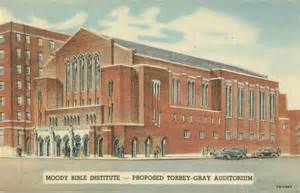
As I’ve been finding in the archives this past year, even schools that agreed with BJU’s fundamentalist theology sometimes disagreed with BJU’s position against interracial marriage. At the Moody Bible Institute, for example, leaders decided to cancel an invitation to pro-BJU fundamentalist leader John R. Rice. The decision subjected MBI’s leaders to withering criticism from fundamentalists nationwide.

Reporters and observers have noted that SCOTUS’s decision in this case might raise questions for leaders of conservative religious schools. Those leaders should also consider another likely outcome. If SCOTUS’s decision puts pressure on school leaders to recognize same-sex marriages, it might lead to another in a long line of bitter fights among schools.

Will conservative evangelicals and Catholics submit to the law of the land? Or will they resist, citing a higher authority? Will conservative schools lose their conservative credibility if they give in to the new cultural ethos?

It’s not going to be an easy choice. If I were the president of a conservative Christian school or college, I’d get myself ready for a lose-lose decision. Do I want my school to be labeled a bunch of fanatical bigots? Or would I prefer to join the ranks of schools that don’t take their religions very seriously?

MBI Kind of Town…

What did you do after high school? Did you go to a “college?” Or was it a “university,” “institute,” a “normal school,” or maybe a “professional school?” For generations of ambitious Protestant missionaries, the Moody Bible Institute in Chicago has been the best-known institution of evangelical higher ed. So much so that MBI has clung to the “BI” name much longer than many other evangelical colleges.

DOWNtown funk...

DOWNtown funk…

I just rolled into Chi-town on the last of my research trips this year. As SAGLRROILYBYGTH are well aware, I’m working on a book about the history of evangelical higher ed. This year, I’ve traveled to Bob Jones University, Wheaton College, Biola University, Gordon College, and Liberty University.

MBI is last, but certainly not least. I’ve logged my share of time in these archives over the years, especially while working on my PhD dissertation and first book. MBI is not the oldest Bible Institute, but it has remained far and away the most influential.

For those outside of the orbit of evangelical culture, the primary goal of Bible institutes has been to provide quick and affordable education for missionaries. In order to serve effectively on the mission field, many evangelicals have believed, missionaries need a thorough knowledge of the Bible. In order to bring people to true salvation, missionaries need a proper knowledge, too.

Beginning in the late 1800s, Bible institutes popped up in American cities nationwide. Many of them attracted students without a lot of academic preparation. These students, after all, were not heading into the traditional professions, but rather heading out to spread the Gospel in every land. They did not need to know Latin and trigonometry, but rather only the Bible and maybe some basic medicine and language skills.

Over the decades, many of these Bible institutes turned into colleges or universities of one kind or another. This was part of the triple revolution in higher education that Roger Geiger describes in his new book, The History of American Higher Education. By 1940, Professor Geiger argues, the wild diversity of early institutions of higher education had become standardized, a recognizable modern system of American higher education.

In this system, no one went to college without first completing a high-school education. They looked forward to an education that would prepare them for specific professions. Colleges themselves closed their preparatory departments or split them off into stand-along high schools. Universities had shaken out into a relatively stable hierarchy of prestige and social influence. At the top were wealthy old schools such as Harvard and the University of Michigan. At these universities, undergraduate education rollicked along in a cloud of sports, fraternities, and social climbing, while the schools themselves fought viciously to increase their research footprint.

As this modern system regularized itself in the years after World War I, several types of institutions phased out. These evolutionary also-rans included many institutes of technology, proprietary medical or legal schools, “female institutes,” normal schools, and—though Professor Geiger doesn’t mention them—most of the Bible institutes.

These old-fashioned types of higher education did not disappear. Rather, most of them changed to offer the new standard bachelor’s degrees. Many of them built new dormitories and fielded sports teams. And most of them took their place in the competitive hierarchy that arched from Harvard down to Podunk State College & Grill.

A very few exceptions stood out from this winnowing process, at least symbolically. Some of the old-fashioned institutions of higher education had been so successful in the 1800s that they felt no need to change their names, even as they usually adopted some of the features of modern higher education. Most notably, the Massachusetts Institute of Technology never changed its name to call itself a “college” or a “university.” MIT began as one of a scramble of “institutes of technology” in the years surrounding the Civil War. Unlike today’s MIT, the early institutes did not focus on recognizably pure modern research. Instead, they mostly provided students with a more practical mechanical education meant for workers in industrial workshops.

As more and more students wanted to spend their tuition dollars at a “college” or “university” that took its place in the ever-more-rigid hierarchy after World War I, most of these “institutes of technology” turned themselves into “colleges” or “universities.”

Following a somewhat similar pattern, since 1940 most of the crop of Bible institutes that sprang up around the turn of the twentieth century turned themselves into “colleges” or “universities.” Biola University, for example, began its life as the Bible Institute of Los Angeles—BIOLA, get it? Gordon College, too, had its roots as the Boston Missionary Training School. As early Gordon President Nathan Wood remembered, the first name change—to Gordon College of Theology and Missions—resulted from student pressure.   Three class presidents, Wood recalled, requested

a change of name to one which would express the collegiate and theological work of the school. . . . It meant much to them as future Alumni.

To put it in terms Wood never used, the Gordon students recognized early the congealing patterns of modern American higher education. A “training school” did not convey the same prestige and professional opportunities as did a “college.”

For some stand-out schools, however, these rules did not apply. Moody Bible Institute was so well known among evangelicals its name sufficed to keep students coming. There was no need for it to change its name to acknowledge the changing environment of American higher education. Like MIT, MBI had created such a unique niche in higher education that it kept its old fashioned name and much of its old-fashioned structure. Also like MIT, MBI took on many of the features of modern higher education. Unlike in its early days, MBI now offers college degrees, not just Bible training.

Doubtless, I’ll find some evidence here in the archives about efforts over the years to change MBI’s name. Unlike smaller schools, however, MBI had the size needed to stand out as an island in the new seas of modern higher education.

Schools of Social(ist) Work

America’s colleges and universities have become left-wing indoctrination factories. At least, that has long been a favorite conservative complaint. Today in the pages of the Weekly Standard we see another example of the “closing of the campus mind.” Why do so many conservatives seem to take such intense pleasure in the supposed leftist domination of American higher education?

Bearded weirdos...

Bearded weirdos…

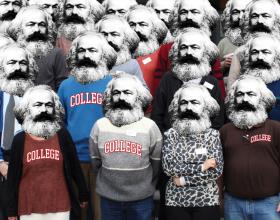
In today’s Weekly Standard, Devorah Goldman shares her horror story from Hunter College’s School of Social Work. As a conservative, Ms. Goldman was asked politely not to participate in class discussions. She had to hold her tongue as she read anti-conservative textbooks. She had to hold her tongue as professors imposed racist, ideologically slanted ideas on her classes.

Goldman’s story of abysmally closed-minded universities seems to resonate among conservative intellectuals. As we’ve seen recently, some conservative academics have interpreted recent events as the death knell for conservative thinkers at mainstream universities. Elsewhere, critics have wondered if higher education as a whole has been irredeemably lost to true open-mindedness.

As a non-conservative who writes a lot about conservatism and education, these complaints raise two difficult questions for me.

  1. First, why do so many conservative thinkers seem to emphasize the leftism of colleges? That is, why do conservatives seem to take such bitter joy from an exaggerated assumption that they are no longer welcome in higher ed?
  2. Second, why don’t these conservative intellectuals recognize the long tradition of conservative laments about higher ed? In every case, it seems as if conservatives think higher ed has just recently switched over to the dark side.

Let’s take the second of these questions first. As Ms. Goldman’s story shows, every conservative complaint implies that the closing of the college mind is a recent phenomenon. But conservatives (and liberals, for that matter) have been protesting against the goings-on at mainstream colleges for almost a century.

In 1987, for example, Chicago’s Allan Bloom scored a surprise best-seller with his Closing of the American Mind. Bloom worried back then that universities had become nothing but indoctrination factories.

Even earlier, conservative godfather William F. Buckley Jr. began his long career with an indictment of the culture at his alma mater. In God and Man at Yale (1951), Buckley blasted the sneering secularism and lax morality of his school.

Some people think Buckley invented modern conservatism, but the same themes go way back. In the 1930s, for instance, Congressman Hamilton Fish excoriated leading schools as subversive breeding grounds for communists. Fish named names. Columbia, New York University, City College of New York, the University of Chicago, Wisconsin, Penn, and North Carolina, Fish charged in 1935, had become “honeycombed with Socialists, near Communists and Communists.” As I note in my new book, Fish and other anti-communist conservatives in the 1930s assumed that leading colleges had recently been hopelessly lost to left-wing collegiate cabals.

Back in the 1920s, too, religious conservatives warned each other that recent events had caused the loss of mainstream colleges. As I’m digging into in my current research, fundamentalists such as Bob Jones Sr. convinced themselves and anyone who would listen that 1920s trends had moved college into the enemy camp. Too many schools, Jones charged, attacked the faith of conservative students. As Jones put it,

I had just about as lief send a child to school in hell as to put him in one of those institutions. We are spending millions of dollars on education in this country, but if that is the kind of education we are going to have we would be better off without our universities and colleges.

In every case, each generation of conservative activist has implied that these lamentable changes were recent occurrences. In every case, conservatives suggest that higher ed “these days” has been taken over by left-wingers. If this is such a long and strong tradition among conservatives, why do they keep insisting it is a recent phenomenon?

And why do conservatives seem so eager to emphasize their own victimhood? I don’t doubt Goldman’s story. I can imagine that some teachers and some schools really do insist on an ideological conformity. But there are plenty of other schools that do not. Why don’t conservatives spend more mental energy trumpeting their own dominance of some forms of higher education?

Recently, for example, conservative academic extraordinaire Robert George praised his school’s new academic-freedom rule. Why don’t more conservative intellectuals join Professor George in proclaiming the continuing academic clout of conservative or conservative-friendly ideas?

Some might think that conservatism only dominates less-prestigious schools. Ms. Goldman, for example, would likely have had a very different experience at a less prominent school of social work. But as the case of Professor George makes clear, leading schools such as Chicago and Princeton have long served as congenial homes for conservative intellectuals.

Instead of tearing their hair and gnashing their teeth due to the supposed loss of higher education, why don’t conservative intellectuals celebrate their continuing influence at many leading colleges?

University Apocalypse

Are conservative religious academics forced these days to live “deeply closeted” lives? Have elite universities become so hostile to conservative religious thought that openly acknowledging their religion would be career suicide for academics? In the aftermath of the recent debate over gay rights and religious freedom in Indiana, one elite academic shares his worries in the pages of The American Conservative.

We have to ask: Are things really so dire for conservative academics?

Private?  or Closeted?

Private? or Closeted?

First, though, some context. Readers may remember Jonathan Zimmerman’s (liberal) plea to include more conservatives on campus. And leading schools such as Colorado University have adopted programs to bring conservative thinking to liberal colleges. Both conservatives and non-conservatives agree: Good universities need to recruit actively among a wide diversity of intellectual types.

New voices say it’s not happening.

Crunchy conservative Rod Dreher recently shared his conversation on these issues with an anonymous professor at an elite law school. This professor worried that the “overculture” had reacted with frightening intellectual totalitarianism to the recent Indiana case. At leading colleges, “Prof. Kingsfield” warned, religious conservatives are no longer welcome.

“A college professor who is already tenured is probably safe,” Dreher tells us, summing up “Kingsfield’s” story.

Those who aren’t tenured, are in danger. Those who are believed to be religious, or at least religious in ways the legal overculture believes constitutes bigotry, will likely never be hired. For example, the professor said, he was privy to the debate within a faculty hiring meeting in which the candidacy of a liberal Christian was discussed. Though the candidate appeared in every sense to be quite liberal in her views, the fact that she was an open Christian prompted discussion as to whether or not the university would be hiring a “fundamentalist.”

“Kingsfield” also argues that conservative schools will likely face increasing pressure from accrediting bodies. He cites the recent experience of Gordon College. In that case, a re-articulation of a long-standing school policy against sexual activity among students—including homosexual students—created a firestorm of controversy.

Rod Dreher included as a follow-up several emails from academics claiming to have been discriminated against in higher ed.

Do you buy it?

There are a few caveats we need to keep in mind. First, Professor “Kingsfield” seems to be talking about trends at elite colleges. I’ve been told many times by the sophisticated and good-looking regular readers of I Love You but You’re Going to Hell (SAGLRROILYBYGTH) that their experiences in non-elite colleges have been very different. One correspondent, for instance, told me that his colleagues in a large second-tier state school explicitly taught their students to teach in a conservative religious way.

Also, we need to remember that we’re only talking about one conservative tradition here. Generally, non-religious conservatives have had a very easy time fitting into the culture at elite universities. Folks such as the late Milton Friedman, surely, have not faced any sort of career danger for their conservative ideas.

In my experience, my fellow progressive academic folks really do often combine a shocking ignorance of conservative religious culture with a casual contempt for conservative religious ideas. One of the reasons I started this blog, in fact, was due to the fact that so many of my fellow progressives seemed utterly hostile to and uninformed about American conservatism.

On the other hand, my beloved medium-sized public university seems fairly welcoming to religious conservatives. Perhaps because I talk too much about conservatism and fundamentalism, more than one of my faculty colleagues have shared their religious beliefs and background. They don’t trumpet their beliefs, but they don’t hide them either.

My colleagues keep their beliefs private. That’s not the same thing as keeping them “deeply closeted,” though. Are things really so bad for conservative religious academics?

Fundamentalism and the Modern University

Are evangelical colleges modern? Or, with their insistence that knowledge has its roots in God’s Holy Word, are they somehow trapped in medieval ideas about knowledge and the purposes of higher education? The answer is more complicated than it might seem at first.

As the sophisticated and good-looking regular readers of ILYBYGTH (SAGLRROILYBYGTH) are sick of hearing, I’m hard at work on my book about evangelical higher ed. In the twentieth century, Protestant fundamentalists opened or transformed a network of colleges dedicated to protecting fundamentalist faith. If students are led astray at mainstream secular colleges, the thinking went, fundamentalists needed their own schools to teach each new generation of Christians how to be educated and evangelical.

As part of my reading list, I’m deep in Roger Geiger’s new book, The History of American Higher Education (Princeton University Press, 2015). I’m writing a full review for Teachers College Record and I’ll be sure to post links to that review when it comes out.

Are fundamentalists colleges modern? Or are they trapped in the 1600s?

Are fundamentalist colleges modern? Or are they trapped in the 1600s?

In the meantime, though, Professor Geiger’s survey of the first colleges raises some tricky questions for fundamentalist higher education. As with so many early American institutions, colleges such as Harvard and Yale represented the tail end of medieval traditions, just as they were changing into recognizably modern ways of thinking.

Conservative evangelicals like to point out that America’s leading colleges were often founded as religious schools. It’s true. Harvard and Yale were both intended, first and foremost, to defend orthodox Puritanism. Not only were they ferociously religious, but they envisioned their role in a radically non-modern way. Instead of serving as an institution that encouraged new thinking, Harvard and Yale in the 1600s and early 1700s both saw their role as passing along established truth. As Prof. Geiger puts it, in the early decades, “The corpus of knowledge transmitted at Harvard College was considered fixed, and inquiry after new knowledge was beyond imagining.”

Orthodoxy at these early schools was defended with a rigor that would make twentieth-century fundamentalists proud. Harvard’s first president, for example, was ousted for theological reasons. President Henry Dunster came to believe that infant baptism was not a scriptural practice. As a result, the General Court summarily got rid of him. In their words, no one could lead a college if they “manifested themselves unsound in the faith.”

Both Harvard and Yale made explicit their goals. In early years, Yale explained its primary religious mission:

Every student shall consider the main end of his study to wit to know God in Jesus Christ and answerably to lead a Godly sober life.

It was not much different at Harvard:

the main end of [a student’s] life and studies is, to know God and Jesus Christ which is eternal life, Joh. 17.3

In all these aspects, life at Harvard and Yale between the 1630s and 1720s seems remarkably similar to life at fundamentalist colleges in the early twentieth century. For schools such as Wheaton College, Bob Jones College, Bible Institute of Los Angeles, or Gordon College, these Puritan echoes resounded loudly. At all these fundamentalist schools, leaders insisted that the first goal was to help students understand themselves as Christians. The first intellectual challenge was to study seemingly distinct bodies of knowledge to see the hidden connections put in place by God.

In this way, then, it seems as if fundamentalist colleges—even those more liberal schools that eventually abandoned the “fundamentalist” label—hearken back to a pre-modern vision of higher education.

We have to be careful, though, before we assume too much. In other important ways, twentieth century dissenting religious colleges participated fully in the central intellectual tradition of modern higher education.

According to Professor Geiger, colonial higher education went through a revolutionary change in the 1720s-1740s. During that period, endowed professorships at Harvard gave some faculty members the independence to pursue new forms of knowledge. These professors began to incorporate the ideas of new thinkers such as Isaac Newton and John Locke.

The radical change came not only from the newness of the ideas, but from the notion that the college or university should be the place to explore such new ideas. As Professor Geiger puts it,

The significance and prestige of Newtonian science altered college teaching by introducing the experimental lecture employing apparatus, creating a demand for specialized professors and establishing the expectation that the curriculum should incorporate new knowledge.

A fundamental characteristic of the modern university emerged in the decades before the American Revolution. College, more than any other institution, came to be seen as the province of cutting-edge thinking. As Professor Geiger points out, even before Ben Franklin made his famous experiments with lightning, John Winthrop at Harvard used his endowed Hollis Chair funding to purchase equipment that would allow him to demonstrate the properties of electricity.

Just as the fundamentalist colleges of the twentieth century clung to the pre-modern notion that universities ought to pass along established truths, those same fundamentalist schools fully participated in the modern notion that universities ought to explore new truths.

An evangelical scientist, for example, such as Russell Mixter at Wheaton College in the 1950s, believed that no amount of human investigating could overturn the truths of Scripture. But Mixter (and others like him) also saw himself as an intellectual specialist, a scientist exploring the outer boundaries of biology to discover new things about God’s creation.

Are fundamentalist and evangelical colleges modern? In this sense, they certainly are. The faculty at twentieth- and twenty-first century conservative colleges are divided into academic disciplines. Each of them is expected to carry out research in his or her field. The definition of those fields may be different from the ones at secular institutions, but the fundamentally modern notion of research remains central.

At the same time, though, by envisioning themselves as the guardians of students’ faiths, fundamentalist colleges hearken back to the pre-modern roots of the Ivy League. As Professor Geiger argues about 17th century Puritan higher education, “the deeper purpose of the college course and the overriding preoccupation of the institutions were to demonstrate the truth of Christianity.”

Today’s evangelical colleges would agree.