School Protests and Negative Nellies

Suburban Jefferson County is in an uproar. Teachers and students have taken to the streets. They’re protesting a move by conservative school-board members to modify the new Advanced Placement US History framework. Predictably, conservatives nationwide have rallied behind those school-board members. In ways today’s protesters might not recognize, conservative rhetoric in this case dredges up a long conservative tradition—the fight against excessive negativity toward America. In surprising ways for “The Party of No,” when it comes to educational attitudes, conservatives have often been the party of “Yes, Please.”

This Denver-area protest is not the first to result from the changing framework for the Advanced Placement US History class. Conservative pundits have attacked the changes as pernicious and short-sighted. As we’ve noted here at ILYBYGTH, those conservative concerns have a legacy all their own. Conservative intellectuals and activists have protested that the new framework depicts the main themes of US History as oppression and racism. Some conservatives have called for US History to be taught in more traditional ways, more patriotic ways.

In this case, conservative school-board members proposed a new look at the framework. The five-member board has a solid three-member conservative majority, and those three called for a reform that would emphasize “positive aspects” of US History, an emphasis on ideas that “promote citizenship, patriotism, essentials and benefits of the free enterprise system, respect for authority and respect for individual right.” In addition, conservative leaders want less emphasis on materials that “encourage or condone civil disorder, social strife or disregard of the law.”

In protest, district teachers called for an orderly sick-out. Teachers planned to call in sick to draw attention to both this change in curriculum and a proposed change to teacher pay. As word spread, students joined in. Soon, teachers and students alike took to the streets to protest any change in the history curriculum.

Predictably, conservative commentators huffed and puffed at the student protest. Gretchen Carlson of Fox News called the protesters “punks.” “How can being patriotic or learning about patriotism be a negative?” Carlson asked. “And what does it say about our young people and the teachers joining the protests that patriotism is now a negative?”

Writing in the pages of National Review Online, Ian Tuttle had a similarly dismissive attitude toward these “sign-waving baby barbarians.” Not only did the students expose their own ignorance with their hopelessly ironic protest signs, but their movement could not even count as legitimate social protest. Real protest, Tuttle fumed, was a vital patriotic legacy. This sort of display, in contrast, was only “self-indulgent grievance-mongering.”

Maybe a little cencoring would be okay...?

Maybe a little cencoring would be okay…?

Back in Colorado, one of the conservative board members opined that the student protesters were being used as hapless “political pawns.” The real issue, he said, was the question of teacher pay. The teachers’ unions cynically exploited the naïve enthusiasm of students in order to line the pockets of union members.

There’s more going on here than just 1960s hangover culture wars. Beneath these specific worries about student orderliness and patriotism, there is a decided theme about the proper attitude schools and students should have toward American society in general. As I researched my upcoming book about conservative educational activism in the twentieth century, I came across this theme time and again. In addition to worries about political leftism and secularism in schools, conservatives have worried vaguely about a pervading sense of negativity in progressive school curricula. Sometimes this has had to do with the portrayal of America’s past, as in the current Colorado student protests. But sometimes it has been a broader complaint about a general negative attitude in school books.

In what follows, I’ll share three long examples from 1923, 1939, and 1970. In each case, leading conservative activists attacked the negativity of progressive educators. Just as in Jefferson County, conservatives in each case worried that students were being taught that America stunk, that life in general stunk.

First, a speech from April 16, 1923. In this speech, the leader of the National Society of the Daughters of the American Revolution warned of the creeping negativity and anti-patriotism of America’s teachers. Too many teachers, President General Anne Minor insisted, poured that negativity down the throats of trusting young schoolchildren.

Character and patriotism and obedience to law—there are the essentials of training in the schools. Do we find them everywhere? There are many who feel that there is a weakness of moral fibre [sic] in the teaching in many of our schools. And it is well known that there is an organized movement of many years’ standing among radicals to insinuate their doctrines into the schools and colleges all over the land….We want no teachers who say there are two sides to every question, including even our system of government; who care more for their ‘academic freedom of speech’ and opinion (so called) than for their country. Academic freedom of speech has no place in school, where the youth of our country are taught and their unformed minds are developed. There are no two sides to loyalty to this country and its flag. There is nothing debatable about allegiance to that flag and the Republic for which it stands. Freedom of speech does not give the right to teach disloyalty to our children and college youth. The teacher who does not wish to teach loyalty toward the land that employs him, has one good remedy. He or she may resign and go where disloyal opinions can find expression without harm to anyone. Guard well your schools, lest the life of the nation be poisoned at its source.

Years later, in 1939, a school-board member in Englewood, New Jersey lambasted the leftism and negativity of a popular set of textbooks. In this case, that conservative school board member was B.C. “Bertie” Forbes, the founder of Forbes Magazine. The textbooks at issue were a set of social-studies books by progressive scholar Harold Rugg. In this snippet, Forbes tells a story he repeated over and over again in his crusade against the Rugg books:

One of [a local teacher’s] pupils came to me, very much upset. In effect, he said that he had always regarded America and the American form of government as wonderful. But, he proceeded to relate that when the class had been asked to record their opinion as to whether ‘The people of the United States have a better government than have the people of any other county in the world,’ their teacher expressed disagreement with those young Americans who had replied, ‘Yes.’ According to this pupil she disabused their minds of any such idea. According to him, she told her young charges that the answer was ‘No’, that ‘there are several countries in Europe which have as good, if not better, forms of government than ours.’

At this critical time, when we are preparing to conscript our youths to become American soldiers, I cannot but question the wisdom of impregnating young minds with any such notion that our system of government is open to question.

If teachers of the Rugg books are seeking ‘subtly’, to use Professor Rugg’s own word, to convey such ideas to the coming generation, ideas which cannot possibly inspire them with veneration for their flag—which they are asked to salute every day—surely the parents of Englewood are entitled to learn the facts.

A generation later, in 1970, conservative activists Mel and Norma Gabler told the Texas State Board of Education that too many textbooks focused only on the negative. The Gablers went through the list of approved books, one by one. In each case, the Gablers noted the relentless negativity of the texts. In what follows, I’ll include a full long book-by-book quotation from the Gablers’ testimony:

This book contains some of the chilling, horror-type stories that seem to appeal to the morbid imagination of this age’s youth; but so much time spent thinking upon strangeness can make it almost seem normal. The characters in ‘The Jam’ are dope addicts. ‘The Hitchhiker,’ which follows, has an identical climax, both written to horrify. ‘The Birds’ was made into a Hitchcock movie, so is well-known, but in reading it there is so much more blood and gruesome detail that the reader feels the need to escape and cleanse himself from such horror. ‘Zero’ leaves the impression that it is normal for children to hate parents and for parents to be indifferent to the needs of children. Everything in the book is conducive to causing emotional instability in the impressionable mind.

This [Rebels and Regulars] is another very depressing book. As far as the language used, it is in keeping with the characters and plots of the stories, but not the sort of language the thoughtful parent would approve of in his children. There is throughout the book the undercurrent of ‘a cause,’ which gives a prejudiced viewpoint, always picturing the white man as the villain against different minority groups or individuals. Typical of the stories is ‘The Cyclists’ Raid,’ which is militant, lawless, defiant, and completely without consideration for the individual. . . . A whole semester of concentrating upon rebellion as pictured in these stories will have a negative effect upon an impressionable young person. It becomes more honorable to rebel than to obey laws or consider the rights of others. . . .

This book [Ways of Justice] indicates that justice is whatever an individual decides it should be. ‘Junkie Joe Had Some Money’ shows bullies getting away with murder because the only witness is intimidated. In ‘Manuel,’ a kindly act is rewarded with utmost cruelty, written in vivid detail. ‘Mateo [86] Falcone’ tells of a young boy who is bribed to reveal the hiding place of another, then his father kills him. Nothing here to indicate love or understanding is possible between parents and child. ‘Marijuana and a Pistol’ gives all the sordid details of a maladjusted youth who smokes ‘weeds,’ including the uncontrolled giggling and vomiting. ‘They Grind Exceedingly Small’ is a story about the person who has money, taking advantage of the poor, hard-working, underprivileged—indicating that all money and power are in the hands of the cruel, wicked, dishonest, and undeserving. . . .

Couldn’t half of the stories in this series tell about people living together in harmony, love, understanding, and helpfulness?

Is reality only negative? Does not reality also include the many acts of kindness between races that is evident across our nation? It must be remembered that qualities such as morality must be taught. They do not come naturally. Education without morality will result in a depraved society.

Our conclusion is that if these books do not contribute to rebellion, lack of respect for authority, sadism, violence, and disillusionment, they will most certainly defeat the whole purpose for studying literature in our schools; for there is absolutely nothing presented here that would open the wonderful world of the printed page to our youth and cause them to want to pursue reading for the pure joy of doing so!

In all these conservative protests, the notion that school materials must somehow be positive and patriotic takes center place. Whether it was in 1923, 1939, 1970, or today, conservatives have insisted that school materials do more than present the negative side of life. In today’s protest, the issue is the teaching of US History. And that has certainly been a central subject in these battles. But it was not only history that became controversial. As the Gablers pointed out, the negativity of the cultural left showed up in literature selections as well. As they asked so plaintively, “Is reality only negative?”  And, and President General Minor protested way back when, a pervasive, destructive negativity also showed up in teachers’ attitudes.

Again and again, conservatives have wanted students to learn positive messages. Conservatives have worried that too much negativity might produce a generation of cynics. In a sense, we might say that conservatives in schools have sometimes been the party of positivity.
Bill Gates: Creation/Evolution Warrior ???

Bill Gates seems to be wading into the creationism/evolution controversies. But he doesn’t seem to know it. At least that’s the sense I get from an article in this weekend’s New York Times Magazine.

Bill-Gates-bashing is a popular sport these days among progressive-education types. I don’t usually go in for it. But this article makes it crystal clear that Mr. Gates really does have more money than sense. He seems utterly unaware of the history and context of his own pet projects.

The story focuses on Mr. Gates’ new vision for teaching World History in American high schools. Mr. Gates apparently became enamored of the lecturing style of one David Christian, an Australian historian with a penchant for offering what journalist Andrew Ross Sorkin calls a “unifying narrative of life on earth.”

Gates liked it. So he thought everyone should get it. He funded a project to bring Professor Christian’s style of “unifying” world history to high schools nationwide. Instead of lumbering through disconnected areas of culture and geography, the thinking goes, students will be electrified to see the connections behind seemingly disparate events and disciplines.

Let’s ignore for a minute the other painful moments in this article, such as when Mr. Gates gleefully notes his ignorance of the history of teaching biology in secondary schools. Gates told Sorkin happily that he had no idea about this basic history. “It was pretty uncharted territory,” Gates said, “But it was pretty cool.” Of course, this history of biology as a school subject is not at all “uncharted territory.” Even a two-second google search would have offered Mr. Gates some quick historical outlines of the issues involved.

Let’s also pass by Mr. Sorkin’s apparent ignorance of the roughest outline of American educational history, as when he states that high-school education began to be mandatory in the 1850s. It didn’t. In some states, such as Massachusetts, education became compulsory at that date. In other states compulsory education laws did not kick in until the 1910s. Even in compulsory-education states, high school was not required as such. Again, I’m not expecting a journalist like Sorkin to have delved deeply into this history. But even a check of Wikipedia would have helped.

But let’s politely ignore those howlers and move on to the main question: What does this new Gates history curriculum have to do with creationism?

Both Gates and Professor Christian do not seem aware of the long history of their sort of “unifying” history. As Jon H. Roberts demonstrated so brilliantly in his co-authored book The Sacred and the Secular University, the decisive shift away from religious moralizing in mainstream colleges came with the abandonment of the effort to offer students a satisfying “unifying” narrative.

Throughout the eighteenth and nineteenth centuries, Roberts demonstrated, college presidents traditionally offered a capstone course in “moral philosophy.” This course hoped to give students a sense of the unifying nature of all forms of truth. In most cases, that truth was lodged in Christian theology. In other courses, too, professors in old-style colleges tended to suggest that there was a supernatural glue that held all knowledge together. It was the intellectual revolution that included Darwin’s evolutionary mechanism of natural selection that wrought a wholesale change in this sort of “unifying” education.

As Roberts’ co-author James Turner argued, this shift in university attitudes was pushed and accompanied by the rising prestige of disciplinary knowledge. In older schools, professors were supposed to pursue knowledge as such, to pursue the unifying sorts of knowledge that David Christian seems to prefer. In modern universities, that knowledge was parceled out into the academic disciplines we’re familiar with today.

What does any of this have to do with Bill Gates’ Big History Project?

Gates and Christian seem utterly unaware that the notion of a “unifying” sort of history class is not a new idea. It is, instead, a discarded idea. As philosopher Philip Kitcher might say, this is not “bad history” or “new history,” but rather “dead history.”

In its older incarnation, a sweeping history that unified all sorts of knowledge suggested that the unifying element was God. The reason students should seek knowledge in all its forms, the thinking went, was because all knowledge pointed toward the Creator.

Whether they mean to or not, Gates and Christian will have to choose what sort of unifying idea they prefer. And they seem surprisingly unaware that this choice is precisely at issue in our century-long culture war over evolution and creationism.

The Big History Project doesn’t put God at the center of its narrative. It begins with the assumption that the universe is 13.7 billion years old. It explains the roots of humanity in other forms of life. These are ideas at the center of the continuing creation-evolution controversies.   If Gates and Christian are looking to produce a Cosmos-like statement about the intellectual weakness of creationism, fine.

But they don’t even seem aware of the issue. In the NYT article, at least, Gates seems to worry only about educational bureaucrats getting in the way of his big idea.

Maybe I’m missing something. Perhaps Gates deliberately plans to bypass creationists entirely. Perhaps he hopes that by not mentioning creation/evolution controversies, he won’t have to engage with them. But for anyone even mildly aware of the current state of cultural tension over the teaching of humanity’s long history, such a curriculum seems fraught with controversy.  It seems like something they might want to think about.

America: Schools Taken over by Scheming Progressives

What sorts of history did you learn in school?  As I argue in a recent commentary published on History News Network, conservative thinkers and activists have often insisted that school history has been taken over by a scheming, America-hating, progressive history cabal.

It looks as if Dinesh D’Souza’s new film dives headfirst into that tradition.  In America: Imagine the World without Her, D’Souza denounces American education as woefully slanted.

In a recent interview about the film, D’Souza accuses even the best schools of teaching a “doctored account” of history.  Young people, D’Souza believes, have all been taught a skewed leftist history.  In his film, D’Souza hopes to counter this horrible history with a heroic counter-argument.

But as I found when I researched the twentieth-century history of conservative activism in the United States, I found that conservatives have exerted just as much influence over the nature of American education as have progressives.

So why do conservatives like D’Souza continue to insist that schools have been taken over by dunderheaded progressives?  If you want to read my humble opinion, you’ll have to check out the HNN essay.

A Patriot’s History: The Movie!

What’s a patriotic conservative to do?  So often, history textbooks have been accused of peddling a leftist mishmash of America-bashing and skewed intellectual flag-burning.  As we’ve argued in these pages, for generations conservatives from the American Legion to David Barton have attempted to publish their own history textbooks that tell a more patriotic, more Christian story.

One of the most successful of those textbook efforts has been Larry Schweikert’s and Michael Allen’s 2004 A Patriot’s History of the United States. The book tells the story of the United States in a way that celebrates the triumphs and tragedies of America from a traditionalist patriotic viewpoint.  According to the book’s Wikipedia page, one reviewer from the Heritage Foundation wrote in 2005 that the book centered on a simple premise: “that there are principles and purposes reflected in American history that make this imperfect country worthy of our affection.”  Other reviewers had more hostile opinions.  David Hoogland Noon wrote in the pages of the History Teacher that this book was “written for an audience of the previously converted . . . hardly worth anyone else’s time.”

Via Andrew Palmer at Conservative Teachers of America we see that Schweikert is hoping to turn the book into a movie.  Schweikert has published a four-and-a-half minute trailer.  Tellingly, the dramatic intro promises the film will tell viewers “the history you always knew.”  In other words, the approach of Schweikert and Allen has been to confirm the traditional story of America’s greatness.  Not that this story has been one of unalloyed heroism, Schweikert and Allen might say, but overall the sweep of history has proven the United States to be the greatest nation on earth.

The choice of bits and pieces for this trailer tells us something about the movie’s approach.  First of all, it begins and ends with fireworks.  It includes scenic panoramas of cherry blossoms on the Mall in Washington DC, Ansel-Adams-like vistas of rocky outcroppings, and other traditional American eye candy.  As I watched, I took sketchy notes of some of the featured elements:

  • Happy colonists
  • Heroic suffering in the Revolutionary War
  • Heroic racing in wagons to settle the West
  • The Civil War
  • An Industrial Revolution with awesome achievement
  • D-day and Iwo Jima
  • Immigrants as ardent patriots
  • The Green Bay Packers!
  • Mount Rushmore
  • The Moon Landing
  • Martin Luther King Jr.
  • A jet in Vietnam napalming a field
  • Reagan calling on Gorbachev to tear down this wall
  • Baseball
  • The hockey “Miracle on Ice” of 1980
  • Lots of Fireworks.

Clearly, any movie trailer tells only part of the story.  This one certainly skews toward the positive elements of American history.  Unlike some academic histories, the story of the settling of the West is told as a heroic race to fill in land with settlers, not as the invasion of Europeans and the genocide of the native inhabitants.  As much as what was included, this trailer leaves out some important elements.  I saw no suggestion of race slavery, for example, nor of the systematic extermination of native peoples.

Will conservative teachers and schools embrace the film as conservatives embraced the book?  I don’t see why not.  In my experience, conservative intellectuals don’t want children to read patriotic lies about America’s past, but they do want children to read patriotic truths.  In the case of the American Legion’s 1926 textbook series, for example, as soon as the Legion leadership found out that the book was riddled with errors, the Legion pulled its support.  And as soon as David Barton’s book The Jefferson Lies accumulated accusations of inaccuracy, its original publisher yanked it.

My hunch is that the makers of A Patriot’s History would argue that they do tell the full story of America’s past.  The trailer, for example, did include clips of America’s troubling policy of napalming villages in the Vietnam War.  To be a success, I’m guessing, this film will have to convince conservative audiences of two things.  First, it must seem like a full and true history of these United States.  Second, it must make clear that this country—despite its historical blemishes—is the greatest nation on the earth.

The hard question remains: Would you want your kids to watch it?


150 Years Without History Are Enough!

It’s not a “conservative” thing, really.  Or a “progressive,” “liberal,” or “traditionalist” thing.  But I’ve mounted up on my high horse in the pages of History News Network to complain about the sad state of American history education.

Specifically, I’m stumped and saddened by the continuing prevalence of neo-Confederate histories in America’s public schools.  Or, at least, by the continuing desire of some activists and authors to keep neo-Confederate histories alive.

In the HNN essay, I argue that there are clear parallels between this sort of history education and the long campaign against the teaching of evolution in public-school science classes.   Just as in that case, I think there are plenty of conservative intellectuals who will agree with me that neo-Confederate myths shouldn’t be taught as real history, just as there are lots of conservative evangelicals who dispute the young-earth style of creationism peddled by Ken Ham.  Just as I wouldn’t want history teachers to use Zinn’s woefully slanted leftist People’s History of America in their classrooms, I bet there are plenty of conservatives who don’t want American kids to learn that the Civil Rights Movement was no big deal, or that lots of slaves fought FOR the Confederacy in the Civil War.

Take a look and offer your comments over there.  Bonus points if you can make sense of my oh-so-clever title BEFORE reading the essay on HNN!


What Do You Want Your 7-Year Old to Learn about Lynching?

A story yesterday from Jacksonville, Florida raises some difficult questions about what we want to teach our children.

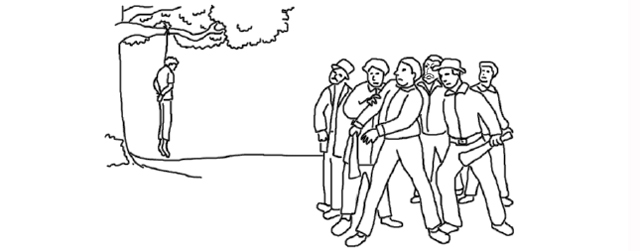
According to News4Jax.com, a parent of a second grader complained at the coloring book his child brought home.  The coloring book, “Who Was Jim Crow?” by edhelper.com, included some disturbing racial imagery.  Not least shocking was a picture of a crowd lynching a victim.

Image source: News4Jax.com

Image source: News4Jax.com

As a historian, I think we need to teach young people the sometimes-disturbing story of America’s past.  But this sort of classroom material raises all sorts of questions:

  • How old do Americans need to be to learn about racial stereotyping?
  • How should students be taught about America’s history of racial violence?
  • Should teachers be using cheap on-line teaching materials like this?  Even if the school board approved them?
  • Is this an example of racial political correctness gone wild?  Or is this an example of classroom racism?
  • Can offensive racial stereotyping ever make good teaching materials?

Get In Line, David Barton

What history books should American school children read?

Most recently, the history darling-in-chief among many conservatives has been Wallbuilders’ David BartonGlenn Beck, Mike Huckabee, and other conservative politicians have praised Barton’s vision of American history.

For those who haven’t followed the story lately, here’s a brief synopsis: Barton claims to be the best historian around, the only one honest and dedicated enough to discover the real Christian intention of most of the Founding Fathers.  His latest book, The Jefferson Lies, came under brutal attack for its historical inaccuracies and misrepresentations.  The accusations came not only from partisan leftists, but also from conservative Christian critics.  As a result, the original publisher pulled the book from store shelves.  Glenn Beck’s publishing arm quickly picked up the title.

Image source: Ebay

Image source: Ebay

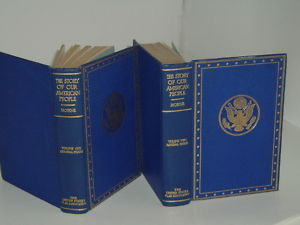
In the research for my current book about conservative educational activism in the twentieth century, I came across an eerily similar story from the 1920s.  In that decade, the American Legion resolved to sponsor a two-volume school history.  Too many of the books on the market, the Legion concluded in 1922, “contain misrepresentation of American history.”  Legion leaders contacted Charles F. Horne, a professor of English at City College of New York.  Horne agreed to author the books, to be called The Story of Our American People.

This textbook, the Legion’s special committee in charge of the textbook project declared in 1925, would build “character.”  Too often, the Legion leaders lamented, young people “grow up ignorant or anarchistic or otherwise ‘destructive.’”  There was no chance, the Legion wrote, that such youth, taught that their government deserved nothing but contempt, could mature into healthy, productive citizens.  Most commercial history textbooks only tore down young people’s confidence in their society and government.  A good history textbook could fix this.  The proper teaching of history, the Legion argued, must teach, despite “occasional mistakes,” that American history has been “so glorious that its proper study must inspire any child to patriotism.”

When a preliminary draft emerged in 1925, it earned some instant praise from conservatives who had long fretted about the deplorable state of most history textbooks.  Walter M. Pierce, for example, in 1926 the Klan-backed governor of Oregon, dashed off a letter to Professor Horne.  The new volumes, Governor Pierce gushed, represented “the finest history of early America that we have ever had.”

But other early readers took a different view.  Writing in the pages of Harper’s Magazine, historian Harold Underwood Faulkner blasted Horne’s books as “perverted American history.”  No professional historian, Faulkner sniffed, would have produced such drivel.  The books represented nothing more than a “bombastic eulogy of all things American.” (Harold Underwood Faulkner, “Perverted American History,” Harper’s, Feb. 1926, pp. 337-346. [Subscription only.]) They could not even be criticized on historical grounds, Faulkner claimed, since the books did not really constitute a history.  Worse, the books were intended to “produce a bigoted and stereotyped nationalism . . . a deplorable subservience to the rule of ignorance.”

Such criticism from snobby historians might not have doomed Horne’s books.  But an internal committee of the American Legion itself also found the books “filled with incomplete and inaccurate statements.”  Instead of inspiring American youth to embrace a patriotic vision of America’s past, the Legion investigators concluded, such shoddy history could only mislead youth and heap ridicule on the American Legion.

The Legion abrogated its contract with Horne.  They agreed not to receive any revenue from the book project and withdrew their endorsement.

As a result, the books never made the impact on schools Legion activists had hoped for.  Even among Legionnaires, the 1920s textbook project quickly became a politely forgotten story.  In 1949, for example, one Legionnaire wrote in the pages of The American Legion Magazine that the Legion ought to sponsor its own patriotic textbooks.  Such a textbook series, this writer insisted—apparently utterly innocent of the history of the Horne histories—could replace the overabundance of boring pink textbooks with “the rich and meaty story of American history.” [See John Dixon, “What’s Wrong with American History?” The American Legion Magazine (May, 1949): 40.]

So get in line, Mr. Barton.  You are far from the first to attempt to impose sectarian history on America.  Just as the fiercest and most effective critics of the Horne books were the Legion investigators themselves, so the conservative Christian criticism of Barton’s books helped isolate and neutralize Barton’s influence.

TRADITIONALIST EDUCATION Ia: DISCOVERY…OF WHAT? (continued…)

Traditionalist educators have sometimes tried to combat the philosophical underpinnings of progressivist education.  In America, conservatives have often argued from a Christian viewpoint.  The materialist understanding of humans, they sometimes say, misunderstands the nature of humanity.  People are not merely clever apes, but something essentially different.  Therefore, young humans need to be taught that there are transcendent truths; there are absolute values of right and wrong that need to be transmitted from one generation to the next.

This has concrete implications in classroom practice.  If there are eternal values and truths, it is not merely mistaken to adopt a “discovery” approach to classroom teaching.  If there are such things, it becomes both cruel and dangerous to do so.  It would
be like allowing students to wander at will around a field, when the teacher knows full well that there are intellectual landmines buried throughout the field.  It would be to keep silent as students wandered away from the truth.  Instead, the proper role for a teacher is to lead the children carefully along an intellectual path. The teacher’s job is not to encourage the children to wander, but to correct the children—sternly if necessary—to keep them from straying from the correct path.

What does this mean for day-to-day teaching?  If we have this kind of traditionalist mindset about the nature of morality—that there are eternal values of right and wrong—then the goal of education must be to impart those truths.  Fundamentally, it requires us to acknowledge that the teacher must remain the authority in the classroom.  Consider two different ways of teaching about the history of antebellum slavery.  A progressivist pedagogy might encourage students to collect information about the nature of
that slavery, make a website in which that history is explained, then present this website to the class and school/learning community.  The role of the teacher in this scheme is to help the student find research material, guide the process by which the student learns how to put the information into a website, facilitate the presentation, and evaluate the presentation by suggesting improvements.  The student might then improve the presentation based on the teacher’s feedback.  The goal would be for the student to be motivated by her interest in the subject, to conduct authentic research in which she learns about the history of
American slavery, and then gets practice in speaking to a group.  All of those skills are improved while the student learns about the historical content.  It sounds good.  But what happens when the student concludes that antebellum plantation life didn’t
look too bad for slaves?  It may sound outlandish, but such was my experience with student research time and time again.  Students did not yet have the ability to fully understand the horrors of being owned.  They did not yet have the intellectual
maturity to put themselves fully into the shoes of a slave and understand what such a thing would mean.  Students would
look at the maps online of the typical plantation house and conclude that slaves had a “nice little row of houses all to themselves.”  Even worse, what happens when the student finds online sites from white supremacists claiming that slaves enjoyed slavery?  How does she know what information to include or exclude?  And if she presents her history of the happy slave to the rest of the class, how are they to know that such history is fundamentally flawed?  The role of the teacher is precisely to prevent those things
from happening.  Before a student can be encouraged to “discover” the historical lessons of antebellum slavery, she must
be given a lot of information about the topic.  She needs to understand the horrors of dehumanization that accompanied
chattel slavery.  She needs to understand that slaves were people, just like her, with the same rights and expectations.  There are values, in other words, that a student must be directly taught.  It is not responsible to allow students to explore among the ideas that are out there about slavery without giving them a roadmap.  Students should be led intellectually to understand that owning other humans is a fundamental injustice.  They should not be expected to consider that truth as one idea among others.
