Is This the Creationist Conspiracy?

Anti-creationists have warned about it for generations: Creationists are joining forces to sweep away reason and science. A growing conspiracy of dunces threatens to upend centuries of progress. But a recent tiff between leading American creationists demonstrates just how fractured and divided creationists really are.  And it demonstrates the ways hysterical anti-creationism may do more harm than good.

The threats of a creationist conspiracy go back to the roots of America’s evolution/creation culture wars. In his 1927 book, The War on Modern Science, Maynard Shipley warned that the fundamentalist “forces of obscurantism” threatened to overthrow real learning. As Shipley put it,

The armies of ignorance are being organized, literally by the millions, for a combined political assault on modern science.

Ever since, science writers have warned of this impending threat. Isaac Asimov, for instance, warned in 1981 of the “threat of creationism.” Such unified anti-scientists, Asimov believed, had made great strides toward setting up “the full groundwork . . . for legally enforced ignorance and totalitarian thought control.” Like Shipley, Asimov noted that not all religious people are creationists, but also like Shipley, Asimov failed to notice the differences between creationists. The only religious people one could trust, Asimov wrote, were those “who think of the Bible as a source of spiritual truth and accept much of it as symbolically rather than literally true.”

What Asimov missed was the crucial fact that many creationists DO endorse real science; many folks who think of the Bible as more than just symbolic also accept the ideas of an ancient earth and human evolution.

This is more than just a quibble. When leading scientists and science pundits lump together all creationists as “armies of ignorance,” they needlessly abandon and heedlessly insult potential allies in creation/evolution debates. When science writers such as Jerry Coyne attack all religious discussion as “accommodationism,” they unnecessarily alienate creationists who want to teach more and better evolution.

A recent interchange between leading creationists demonstrates the way international creationism really works. Creationism in practice is not a horde of Bible-believing fanatics, relentlessly unified on the age of the earth and the origins of humanity. In practice, rather, creationism is a splintered and fractious impulse, fighting internal foes more viciously than external ones.

The “evolutionary creationist” Deborah Haarsma, leader of BioLogos, recently reached out to young-earth creationist leader Ken Ham of Answers In Genesis. Haarsma was “troubled” by Ham’s angry polemic about a third creationist, Hugh Ross of the old-earth Reasons to Believe.

We all have our differences, Dr. Haarsma said. But why can’t we come together over our shared Biblical faith? About our shared concern that young people are leaving the church? Why can’t we at least sit down together for a cordial dinner and talk over our differences?

Ken Ham publicly rebuffed Haarsma’s efforts. Ham agreed that his animus toward Ross was not at all personal. As Ham explained, “I don’t consider Dr. Ross a personal enemy . . . he is actually a pleasant person.” But Ross was also an “enemy of biblical authority.” And Haarsma was no better. “People like Dr. Haarsma,” Ham wrote,

make it sound like they have such a high view of the Bible, whereas in reality, she has a low view of Scripture and a high view of man’s fallible beliefs about origins!

There will be no dinner. There will be no grand alliance of creationists. Instead, we see the ways some creationists will tend to isolate themselves into smaller and smaller like-minded communities.

This story spreads beyond the borders of the United States. As historian Ronald Numbers described in The Creationists, in the mid-1980s the minister of education in Turkey wrote to the San-Diego based Institute for Creation Research. Turkey’s schools, the minister wrote, needed to “eliminate the secular-based, evolution-only teaching dominant in their schools and replace it with a curriculum teaching the two models, evolution and creation, fairly” (pg. 421). And Islamic creationism, much of it based in Turkey, has thrived. However, Numbers concluded, “the partnership between the equally uncompromising Christian and Muslim fundamentalists remained understandably unstable” (425). Numbers cited the rhetoric of American creationist leader Henry Morris: “Mohammed is dead and Jesus is alive!” As Numbers noted acerbically, such talk was “hardly calculated to win Muslim friends” (425).

There will be predictable tensions between different types of creationists. Though some conservative religious voices will work to spread evolutionary theory among evangelicals, others will focus on what Ken Ham called “rebuilding a wall” (Nehemiah 6:1-3).

Folks like me who want to see more and better evolution education will be wise to reach out to those conservative religious folks who also believe in evolution. Instead of copying the tactics of Ken Ham, as Jerry Coyne is prone to do, science promoters should embrace allies and make friends. Instead of shrieking about the “armies of ignorance,” science promoters will do well to look closer at the creationist population. There are plenty of friends there.


Child Abuse or Church Camp?

The way we ask the question says a lot.

We could ask it this way: Is it abusive to encourage children to have certain religious experiences?

Or we could put it like this: Should children and toddlers be coerced and terrified?

Either way, these questions are prompted by a new church-camp video that is making the rounds these days.  In the video, we see young children experiencing some of the typical manifestations of charismatic Christian worship.  They jerk their limbs, fall to the ground, engage in babbling speech, cry and shout.

Adults surround the children, clearly encouraging them to behave the right way.  Some children seem to participate enthusiastically.  Others seem confused, intimidated, or tearful.

There’s not much new here.  These sorts of behaviors have been manifestations of charismatic worship for a long time.  For just as long, they have been criticized by critics.  In the first Great Awakening of the 1740s, Boston minister Charles Chauncy famously attacked the revivalists for their embrace of “enthusiasm.”  Their emotional services prompted false conversions, Chauncy believed.  Attendees at big revival meetings found themselves caught up in the moment, jerking their bodies, crying out, falling down, but not becoming truly Christian.

More recent critics focus on the way young children are bullied into a traumatic emotional experience.  Atheist pundit Jerry Coyne, for instance, puts it this way:

It’s brainwashing, pure and simple. The kids have no choice. Is there anyone who wouldn’t call this abuse?

These behaviors seem bizarre to me as well.  But I don’t call it abuse.  The adults in this video, to my mind, don’t appear to be victimizing children, but rather trying to share an authentically held belief with them.  That’s a big difference.

I know this is a difficult topic to discuss.  I also know that I have absolutely no personal experience with this sort of thing.  And I sympathize deeply with those who found themselves traumatized by this sort of intense religious upbringing.

But if we call it “abuse” we are doing more than simply insulting these adult believers.  If we call it “abuse” we open the door to government intervention in these religious ceremonies, and others.

Perhaps some other examples will help make the case.  It is sadly not uncommon for religious people to insist on alternative medical care for children.  Instead of chemotherapy, for example, some believers may lay hands on a child who is suffering from cancer.  This is abusive.  The child is being substantially harmed by being denied effective treatment.

It is also sadly not uncommon for religious organizations—and, to be fair, non-religious organizations—to cover up sex abuse of minors in the name of religious solidarity.  Here, too, the government must intervene.  This is abuse.

Again, my heartiest sympathies go out to those who are struggling to overcome religious upbringings they found coercive.  Writers such as Samantha Field and Jonny Scaramanga have educated me a great deal about the ways religious beliefs can cause emotional harm and long-term trauma.

I’m not dismissing that.  But the church-camp activities here seem to be something different than “abuse.”  Am I wrong?


A Christian in the Lion’s Blog

Okay, be honest: How many of us are brave enough to try talking with people who really really hate us?  I talk a good game, but in real life I hardly ever interact with people very different from me.  Recently on the arch-evolutionist/atheist blog Why Evolution Is True Don McLeroy tried to defend his religion.  I don’t agree with McLeroy’s ideas about God or science, but I have to give him credit for his willingness to talk civilly with his culture-war enemies.

You may remember Dr. McLeroy as the Texas dentist who came to educational power a few years back on the Texas State Board of Education.  Viewers of the documentary The Revisionaries will remember some of McLeroy’s positions.  He wanted less evolution and more country music.  He wanted less hip-hop and more Ronald Reagan.

Those of us outside the world of young-earth creationism were wowed to hear McLeroy teach his Sunday-school class the verities of his religion.  How did all those animals fit on the ark?  Easy! How was it possible that all the evidence of an ancient earth was wrong?   No problem!

And some viewers poked fun at McLeroy for his anti-expert opinions.  “I disagree with the experts,” McLeroy famously intoned in The Revisionaries.  “Someone has to stand up to them.”  To many skeptics, this sort of attitude demonstrated McLeroy’s willful ignorance.  Why WOULDN’T we want experts to decide our school curricula, critics asked incredulously?  As I argued at the time, however, McLeroy’s ideas about proper expertise have a long and storied history among educational conservatives.

In his recent appearance on Why Evolution Is True, McLeroy defends his Biblical epistemology.  McLeroy had pointed out elsewhere that 500 witnesses had attested to Jesus’ rebirth.  For McLeroy, that seemed to be important evidence.  Not surprisingly, the commenters of WEIT tore McLeroy apart.  Some did it politely, calling him “Dr. McLeroy.”  Some did not, referring to him as “Donnie-boy.”

The crux of the disagreement concerned the nature of evidence and how we can know something.  For McLeroy, Paul’s biblical statement that 500 witnesses had seen the Risen Jesus seemed conclusive.  As the readers of WEIT pointed out—and I wholeheartedly agree—there are enormous holes with this sort of knowing.  How can we know Paul really consulted 500 other witnesses?  How do we trust what Paul thought he saw?  Indeed, how can we know Paul was a real person at all?  For folks like me and the commenters on WEIT, such evidence does not count as convincing.

For folks like Dr. McLeroy, the Bible’s writings carry greater weight.  If the Bible attests to something, we know with confidence that it is true.  If the Bible says God created the universe in six days, then we have no need to doubt it.  We can trust that it is true.  Indeed, if we don’t trust that it is true, we risk calling God Himself a liar.

'Cause the Bible Tells Me So...

‘Cause the Bible Tells Me So…

Obviously, these two very different attitudes toward knowledge have a difficult time communicating with each other.  But there seems to be a cottage industry of efforts to do so.  Conservative theologian Doug Wilson and atheist-at-large Christopher Hitchens spent some time together in the film Collision.  As Wilson and Hitchens found out, there is not much point in shouting at each other.  Each side misunderstands the other in such fundamental ways that time is better spent chatting politely and drinking beer.

In his recent appearance, Don McLeroy thanked WEIT commenters for their opinions, and promised to read the books suggested.  But he did not seem likely to be convinced.  Nor did WEIT readers seem likely to turn to the Bible the next time they had a question about science, history, or politics.  Nevertheless, McLeroy pointedly maintained his famous good-natured politeness.

In the end, that might be the extent of dialogue we can expect across these profound culture-war chasms.


Creationist Credentials and the Toilet-Paper Doctorate

What does it take for a creationist to earn a PhD?  As arch-anti-creationist Jerry Coyne pointed out yesterday, not a whole lot.  Coyne looked at the embarrassingly weak doctoral work of young-earth creationist Kent Hovind.  This sham dissertation leads us to ask again about the paradoxical relationship between creationism and credentials.

patriot bible university

Hovind’s Alma Mater

It does not take a creationist-hater like Professor Coyne to find big problems with Hovind’s doctoral work.  Hovind cranked out a hundred awkward pages of claptrap about creationism under the auspices of Patriot Bible University of Del Norte, Colorado.

Intelligent creationists might cringe at this sort of hucksterism, with good reason.  It allows even the most accomplished creationists, such as Harvard-educated Kurt Wise, to be lumped together with this sort of snake-oil academic flim-flam.

Throughout the history of the creation/evolution debates, creationists have struggled to prove their intellectual bona fides.  It hasn’t been easy.  For the first generation of modern anti-evolutionists, it came as a surprise to find that their ideas no longer held sway at leading research universities and intellectual institutions.

As Glenn Branch of the National Center for Science Education demonstrated recently, this 1920s revelation led anti-evolutionists to scramble for certifiable creationist experts.  The most famous anti-evolutionist of the 1920s, William Jennings Bryan, groped awkwardly among scientists to find some who opposed “Darwinism.”

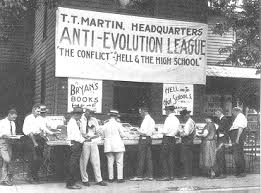
Bryan wasn’t alone.  As I note in my 1920s book, all the anti-evolution activists of the 1920s were obsessed with demonstrating that creationism[*] had expert support.  T.T. Martin, for example, who attracted attention with his eye-catching booth at the 1920s Scopes monkey trial, listed his expert supporters relentlessly.  In his book Hell and the High School, 67 out of 175 pages consisted of nothing more than lists of anti-evolution experts and their backgrounds.

Experts! Experts! Get Yr Experts Here!

Experts! Experts! Get Yr Experts Here!

Another anti-evolution activist from the 1920s showed similar determination.  On a typical page of Alfred Fairhurst’s Atheism in Our Universities, Fairhurst included only 23 original words.  The remaining 107 consisted of quotes from “leading writers on evolution.”

Writing in 1922, Arthur Brown used the same tactic.  He piled up impressive-sounding lists of experts and scientists who disputed evolution.  Why should readers accept evolution, Brown asked, when it had been discarded by the likes of

world-renowned men like Virchow of Berlin, Dawson of Montreal, Etheridge of the British Museum, Groette of Strassburg University, Paulson of Berlin, Clerk Maxwell, Dana, Naegeli, Holliker, Wagner, Snell, Tovel, Bunge the physiological chemist, Brown, Hofman, and Askernazy, botanists, Oswald Heer, the geologist, Carl Ernst von Baer, the eminent zoologist and anthropologist, Du Bois Reymond, Stuckenburg and Zockler, and a host of others. . . .  It seems to be a fact that NO opinion from whatever source, no matter how weighty or learned, is of any account with those who are consumed with the determination to reject the Bible at any cost, and shut God out of His universe.

As I traced in my 1920s book, following the work of historian Ron Numbers, this impressive-sounding list did not really make the point Brown hoped it would.  The names he listed came from earlier generations or from scientists who agreed with evolution’s broad outlines but disagreed on details.  But Brown, like Bryan, Martin, Fairhurst, and virtually all other creationist activists felt compelled to establish the academic credentials of anti-evolutionists.

Hovind’s case reminds us of this peculiar conundrum of credentials among creationists.  One does not have to be an evolutionary bulldog like Professor Coyne to find Hovind’s academic pretensions silly and reprehensible.  Hovind’s work certainly gives skeptics such as Professor Coyne an easy route of attack.

For those of us who don’t care to attack or defend creationism, though, Hovind’s doctoral ouvre offers different lessons.  Once a dissenting group has been turned away from mainstream institutions, credentials become both more precious and easier to attain.  At least since the 1920s, that is, anti-evolutionists have scrambled to find expert backing for their beliefs.  But once creationism had been kicked out of elite research universities, it became far easier for creationists to claim credit for academic work at bogus universities.  If universities themselves are suspect, in other words, the ridiculousness of diploma mills like the Patriot Bible University becomes less damning.

[*] The term “creationism” is an anachronism here.  Anti-evolutionists in the 1920s did not call their beliefs “creationism” yet.  But I’ll use it just to keep things readable.

Montana Tech Faculty: Conservatism YES, Creationism NO

H/T: LMW

Can a science-oriented public museum welcome creationists as commencement speakers? No way, says a faculty group at Montana Tech.

According to an article by Scott Jaschik in Inside Higher Ed, the controversy at Montana Tech revolves around the coming commencement address by Greg and Susan Gianforte. No matter which way we slice it, this discussion raises crucial questions about the values of diversity, the politics of creationism, and the nature of science.

According to the university’s Chancellor, Don Blackketter, the Gianfortes are the perfect choice. After all, Montana Tech is a science-oriented subunit of the University of Montana. Ms. Gianforte has engineering degrees from fancy schools including Cornell and Berkeley and the couple together has a long record of success in software entrepreneurship. As Blackketter gushed on the school’s website,

Greg and Susan are a great example of passionate individuals and entrepreneurs who have had much success and have given back in so many ways. Their messages will resonate well with our students who will be leaving Montana Tech to make their mark out in the world. We are honored they will be a part of our event.

If you ask some of the faculty, however, you’ll likely get a different story. In addition to supporting conservative causes such as the Milton Friedman Foundation and the Association of Classical Christian Schools, the Gianfortes have donated to the creationist Glendive Dinosaur and Fossil Museum. The museum endorses a vigorously creationist vision of the origins of the earth and of humanity.

According to journalist Scott Jaschik, faculty protesters insist they do not have a beef with the conservative politics of the Gianfortes. But the faculty faction DOES object to the Gianfortes’ support for creationism. Pat Munday, department chair for technical communication and a professor of science and technology studies, told Jaschik that a “publicly funded, science-based institution” like MT could not seem to condone such anti-scientific beliefs. More provocatively, Henry Gonshak of the English Department told Jaschik that the Gianfortes could not cut the mustard. Though they promised not to discuss their political activism, Gonshak was not convinced. “If Saddam Hussein or Osama bin Laden promised not to mention their own political and religious beliefs,” Gonshak asked, “would we pick them as commencement speakers?”

Though I find Gonshak’s comparison excessive and counterproductive, I agree with him that inviting creationist-supporters to speak at a public science school’s commencement raises some difficult questions. First of all, are the Gianfortes automatically “anti-science” for their support of a creationist museum? Chancellor Blackketter doesn’t think so. He told Jaschik the Gianfortes were “great supporters of science and . . . science and math have been part of their successful business ventures.” As we’ve argued time and time again, the notion among some mainstream scientists that creationists are incapable of learning or using “real” science just doesn’t hold water. The Gianfortes seem like an example of successful creationist engineers.

Second, does it suppress the university’s mission of intellectual diversity to ban commencement speakers of any kind? What if the university wanted to ban prominent science pundit Jerry Coyne due to Coyne’s in-your-face atheism and unapologetic dismissal of religious beliefs? Wouldn’t that seem outrageous? How can we ban one sort of speaker and not another?

Third, should we think about this as a political question? That is, must we who want more evolution taught in our nation’s public schools fight against any event that lends scientific credibility to evolution deniers? If so, the faculty’s move at Montana Tech seems appropriate. Hosting the Gianfortes as commencement speakers at a public science university sends a message. If science does not include creationism, the Gianfortes should not be invited to speak.

Fourth, does it matter that the Gianfortes are charged with supporting a creationist institution, rather than promoting creationism directly? It seems an illegitimate McCarthyite tactic to dig through the record of public figures to denounce them by association. Do we know if the Gianfortes themselves are creationists? I’ve given money to the Catholic Church, for example. But I would not consider it fair to label my politics as anti-contraception because of that. People should be judged on their own merits, not smeared by tenuous affiliations.

The ultimate question, I suppose, is this: Would you sign a faculty petition to oust the Gianfortes as commencement speakers?


What Would Bryan Do?

H/t KT

Would William Jennings Bryan support the recent move by the president of Bryan College?  That’s the question Bryan’s great-grandchildren are asking these days.

As we’ve reported, Bryan College’s leadership has imposed a new, stricter faculty policy.  From now on, faculty must believe that Adam and Eve were real, historical persons and the real, genetic origins of all subsequent humanity.  As science pundit Jerry Coyne has pointed out, that puts evangelical scientists in a pickle, since genetic evidence indicates that the smallest possible pool of original humans had to be at least 2,250 people.  Bryan College is home to science-curriculum innovators Brian Eisenback and Ken Turner, who hope to show evangelical students that evolution does not necessarily disprove their Biblical faith.

What would the original Bryan say about all this?  The college, after all, was founded as a memorial to Bryan’s last decade of work defending the centrality of Biblical wisdom in American life and politics.  As I argued in my 1920s book, though, Bryan himself held some beliefs about both the beginnings and the end of time that have made other conservative evangelical Protestants uncomfortable.  Bryan did not believe in a young earth, nor in a literal six-day creation.  Nor did Bryan think Jesus had to come back before the earth experienced its promised thousand-year reign of peace and justice.

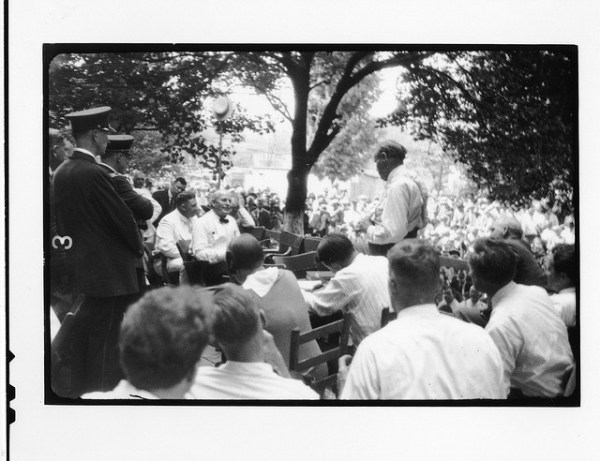
Bryan Gets Grilled by Darrow at the Scopes Trial

Bryan Gets Grilled by Darrow at the Scopes Trial

Other historians, too, have noted Bryan’s complicated relationship with the fundamentalist movement in its first decade, the 1920s.  Lawrence Levine’s Defender of the Faith and, more recently, Michael Kazin’s A Godly Hero both get into the gritty details of Bryan’s anti-evolution crusade.

Historians might disagree, but we all will get nervous about trying to predict what Bryan would say about today’s dust-up at Bryan College.  Because Bryan’s ideology and theology remain necessarily part of his life between 1915 and 1925.  It is mostly meaningless to ask what he would say today, because the situation today is so wildly different from what it was back then.

For example, when Bryan led his anti-evolution movement in the 1920s, the scientific jury was still out on the mechanism of evolution.  Darwin’s explanation—modified descent through natural selection—had been roundly criticized and nearly dismissed by the mainstream scientific community.  So when Bryan led the charge against the teaching of evolution, he could claim with scientific legitimacy that natural selection was not established scientifically.  It was not until years after Bryan’s death that biologists and geneticists such as Theodosius Dobzhansky, Ernst Mayr, R.A. Fisher, J.B.S. Haldane, Sewall Wright, and others solved the problem of genetic “swamping” that seemed to make Darwin’s idea of natural selection a non-starter.

I’ve spent my time with Bryan’s papers at the Library of Congress.  I like Bryan.  He was a successful politician, but I don’t hold that against him.  I believe he was also sincere and devoted to justice.  I came to believe that Bryan was profoundly shocked and surprised when he could not produce his dream team of scientific experts at the Scopes Trial to put evolutionary scientists in their place.

Of course, Bryan died just a few days after the trial.  I can’t help but wonder how he might have “evolved” in his thinking if he had lived.  Would his experience at the Scopes Trial have caused him to re-think his confidence that evolutionary science would soon be disproven?  And, more intriguing, how would Bryan have responded if he had lived for an even longer stretch?  An Old-Testament sort of lifespan?

Would Bryan have embraced the “new evangelicalism” of Carl Henry and Billy Graham?  Would he have worked to make sure Biblical religion remained in conversation with mainstream American culture and politics?

I can’t help but think that he would.  I agree with Bryan’s great-grandson Kent Owen, who told reporter Kevin Hardy, “My view of Bryan is that things weren’t set in stone. . . .  He was pragmatic.”

What does this mean for today’s leadership at Bryan College?  On one hand, they are continuing the legacy of their school.  Bryan College was never bound too tightly to the thinking of the original William Jennings Bryan.  From its outset, Bryan College took a firmer, more “fundamentalist” position than Bryan himself ever did.  But on the other hand, the insistence of today’s leadership that Bryan College faculty sign on to a specific understanding of the historicity of Adam & Eve does not sound like something the Great Commoner would have supported.  As long as the principle of respect and reverence for the Bible was maintained, the original Bryan thought, people of good will could disagree on the details.

Creation, Evolution, and College Marketing

Bryan College is having a rough time.  The school is experiencing angst as it wrestles with a new policy about the origins of humanity.  The leadership is insisting that members of the school community must adhere to a newly rigid position on origins.  All members of the college community, it seems, will be asked to sign off on a doctrinal statement recognizing that Adam & Eve represented the real, historical ancestors of all humanity.  Traditionally, faculty and students had been encouraged, or at least permitted, to embrace a relatively wide scope of Biblical opinions about the age of the earth and the historicity of Adam & Eve.

Some commentators have argued that this represents a false dilemma for Christians, or even that Bryan’s misery proves the failure of religion in the modern world.  But there is a simpler explanation.

Those familiar with the history of Bryan College can’t help but note the ironies here.  As I point out in my 1920s book, the founding of Bryan College was stymied by William Jennings Bryan’s unorthodox brand of conservative evangelical Protestantism.  Not only did the original Bryan not embrace the notion of a young earth, but Bryan was loud and proud about his postmillennial interpretation of Scripture.  For the growing fundamentalist movement in the 1920s, Bryan’s old-earth position was not remarkable or problematic.  Many leading fundamentalist thinkers in the 1920s had “liberal” positions about the age of the earth.  But Bryan’s postmillennial beliefs caused some worry.  Could “fundamentalists” be postmillennialists?  Such debates threatened to derail the funding of the new university in the 1920s.

Such arguments based on the history of Bryan College are relevant in today’s disputes.  The current leadership of the school insists that their new statement of faith is really only a clarification of their traditional creed.  Indeed, it would have to be, since part of that original charter stipulated that the creed could never be altered.

Faculty members at Bryan differ, however.  As we’ve noted in these pages, faculty members such as Bryan Eisenback have crafted innovative school curricula that hope to teach evolution to Christians in a Christian way.  As described in a recent article in Chattanooga’s Times Free Press, Eisenback has been accused of teaching both evolution and creationism.  As Eisenback described to the TFP,

In my view, God gave us science to learn about the physical world.  When people embrace that, science is our way of understanding God’s handiwork, so to speak, then science isn’t threatening. It becomes exciting.

As usual, Josh Rosenau of the National Center for Science Education offered a sensible argument in the pages of the TFP.  Bryan’s leadership, Rosenau noted, seemed to be staking out a hard-line position unnecessarily.  “The evangelical position,” Rosenau argued, “doesn’t have to be an outright rejection of human evolution. There are ways to be a Bible-believing literalist without being at odds with science.”

Less convincing was the cackling triumphalism of science pundit Jerry Coyne.  In the pages of The New Republic, Coyne argued that the mess at Bryan College resulted from a necessary clash between advancing science and retreating religion.  “Bryan is fighting a losing battle,” Coyne crowed,

but it will be a long battle. These vestiges of superstition, and of blind adherence to it, will eventually disappear as America becomes more secular. There will always be Biblical literalism, but I’m confident it will slowly wane. But it will wane not with the changing of minds, but over the corpses of its adherents, as the older generation dies off and the younger, exposed to secularism and doubt on the internet, begins to ask questions.

I’m an avid reader of Coyne’s blog, but I don’t see how his argument makes sense.  The “older generation” he refers to is many generations derived from the founders of Bryan College.  A pile of the corpses of adherents to Bryan College’s conservative theology would be too high for any young people to climb over!

Corpse imagery aside, there’s a more important point to be made here.  College presidents want most of all to see their institutions thrive.  As the Chattanooga TFP article makes clear, the problem at Bryan College started when prominent young-earth creationist Ken Ham accused the college of falling away from Biblical orthodoxy.  The leadership of Bryan College faces a worrying prospect.  What if conservative evangelical parents no longer trust the orthodoxy on tap at Bryan?  What if they no longer agree to send their children and their tuition dollars to the school?

More than nuances in Biblical scholarship or evolutionary theory, college presidents must consider such things.  The dangers to the bottom line from the condemnation of Ken Ham are real and substantial.  Unless the leadership acted to shore up the impression of orthodoxy, they must have worried that their institution would become just another failed small religious college.

Let me be clear: I have no inside knowledge of the goings-on at Bryan College.  But it seems as if the simplest explanation here is probably the right one.  Beyond keeping the faith true, college presidents must worry about keeping the lights on.  In today’s climate, a bad review from the likes of Ken Ham could easily spell the end of any conservative evangelical school.


To Debate or Not to Debate

Bill Nye and Ken Ham will be going a few rhetorical rounds next month.

The mega-popular science educator will broach the creationist lion’s den of the Creation Museum on February 4th.  The topic: “Is creation a viable model of origins in today’s modern scientific era?”

Image Source: Answers In Genesis

Image Source: Answers In Genesis

Are these debates worthwhile?  In the past they had decisive impact on the formation of American creationism and fundamentalism.  But these days such debates are a different animal.

Science pundits don’t like it.  Jerry Coyne warned that Bill Nye will only be putting money and legitimacy in Ham’s deep pocketsPZ Myers wisely concludes that each side will likely only speak past the other.

I agree.  The audience at this debate will likely not be moved by either man’s arguments.  No matter how scientifically accurate or biblically flawless, logical arguments tend not to be the deciding factor in determining one’s beliefs about human origins.

As David Long’s ethnography demonstrated so powerfully, creationists can thrive in mainstream scientific environments without abandoning their religious ideas.  Many creationists have simply been taught to regard mainstream scientists as deeply flawed and bumbling fools.  It is easy to dismiss plausible-sounding talk from someone we have already deemed unreliable.

It’s hard to imagine Ham’s Cincinnati audience won’t be prepared to dismiss Nye’s mainstream science talk out of hand.  I assume Nye is hoping that he may still plant a few seeds of science doubt in the minds of those who hear him.  Not much reason to offer Ham such a plum chance to look like a reputable scientific authority.

At the start of America’s public evolution/creation battles, this legacy of public debating functioned much more powerfully, since creationists had not yet set up alternative institutions.  As I describe in my 1920s book, some of the most influential creationists of the 1920s received humiliating public trouncings in popular debates.

At a talk on the campus of the University of Minnesota, for example, fundamentalist leader William Bell Riley found himself surprised by a student prank.  Someone lowered a monkey onto the stage as Riley tried to convince his audience that creationism was reputable science.  “Every time I hear the argument that this is a controversy between experts on the one hand, and, as someone has said, ‘organized ignorance,’ on the other, I smile,” Riley told the St. Paul Pioneer Press in 1927.  “This is not a debate between the educated and the uneducated.”

Similarly, in London, creationist godfather George McCready Price found himself hooted off the stage in the days following the 1925 Scopes Trial.  He had tried to tell the merciless audience that the theory of evolution was doomed as mainstream science.  Such flawed science, Price insisted, may have worked fine

for the times of comparative ignorance of the real facts of heredity and variation and of the facts of geology which prevailed during the latter part of the nineteenth century; but that this theory is now entirely out of date, and hopelessly inadequate for us. . . .  We are making scientific history very fast these days; and the specialist in some corner of science who keeps on humming a little tune to himself, quietly ignoring all this modern evidence against Evolution, is simply living in a fools’ paradise.  He will soon be so far behind that he will wake up some fine morning and find that he needs an introduction to the modern scientific world.

The audience didn’t buy it.  Price found himself heckled so mercilessly that he could not complete his presentation.  That London debacle was Price’s last public debate.  After that experience he focused his considerable energy on founding alternative scientific institutions to prevent future creationists from needing to convert mainstream scientists.

Back in those days, creationists and fundamentalist scientists still attempted to tell audiences that they represented the true mainstream of scientific discovery.  Such early creationists eagerly debated in a variety of settings in hope of convincing middle-of-the-road audiences that evolutionary science was not real science.

In that context, public debates held promise for both sides.  Creationists hoped to prove that they had better science.  Evolutionary scientists hoped to demonstrate the scientific vapidity of creationism.

These days, both sides have hardened.  Creationists these days are not unaware of the fact that their science does not represent the scientific mainstream.  Evolutionary scientists are not hoping to relieve creationists of their naïve ignorance.

Rather, both sides in these debates enter and exit with the same set ideas.  Each side knows who to trust on that stage and who to ignore.  No matter how persuasive Ken Ham can be, he doesn’t really hope to change Bill Nye’s mind.  Rather, this exercise merely serves to give each charismatic speaker the chance to gain a sliver of legitimacy and respectability in the opposite camp.


Should Adults Lie to Children?

I’ll say it: Lying to children is a vital part of a good education.

Adults lie to children all the time.  Santa Claus. Easter Bunny. Tooth Fairy. Daddy will eventually come home again…

But can such lies be considered “education?”  Our attitude toward this question might tell us a thing or two about the continuing culture wars over American education.

The question came up again in Professor Jerry Coyne’s review of Jonny Scaramanga’s Salon article.  For those of you who just joined the party, Professor Coyne is an irascible atheist and scientist.  He is an inveterate campaigner against creationism and delusional religionism.  Scaramanga is a recovering fundamentalist, blogger, and sometime contributor to these pages.  Scaramanga’s Salon article decried the repackaged fundamentalist curricula that are being taught in some publicly funded charter schools in Texas.

In response, Coyne thundered,

Adults have the right to be as stupid as they want, but I don’t think they have the right to tell lies to children. Those lies include not only religious dogma, but the antiscience attitudes that come with it. How sad that a group of bright and curious children can become ignorant, superstitious ideologues simply because they were born into the wrong families.

Professor Coyne is not the first science pundit to take this position.  In his 1964 anti-creationism book This View of Life, paleontologist George Gaylord Simpson blasted the lies that had thwarted evolution education.  “Even now,” Simpson argued,

a hundred years after The Origin of Species, most people have not really entered the world into which Darwin led—alas!—only a minority of us.  Life may be considerably happier for some people in the older worlds of superstition.  It is possible that some children are made happy by a belief in Santa Claus, but adults should prefer to live in a world of reality and reason.

But as anyone involved with education knows, adults lie to children all the time.  Doing so is a vital part of every good education.  Let’s look at a couple of examples.

1.) “This is what we believe.” 

Every education, in every culture, whether it means formal schooling, apprenticeships, or informal instruction, includes the passing along of central ideas.  Professor Coyne meant that adults should not tell young people things that are untrue.  But what if the adults believe it fervently?  Is that a lie?  Or, to complicate the matter, what if the adult isn’t sure if she believes it fervently, but is convinced that it will be good for the young person to believe?  For example, in the world of religious faith, an adult may have had serious doubts about her faith, but decide that a young person is not yet mature enough to consider those gray areas.  She might then tell young people that certain religious mysteries are simply truths, knowing that later the child will and should wrestle with the more complicated questions about it.

2.) “You can do this.”

This can be a flat-out lie.  Teachers and parents often work to inspire confidence in their children and students, even when the adults are very unsure of the truth of their statements.  Adults may have serious doubts that young people can, indeed, accomplish certain goals.  Yet the adults might tell the children that such goals are definitely, absolutely, 100% achievable.  It’s a lie.  But it is something good parents and teachers do.

3.) “I hate phonies.”

In our culture, many of the biggest truths are best understood through lies.  I’m no Salinger fan, but I still remember reading Catcher in the Rye in high school.  I remember Holden’s struggle with phonies.  It taught me important truths about the ways people interact with one another.  None of it was “true,” of course.  It was all fiction, all lies.  But my teacher taught me those lies.  And I’m very glad she did.

Our attitude about lying to young people can tell us a lot about our positions on key educational culture-war issues.  Professors Coyne and Simpson think it is not okay for young people to learn creationism or other religious falsehoods.  But that position doesn’t include room for the complexities of real education.  Adults lie to children all the time, for the children’s benefit.  Sometimes they do so deliberately.

But more often, adults tell children things that the adults think are true.  Creationists don’t set out to deceive their children; they hope instead to protect their children from the deceptions of mainstream science.

But what if we don’t agree that creationism is true?  Are those creationists guilty of lying to children?  Professor Simpson said yes.  Professor Coyne says yes.  Jonny Scaramanga, I’m guessing, would say yes.

I disagree.  Teaching children our core beliefs is not lying.  Even if I think those beliefs are untrue (and I do think young-earth creationist beliefs are untrue), parents who teach such things to their children are guilty of nothing more than educating their offspring.

There is no parental right more fundamental than that.


Commenting, Evolution, and Public Forums

Another prominent website in the evolution/creation debates has changed its comment policy.

As you may recall, Popular Science announced recently that it was shutting off public comments entirely.  Now BioLogos has decided to vet, edit, and publish only select comments, along with author response.

For those new to the scene, BioLogos has made itself the leading voice for theistic evolution, what its leaders often call “evolutionary creationism.”  Founded by evangelical scientist Francis Collins, the organization has hoped to spread the idea that good science and good religion do not need to conflict.  Bible-believing Christians, BioLogos believes, can still embrace evolutionary science.

But that does not mean, apparently, that good manners and blog commenting can go together.  BioLogos’ Content Manager Jim Stump explained their reasoning for changing their public comment policy.  Too much of the online discussion, Stump said, was dominated by a few voices.  Instead of merely leaving comments open, editors will solicit email comments.  Those comments will be organized into a more coherent back-and-forth between commenters and original authors.  The hope is that this model will encourage more participation from more people than the open-forum approach.

Will it work?

If it does, is it worth the price of restricting open dialogue?

Ferocious critic Jerry Coyne called this a “desperation move” by an organization foundering on the shoals of reality.  Too many commenters, Coyne argued, were asking awkward questions and making persuasive arguments.  The real questions—about how God interacts with the world—proved threatening to BioLogos’ position on the compatibility of science and faith, Coyne said.  Too wide a chasm yawned between real science—which recognizes the extremely unlikeliness of humanity deriving from only two people—and evangelical religion—which insists on an historical Adam & Eve.

I don’t share Professor Coyne’s contempt for the BioLogos mission.  I believe the evolution/creation debates have plenty of room for scientific belief that rubs along with religious belief.

But I agree with Coyne that shutting down comments to preclude dominance by a few voices doesn’t make much sense.  The purpose of this sort of online publication is precisely to allow a free flow of ideas and discussion between people who might not otherwise meet one another.  If a few vociferous voices dominate that discussion, so be it.

A better way to include the unincluded would be actively to solicit short columns and opinion pieces by a wide spectrum of readers.  That way, more voices could be included from people who might shy away from the hurly-burly of an active and combative open-comment forum.