Let’s Be Civil: Scott F. Aikin & Robert B. Talisse

We must be civil.  If we here at ILYBYGTH hope to understand Fundamentalist America from the outside, it is not optional.  The purpose of ILYBYGTH is to imagine the best reasons for conservative ideas on evolution, religion, education, etc.  Without civility, this turns into another useless and bitter witchhunt.

But what does it mean to be civil?  Philosophers Scott F. Aikin and Robert B. Talisse of Vanderbilt offer a compelling short definition of true civility.  In a piece on 3 Quarks Daily, the two philosophers argue for a more precise and healthy definition of civil argument.  “We now are able,” Aikin and Talisse say in part,

“[to] identify civility in argument with tendencies that enable the exchange of reasons among disputants. Chief among these concerns the need for those who disagree to actually engage with each other’s reasons.  This requires arguers to earnestly attempt to correctly understand and accurately represent each other’s views.  For similar reasons, arguers must also give a proper hearing to their opponents’ reasons, especially when the opponent is responding to criticism.  In addition, when making the case for their own view, arguers must seek to present reasons that their opponents could at least in principle see the relevance of.  We can summarize these ideas by saying that civility in argument has three dimensions: Representation, Reception,and Reciprocity.”

And they conclude:

“Thus we see that civility in argument is not a matter of being nice, calm, or even polite.  It instead has to do with being a sincere arguer.  Civility is consistent with sharp tones, raised voices, and other forms of adversariality that would in other contexts be inappropriate.  But our model of civility also holds that name-calling, impoliteness, and hostility are to be avoided when they would obstruct or undermine properly run argument.”

For those of us who try to engage with those with whom we don’t agree or don’t even understand, this definition will help define the parameters of civil discourse.  It is a reminder that we must not abandon our own positions in order to respect the other.  Such wallpapering is not true civility, but rather only a stalling maneuver.  This definition also frees us to be angry, so long as we understand that anger is a feeling, not an argument or strategy.  True civility, in my opinion, is like parents arguing in that quiet time when a baby has just fallen asleep after a long stretch of midnight crying.  Both parents can be angry.  Both can point fingers and accuse the other of sloth.  But both parents also implicitly–automatically–keep their voices down to a hushed whisper.  Though they may have a ferocious argument, they both agree not to wake the baby.

Can people really do this?  There often does not seem to be any agreement to keep argument civil.  Culture warriors break this implicit code all the time, engaging in violence or accusing one another of inciting violence.

But there is hope.  Political scientist Morris Fiorina has argued that the “culture-wars” are not truly as vicious as they are made out to be.  Scholars such as Jonathan Haidt insist that there are moral positions on both sides of many hot-button issues.  And activists such as John Corvino and Maggie Gallagher have committed to talking civilly with one another, sometmes with “sharp tones, raised voices, and other forms of adversariality.”

So let’s be civil.  When we disagree, let’s remember to try to understand the other side.  Let’s listen to one another.  Let’s give reasons that might make sense to the other side.  And let’s agree to be open to changing our ideas.  A tall order, but a necessary one.

Confessions of an Outsider in Fundamentalist America

Several people have asked me lately to clarify my position.  If I’m not trying to boost fundamentalism, and I’m not trying to fight against it, why bother with this blog?  I appreciate the question, so I’ll take a stab at an explanation.

Blog readers tend to come from a few different camps.  Some are refugees from Fundamentalist America (or Australia, or Canada, or UK).  That is, they grew up in conservative religious families and have been estranged from that tradition.  Others are residents and defenders of Fundamentalist America.  A few are resolute anti-fundamentalists.

I fit into none of those categories.  I grew up in a mostly secular, culturally liberal family.  We lived in the northern suburbs of Boston, where it was easy to assume that fundamentalism belonged only in Footloose.

I’ll have Bacon with mine.

Once I moved out of that bubble, I found myself working and living with people who shared a profound cultural conservatism, very different from the kind of culture I grew up with.  Most of them were not the monsters I had expected.  By the time I started teaching high school, I had some encounters with cultural conservatives that left a sour taste in my mouth.  I began my academic career as a historian interested in populist movements.  I had hoped to study nineteenth- and twentieth-century popular insurgencies.  I was particularly interested in the strength of conservative popular insurgencies.  When I started my PhD work at the University of Wisconsin, I felt that the conservative folks that I had lived and worked with had not been adequately studied.  Once I read more deeply from recent academic history, I realized that such historians had, indeed, spent a good deal of time examining the conservative popular tradition.  I decided to join that group.

I was particularly interested in educational history, for a couple of reasons.  First of all, I was influenced by both the work and the personality of Bill Reese.  Reese had studied grass-roots educational insurgencies.  His work showed me that the best place to study cultural conflict was in educational history.  The field combined all the interesting parts of political history, cultural history, religious history, and intellectual history.  After all, it was—and is—in the schools that the cultural fat hits the fire, so to speak.  The nature of morality, the boundaries of legitimate knowledge, the fundamental premises of religion and culture…all these issues are often only articulated in the public sphere when they need to be adjudicated in public schools.

Once I decided to study educational history, I looked for an important educational movement or group that had not been studied by academic historians.  The Protestant fundamentalists of the 1920s seemed like such a group.  Once Ron Numbers–historian of science and medicine, the world’s leading academic authority on scientific creationism, and an all-around great guy–agreed to work with me, my research path was clear.

Years later, after I have published and spoken a good deal about such conservative religious folks, I found that one question kept coming up, especially among my academic audiences.  Some members of such audiences always wondered why so much educational policy was “still” dictated by cultural conservatives.  Prayers in school, creationism, “heritage” history; all these seemed to come as a surprise to many members of my academic audiences.

Like me, many of the members of those audiences had lived most of their lives in very sheltered, very liberal, very secular environments.  They often shared a disturbing combination of profound ignorance with utter arrogance.  They thought that all of America did or should share their cultural beliefs.  And they believed this while considering themselves open-minded and committed to welcoming a diversity of cultural voices.

I found myself deeply embarrassed for such people, especially because I shared the same background.  Before I began exploring the educational, intellectual, cultural, and religious histories of conservatism, I assumed—without examining my own assumptions—that Fundamentalist America represented only a cultural backwater, destined to dry out and disappear as our society evolved.

Perhaps an example will clarify.  After one talk I gave about anti-evolution activism in the 1920s, one audience member raised a hand and asked, “What is the matter with these people?”  The rest of the audience giggled and nodded.  I have since come to know the person who asked that question.  She is delightful.  She cares deeply about other people.  She is a prominent education researcher and well-known scholar in her field.  She has dedicated her professional life, and much of her personal life, to making public education more accommodating for people with physical disabilities.  She would be horrified to be accused of bigotry, closedmindness, or prejudice.

Yet when she heard my talk about the intellectual background of anti-evolutionism, she did not think twice about dismissing all such people—nearly half of American adults—as “these people.”

It is for people like her that I write this blog.  My mission, if that’s not too lofty a term, is to introduce Fundamentalist America to people who are ignorant about it.  Part of that means demonstrating the popularity and strength of conservative religious ideas in American public life.  Part of it means explaining the reasons why intelligent, well-meaning people may embrace notions such as young-earth creationism and an inerrant Bible as a primary authority in making political decisions.

None of this means I agree with such positions.  I don’t.  But I would like to join those who try to build understanding between opposing cultural visions.  Like Jonathan Haidt, I believe that many of our cultural battles could be less bloody.  One way to make them so is to make sure each side understands the other.  As someone who comes from outside the borders of Fundamentalist America, but spends much of my time exploring the history and culture of Fundamentalist America, I believe I can be of use in explaining FA to other outsiders.

Will this solve all our disagreements?  Of course not.  But I believe it will be better to understand and even sympathize with our opponents’ positions, even if we must eventually respectfully disagree.

IN THE NEWS: Ignorance or Disdain? Fundamentalists, Science, and Alternative Intellectual Institutions

The folks at Scienceblog recently reviewed the findings of Gordon Gauchat, a postdoctoral fellow at University of North Carolina.  In his study, Gauchat found that Americans who self-identify as conservatives trust “science” less in 2010 than conservatives did in 1974.  In contrast, self-identified liberals and moderates kept a stable attitude toward “science” during that period.

So what do these findings tell us?  On first glance, it might seem as if conservatives simply don’t like science.  After all, we’ve seen a rush to denigrate climate-change science and evolution among 2012’s Republican Presidential candidates.  This confirms some culture-war stereotypes, which paint Fundamentalist America as the hillbilly redoubt of Nascar, meth labs, married cousins, and a hatred for all forms of higher learning.

But the study needs a second look.  The level of respondents’ education had an inverse relationship to their reported trust of “science.”  That is, conservatives who had more education tended to trust science less.  This is not about anti-intellectualism or anti-science, at least not as such.

Let me suggest an historical analogy.  I’m not sure if it’s got legs, but I think it’s worth thinking about if we want to understand the phenomenon of educated conservatives maligning “science.”

In the Glory Days of American liberalism, a deep distrust of the cultural and political establishment took hold among the well-educated Left.  With the founding of the Students for a Democratic Society in 1962, some of the best-educated young people in the country announced their disdain for the establishment world of universities, governments, and research centers.  These earnest, intelligent young leftists would have responded to a survey that they did not trust mainstream intellectuals.  As they agreed in their 1962 Port Huron Statement, SDS disdained academic culture. They attacked their “professors and administrators,” as tools of The Man who

“sacrifice controversy to public relations; their curriculums change more slowly than the living events of the world; their skills and silence are purchased by investors in the arms race; passion is called unscholastic.”
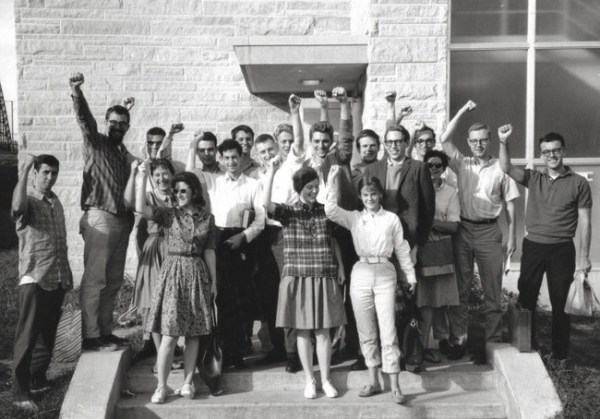
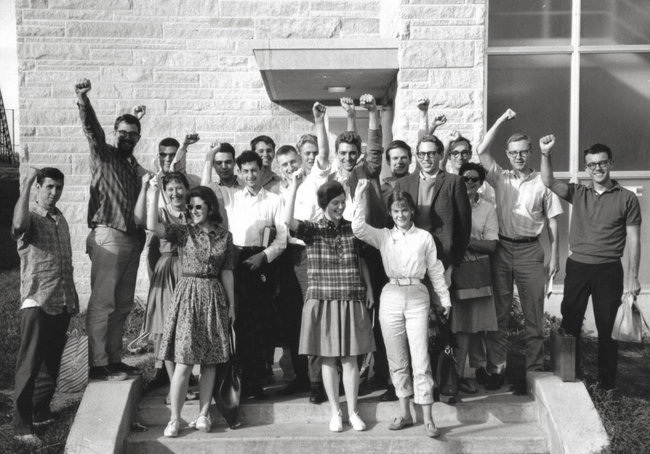
Did this disdain for the culture of higher education mean that the intellectuals of SDS were anti-intellectual?  No, what it signaled was an active disdain for the dominant culture of American higher education.

In less than a decade, this anti-establishment impulse among well-educated young leftists had careened down a startling path and mutated into a very different animal.  By 1970, the scattered remnants of SDS had resorted to bombing the Pentagon, army bases, and—accidentally—themselves.  Leftist disdain for the establishment had morphed from the smiling, fist-shaking intellectualism of the 1963 SDS meeting pictured above into the gleeful nihilism of Abbie Hoffman pictured below.

So what might this analogy tell us about the feelings of today’s conservatives and fundamentalists about mainstream science?  For one thing, it suggests that the proper term here is not “ignorance,” but “disdain.”  Well-educated American fundamentalists are not ignorant about mainstream science, but they feel a deep disdain for it.  That disdain has increased in the last generation as alternative intellectual institutions have propagated an anti-establishment culture.

Other studies have supported this intuition.  As we reviewed here recently, Jonathan Haidt’s Righteous Mind included a survey of 2000 respondents.  In this study, self-identified conservatives and moderates were very good at predicting the moral responses of liberals.  Self-identified liberals, on the other hand, could not guess what conservatives might say.  This suggests that Fundamentalist America is well aware of what liberals think, but liberals have allowed themselves to become ignorant of other intellectual options.

Let’s return to our analogy to see if it helps explain this phenomenon.  If fundamentalists in 2010 share the disdain for mainstream intellectual culture that was espoused by well-educated young leftists in the early 1960s, what might be the results?

In the case of the Left, this divorce from academic culture was merely a trial separation.  Most of the student radicals of the 1960s and 1970s ended up the boring center-leftists of the 1990s.  The academically inclined among them founded or joined friendly academic centers hoping to eliminate racism or poverty or war.  The more talented and lucky managed to open new fields of study and press for new visions of education, promoting successful “ethnic studies” programs and multicultural education initiatives.  For a small minority of 1960s/70s leftists, those who followed the logic of anti-establishment culture to its bitter 1970s conclusion, this meant increasingly bizarre forms of dress and behavior, meant to signal distance from the establishment.  For a tiny fraction, this meant political and cultural violence, such as bombs at the Pentagon and Days of Rage.

What will it mean for fundamentalists?  If the historical analogy holds any weight, this distancing between mainstream science and fundamentalists will lead a small fringe on the Right to continue its violent campaign against America.  Like the violent Weather Underground, some fundamentalists will likely follow the logic of separation from mainstream culture to a violent conclusion.  But for the overwhelming majority of conservatives and fundamentalists, if the historical analogy holds any weight, it will mean the continuation of a trend toward alternative intellectual institutions.  Many conservative and fundamentalist intellectual types will find congenial homes in the widening world of the academy and private foundations/think-tanks.  Since the 1970s, indeed, we have seen a proliferation of conservative think tanks and foundations, such as the Heritage Foundation.  In recent years, these conservative alternative intellectual centers have offered well-educated fundamentalists a happy home in which to continue their intellectual work while continuing to feel a deep disdain for mainstream intellectual culture.  In some cases, this has included a disdain for mainstream science.  For example, a new intellectual center at Biola University, the Center for Christian Thought has promised to offer

“scholars from a variety of Christian perspectives a unique opportunity to work collaboratively on a selected theme. Together, they develop their ideas, refine their thinking, and examine important cultural issues in a way that is informed by Scripture. Ultimately, the collaborative work will result in scholarly and popular-level materials, providing the broader culture with thoughtful and carefully articulated Christian perspectives on current events, ethical concerns, and social trends.”

Just as the 1970s witnessed a huge increase in Left-friendly academic centers and fields of study, so this widening cultural distance between educated fundamentalists and mainstream science and academic life should lead to an increase in fundamentalist-friendly academic centers like this one.  It will lead to a deepening division between types of well-educated people; it will force Americans to confront their notions that there is one “correct” version of science and intellectualism.

***Thanks for the reference to Tim Lacy at USIH  ***

Required Reading: Are we all bigots now? Haidt’s Righteous Mind

Fundamentalists get called bigots a lot.  They don’t like it.  Since the 1920s, they have spent a lot of mental time and energy proving that they are, in fact, the side of openminded scientific inquiry.  For example, in the early 1920s fundamentalist intellectual Alfred Fairhurst complained that the teaching of evolution served mainly to close student minds.  “I am sure,” Fairhurst complained,

“that the teachers who would teach the subject are not fully prepared to present both sides as should be done when taught.  I believe that the teaching of evolution is mostly dogmatic, and that the result of teaching it is a new crop of dogmatists.  I am aware that there are those who hold that the subject of evolution greatly expands the mind.  I think that, as taught, it warps the mind and closes it against much truth.”

Generations later, in 1995, Duane Gish agreed that excluding creation science from public schools was nothing but “bigotry.”

Like the creationist activist Duane Gish, fundamentalists like to call their secular and liberal foes the true bigots.  As we have explored here at ILYBYGTH, fundamentalist activists such Bradley Johnson press the limits of fundamentalist free speech.  They provoke repression of their public religiosity in order to highlight the masked bigotry of hypocritical liberals.  Traditionalists point to foundational lefty intellectuals such as Herbert Marcuse as creeping totalitarians.  Marcuse and his minions, fundamentalists assert, are the ones who will not tolerate any disagreement.

I’m no fundamentalist, but I’ve seen this kind of anti-fundamentalist bigotry in action.  My academic research focuses on the history of fundamentalism.  While giving talks or discussing my research, I’ve often been surprised by both the viciousness and the ingenuousness of anti-fundamentalist bigotry.  I once had a very intelligent, well educated college student ask me how long it would take before religious people realized that religion was only for weak, ignorant people.  A colleague asked me once, regarding fundamentalists, “What’s wrong with these people?”  Another academic acquaintance suggested that the cure to the creation/evolution debate would be to “round up all the crazy white people” and force them to go through a rigorous de-theization education.  I like to think this last person was joking, but her comment elicited raucous cheers in the conference room.  All of these comments, fundamentalists would say with some justification, would never be tolerated about any other cultural group in our society.  Perhaps most egregious, the people making these comments tend to be almost entirely ignorant about fundamentalism.  They form their opinions based on vague stereotypes and in-group thinking, the very definition of bigotry.

So I sympathize with fundamentalist claims.  But I do agree there are limits.  I agree that fundamentalists often make these claims of victimization in order to promote a false moral equivalence between cultural sides.  For example, if we acknowledge the cultural legitimacy of creation science, do we give in to a strategic desire to muddle the issues in mainstream science and evolution?  (For an example of this debate, see the discussion at the US Intellectual History blog about the legitimacy of ILBYGTH’s fundamentalist-friendly forum.)

A new book casts a pox on all houses.  Psychologist Jonathan Haidt argues that most Americans decide first and come up with reasons later.  In The Righteous Mind: Why Good People Are Divided by Politics and Religion, Haidt describes his conclusions from over 130,000 online morality tests he and his colleagues delivered.  Their website, YourMorals.org, asks people an array of moral questions, from the mundane (Should teenagers listen to their parents’ advice?) to the bizarre (Is it morally acceptable to have sex with a dead chicken?).  For most people, Haidt argues, the moral answer is intuitive, not rational.  We do not start with principles and deduce the proper response.  Rather, we answer first and come up with justifications later.

If the nature of bigotry is to cling to irrational ideas demanded by ingroups and cultural cliques, then, according to Haidt, we’re all bigots now.  The moral answers we insist upon derive more from “groupishness” than from reason.

Not that both sides of America’s “culture wars” do everything the same way.  Haidt and his colleagues parsed morality into six fundamental notions: care, fairness, liberty, loyalty, authority, and sanctity.  Most Americans are deeply moved by the first three of these.  Liberals, however, tend to “care” more.  Conservatives tend to be more concerned with “fairness.”  According to Haidt—who self-identifies as a recovering partisan liberal—American conservatives do a better job with loyalty, authority, and sanctity.  Haidt disputes the notion that conservatives somehow trick voters into voting against their economic interests.  Rather, Haidt thinks conservatives simply do better at speaking to all six of the fundamental moral notions people really care about.

The most compelling part of Haidt’s book, for ILYBYGTH readers, is his conclusion about the closedmindedness of liberal America.  Haidt conducted a survey of 2,000 Americans, asking them to predict the moral choices of those with whom they disagree.  Self-identified “liberals” fared the worst at this game.  That is, respondents who called themselves “very liberal” ended up being the worst able to guess what fundamentalists cared about.  For outsiders—non-fundamentalists—who are trying to understand Fundamentalist America, this must serve as a sobering warning.  Simply because the worldview of liberal America treasures such notions as inclusiveness, tolerance, openmindedness, and rationality, doesn’t mean that we naturally apply such notions to fundamentalist ideas.  Rather, liberals—at least in Haidt’s research—tend to be the least able to understand where their cultural rivals are coming from.

Haidt hopes that true humility about the bigotry of our own moral impulses might lead to a softening of America’s culture wars.  He argues that one way to overcome our “groupishness” is to spend time engaged with the moral understandings of those with whom we disagree.  He has established one web forum to do just that.  At civilpolitics.org, he and his colleagues have listed ways to help Americans of different moral backgrounds to work together more calmly and productively.

Such anti-bigotry is the goal of ILYBTGTH as well.  Acknowledging the pre-rational roots of our strong moral feelings does not mean simply throwing up our hands and embracing moral relativity.  But making an honest effort to understand someone else’s moral universe can’t help but move us along the spectrum to a moral society we can all live with.