From the Archives: The Past Was Creeeeepy

Historian Rule #1: Don’t let your present hang-ups dictate how you view the past. Fine. But sometimes the past seems so gross it’s hard to ignore. Yesterday in the archives, for example, as I read through boxes of letters to and from Joseph Lancaster for my new book, I came across this 19th-century weirdness:my choice young friend

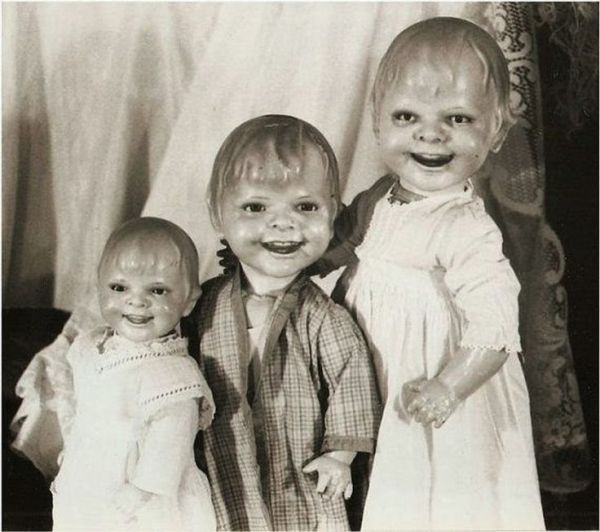
“My Choice Young Friend?” Why not just “Dear Betsy?” I’m thinking the letter-writer was perfectly sincere. She wanted her young friend to know that she was loved. Still, I can’t seem to get this salutation out of the “haunted doll” category.

creepy dolls

My other “Choice Young Friends”

From the Archives: Look at Me When I’m Talking to You!

SAGLRROILYBYGTH know I’m spending my summer nerdily buried in the archives researching my new book. Some of the language oozing out of 1804 sounds depressingly similar to twenty-first century school talk.

In these pages, we’ve talked at length about schools and social justice. Can we yell at students to make them be better citizens? Is it unhealthy if schools for low-income students have them sit silently at lunch, march militarily down halls, and chant rote answers to repetitive test-driven curricula?

At New York’s famous Success Academies, for example, students are famously dictated to for their own good. Teachers and students follow a scripted set of behavioral norms. Students are directed to sit with their hands folded properly, their backs straight, and their eyes always on the teacher. As the New York Times exposed a few years ago, the tone could sometimes get creepy.

https://www.youtube.com/watch?v=AzWicLyDTkw

In this vision of good public education, students are thought to need intense behavioral control for their own good. Silent lunches, single-file marching in silence from class to class, and instant obedience are the hallmarks of the “no-excuses” approach. As Joan Goodman of the University of Pennsylvania has argued, the goal is submission. As Dr. Goodman put it,

To reach these objectives, these schools have developed very elaborate behavioral regimes that they insist all children follow, starting in kindergarten. Submission, obedience, and self-control are very large values. They want kids to submit. You can’t really do this kind of instruction if you don’t have very submissive children who are capable of high levels of inhibition and do whatever they’re told.

In New York and other big cities these days, this approach is often touted as the latest thing, a new idea to help low-income students overcome unfair social hurdles to achieve academic success. As I’m finding in the archives, however, it’s the oldest approach in the books.

LOOK AT ME

Notes from 1804…or is it 2016?

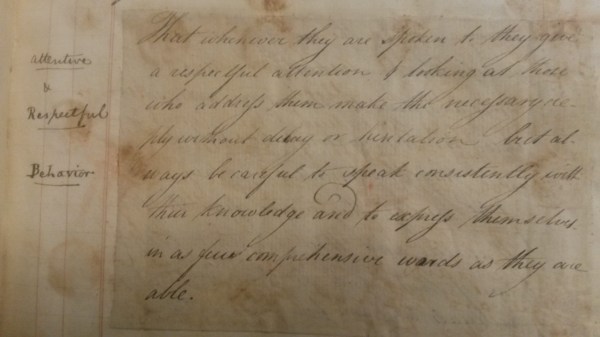
In an 1804 note, for example, school reformer Joseph Lancaster clarified the proper way schools must exert total control over students from low-income homes. As Lancaster argued,

That whenever they are spoken to they give a respectful attention by looking at those who address them make the necessary reply without delay or hesitation but always be careful to speak consistently with their knowledge and to express themselves in as few comprehensive words as they are able.

Way back then, urban schools in Philadelphia, New York, Baltimore, Albany, and elsewhere were already forcing low-income students to endure the rigors of a no-excuses approach. As Lancaster went on,

That they forbear talking to each other at meals—school hours or reading unless there be sufficient occasion. That they avoid running in the house but walk uprightly and take care to shut all doors after them (that they know out to be) with as little noise as possible.

Seems sad but true: When it comes to using schools to help children from low-income families, the answers have always involved creepy amounts of control and discipline. I can’t help but wonder: Do children from affluent families ever have to experience this sort of brow-beating and dictation?

The Death of College: We’ve Been Here Before

Ask anyone with a PhD in history, English, or philosophy. They’ll tell you: It’s not just a tough career path, there IS NO career path. Most universities rely on non-tenure-track teachers these days. In the new Atlantic Adam Harris reviews the bleak future of higher education. As my current research is showing me, we’ve been here before.

As Harris writes, Bryan Alexander’s predictions seem to be coming true. There just aren’t as many college students as there used to be. Enrollments are down and they will continue to slide. As Harris explains,

Why is the dip in enrollment such a big deal? Well, quite plainly, the business model for a lot of colleges is dependent on enrollment. If enrollments decline, revenues decline, and colleges have less money for facilities, faculty, and programs. That creates a sort of death spiral in which colleges are getting rid of programs, which in turn makes it harder to attract students, and so on.

No one ever asks the historians, but in this case we do have a strong precedent. Two hundred years ago, the systems we think of as K-12 education began to evolve into something close to their current form. It was a jagged and slow process, spread out over thirty or more years.

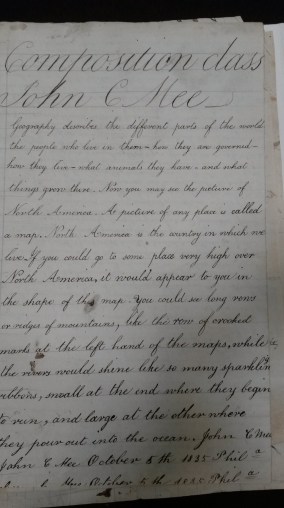
composition class John C Mee Oct 5 1835 Phila

Someone always has to read all the essays…

Our current system of mostly public education didn’t simply grow in an empty field. It pushed out several existing educational systems. The biggest losers in this evolution were the so-called “school masters” of the old system. As public schools took on their current form (more or less), the masters slowly lost their positions as the snobbish titans of education. Their experiences in the antebellum years could serve as a preview to the current state of tenure-track university faculty.

It’s not that the masters didn’t know what was happening. Their anxiety is palpable in every page of the letters and reports I’m reading these days in Joseph Lancaster’s papers.

For example, as one of Lancaster’s former pupils advised Lancaster in 1822, it would be better to get some students in the door immediately at Lancaster’s new school in Philadelphia. Enrollment was key to paying all the bills. As this pupil told Lancaster,

I think it would be well to admit a number of pupils at an easier rate than you have done, for you will be able to manage a greater number well organized in your own excellent mode, than a few on the imperfect plan hitherto pursued in the Institute. I think further, on this ground, could you fill your classes but respectably and get early and frequent exhibitions a short time would raise you in great and exalted honor high very high above your present inconvenient situation and engagement.

In the old system, school “Masters” experienced the dizzying shifts that today’s tenure-track faculty are experiencing. When their schools filled their enrollments, they were happy. When their schools faltered, masters suffered. Always, always, they lived in a state of continual uncertainty about the future. Would enough students come to full the school? Would they need to move to a different school, or maybe strike out on their own?

Sound familiar?

By the 1840s, the masters’ schools were tottering. As Bill Reese has described so compellingly, common-school reformers like Horace Mann toppled the Master system in Massachusetts with a set of new standardized tests.

What does this history tell us about today’s higher-ed situation? We don’t want to be too glib in our predictions, but the obvious guess would be this: We are facing a generation-long transition to a different sort of higher education. Instead of relying on effete experts for instructors, colleges will increasingly rely on a professionalized teaching force with little or no expectation of research and publication. Students will be expected more and more to prove their success with adequate performance on new sets of standardized tests.

The death of college is a death long foretold.

Hello, Worcester!

Things might get a little quiet around the ILYBYGTH International offices for a few weeks. I’m off in scenic Worcester, Massachusetts, studying at the American Antiquarian Society. Thanks to the AAS, I’ve got a generous Alstott Morgan fellowship to support me here for a full month.

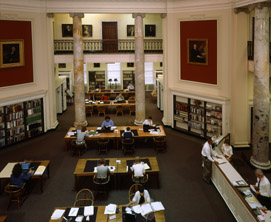
AAS reading room

My nerdy new home away from home…

I’m excited. The AAS has seventeen boxes of papers from Joseph Lancaster. [For more about this research, see here.] I can’t wait to dive in. Why, oh why, did Lancaster believe his “system” could solve urban poverty in one generation? And why did so many otherwise intelligent people believe him?

I’ll see if his papers hold the clue.

Bursting the Conservative Bubble about Educational History

How did American public schools get started? Like the rest of us, conservative intellectuals and activists have always told themselves stories that confirmed what they wanted to believe. This morning, we see another expression of century-old conservative myths about educational history.

As I found in the research for my book about educational conservatism, conservatism has always been fueled by a false notion of America’s past. When it comes to schools and schooling, conservative activists since at least the 1930s have told themselves that schools used to be great, but scheming progressive New Yorkers took over at some point and ruined everything.
rafferty what they are doing

Schools USED to be great…

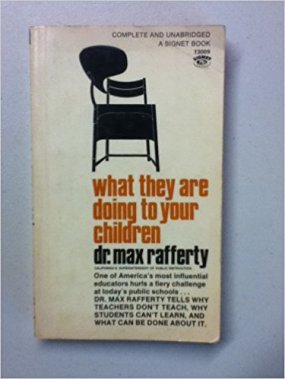
Consider this example from my favorite twentieth-century educational conservative, Max Rafferty. Rafferty was the superintendent of California’s public schools in the 1960s. He was a popular syndicated columnist and almost won the US Senate race in 1968. One of the reasons for Rafferty’s popularity was his persuasive but false vision of educational history. He told readers over and over again that American public schools used to be great, local institutions. The problem came, Rafferty explained, when New York “progressives” took over.

As Rafferty wrote in his 1964 book What They Are Doing to Your Children,

Wherever progressive education was allowed in infiltrate—and this was almost everywhere—the mastery of basic skills began insensibly to erode, knowledge of the great cultures and contributions of past civilizations started to slip and slide, reverence for the heroes of our nation’s past faded and withered under the burning glare of pragmatism.

This morning we stumbled across a 2018 update of this twentieth-century just-so story. Writing from Pepperdine’s American Project, Bruce Frohnen tries to explain why conservatives hate public schools. Along the way, Prof. Frohnen makes big false assumptions about the history of those schools.

First example: Like a lot of conservatives, Frohnen incorrectly assumes that federal and state leaders call the shots in public schools. As Prof. Frohnen puts it,

The problem is precisely that they are run by people and according to rules that are too distant from, and consequently hostile toward, our local communities.

Not really. Most teachers ARE the local communities.  As Stanford’s Susanna Loeb found,

A full 61 percent of teachers first teach in schools located within 15 miles of their hometown; 85 percent get their first teaching job within 40 miles of their hometown. And 34 percent of new teachers took their first job in the same school district in which they attended high school.

Similarly, Penn State political scientists Michael Berkman and Eric Plutzer found that the most important factor driving teachers’ choices about evolution education was local values. If communities wanted evolution taught, teachers taught it. If they didn’t, they didn’t.
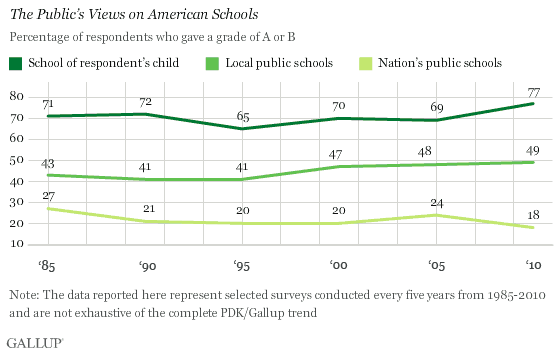
gallup local schools

If schools aren’t local, why are so many locals happy with them?

So, yes, the impact of federal funding has increased since 1950. But most of the day-to-day decisions about schooling and education are made at the very local level. This localism might explain why most American parents are actually very happy with their children’s schools. Gallup polls have consistently found that most people grade their kids’ schools highly, in spite of the hand-wringing by pundits like Dr. Frohnen.

Second example: Like a lot of people, Prof. Frohnen mischaracterizes the early history of American public education. As he argues [emphasis added by me],

Today, politicians, professional educators, and administrators all tell us that the federally-regulated public school is essential to American public life—that it is the place where children from widely divergent socio-economic, racial, and ethnic backgrounds come together to learn what it means to be an American. It is understandable that Conservatives harken back to this vision as they face an education establishment determined to undermine our common culture. But we need to remember that historically American schools integrated students, not into some national community defined by ideology, but into local communities defined by tradition, history, and local relationships. Nationalized education got its start with the famous 19th century educator, Horace Mann.

Nope. From the get-go, ed reformers promised that publicly funded schools would serve a national purpose. And those reformers preceded the attention-hogging Horace Mann. Consider just a couple of examples from my recent research into the career of Joseph Lancaster. Starting in 1818, Lancaster swept into Philadelphia, New York, and other cities, promising that his “system” could educate a new nation’s children.

Lancaster and his fellow reformers insisted that their goal was precisely to train NATIONAL citizens, not local ones. As he wrote in a 1817 guide to his system [emphasis added again],

Another inducement to pursue the Lancasterian system, as it respects the state at large, is the uniformity of principles and habits, which would be thus inculcated among the children of those citizens who are the subjects of this kind of instruction, a desideratum essential to the formation of correct national feeling and character.

In all of his early writing, Lancaster explicitly promoted his scheme as a way to foster “NATIONAL EDUCATION” [his emphasis this time]. Indeed, one of the reasons Lancaster’s reform plan was so popular in the 1810s was precisely because it promised to train national citizens—at the time, the security of the new nation was extremely shaky.

So, SAGLRROILYBYGTH, agree with Prof. Frohnen’s ideas about public schools or don’t. Embrace his vision of conservative principles or don’t. But whatever you do, don’t listen to pundits who tell you that America’s public schools are ruled by any distant power. And don’t buy the old line that schools in the old days used to be about purely local values.

It just ain’t so.

What’s Wrong with Safer Schools?

For anyone who thinks Dan Patrick has a solution to school shootings, I have a two-hundred-year-old solution to urban poverty to sell you. As-is.

NYC manual 2 diagrams alphabet wheel

The solution to urban poverty, 1820 style…

You may have seen it by now: In the aftermath to the latest horrific school shooting, Texas’s Lieutenant Governor Dan Patrick has suggested tightening up school architecture. As Patrick put it,

We may have to look at the design of our schools looking forward, and retrofitting schools that are already built and what I mean by that is there are too many entrances and too many exits. . . . There aren’t enough people to put a guard at every entrance and exit.

Let’s be clear: There’s nothing wrong with thinking about school architecture and changing doors. What IS wrong is diverting attention from a real problem by directing conversations toward secondary considerations. In this case, we need to talk about school cultures that coerce and alienate students. We need to talk about gun laws that put deadly weapons in the hands of angry boys.

Along the way, we might ALSO talk about entrances, but it can’t be our main focus. In this case, IMHO, Dan Patrick is trying to wiggle out of a difficult political position by diverting attention from the real problems.

And, as I’m finding in my current research, this sort of diversionary tactic is the oldest trick in the school-reform book. Two hundred years ago, city planners in places such as Philadelphia, Boston, and New York faced a difficult dilemma. They had crowds of children in their streets from low-income families. The families couldn’t afford to send them to school so the children were growing up without being able to read or write.

What could be done? From London, Joseph Lancaster promised a solution. He described his system for educating poor children in meticulous detail. With the right school architecture and equipment, he promised, cities could eliminate the problem of poverty in just a few short years.

It didn’t work.

Just like Lt. Gov. Patrick’s plans to block doors and windows, Lancaster’s supposed solution treated minor symptoms in order to ignore the underlying cause. The right reading strategy is a good thing, but it is not a cure for urban poverty.

From the Archives: Bad News for Striking Teachers

History might not be destiny, but it can be depressing. As I’ve worked in the Philadelphia archives for my new book, I’ve found some reminders that teachers have always had to shell out their own money just to do their jobs.

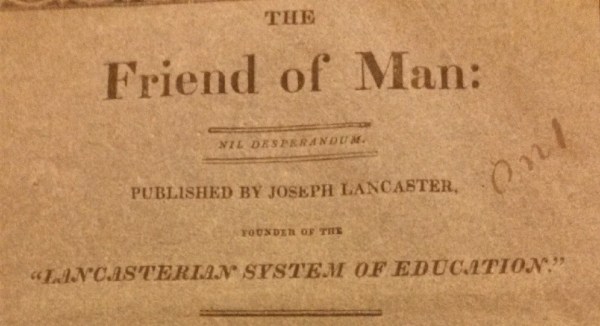
Friend of Man 1 cover

Working without pay has always been considered part of the job…

These days, teacher protests have focused on both low pay and low school funding. As in Oklahoma, teachers have generated sympathy and political power by pointing out how shoddy their classrooms are, and how often they dip into their own wallets to pay for basic classroom materials.

oklahoma textbooks 1

Teachers shouldn’t have to pay for everything, but they’ve always had to…

As I read Joseph Lancaster’s 1821 newsletter I couldn’t help but notice a disturbing parallel. When Lancaster started his career as an educator, he wrote, he visited the nearby town of Stockport, near Manchester. The schools had been terrible until teachers stepped up. They needed better supplies. They needed an expensive new school building. As Lancaster described, the teachers

as a body, offered to work extra hours at their trades, and from their own earnings, to save and devote the sum of five hundred pounds sterling to the proposed building—within twelve months.

Joseph Lancaster told this as a happy tale, showing the possibilities of education if we all pulled together. Almost two hundred years later, though, I can’t help but be a little bummed out that teachers are still expected to donate their scanty mite in order to keep the school lights on.


The Problem with Theoretical Children

Two hundred years is a long time to bang your head against a wall. When it comes to school reform, though, that’s what we seem to do. I’m just back from an archive trip in Philadelphia and I’m spooked by the parallels between school-reform mistakes back then and those pointed out just this week by a savvy teacher in New York.

The New York teacher, Emily Kaplan, tells a story any experienced teacher can relate to. She studied at a great university, learned all she could about children and teaching. When she got to her first classroom, she immediately ran into a situation she had never prepared for: One of her students just wouldn’t/couldn’t stop farting. It’s funny, but it’s more than funny, too. As Kaplan puts it, most of our big-picture ed-reform plans are made for “theoretical children.” As she explains,

Theoretical children are useful: they are predictable, generalizable. They lend themselves easily to an agenda; nothing they do is inexplicable. Their development is linear, their roadblocks routine. They exist neatly in quantified data; they are easily essentialized. Theoretical children don’t cry for no reason, they don’t laugh out of turn; theoretical children certainly don’t fart.

Theoretical children are discussed often by scholars and policymakers, but theoretical children don’t populate our classrooms— because theoretical children don’t exist.

Kaplan is right on. Every real teacher knows that plans need to be held lightly; theories need to be embraced tentatively. As I’m learning in my new research, the effort by experts to change schools based on what children theoretically will do has always plagued our school-reformm dreams.

Last week I began the archival grunt work for my new book. I’m exploring the school-reform plans of Joseph Lancaster and his devotees. Two hundred years ago, nearly exactly, the Pennsylvania legislature passed a law mandating Lancaster-style schools for Philadelphia. Why were the lawmakers so excited about this educational plan?

lancaster schools

Nothing can go wrong if the system is right.

In large part, Lancaster convinced politicians that he had figured out a perfect system. He pitched a school set-up that would deliver cheap, effective literacy, numeracy, punctuality, and nondenominational Protestantism to poor children. In 1803, for example, he published his flawless system, a system built on the actions of “theoretical children.”

As Lancaster explained, school discipline had long been a problem, but he had solved it. He outlined at painful length and detail the way he had supervising boys—“monitors”—track the behavior of their fellows. Students who misbehaved would have logs tied around their necks. They would be shackled together with other miscreants. If that didn’t work, they might be

put in a sack, or in a basket, suspended to the roof of the school, in the sight of all the pupils, who frequently smile at the birds in the cage.

Lancaster didn’t like shaming his students this way, but he thought it was the perfect solution. As he explained, when the misbehaving student

Finds how easily his punishments are repeated—that he himself is made the instrument—and no respite or comfort for him, but by behaving well, it is more than probable he will change for the better.

In theory, the plan was perfect. In theory, anyone could follow the simple steps laid out for good student behavior. In theory, students responded well to Lancaster’s machinations.

Guess what—it didn’t work. As Emily Kaplan points out, children don’t exist only in theory. They fart. They rebel. And sometimes, if you tie a log around their neck or hang them in a birdcage, they don’t respond well.

News Again: The Oldest Scandal in Public Schools

Don’t act surprised. The depressingly predictable scandal in DC schools serves as yet another reminder of a centuries-old truth about public education. When people tell you they have figured out how to fix urban schools on the cheap, they’re either lying or fooling themselves. When they show you proof, they’re faking it.

ballou HS DC

Where magic didn’t happen….

Here’s what we know: NPR investigated Ballou High School in Washington DC. The school showed remarkable sudden improvements. Graduation rates suddenly jumped to 100% and all the grads were accepted to college.

A triumph, right? Not really. Turns out about a third of the students hadn’t been to school enough to meet minimum requirements. Many of them couldn’t read or write well. Teachers felt enormous pressure to move kids along, whether or not they had met any of their educational goals. Some teachers reported a “culture of fear;” they felt forced to do things they knew weren’t right.

Now wunderkind chancellor Antwan Wilson is in the spotlight. What did he know and when did he know it? Not only Wilson, but informed school folks are all keenly aware of the sobering truth: We all knew this would happen and we’ve known it for centuries. Even for those few folks who don’t read ILYBYGTH to find out the centuries-old story of urban school reform, there are so many recent examples that no one can claim ignorance.

Consider Rod Paige and the overstuffed “Houston Miracle.” Or the ugly cheating scandal in Atlanta. Time and time again, when reformers and administrators build sparkling careers on their sudden, dramatic improvements, they have simply cut corners, cheated, and fudged numbers.

For SAGLRROILYBYGTH in the know, these sorts of educational con jobs are the oldest story in urban public education. As I’m researching these days, in the early 1800s Joseph Lancaster set the pattern that Paige, Wilson, and many others would follow. Lancaster was an earnest young Quaker who opened a school for urban urchins in London. He copied a system that allowed him to educate hundreds of students with only one adult teacher.

Soon, a group of wealthy philanthropists hyped Lancaster’s “Borough Road Miracle.” Lancaster thought he had figured out something radically new. He promised he could establish similar schools for America’s cities. He promised he could turn illiterate “Street Arabs” into upstanding literate Christian citizens.

lancaster schools

The promise: Everyone learns, no one pays…

He couldn’t.

In a few years, Lancaster’s over-hyped schools had flopped and failed. Parents and students complained that they were abused and under-educated. Teachers warned that Lancaster’s methods didn’t work. Lancaster himself was in debt up to his ears and fled to Caracas.

The lesson? It’s not that school reform isn’t possible or desirable. Rather, we need to remember that charismatic, ambitious reformers will always promise more than they can deliver. Politicians will tend to glom on to silver-bullet solutions that don’t cost any extra. School reports that sound too good to be true usually are.

School reform IS possible, but it isn’t easy and it isn’t cheap. If we really want to fix our public schools, we need to stop looking for magic solutions and rather do the difficult and expensive job of improving every school.

How Do You Keep an Iceberg Fresh?

The pattern is as old as school reform itself. When we find a school that works, how can we transport those successes to schools everywhere? Two recent stories underline the perennial misunderstandings about school and school reform that have always bedeviled well-meaning reformers. A good school is not something we can package, market, and ship. It’s as difficult as trying to tow an iceberg.

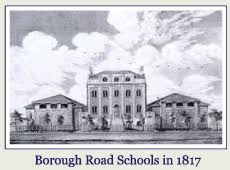
As I’m finding in the research for my next book, good people have always made this same goof. When Joseph Lancaster’s Borough Road School in London began showing decent results educating kids from low-income homes, he became an instant celebrity. Fabulously wealthy dilettantes visited the school and gushed. Back then, those folks were actual royalty.

borough road school 1817Soon, the young Lancaster started believing his own fundraising spiel. He promised the leaders of New York, Boston, and Philadelphia that his master plan could work in any school, anywhere. It couldn’t and it didn’t. The mistake Lancaster made—one of them, at least—was to assume that his limited successes were due to the specific methods he was using, rather than to his endlessly deep royal pockets and his authentic love and enthusiasm for his school and students.


These days, progressive teachers fume about well-meaning celebrities making these same sorts of centuries-old mistakes. In The Nation recently, Megan Erickson offered a scathing review of Eva Moskowitz’s self-promotional memoir. Moskowitz is hard to like. Among her many face-palm-worthy notions is the idea that she could package her program at Success Academy and use it to “fix” schools everywhere.

When Moskowitz connected with some wealthy backers, they hoped to help her do just that. As Erickson put it,

They wanted to figure out how to set up a school that cost no more to run than district schools but achieved far better results, and then replicate that model throughout the country.

As Lancaster’s story showed, it has never worked that way. School is an intensely local enterprise. Trying to package and replicate it will always be a losing proposition.

Don’t believe it?

Consider the story told this week by curmudgucrat Peter Greene. Greene looks at the deterioration of the AltSchool program. This intensely personalized school program for wealthy families has run into some problems, as Greene describes here and here.

The problem?…you guessed it: AltSchool is hoping to take an expensive program and cut it down to fit a replicable mass-market budget. As Greene laments,

Now that Ventilla has some things that sort of work, it’s time to sell a version of them to other schools and make some real bank.

Those schemes have never worked and they never will, just like wacky schemes to tow icebergs from Antarctica to hot deserts. Since at least the 1970s, attention-hungry politicians from hot places have always flirted with such plans. After all, they say, the icebergs are just floating around. With a little funding and pluck, icebergs could provide nice cool water for hot dry deserts.

Could it really work? No! I’m embarrassed to even spell it out, but I will. When you tow icebergs to the equator, the icebergs don’t like it. They break up. They melt.

What does any of this have to do with school reform? Like good schools, icebergs are intensely LOCAL things. They come about because of local conditions. So do good schools. Good schools are fueled by families who feel included. They are good because of the enthusiasm, energy, and dedication of teachers and staff. Good schools work because leaders make smart decisions that focus on supporting those good things and getting obstacles out of the way.

Trying to package those things up, slap a marketing label on them and ship them to other schools is not a smart way to create good schools, just like towing icebergs is not a good way to get ice. Of course, with enough money and energy, it might be possible to pull an iceberg around. You might even make it to the desert. But what you’ll be left with won’t be worth all the hassle; all you’ll get is a handful of lukewarm disappointment.