
Bill Nye and Ken Ham will be going a few rhetorical rounds next month.
The mega-popular science educator will broach the creationist lion’s den of the Creation Museum on February 4th. The topic: “Is creation a viable model of origins in today’s modern scientific era?”

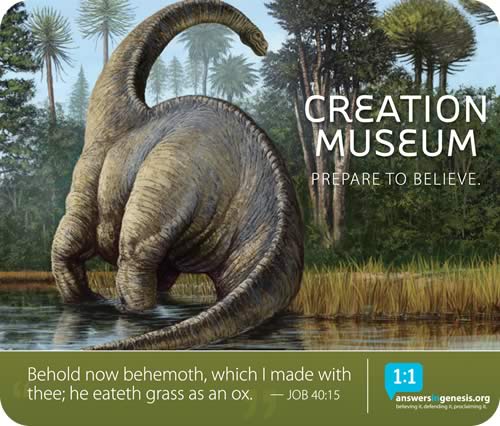
Image Source: Answers In Genesis
Are these debates worthwhile? In the past they had decisive impact on the formation of American creationism and fundamentalism. But these days such debates are a different animal.
Science pundits don’t like it. Jerry Coyne warned that Bill Nye will only be putting money and legitimacy in Ham’s deep pockets. PZ Myers wisely concludes that each side will likely only speak past the other.
I agree. The audience at this debate will likely not be moved by either man’s arguments. No matter how scientifically accurate or biblically flawless, logical arguments tend not to be the deciding factor in determining one’s beliefs about human origins.
As David Long’s ethnography demonstrated so powerfully, creationists can thrive in mainstream scientific environments without abandoning their religious ideas. Many creationists have simply been taught to regard mainstream scientists as deeply flawed and bumbling fools. It is easy to dismiss plausible-sounding talk from someone we have already deemed unreliable.
It’s hard to imagine Ham’s Cincinnati audience won’t be prepared to dismiss Nye’s mainstream science talk out of hand. I assume Nye is hoping that he may still plant a few seeds of science doubt in the minds of those who hear him. Not much reason to offer Ham such a plum chance to look like a reputable scientific authority.
At the start of America’s public evolution/creation battles, this legacy of public debating functioned much more powerfully, since creationists had not yet set up alternative institutions. As I describe in my 1920s book, some of the most influential creationists of the 1920s received humiliating public trouncings in popular debates.
At a talk on the campus of the University of Minnesota, for example, fundamentalist leader William Bell Riley found himself surprised by a student prank. Someone lowered a monkey onto the stage as Riley tried to convince his audience that creationism was reputable science. “Every time I hear the argument that this is a controversy between experts on the one hand, and, as someone has said, ‘organized ignorance,’ on the other, I smile,” Riley told the St. Paul Pioneer Press in 1927. “This is not a debate between the educated and the uneducated.”
Similarly, in London, creationist godfather George McCready Price found himself hooted off the stage in the days following the 1925 Scopes Trial. He had tried to tell the merciless audience that the theory of evolution was doomed as mainstream science. Such flawed science, Price insisted, may have worked fine
for the times of comparative ignorance of the real facts of heredity and variation and of the facts of geology which prevailed during the latter part of the nineteenth century; but that this theory is now entirely out of date, and hopelessly inadequate for us. . . . We are making scientific history very fast these days; and the specialist in some corner of science who keeps on humming a little tune to himself, quietly ignoring all this modern evidence against Evolution, is simply living in a fools’ paradise. He will soon be so far behind that he will wake up some fine morning and find that he needs an introduction to the modern scientific world.
The audience didn’t buy it. Price found himself heckled so mercilessly that he could not complete his presentation. That London debacle was Price’s last public debate. After that experience he focused his considerable energy on founding alternative scientific institutions to prevent future creationists from needing to convert mainstream scientists.
Back in those days, creationists and fundamentalist scientists still attempted to tell audiences that they represented the true mainstream of scientific discovery. Such early creationists eagerly debated in a variety of settings in hope of convincing middle-of-the-road audiences that evolutionary science was not real science.
In that context, public debates held promise for both sides. Creationists hoped to prove that they had better science. Evolutionary scientists hoped to demonstrate the scientific vapidity of creationism.
These days, both sides have hardened. Creationists these days are not unaware of the fact that their science does not represent the scientific mainstream. Evolutionary scientists are not hoping to relieve creationists of their naïve ignorance.
Rather, both sides in these debates enter and exit with the same set ideas. Each side knows who to trust on that stage and who to ignore. No matter how persuasive Ken Ham can be, he doesn’t really hope to change Bill Nye’s mind. Rather, this exercise merely serves to give each charismatic speaker the chance to gain a sliver of legitimacy and respectability in the opposite camp.









 I Love You but You're Going to Hell