The Handwriting on the Wall for Christian Colleges

It doesn’t look good.

For small colleges of any sort, the future looks grim. A new report from Moody’s (the investor service, not the Bible institute) offers some scary predictions about the iffy future of small schools. For conservative evangelical colleges, however, this looming financial crisis also represents a uniquely religious crisis. Will small evangelical colleges be able to resist the growing pressure to become more radical in their orthodoxy?

Look out, Daniel!

Look out, Danny!

Inside Higher Education describes the sobering financial outlook. In the next few years, college closings will likely triple. Why? Fewer students means fewer tuition dollars, which means fewer scholarship dollars, which means fewer students. Rinse and repeat.

Among conservative evangelical schools, we’ve already seen the trend. Former evangelical schools such as Northland University, Tennessee Temple, and Clearwater Christian have all closed their doors. In some cases, the “Wal-Marts” of Christian colleges have emerged even stronger. Cedarville University, for example, has offered to accept all students from Clearwater Christian. As with non-evangelical schools, the big will likely get bigger and the small will get gone.

For small evangelical colleges, this presents a double pickle. In desperate need of more students, schools will likely become extra-timid about offending conservative parents and pundits. As I’ve argued before, young-earth impresarios such as Ken Ham already exert outsize influence on college curricula. If Ham publicly denounces a college—which he likes to do—you can bet young-earth creationist parents might listen.

We’ve seen it happen at Bryan College. Rumors of evolution-friendly professors caused administrators to crack down. Any whiff of evolutionary heterodoxy, and schools might scare away potential creationist students.

At other evangelical colleges, too, as we’ve already seen in schools such as Mid-America Nazarene or Northwest Nazarene, administrators desperate for tuition dollars will be tempted to insist on a more rigidly orthodox reputation.

Things aren’t looking good for small colleges in general. But conservative evangelical schools face this special burden. In order to attract the largest possible number of students in their niche, they might have to emphasize more firmly the things that make them stand out from public schools. In the case of conservative evangelical schools, that distinctive element has always been orthodoxy.

In the past, well-known schools such as Bryan College might have relied on their long history as staunchly conservative institutions. They might have assumed that conservative evangelical parents would trust their orthodoxy, based on their long-held reputation as a bastion of conservative evangelical education. These days, no-holds-barred competition for students will mean that every school must guard its image far more aggressively.

Does It Matter Where Your Kid Goes to College?

Relax.

That’s one message we might take away from Kevin Carey’s recent piece in the New York Times. He argues that the vast gulf between the “best” universities and the rest is nothing but an illusion. That certainly fits with my experience in the past twenty years as a graduate student and professor. But is it also true about the gulf between mainstream colleges and dissenting religious ones?

Carey insists, in a nutshell, that students will do just as well whether they go to Harvard or Podunk U. Or, to be more precise, Carey argues that the differences between elite schools and the rest are more about marketing than about actual educational impact.

...it doesn't!

…it doesn’t!

To back up his claims, Carey relies on the 2005 edition of a study by Ernest Pascarella and Patrick Terenzini. There are some differences between schools, of course. As Carey puts it,

But these findings are overwhelmed in both size and degree by the many instances in which researchers trying to detect differences between colleges found nothing.

“The great majority of postsecondary institutions appear to have surprisingly similar net impacts on student growth,” the authors write. “If there is one thing that characterizes the research on between-college effects on the acquisition of subject matter knowledge and academic skills, it is that in the most internally valid studies, even the statistically significant effects tend to be quite small and often trivial in magnitude.”

As the SAGLRROILYBYGTH are well aware, I’m up to my eyeballs in work on my new book about conservative evangelical Protestant higher education. These schools exist because most people think it matters a great deal where kids go to college. Not only in terms of making connections and building a career, but in terms of learning good values and building a life as a certain sort of Christian.

As evangelist Bob Jones Sr. explained in 1928, he founded his college in order to help parents relax. “The fathers and mothers who place their sons and daughters in our institution,” Jones promised,

can go to sleep at night with no haunting fear that some skeptical teacher will steal the faith of their precious children. Your son and daughter can get in the Bob Jones College everything that they can get in any school of Liberal Arts.

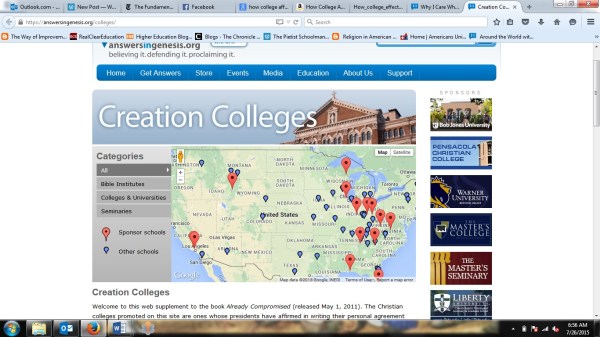
These days, too, conservative religious leaders spend a good deal of time and effort helping parents find the right schools for their kids. As I argued a while back, creationist leader Ken Ham of Answers In Genesis offers lists of “safe” schools, schools that reliably teach young-earth creationism and ONLY young-earth creationism.

Can college make a difference?

Can college make a difference?

Kevin Carey’s recent look at the research prompts some important questions.

  • If the academic and professional difference between mainstream schools is not as great as we all think, is the difference between mainstream schools and religious schools also not as great as we think?
  • Might it be possible for conservative parents to relax about where their kids go to school, and instead focus on helping their kids make the most out of whatever school they DO attend?
  • Do religious students fare well at secular/pluralist schools?

Let’s Fight about Evolution and Climate Change

Put your money where your mouth is. That’s the message Trey Kay explores in his new Us & Them podcast. What happens when creationists and scientists put up a challenge to their foes? Trey talks with a creationist and a mainstream scientist, both of whom have put up big money to lure their enemies into a losing debate.

The two sides are represented by creationist Karl Priest and physicist Christopher Keating. Priest has offered a $10,000 Life Science Prize. Anyone who can debate Joseph Mastropaolo and can convince a judge of the evidence for evolution will win the money. Keating has put up $30,000 to anyone who can come up with scientific evidence against human-caused climate change.

For those of us interested in educational culture wars, it doesn’t get much better than this. Trey talks with both men alone, then puts them together for a culture-war conversation. What makes creationists so confident? Mainstream scientists?

As Trey concludes, both men offer their prizes in an attempt to get attention for their side. Neither really hopes to convince the other.

That’s been the case for evolution/creation debates for a long time now. Some of us remember the recent head-to-head debate between Bill Nye and Ken Ham. As we discussed at the time, this sort of debate tends to preach to the choir on each side. For mainstream scientists, Bill Nye’s arguments sounded iron-clad. For creationists, Ken Ham made his case.

As historian Ron Numbers has documented, these evolution-creation debates have a long and checkered history. Time and again, high-profile public figures have challenged their foes to debate the issue. Does anyone really hope to solve the issue this way?

As Trey Kay explores in this podcast, it is easy enough to talk politely to one another. But once creationists and evolutionists try to debate, we quickly end up just spinning our wheels.

Creationism Then & Now

Do you read Ted Davis? For folks interested in the creation/evolution debates, Professor Davis has long produced essential historical analyses of the various voices of creationism in all their befuddling complexity. I was reading one of Professor Davis’ essays on the Biologos Forum recently and it raised some perennial questions: Can we compare the dissenting science of today’s creationists to the scientific ideas of long ago? Can today’s creationists claim a long legacy of prestigious scientific antecedents?

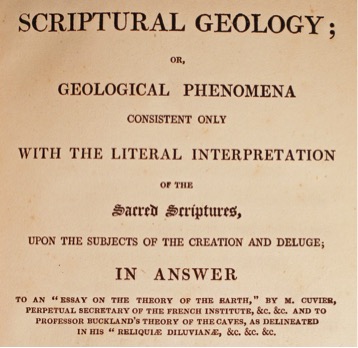
Cutting-edge creation science, c. 1827

Cutting-edge creation science, c. 1827

Davis is writing these days about science and creationism in antebellum America. In this post, he explains the school of “Scriptural Geology” that attracted religious scientists in the early 1800s. Scholars such as Princeton Seminary’s Samuel Miller and Anglican minister George Bugg rebutted new(ish) ideas of an ancient earth.

Professor Davis pointed out the remarkable similarities of their 19th-century arguments with the 21st-century arguments of today’s young-earth creationists. As Davis put it,

Readers familiar with Henry Morris or Ken Ham will find many of their ideas, expressed in substantially the same ways and for the same reasons, in the pages of Bugg’s book.

Now, Professor Davis would be the last person to ignore historical context or to misunderstand the historical changes that have wracked the world of creationist scientists. Yet his comparison to the Scriptural Geologists to Answers in Genesis or the Institute for Creation Research points out the radical changes that have taken place in the realms of creationism and science.

In the 1820s, discussions of the age of the earth still had some fading legitimacy among mainstream scientists. Even as late as the 1920s, when American politicians such as William Jennings Bryan insisted that “Darwinism” was losing scientific prestige, their claims made some sense. In the 1920s, for example, mainstream scientists had not yet cobbled together the modern evolutionary synthesis. They had not yet figured out how to reconcile the mechanism of natural selection with the maintenance of beneficial mutations.

As I describe in my upcoming book, mainstream science has changed enormously over the course of the twentieth century. Positions that made some scientific sense in 1827, or 1927, lost those claims as the 20th century progressed.

As an obvious result, there yawns an enormous gulf between the work of George Bugg and that of Ken Ham or Henry Morris. Today’s young-earth creationists are forced to take the role of utter scientific outsiders. They are forced to dismiss the entirety of mainstream evolutionary science as deluded.

Of course, as Professor Davis explains, earlier “creationists” such as Miller and Bugg also felt like scientific outsiders. But their position was radically different. Saying nearly the exact same thing, as always, can mean very different things, depending on when one says them.

NASA Puts Creationists to Work!

Forget about creationism in public schools for a minute. Is it true that the US Government hires young-earth creationist scientists? Can it be true that leading scientific agencies such as NASA employ people who believe that the universe was created within the past 10,000 years?

All in a day's work?

All in a day’s work?

In the past, we’ve heard of government geologists who hold to young-earth creationist beliefs. But today we see a claim by young-earth impresario Ken Ham that NASA employs “many” creationist scientists. Is it true?

Ken Ham, the force behind leading young-earth ministry Answers In Genesis, wants to be clear. He is not talking about folks like John Glenn. Glenn, world-famous astronaut and sometime Senator, recently attested to a more moderate vision of creationism. Apparently, sixteen years ago, Glenn had claimed, “to look out at this kind of creation out here and not believe in God is to me impossible.” Recently, he offered a slightly different explanation of his creationist beliefs. “I don’t see,” Glenn attested,

that I’m any less religious by the fact that I can appreciate the fact that science just records that we change with evolution and time, and that’s a fact. It doesn’t mean it’s less wondrous and it doesn’t mean that there can’t be some power greater than any of us that has been behind and is behind whatever is going on.

Teach evolution, Glenn insisted. There’s no reason we can’t do that in our public schools without hurting children’s religious belief.

Not so fast, Ham warned. If we accept the premises of deep time and evolution, we have to call God a liar, and we have to ignore reams of scientific evidence that points to a newer creation.

Luckily, Ham reports, the labs of NASA are freighted with true creationist scientists. When he gave a talk to the “Bible Club” at NASA’s Goddard Space Flight Center in 1994, Ham says, he was “thrilled to meet many scientists who were also biblical creationists!”

Now, maybe it’s my secular bias, but I have a hard time believing that NASA really employs a sizeable population of young-earth creationists. In the past, I’ve defended the notion that young-earth creationists are not necessarily “ignorant,” as so many secular people like to claim. We have scads of evidence that smart people can be trained in scientific careers and hold to a belief that the universe is fairly new.

But Ham’s claim that NASA is teeming with young-earth creationists seems to be a different case. In the day-to-day work of NASA—a work I admit I know nothing about—it would seem difficult to reconcile a belief in a newish universe with basic assumptions about space exploration.

The claim seems to put Mr. Ham in a difficult position. If NASA really does employ “many” creationist scientists, then NASA can’t fairly be accused of anti-creationist prejudice. But Answers In Genesis insists that mainstream scientists are uniformly blinded to the truths of creationist science by willful prejudice.

On the other hand, if NASA doesn’t really employ “many” creationist scientists, then Ham’s claim doesn’t stand up. He mentioned one of NASA’s creationist scientists by name, one Bill Daniels. If it’s the same person, Bill C. Daniels of New Smyrna Beach, Florida worked as a “project equipment manager” for NASA, according to Daniels’ obituary. Is it possible that NASA’s Bible Club was full of employees who did not have to engage with the scientific paradoxes of young-earth belief in an organization dedicated to exploring an ancient universe?

Creationism and Job Security

Creationism is more than just an idea, more than just a choice. In the United States, creationism represents a complete set of dissenting institutions: Schools, churches, publishing houses, summer camps, etc. These institutions do more than create an intellectual subculture. As we are reminded this morning, they also provide the nuts-and-bolts support creationists need in order to thrive.

For some of us outsiders, it can be difficult to understand how a creationist can remain so firmly entrenched in her beliefs when the claims of mainstream science seem so compelling. Recently, for example, Professor Dan Kahan drew attention to the ways creationist students can do well in mainstream science classes. He described the case of “Krista,” a high-school senior who excelled in her biology class while holding on to her creationist beliefs.

Krista wants to be a veterinarian. And, as Kahan points out, she might not be able to maintain her “cognitive dualism.” If she doesn’t, though, Kahan insists it will not be due to some sort of “logical or psychological contradiction.” To the contrary, Kahan concludes, Krista’s eventual “upsetting incompatibility” will be the result of

an imperfection in the constitution of an aspiring Liberal Republic of Science that hasn’t yet acquired the knowledge, created the institutions, and cultivated the public mores necessary to quiet the forms of cultural status competition that force diverse citizens to choose between using their reason to know what is known by science and using it to express their defining moral commitments (Elsdon-Baker 2015; Hameed 2015; Kahan 2015; Kahan in press).

In other words, if future Krista is forced to choose between the mainstream science she uses in her day job and the dissenting science she uses in her faith life, it will be because the United States has several competing scientific authorities. Our society, Kahan argues, has not yet figured out a way to decide between the scientific claims of creationism and the scientific claims of mainstream evolutionary science.  People like Krista (and the rest of us) are forced to rely on authorities to tell them which science is appropriate for them.

In her day-to-day life, though, Krista will likely be able to get by without straddling the boundaries between these competing scientific realms. More likely, Krista will continue her science career without ever needing to wrestle with its apparent contradictions. Her potential success will be due at least in part to the fact that creationists have successfully created institutions and cultivated creationist mores that allow creationists to use mainstream science without giving up their theological reservations. Perhaps even more important on the day-to-day level, Krista may succeed as a creationist veterinarian because her job might depend on it.

In academic realms, at least, creationism can be a big career boost. It has always been thus. As Bradley Gundlach has described in his great book Process & Providence, creationist colleges have often guaranteed steady work for creationists. In 1878, back when Princeton University and Princeton Seminary remained dedicated to a religious interpretation of emerging evolutionary science, school leaders worked hard to woo top creationists. The school took unprecedented measures to lure John William Dawson away from McGill University in Montreal. At that time, Dawson was one of a dwindling band of scientists with mainstream credentials who still disputed the transmutation of species.

Take this job and love it...

Take this job and love it…

Dawson didn’t come. But Princeton’s herculean efforts to get him demonstrate the possible career upside of creationism. If a geologist, or a veterinarian, or a science teacher can represent a dissenting creationist idea, then he or she will be uniquely attractive to the many institutions that insist on creationism.

Don’t believe it? Check out this morning’s job post on Ken Ham’s blog. As Ham explains, he doesn’t usually post such things, but he recently met with a school administrator from Kansas City. That school principal needed a science teacher, and he only wanted one who signed on to Ham’s brand of young-earth creationism. The school required a teacher who knew creation science and was “trained in apologetics.”

For students like Krista, as Professor Kahan argues, belief in a young-earth need not lead to any sort of intellectual discomfort at all. And, as this job posting reminds us, Krista might feel significant practical incentives to ignore any discomfort she might feel.

Commitment to a young earth and a special divine creation might, after all, offer increased job security in the nationwide network of dissenting creationist institutions.

But What about All the Dead Bodies?…

Forget about evolution and creationism for a minute. We see more evidence today that the first shot in many educational culture wars takes place not in science, but in history.

When it comes to schooling and culture wars, we spend a disproportionate amount of time talking about creationism and science. It makes sense. In that case, we see a stark and shocking disconnect between contending visions of proper knowledge for children.

But some of the most virulent culture-war battles happen over historical issues. Conservative Christians in the United States often embrace an historical narrative that is at odds with mainstream academic interpretations. Counter-historians like David Barton sell just as many books as do counter-scientists like Ken Ham. And the difference between mainstream academic history and dissenting Christian histories can be just as stark as the differences between the modern evolutionary synthesis and young-earth creationism.

In the United States, one of the most stubborn conservative dissenting histories has been that of neo-Confederatism. As David Blight demonstrated in his terrific book Race & Reunion, conservative history activists in the US South scored major successes in limiting public-school histories to those that flattered the losing side in the Civil War.

In nations around the world, culture-war conflicts often show up as debates over the nature of real history. In Japan, for example, the horrific crimes of the Japanese army in World War II are repeatedly minimized or even ignored in mainstream textbooks. In my own ancestral homeland of Estonia, a long Russian occupation has generated a kind of historic cognitive dualism. Most Estonians of a certain age know the pro-Russian history they got in their Soviet-era schoolbooks, but they don’t believe it. In contrast, Estonians tend to believe a folk history of heroic Estonian resistance, even though they don’t know much about it.[1]

In the pages of the New York Times this morning, we see another example of this kind of battle for history. In pro-Russian breakaway regions of Ukraine, new educational directives insist that the Soviet famine of the 1930s was not a Stalinist genocide, but rather a morally neutral tragedy that befell the entire Soviet Union.

Controlling the past to control the future...

Controlling the past to control the future…

According to mainstream historians, including especially Robert Conquest in English, the Ukrainian famine was anything but morally neutral. Instead, the famine—a tragedy that killed millions of people—was the precise goal of Stalinist policy. In order to bring restive provinces in line, Stalin intended for the region to suffer.

According to the NYT, the new “Fatherland History” hopes to emphasize the region’s long ties with Russia. It plans to minimize Ukrainian nationalist ideas. Igor V. Kostenok, the new minister of education in charge of the new historical guidelines, described the goal as the creation of “a culture, a culture for the Slavic world, for the Russian world.”

Will it work? Not likely. As is the case in every aspect of our educational culture wars, dissenting ideas have a way of surviving and even thriving in spite of official condemnation.

[1] See James V. Wertsch, “Is It Possible to Teach Beliefs, as Well as Knowledge about History?” in Stearns, Seixas, and Wineburg eds., Knowing, Teaching, and Learning History (NYU Press, 2000), pp. 38-50.

Creationism in the Land of the Bible

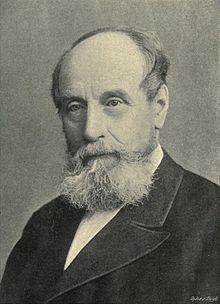
Quick: When I say “creationist,” whom do you picture? Ken Ham, the Australian-American creationist impresario of Kentucky? Or Arye Dary of Israel’s Shas Party?

Is THIS the face of creationism?

Is THIS the face of creationism?

As Josh Rosenau of the National Center for Science Education pointed out recently, the question of Palestinian statehood received the lion’s share of attention after the last round of elections in Israel. But those elections could also have significant impact on the teaching of evolution in Israel’s schools.

In a nutshell, the new government will likely be dominated by conservative parties. In Israel, that means a significant political presence for the more conservative religious factions. Many of those groups oppose the teaching of evolution.

...or is THIS?

…or is THIS?

As Rosenau relates, the topic of evolution only recently became a required part of the middle-school curriculum in secular Israeli public schools. Arye Dary of the Shas Party, a likely government partner, made no bones about his opposition to evolution education. “As an ultra-orthodox party,” Dary explained,

that believes that our forefathers were Adam and Eve, Abraham, Isaac and Jacob, and that our holy matriarchs were Sarah, Rebecca, Rachel and Leah, we refuse to teach our children that they originated from apes.

For those few who continue to believe that creationism is uniquely American, or peculiar to conservative Protestantism, this serves as a healthy reminder of the truth.  Creationism as a political and educational impulse is strong worldwide.  Conservatives of many backgrounds in many countries insist that there is more to “truth” than can be divined by human scrabblings.

Christian School Causes Student to Abandon Creationism

How can parents make sure their children don’t lose their faiths? Enrolling them in religious school is not enough. As a recent story from the BioLogos Forum makes clear, education ranges far beyond schooling. Too many hasty critics, religious and secular alike, have assumed that we can control education by controlling schooling. It’s just not that simple.

This Christian learned to embrace evolution, but not in school...

This Christian learned to embrace evolution, but not in school…

In the pages of the BioLogos Forum, college sophomore Garrett Crawford shared his educational story. Crawford was raised in a conservative evangelical household. He went to a Christian school, one that presumably hoped to shield Crawford’s faith from secularism. While at that school, Crawford relates, he grew curious about the scientific evidence for evolution. After a lot of reading and study, Crawford concluded that he could no longer believe in young-earth creationism. After a lot more reading and study, Crawford concluded that Christian faith does not require a belief in a young earth. It is entirely theologically legitimate, he decided, to accept the science of evolution.

In Crawford’s case, his education took him in directions his school never intended.

Such stories shouldn’t surprise us. After all, with just a moment or two of reflection, we can all think of ways that our “education” has differed from our “schooling.” Yet in all of our tumultuous educational culture wars, pundits rush to make sweeping claims about education based on scanty evidence from schools.

We’ve seen this recently in the pages of the New York Times, when philosopher Justin McBrayer declared–based on data that was not just slim, but positively anorexic–that Our Schools Were Training Amoral Monsters.

Among conservative Christians, too, this tradition of school-bashing has a long history.  In the 1970s, for example, fundamentalist school leader A.A. “Buzz” Baker decried the tendency of many conservative Christians to rush into school-founding for the wrong reasons. In his book The Successful Christian School (1979) Baker warned that too many parents and pastors rushed to open new schools because they thought

Public education has failed! It is failing to provide a good academic education while exposing our children to a godless, secular-humanistic approach to life.

Leading young-earth creationists have long assumed that the best way to protect their children’s faith is by attending creationism-friendly schools. Ken Ham, for example, argued that Christian colleges and universities can lead students astray from true faith when they abandon young-earth thinking. As he put it,

the real issue concerns Christian colleges, universities, and seminaries that break away from the authority of Scripture in Genesis—held to by the majority of scholars up through the Reformation—and teach students that God’s Word doesn’t mean what it says. That’s what makes students doubt the truthfulness of the Bible as a whole, and can be a major reason many of them walk away from the Christian (not “creationist”) faith, as we see happening in our culture today.

From the other side, many secular or liberal critics insist that fundamentalist schools are nothing but indoctrination factories. As friend of ILYBYGTH (FOILYBYGTH) Jonny Scaramanga told the BBC, his fundamentalist schooling experiences were nothing short of “horrendous.” During his sojourn in a fundamentalist school, Scaramanga remembers, he did nothing but recite back theological nostrums. The school was so socially crippling, Scaramanga relates, for the rest of his life he was “always playing catch up.”

Scaramanga’s own case, however, shows that schooling of any sort is only one part of a person’s education. Scaramanga himself has now become a leading voice in the anti-fundamentalist education scene. Like Garrett Crawford, Scaramanga’s education took him in directions that his schooling never intended.

The take-away? Of course we should all care about the way schools operate. Better schools will help produce better educations for all students. At the same time, though, we all need to remind ourselves that formal schooling makes up only one slice—sometimes a small slice—of a person’s education.

How many of us, after all, can say that we came out the way our schools intended?

Religious Students, Secular Schools

HT: HH

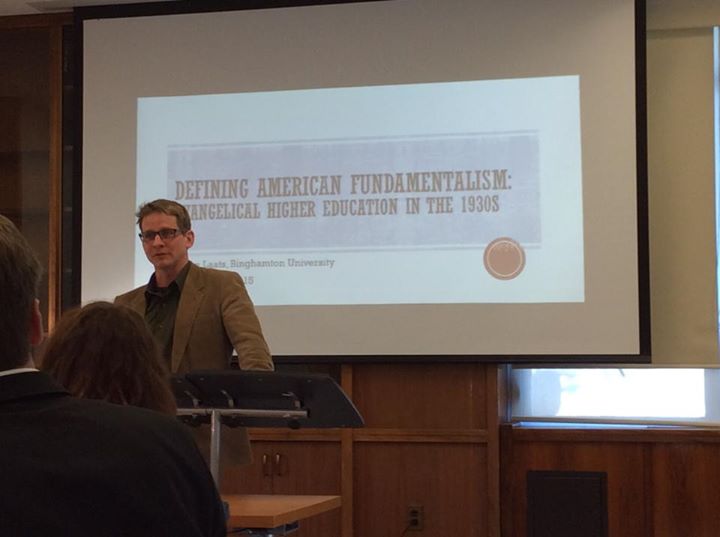
Thanks to all those who came out Wednesday to participate in my talk at Binghamton University about fundamentalist colleges in the 1930s.  Not only was a good time had by all, but the conversation made clear that even at this, our most “secular” of colleges, religion is thriving.  Despite the ignorant nostrums of elite secular academics and fuming fundamentalists, conservative religious students and faculty seem to thrive at pluralist schools like ours.

Don't hate me  because I'm beautiful...

Don’t hate me because I’m beautiful…

For those who are just tuning in, this talk was part of our series in “Religion in the Modern University.”  I shared my current research into conservative evangelical colleges.  The conversation after the formal talk revealed that both students and faculty at our beloved public university come from all sorts of religious backgrounds, including conservative evangelical Protestantism.

Unlike the schools I’m studying, our “secular” college does not actively encourage any specific sort of religious belief.  Nevertheless, our school proves a congenial home for students and faculty who hold conservative evangelical beliefs.

This flies in the face of some common assumptions about secularism and higher education.  As sociologist Elaine Howard Ecklund found in her study of elite secular academics, many of them have absolutely no idea of the high level of religious belief at their own non-religious elite universities.

Fundamentalists, too, have long assumed that “secular” colleges were hostile to their sort of religious belief.  As fundamentalist college founder Bob Jones Sr. was fond of saying in the 1920s, he would

just about as lief [sic] send a child to school in hell as to put him in one of those institutions.

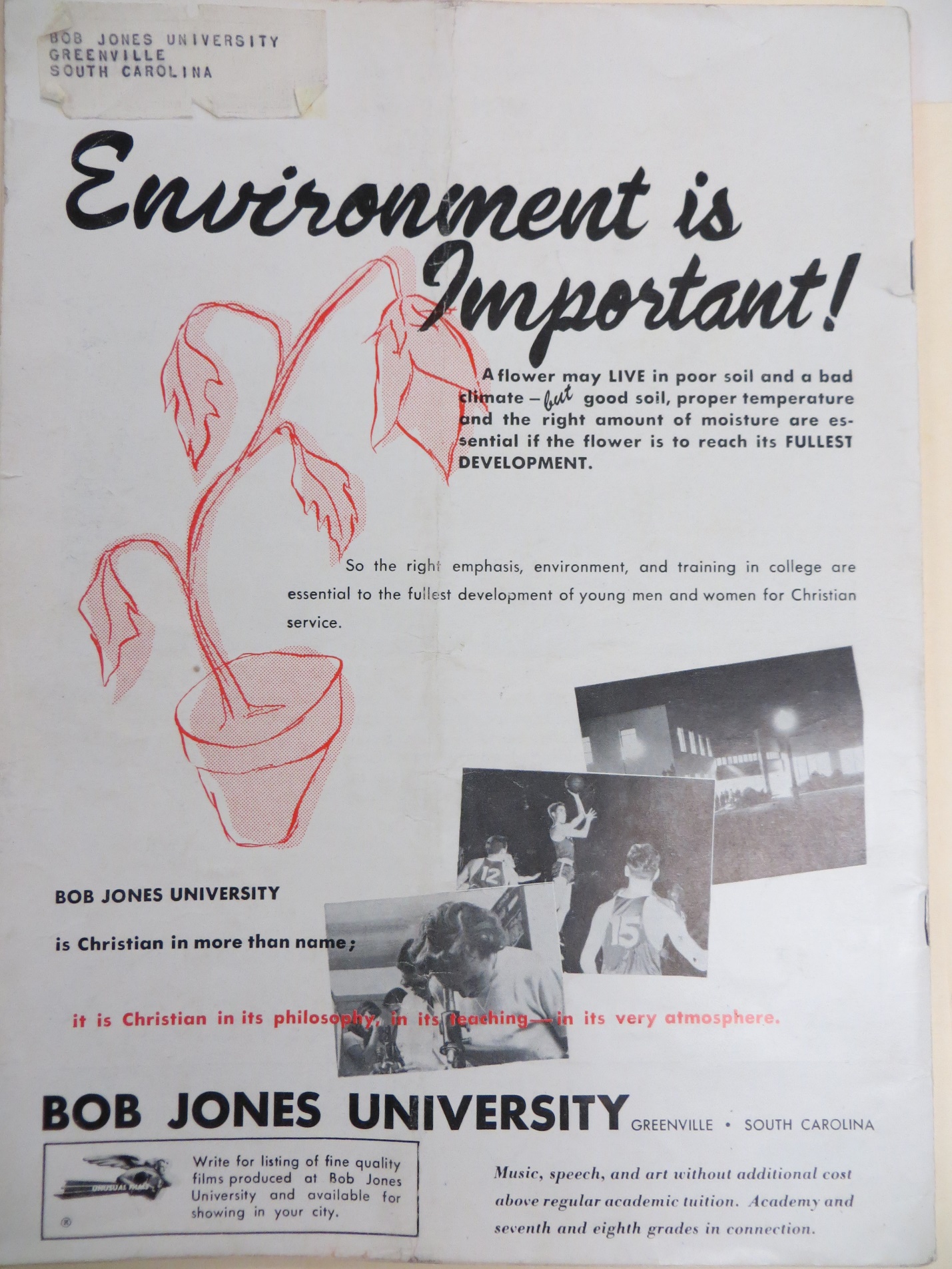
At Bob Jones University, as at other fundamentalist universities, this notion that only a truly fundamentalist school can protect students’ faith remained central throughout the twentieth century, as this 1956 advertisement demonstrated.

Fundamentalist students, fundamentalist schools

Fundamentalist students, fundamentalist schools

More recently, too, creationist leader Ken Ham took me to task for questioning his insistence that creationist families must send their children to young-earth-friendly colleges.  As Ham concludes,

at the very minimum I do urge parents to ensure they do all they can to equip their children to be able to defend the Christian faith against the attacks of our day, and to stand uncompromisingly on the authority of the Word of God.

Does that mean that religious students need to go to schools that share their faith?  I don’t think so.

I certainly understand the many differences between a pluralist school like our beloved Binghamton University and schools with a unified religious message.  But we need to remember that so-called “secular” colleges like ours are often very friendly places to creationists and fundamentalists.