US Government Employs Creationist Scientists

Thanks to the ever-watchful Sensuous Curmudgeon, we learn of plans to open a new, enormous creation museum near Boise, Idaho.  But in exploring the announcement of this planned mega-museum, we came across an interesting tidbit: Two of the creationist scientists involved in this project worked for the US government as geologists.  Does this mean that the government is funding creation science?  And does it prove the creationist claim that their experts are engaged in “real” science?

As reported yesterday by the Boise Weekly, the Northwest Science Museum has big ambitions.  Its founders want to open an enormous display area, 300,000 to 450,000 square feet.  They hope to build a full-size replica Noah’s Ark that could rival the plans of the more-established Creation Museum in Kentucky.

Big Plans for Boise

Big Plans for Boise

Whether or not the Idaho creationists succeed in their lavish plans, they will likely end up adding another stop to those who want to tour the nation’s many creation museums.  More interesting, the announced plans also raise crucial questions about creationism and government support for religion.

In their attempt to raise funds for their new project, the leaders of the Boise museum published a prospectus that includes information about themselves.  According to this document, the leadership team includes two experienced geologists.

Douglas J. Bennett, founder of the museum, has degrees in geology and science education from Boise State University.  For the past eighteen years, Bennett has worked as a geologist for the US Bureau of Reclamation.  Similarly, museum founder Brent Carter earned a degree in geology from a large public university and worked for 42 years as a geologist for the same US Bureau, retiring with the title of Chief Geologist of the Pacific Northwest Region.

More than the opening of a new creation museum, these careers raise important questions for those of us interested in issues of evolution and creationism.

First, some might suggest that long governmental careers for these ardent and active creationists implies government support for religion.  But does it really?  After all, the government likely hired them to do specific jobs.  They had the necessary qualifications.  Whatever they chose to do in their private lives wouldn’t be any of the government’s business.  Nor would the government be supporting these men’s religious work, as long as each geologist didn’t do his creationist research while on the clock.

More interesting, we have to ask what these careers tell us about the intersection of mainstream science and creation science.  In the recent debate between leading creationist Ken Ham and leading science pundit Bill Nye, Nye repeated his charge that creationism blocked kids from learning science.  Ham retorted with several examples of successful creationist scientists and engineers.

The careers of Bennett and Carter seem to help the creationist case.  After all, if they have both had successful careers as geologists, how can we say that creationists can’t do science?  One might suggest that the sorts of engineering tasks these creationists engaged in were not primary science.  But it seems to me a stretch to say that these creationist geologists did not have careers specifically in the science that is contested.  In other words, both of these men worked as geologists, though their religious beliefs gave them very non-mainstream ideas about that geology.

Consider—again from the museum prospectus—the tasks Bennett claimed to have worked on for the US government.  As part of his job, Bennett

Performed surface and subsurface geotechnical studies and exploration programs utilizing diamond drill, power-auger, test pits, tunnels, and other processes to secure data for seismotectonic, ground-water, and other special studies of dams, reservoirs, canals, tunnels, spillways, power plants, and related structures.

One might say that none of this engineering work includes primary geological research.  And if it did, someone who believed in a young earth and a recent world-wide flood would be at a crippling disadvantage.  But anti-creationists sometimes make a different point.  Bill Nye, for instance, has warned that a creationist nation will soon fall behind in technology and engineering.

The careers of Bennett and Carter seem to demonstrate the weakness of that argument.  Indeed, Nye argues that creationism will turn kids away from science-related careers.  But in the case of these two men, at least, it was precisely their religious beliefs that led them to careers in geology.

So does this case show government support for creationism?  Not really.  But it does offer evidence that creationism does not necessarily deter young people from going into science-related careers.  Indeed, because of the tumult over the nature of biology and geology, perhaps creationist beliefs actually drive some young people into careers in science.


Bad News for Everyone

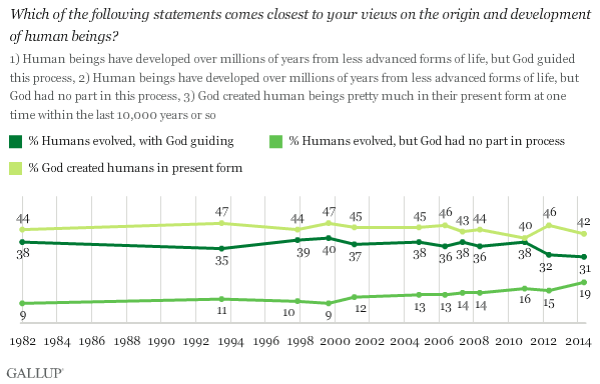
Have you seen it yet?  The new Gallup poll on creationism and evolution is out.  The numbers are about the same as they have been for the past thirty years.  But beyond those numbers, the backgrounds of Gallup’s respondents has some bad news for creationists.  It also has bad news for evolution-lovers.

Stable Numbers Since the 1980s

Stable Numbers Since the 1980s

Since the 1980s, Gallup’s pollsters have been offering respondents three options about the origins of humanity.  This time, 42% chose the young-earth creationist option: “God created human beings pretty much in their present form at one time within the last 10,000 years or so.”  In contrast, 31% chose “Human beings have developed over millions of years from less advanced forms of life, but God guided the process.”  A whopping 19% selected “Human beings have developed over millions of years from less advanced forms of life, but God had no part in the process.”

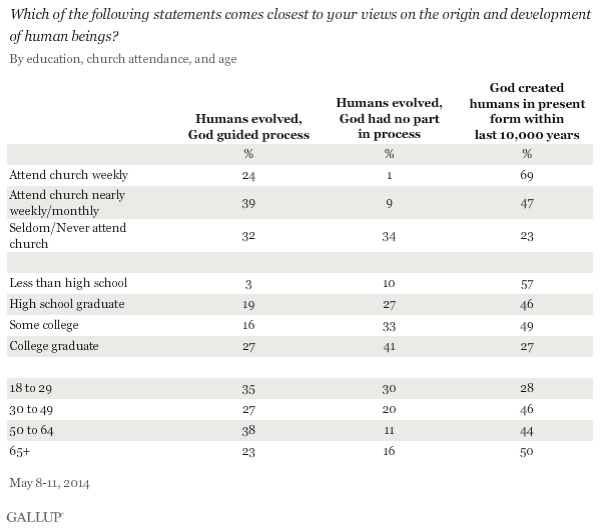
Those numbers have remained fairly stable for the past generation.  But another result of the recent poll numbers needs some examination.  The young-earth position is much more common among less educated adults.  For those with less than a high-school diploma, 57% selected the young-earth option.  A far smaller proportion, only 27%, of Americans with a college degree chose the young-earth explanation.

"Organized Ignorance?"

“Organized Ignorance?”

This is bad news for everyone.

For creationists, these numbers suggest that more education means less creationism.  Throughout the lifespan of American creationism, creationist intellectuals have fought a rearguard action against accusations of ignorance.  In 1927, for example, Minneapolis fundamentalist leader William Bell Riley told a reporter,

Every time I hear the argument that this is a controversy between experts on the one hand, and, as someone has said, ‘organized ignorance,’ on the other, I smile.  This is not a debate between the educated and the uneducated.

Riley’s smile grew more and more strained as the 1920s wore on.  And later generations of creationists found it even more difficult to take the intellectual high ground.  These numbers mean bad news for them.

But the numbers mean bad news for evolution mavens, too.

Though more college grads embrace a non-young-earth understanding of the origins of humanity, 27% is still a significant number.  It means that over a quarter of adults who have been to college—educated adults, that is—select a young earth as the best explanation.  Over a quarter!  Some of those, to be sure, may attend what young-earth creationists embrace as “Creation Colleges.”  Ken Ham of Answers In Genesis, for example, publishes a list (and a map!) of schools that he views as faithful to the Bible’s obvious meaning.

But many of those college-educated young-earth creationists likely attend non-creationist colleges as well.  As anthropologist David Long demonstrated in his study of creationists at a large public university, studying biology at a secular university does not tend to shake the faith of creationist students.  Of his interview subjects, only one abandoned her creation faith as she majored in biology.  And it wasn’t the science that convinced her.  She had already begun to move away from her faith in high school, due to an early pregnancy and the sour reaction of her church community.

As I argued a while back in the pages of the Chronicle of Higher Education, anti-creationists are too fond of calling all creationists “ignoramuses.”  Certainly, some folks must embrace creationism because they just don’t know better.  But many educated adults DO know about evolution.  They simply choose young-earth creationism instead.  That is a troubling fact that anti-creationists have always had a hard time dealing with.


Take the Creation Museum Challenge

We can gnash our teeth.  We can pull our hair.  But no matter what we do, the Creation Museum of Answers In Genesis has pulled it off.  With its new $1.5 million dinosaur exhibit, the flagship museum of young-earth creationism has successfully mimicked the outward appearance of mainstream scientific museums.

Big Valley Creation Science Museum

Big Valley Creation Science Museum

It used to be easy.  Creationist museums used to be only sad little affairs.  They used to look like this one from Alberta, Canada.  The Big Valley Creation Science Museum, pictured here, may do a great job in spreading the creationism gospel.  But no idle tourist would be likely to confuse it with mainstream museums such as the Smithsonian’s Museum of Natural History or Boston’s Museum of Science.

It used to be easy for outsiders like me to mock the lame pretensions of the many creation museums that dotted our great land.  And Canada.  As one angry visitor noted, even the bigger creation museums used to have strange, sad displays like this one from San Diego’s Creation and Earth History Museum.

Not a Lot of Big Bang for your Buck

Not a Lot of Big Bang for your Buck

But here’s the new challenge: Can you tell which of the three pictures below comes from Kentucky’s Creation Museum display and which come from the Smithsonian and Boston’s Museum of Science?  As arch-creationist Ken Ham explained gleefully recently, this new display of a million-dollar Allosaurus fossil puts Ham’s Creation Museum in the same league as those mainstream museums.  As Ham put it,

For decades I’ve walked through many leading secular museums, like the Smithsonian in Washington, D.C., and have seen their impressive dinosaur skeletons. But they were used for evolution. Now we have one of that class, and it will help us defend the book of Genesis and expose the scientific problems with evolution.

So take the Creation-Museum challenge.  Just by looking, can you tell which of these images comes from a young-earth creationist museum and which come from mainstream ones?  (Don’t cheat.  But once you’ve given it a try, you can click on each image to see its provenance.)

Is this "real" science?"

Is This “Real” Science?”

Or Is It This One?

Or Is It This One?

Millions of Years?  Or Millions of Dollars?

Millions of Years? Or Millions of Dollars?

This successful mimicry is important.  In creationism’s twentieth-century struggle to establish alternative educational institutions to rival those of mainstream science, young-earth creationists often wrestled with significant disadvantages.  Not least of these were questions of funding, as historian Ron Numbers described in his must-read book The Creationists and I detailed in my 1920s book.  In the case of this priceless fossil, rich creationists Michael and Stephen Peroutka donated it to help the Creation Museum with its work.

It would be nice to think that America’s public would make its decisions about the age of the earth and the origins of humanity by weighing evidence and considering counter-claims.  To people like me, the Creation Museum’s claim that this well-preserved fossil serves as proof of a worldwide flood 4,300 years ago seems absurd.

But I don’t think we need to be very cynical to guess that appearance matters.  As Dan Kahan argues, what people believe about creation and evolution usually has more to do with their cultural identity than it does with scientific evidence.  If Answers In Genesis can make their museum LOOK like the Smithsonian, many visitors will assume it is just as good.  And if Answers In Genesis can crank out peer-reviewed science publications that attest to the scientific veracity of their claims, many readers will assume their science is just as good.

So take the Creation Museum challenge.  If you can’t tell the difference, how can you expect anyone else to?


The Creation Debate We Need

Ken Ham, creationist debater extraordinaire, has again thrown down the gauntlet. This time, Ham has challenged conservative evangelist Pat Robertson. More than watching Ham battle Science Guy Bill Nye, America needs to hear this debate between conservative evangelical Protestant creationists.

Apparently, according to Mr. Ham and the folks at Right Wing Watch, Robertson has been taking pot-shots at young-earth creationism lately. On his television show The 700 Club, Robertson recently announced, “You have to be deaf, dumb and blind to think that this Earth that we live in only has 6,000 years of existence.”

As he has done recently with other conservative colleges such as Calvin and Bryan, Ham wondered pointedly if Robertson’s colleagues at Regent University really support Robertson’s old-earth position. Ham asked if the school followed Robertson in “compromis[ing] the Word of God with the pagan ideas of fallible men.”

Ham offered to debate these issues with Robertson. As Ham put it,

I wonder if Pat Robertson would be prepared to discuss these issues with me or one of our AiG scientists on the 700 Club? Or maybe in some sort of debate format at Regent University? We are certainly willing to do that…. I wonder if Pat Robertson, who is allowed to state these things so publicly through CBN will agree to have his statements publicly challenged and tested!

Both conservative religious folks and outsiders like me would benefit from such a debate. We outsiders would learn more about the issues that matter to creationists. None of us were particularly surprised by the arguments Bill Nye put forward. But many of us would be enlightened to hear the reasons for and against belief in a young earth, since both sides would be arguing from a relatively similar religious perspective. We outsiders could learn about the kaleidoscopic world of creationism. For some people, this might be the first time they heard that not every creationist embraces the idea of a young earth.

And evangelicals would benefit enormously. After all, belief in a young-earth as creationist orthodoxy is a very recent phenomenon. As historian Ron Numbers demonstrated so powerfully, until the second half of the twentieth century, belief in a young earth was restricted to a relatively small percentage of conservative evangelicals. At the time of the Scopes trial in 1925, for example, leading fundamentalists differed in their beliefs about the age of the earth. At that time, no one looked askance at anti-evolutionist leaders such as William Jennings Bryan who believed in an ancient earth. Only with the publication of Henry Morris’ and John Whitcomb’s creationist blockbuster The Genesis Flood did young-earth creationism become a dominant theme in conservative American evangelical thought.

Many young evangelicals these days don’t know this history. They often assume they must either accept the doctrine of a young earth or abandon their religion entirely. A debate between two conservative evangelical leaders would demonstrate the possibilities.


Was I Fair to Ken Ham?

Ken Ham complains that I was not precise enough.  I think I was.

Here’s the issue: On his blog today, leading young-earth creationist Ken Ham chided yours truly for saying “Ken Ham” when I really meant something like “conservative Christians.”  Ham was reacting to a recent post of mine in which I asked about Ham’s inordinate influence over some conservative Protestant colleges.  In that post, I noted Ham’s recent pronouncements about leading evangelical schools such as Calvin College and Bryan College.  I wondered if conservative schools had to bend over backwards to satisfy Christian critics like Ham.  Did schools like Bryan College have to toe the Ham line in order to maintain their support base among conservative evangelical Protestants?

Be More Precise, Please

Be More Precise, Please

Ham said I needed to be “more precise.”  Ham made the fair point that Science Guy Bill Nye often used the unfair rhetorical strategy of reducing all creationism to simply Ken Ham.  Of talking about creationism as if it were just a one-man crusade to bilk taxpayers and fool schoolchildren.

When it comes to Bill Nye’s language, I agree with Ham.  Bill Nye–with whom I generally agree–does not always seem to understand creationism.  In a recent post, for instance, I agreed with Mr. Ham that Bill Nye “Misse[d] the Boat on Creationism.”  I have also agreed with Mr. Ham that Mr. Nye’s use of phrases such as “Ham’s followers” is sneaky and unfair.

But in this case, I was not doing any such thing.  In my essay about Mr. Ham’s influence on conservative Christian colleges, I was talking precisely about the work of Mr. Ham and Answers In Genesis.  If I was incorrect about the influence of Ham in the recent controversy at Bryan College, I’ll apologize.  But I won’t apologize for mistakes I didn’t make.

Ham also notes that I expand my questions to include the state of conservative evangelical colleges and sexual assault.  As ILYBYGTH readers know, this is a question that has been bandied about here recently.  Those who are new to the blog will not be aware that we do not simply attack “fundamentalist” schools as rape havens.  Indeed, our recent string of commentary began with questions about a journalist’s unschooled presumptions about the nature of fundamentalism.  We do not assume that sexual assault is somehow unique to conservative religious colleges, but it does seem that there is a connection between the opaque authoritarian cultures of many conservative colleges and a culture that blames the victims of sexual assault.

The central point of interest to me, though, then and now, is whether and how Mr. Ham has come to wield such authority over conservative evangelical colleges.  In the case of Bryan College, at least, Ham’s worries led to changes at the school.  I can’t help but wonder if Ham’s say-so is of enormous influence at similar colleges and universities.  This is not a question about conservatism in general.  This is not a question about creationism in general.  This is a specific question about the influence of Mr. Ham’s Answers In Genesis ministry.


Bill Nye Misses the Boat on Creationism

What does it mean to be a creationist?  Especially a young-earth creationist of the Ken Ham sort?  “Science Guy” Bill Nye argued the other day that creationism represents “striking science illiteracy.”

I like Bill Nye.  I like science.  But Nye’s statement represents a lamentable cultural illiteracy.  In the long run, it doesn’t help the cause of evolution education.  It does not help to bridge the culture-war trenches.

Around minute five of the video above, Nye begins to discuss his recent debate with young-earth creationist leader Ken Ham.  Nye humbly acknowledges that it might not have been a good idea to debate Ham.  But he went ahead with the debate.  Why?  Because Nye worries about the “striking science illiteracy” represented by young-earth creationism in the United States (around 6:23 in the video clip above).  Without science, Nye goes on, there would be no internet.  There would not be enough food for everyone.  Science and especially science education represent basic building blocks of a just and prosperous society.  Nye hopes that high-profile debates might help voters and taxpayers de-fund and delegitimize creationism in America’s public schools.

For the record, I agree that the “Ham-on-Nye” debate was a good thing for those of us who want more and better evolution education in America’s schools.  I applaud Nye’s bravery and his presentation skills.  But I wish he would not rely on this false notion that young-earth creationism represents a simple lack of knowledge about evolution.  It is not true, and it suggests bad policy approaches to improving evolution education.

Consider, for example, our best recent polls about science literacy and creationism.  As political scientists Eric Plutzer and Michael Berkman recount in their book Evolution, Creationism and the Battle to Control America’s Classrooms, creationists are not less scientifically literate than non-creationists.

For instance, one Pew poll from 2005 found that Americans who know about the scientific consensus in favor of evolution still support the teaching of creationism in public schools.  You read that right: Among the 54% of Americans who agree that scientists agree about evolution, large majorities (74%) supported teaching creationism, intelligent design, or some mix of evolution, ID, and creationism in public-school science classes.

Another poll that Berkman and Plutzer summarize found that general scientific literacy was not correlated with belief in evolution.  That is, whether or not one was aware of general scientific information had no relation to whether or not one evinced a belief in evolution.

As Dan Kahan noted recently, even the National Science Foundation has considered removing a question about evolution from its science-literacy poll.  Why?  Because there is no correlation between general scientific knowledge and beliefs about evolution.  What people know or don’t know about evolution does not give us any information about whether they believe it or don’t.

Knowledge is distinct from belief.

Bill Nye’s assumption that young-earth creationism represents a lack of scientific knowledge is more than just an embarrassing ignorance on Nye’s part.  The educational and political tasks in cases of naïve non-knowledge are worlds apart from the educational and political tasks in cases of intentional or constructed non-knowledge.  In the case of evolution education, if creationists were simply unaware of evolutionary science, then outreach programs would have a good chance of success.  The task would be simply to spread information.  But in reality, evolution education must recognize that many students and families are not simply ignorant, but resistant to this form of knowledge.  Educational efforts must strive first to understand the reasons for this resistance.  Only then can evolution educators hope to develop effective strategies to teach evolution.

Consider an example from outside the world of evolution education.  Imagine your task is to deliver polio vaccine in a rural area.  If the people in the area did not know about the vaccine, you could simply publicize the benefits and the location of the vaccination clinic.  Then people would bring their children to receive the vaccine.

But if the people in the area thought that the vaccine was dangerous, you couldn’t simply put up posters and distribute flyers.  You would have to engage in a very different task.  You would have to understand why people thought the vaccine was dangerous.  You would have to get to know the reasoning involved in order to offer counter-arguments that would be convincing.  Only if you could convince people that the vaccine was helpful and not dangerous could you ever hope to vaccinate large percentages of the population.

Bill Nye is talented.  Bill Nye is brave.  Bill Nye is smart.

But he continues to display a puzzling ignorance about the contours of creationism in America.  Instead of using his considerable influence to suggest pragmatic policies to spread evolution education, he continues to misdirect evolution education policy.  He needs to learn about creationism if he wants to debate it intelligently.


Ham on Nye: The Debate Continues

He-said-he-said.  Who are we to believe? Bill Nye “The Science Guy” and creationist leader Ken Ham have published reflections on their recent debate.  Nye explains his triumphHam says, not so fast.  To this reader, Ham seems to be on the defensive.

As ILYBYGTH readers recall, the debate itself occurred a couple of months ago.  Bill Nye traveled to Ham’s Creation Museum to tackle the question, “Is creation a viable model of origins in the modern scientific era?”  The debate rollicked over some familiar territory and included some surprises.  Ham focused on his idiosyncratic definition of science, split into authentic “observational” science and illegitimate “historical” science.  Nye piled on the traditional skeptical puzzlers: How could a tree be more than 6,000 years old on a young earth?  Why are there no fossils out of order?  How could an Ark survive?

In the pages of the Skeptical Inquirer, Nye recently offered his reflections on the debate.  He explains his strategy to pile on example after example of young-earth-confounding science.  He explains his decision to spend his first precious ninety seconds on a mild joke about bow ties.  He profusely thanks his advisers, such as the experienced creation/evolution debaters at the National Center for Science Education.  Nye’s tone is profoundly celebratory.  In short, he explains how and why he triumphed.

Perhaps not surprising, Ken Ham took exception to Nye’s comments.  Never one to back away from a challenge, Ham recently published a rejoinder to Nye’s memoir.  To me, Ham’s article seems strangely defensive.  Don’t get me wrong: I’m no follower of Mr. Ham.  But I have defended him against vicious verbal assaults from skeptics.  I have also taken The Science Guy to task for his woeful misunderstanding of the culture of creationism.  But in this case, Ham’s only defense seems to be to niggle around the edges of Nye’s memories.

Ham objects, for example, to Nye’s memory of how the debate came about.  The way Nye tells it, Ham persistently challenged Nye to a debate until Nye agreed.  The way Ken Ham remembers it, however, the whole thing came about at the suggestion of an Associated Press reporter.

Ham also objected to Nye’s repeated suggestion that Ham has a “congregation,” and that all of these museums appeal to “Ham’s followers.”  Such language, Ham protests, seems to be an effort to marginalize Ham’s Answers In Genesis ministry as a fringe cult.  Fair enough.  I would be surprised if Bill Nye knew much about the history of parachurch organizations in American (and Australian) evangelical Protestantism.  For evangelical Protestants, there is often a clear distinction between church and broader organizations that also help the cause.  Missionary groups, Bible leagues, youth organizations, and similar parachurch organizations are a familiar part of the evangelical experience.  Nye really does seem to miss this distinction entirely.  But does it matter?  Does it really hurt Ham’s cause if outsiders think of his work as a “congregation” instead of a “ministry?”  It seems the distinction only matters to members themselves.

Perhaps strangest of all, Ham claims to catch Nye in an embarrassing distortion of the truth.  Nye insists that he had never been inside the Creation Museum before the debate.  One time when he was in the area, Nye explained, he drove around the parking lot, but the museum itself was closed.  Nye says he saw the “infamous” statue of a dinosaur with early humans outside the museum.  But Ham seems to prove that Nye distorted this memory.  Ham produces a photo that apparently shows Bill Nye outside the Creation Museum in 2011.  Ham even notes a 2011 Facebook post that seems to confirm the date and duration (122 seconds!) of Nye’s visit.  The museum, Ham claims, was indeed open at the time.  Plus, there is no statue outside the museum that depicts humans cavorting with dinosaurs.  How could Nye have seen a statue that doesn’t exist?

Nye's 122 Seconds Outside the Creation Museum

Nye’s 122 Seconds Outside the Creation Museum

These sorts of nitpicks put Nye in an awkward position.  Why would Nye embellish his memories of his 2011 visit to the Creation Museum’s parking lot?

In the end, though, they don’t seem to make a difference.  Throughout this post-debate commentary, Ken Ham takes a decidedly defensive tone.  He pokes holes in Nye’s memories, but he doesn’t really challenge Nye’s central conclusion that the debate was a triumph for mainstream science.


Ken Ham Is My Guidance Counselor

Why does Ken Ham care where you go to college? Where you send your kids?   Because “college” is more than just a collection of classes and academics. For religious conservatives as for everybody else, “college” represents a formative experience. The ideas one will encounter, the personal connections one will make, and the changes in one’s outlook and worldview all make the college years some of the most transformative in our lives.

In recent years, Ham, America’s (and Australia’s) leading voice for young-earth creationism, has established himself as the arbiter of creationist orthodoxy in college attendance. And his word carries weight in the world of evangelical higher education.

Recently, for instance, Ham warned readers at Answers In Genesis about the dangers of attending Calvin College. Students at that storied Christian school, Ham explained, were “being influenced . . . to undermine the authority of Scripture in many ways.” When faculty engage in evolutionary research and teaching that might turn away from Ham’s strict attitudes about knowledge and creation, Ham warns, students will too often abandon their creationist faith.

As a precaution, Ham offers readers a list of schools that adhere to the young-earth creationism taught by Ham’s Answers In Genesis ministry. To be safe, Ham warns, parents and students ought to stick with schools that have proven their fidelity to these ideas.

Ham’s anxiety over the crumbling orthodoxy in Christian higher education is nothing new. As I argue in my 1920s book, many of today’s evangelical schools had their origins in the founding decade of American fundamentalism. Back in the 1920s, religious schools often faced a choice between fundamentalist orthodoxy and modernist adaptation. Most chose modernism. The University of Chicago, for example, founded as a Baptist beacon of learning, became the leading voice for theological modernism, employing such folks as Shailer Mathews and Shirley Jackson Case. In contrast, a few Christian schools, most famously Wheaton College, sided with the fundamentalist movement.

Leading fundamentalists in the 1920s also founded a spate of new schools to embody their theological and cultural conservatism. Perhaps most prominently, evangelist Bob Jones Sr. opened Bob Jones College (now Bob Jones University) in 1926. The goal of this school was to form the fundamentalist character of young people while educating them in the best traditions of arts and sciences. In order to reassure parents that the school would never slide toward theological modernism or cultural liberalism, Jones and his allies established a rock-ribbed charter. This charter hoped to guarantee the continuing orthodoxy of the school. The charter’s second paragraph outlined that orthodoxy:

The general nature and object of the corporation shall be to conduct an institution of learning for the general education of youth in the essentials of culture and in the arts and sciences, giving special emphasis to the Christian religion and the ethics revealed in the Holy Scriptures, combating all atheistic, agnostic, pagan and so-called scientific adulterations of the Gospel, unqualifiedly affirming and teaching the inspiration of the Bible (both Old and New Testaments); the creation of man by the direct act of God; the incarnation and virgin birth of our Lord and Saviour, Jesus Christ; His identification as the Son of God; His vicarious atonement for the sins of mankind by the shedding of His blood on the Cross; the resurrection of His body from the tomb; His power to save me from sin; the new birth through the regeneration by the Holy Spirit; and the gift of eternal life by the grace of God.

Perhaps most notably, the next line specified that this charter “shall never be amended, modified, altered, or changed as to the provisions hereinbefore set forth.” Also remarkable, according to a 1960 reminiscence by Bob Jones Sr., at its founding BJU decreed that every graduating senior would pledge to monitor the school’s continuing fundamentalism. “Should the policy and conduct of the University ever, in my lifetime, deviate, in the slightest particular, from the letter or spirit of this Creed,” seniors would promise,

I hereby pledge myself to exert all my influence to affect a change in conditions; failing which, I will resort to such legal measures as the courts may offer to the end that the institution may be kept true to the University Creed and the original intentions of the founder.

Most evangelical colleges established similar creeds and many promised never to amend them. Not many others, to my knowledge, required such strict supervision by their alumni.

These days, Ken Ham has taken over the role of orthodoxy’s gadfly. In addition to his warnings about waverings from his definition of creationism at Calvin College, Ham has warned that other evangelical schools might be threatening the faith of their students. And Ham’s warnings carry weight.

In one recent episode at Bryan College, for example, Ham’s public worries about faculty orthodoxy led the school’s leadership to instigate a new sort of creationist orthodoxy pledge for faculty. From now on, faculty must publicly avow their belief in a real, historic Adam and Eve. As I argued at the time, the fallout from Bryan College’s policy shift might lead to a shake-up of faculty. More directly relevant, the furor at Bryan seems to testify to Ham’s influence. Worried that creationist parents might not send their students and their tuition dollars, Bryan’s leaders acted to shore up their image as a home of young-earth creationist orthodoxy.

Also intriguing, I must ask again if the drive to protect their reputations as safe theological and cultural havens has led some conservative evangelical schools to cover up incidents of sexual assault. Of course, these are very serious allegations, and I do not ask these questions lightly. I am certainly not accusing Ken Ham or the leadership of these schools of condoning sexual assault. But the drive to present a public face as a uniquely safe environment for fundamentalist students certainly puts undue pressure on college leaders. It is not unfair to wonder if such pressure might lead schools to downplay any cases that might threaten those reputations.

Outside the world of conservative evangelical Protestantism, colleges spend an inordinate amount of time and treasure to attract students. Flashy dorm rooms, high-visibility sports programs, celebrity faculty, and lavish campus lifestyles all hope to convince families to send their kids and their money to certain schools. The pressure on recruiters is intense.

There is a similar pressure on evangelical colleges. Influential voices such as that of Ken Ham are able to exert outsized influence by warning creationist families toward or away from certain schools. Without Ham’s imprimatur, conservative schools may lose the loyalty of students and families.


Can Christian Colleges Say the R-Word?

Do conservative Christians encourage rape?  It’s a difficult thing to talk about, but it is a question these days at the center of discussions about conservatism, Christianity and higher education.  Most recently, blogger Samantha Field related the stories of students at Pensacola Christian College who had been punished by the school after suffering sexual assaults.  The accusations have attracted enough attention that PCC has felt obliged to make a public denial.  The school said it has been “harassed and victimized” by these accusations.  PCC, the school insisted, has always acted in accordance with the law.

This is not only an issue at Pensacola Christian College.  As journalist Kiera Feldman argued in a recent New Republic article, a similar culture of institutional arrogance prevails at Patrick Henry College.  And Bob Jones University has gone back and forth with its efforts to examine its own culture.  More broadly, Billy Graham’s grandson attracted attention a few months back for asking if evangelical Protestants had a worse record of dealing with sex abuse than did the Catholic Church.

These are difficult questions to ask.  For an earlier post about this issue, I’ve been called insensitive (fair, and I apologize again), ignorant (sometimes fair, sometimes unfair) and guilty of condoning or excusing cover-ups (utterly unfair).  What I asked was whether or not these accusations of institutional misconduct rely on stereotyped assumptions about conservative evangelical Protestants.  In other words, is there something specifically about the religion of these schools that is somehow to blame?  Or is it an institutional culture at these conservative schools that blames victims and excuses criminals?  Is there something about the Christian nature of these schools that promotes and excuses rape?  Or is this a question of institutional mismanagement?  Finally, we have to ask, is this whole thing somehow more aggravated at these schools than it is at secular or pluralist schools?

After reading more about these cases, it seems the attitude toward rape of school leaders really is wrapped up intimately with their institutional tradition, and maybe even with their theological tradition.  It seems this is more than just another case of fundamentalist-bashing.  In the past, I have defended young-earth creationists against accusations that they are guilty of criminal abuse.  I’ve chided secular journalists—with whom I’m generally sympathetic—for misrepresenting the claims of young earth creationists.  These cases from conservative colleges seemed to me, at first, to represent similar sorts of knee-jerk anti-fundamentalist stereotyping.  I didn’t try to cast doubt on the sincerity of the victims, to be clear, but I did ask whether the accusations against the schools unfairly tied belief in an inerrant Bible to cases of institutional misconduct.

I do not come from a conservative evangelical or fundamentalist background.  But for a living, I study conservative educational activism, especially the educational thinking of conservative Protestants in the United States.  I’m aware of the history of American fundamentalism, including the ways theology has been profoundly combined with hierarchical gender notions.  As I wrote in my 1920s book and as Margaret Bendroth argued in hers, in its early decades American fundamentalism relied on notions of male dominance and female submissiveness.

We know that all colleges these days are struggling with proper ways to handle sexual assault cases.  The charges against schools such as Patrick Henry College, Pensacola Christian College, and Bob Jones University suggest that the campus culture at these conservative schools makes that difficult task much harder.  It seems the fundamentalist culture of these schools has intensified the already brutal culture on many secular college campuses.

This does not mean that every fundamentalist condones sexual assault, of course.  This does not even mean that every student, faculty member, or administrator of these schools agrees with the overall school culture.  Nor can we even say with confidence that this culture is somehow a necessary outgrowth of the theology of the schools, rather than primarily a question of hierarchical, closed-off, inflexible administrative structure.  But it does seem that the dominant atmosphere of these schools needs to share blame in this aggravated culture of condoning and excusing sexual assault.

The best comparison, it seems to me, is the atrocious record of the Catholic Church with its recent sex-abuse scandals.  No one says that every Catholic—let alone every Catholic priest—is part of this scandal.  Nor do we even say with confidence that this is something caused directly by the theology of the Catholic Church.  And we can of course point out that far more non-Catholics committed sex abuse than did Catholic priests.  But such objections miss the point.  There was something profoundly wrong with the way the power structure of the church handled those cases.  It seems there’s a similar connection here between institutional structure and moral accountability.

Those few who might use these cases to suggest that Christianity as a whole is a rape-centered religion are just as wrong as they have ever been.  And we must remember that there is a wide variety in conservative evangelical colleges.  A culture that dominates at BJU, PHC, or PCC will be very different from the culture at other evangelical schools such as Wheaton.  But even remembering those important caveats, there is something deeply troubling with the institutional power structure in these fundamentalist schools.

What will colleges do to respond?  As I’ve argued elsewhere, these schools rely on their reputation as havens of religious orthodoxy in a secularized society.  As the first Bob Jones insisted when he founded Bob Jones College in the 1920s,

Fathers and mothers who place their sons and daughters in our institution can go to sleep at night with no haunting fear that some skeptical teacher will steal the faith of their precious children.

Today’s school leaders, no less than the founders, must be able to say confidently that students will be theologically and physically safe.  How can they reassure parents and future students that they have responded to these accusations?

Will Creationists Take Half a Loaf?: An Anthropologist’s Response

Guest Post by David Long

David Long is an anthropologist and science educator at the Center for Restructuring Education in Science and Technology at George Mason University.  He is the author of Evolution and Religion in American Education: An Ethnography, based on his PhD dissertation at the University of Kentucky.  The editors asked David to respond to a recent ILYBYGTH post: Will Creationists Take Half a Loaf?

Will historians and philosophers accept that they are not baking or dividing bread?

I conduct research on the American relationship toward science as it plays out in schools.   When I began doing this with professional earnest a few years ago, my intention was much the same as Adam Laats, and many others who work in this area.  Originally, it was my hope that anti-evolution attitudes could be something that we set aside in American life.  Like many scientists and science educators, my unexamined assumption was that knowledge of evolution—as a well-reasoned, scientifically supported argumentation about the state of biological affairs—was something unavoidable.   Science disclosed a truth, and as such public attitudes should come along.

We know this is not the case.  Publics are multiple and working towards different ends. As Adam Laats should know well, the purpose of public schooling in the United States has always been in contention, and there have always been dissenters.  Science as a topic of study has been champion, demon, and utilitarian tool depending on who is reading the message it presents.  More importantly, as I came to see clearly while going to college with creationists as they studied evolution, evolution doesn’t fit within a creationist understanding of the world.  Making it fit changes one’s beliefs.  While this point may prompt quizzical looks, it’s germane to understanding the position Laats and Siegel seem to be holding, and where the weaknesses of that position are.  The conversation I intend to invoke can range wildly across disciplines.  To rein this in, I’ll simply do my gadfly work by commenting on Laats’ assertions toward some better conversation.  Let’s begin:

~ Students in public schools must be taught the best science available. 

This seems like a no-brainer claim about how school should be, except:  We have never had and for the foreseeable future do not have anything close to a teaching force that either knows or is pedagogically effective at teaching “the best science available”. The Devil’s advocate would point out that those who arguably understand the ‘best’ are Ph.D. scientists at the edges of their field. The “best science available” is vast, excruciatingly detailed, and often simply hard to learn.  Scientists rely on science’s authority when looking at the claims of science far afield from their own specialty in ways not unlike the public. Also, what moral warrant do Laats and Seigel draw upon to claim that this ‘must’ be so?  Shouldn’t students have the best of every subject?  A better question for me is why do we not have it currently and how are historians and philosophers fixing this?  I agree with Laats’ intent, but underscore the fact that the pipeline of science teachers is not currently prepared to do so.  It seems odd then to listen to historians and philosophers about a problem whose ‘fix’ lies within science education.  The help is of course welcome, but what practical steps are they taking to improve the concrete situation?

~ Too many scientists and science teachers take this to mean that creationism must be purged from students’ minds. 

As commentary to Laats’ post attested, supported by Berkman and Plutzer, the teaching profession has already produced a pragmatic ‘fix’ to this problem by downplaying evolution where it prompts local political turmoil in schools. Teachers are not well paid, work under a current accountability regime of non-stop, high-stakes standardized testing, and for the science, technology, engineering, and math (STEM) subjects, have an incredibly high professional turnover rate.  Evolution education, from this point of view, is not job no. 1.

For scientists who decry what they perceive as an abandonment of reason in classrooms, the root of their perspectival problem lies in the legacy of positivism which the sciences carry.  The sciences have been fairly slow in acknowledging that the social landscape and playing field of civic discourse has moved on to one that’s strongly post-modern.  Leaving debates about evolution aside, there is likely a bigger issue of general ambivalence toward science which may pose a much greater threat to the health of the enterprise in the coming years.

~ Public schools should tell students nothing about what religious beliefs they should hold.

This statement simply doesn’t correspond with what a critical eye on the political and social content and implicit curriculum of schooling sees.  Many religious and political conservatives reject a form of schooling that has made the policy move to set God aside.  Laats’ and Seigel’s normative position in these regards doesn’t stop creationists from seeing it for what it is—a liberal ideal of church and state separation.  Being mute, or feigning toward a Jeffersonian ideal is a political position—one that tells some conservatives clearly that you are not one of them, nor on the same Godly educational mission.  It’s the same idea of being mute or not regarding marriage equality, abortion, school prayer, etc.  Normative values that we (Laats, etc.) hold aren’t value-neutral.  It also explains a lot of the reasons why many conservatives homeschool their children.

~ In short, the goal of evolution education should be for students to understand or know evolutionary theory, but not (necessarily) to believe it.

What is understanding and what is knowing?   These are epistemological questions.  For me, understanding “inhabits a domain of possibility” as Mark Wrathall describes it, in a way useful for thinking through the logic of many who reject evolution.  For creationists, they cannot imagine a way in which evolution could ever possibly work within the content of their day-to-day lives, for the damage it inflicts on the narrative content of their faith relationship. Seeing it otherwise—in the affirmative—is outside their current domain of possibility.  For those who have come to ‘know’ differently, they are no longer—as a matter of belief—creationists in the way Ken Ham or those like him would hope.  They also, as I show in my book, have incurred social costs in how this new knowledge works within their social lives.  Suddenly being affirmative toward evolution with Grandma and your Youth Group marks you as heretic.

A distinction like Laats and Seigel make may well be a red herring.  A majority of the creationists I have worked with as research participants were excellent test takers and understood the internal logic of evolutionary theory—they just rejected the facticity of it.   The distinction Laats and Seigel draw depends on an overly formal sense of rationalism, which has been shown by Jonathan Haidt and other motivated-reasoning researchers to not be an accurate description of everyday human reason.  The point: Would Laats and Siegel be satisfied with their above distinction if the U.S. were to become radically more creationist?—so much so that public schooling came to outlaw evolutionary theory? Refraining from interrogating belief is easy. Working with students to come to understand the epistemologies they’ve been raised with, and what mediating work those thinking styles do when examining the claims of science is hard.  It is hard work we can’t back away from.

The framing of Laats’ post is instructive, especially in light of my above criticism of historians and philosophers making expert recommendations toward a population that is mostly not listening.  We, through the varieties of American social life, bake the bread that Laats speaks of.  As a nation, we produce creationism as an output of religious tradition, as well as the science educators for whom Laats’ loaf is to be split. But it’s not a clean split—nowhere close to it.  Science teachers sometimes are creationists themselves.  Many more have sympathies far less divisive than the terms of the split.  Most importantly, do historians and philosophers carry moral weight such that they are the bread-breakers?