Teachers, Tests, and Gay Marriage

Quick: What do high-stakes tests have to do with gay marriage? Michael Petrilli argues that teachers who discourage students from taking the tests are like government officials who refuse to issue same-sex marriage certificates. Whether you like his argument or not, Petrilli is drawing on a long but ambivalent American tradition.

By now you’ve heard of Kim Davis. She is the county clerk of Rowan County, Kentucky. She has attracted national attention with her refusal to issue marriage licenses to same-sex couples.
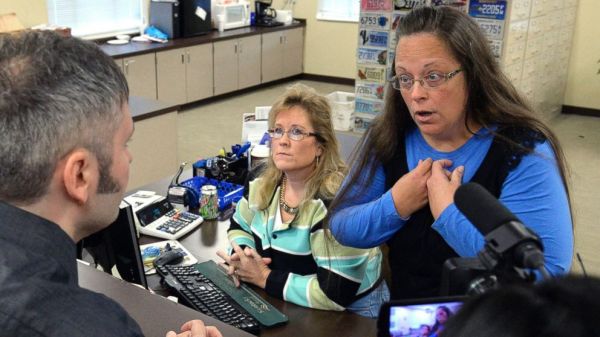
Heroically flouting the Constitution?

Heroically flouting the Constitution?

Petrilli, in many ways the leading public voice of market conservatism in education, implies that progressives might not want to be so quick to condemn Davis’s pugnacious policy. After all, Petrilli writes, many progressive teachers these days encourage parents to opt-out of high-stakes tests. Are those teachers similar to Davis? Petrilli asks,

Here the question isn’t whether parents have a right to excuse their children from taking the state assessment. (They almost certainly do.) The issue is whether educators can face sanctions for encouraging parents to engage in an act of civil disobedience. Is that akin to refusing to give the test (which surely is reason for dismissal)? What if they merely inform parents of their rights?

As I argued in my recent book, this argument about the role of teachers has long roots. When it comes to educational culture wars, the winds have blown both ways. When conservatives felt that school law enforced their side, they insisted teachers must obey. When they felt otherwise, they lauded brave teachers who resisted.

Back in the 1920s, for example, William Jennings Bryan knew he had popular opinion on his side. He refused to allow teachers to teach evolution against the wishes of their local communities. As Jennings famously argued back then, “The hand that writes the paycheck rules the school.”

Similarly, when left-leaning teachers from the 1930s through the 1950s were thought to be too friendly to communism, conservative activists insisted on teacher obedience. In 1950s Pasadena, for instance, conservative leader Louise Padelford blasted progressive teachers who sought to drill suggestible students in the need for “social change,” rather than simply teaching “reading, writing, spelling, grammar, arithmetic, history, etc.”

When the shoe is on the other foot, of course, conservatives have praised teachers for bravely resisting the dictates of educational higher-ups. Writing from the Pacific Justice Institute, for instance, Brad and Susanne Dacus have offered teachers a handy guide for safely and legally evangelizing in public schools. Too many teachers, the Dacuses warn, cower before the seemingly invincible might of secularism. “Would you be willing,” they ask,

to take a stand for the sake of the young, innocent children who are bombarded by a pro-homosexual agenda? As a parent, would you be willing to stand up for your child’s right to express his religious views? Many are timid about standing by the Word of God when it has the potential to create a ruckus. Reading through the Gospels reminds us that Christ was not afraid to make a ruckus in the name of truth. The New Testament, especially the book of Acts, focuses on the apostles’ goal to take a stand for the Gospel, regardless of the circumstances. We are not alone in this challenge. Be reminded of the verse in Joshua, which says,

“Be strong and courageous. Do not be afraid or terrified; do not be discouraged, for the Lord your God will be with you, wherever you go.”

To be fair, Petrilli will have none of this argument. He specifically notes, for instance, that public-school science teachers have a responsibility to teach evolution—and only evolution—as science. If they don’t like it, they can resign.

Petrilli’s argument, like those of other conservative activists going back a hundred years, relies on the fact that we Americans aren’t quite sure of what we want teachers to do.

Do we expect teachers to be brave rule-flouters, a la Dead Poets Society?

Or instead to we insist that teachers embody “the rules,” a la Principal Skinner?

The correct answer, of course, is “Yes.” We Americans expect the impossible of our teachers. We count on them to be both daring iconoclasts and sober rule-followers. We depend on them to encourage students to wonder and to inhibit students from wiggling.

So is Michael Petrilli right? Are dissenting teachers like dissenting county clerks? Only half. In the American tradition, teachers do indeed have to embody the rules and respect for the rules. But teachers also have to embody the right moral decisions, even when those decisions go against the rules.

Will the REAL Conservative Fan of the Common Core Please Stand Up

Are the new(ish) Common Core Learning Standards “conservative?” Some say yes, some say no. But even among those who say yes, we see a split. Leading conservative educational thinker Sol Stern offers one “conservative” vision of the Common Core, while Michael Petrilli gives another. And their differences can tell us a lot about the complicated world of conservative educational thinking.

Among some conservatives—some of them literally from an earlier generation—the new standards seem obviously objectionable, simply because of their provenance. Phyllis Schlafly, for example, emerged from the 1970s to bash the Common Core as a power grab by “Obama administration left-wing bureaucrats.” Some pundits from a newer generation agree. Glenn Beck and Michelle Malkin warn that the new standards are turning American kids into “guinea pigs.”

But among those conservatives who like the Common Core—or at least think the new standards are the least-bad option—we see different emphases. Both Stern and Petrilli agree that the new standards will offer a more rigorous academic experience. But Stern suggests that such rigor is the core of the conservative case for the Core, while Petrilli says that academic rigor is only one aspect of the conservative argument in favor of the new standards.

Writing in the pages of the New Criterion, Stern defends the Common Core as the best “chance of restoring traditional academic content to the classroom.” As Stern explains,

As a conservative, I remain convinced that, faults and all, the Common Core still presents a golden opportunity and a challenge for states and school districts to rethink what is taught in their classrooms. The Standards are more than just a list of learning objectives and skills that American students are expected to achieve by the end of each grade level. The most hopeful part of the new Standards is that they reject the instructional malpractice that prevents the public schools from fulfilling their historic mission of producing literate American citizens who know something about their country’s history and its republican heritage. Contrary to the conservatives’ complaints, the Common Core is, in fact, a document that the founders would approve.

Michael Petrilli does not disagree. He thinks the Common Core will indeed help re-introduce academic rigor to public schools. But as he argued a while back in the pages of the Weekly Standard along with co-author Chester Finn, the real score of the Core is elsewhere. As Petrilli tells the story, the road to the Common Core began back in the days of Bill Bennett, Reagan’s second secretary of education.

Petrilli argues that the new standards fulfill a generation-long conservative plan to make schools more measurable, more interchangeable. With such standards in place, free-market conservatives have thought, public schools could be freed from the dead hand of left-leaning teachers’ unions. Parents could be offered a market-friendly menu of charter schools and voucher-funded private schools.

In Petrilli’s words,

Standards do a good job of clarifying the public’s expectations for schools, and signaling to parents and taxpayers whether the campus down the street is educating its students poorly or well. But standards-based reform has never had a suitable answer for failing schools. It can identify them but has had little success turning them around.

Choice, on the other hand, is great at creating new school options, places that can replace the failures and give needy kids decent alternatives. Yet market-based reform needs reliable consumer information for it to lead to strong outcomes—information that standards and tests are excellent at providing.

We might describe this difference in conservative emphases as a difference between a “classroom” approach to conservative school reform and a “systemic” approach. Or maybe a “traditionalist” versus a “free-market” approach.  And, again, we don’t want to make these plans sound entirely exclusive.

But it seems as if Stern is arguing that the heart of “conservative” reform must be with an intellectual change in the way kids are taught. Stern excoriates pedagogical ideas such as “balanced literacy.” Instead, Stern celebrates the approach of anti-progressive E.D. Hirsch. Instead of looking at structural reforms, Hirsch and Stern wanted conservative reforms to begin in the classroom. Students needed to learn basic cultural information, to focus on “Core Knowledge.”

Petrilli, on the other hand, emphasizes a different approach. Academic rigor is important, Petrilli argues, but it is only one of the reasons for conservatives to support the Core. At least as important, Petrilli says, is the boost the standards will give to school choice. Without what Petrilli calls “true external standards,” it will always be impossible to introduce a true educational marketplace. After all, how can parents know what school is the best if there are not measures that compare schools in a fair way?

In any case, these conservative pleas in favor of the Common Core might be too little, too late. Recent polls have indicated plummeting popular support for the new standards. In spite of the smart arguments of intellectuals like Stern and Petrilli, parents might decide that these standards are just too iffy.


Building the Machine: Conservatives Debate the Common Core

She’s in a hurry.

Balancing a crate of oranges in one hand, a purse and bag of groceries in the other, a stylish, affluent, and beautiful mom hustles to answer a call on her iPhone from a friend. “Calling to see if you’re going to the special PTA meeting,” the friend asks as creepy music deedles in the background, “the school is changing the tests next Spring . . . something about the Common Core Standards?”

http://www.youtube.com/watch?v=zjxBClx01jc

That’s the opening of a new short film about the Common Core Standards produced by the Home School Legal Defense Association. The forty-minute film, Building the Machine, examines conservative arguments for and against the new standards. As we’ve noted in these pages [check out ILYBYGTH coverage here, here, or here, for instance], conservatives have wondered about the implications of these new standards. I’m told by watchful members of the ILYBYGTH community that the film has made a big splash among conservative homeschoolers. What are conservatives supposed to think about the new standards? What do they need to know about them?

The conservative HSLDA certainly wants to portray the CCSS in a negative light. As HSLDA leader Michael Farris makes clear in the documentary, he feels the standards make a fetish of centralization, systematization, and data collection. But the film gives ample time for pro-CCSS conservative intellectuals to make their cases.

Most prominently, Michael Petrilli of the conservative-leaning Fordham Institute tries to allay conservative worries. The standards, Petrilli argues, resulted from an open and public process. They were not imposed top-down by grasping central elites. Best of all, they will improve education. They will hold teachers, unions, administrators, and students to higher standards. Are they perfect? Not according to Petrilli. But they are the nation’s best shot at renewing academic rigor in public education.

Petrilli is joined by conservative standards-boosters such as Mike Huckabee and Chester Finn. But most of the screen time is devoted to CCSS dissidents Sandra Stotsky and Jim Milgram. Both were part of the original validation committee in charge of the standards, and both refused to sign off on the final product. Why? Both Stotsky and Milgram assert that the new standards are not offering the rigorous academic benchmark that they claim to be. And both insist that their dissent was swept under the rug.

The HSLDA documentary also features conservative critics from the Heartland Institute and Pioneer Institute. The new standards, conservative intellectuals complain, were crafted in a secretive manner, rammed through by the federal government, and do not make academic sense. By aiming at the broad middle, by promising to make all students “college and career ready,” these standards fail to prepare students for either college or careers. More troubling, the standards represent a dictatorial overreach by central government. Mega-rich donors such as Bill Gates greased the slide and snuck this project past the complacent American public.

Perhaps more than the messages delivered by the talking heads, the film’s fast-cut montages and sinister musical background send a clear message: Take your kids and run for the hills. We can’t all be as hip, rich, and beautiful as the mom in the opening montage. But the film makes it clear. All of us—beautiful moms and the rest of us alike—need to wake up and smell the Common Core.


A Conservative Plea for the Common Core

Don’t throw the conservative baby out with the Common Core bathwater. That’s the plea this morning from two leading conservative intellectuals.

Writing in the Weekly Standard, Chester Finn Jr. and Michael Petrilli rally conservative support for the new standards.

As we’ve noted in these pages, all sorts of conservative activists, from Phyllis Schlafly to the Heritage Foundation to the Tea Party, have denounced the centralizing tendencies of the Common Core.

The conservative credentials of Finn and Petrilli are difficult to dispute.  Both have long been leading voices for the movement to introduce market choices into public education and reduce the influence of unions and left-leaning schools of education.  Both have worked in conservative think tanks and conservative political administrations to fight for such measures.

They want conservatives to embrace the Common Core as the best available program to heal public education.  As they argue,

the fact that Obama thinks well of it doesn’t means there’s anything (else) wrong with it. This is understood by the many respected conservatives who back the Common Core, including such scarred veterans of the education-reform wars as Jeb Bush, Bill Bennett, John Engler, Chris Christie, Mike Huckabee, Sonny Perdue, Bobby Jindal, Rod Paige, and Mitch Daniels. They realize that academic standards are only the beginning, setting out a destination but not how to get there. They understand, however, that a destination worth reaching beats aimless wandering—and a big modern country is better off if it knows how all its kids and schools are doing against a rigorous set of shared expectations for the three R’s.

Finn and Petrilli offer three specific ways to use the Common Core to best conservative advantage.  Conservatives, they insist,

should maximize the good it can do and minimize its potential harm. Here are three useful steps:

  • Draw a bright line between the standards and the federal government. (Iowa Senator Chuck Grassley is onto one approach with his proposal to ban any further federal spending related to the Common Core.)

  • Overhaul No Child Left Behind as proposed by Senator Lamar Alexander and House education committee chairman John Kline, in effect rolling back the regulatory regime that has turned results-based school accountability into Uncle Sam’s business. (The tighten-the-screws alternative advanced by Senate Democrats would entangle Washington even further with states’ standards and accountability systems—as well as much more mischief.)

  • Continue to push aggressively in dozens of states for more school choice, both public and private—and allow voucher schools (and maybe charters, too) to opt out of their states’ standards and tests (Common Core or otherwise) if they can present alternatives that are just as rigorous. (Disclosure: the co-authors of this piece are still tussling over this one!)

Finn and Petrilli base their argument on a conservative vision of the recent history of American education.  As I’ve argued in the pages of Teachers College Record, conservative school reform proposals, no less than progressive ones, depend on their own interpretations of American history.

In this case, Finn and Petrilli remind their fellow conservatives that the fundamental ideas embraced by the Common Core, including elevated academic standards as well as rigorous standardized testing, began as conservative responses to a public education system that had strayed from its true mission. In the 1970s, they recount, control over public education had been seized by well-meaning but short-sighted leftists who emphasized equity at the expense of rigor.  After 1983’s Nation at Risk report, bold conservative reformers such as Ronald Reagan, Lamar Alexander, and William J. Bennett took steps to reverse that curse.

The solutions back then included increased public money for private education as well as ambitious new standards.  To lend heft to such standards, iron-clad standardized tests hoped to limit the ways educational bureaucrats could game the system.

The Common Core, Finn and Petrilli insist, represent an imperfect attempt to impose those higher standards.  In the end, by providing better information about school performance to parents and policy makers, the standards will fuel the conservative drive for greater privatization of public education.

So what is a conservative to do?  According to these scholars, the real conservative choice is to back the Common Core.  As they conclude, conservatives who take time to read the standards themselves “will be impressed by their rigor, thoroughness, solidity, and ambition—even their ‘conservative’ nature.”