A Long Way from Texas…

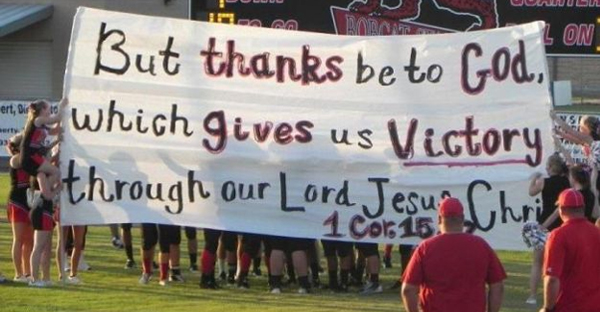
Can cheerleaders at a public school sport Biblical phrases on banners?

The cheerleaders in Kountze, Texas, think so.  So does the Texas Attorney General.  So do tens of thousands of Facebook supporters of the cheer team.
But an important part of this story is often being left out by coverage in some mainstream media outlets. Why?

We’ve reported on this story before.  In short, this group of cheerleaders sued when their school superintendent banned their religious banners from football games.  So far, the cheerleaders have been allowed to keep on cheering for Jesus at their games.

Recently, we’ve noticed a puzzling trend in the reporting about this story.  An editorial in yesterday’s New York Times, for instance, bemoaned the situation in Kountze.  “In this country — including in Texas — the Constitution does not leave religious freedom up to majority rule,” the editors insisted.

I agree with the NYT‘s basic position: the SCOTUS precedent in 2000’s Sante Fe ISD v. Doe speaks directly to this case.  Even student-led prayer, if sanctioned by the school district, implies an endorsement of particular religious beliefs by the government.  Though the Kountze cheerleaders insist that their banners represent purely private speech, this seems a stretch.

However, I’m puzzled by the way NYT coverage has left out a vital part of this story.  For those of us who want to understand the ways conservatism works in American education, whether it be about evolution, school prayer, sex education, or other issues, the skewed coverage in the NYT makes the job much harder.

Here’s the problem:  In yesterday’s editorial and in earlier reporting on this Kountze story, the NYT left out an important key player in the drama.  The NYT neglected to mention the role of the Freedom from Religion Foundation.  This Wisconsin-based group warned the school superintendent of its plans to sue over the banner issue.  Only then did the superintendent ban the cheerleaders’ religious practice.

The NYT misled readers with its description of the reasoning in Texas.  The editors described the case as follows:

“Those banners are not merely personal expressions of belief, but in that setting become religious messages endorsed by the school, the school district and the local government.       

“That’s why officials of the school district last month prohibited the banners at football games.”

But the way the story really played out, the school district only prohibited the banners under pressure.  In fact, as the Los Angeles Times reported, the school superintendent himself supported the cheerleaders.

If we hope to understand the dynamic, in this case or in the many other school-prayer cases in history and in the news, we must not omit such an important element.

Please do not misunderstand: I am not denouncing the Freedom from Religion Foundation.  I do not think that sectarian prayers belong at public-school events.  But I do want to understand these cases, and ignoring important elements such as the role of outside organizations leaves us unable to understand the situation.

As political scientists Michael Berkman and Eric Plutzer have argued in their books Ten Thousand Democracies and Evolution, Creationism, and the Battle to Control America’s Classrooms, teachers and school districts respond to local culture.  When communities want prayer and creationism in public schools, schools include prayer and creationism.

As Berkman and Plutzer proved with their survey of high-school biology teachers, the beliefs of those teachers usually closely match those of their local communities.

In the Kountze case, the school district, including even the superintendent who banned the banners, supports the cheerleaders.  As superintendent Kevin Weldon told the LA Times, the judge in this case “was in a pretty tough predicament, like myself. . . . I personally applaud the kids for standing up for their beliefs in such a bold way.”

If we hope to understand the ways issues such as creationism and school prayer play out in America’s schools, we can’t let ourselves miss the way schools, teachers, and school districts actually function.  Teachers, as Berkman and Plutzer insist, are “street-level bureaucrats.”  They represent majority opinion in their communities.  The same is often true for superintendents such as Kevin Weldon in Kountze.

None of this is new.  In the Scopes Trial in 1925, the prohibition of evolution in Dayton, Tennessee only became controversial when the American Civil Liberties Union became involved.  More recently, as political scientists Kenneth Dolbeare and Phillip Hammond demonstrated in the 1970s, US Supreme Court decisions about school prayer and Bible reading often have no discernable effect on school practice.  After the 1962 and 1963 Supreme Court decisions against the reading of the Bible and reciting of the Lord’s Prayer in public schools, Dolbeare and Hammond found that all the schools in their survey continued to pray and read the Bible.  Most important, those practices caused absolutely no controversy in the communities they studied.

If we hope to understand school prayer controversies, we can’t allow ourselves to leave out the role of key players such as the Freedom from Religion Foundation.  Perhaps the NYT editors hoped to avoid the old chestnut that only “outside agitators” brought about this sort of school controversy.  Whatever their reasons, they misrepresent the story and make it more difficult for outsiders like me to understand the nature of these school battles.
The Bible in America: Thunderbolt, Part III: What Thunderbolt?

As we’ve discussed here lately, some fundamentalists harp on the Schempp and Engel Supreme Court decisions of 1962 and 1963 as the time God was kicked out of public schools.

Some of the reasons for this go beyond the obvious.  First of all, although the 1963 case took the name of Abington Township School District v. Schempp, it was actually a joinder decision with a case brought by the prominent atheist Madalyn Murray O’Hair.  The Schempp family were religious Unitarians.  Murray (later Murray O’Hair) was an outspoken and aggressive atheist.  Partly as a result, the Schempp case took on overtones of a fight of religion vs. atheism.  It took on overtones, in Fundamentalist America, of a last-ditch defense of God.

Such perceived high stakes led to a perception of a profound loss for Fundamentalist America.  As we’ve argued here recently, conservative evangelical Protestants reacted with profound dismay and disillusionment to the court’s 1963 decision.  A Moody Monthly poll in 1964 ranked the decision as the most important social or political event of the year, more important than the church bombings in Birmingham, Alabama.  Presbyterian fundamentalist leader Carl McIntire asked, after more than a decade of struggle to pass a Constitutional prayer amendment, “Why aren’t Christians standing where it counts and saying, ‘I’m for America and I’m for the Bible?’”

But what did the 1962 and 1963 decisions actually do?  What effects did they have in America’s public schools?

In the aftermath of the Schempp decision, a pair of political scientists—Kenneth Dolbeare and Phillipp Hammond—studied the effects.  They first consulted survey data.  Not surprisingly, they discovered that the Schempp and Engel decisions had led to a precipitous drop in the amount of school-sponsored religious activity that went on in public schools.  More precisely, they found that the decisions had led public school leaders to report a sharp drop.  About two-thirds of school districts reported that they stopped school-sponsored devotions.  Teachers reported a sharp decline.  Sixty percent reported that they had lead classroom prayers before the decisions, while only 28% admitted they still led such prayers.

Of course, even these large declines meant that many teachers and school districts continued to lead prayers and Bible readings.  But even that stubborn minority was isolated.  Most of such holdouts were in the South.  Reports from the West—where such in-school religious practice had often already been banned—and from the Plains and Northeast gave a much different picture.  In those regions, survey responses indicated nearly full compliance with the Supreme Court decisions.

We must remember that the South at this time was roiling with anti-Brown sentiment.  The white power structure had nearly unanimously agreed to resist school desegregation in spite of the 1954 Supreme Court ruling.  Many agreed with Alabama Governor George Wallace, who had declared in 1963, “I don’t care what they say in Washington.  We are going to keep right on beating the Bible in the public schools of Alabama.  I wouldn’t be surprised if they sent troops into the classrooms and arrested little boys and girls who read the Bible and pray.”

In such a climate, school leaders in the former Confederacy had a much easier time publicly renouncing the Supreme Court’s ban on school-sponsored prayer.  Indeed, it may have been political suicide for many of them to publicly support the Court.

Outside the South, however, most survey respondents claimed they had stopped teacher-led prayers and Bible readings.  But when Hammond and Dolbeare examined those schools and classrooms more closely, they found that even outside the South, teacher-led prayer and Bible reading went on just as they had before the decisions.  In other words, teachers and school administrators outside the South told surveyors that they had stopped leading religious devotions in their public schools.  They knew that such practices had been prohibited.  But when the classroom doors were closed, they continued to pray and read from the Bible with their students.

Most remarkable, in Dolbeare and Hammond’s opinion, was the fact that throughout the communities they studied in the Midwest, everyone knew what was going on and no one complained.  As long as state-level school administrators could claim that they did not know of any teacher-led devotions, the devotions themselves went on undisturbed.  Teachers led prayers in their classrooms.  School building principals led prayers at school ceremonies.  Bible verses adorned graduation speeches and school hallways.  According to Hammond and Dolbeare, most of the people involved were aware of the Supreme Court’s ruling.  Yet they continued to engage in exactly the sorts of practice the Court had ruled against.

Fast forward to the twenty-first century, and we see a much different picture.  Regional variations in racial desegregation in schools have often flip-flopped, with the most segregated school districts now in places such as New York City, Detroit, and Milwaukee, Wisconsin.  Similarly, in spite of a relatively recent New York Times article that assumed school-sponsored religious practices had been shunted to “some corners of the country, especially in the rural South,” even a casual observer of the news will see that battles over the proper role of religion in public schools continue all over the country.

For example, we noted recently a remarkable law passed recently in New Hampshire, hardly an outpost of the “rural South.”  This law mandated that parents could request alternate textbooks or curricular materials for any reason.  In theory, this could mean that strict vegetarian parents could object to books that portrayed meat-eating in a flattering light.  The intent of the law, however, was clearly to protect the faith of evangelical Protestant children.  The push for the law began when one family objected to the Jesus-bashing of author Barbara Ehrenreich.

Or the continuing case of Bradley Johnson.  Johnson insisted on putting religion-friendly placards on his classroom wall.  His stubborn activism can only be called “Southern” if we include “Southern” California.  And while San Diego is technically one corner of the country, it is hardly an isolated outpost of ‘hillbilly’ culture.

Just as it was for Dolbeare and Hammond in the 1960s, it is nearly impossible for us to know what really goes on in most public-school classrooms.  Cases like Johnson’s don’t tell us much about what most teachers are doing.  As Dolbeare and Hammond concluded, one of the main reasons for the continuing practices of teacher-led prayers and Bible readings was that everyone involved hoped to avoid any controversy.  Parents did not want to stand out as anti-prayer.  Teachers did not want to appear to denigrate religion.  School administrators did not want to crack down on what many perceived to be wholesome traditional American practices.

These days, it is difficult to predict just what practices might pass for non-controversial in America’s public schools.  Local traditions—even down to the level of individual schools and neighborhoods—trump Supreme Court decisions or New York Times reporters’ assumptions.

For conservatives, this means that traditional practices such as prayer or Bible reading might continue in public schools, as long as there has never been a local complaint against the practice.  It also means that conservative activists such as Bradley Johnson might mount a counter-revolution in any part of the country.

For many such activists, public schools have taken on an aura of secular fortresses.  In the rhetoric of many conservatives, public schools are the headquarters of Jesus-bashing, evolution-teaching, sex-teaching, drug-selling liberals.  A more careful look, like what Dolbeare and Hammond did forty years ago, would likely present a much more traditional, religion-friendly picture of life inside those public-school walls.

In the News: Tennessee Two-Step

Tennessee’s lawmakers recently passed a law that—according to supporters—will allow teachers to work with more academic freedom.  It will encourage students, supporters insist, to explore ideas beyond the surface.  Opponents argue that the new law is only a sneak-attack by creationists and intelligent designers.  The law speaks in the language of academic freedom, opponents say, only to mask its true creationist intent.

The law itself claims to want to “help students develop critical thinking skills.”  Since the teaching of “some scientific subjects, including, but not limited to, biological evolution, the chemical origins of life, global warming, and human cloning, can cause controversy,” the law asserts that Tennessee teachers need clarification and assistance in teaching such issues.  The law mandates that school districts allow and encourage teachers to teach such controversial issues.  The law states that “teachers shall be permitted to help students understand, analyze, critique, and review in an objective manner the scientific strengths and scientific weaknesses of existing scientific theories.”  Finally, the new law notes that this law “shall not be construed to promote any religious or non-religious doctrine.”

In presenting the issue as one of academic freedom, Tennessee lawmakers apparently hope to overcome constitutional objections that have overwhelmed other anti-evolution laws.  The inspiration seems to have come from the Discovery Institute, a think tank dedicated to promoting the teaching of intelligent design.  In 2007, the Discovery Institute offered a similar-sounding model Academic Freedom bill.

Tennessee is not the first state to enact such a law.  In 2008 Louisiana lawmakers passed a similar “academic freedom” law.  Even earlier, in 2001, then-Senator Rick Santorum inserted a non-binding note into the No Child Left Behind Act that recommended teaching a full range of ideas whenever “controversial issues” were taught.

The Tennessee law has attracted more than its share of journalistic attention because of the easy connection to the 1925 Scopes trial.  The editors of the New York Times, for example, began their objection to the Tennessee law by intoning, “Eighty-seven years after Tennessee was nationally embarrassed for criminally prosecuting the teaching of evolution, the state government is at it again.”

Nearly all the news coverage of the new law insists on connecting it to the famous 1925 trial.  Coverage in USA Today and the Huffington Post offer a sample of the way every journalist seems obliged to mention Scopes.

However, as perspicacious observers have noted, this new law represents something very different from the 1925 event.  Today’s laws demonstrate a remarkable shift in the strategy and nature of anti-evolution activism.  As Charles Haynes of the First Amendment Center pointed out, today “the curriculum shoe is on the other foot.”

Haynes is right.  The power in public schools has shifted decisively.  Anti-evolution activists today do not try to ban evolution from public schools.  Rather, anti-evolutionists these days struggle to insert wedges into school curricula.  They hope to create opportunities for teachers and students to question the scientific claims of evolution.  At the time of the Scopes trial in 1925, anti-evolutionists had a much different agenda.

In my book Fundamentalism and Education in the Scopes Era, (coming soon in paperback edition, pre-order today!), I explore the ways so-called “anti-evolution” laws in the 1920s included much more than simply the teaching of evolution or creation.  The laws themselves, including Tennessee’s 1925 Butler Act, usually preserved a special role for Protestant theology in public schools.  Other bills considered “anti-evolution” made much more sweeping claims.  In 1924, Representative John W. Summers of Washington successfully inserted an amendment banning “disrespect of the Holy Bible” among Washington D.C. teachers.  In a similar vein, one so-called anti-evolution bill in North Carolina (1927) actually would have banned any teaching that would “contradict the fundamental truth of the Holy Bible.”  A proposed bill in West Virginia cut an even broader swath.  That bill would have banned the teaching of “any nefarious matter in our public schools.”  In Florida, a 1927 bill hoped to prohibit teaching and textbooks that promoted “any theory that denies the existence of God, that denies the divine creation of man, or that teaches atheism or infidelity, or that contains vulgar, obscene, or indecent matter.”

These bills were about more than just prohibiting evolution. They asserted ideological and theological control over public schools.  Public schools, in the vision of these bill’s supporters, ought to do more than just ban evolution.  They ought to be purged of any notion that might challenge the traditional evangelical morality of students.
Today’s laws are also about more than the teaching of evolution, but in a very different way.  Rick Santorum’s non-binding rider to NCLB was more about making a statement about the nature of science, culture, and education than about transforming education.  It didn’t and couldn’t actually change the way teaching happened.  Some observers have suggested that Tennessee’s law will also not change a thing.

But such laws do change something.  For one thing, laws like the ones in Tennessee and Louisiana demonstrate the political power of anti-evolutionism.  These laws show that significant numbers of voters in those states agree with this kind of cultural statement against the claims of mainstream science.  Laws like these also tell us something about the ways schooling is controlled.  If mainstream scientists cannot simply decide what will be the best sort of science education, then we can see that schooling is not simply a neutral institution in which knowledge is disseminated.  Rather, laws like this show clearly that knowledge is political.  Schools do not simply teach what is true.  Schools teach what culture decides children should know.

In the News: Public Schools and Public Christianity

Yesterday’s New York Times ran an article “exposing” the strong role played in some public schools by Biblical Christianity.

The article describes the evangelistic activities condoned and even promoted by several public schools.  At one school, a performer/evangelist bragged that hundreds of middle-schoolers had embraced the Gospel at an in-school rally.  You can still find his promo video of the event on Youtube.  At another school, a teacher preached the Gospel through a bullhorn as students arrived for school.  In another school district, teachers and administrators led a prayer service before a high-stakes standardized test.

It’s worth reading the article, especially for those who share the perspective of the article’s author that these questions of public Christianity in public schools had been settled since the mid-1960s.  Of course, more careful students of the culture wars will be able to point out a few problems with the article’s interpretation.

For one thing, the notion that these issues had somehow been settled with a couple of high-profile US Supreme Court cases is far too simple.  Those cases–Engel v. Vitale in 1962 and Abington School District v. Schempp in 1963–insisted that public schools could not mandate a prayer, have students read the Bible, nor have teachers lead students in the Lord’s Prayer, even if students could be excused.

As Kenneth M. Dolbeare and Phillip E. Hammond demostrated convincingly in 1971, those decisions often had neglible effect on actual policy and practice in real public schools.  These two political scientists studied five towns in the pseudonymous midwestern state of “Midway,” and they found that school practice after the Engel and Schempp decisions continued largely as before.  In schools where teachers and students had been praying and reading the Bible, they kept on doing it.  More surprising for the authors of the study, this utter evasion of the Court’s intent raised absolutely no controversy in any of the towns.

More careful students of the history of the struggle over the role of conservative Biblical Christianity in the public square will also likely wince at the author’s use of geographic stereotypes.  The author reports that these demonstrations of public Christianity remained powerful “in some corners of the country, especially in the rural South.”  This has long been the oversimplistic cultural geographic stereotype of fundamentalism.  In this case, it is puzzling that a careful journalist would still fall into this misleading stereotype.  After all, the article itself describes one of its cases from Baltimore, Maryland.  It defies even the simplest common sense to lump this major metropolitan area in with others as being some kind of backward corner of the country.

The notion that these “corners of the country” are the strongholds of Biblical Christianity largely results, in my opinion, from the idea that only those areas in which Biblical Christianity remains utterly dominant in the public sphere are important to this discussion.  Evidence piles up, though, that such conflicts over the role of conservative Christianity in public schools map much more completely over the rest of the country, including the North, the West, and in large cities.  Allow me to use a couple of examples.  In one of my first teaching jobs, in St. Louis, I worked briefly in a pretty rough public high school.  The student body was mostly from low-income families.  Students, faculty, and administration were all almost entirely African American.  I was surprised to find out that most of the teachers began their classes with a Bible verse and prayer.  It did not seem to be a controversial thing.  Students and faculty took it as the norm.   Beyond just my personal experience, more careful surveys of traditional religiosity in public schools have found that the stereotypical imagined geography of schools in the rural South as being the most congenial homes of public Christianity don’t hold up.  R.B. Dierenfeld, for instance, conducted surveys of public school religious practice, and found Bible reading the most prevalent in public schools in large cities.  It was equally strong in the Northeast and Southeast, and faded away in the West.

One final point: the tone of  the article’s author tended toward the incredulous.  The author seemed surprised that people “still” prayed in public schools.  The evangelists, on the other hand, seemed fully aware that they were evangelizing on hostile terrain.  Christian Chapman, along with one school’s principal, specifically hoped to reach students in purportedly “Godless” public schools, even if it meant the end of the principal’s career.  As Chapman suggested in the NYT article, students in public schools heard the hostile message of “evolution” every day.  Why shouldn’t they hear from the other side?
These days, this kind of discrepancy seems common.  Secular and pluralistic types often assume that religion has been banished from the public square.  Those battling to get more Jesus into public schools seem fully conscious that their mission has become subversive.

FURTHER READING: Kenneth M. Dolbeare and Phillip E. Hammond, The School Prayer Decisions: From Court Policy to Local Practice (Chicago: University of Chicago Press, 1971); R. B. Dierenfield, Religion in American Public Schools (Washington: Public Affairs Press, 1962).

In the News: Schooling, Poverty, and the Educational Culture Wars

In a recent piece in the New York Times, (Class Matters: Why Won’t We Admit It?)  policy professor Helen Ladd and journalist/college-guide writer Edward Fiske offered a strong argument for the close link between social class and school performance.

Poorer children tend to do worse in school.  As Ladd and Fiske point out, this is not news.  Nor is this only an American dilemma.  Other countries face similar situations.
The point of Ladd’s and Fiske’s piece is that federal policy has obstinately and deliberately ignored this important aspect of education policy.

For those interested in the continuing culture wars over education, the more interesting question is this: how have the progressives/liberals/Left come to embrace the position that fixing only schools can not fix education, while the traditionalists/conservatives/Right has taken to heart the idea that schools can be fixed by more rigorous testing and standards?

After all, the notion that schools are only one educational institution among many has long conservative roots.  For generations, educational conservatives have argued that the educational rights of family, church, and other non-school institutions must be respected.

Similarly, for a long time the notion that schools must find ways to test every student to determine individual capability and performance has a long and respectable progressive history.

Yet these days, the notion that schools alone can’t be held responsible for students’ total education has become a favorite on the educational left.

My hunch is that there are two main reasons for this development.

First of all, ten years of No Child Left Behind has shifted the ideological weight of “testing” squarely from left to right.  But this did not come out of Right field.  The progressive appeal of testing faded when the cultural biases of IQ tests were clearly established in the middle of the twentieth century.  When progressives called for more testing, they did so in the hope that such tests would allow schools to tailor education more closely to individual strengths and interests.  When traditionalists call for more testing, they do it as an appeal to the long American tradition of educational exhibitionism.  In the American tradition, schools, teachers, and students are all expected to make public displays of their learning. Today’s high-stakes tests are only an updated version of the old tradition of calling the schoolmaster out on the rug, forcing students to “toe the line,” to show off their learning in ways the community finds acceptable.

In addition, the argument that schools alone can’t fix education comes from a progressive notion that any social improvement must be more than just a policy band-aid.  That is, in order to fix schools, we must fix the more basic injustices of our society.  In order to improve students’ performance, we need to address the fundamental economic imbalance of society.  This would shift the discussion in markedly progressive directions.  Instead of labeling poor children and schools in less affluent areas as ‘failing,’ we would need to start talking about reducing the Gini coefficient, about reducing the growing chasm between the few rich and the many poor.  Instead of blaming schools and teachers for cheating on high-stakes tests, we would need to find ways to improve the economic well-being of huge numbers of poor people.

The ideological baggage that comes along with each of these educational positions points out the difficulty of speaking calmly and clearly about education reform.  Each side hopes to seize the moral high ground, even while claiming to argue in practical, non-ideological terms.  But the very terms we use frame the discussion in ways that are difficult to overcome.  Are we talking about a redistribution of income?  Or are we talking about improving individual performance in reading and math?